Conference | Private Collecting and Public Display

Frederick MacKenzie, The National Gallery When at Mr J. J. Angerstein’s House, Pall Mall, 1824–34, watercolour
(London: V&A, 40-1887)
◊ ◊ ◊ ◊ ◊
From the conference programme:
Private Collecting and Public Display: Art Markets and Museums
University of Leeds, 30–31 March 2017
Registration due by 20 March 2017
The Centre for the Study of the Art and Antiques Market at the University of Leeds is delighted to announce that registration is now open for an international two-day conference exploring the relationship between the ‘private’ and ‘public’ spheres of the art market and the museum. This interdisciplinary conference offers the opportunity to hear new research in the fields of art market studies, museum studies, and the histories of collecting. Registration information is available here. For any further information, please contact csaa@leeds.ac.uk.
T H U R S D A Y , 3 0 M A R C H 2 0 1 7
9.00 Registration
9.30 Welcome, Mark Westgarth, Director, Centre for the Study of the Art & Antiques Market, University of Leeds
9.45 I | Birth of the Museum
• Marie Tavinor (Christie’s Education, London), The ‘Potent Tate’ and the Founding of the Tate Gallery: An Insight into Taste and the Politics of Donation in Late Victorian England
• Margaraet Iacono (The Frick Collection, New York), Going Public: The Frick Collection’s Transformation from Private Home to House Museum
• Helen Glaister (Victoria & Albert Museum, London), From Buxted Park to South Kensington and Beyond: The Ionides Collection of Chinese Export Porcelain
11.00 Coffee and tea
11.30 II | Legacy through Display: From Private to Public
• Nicole Cochrane (University of Hull), Ancient Sculpture and the Narratives of Collecting: (Re)Contextualizing Museum Space
• Alison Clarke (University of Liverpool / National Gallery London), Pure Eighteenth-Century Art Unspoiled by Any Element Foreign to Its Nature: The Agnew’s Exhibitions of The Frick Fragonards
• Isobel MacDonald (University of Glasgow / The Burrell Collection), Tracing The Development of the Burrell Collection from Deed of Gift (1944) to Pollok Park, Glasgow (Present Day)
12.45 Lunch
1.45 III | Dealers and Markets: Thinking of the Past, Looking towards the Future
• Pamella Guerdat (University of Neuchatel, Paris), A Heritage under Construction: René Gimpel’s (1881–1945) Roles between Private Collectors and Public Museums
• Ana Mântua (Dr Anastácio Gonçalves House Museum, Lisbon), One Man’s Choices and the Portuguese Art Market, 1925–1965
• Kerry Harker and John Wright (University of Leeds), Blurring the Boundaries: Reconsidering ‘Public’ and ‘Private’ in the Alternative Art Market Activities of Artist-Led Groups, Organisations, and Collectives
3.00 IV | Power, Influence, and Agency: A Critical Look at Private Collections Going Public
• Pier Paolo (IES Abroad Italy, Rome), From Objects of Devotion to Icons of Beauty: The Institution of the National Museum in the Vatican at the Time of the Roman Republic, 1798–99
• Verda Bingol (Istanbul Technical University), From the Cradle to the Museum: The Elgiz Collection
• Dorothy Barenscott (Independent Art Historian), Steve Wynn: Art Collecting and Exhibition, ‘Vegas Style’
4.15 Coffee and tea
4.45 Keynote Address
• Susanna Avery-Quash, Senior Research Curator (History of Collecting), National Gallery London
6.00 Drinks Reception
F R I D A Y , 3 1 M A R C H 2 0 1 7
9.00 Registration
9.40 V | The Visibility of Private Collections within the Public Arena
• Marcela Drien (Universidad Adolfo Ibáñez, Chile), Exhibiting Domestic Museums: Chilean Art Collectors at Santiago’s Exposicion Internacional of 1875
• Rasmus Kjaerboe (Ribe Art Museum, Denmark), Collecting To Be Modern: The Early Twentieth-Century Art Collections of Prince Eugen, Ernest Thiel, and Klas Fåhraeus
• Kathryn Brown (University of Loughborough), Patrimony and Patronage: Collecting and Exhibiting Contemporary Art in France
11.00 Coffee and tea
11.30 VI | Museum Quality? Deaccessioning Museums onto the Art Market
• Gareth Fletcher (Sotheby’s Institute of Art, London), But Is It Really Museum Quality? – Evaluating the Impact of Institutional Provenance within the International Art Market
• Nicola Sinclair (University of York), ‘You Have Culled One or Two Beauties But the Memorial of Art Is Gone’: How (Not) To Translate Paintings of Historical Value from Private to Public Collections and back again in Mid-Nineteenth-Century Britain
• Martin Hartung (ETH Zürich, Switzerland), A Philanthropic Legacy: The Controversial Case of DIA in New York
12.45 Lunch
1.45 VII | Private Collections and Public Museums: Working across Boundaries
• Kate Beats (University of Cambridge), Cambridge’s First Museums: The Private College Collections behind the Public Museums in Cambridge
• Helen Ritchie (Fitzwilliam Museum, Cambridge), The Frua-Valsecchi Collection at The Fitzwilliam Museum: A Case Study
• Tom Boggis (Holburne Museum, Bath), Public Collection, Private House: Display of the Heveningham Furniture Collection in the Twentieth Century
3:00 Coffee and tea
3.30 Round Table Discussion
5.00 Closing Remarks
Workshop | The Pencheon Collection in Context

From the workshop flyer:
The Pencheon Collection in Context: Collecting and Recollecting the French Revolution
University of Leeds, 17 March 2017
The Pencheon Collection in the Brotherton Library, University of Leeds, of material relating to the French Revolution contains nearly 3,000 volumes in French and English along with boxes of miscellaneous items—manuscripts, pamphlets, prints, maps, booksellers’ catalogues, newspaper clippings, correspondence and additional ephemera—many of them related to the process of collection. It was created by James Michael Pencheon (1924–1982), a neurosurgeon and psychiatrist, who had studied medicine at the University of Leeds but who then developed an interest in the historical knowledge of the French Revolution ostensibly outside his disciplinary field, but perhaps inflected by his research in psychology. This resource raises questions about the formation of the cultural memory of the French Revolution in Britain, about the role and approach of individual collectors of materials on the French Revolution, and about what can be learnt about the acquisitions policies and subsequent use of such collections in university libraries. This workshop will enable networking about the collection and its use to begin.
Speakers—including Madame Valérie Guillaume, Directrice of the Musée Carnavalet, Paris, and leading UK specialists from the fields of History, History of Art, and French Studies—will give short presentations on their work on analogous collections, sharing insights and ideas and helping us to refine our aims and objectives for the future exploitation of the collection. All are welcome to attend. The £20 cost includes lunch and refreshments. Registration information is available here.
Contacts: Dr Valerie Mainz, v.s.mainz@leeds.ac.uk; and Dr Paul Rowe: P.Rowe@leeds.ac.uk
In collaboration with the Institut français du Royaume-Uni and the Centre for the Comparative History of Print (CentreCHoP)
◊ ◊ ◊ ◊ ◊
P R O G R A M M E
10.00 Introduction
• Valerie Mainz, School of Fine Art, History of Art and Cultural Studies, University of Leeds
• Paul Rowe, School of Languages, Cultures and Societies, University of Leeds
10.15 French Revolutionary Collections in Britain, 1: The Contexts and Methodological Challenges
• Tom Stammers, Department of History, University of Durham/Bowes Museum
• Richard Taws, Department of History of Art, UCL London/UCL prints
11.15 Coffee
11.30 Plenary: The Musée Carnavalet and the Collecting of the French Revolution in France
• Valérie Guillaume, Directrice, Musée Carnavalet
12.15 French Revolutionary Collections in Britain, 2: The Contexts and Methodological Challenges
• Kate Astbury, School of Modern Languages and Cultures, University of Warwick/Marandet Collection
• Phillippa Plock, Waddesdon Manor/Ferdinand de Rothschild Collection
13.15 Lunch
14.15 The French Revolution in Britain: Historians’ Perspectives
• Munro Price, Department of Peace Studies and International Development, University of Bradford
• Juliette Réboul, Historical, Literary and Cultural Studies, Radboud University, Nijmegen/Emigrés and memoirs
15.15 The Psychopathology of the French Revolution
• Mechthild Fend, Department of History of Art, UCL London
15.45 Round Table: The Potential of the Pencheon Collection and Next Steps
• The Pencheon Collection as a resource for researchers
• Studying the Pencheon Collection: UG, PGT, PGR
• Public engagement
• Impact
• What are the priorities?
CAA 2017, New York: Memorial Session for Mary Sheriff
In addition to this year’s regular CAA offerings, the schedule includes a memorial session for Mary Sheriff (other Enfilade postings for CAA 2017 have been updated with the addition). The session is open to the public, and no conference registration is required to attend. Tara Zanardi’s session ‘Superpowers in the Global Eighteenth Century: Empire, Colonialism, and Cultural Contact’ (Friday, 17 February 2017, 10:30–12:00) will also be dedicated to Mary.
Beyond CAA, other events are planned, including two symposia in conjunction with the exhibition Becoming a Woman in the Age of Enlightenment, curated by Mary Sheriff and Melissa Hyde. In addition, there’s a gathering in Paris at INHA scheduled for Saturday, February 25 at 3:30 in the Salle Mariette.
Key Conversation: Mary Sheriff (1950–2016): A Memorial Session
Saturday, 18 February 2017, 12:15–1:15, Madison Suite, 2nd Floor
Chair: Francesca Fiorani (University of Virginia)
Join this session to remember Mary Sheriff. Come together, share memories, and celebrate her achievements.
◊ ◊ ◊ ◊ ◊
Note (added 26 January) — The original posting listed an incorrect date for the Paris event; it’s been corrected.
Symposium | Garnitures: Vases in Interiors
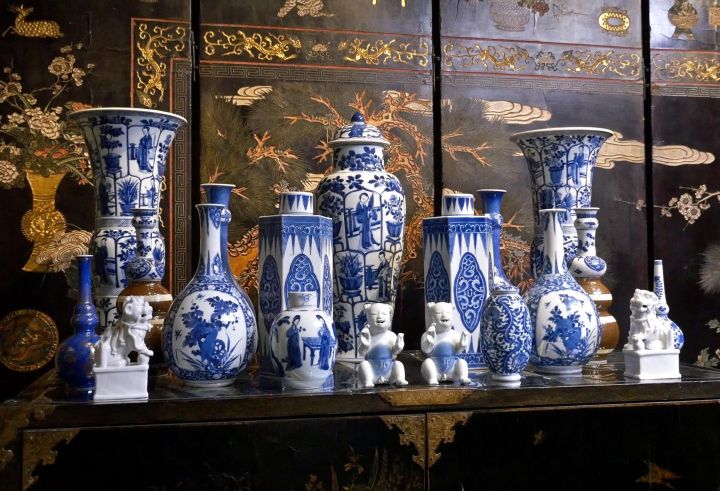
Assembled garniture, porcelain from Jingdezhen and Dehua, China, 1650–1720, on an English japanned cabinet, ca. 1680, in the British Galleries at the Victoria and Albert Museum, London (Photo: Peter Kelleher).
◊ ◊ ◊ ◊ ◊
Garnitures: Vases in Interiors
Victoria and Albert Museum, London, 17 March 2017
Organized by Matilda Pye, Patricia Ferguson, and Reino Liefkes
The focus of this one-day symposium is the garniture, assembled or matched sets of primarily ceramic vessels, displayed in European interiors from 1620 and 2017. It will contextualize and enhance the ground-breaking Garnitures: Vase Sets from National Trust Houses, a temporary display in the Ceramics Gallery at the Victoria and Albert Museum, on view until 30 April 2017, and curated by Patricia Ferguson, Honorary Adviser on Ceramics to the National Trust, with Reino Liefkes, Senior Curator, Victoria and Albert Museum. The Headley Trust has generously supported the display, a publication of the same title and this symposium.
Many of the leading international ceramic specialists and contemporary makers will explore national differences in how European tastemakers and followers used garnitures to ornament and enliven interiors in the Netherlands, France, Saxony, and Britain. These displays were typically dictated by innovative architectural features in elite interiors, such as the development of the chimneypiece in France in the mid-seventeenth century, as well as the furniture types associated with these cultures and available materials: Asian porcelain, Dutch delftware, French faience, silver, and European porcelain. The papers will cover the use of the vase in China, its adaptation and collection in the West, the impact on the potteries in Japan and Delft and at porcelain manufactories in Germany at Meissen, and in France at Sevres, in addition to the revival of interest among collectors in the nineteenth century.
As evidence that artists and ceramicists are still fascinated by the idea of the series and repetition in forms, colours, and pattern, the day will conclude with papers by artists Edmund de Waal and Matt Smith—both well known for their site-specific ceramic work in museums, galleries, and historic houses—who will share their own personal responses to this interior phenomenon. Other speakers will include Dr. Yu-ping Luk, curator, Chinese collections, Asian Department, V&A; Patricia Ferguson; Suzanne Lambooy, curator applied arts, Gemeentemuseum, The Hague, Netherlands; Dr. Julia Weber, director, Porzellansammlung, Staatliche Kunstsammlungen, Dresden, Germany; Dame Rosalind Savill, DBE, FSA, FBA, President of the French Porcelain Society, and former Director of the Wallace Collection; Tamara Préaud, the former Archivist, Manufacture Nationale de Sèvres, France, Selma Schwartz, Associate Curator, Waddesdon Manor, The National Trust. The conference will be of interest to students and scholars of Asian, European and Contemporary ceramics, silver, the country house, the history of the interior, collecting, and taste. The day will conclude with a lively round table discussion.
The full conference fee is £25; concessions available. To book, please follow this link.
P R O G R A M M E
10.00 Registration
10.30 Matilda Pye (Learning Academy, V&A), Welcome
10.35 Patricia Ferguson (Curator, Vase Sets from National Trust Houses), Introduction
11.00 Suzanne Lambooy (Gemeentemuseum, The Hague), Delft Garnitures in the Dutch Interior
11.25 Yu-ping Luk (V&A), The Vase in China
11.45 Ros Savill (Former Director Wallace Collection), Vincennes and Sevres Garnitures
12.15 Tamara Preaud (Former Archivist Sèvres, Cité de la céramique , Musée National de Sèvres), Evidence of Biscuit Figures in Sevres Garnitures
12.30 Discussion
12.45 Lunch Break
13.45 Selma Schwartz (Waddesdon Manor, National Trust), Collecting in the 19th Century: Sevres Garnitures at Waddesdon Manor
14.05 Julia Weber (Porzellansammlung, Staatliche Kunstsammlungen, Dresden), Meissen and Garnitures in the Collection of Augustus the Strong
14.30 Refreshments
15.00 Edmund de Waal and Matt Smith, Contemporary Perspectives
Conference | Early Modern Viewers and Buildings in Motion
From H-ArtHist:
Early Modern Viewers and Buildings in Motion
St. John’s College, University of Cambridge, 25 February 2017
Registration due by 12 February 2017
Movement, both literal and metaphorical, lies at the heart of early modern European architectural theory, design and experience. Architectural authors invoked the notion of progress as temporal motion, structured their books as tours of buildings, and followed the ancient Roman Vitruvius in explaining how to manipulate the motions of winds through building design. Simultaneously, poets led their readers on tours of house and estate, and Aristotelian as well as mechanistic philosophers averred that motion was inherent to human perception from particle vibrations in one’s senses to neural vibrations in one’s brain. Across a range of scales in actual lived experience, moreover, viewers and buildings were frequently in motion; people walked through built spaces, interiors contained portable furnishings, and travellers and prints circulated ideas of buildings internationally.
This conference seeks to examine the range of scales, media, and theoretical discussions which foreground early modern intersections of architecture and motion. In so doing, it both puts into motion the usually static viewer and building of historical narratives and merges often independent yet overlapping strands of analysis—for instance, the ‘mobile viewer’ studied by art historians Michael Baxandall and Svetlana Alpers and the tensions surrounding early modern globalization discussed by cultural historians. These and other strands of inquiry are brought together by an international, interdisciplinary group of speakers examining case studies encompassing England, France, Italy, German-speaking areas, and the New World during the fourteenth through nineteenth centuries.
Supported by St. John’s College, University of Cambridge and by the Institute of Advanced Study, the Institute of Medieval and Early Modern Studies, and the School of Modern Languages and Cultures, Durham University.
The fee, which includes lunch and refreshments, is £15. More information is available here»
P R O G R A M M E
9.30 Registration
10.00 Welcome | Frank Salmon (University of Cambridge) and Kimberley Skelton (Durham University)
10.05 Session 1 | Chair: Kimberley Skelton (Durham University)
• Allison Stielau (University College London), The Censer as Mobile Mini-Building, Swung Structure, and Producer of Olfactory Space
• Andrew Chen (University of Cambridge), Fourteenth-century Ascetic Imagery in a Staircase at Santa Maria della Scala, Siena
• Donal Cooper (University of Cambridge), Fleeting Visions: Occluded Altarpieces and Mobile Eyes in the Italian Renaissance Church Interior
11.30 Coffee
12.00 Session 2 | Chair: Frank Salmon (University of Cambridge)
• Stefano Cracolici (Durham University), The Poliphilo Syndrome
• Kimberley Skelton (Durham University), Sensory Vibrations and Social Reform at San Michele a Ripa in Rome
• Bram Van Oostveldt (University of Amsterdam/Leiden University), Frantic Memories and Excessive Objects: Monicart’s Versailles immortalisé ou les merveilles parlantes de Versailles (1720)
1.30 Lunch
2.30 Session 3 | Chair: Donal Cooper (University of Cambridge)
• Caroline van Eck (University of Cambridge), Moving through Space and Time: Immersive Spaces at the Hôtel de Beauharnais in Paris
• Edmund Thomas (Durham University), Movement Through Ruins: Re-experiencing the Antique in Eighteenth-Century Travelogues
• Rebecca Tropp (University of Cambridge), Movement and the Central Core: Design Principles in the Country Houses of John Nash
4.00 Tea
4.30 Session 4 | Chair: Stefano Cracolici (Durham University)
• Daniel Jütte (New York University/University of Cambridge), Entering the Early Modern City: Gates as Sites of Passage
• James Campbell (University of Cambridge), Libraries in Motion
• Emily Mann (University of Kent), From Ship to Shore: The Architecture of Early Modern Trading Companies
6.00 Wine Reception
Conference | CAA 2017, New York
105th Annual Conference of the College Art Association
New York Hilton Midtown, 15–18 February 2017
 The 2017 College Art Association conference takes place in New York, February 15–18, at the New York Hilton Midtown (1335 Avenue of the Americas). In introducing the eighteenth-century offerings for CAA 2016, I complained there were only four panels that seemed obviously relevant for the period. This year, again there are only a handful of sessions. Still, these look fabulous, and for anyone put off by the exorbitant registration fee (which can run as high as $495), bear in mind that there are other options ($20 per single time-slot session), which might be especially attractive for anyone in the New York area. We would love to have you join us!
Also, I’m glad to extend a warm invitation to HECAA members to join a group of HBA members on Saturday for a day trip to visit the recently re-opened Yale Center for British Art and to tour the exhibition Enlightened Princesses: Caroline, Augusta, Charlotte, and the Shaping of the Modern World with Lisa Ford, Assistant Director of Research. Space is limited. For more information or to reserve a spot, please email: CraigAshleyHanson@gmail.com. –CH
◊ ◊ ◊ ◊ ◊
Charting a New Course: Reorienting the Discourse of Early African American Art History
Wednesday, 15 February 2017, 3:30–5:00, Clinton Suite, 2nd Floor
Chairs: Mia L. Bagneris (Tulane University) and Anna Arabindan-Kesson (Princeton University)
• Jennifer Van Horn (George Mason University), Stealing a Glance: Enslaved Viewers in the Plantation South
• Key Jo Lee (Yale University), Face(ing) the Impossibility of Recovery: Tracing the Affective Terrain of the Anonymous in African American Photography
• Phillip Troutman (The George Washington University), Techniques of the Engraver: Patrick Henry Reason’s African American Portraits, 1830s–1860s
◊ ◊ ◊ ◊ ◊
Editing Journals in a Digital Age, Association of Research Institutes in Art History (ARIAH)
Thursday, 16 February 2017, 8:30–10:00am, East Ballroom, 3rd Floor
Chairs: Sarah Victoria Turner (The Paul Mellon Centre for Studies in British Art) and Martina Droth (Yale Center for British Art)
• Samuel Bibby, Reflections on Editing Art History
• Petra ten-Doesschate Chu, Reflections on Editing Nineteenth-Century Art Worldwide
• Kirk Ambrose, Reflection on Editing The Art Bulletin
• Alison M. Kettering, Reflections on Editing the Journal of Historians of Netherlandish Art
• Discussant: Gail Feigenbaum (Getty Research Institute)
◊ ◊ ◊ ◊ ◊
Transglobal Collecting: Co-Producing and Re-visioning British Art Abroad (HBA)
Thursday, 16 February 2017, 3:30–5:00, Gramercy B/East, 2nd Floor
Chair: Julie Codell (Arizona State University)
• Kathleen Stuart (Denver Art Museum), The Berger Collection at the Denver Art Museum: British Art in the Rocky Mountain West
• Elizabeth A. Pergam (Sotheby’s Institute of Art, New York), The British Model of Collecting: Importing British Art to America
• Andrew Stephenson (University of East London), ‘A Thing That Racially Belongs to Us More Than Any of the Latin Styles’: Collecting and Displaying English Art in Private Collections in the United States, c.1890–1926
• Nancy Scott (Brandeis University), Paintings across the Pond: Anchoring J. M. W. Turner in American Collections
◊ ◊ ◊ ◊ ◊
Studies in Eighteenth-Century Style
Friday, 17 February 2017, 8:30–10:00am, Gramercy B/East, 2nd Floor
• Josefine Baark (Lingnan University), ‘The King Stared at the Figure in Astonishment’: Chinese Nodding-Head Figures in Early Modern Denmark
• Andrea Bell (Parsons School of Design, The New School), The Geometrical Landscape: Architecture and the Severity of Style in Rome
• Tracy Ehrlich (The New School), Fashioning the Architectural Body in Eighteenth-Century Rome
• Kristin O’Rourke (Dartmouth College), The Toilette: Dressing in Public and Private
◊ ◊ ◊ ◊ ◊
Superpowers in the Global Eighteenth Century: Empire, Colonialism, and Cultural Contact
Friday, 17 February 2017, 10:30–12:00, Beekman Parlor, 2nd Floor
Chair: Tara Zanardi (The Metropolitan Museum of Art)
• Joanna Gohmann (Walters Art Museum), A Sign of Empire: The Pineapple in the Colonial British World
• Jocelyn Anderson (Independent Scholar), ‘The Most Remarkable Places’: Military Views of North America and the Caribbean in the Mid-Eighteenth Century”
• Amelia Rauser (Franklin and Marshall College), Satanic Mills, Indian Muslin, and the Materiality of Neoclassical Dress in the 1790s
• Discussant: Michael Yonan (University of Missouri)
The session is dedicated to the memory of Mary Sheriff (1950–2016).
◊ ◊ ◊ ◊ ◊
Yale Center for British Art and Paul Mellon Center Reception
Friday, 17 February 2017, 12:00–1:30, East Ballroom Foyer, 3rd Floor
◊ ◊ ◊ ◊ ◊
Art and Caricature
Friday, 17 February 2017, 5:30–7:00, Gramercy A/West, 2nd Floor
Chair: Phoebe Wolfskill (Indiana University)
• Anne L. Williams (Virginia Commonwealth University), Early Modern Multivalence: Caricature, Subversion, and Veneration in Sacred Art
• Richard Taws (University College London), The Smiling Face of Terror: Etienne Béricourt’s French Revolution
• Matthew Von Vogt (Indiana University), Pasolini’s Authorial Caricature: Reconsidering Authorship in the Intellettuale
• Corina L. Apostol (Rutgers University), Aggravating the Powerful: Political Caricature Now and Then
◊ ◊ ◊ ◊ ◊
The Netherlands and the Global Baroque, Historians of Netherlandish Art (HNA)
Saturday, 18 February 2017, 8:30–10:00am, Trianon Ballroom, 3rd Floor
Chair: Caroline Fowler (Yale University)
• Adam Eaker (The Metropolitan Museum of Art), Suriname on Display
• Christina An (Boston University), Art beyond Price or Place: Vermeer, Asia, and the Poetics of Painting
• Marsely Kehoe (Michigan State University), A Global Dutch Architecture?: Hybridity in Curaçao’s Eighteenth-Century Merchant Homes
◊ ◊ ◊ ◊ ◊
Key Conversation: Mary Sheriff (1950–2016): A Memorial Session
Saturday, 18 February 2017, 12:15–1:15, Madison Suite, 2nd Floor
Chair: Francesca Fiorani (University of Virginia)
Join this session to remember Mary Sheriff. Come together, share memories, and celebrate her achievements.
◊ ◊ ◊ ◊ ◊
Graphic Growth: Discovering, Drawing, and Understanding Nature in the Early Modern World
Saturday, 18 February 2017, 1:30–3:00, Madison Suite, 2nd Floor
Chairs: Catherine Girard (Williams College) and Jaya Remond (Max Planck Institute for the History of Science)
• Madeleine C. Viljoen (The New York Public Library), Ornament’s Science
• Katherine M. Reinhart (University of Cambridge), Graphic Practice and Natural Philosophy in the Early Paris Académie Royale des Sciences
• Elizabeth Athens (Worcester Art Museum), The Animating Mark: William Bartram’s Drawings from Life
◊ ◊ ◊ ◊ ◊
Day Trip to New Haven for the Yale Center for British Art
Saturday, 18 February 2017, 10:00am–5:00pm
Opportunity to visit the recently re-opened Yale Center for British Art and to tour the exhibition Enlightened Princesses: Caroline, Augusta, Charlotte, and the Shaping of the Modern World with Lisa Ford, Assistant Director of Research. Space is limited. For more information or to reserve a spot, please email: CraigAshleyHanson@gmail.com.
◊ ◊ ◊ ◊ ◊
Note (added 25 January 2017) — The original posting did not include the memorial session for Mary Sheriff.
Note (added 6 February 2017) — The original posting did not include the session on editing journals in a digital age.
Study Day | Print Collecting in the 18th Century
A study day in connection with the exhibition An Amateur’s Passion: Lord Fitzwilliam’s Print Collection . . .
Print Collecting in the 18th Century: English Print
Collectors and Collections of English Prints
The Fitzwilliam Museum, Cambridge, 20 January 2017

Jan Collaert Album (Cambridge: The Fitzwilliam Museum)
From the outset the print collection was one of the chief glories of the Fitzwilliam. The collection of Richard, 7th Viscount Fitzwilliam (1745–1816), which he left to the University of Cambridge in order to found the Fitzwilliam, included 198 albums of prints and four unbound portfolios, containing some 40,000 prints. Lord Fitzwilliam’s collection of Rembrandt prints was considered one of the two best collections of his day, but he had much else besides. His collections of Netherlandish and early German prints, notably those by Dürer, were remarkably complete. He spent much time in Paris in the 1780s (he had a mistress there), thus affording him the opportunity to collect French prints in large number. Some of his albums derive from French aristocratic collections broken up at the time of the French Revolution. These albums still sit on the shelves in the Print Room of the Fitzwilliam today. Although the stars of the collection—the Rembrandts, the Dürers—have long since been mounted in separate mounts (mats) for ease of study and display, most of Fitzwilliam’s albums remain intact: a fabulously rare and precious document of an eighteenth-century print collection. Fitzwilliam himself carefully supervised the arrangement of the prints in these albums, mostly during the last years of his life, when he retired to his house in Richmond to devote himself to such tasks.
Tickets £10. Lunch is not included, but coffee is provided. Booking is essential: telephone 01223 332904 or email education@fitzmuseum.cam.ac.uk.
◊ ◊ ◊ ◊ ◊
P R O G R A M M E
10.00 Registration and coffee
10.20 Morning Session
• David Alexander, Print Collecting in Eighteenth Century Britain: An Overview
• Nick Stogdon, Collecting Rembrandt Prints in the Eighteenth Century
• Simon Turner, Collecting Hollar: Drawings and Prints
• Elenor Ling, Lord Fitzwilliam’s Print Collection
• Meredith Hale, Thomas Kerrich as Print Collector
12:30 Short tour of An Amateur’s Passion
12:45 Group A visits Graham Robertson Study Room to view selection of albums
13:00 Group B visits Graham Robertson Study Room to view selection of albums
13:15 Lunch
14.30 Afternoon Session
• Sileas Wood, John Brand: Antiquarian
• Sarah Grant, Marie-Antoinette and the Princesse de Lamballe’s English Prints’ Prints
• Kate Heard, ‘A Most Profitable and Intelligent Study’: George IV as a Collector of Prints
15.30 Closing remarks and final discussion
Journée d’études | Vie et survie d’un motif décoratif, 1550–1789
From Le Blog de L’ApAhAu
Vie et survie d’un motif décoratif, 1550–1789
Institut national d’histoire de l’art, Paris, 30 November 2016
Cette journée d’étude souhaite s’interroger sur la survivance de certains motifs dans les programmes décoratifs de la période moderne. Il s’agirait de définir le motif décoratif de son invention jusqu’à ses usages les plus tardifs afin de proposer une réflexion sur la fonction du décor et ses modalités de réception. Cette réflexion portera à la fois sur l’invention du motif, c’est-à-dire sur sa naissance et ses conditions de création et la place qu’il occupe dans le système décoratif. Sera également abordée la question de la survie et de la récurrence du motif sous différentes formes et divers usages dans le décor intérieur qu’il soit public ou privé. Enfin la survivance d’un motif à travers les siècles nous amène à nous interroger sur sa réception et la fluctuation de sa valeur dans le temps.
Comité scientifique
Lucille Calderini, lucille.calderini@inha.fr
Bastien Coulon, blycoulon@gmail.com
Charlotte Rousset, charlotte_rousset@hotmail.com
P R O G R A M M E
9.45 Accueil des intervenants et mot d’introduction
10.00 Vie et résurgence d’un procédé visuel
• Tiphaine Gaumy (Université de Caen), Un pais ou les chapeaux n’ont point esté faicts pour couvrir la teste… : le salut, un motif décoratif plus complexe qu’il n’y paraît, 1550–1700
• Stéphanie Imbaud (Université Paris 1 Panthéon–Sorbonne), Les lambrequins dans les représentations armoriées du XVIe au XVIIIe siècles
• Charlotte Rousset (Université Paris 1 Panthéon–Sorbonne), Vie et survie d’emblèmes au service d’une ornementation efficace : le cas de l’entrée royale de Marie de Médicis à Avignon en 1600
12.00 Pause déjeuner
14.00 Création et évolution d’un motif décoratif : le trophée
• Sébastien Bontemps (Université Paris 1 Panthéon–Sorbonne, Bnf), Célébrer Dieu, célébrer le Roi : le motif du trophée en France du XVIe au XVIIIe siècle
• Chloé Perrot (Université Lille 3, Ecole du Louvre), Le trophée comme motif ornemental : composition, formes et évolution en France du XVIe au XVIIIe siècles
15.15 Pause
15.30 Le motif décoratif en architecture
• Francisco Mamani Fuentes (ENS, Université de Grenade), L’arabesque et l’héritage andalou en Espagne et en Amérique latine pendant le XVI siècle
• Lucille Calderini (Université Paris 1 Panthéon–Sorbonne, Inha), La fontaine dans la gravure de Jean Lepautre: création et variation d’un motif au XVIIe siècle
• Michaël Decrossas (EPHE, Université catholique de l’ouest Angers), Regard de l’architecte sur le motif : la conception ornementale selon Pierre Vigné de Vigny (1690–1772)
17.00 Discussion et mot de conclusion
Conference | More Than Meets the Page: Printing Text and Images
From Warwick’s Humanities Research Centre:
More Than Meets the Page: Printing Text and Images in Italy, 1570s–1700s
University of Warwick, 4 March 2017
For Italy, the ‘long seventeenth century’ was a period of considerable financial challenges. This was especially evident on the book market. Nevertheless, thanks to new techniques and formats that mutually related text and images within the same publication, innovative genres were born that were marketed towards both ends of the audience spectrum, from the learned to the illiterate.
More Than Meets the Page: Printing Text and Images in Italy, 1570s–1700s aims to investigate the ways in which the consolidation of the book and print trade influenced the development of such new book genres from the late sixteenth to the early eighteenth century. The new commercial items, moreover, contributed to the spread of cultural phenomena, for instance the Grand Tour through its souvenir prints that were sometimes incorporated in atlases. This one-day interdisciplinary conference seeks to examine these matters by focusing on the products, audiences, and professionals involved. By doing so, it sets out to lay the foundations for a shared history of printed products and markets in the early modern period. The conference promotes a multidisciplinary perspective, bridging the gaps between art history, history of the book, and other disciplines such as intellectual history and communication studies.
◊ ◊ ◊ ◊ ◊
P R O G R A M M E
9.45 Registration and coffee
10.10 Welcome and introduction
10.20 Session 1: Understanding Techniques and Genres
Chair: Rosa Salzberg (University of Warwick)
• Angela McShane (RCA/V&A), Keynote Lecture
• Liz Miller (V&A), Libri et Stampe in Rame’: A Bound Volume of Antonio Lafreri’s Architectural and Ornament Publications
• Loretta Vandi (Scuola del libro, Urbino), Handy and Cheap: Giovanni Baleni Printer and Seller of Chap-books in Late Sixteenth-Century Florence and Lucca
• Floriana Giallombardo (University of Palermo), The Venetian Musei by Paolo Boccone (1697): The Illustrated Natural Book and the Social Production of Natural Knowledge
12.10 Lunch
13.10 Session 2: Tracing Networks
Chair: Max Engammare (Institut de l’Historie de la Réformation, University of Geneva)
• Marika Keblusek (Leiden University), Keynote Lecture
• Ingeborg van Vugt (Scuola Normale Superiore di Pisa/Amsterdam University), Books beyond Borders? The Circulation of Prohibited Books in the Epistolary Network of Antonio Magliabechi (1633–1714)
• Huub van der Linden (École Française de Rome/University College Roosevelt), The Private Exchange of Printed Ephemera between Bologna and Rome around 1700
• Nina Lamal (University of St Andrews), Challenges and Opportunities: Printing and Marketing the First Italian Newspapers
15.00 Tea and coffee
15.30 Session 3: Evolving Markets and Audiences
Chair: Ingrid de Smet (University of Warwick)
• Julia Martins (The Warburg Institute), Illustrating Alchemical Recipes: Books of Secrets and the Case of I Secreti della Signora Isabella Cortese in Early Modern Italy
• Domenico Ciccarello (University of Palermo), Baroque Imagery and Literary Genres in Sicily: An Overview across Print Books with Illustrations
• Flavia Bruni (Sapienza University/University of St Andrews) ‘Becoming Peripheral: The Decline of the Italian Book Market in the Seventeenth Century’
16.45 Roundtable and closing remarks
17.15 Wine reception and buffet
Journées d’Étude | Académies d’Art et Mondes Sociaux, 1740–1805
From the conference programme:
Académies d’Art et Mondes Sociaux, 1740–1805
Fonder les institutions artistiques : l’individu, la communauté et leurs réseaux
Centre Allemand d’Histoire de l’Art, Paris, 8–9 December 2016
 Le XVIIIe siècle connaît un mouvement inédit de fondation d’écoles de dessin et d’académies d’art dans toutes les régions en France. Le phénomène émerge à partir des années 1740 à Rouen et à Toulouse puis se déploie sur l’ensemble du territoire. Il est le fait de quelques hommes déterminés, qui s’inscrivent à la suite des grands projets colbertiens de modernisation de l’État. Ils agissent dans un jeu de tension entre pouvoirs municipaux et autorité royale, ambitions personnelles et intérêts communautaires, projet pédagogique et visée commerciale. Comment naissent ces institutions et quel rôle y prend l’individu selon son rang, ses activités, son milieu ? Quelles stratégies sont mises en œuvre pour donner un cadre juridique et une légitimité sociale à ces établissements ? Quelles logiques président à leur fondation, ces écoles étant pensées comme des structures-clef de la formation et des échanges artistiques, mais aussi comme des viviers d’artistes, d’artisans et d’entrepreneurs prêts à développer des centres de production en Europe. De quelle manière le « modèle » de l’Académie royale de peinture et de sculpture est-il utilisé ou, à l’inverse, contourné devant les contraintes et les logiques locales ?
Ces journées d’étude, premier volet d’une série consacrée aux réseaux des académies d’art, seront l’occasion de questionner la genèse des institutions à travers le prisme de l’individu. En prenant l’exemple de quelques figures phare—entendues comme les ego et leurs alter engagés dans des liens aux configurations multiples, notamment familiales, amicales, socio-professionnelles—nous interrogerons l’épaisseur et l’efficacité des relations humaines dans la construction et l’organisation des établissements. Dans un aller-retour permanent entre l’individuel et le collectif, il s’agira aussi de réfléchir à la fonction des structures institutionnelles comme régulateur social. L’objectif est donc d’accompagner une relecture du mouvement académique à l’appui d’outils d’analyse encore peu usités. Les intervenants s’attacheront à la fois à examiner les sources qui documentent l’ouverture des écoles (correspondances, lettres patentes, etc.) et à déterminer les réseaux sociaux activés.
Issu d’un partenariat scientifique entre le programme de recherche ACA-RES (Les Académies d’art et leurs réseaux dans la France pré-industrielle, soutenu par le Labex Structuration des Mondes Sociaux de l’Université de Toulouse et la MSH-T2) et le Centre allemand d’histoire de l’art de Paris, cette journée d’étude entend privilégier le dialogue entre spécialistes et jeunes chercheurs.
Comité d’organisation
Markus Castor (Centre allemand d’histoire de l’art)
Anne Perrin-Khelissa (Université Toulouse – Jean Jaurès, Laboratoire FRAMESPA UMR 5136)
Émilie Roffidal (CNRS, Laboratoire FRAMESPA UMR 5136)
◊ ◊ ◊ ◊ ◊
J E U D I , 8 D É C E M B R E 2 0 1 6
17.30 Ouverture — Thomas Kirchner, directeur de Centre allemand d’histoire de l’art Paris
Conférence introductive — Christian Michel, Université de Lausanne, Les relations complexes entre l’Académie royale de peinture et de sculpture et les autres académies du royaume
18.30 Apéritif dinatoire pour les participants
V E N D R E D I , 9 D É C E M B R E 2 0 1 6
Intervenants de la journée
• Aude Gobet (musée du Louvre), L’académie de Rouen
• Arianne James-Sarazin, L’école de dessin d’Angers
• Gaëtane Maës (université de Lille 3), Les académies de Lille et Valenciennes
• Laëtitia Pierre et Gérard Fabre (musée des beaux-arts de Marseille), L’académie de Marseille
• Fabienne Sartre (université Paul-Valéry-Montpellier 3), L’académie de Toulouse
• Elsa Trani (université Paul-Valéry-Montpellier 3), L’académie de Montpellier
• Nelly Vi-Tong (université de Bourgogne), L’académie de Dijon
9.00 Accueil par Markus Castor, Anne Perrin Khelissa, Emilie Roffidal
9.20 Séance de travail 1 : les hommes
Il s’agira de mettre l’accent sur le rôle des individus dans la création des écoles de dessins et des académies artistiques. Nous interrogerons notamment leur origine sociale, leur carrière, leur entregent, etc.
10.20 Pause
11.30 Table-ronde avec l’ensemble des intervenants et les organisateurs
12.30 Pause déjeuner
14.00 Séance de travail 2 : les textes fondateurs
Au cours de cette séance, les textes fondateurs des établissements (lettres patentes, statuts, règlements et d’autres sources) seront examinés pour en questionner les contenus, les objectifs et leurs évolutions.
15.15 Pause
16.15 Table-ronde avec l’ensemble des intervenants et les organisateurs
17.00 Conférence conclusive — Nathalie Heinich (EHESS), Le phénomène académique : une approche sociologique










leave a comment