Exhibition | In Pursuit of Pleasure: The Polite and Impolite

Now on view at Fairfax House:
In Pursuit of Pleasure: The Polite and Impolite World of Georgian Entertainment
Fairfax House, York, 29 July — 31 December 2016
From exotica to erotica, In Pursuit of Pleasure opens a window onto the outrageous and sometimes shocking behaviour of ‘polite society’—conducted in the name of entertainment.
Fairfax House’s major summer exhibition will look at the social scene in English towns and cities including London, delving into the tempting array of decadent activities and pleasurable pursuits catering for all tastes and predilections, sometimes challenging the notions of what ‘polite’ entertainment encompassed in the eighteenth century. In Pursuit of Pleasure also specifically uncovers the richness of Georgian York’s offerings as the social capital of the North and the place to see and be seen. With Burlington’s exquisite new Assembly Rooms, the excitement of the races, as well as the city’s renowned Theatre Royal, the city enjoyed a social and cultural renaissance. The explosion of luxury retail experiences combined to make York the destination of choice for those in pursuit of refined amusement. As well as exploring its lively winter season with rounds of dinners, balls, assemblies and parties, the exhibition delves into the city’s debauched diversions, including ‘polite’ society’s taste for notorious trials, visiting prisons and public hangings, the wanton pleasures available in the city’s brothels, as well as raucous activities such as cockfighting, bear baiting and street boxing. In exploring the full gamut of York’s lively social and cultural life In Pursuit of Pleasure reveals a fascinating world of the city’s exuberant, and often times murky, past.
The Fairfax House website includes images of objects in the exhibition, including a remarkable ivory dildo (more information on that here).
◊ ◊ ◊ ◊ ◊
2016 Georgian Studies Symposium
Polite and Impolite Pleasures: Entertaining the Georgian City
York Hilton Hotel and Fairfax House, York, 21 October 2016
Early registration ends 30 September 2016
The Georgian era saw a huge increase in the range and variety of entertainments available to an expanding and urbanising population. In the towns and cities of Georgian Britain, urban life offered a dazzling and constantly changing kaleidoscope of pleasures that could be enjoyed for a price. The lowest and the highest forms of entertainment were catered for along with everything in between, from the cultivated recreations of the nobility through the gentility of middle-class leisure to the earthier enjoyments of the ‘common folk’.
New cultures of entertainment reflected changing patterns of work, mobility and social relations, and reflected developments in class, gender and the dynamics of personal and collective identity. The urban environment itself was affected by these changing cultures of entertainment. From London to provincial centres, industrial cities to market towns, new promenades, parks, streets and squares were developed, new theatres, assembly rooms and concert halls were built and embellished. And paralleling this brightly-lit and orderly world of polite pleasure was another, darker urban realm of more dubious diversions: prostitution and prize fights, the gambling stew and the drinking den.
From theatrical performances and musical recitals, assemblies and dances, to race meetings, boxing matches, cock fights and hangings, the fourth Fairfax House Symposium in Georgian Studies explores the theme of Georgian entertainment and the ‘polite and impolite pleasures’ of the long eighteenth century (c.1680–1830).
Keynote Speakers
• Ivan Day (British and European culinary historian, scholar, broadcaster and writer)
‘Crocants, Collops, and Codsounds: Fashions in Dining and Food in Georgian Provincial Towns and Cities’
• Murray Pittock (Bradley Professor of English Literature, University of Glasgow)
‘Music, Theatre, Innovation, and Resistance: Edinburgh in the First Age of Enlightenment’
Conference | French Royal Furniture by Jean-Henri Riesener
In connection with the exhibition now on view, Waddeson Manor is hosting this conference:
A Closer Look: Spotlight on French Royal Furniture by Jean-Henri Riesener
The National Trust and Waddesdon Manor (Rothschild Collections) Annual Conference
Waddesdon Manor, Buckinghamshire, 20 September 2016
To book a place, please call 01296 653226 between 10am and 4pm. The fee for the day is £25, which includes all catering; the fee can be paid with a debit or credit card. Please let us know if you have any dietary requirements. The nearest railway station is Aylesbury Vale Parkway (5–10 minutes from Waddesdon), and it is advisable to pre-book a taxi from the station to Waddesdon Manor. Another option is Aylesbury Station (10–15 minutes from Waddesdon); as a rule, there are taxis outside the station.
P R O G R A M M E
10:00 Registration and coffee
10:30 Welcome and introduction, Christopher Rowell (Furniture Curator, National Trust) and Pippa Shirley (Head of Collection, National Trust / Waddesdon Manor)
10:40 Riesener at Waddesdon Manor
• Emily Roy (Curator) and Ulrich Leben (Associate Curator), Introduction to the Exhibition and Research Project
• Lindsay Macnaughton (Oxford University Intern), Grammar and the Garde-Meuble de la Couronne: Chests of Drawers by Jean-Henri Riesener, 1774–84
• Juliet Carey (Senoir Curator), A Newly Discovered Portrait of Riesener
11:30 Riesener at the Wallace Collection
• Helen Jacobsen (Head of Curatorial Team, Wallace Collection): The 4th Marquess of Hertford’s Taste for Riesener, 1840–70
• Jürgen Huber (Senior Conservator, Wallace Collection): Riesener Revealed: Documentation and Observation…The Journey So Far
12:00 Rufus Bird (Deputy Surveyor of The Queen’s Works of Art, Royal Collections Trust), George IV and Riesener
12:15 Yannick Chastang (Independent Conservator), Riesener’s Floral Marquetry
12:30 Questions and discussion
13:00 Lunch
14:30 Bertrand Rondot (Chief Curator, Château de Versailles), Versailles, Riesener’s Palace
14.50 Wolf Burchardt (Furniture Research Curator, National Trust), Continental Furniture in National Trust Houses
15:10 Matthew Hirst (Curator, Woburn Abbey), French and Francophile Furniture in the Woburn Abbey Collection
15:30 Miriam Schefzyk (PhD Candidate, Westfälische Wilhelms-Universität Münster & École Pratique des Hautes Études, Paris), Furniture with Porcelain Plaques at Waddesdon Manor
15:45 Carolyn Sargentson (Senior Lecturer in Art History, University of Sussex), A Business Model for Refinement? Riesener’s 1773 Commission for Pierre de Fontanieu
16:05 Questions and discussion
16:30 Tea
16:45 Entry to see the Riesener exhibition and collections
17:30 Wine reception
Conference | Art in the British Country House

Joseph Mallord William Turner, The South Wall of the Square Dining-Room (Petworth), 1827, gouache on paper, 13.8 × 18.8 cm
(London: Tate).
◊ ◊ ◊ ◊ ◊
From the Paul Mellon Centre for Studies in British Art:
Art in the British Country House: Collecting and Display
Paul Mellon Centre for Studies in British Art, London, 7 October 2016
This conference is the first in a series associated with the Paul Mellon Centre’s flagship research project Art in the British Country House: Collecting and Display, which investigates the collection and display of works of art in the country house in Britain from the sixteenth century to the present day.
The crucial importance of the country house to understanding the history of art-collection and display in Britain is indisputable and of long-standing interest to historians of British art. This project, in turning a fresh eye on the collections of art associated with the country house, builds on exciting new developments within this area of scholarship, which shed new light on the wide range of motivations and circumstances that have shaped such collections. The project extends to the country house a growing scholarly interest in modes of pictorial display, which has hitherto tended to focus on the display of paintings, sculpture and prints within more urban and public environments, and on the exhibition space in particular.
The conference will consist of eight papers, followed by a keynote lecture. The papers will be grouped together in themes over four sections, addressing subject matter ranging from the mid-seventeenth century to the late nineteenth century. In the keynote lecture Adriano Ayminino will address the aspects of the history and methodology of country house scholarship over the past hundred years.
General Admission: £20 (+ admin fee)
Concession ticket: £15 (+ admin fee)
The concession rate is available for students and 60+. Ticket prices include refreshments, lunch and drinks reception
◊ ◊ ◊ ◊ ◊
P R O G R A M M E
9:00 Registration
9:30 Welcome and Introduction by Martin Postle
9:45 Emily Burns (University of Nottingham), The Grand Designs of Sir Justinian Isham: Investigating the Patronage, Collecting and Display at Lamport Hall during the Interregnum
10:10 Amelia Smith (Birkbeck College, University of London), “The most capital masters dispers’d all over the house”: Displays of Art at Longford Castle in the Late Eighteenth Century
10:55 Coffee
11:25 Susan Gordon (University of Leicester), ‘Bronzo Mad’: The Choice, Order and Location of General James Dormer’s Sculpture, Collection at Rousham, Oxfordshire
11:50 Joan Coutu (University of Waterloo), The Future of the Past: Copies of Antique Statues at Wentworth Woodhouse
12:35 Lunch
13:50 Peter Björn Kerber (J. Paul Getty Museum), The Audio- Visual Charles Jennens
14:15 Andrew Loukes (Petworth House, National Trust) ‘Solid, liberal, rich and English’: Patronage and Patriotism at Petworth in the Early 19th Century
15:00 Tea and coffee
15:30 Caroline McCaffrey-Howarth (University of Leeds) Forming Hierarchies and Creating Dialogues: Ferdinand de Rothschild’s Display of Sèvres Porcelain at Waddesdon Manor
15:55 Nicola Pickering (London Transport Museum), Mayer Amschel de Rothschild and Mentmore Towers: Displaying le goût Rothschild
16:40 Keynote Speaker: Adriano Aymonino (University of Buckingham)
17:45 Drinks Reception
Conference | Capability Brown: Perception and Response

Programme for the conference:
Capability Brown: Perception and Response in a Global Context
University of Bath, 9–11 September 2016
Capability Brown changed the face of 18th-century England. Yet he left little written explanation of his work. Much must be inferred from his surviving landscapes and by seeing his work in the wider context of the naturalistic style that developed in Europe and further afield. This major conference, organised by the Cultural Landscapes and Historic Gardens Committee of ICOMOS-UK (International Council on Monuments and Sites UK), will be one of the highlights of the first-ever national Capability Brown Festival, providing an international dimension to complement the UK’s national festival of events, openings, exhibitions and publications.
Over a three-day conference in the historic city of Bath (one of the UK’s World Heritage Sites), world-renowned researchers and practitioners will present Brown’s work in a global context and explore the ways in which it has been interpreted over the last 250 years. The conference will include evening receptions at Prior Park, the Brown designed valley garden with its iconic Palladian bridge overlooking the city, and at the Bath Assembly Rooms. There will also be a tour of Brown’s landscape at Croome Court, recently restored by the National Trust. Conference papers will be published for delegates in a special edition of Garden History.
◊ ◊ ◊ ◊ ◊
F R I D A Y , 9 S E P T E M B E R 2 0 1 6
10:00 Registration
11:00 Session I | Brown in Great Britain
• Welcome by David Thackray OBE (President of ICOMOS-UK)
• Address by His Royal Highness the Duke of Gloucester KG GCVO (Patron, ICOMOS-UK)
• Introduction by Marion Harney (University of Bath)
• Keynote Talk: Brown and Neo-Classicism, John Dixon Hunt (University of Pennsylvania)
• Lancelot Brown’s Design of the Waters at Blenheim, Hal Moggridge OBE VMH (Past President of the Landscape Institute, Consulting Landscape Architect at Blenheim, 1981–2001)
12.40 Lunch
14:00 Session I | Brown in Great Britain, continued
• Shrubbery to Grove and Flower Garden to Meadow, Mark Laird (Historic Landscape Consultant)
• Brown at Burghley: Aestheticising the Medieval Past, Megan Aldrich (Sotheby’s Institute of Art, London)
15:00 Afternoon Break
15:30 Session 2 | Brown as Perceived Abroad, part A
• The Limits of Brown’s Landscape: Translations of the Landscape Garden into Ireland, Finola O’Kane Crimmins (University College Dublin)
• Models in this Art: Tracing the Brownian Landscape Tradition in America, Therese O’Malley (Center for Advanced Study in the Visual Arts, National Gallery of Art, Washington DC)
18.30 Reception at Prior Park (depart at 17:45)
S A T U R D A Y , 1 0 S E P T E M B E R 2 0 1 6
9:30 Session 3 | Brown as Perceived Abroad, part B
• Introduction by Michael Symes (Garden Historian)
• Brown Invisible in France? The French Perception and Reception of Gardens in Eighteenth Century Britain, Laurent Châtel (Université Paris-Sorbonne) and Monique Mosser (Garden Historian)
• The English Garden in the Low Countries and the Principauté of Liège, Nathalie de Harlez de Deulin (Université de Liège)
• Thomas Whately, Catherine the Great, and the Brownian Tradition in Russia, Boris Sokolov (Russian State University for the Humanities)
• Capability Brown’s Design for Schönenberg at Laeken near Brussels, 1782, Wim Oers (Catholic University of Leuven)
• Hungarian Garden Tourists in Search of Brown’s Legacy, Kristor Fatsar (Writtle College, University of Essex)
• Brown’s Impact on Garden Design in Hungary, Gábor Alfödy (Landscape Architect and Garden Historian)
13:10 Lunch
14:25 Session 4 | Echoes of Brown
• Introduction by Peter Goodchild (Director of The Garden and Landscape Heritage Trust, UK)
• George Parkyn’s “Entwürfe…” Published in Leipzig in 1796 and 1805, Eva Ruoff (Aalto University)
• The Early Landscape Garden in Germany, Marcus Köhler (Technische Universtaet Dresden)
• Beauty in Simplicity: An Exploration of the Design Principles of Capability Brown, Matthew Tickner (Director, Cookson & Tickner Ltd) and Will Cookson (Landscape Architect, Cookson & Tickner Ltd)
• Misconceptions, John Phibbs (Principal, Debois Landscape Survey Group)
• Why Celebrate Capability Brown?, Oliver Cox (University of Oxford)
18.00 Civic Reception in the Assembly Rooms, with Address from Dame Helen Ghosh (Director-General of the National Trust)
S U N D A Y , 1 1 S E P T E M B E R 2 0 1 6
9:00 Session 5 | Reflections on Brown’s Legacy
• Introduction by Steven Brown (Chair of the ICOMOS International Scientific Committee of Cultural Landscapes)
• Reflections and Future Directions, Michael Symes (Garden Historian)
10:00 Coffee
10:30 Depart in coaches for Croome Court, Worcestershire
12:30 Site Visit to Croome Court
16:00 Depart Croome Court to return to Bath
Exhibition | Gardens, Art, and Commerce in Chinese Woodblock Prints
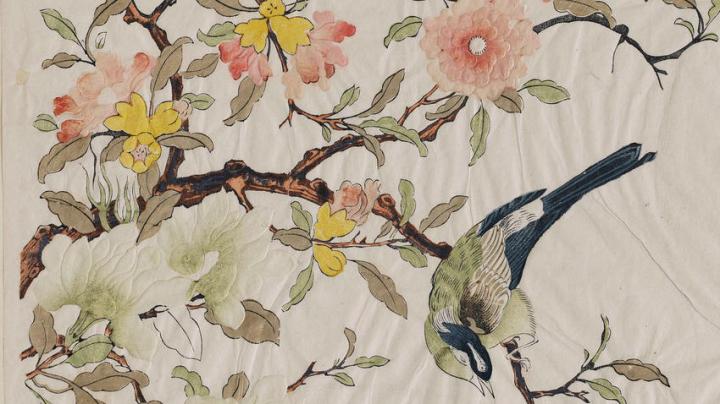
Ding Liangxian, Pomegranate and Magnolia with Bird, (detail), Qing Dynasty, 1700–50; woodblock print with embossing, ink, and colors on paper (multiblock technique with hand-coloring), 11 7/8 × 14 3/4 inches (Boston: Museum of Fine Arts)
◊ ◊ ◊ ◊ ◊
Press release (28 June 2016) from The Huntington:
Gardens, Art, and Commerce in Chinese Woodblock Prints
The Huntington, San Marino, CA, 17 September 2016 — 9 January 2017
Curated by June Li and Suzanne Wright
The Huntington Library, Art Collections, and Botanical Gardens will present a major international loan exhibition exploring the art, craft, and cultural significance of Chinese woodblock prints made during their golden age, with works made from the late 16th century through the 19th century. Gardens, Art, and Commerce in Chinese Woodblock Prints brings together 48 of the finest examples gathered from the National Library of China, Beijing; the Nanjing Library; the Shanghai Museum; and 14 institutional and private collections in the United States. The exhibition presents monumental visual accounts of sprawling, architecturally elaborate ‘scholar’s gardens’, alongside delicate prints with painterly textures and subtle colors depicting plants, birds, and other garden elements so finely wrought they might be mistaken for watercolors. A highlight of the exhibition is The Huntington’s rare edition of the Ten Bamboo Studio Manual of Calligraphy and Painting (ca. 1633–1703), acquired in 2014, and on public view for the first time in this exhibition.
Research informing the exhibition and an accompanying catalog reveals much about the history and significance of Chinese pictorial printing during the period, including its influence on better-known Japanese woodblock artists and collectors. Coveted for their artistic merit and technical virtuosity, Chinese illustrated books and pictorial works were collected by the literati and wealthy merchant classes in both China and Japan. The Ten Bamboo Studio Manual, for example, contains the inscriptions of five renowned Japanese artists, successive owners who treasured the artistically ambitious and visually creative volumes as an important resource.
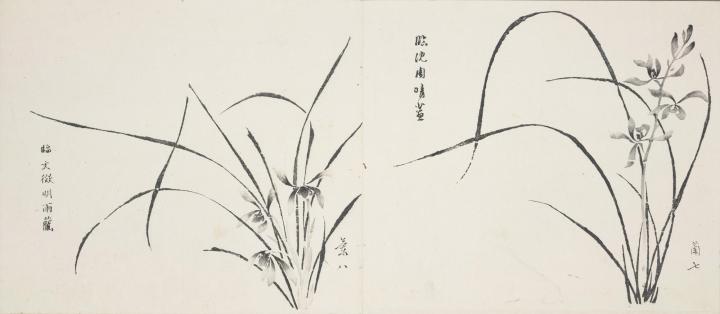
Lotus Leaf, Lotus Root, and Two Jitou Capsules, with calligraphy by Sun Yuwang, Fruit 10, from Ten Bamboo Studio Manual of Calligraphy and Painting, compiled and edited by Hu Zhengyan; woodblock-printed book, ink and colors on paper, each page 9 7/8 × 11 1/4 inches (San Marino: Huntington Library, Art Collections and Botanical Gardens)
◊ ◊ ◊ ◊ ◊
The founding curator of The Huntington’s Chinese Garden, June Li, is co-curator of the exhibition and co-author of the catalog, along with Chinese woodblock print specialist Suzanne Wright, associate professor of art history at the University of Tennessee.
Gardens, Art, and Commerce in Chinese Woodblock Prints unites several interests at The Huntington. It is the home of one of the most extensive collections of early printed books in the nation, various collections of prints by European and American artists, and one of the largest Chinese scholar’s gardens outside of China.
“This exhibition is utterly evocative of The Huntington’s transdisciplinary nature,” said Laura Skandera Trombley, Huntington president. “Woodblock prints were formative communication and aesthetic tools that served a number of purposes over time, from disseminating Buddhist teachings to depicting ideals of beauty. This perfect fusion of art and language, an integration of emotion and intellectual pursuit, is evidenced in The Huntington’s art and library collections, and is embodied in our stunning Suzhou-style Chinese Garden. We are enormously grateful for June Li’s commitment and guiding vision for this extraordinary exhibition.”
During the late Ming (1368–1644) and early Qing (1644–1912) dynasties, an increase in wealth, stemming in part from the salt, rice, and silk industries, led to higher levels of literacy and education. Consumer demand for printed words and images increased as merchants and scholars looked for ways to display their taste in drama, poetry, literature, and art. For these elites, gardens were central to a cultured life, appearing frequently in woodblock prints as subject or setting. By the 1590s, several enterprising publishers were successfully meeting the strong demand for woodblock prints. They hired renowned designers, carvers, and printers to produce sophisticated and exquisite works, raising the standards of printmaking. During the last decades of the Ming dynasty, several centers of printing around the lower Yangzi River delta grew in reputation, ushering in a golden age of Chinese pictorial printing.
“In the realm of Chinese art, pictorial woodblock prints are not as familiar as paintings, calligraphy, or ceramics,” said Li. “The subject of woodblock prints usually brings to mind Buddhist icons, Daoist deities, or folk images, rather than refined and artistic works. But, over the past few years, scholars researching the historical and artistic aspects of these prints have re-introduced a trove of beautiful works that are highly accomplished.”
Building on this story, Gardens, Art, and Commerce in Chinese Woodblock Prints is organized into thematic sections with explanatory panels in both English and Chinese. In the first gallery visitors will find an impressive nine-and-an-half-foot long hand scroll that was commissioned by the Song emperor Taizong (r. 976–97). An unusual Buddhist work that depicts landscape rather than images of deities, it is the earliest and only religious work in the exhibition, showing the lofty achievements of woodblock printers by the 10th century, with enormous clarity of line and painstaking attention to the details of mountains, streams, trees, and tiny figures. The accomplishments of such early printing established the technical foundation from which later Ming and Qing artists grew. Illustrations of the Garden Scenery of the Hall of Encircling Jade, an extraordinary set of 45 prints produced around 1602 to 1605, will be displayed in facsimile (the only evidence that remains of the original). Taken as a whole, the prints illustrate the enormous garden estate of a successful merchant, scholar, and book publisher of the early 17th century. The detailed prints show what seems to be acres of a fashionable garden, with a large, elegant hall framing scholars seated in conversation; a courtyard where figures re-enact a famous poetry game around a table; an enclosure for carefully sculpted penjing (bonsai trees); and more than a hundred names inscribed on buildings, ponds, and rocks. The print has an elevated viewpoint and changing perspectives that allow glimpses into interior spaces, revealing a cultivated life of books and men in scholars’ robes deep in discussion.
The exhibition next focuses exclusively on prints about gardens, both historical and fictional. Historical gardens include famous sites recorded by emperors, such as Suzhou’s Lion Grove, a popular tourist destination to this day. Another imperial work, a scroll more than 25 feet long (six feet of which will be displayed), shows urban gardens and the bustle of daily life in 18th-century Beijing.
The effects of exchanges between European missionaries and the Chinese also are explored in the exhibition. One publisher incorporated biblical illustrations into his ink catalog, produced around 1616. The Qianlong emperor in 1783–86 commissioned a set of large copperplate engravings in a European style that showed details of the European pavilions in his private retreat.
Another section of the exhibition explores the styles of print artists from the late 16th through the 18th centuries in publishing centers such as Hangzhou, Huizhou, Wuxi, and Suzhou. On view are several examples by different publishers illustrating a single popular story, The Story of the Western Chamber, making clear their varying visual and artistic interpretations. In some cases, prints were made to resemble known paintings. Sometimes famous painters, such as Chen Hongshou (1598–1652), designed works expressly for printing. The exhibition includes a rare early edition of Chen’s version of The Story of the Western Chamber, as well as a set of cards he designed for a drinking game.
The exhibition also looks at accomplishments in multi-color and embossed printing, such as beautifully printed guides offering suggestions for cultivating taste. These manuals prescribed appropriate pastimes for a cultivated life, instructed on calligraphy, and advised on chess strategy and drinking games for men, and embroidery patterns for women. They also illustrated musical and dramatic works such as the popular Peony Pavilion. Many of these leisure activities took place in the garden, and prints showing scholar’s rocks, which had become precious items for the discerning collector, will be represented by finely printed editions of well-known works including a rare edition of The Stone Compendium of Plain Garden. Two examples of actual scholar’s rocks from The Huntington’s collection will be on view to complement the book.
Additionally, four iPads in the galleries will allow for a deeper investigation of Illustrations of the Garden Scenery of the Hall of Encircling Jade (a work showing the large garden estate of the successful merchant and publisher Wang Tingna) and allow visitors to see all the leaves of The Huntington’s Ten Bamboo Studio Manual of Calligraphy and Painting, a work that due to its delicate nature can only be viewed a few leaves at a time in the galleries.
Visitors of all ages can view Chinese woodblock printing techniques in a gallery featuring a replica of a printing table, along with carving tools, colored inks, paper, brushes, and burnishers. To better understand the multi-color printing process, a set of woodblocks and step-by-step prints replicating a page of the Ten Bamboo Studio Manual will be on view, a display commissioned from the Shanghai publisher Duo Yun Xuan especially for the exhibition.
T. June Li and Suzanne E. Wright, Gardens, Art, and Commerce in Chinese Woodblock Prints (San Marino: The Huntington Library, Art Collections, and Botanical Gardens, 2016), 176 pages, ISBN 978-0873282673, $50.
June Li details the origins and provenance of The Huntington’s Ten Bamboo Studio Manual of Calligraphy and Painting, a landmark of multi-block color printing, with particular emphasis on its appeal to 18th- and 19th-century Japanese collectors. Suzanne Wright traces the development of three distinct regional styles of woodblock-printed illustrations during the late Ming dynasty, with striking examples of each style drawn from the exhibition. The 176-page volume, published by The Huntington, features more than 150 illustrations, including full-color plates of each work in the exhibition.
◊ ◊ ◊ ◊ ◊
Exhibition Symposium | Word and Image: Chinese Woodblock Prints
The Huntington, San Marino, CA, 12 November 2016
The late Ming period witnessed an unprecedented production of woodblock images printed for many different purposes, including illustrations for drama and games, decorations for stationery paper or ink making, as well as pictorial works for the market. This symposium will explore the relationship and interaction between image and text in woodblock prints during the late Ming and early Qing periods. Register online here.
• Kai-Wing Chow (University of Illinois at Urbana-Champaign), “Nature, Print, and Art: Commerce and Garden Culture in Late Imperial China”
• He Yuming (University of California, Davis), “Illustrating Encyclopedic Knowledge in the Ming”
• Richard Strassberg (University of California, Los Angeles), “The Kangxi Emperor’s Thirty-Six Views: The Making of an Imperial Publication”
• Meng-ching Ma (National Tsing Hua University, Taiwan), “‘Poetic Pictures’ in Late-Ming Illustrated Dramatic Publications”
• Suzanne Wright (University of Tennessee, Knoxville), “The Swallow Messenger: Text and Image”
• Hu Jun (Northwestern University), “A Panoply of Metaphor: Painting and Intermediality in the Late Ming”
Conference | The Age of Luxury: The Georgian Country House
Looking ahead to the fall, from the Sussex Archaeological Society:
The Age of Luxury: The Georgian Country House and Its Setting, 1700–1820
King’s Church, Lewes, 15 October 2016
Organized by Sue Berry

J. Lambert of Lewes, detail of a watercolour showing Newick Place near Lewes, the home of Lady Vernon, 1780 (Sussex Archaeological Society)
Between 1700 and 1820, old houses were transformed and new ones built, some on a spectacular scale by owners who would now be regarded as multi-millionaires. From the later seventeenth century right throughout the eighteenth, the influence of the Grand Tour on country house owners was considerable, not least as many of them travelled abroad themselves, seeing European fashions at first hand. Some Sussex houses still have collections purchased on Grand Tours, though many have since been sold off. Architectural styles were varied, reflecting the influence of Dutch, French, and Classical inspirations as well as our home grown Gothic. Landscapes also evolved from formal to the famous landscape parks of the mid to later eighteenth century. Interiors became more showy, increasingly reflecting the high quality of British craftsmanship. Ever more servants were needed to run a lavish lifestyle which included racing, hunting and other expensive social activities. Our speakers, all specialists in their fields, will address these many aspects of the Georgian country house.
We are hoping to organise visits related to this conference during the summer of 2016, which will offer participants the opportunity to explore aspects of our themes ahead of the conference itself. These events will be advertised to Sussex Archaeological Society members in our April newsletter and details will be available to everyone online. Charges and number restrictions will apply to these. Priority will be given to those who have booked to attend this conference.
Advance booking is strongly recommended as we cannot guarantee there will be places available on the door. Registration on the day opens at 9.30am when you can sign in and collect your copy of the delegate handbook. The ticket price includes a light lunch and coffee and tea on arrival and in the breaks. If you have special dietary requirements or particular access needs, we will do our best to accommodate these if we have advance notice.
King’s Church, Brooks Road, Lewes BN7 2BY. Lewes is easily accessible by road and public transport. There is no parking on site, but there is on-street parking around the building and a long-stay car park half a mile away. Lewes station with its large car park is just under one mile away, and buses stop at the start of Brooks Road. Further details, including directions, will be sent with confirmation of your booking. Non-members are welcome. Please direct all conference enquiries to: Lorna Gartside, Sussex Archaeological Society, Bull House, 92 High Street, LEWES BN7 1XH, email: members@sussexpast.co.uk.
◊ ◊ ◊ ◊ ◊
S A T U R D A Y, 1 5 O C T O B E R 2 0 1 6
10:00 Welcome and introduction, Maurice Howard (University of Sussex)
10:05 The English Country House, 1680–1820: Architecture and Planning, Geoffrey Tyack (Kellogg College, University of Oxford)
10:45 The Grand Tour and the Creation of the Country House in Eighteenth-Century Britain, Jonathan Yarker (Lowell Libson, Ltd.)
11:25 Tea and coffee
11:45 England, France, and the Netherlands: Garden Design in England, 1680–1710, Sally Jeffery (independent architectural and garden historian)
12:25 Pleasure in the Pleasure Gardens of Georgian England, Stephen Bending (University of Southampton)
1:05 Lunch
2:00 From Rococo to Neo-Classicism: Fashioning the Georgian Interior, Susan Bracken (independent historian specialising in furnishings)
2:40 ‘It gives me Reason to believe your Ladyship does not think me a servant to sute her.’ Household Management and Servant Organisation, Julie Day (independent historian of the English country house)
3:20 Tea and coffee
3:40 The Country House Guidebook in the Long Eighteenth Century: A Nuanced Message, Paula Riddy (independent art historian)
4:20 Much Spending, Not Always Afforded: The Transformation of the Country House and Its Setting in Sussex, Sue Berry (specialist in Georgian seaside resorts and the country house estates of Sussex)
5:00 Questions and end
Conference | Staging the Holy
From H-ArtHist:
Internationaler Barocksommerkurs: Die Inszenierung des Heiligen
Bibliothek Werner Oechslin, Einsiedeln, Switzerland, 26–30 June 2016
Registration due by 24 June 2016
Mit Unterstützung der Schweizerischen Akademie der Geistes- und Sozialwissenschaften und des Schweizerischen Nationalfonds. Die Veranstaltung ist öffentlich. Gasthörer sind herzlich willkommen. Aus organisatorischen Gründen bitten wir um Anmeldung an: info@bibliothek-oechslin.ch.
S U N D A Y , 2 6 J U N E 2 0 1 6
I. Göttliches / Heiliges: Sakramente und Hostie
9.15 Round Table: Einführung mit Axel Christoph Gampp, Stefan Kummer, Werner Oechslin, Tristan Weddigen
9.50 Piet Lombaerde (Universität Antwerpen), Statues of the saints as mirrors of divine light in Jesuit Baroque architecture in the Southern Netherlands
10.30 Kaffeepause
11.00 Evangelia Papoulia (University of London), Pope Gregory XIII’s Staging of the Sacraments in the Lateran
11.40 Helen Boessenecker (Universität Bonn), Heiligenstatuen und “early christian revival”. Zur (Re-)Inszenierung des Heiligen in der römischen Altarskulptur um 1600
12.20 Reinhard Gruhl (Universität Hamburg), Frühneuzeitlich-calvinistische Kultanalyse und Kultkritik in Rivets großem Exodus-Kommentar
13.00 Mittagspause
14.30 Steffen Zierholz (Universität Bern), Bild und Rahmen. Zu Berninis Hauptaltar in Sant’Andrea al Quirinale in Rom
15.10 Tobias Glitsch (RWTH Aachen), Die Sakralisierung des Messgeschehens im Altarraum von S. Andrea al Quirinale
15.50 Kaffeepause
16.20 Mirjam Brandt (Universität Bonn), Gloriosa Antiquitas – Zur Wertschätzung mittelalterlicher vasa sacra im 17. und 18. Jahrhundert
17.00 Mateusz Kapustka (Universität Zürich), Barocke Bildgeometrie der Hostie?
18.30 Gemeinsames Abendessen
M O N D A Y , 2 7 J U N E 2 0 1 6
II. Apparate / Maschinen / Theater
9.00 Johannes Gebhardt (Universität Leipzig/Biblioteca Hertziana Rom), Apparitio Sacri – Occultatio Operis: Zeigen und Verbergen von Kultbildern im Italien des 17. Jahrhunderts
9.40 Ria Fabri (Universität Antwerpen), Staging the sacred: Mechanical systems and a hidden theatre in the Antwerp Jesuit church
10.20 Kaffeepause
10.50 Noria K. Litaker (University of Pennsylvania, Philadelphia), From Bits to Bodies: The Construction and Presentation of Whole-Body Catacomb Saints in Baroque Bavaria
11.30 Jens Niebaum (Universität Münster), “Plus Ultra”: Figuration des Heiligen an der Fassade der Wiener Karlskirche
12.10 Léon Lock (Leuven), Renewing devotional practices in Antwerp in the late 17th century: The role of sculpted saints
13.00 Mittagspause
14.30 Verena Villiger (Museum für Kunst und Geschichte Freiburg), Arbeit an der Inszenierung: Der Maler Hans Fries entwickelt ein Marienbild (um 1504/05)
15.10 Nina Niedermeier (Universität München), Filippo Neri umarmt Ignatius von Loyola – die strahlende Seele als Zeichen von Heiligkeit
15.50 Kaffeepause
16.20 Susanne Lang (Darmstadt), “also reden die Altär und Bildnussen” vom Sterben des Hl. Franz Xaver – zum Beispiel in Rastatt
17.00 Sabrina Leps (Staatliche Kunstsammlungen Dresden), Die Inszenierung des Heiligen Franz Xaver in der protestantischen Diaspora
17.50 Führung durch die Bibliothek
19.00 Gemeinsames Abendessen
T U E S D A Y , 2 8 J U N E 2 0 1 6
Day-long excursions to Hergiswald, Blatten, Lucerne, Sachseln, Beckenried, and Gersau
W E D N E S D A Y , 2 9 J U N E 2 0 1 6
III. Das Innen und Aussen des Heiligen
9.30 Lorenzo Santoro (Università della Calabria, Arcavacata), Giovanni Battista Guadagnini’s Critique of Via Crucis: The Question of the Station of the Cross Ritual in the Italian Late Enlightenment
10.10 Matija Jerkovic (Pontificia Università Gregoriana, Rom), Sacred Art and Its Liturgical Staging: Reliquary Bust of Saint Stephen of Hungary
10.50 Kaffeepause
11.20 Stephan Boll (Universität Stuttgart), Santa Rosalia von Palermo: Die Inszenierung einer neuen „alten“ Heiligen im Barock
12.00 Marek Pučalík (Karlsuniversität Prag), “Catholische Vergötterung des Heiligen Johann von Nepomuck“: Eine unbekannte Beschreibung der Triumphpforten zur Feier der Kanonisation des hl. Johann Nepomuk in Prag (1730)
13.00 Mittagspause
14.30 Barbara Lawatsch-Melton (Emory University, Atlanta), Celebrating Sanctity at Nonnenberg Abbey (1622–1682): Observing and Transcending Boundaries
15.10 Claire Guinomet (Humboldt-Forum Berlin), Die Inszenierung des Heiligen am Beispiel des Tempietto-Tabernakels im 16. und 17. Jahrhundert
15.50 Kaffeepause
16.20 Peter Heinrich Jahn (TU Dresden), Evozierte Sakralität in profanem Kontext – Inszenierungen der polnischen Königswürde in den Dresdner Residenzschlossplanungen des Matthäus Daniel Pöppelmann
17.00 Virgil Pop (Universitatea Tehnica din Cluj-Napoca), The Restorations of Medieval Churches in Transylvania in the Age of Baroque
T H U R S D A Y , 3 0 J U N E 2 0 1 6
IV. Orte und Wege
9.30 Thomas Wilke (Stuttgart), Das Turiner Grabtuch – die „Staatsreliquie“ der Savoyer
10.10 Silvia Tammaro (Universität Wien), Die Edicola del Santissimo Sacramento von Turin und ihre Darstellung im Theatrum Sabaudiae
10.50 Kaffeepause
11.20 Madleine Skarda (Universität Zürich), “Heiliger Weeg von Prag nach Alt-Bunzlau”: Die Nischenkapellen auf dem Weg zur Martyrienstätte des Heiligen Wenzelsplatz in Stará Boleslav
12.00 Kerstin Borchhardt (Universität Leipzig), Die göttliche Kausalität der Radiolarien-Ikonen: Ernst Haeckels Ästhetik und Inszenierung seiner monistischen Weltformel
13.00 Mittagspause
14.30 Stephan Wyss (Marly FR), Die Inszenierung des Heiligen in umgekehrter Perspektive. – Kunst und Theologie, Pavel Florenskij und Martin Buber
15.10 Joris van Gastel (Bibliotheca Hertziana Rom), Dressing Up the Holy: Stoffwechsel and Ephemerality in Baroque Naples
15.50 Kaffeepause
16.20 Jürgen Müller (TU Dresden), Caravaggio und das Heilige
17.00 Werner Oechslin (Stiftung Bibliothek Werner Oechslin, Einsiedeln), Afterthought: „die historische Construction des Christenthums“
18.30 Abschiedsabendessen
Conference | Auricular Style: Frames
From the conference website:
Auricular Style: Frames
The Wallace Collection, London, 5–6 October 2016
Organized by Gerry Alabone and Lynn Roberts
This two-day international conference is the first dedicated to the Auricular style, centring on one of its most significant manifestations, the picture frame. The conference aims to stimulate awareness and study of this important but neglected style by bringing together research in fine and decorative art histories. Speakers from Europe, UK, and USA will consider the origins and development of the Auricular style in different materials, including silver, wood, stucco, and leather. Papers will explore how other areas of the decorative and applied arts fed into the creation of picture frames. They will examine the influence of prints, drawings, ad the style’s dissemination between European centres in Bohemia, Germany, Italy, France, the Netherlands, and Britain. Poster presentations will be exhibited during the conference. These will be edited with the papers and published, fully illustrated, for free download on Auricular Style: Frames—which, it is hoped, will become a hub for future related research.
Early bird registration is now open. Early bird ticket prices (including Eventbrite’s commission): £100 regular, £90 Icon members, £50 students (ID to be shown at conference). Early bird option ends and prices rise after 30 June. The theatre’s capacity is 150; therefore, early registration is recommended. No refunds will be made after 23 September. If you do not wish your email address to be included in the Delegates list, please contact the event coordinator at gdsg.events@gmail.com.
Convenors: Gerry Alabone (Tate / City and Guilds of London Art School) and Lynn Roberts (The Frame Blog) in association with the Institute of Conservation (Gilding and Decorative Surfaces Group).
◊ ◊ ◊ ◊ ◊
5 O C T O B E R 2 0 1 6
9.00 Registration and coffee
• On the Inception of Auricular Ornament: Paulus van Vianen’s Metamorphic Bodies and the Fleshy Frame (Allison Stielau, McGill University)
• Object Bodies, Metal Mounts and the Skins of Things (Anna Grasskamp, Heidelberg University)
Coffee
• A French Auricular? A Brief History of a Style (Marika Knowles, Harvard University)
• German Knorpelwerk: Auricular Dissemination in Prints, Woodcarving, Stucco and Painted Wall Decorations, 1620–1670 (Daniela Roberts, Würzburg University)
• The Auricular Style in Dutch Furniture (Reinier Baarsen, Leiden University / Rijksmuseum)
Lunch break
• Gilt Leather: A Creative Industry avant la lettre (Eloy Koldeweij, Cultural Heritage Agency, the Netherlands)
• Material Research on Auricular Frames in the Netherlands (Hubert Baija, Rijksmuseum)
• The Auricular Frame Depicted in Paintings (Lynn Roberts, The Frame Blog)
Tea
• Between Amsterdam, Paderborn and Rome: A Remarkable Frame in the Collections of the Louvre (Charlotte Chastel-Rousseau, Louvre)
• Dutch Auricular Woodcarving (Ada de Wit, Radboud University / Wallace Collection)
6 O C T O B E R 2 0 1 6
9.55 Welcome and introduction
• The Development of an Auricular Style in Florence (Adriana Turpin, Institut d’Études Supèrieures des Arts)
• Anthropomorphism and Zoomorphism in the Medici Picture Frames (Marilena Mosco, former Director of Palazzo Pitti)
Coffee
• Florentine Auricular Frames: Techniques and Aesthetics (Aviv Fürst, Palazzo Pitti)
• Documenting Developments in the Taste for Auricular Framing in England, 1620–1700 (Jacob Simon, National Portrait Gallery)
• Looking at Material and Visual Evidence of English Auricular Frames (Gerry Alabone, Tate / City and Guilds of London Art School)
Lunch break
• An Auricular Frame amongst the Founder’s Collection of the Ashmolean Museum (Tim Newbery and Jevon Thistlewood, Ashmolean Museum)
• Picture Galleries in Seventeenth-Century Britain (Honorary Professor Karen Hearn, University College London)
• Notes on the Revival of the Auricular Style for Picture Frames (Christopher Rowell, National Trust)
Tea
• The Auricular Today: Putting an Ear to the Ground (Steve Shriver, art+works)
• Panel discussion with all speakers (to finish at 5.00pm)
Conference | The Staircase in Europe, 1450–1800
From H-ArtHist:
Rencontres européennes d’architecture
L’escalier en Europe: Formes, fonctions, décors, 1450–1800
Institut national d’histoire de l’art, Paris, 9–11 June 2016
J E U D I , 9 J U I N 2 0 1 6
9.30 Accueil des participants
9.45 Introduction
10.00 Première Session: La Renaissance (1)
Président : Jean Guillaume
• Krista de Jonge (Université de Leuven), « L’escalier à la Renaissance : les anciens Pays-Bas revisités »
• Stephan Hoppe (Ludwig-Maximilians-Universität München), « New standards of social climbing. Staircases in Rennaissance Germany »
• Renate Leggatt-Hofer (Federal Monuments Authority Austria-Bundesdenkmalamt, Wien), « Imperial staircase-architecture within the residences of Ferdinand Ist (1521–1564) : Some bold experiments »
13.30 Deuxième Session: La Renaissance (2)
Président : Alexandre Gady
• Marco Rosario Nobile (Università Palermo), « Scale a chiocciola « imperiali ». Due esempi a Malta e in Sicilia »
• Fernando Marias (universidad Complutense, Madrid), « Scala in Spania en longue durée : disegno e stereotomia »
• Nunos Sensos (universidad nova de Lisboa), « L’escalier au Portugal (XVe–XVIIIe s.) »
• Pascal Julien (université de Toulouse II), « Escaliers sculptés de la Renaissance française »
V E N D R E D I , 1 0 J U I N 2 0 1 6
9.30 Troisième Session: Les temps modernes (1)
Président : Basile Baudez
• Gordon Higott (Historien de l’architecture), « Inigo Jones, Sir Christopher Wren et l’escalier en vis à jour central en Angleterre, 1616 – c.1720 »
• Konrad Ottenheym (Utrecht University), « Les escaliers monumentaux dans les palais XVIIe de la cour d’Orange »
• Richard Biegel (Faculty of Arts, Charles University, Prague), « L’escalier des temps modernes en Bohème ? »
• Daniela del Pesco (università Roma III), « Escaliers à Naples au XVIIIe siècle: les ‘scale aperte’ »
14.30 Quatrième Session: Les temps modernes (2)
Président : Emmanuel Lurin
• Christina Strück (Friedrich-Alexander Universität, Erlangen-Nurenberg), « Stagecraft and stairways. Monumental 17th- and 18th-century staircases in Germany »
• Jorge Fernandez-Santos (ETSA, Universidad San Jorge, Saragosse), « Les escaliers entre tradition et académie dans l’Espagne du XVIIIe siècle : un classicisme oblique ? »
• Stefano Piazza (Università di Palermo), « Les escaliers des palais siciliens du XVIIIe siècle »
S A M E D I , 1 1 J U I N 2 0 1 6
9.30 Cinquième Session: études de cas
Président : Pascal Julien
• Guillaume Fonkenell (Musée national de la Renaissance, Ecouen), « Ecouen. Un château d’escaliers »
• Alexandre Gady (Paris-Sorbonne, Centre Chastel), « Du bon usage du vide central. Les escaliers de Versailles »
• Paolo Corniglia (Politecnico di Torino), « Des marches qui ne portent nulle part. Le grand escalier de Juvarra au palais royal inachevé de Rivoli »
12.00 Conclusions, par Claude Mignot
Conference | The Art Market, Collectors, and Agents
From the Seminar on Collecting and Display:
The Art Market, Collectors, and Agents: Then and Now
The Warburg Institute, London, 13 July 2016
Registration due by 11 July 2016
Organized by the Collecting and Display Seminar Group, which is based at the Institute of Historical Research in London. For booking, please email agent.candd2016@gmail.com. A further 2-day conference will take place in Paris in October 2016.
10.00 Registration and coffee
10.15 Introduction
10.30 Session I
• Annemarie Jordan Gschwend — Statesman, Art Agent and Connoisseur: Hans Kevenhüller, Imperial Ambassador at the Court of Philip II of Spain
• Taryn Marie Zarrillo — Marco Boschini and Paolo del Sera: Art Dealers, Advisors and Associates in Seicento Venice
• Michael Wenzel — Sales Strategies of Philipp Hainhofer’s Art Cabinets: The Self-Marketing of Artworks in Early Seventeenth-Century Germany
• Sandra van Ginhoven — The Business Strategies of Guilliam Forchondt’s Art Dealership in Antwerp, 1643–78
• Ulf R. Hansson — ‘An Oracle for Collectors’: Philipp von Stosch and the Collecting and Dealing in Antiquities in Early Eighteenth-Century Rome and Florence
13.00 Lunch
14.00 Session 2
• Maria Celeste Cola — Scottish Agents in Rome in the Eighteenth Century: The Case of Peter Grant
• Christine Godfroy-Gallardo — Establishing Honest Trading Relationships: The Guillaume Martin Case
• Robert Skwirblies — Edward Solly, Felice Cartoni and Their Purchases of Paintings: A ‘Milord’ and His ‘Commissioner’ Creating a Transnational Network of Dealers, ca. 1820
• Lukas Fuchsgruber — Otto Mündler, 9 rue Laval, Paris
• Lynn Catterson — The Mysterious Maurice de Bosdari, a Would-Be Agent of Stefano Borden
16.30 Tea
17.30 Session 3
• Julie Codell — Agent-Scholar Martin Birnbaum (1878–1970): Modernizing the Agent
• Nicola Foster — The Case of Uli Sigg: Collector, Agent, Advisor and Promoter of Contemporary Chinese Art
18.30 Keynote Lecture
• Sophie Raux — Mapping the Agents of the Art Market in Early Modern Europe: An Experimental Research Database
19.15 Reception










leave a comment