Symposium | Cross Media Porcelain
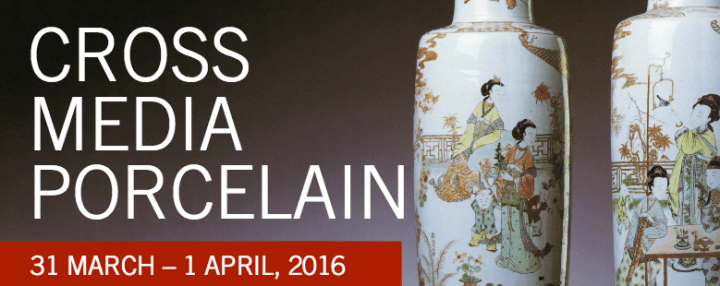
Two Vases, China, Qing Dynasty (1644–1911)
Porzellansammlung, Staatliche Kunstsammlungen Dresden
◊ ◊ ◊ ◊ ◊
From the Institut für Kunstgeschichte Ostasiens:
Cross Media Porcelain
Ruprecht-Karls-Universität Heidelberg, 31 March — 1 April 2016
Organized by Sarah Fraser and Cora Würmell
The Institute for East Asian Art History of Ruprecht-Karls-University Heidelberg would like to invite you to attend the symposium Cross Media Porcelain, which considers the migration of themes and motifs across media—woodblock prints, paintings, porcelains and ultimately early photographs—during the 17th, 18th, and19th centuries. The 17th-century transitional period in porcelain production when official kilns in Jingdezhen were shut during the Ming-Qing transition is our starting point. Participants discuss the expansion of narratives on porcelain surfaces and the emerging dominance of the female form, especially in vessels exported or made for export. Several symposium papers explore the emergence of chinoiserie and its imbededness in objects created in trans-cultural exchange between Europe and Asia.
Cross-Media-Porcelain is organised by the Institute of East Asian Art History, Heidelberg University in cooperation with the Staatliche Kunstsammlungen Dresden (SKD) and is generously funded by Field of Focus 3 Initiative ‘Cultural Dynamics in Globalised Worlds’. Due to limited seating, informal registration is necessary; please email Cecilia C. Zi, cecilia.zi@zo.uni-heidelberg.de.
◊ ◊ ◊ ◊ ◊
T H U R S D A Y , 3 1 M A R C H 2 0 1 6
9:00 Welcome and Introduction
• Sarah E. Fraser, The Emergence of Narrative and the (Female) Figure in Chinese Porcelain
9:30 Chinoiserie
• Adina Badescu, Between China and Europe: Watercolors in the Kupferstichkabinett Dresden, An Approach to Chinoiserie
• Cecilia C. Zi, Who Created Chinoiserie? Cross-media Motifs at the Saxony Court
• Aina Gu, A Case Study of the Chinese Image
10:30 Coffee Break
11:00 Women on Display
• Qiuzi Guo, The Male Gaze: Female Representation in Photography and Porcelain
• Yizhou Wang, Representation of Female Bodies and Narratives on Three-dimensional Dresden Porcelain Surfaces
• Ruoming Wu, Female Representations: Studies of Iconography on Chinese Porcelain in the SKD Collection
12:30 Lunch Break
13:30 Afternoon Presentation
• Anita Xiaoming Wang, Images of Women in Chinese Woodblock Prints in the 18th Century
14:15 Coffee Break
14:30 The World in Saxony
• Jan Hüsgen, ‘Sweetness and Power’: Porcelain and Colonial Consumption in Saxony
• Agnes Matthias, Exploring the Photographic Archive: Ethnography and Depicting the ‘Other’
15:30 Motifs and Visualization
• Lucie Olivova, Three Boys at Play
• Wenzhuo Qiu, ‘Sweeping the Elephant’: A Trans-media Example between Woodblock Prints and Porcelain
• Renyue He, Landscape on Porcelain: The ‘Orchid Pavilion Gathering’
F R I D A Y , 1 A P R I L 2 0 1 6
9:15 Morning Presentation: Dresden Collection
• Cora Würmell, Forgotten Treasures: The Dresden Inventories of the 18th Century
10:00 Global Porcelain
• Karolin Randhahn, Porcelain with Lacquer Application in the Dresden Inventories
• Lianming Wang, ‘European’ Cityscape on Chinese Plates
• Wenting Wu, Roundel, Panel, Lotus Petal: Elements of Byzantine Interior Design Appropriated in Ceramic Decoration, China and the Islamic World
11:30 Coffee Break
11:50 Porcelain in Transformation
• Xiaobing Fan, Transcultural Media: The Transformation of Motifs on Chinese Export Porcelain
• Muyu Zhou, Guangcai Porcelain and the Global Trade
• Feng He, Gazing at Earthly Paradise: Private Theater, Garden, and Female Representation on Early Qing Narrative Porcelain
13:00 Lunch Break
14:00 Afternoon Presentation
• Stacey Pierson, Export or Exported? Primary and Secondary Transfer in 17th- and early 18th-Century Chinese Porcelain
15:00 Final Discussion
Salon du Dessin 2016
From the art fair’s website:
Salon du Dessin 2016
Palais Brongniart, Paris, 30 March — 4 April 2016 / Symposium, 30–31 March 2016
 The Salon du Dessin is a unique event of worldwide renown, lead by its new chairman Louis de Bayser. Serving as a reference for drawing collectors, the Fair also gathers curators, experts or amateurs from across the globe. This year, the Salon du Dessin, will feature 39 prestigious galleries specialising in Old Masters, Modern and Contemporary drawings. More than 1000 drawings will be showcased in the prestigious Palais Brongniart.
To celebrate its 25th anniversary, special works from the Pushkin State Musuem will be unveiled for the first time in France. Curator of French drawings at the Pushkin State Museum and curator of the exhibition Vitaly Michine worked with curators from the private collections department along with the graphic arts department of the Pushkin State Museum to choose the twenty-six works that will be exhibited. Of the drawings, Russian artists produced seventeen, among which three come from Zilberstien collection; nine of the works were produced by European artists.
◊ ◊ ◊ ◊ ◊
Salon du Dessin 2016 Symposium
Palais Brongniart, Paris, 30–31 March 2016
W E D N E S D A Y , 3 0 M A R C H 2 0 1 6
• Sarah Catala, ‘Carcer Socratis Domus Honoris’: The Drawings of Hubert Robert in Prison
• Anne Lenoir and Sophie Join-Lambert, Joseph-Benoit Suvée: A New View of Italy, 1772–78
• Anna Ottani Cavina, Jean-Thomas Thibault: Italian Landscapes, 1788–92
• Emilie Beck Saiello, Typology of Vernet’s Sketchbooks
• Benjamin Couilleaux, Jean-Baptiste Huet: A Neoclassical Artist?
T H U R S D A Y , 3 1 M A R C H 2 0 1 6
• Louis-Antoine Prat, Some New Drawings by David
• Patrick Ramande, The Second Part of the Album of Jean-Germain Drouais de Rennes
• Sylain Laveissière, Prud’hon Draughtsman
• Mehdi Korchane, The Nude under His Skin: The Academic Drawings of Jean-Baptiste Regnault
• Isabelle Mayer-Michalon, Drawings by Charles-Toussaint Labadye for the 1798 Rome Competition: The Battle between the Horatii and the Curiatii
• Rébecca Duffeix, Drawings by Alexandre-Évariste Fragonard in Sèvres
Study Day | Textiles and Diplomacy: Diplomats and Spies
From H-ArtHist:
Textiles and Diplomacy: Diplomats and Spies in the Early Modern Age
Centre for Textile Research, SAXO Institute, University of Copenhagen, 17 March 2016
Convened and introduced by Corinne Thépaut-Cabasset
13:00 Corinne Thépaut-Cabasset (CTR/SAXO Institute Copenhagen), ‘Textiles and Diplomacy: Diplomats and Spies in the Early Modern Age’
13:30 Axel Harms (Rosenborg Castle), ‘Splendour and Confidentiality: Rosenborg Castle and the Diplomacy of Christian IV’
14:00 Cecilia Candreus (Uppsala University), ‘An Embroidered Marriage Proposal to Elizabeth I of England’
14:30 Charlotte Paludan (Independent Textile Scholar Copenhagen), ‘French Espionage on Danish Textile Production’
15:00 Nadia Fernández de Pinedo (Universitad Autonóma Madrid), ‘Textile Consumption in Mid-18th Century-Madrid: Diplomats and Upper Middle Class’
15:30 Sidsel Frisch (University of Copenhagen), ‘Textile Diplomacy: Tapestries of War and Peace’
Conference| Animating the Georgian London Town House
From The National Gallery:
Animating the Georgian London Town House
The National Gallery, London, 17 March 2016
Rediscovering and animating London town houses of the 18th and early 19th centuries
 Organised by the Paul Mellon Centre, London, the National Gallery, and Birkbeck College, University of London, this conference explores the position town houses once occupied in the lives of families and the nation as a whole. Some—such as Spencer House—have survived; many have left fragmentary traces; others have been completely destroyed and can only be recreated on the basis of inventories and descriptive accounts. There is much still to be uncovered about the collections of paintings, sculpture, and decorative arts which these buildings once housed, as well as about their furnishing, architecture, gardens, and refashionings over time.
This event follows on from the successful Animating the 18th-Century Country House conference held at the National Gallery in March 2015. Expert speakers will discuss both famed and little-remembered London town houses, considering how these residences were designed, furnished, and ornamented. Papers also explore the significance and function of these properties for owners and their families, together with the varied experiences of guests and visitors. To book tickets, please visit The National Gallery.
◊ ◊ ◊ ◊ ◊
P R O G R A M M E
10.00 Registration
10.20 Welcome by Susanna Avery-Quash and Kate Retford
10.30 Keynote Lecture
• Desmond Shawe Taylor, ‘Picture displays at Carlton House’
11.30 Coffee break
12.00 Construction and Reconstruction
• Matthew Jenkins and Charlotte Newman, ‘London in pieces: Building biographies in Georgian Mayfair’
• Neil Bingham, ‘The Regency transformation of Burlington House, Piccadilly, documented through the architectural drawings of Samuel Ware’
• Pat Hardy, ‘Canaletto’s town houses’
1.30 Lunch break
2.30 Fashioning and Inhabiting
• Jeremy Howard, ‘New light on Norfolk House: The decoration and furnishing of Norfolk House for the 9th Duke and Duchess of Norfolk’
• Anne Nellis Richter, ‘Glitter and fashion in the “Louvre of London”: Animating Cleveland House’
• Peter Nelson Lindfield, ‘London’s gothic pineapple: 18 Arlington Street’
4.00 Refreshment break
4.30 Keynote Lecture
• Adriano Aymonino and Manolo Guerci, ‘London’s greatest mansion in the Strand: Northumberland House, the urban palace of the 1st Duke and Duchess of Northumberland’
5.30 Closing remarks
◊ ◊ ◊ ◊ ◊
Note (added 2 March 2016) — The original version of this posting inadvertently omitted Anne Nellis Richter’s presentation.
Conference | Leonardo in Britain: Collections and Reception
From the conference programme:
Leonardo in Britain: Collections and Reception
Birkbeck College, The National Gallery, The Warbug Institute, London, 25–27 May 2016
 This conference explore the important role and impact of Leonardo’s paintings and drawings in key British private and public collections. With a focus on the reception of Leonardo in Britain, this conference also looks at the broader British context of the reception of his art and science by addressing selected manuscripts and the first English editions of his Treatise on Painting, as well as historiographical approaches to Leonardo.
Initially conceived as a collaborative project between the late Romano Nanni, former director of the Biblioteca Leonardiana, Vinci and Juliana Barone at Birkbeck College, University of London, the conference has developed into a wider collaboration between these two institutions and the National Gallery, the Warburg Institute, London, and the Kunsthistorisches Institut, Florence. The conference has received support from the Paul Mellon Centre, the British Museum, and the Leonardo da Vinci Society, London.
Each day of the three-day conference will be held at the different partner institutions:
25 May: Birkbeck College, free admission (book tickets)
26 May: The National Gallery, £55/£48 senior citizens/£45 members and Leonardo da Vinici Society members/£28 students
27 May: The Warburg Institute, £15
◊ ◊ ◊ ◊ ◊
W E D N E S D A Y , 2 6 M A Y 2 0 1 6
4.45 Registration
5.15 Welcome and introduction: Juliana Barone (Birkbeck College) and Susanna Avery-Quash (National Gallery)
5.30 Martin Kemp (Oxford University) – ‘Spinning a yarn or two: Leonardo’s two matching Madonnas’
6.30 Drinks
T H U R S D A Y , 2 6 M A Y 2 0 1 6
10.00 Registration
10.30 Welcome and introduction: Juliana Barone (Birkbeck College) and Susanna Avery-Quash (National Gallery)
10.45 Panel 1: Drawings Collections
• Martin Clayton (Royal Collection Trust, Windsor) – ‘The ‘Windsor’ Leonardos after Arundel’
• Jacqueline Thalmann (Christ Church Picture Gallery, Oxford) – ‘Leonardo in the collection of General John Guise (1682–1765)’
• Hugo Chapman and Sarah Vowles (British Museum, London) – ‘Leonardo drawings in Bloomsbury and beyond’
12.45 Lunch break
1.45 Panel 2: Originals, Versions, and Copies
• Carmen Bambach (The Metropolitan Museum, New York) – ‘The St Anne Burlington cartoon: Function, provenance and dating’
• Caroline Campbell and Larry Keith (National Gallery) – ‘Some observations on the provenance and conservation history of the London Virgin of the Rocks’
• Pietro Marani (Università Cattolica, Politecnico, Milan) – ‘Clarifications and novelties on the issue of the copy of the Last Supper at the Royal Academy and its reception in England in the first half of the 19th century’
3.45 Refreshment break
4.15 Panel 3: What Was Thought to Be a Leonardo?
• Margaret Dalivalle (Centre for Medieval and Renaissance Studies, Oxford University) – ‘Said to be of Leonard de Vincia: Or out of his Scoule: Appraising Leonardo in 17th-century England’
• Susanna Avery-Quash (National Gallery) – ‘Sir Charles Eastlake at the National Gallery (1843–1865): Towards a clearer picture of Leonardo as an artist’
F R I D A Y , 2 7 M A Y 2 0 1 6
10.00 Registration
10.10 Welcome and introduction: Juliana Barone (Birkbeck College) and Susanna Avery-Quash (National Gallery)
10.15 Panel 4: Leonardo on Art and Science
• J. V. Field (Birkbeck College) – ‘Leonardo’s after-life in the world of new philosophy’
• Domenico Laurenza (Museo Galileo, Florence) –‘Leonardo’s science in 17th- and 18th-century England: The Codices Leicester, Arundel, and Huygens’
11.30 Refreshment break
12.00 Panel 5: Around the Treatise on Painting
• Juliana Barone (Birkbeck College) – ‘The Treatise on Painting: British collectors’ manuscript copies and the first English printed edition’
• Harry Mount (Oxford Brookes, Oxford) – ‘Leonardo’s Treatise and the empirical undertow in British art theory’
1.15 Lunch (provided)
2.15 Panel 6: Teaching and Theoretical Knowledge
• Charles Saumarez Smith (Royal Academy, London) – ‘Leonardo’s legacy in London: The teaching programme at the Royal Academy’
• Francesco Galluzzi (Accademia Belle Arti, Carrara) – ‘Alexander Cozens, Leonardo da Vinci and landscape painting in England between the 18th and 19th centuries’
3.30 Refreshment break
4.00 Panel 7: Re-reading Leonardo
• Francesca Fiorani (University of Virginia, Virginia) – ‘Kenneth Clark’s Leonardo’
• Alessandro Nova (Kunsthistorisches Institut, Florence) – ‘John Shearman’s Leonardo’
• Claire Farago (University of Colorado at Boulder, Colorado) – ‘Re-reading Richter and MacCurdy in conversation with Carlo Pedretti: Lessons in translation’
5.30 Concluding remarks
Colloquium | Sculpture and Parisian Decorative Arts in Europe, Part II

◊ ◊ ◊ ◊ ◊
From H-ArtHist, with the programme as a PDF file available here:
Le rôle de la sculpture dans la conception, la production, le collectionnisme et
la présentation des arts décoratifs parisiens en Europe, 1715–1815
Centre André Chastel de l’université de Paris-Sorbonne, 14–15 March 2016
Collaboration entre le Centre André Chastel de l’université de Paris-Sorbonne et l’association Low Countries Sculpture, avec nos vifs remerciements pour son soutien à The Boulle Project, Paris. Seconde Partie, suite à la première tenue en 2015 à Mons alors Capitale européenne de la Culture.
Between 1715 and 1830 Paris gradually became the capital of Europe, “a city of power and pleasure, a magnet for people of all nationalities that exerted an influence far beyond the reaches of France,” as Philip Mansel wrote, or as Prince Metternich phrased it, “When Paris sneezes, Europe catches cold.” Within this historical framework and in a time of profound societal change, the consumption and appreciation of luxury goods reached a peak in Paris.
The focus of this one-day international conference will be to investigate the role of the sculptor in the design and production processes of Parisian decorative arts, from large-scale furniture and interior decoration projects to porcelain, silver, gilt bronzes and clocks. In the last few years a number of studies were carried out under the auspices of decorative arts museums and societies such as the Furniture History Society and the French Porcelain Society. It now seems appropriate to bring some of these together to encourage cross-disciplinary approaches on a European level and discussion between all those interested in the materiality and the three-dimensionality of their objects of study.
The relationships between, on the one hand, architects, ornemanistes and other designers, and on the other sculptors, menuisiers, ébénistes, goldsmiths, porcelain manufacturers, bronze casters and other producers, as well as the marchands merciers, will be at the heart of the studies about the design processes. A second layer of understanding of the importance of sculpture in the decorative arts will be shown in the collecting and display in European capitals in subsequent generations, particularly those immediately after the French Revolution, as epitomised by King George IV.
Overall, the intention of this conference is to attempt to shed light on the sculptural aspect of decorative arts produced in Paris in the long 18th century and collected and displayed in the capitals of Europe. Without pretending to be exhaustive, this study day—and its publication—hopes to bring together discussions about the histories and methodologies that could lead to furthering the study of hitherto all too often neglected aspects of the decorative arts.
◊ ◊ ◊ ◊ ◊
L U N D I , 1 4 M A R S 2 0 1 6
Le colloque est accessible gratuitement à tous sur inscription préalable obligatoire par email. Les inscriptions seront clôturées le jeudi 10 mars à minuit.
15.00 Accueil
15.30 Bienvenue et introduction
15.40 Session 1: Collectionnisme et emprunts faits à Paris pour les élites européennes
Président: Peter Fuhring (Fondation Custodia, Paris)
• Lilit Sadoyan (University of California, Santa Barbara / J. Paul Getty Museum, Los Angeles), Collecting at court and beyond: The dissemination and display of Girardon’s sculptural groups
• Jean-Baptiste Corne (École du Louvre / École Pratique des Hautes Études, Paris), Gilles-Paul Cauvet, architecte, sculpteur, graveur, bronzier et collectionneur: un artiste parisien des Lumières?
• Elisabeth Fritz (Universität Jena), Framing the ‘fête galante’ at the court of Frederick the Great
• Giuseppe Dardanello (Università degli Studi di Torino), Francesco Ladatte’s Parisian legacy in the decorative arts in Piedmont
M A R D I , 1 5 M A R S 2 0 1 6
8.30 Inscription au colloque
9.00 Session 2: La représentation d’arts décoratifs sculpturaux
• Ute Christina Koch (LWL-Museumsamt für Westfalen, Münster), From Paris to Dresden: Two recently discovered paintings by Jean-Baptiste Monnoyer and their references to the decoration at the court of Louis XIV
• Miriam Schefzyk (Universität Münster), Les ébénistes allemands à Paris et leurs conceptions sculpturales de meubles (1750–1800): L’exemple des meubles à plaques de porcelaine de Martin Carlin
• John Whitehead (historien d’art), Piat-Joseph Sauvage – une carrière variée: de la peinture monumentale à la miniature en passant par la porcelaine
10.40 Pause café
11.00 Session 3: Le rôle des modèles et la transformation de deux en trois dimensions, I.
Président: Emmanuel Lurin (Centre André Chastel, Université de Paris-Sorbonne)
• Grégory Maugé et Jean-Dominique Augarde (historiens d’art), La sculpture d’André-Charles Boulle et les gravures de Charmeton
• Jarl Kremeier (historien d’art, Berlin), Balthasar Neumann in Paris in 1723: Sculpture and Decoration, Books and Prints
• Léon Lock (université de Leuven), Comment la rocaille parisienne conquit Munich. Le rôle de l’architecte et dessinateur François Cuvilliés (1695–1768)
12.45 Déjeuner
13.45 Session 4: Le rôle des modèles et la transformation de deux en trois dimensions, II.
Président: Antonia Boström (Victoria & Albert Museum, London)
• Alan Darr (The Detroit Institute of Arts), The Role of Sculpture in French Decorative Arts: Case Studies of Notable Acquisitions at the Detroit Institute of Arts
• Laura Langelüddecke (The Wallace Collection, London), Jean-Claude Duplessis père’s designs for the Vincennes/Sèvres manufactory
• Kee Il Choi Jr. (University of Warwick), A Qing imperial portrait as a design source at the Royal Porcelain Manufactory at Sèvres
15.25 Pause café
15.45 Session 5: Nouveauté et continuité dans le rôle de la sculpture entre Louis XVI et Napoléon III
• Alicia Adamczak (Institut catholique de Paris), La sculpture au service des arts décoratifs à l’aube de la Révolution: les ouvrages de Jean-Joseph Foucou pour la duchesse de Mazarin et le comte de Vaudreuil
• Stéphane Laurent (Université de Paris I, Panthéon-Sorbonne), Jean-Baptiste Jules Klagmann, un sculpteur pour les arts décoratifs au dix-neuvième siècle
• Alexandre Gady (Centre André Chastel, Université de Paris-Sorbonne), Jean-Baptiste-Louis Plantar (1790–1879), dernier sculpteur des Bâtiments du Roi
17.30 Conclusions
Conference | Chinese Wallpaper: Trade, Technique and Taste
From the conference website:
Chinese Wallpaper: Trade, Technique and Taste
Coutts & Co / V & A, London, 7–8 April 2016

Detail of the painted wallpaper in the Chinese Bedroom, Belton House. ©National Trust Images/Martin Trelawny
A conference on the subject of Chinese wallpaper will take place in London on 7 and 8 April 2016, with an optional excursion to Brighton on 9 April. The event is being organised jointly by the National Trust and the Victoria and Albert Museum, with generous support from Coutts & Co and the Royal College of Art.
Chinese wallpaper is a product that is finely balanced between east and west, art and design, trade and taste. It has been an important component of western interiors for about 250 years, but it has sometimes been taken for granted, literally fading into the background. However, over the last few decades the conservation of Chinese wallpapers has developed considerably. It is now also the subject of increasing scholarly interest. Traditional-style hand-made Chinese wallpaper is still being produced today and is now also in demand in China itself.
The aim of this conference is to stimulate the momentum of the research into Chinese wallpaper and to capture some of the recent findings. The papers to be presented will include European, American and Chinese perspectives and will look at Chinese wallpaper as art, as design, as cross-cultural exchange, as commodity and as material object.
The first day of the conference will be hosted by Coutts at their premises in the Strand—still containing the Chinese wallpaper acquired by banker Thomas Coutts in the late eighteenth century. The second day will be held at the Victoria and Albert Museum and will include the viewing of actual Chinese export wallpapers from the museum’s collection—the largest in the world, but much of it not normally on display. On 9 April there will be an optional excursion to the Royal Pavilion in Brighton, where Chinese wallpaper formed an important component of the Prince Regent’s decorative vision.
◊ ◊ ◊ ◊ ◊
T H U R S D A Y , 7 A P R I L 2 0 1 6
Coutts & Co.
9:00 Registration and coffee
9:30 Welcome
9:40 Introduction by Margot Finn, Chair in Modern British History, University College London
9:50 Session A
• Emile de Bruijn, ‘Chinese Wallpaper: a Global Product’
• Helen Clifford, ‘From Canton via Custom House to the Country House: Chinese Wallpaper in Transit and the Role of the East India Company, 1750–1850’
• Ming Wilson, ‘Chinese Paper as Commodity’
11:05 Coffee
11:25 Session B
• Xiaoming Wang, ‘Chinese Woodblock New Year Prints and Paintings Used as Wallpaper in Europe in the Eighteenth Century’
• Friederike Wappenschmidt, ‘”Talking Chinese”? Exotic Wall Coverings in German and Austrian Castles’
• Max Tillmann, ‘Chinese Wallpapers and Sensual Exoticism at the Badenburg, Munich’
12:40 Lunch
13:30 Session C
• David Skinner, ‘Using and Marketing “Indian Pictures” in Mid-Eighteenth-Century Dublin’
• Clare Taylor, ‘“A Large Assortment of Curious India Paper”: the Eighteenth-Century English Market for Chinese Wallpaper’
• Patrick Conner, ‘Chinese Wallpaper and Cantonese Export Painting: The Strathallan ‘Drummond’ Wallpaper (Peabody Essex Museum)’
14:45 Tea
15:05 Session D
• Anna Wu, ‘The Chinese Wallpapers at Coutts & Co., London: Mobilising Images of Chinese Life and Industry’
• Sarah Cheang, ‘Red, Black and Gold, and as Glossy as Possible: Modernism, Orientalism, Fashion and Wallpaper’
• Lizzie Deshayes, title TBC [Chinese wallpaper today as produced by Fromental]
• Dominic Evans-Freke, title TBC [Chinese wallpaper today as produced by De Gournay]
F R I D A Y , 8 A P R I L 2 0 1 6
Victoria and Albert Museum
10:00 Registration and coffee
10:25 Welcome by Anna Jackson, Keeper, Asian Department, Victoria and Albert Museum
10:30 Session E
• Andrew Bush, ‘Early Full-Height Block-Printed Chinese Wallpapers in the United Kingdom’
• Thomas Brain, ‘Observations made during the Conservation Treatment of Chinese Landscape Wallpaper at Oud Amelisweerd’
• T. K. McClintock, ‘Chinese Export Wallcoverings: their Conservation as Western and Asian Works’
11:45 Coffee
12:05 Session F
• Allyson McDermott, ‘The Conservation of Chinese Wallpapers’
• Pauline Webber, ‘The Conservation and restoration of Chinese Wallpapers: an Overview’
13:10 Lunch
14:00 Viewing Sessions
Four sessions for viewing Chinese wallpapers (with change-overs)
17:10 Drinks
S A T U R D A Y , 9 A P R I L 20 1 6
Royal Pavilion, Brighton
Optional excursion, travel under own steam, meeting at Royal Pavilion entrance at 11:30, where you will be met by curator Alexandra Loske and paper conservator Amy Junker-Heslip.
Abstracts and speakers’ biographies are available here»
Booking information is available here»
Colloquium | Le théâtre et la peinture dans les discours Académiques
From the colloquium programme:
La Vraisemblance ou les enjeux de la représentation: Le théâtre
et la peinture dans les discours Académiques, 1630–1730
Deutsches Forum Für Kunstgeschichte Paris, Hôtel Lully, 9–11 February 2016
Organized by Markus Castor and Kirsten Dickhaut
Epouser son père ; recevoir de la nourriture directement tombée du ciel ou encore vaincre un dragon… Ces récits mythographiques sont-ils encore aujourd’hui les vecteurs d’une quelconque vraisemblance ? Tous les exemples mentionnés – qu’il s’agisse du Cid de Corneille, du tableau de Poussin, du Saint-Michel de Raphaël ou de la tragédie de Médée de Pierre Corneille mise en musique par Marc-Antoine Charpentier semblent aujourd’hui en être totalement dépourvus. Déjà au XVIIe et au XVIIIe siècles, s’imposait la nécessité d’en rappeler les enjeux. La Querelle du Cid, qui agite les débats de l’Académie Française, a des répercussions au sein de l’Académie royale de peinture et de sculpture comme en témoigne ses conférences. Ces sujets doivent faire dorénavant l’objet d’une introduction préalable vis-à-vis du spectateur afin d’établir les supports cognitifs de cette vraisemblance. La vraisemblance constitue – conformément à la poétique aristotélicienne – l’ensemble des moyens rhétoriques qui permettent de représenter de manière crédible un évènement ou une action. Durant l’âge classique, l’exigence de vraisemblance ne prônait déjà plus une stricte application de ces codes. Au cours du XVIIe et du XVIIIe siècle, l’usage normatif de la vraisemblance ne se justifie pas non plus pleinement par le questionnement interprétatif du sujet. Seuls les sujets d’histoire religieuse échappent à cette révision comme en attestent les conférences académiques.
Cette journée d’étude interrogera les stratégies de relecture critique des œuvres théâtrales et artistiques à travers la réception des discours académiques. Ce sera l’occasion d’évaluer l’impact de certaines thèses jésuites et jansénistes sur les modes de représentation rhétoriques de la vraisemblance. Si au cours du XVIIe et du XVIIIe siècles, les normes de la vraisemblance prévalent à celles de la vérité en ce qui concerne les sujets d’histoire religieuse et mythologique, c’est parce qu’elles sont normalisées par un répertoire rhétorique et visuel intelligible par le public. Le principe de fonder ces normes d’après une appréciation rationnelle des faits et de leur déroulement est une conception qui se popularise progressivement tout au long de l’époque moderne. Au cours du XVIIIe siècle, s’opère un basculement entre deux types de vraisemblance: le premier se fonde sur la rhétorique et rejoint l’interprétation sensualiste des dispositifs scéniques et artistiques ; le second s’impose progressivement durant la seconde moitié du XVIIIe siècle et s’inscrit dans l’élaboration d’une perception rationaliste et mathématique de la représentation, pour aboutir à une projection abstraite de l’univers. La question épistémologique de la représentation est en fait la base de la discussion sur la qualité de toute vraisemblance. Dès la seconde moitié du XVIIe siècle, l’Académie royale de peinture et de sculpture à Paris revendique expressément la dimension intellectuelle de sa pratique des arts. Elle s’inspire des modèles des académies littéraires italiennes dans le but de se distinguer du corporatisme des fabriques artistiques. Cette démonstration s’exerce exclusivement par le biais du genre historique et l’élaboration d’une pédagogie de l’art fondée sur la conceptualisation des modèles artistiques. . . .
◊ ◊ ◊ ◊ ◊
M A R D I , 9 F É V R I E R 2 0 1 6
17:00 Jacqueline Lichtenstein, Université Paris-Sorbonne, Le peintre a-t-il comme le poète, le droit de tout oser? Vérité et vraisemblance dans les conférences académiques
Apéritif
M E R C R E D I , 1 0 F É V R I E R 2 0 1 6
9:00 Présidence de séance: Kirsten Dickhaut et Markus Castor
• Joachim Küpper, Freie Universität Berlin, Le concept de la vraisemblance chez Aristote
• Andreas Kablitz, Universität zu Köln, À propos de la transformation du concept aristotélicien de la vraisemblance dans la poétologie du XVIIe siècle
• Hannah Williams, Queen Mary University of London, Entre théâtre et académie : l’art religieux dans les églises parisiennes
Pause midi
14:00 Présidence de Séance: Markus Castor et Kirsten Dickhaut
• Florence Ferran, Université de Cergy-Pontoise, La Vraisemblance du théâtre
• Anne-Elisabeth Spica, Université de Metz, Paradoxes et points aveugles du paragone
• Élodie Ripoll, Université Koblenz-Landau, Rougir sur la scène classique. Enjeux scéniques et théoriques
• Christophe Henry, Académie de Versailles, Manières, plasticité, analogies: La vraisemblance académique à l’épreuve des scories ataviques et culturelles
• Kirsten Dickhaut, Université Koblenz-Landau, La vraisemblance merveilleuse – une catégorie chère à Corneille et aux Académiciens
J E U D I , 1 1 F É V R I E R 2 0 1 6
9:00 Présidence de Séance: Élodie Ripoll et Kirsten Dickhaut
• Susanne Friede, Alpen-Adria Universität Klagenfurt, Les règles de la vraisemblance et du genre : L’art de la représentation dans quelques comédies de Corneille
• Emmanuelle Hénin, Université de Reims, Vraisemblance et illusion : un discours en trompe-l’œil
• Laëtitia Pierre, Université Panthéon-Sorbonne, Tullia ou la violence représentée, 1667–1735
• Markus A. Castor, DFK Paris, La volonté n’est pas toujours la maîtresse de nos productions – La vraisemblance dans le discours académique et dans la pratique artistique, 1667–1740
Pause midi
13:30 Présidence de Séance: Laëtitia Pierre et Élodie Ripoll
• Lauren Cannady, Clark-Institute, Mass., La question de la vraisemblance dans la peinture selon l’abbé Dubos : une reprise de Roger de Piles ?
• Alain Viala, University of Oxford, Il faut bien des bergers, pour la vraisemblance : de Molière à Watteau
• Theodora Psychoyou, Université Paris-Sorbonne, « Représenter en musique » et « bruit poétique » : de quelques paradoxes de la vraisemblance musicale
CAA 2016, Washington, D.C.
104th Annual Conference of the College Art Association
Washington Marriott Wardman Park Hotel, 3–6 February 2016
The 2016 College Art Association conference takes place in Washington, D.C., February 3–6, at the Washington Marriott Wardman Park Hotel (2660 Woodley Rd NW, Washington, DC 20008).
Speaking for no one but myself, I’m frankly perplexed at how thin the eighteenth-century offerings are, indeed how little there is on any period prior to 1850! In 2010, I could identify eleven sessions with connections to the eighteenth century. This year, I came up with only four (out of 200 sessions). My sense is that CAA is beginning to understand how dissatisfied affiliates are. In any event, the format of the conference will apparently be substantially different next year (note the session on Wednesday addressing the changes). Will the changes matter? We’ll see. The call for submissions will be posted March 1. Stay tuned.
And yet for all that seems to be missing from this year’s schedule, I want to highlight the HECAA and ASECS sessions, both of which look fabulous! And so on Friday, at least, from 12:30 to 5:00, CAA will be a terrific conference.* –CH
* Wearing my hat as president of the Historians of British Art, I can vouch for affiliate frustration there, too. And yet, as with the eighteenth-century offerings, there will be a handful of treats for scholars in British studies, too. And for whatever things, I’ve overlooked, please feel free to note these in the comments section.
◊ ◊ ◊ ◊ ◊
Looking Ahead: Changes to the CAA Conference
Wednesday, 3 February 2016, 12:30—2:00, Wilson B, Mezzanine Level
Chair: Suzanne Preston Blier (Harvard University)
The CAA Annual Conference will undergo significant changes in future years, beginning with the 2017 conference. These changes will create more opportunities for participation. Among the changes:
a) The session grid will feature all 90-minute sessions.
b) The call for proposals will include not one but three main submission categories: sessions without panels, sessions with panels, and individual papers.
c) The call for submissions will be posted on March 1, 2016.
If you have questions about these important changes, please attend this session.
◊ ◊ ◊ ◊ ◊
Neatline for the Art Historian
Thursday, 4 February 2016, 2:30—4:30, Roosevelt 2, Exhibit Hall A, Exhibition Level
Lisa Reilly (University of Virginia) and Ronda Grizzle (Scholars’ Lab, University of Virginia Library). Limit: 25 Participants. $45 for members and $60 for non-members.
Using Neatline, anyone can create beautiful, interactive maps, timelines, and narrative sequences from collections of objects, architectural models, archives and artifacts, which tell scholarly stories in a whole new way. Neatline is a remarkable digital presentation tool that allows art and architectural historians to show change over time. Art historians can use it to create visual presentations which reveal building sequences, mapping of artistic influences and patterns of historic change. Join us for this hands-on introduction to Neatline which will also discuss applications for our discipline. This will be a hands-on workshop; attendees are encouraged to bring their own laptops to participate.
◊ ◊ ◊ ◊ ◊
The Mystery of Masonry Brought to Light:
Freemasonry and Art from the Eighteenth Century until Now
Friday, 5 February 2016, 9:30—12:00, Delaware Suite A, Lobby Level
Chair: Reva J. Wolf (State University of New York at New Paltz)
• David V. Bjelajac (George Washington University), Peter Pelham, Freemasonry and the Alchemical Cunning of John Singleton Copley
• Alisa L. Luxenberg (University of Georgia), Building Codes: New Light on F.*. Baron Taylor and Les Voyages pittoresques et romantiques dans l’ancienne France
• Talinn Grigor (University of California, Davis), Reveil de l’Iran: Freemasonry and Artistic Revivalism from Parsi Bombay to Qajar Tehran
• William D. Moore (Boston University), ‘To Consummate the Plan’: Solomon’s Temple in American Masonic Art, Architecture, and Popular Culture, 1865–1930
• David Martín López (University of Granada), What If Pombal, Goya and Lorca Were Freemasons? New Perspectives on the Masonic and Philo-masonic Presence in Portugal and Spain
Discussant: Aimee E. Newell (Scottish Rite Masonic Museum and Library)
◊ ◊ ◊ ◊ ◊
Eros and Enlightenment (ASECS Session)
Friday, 5 February 2016, 12:30—2:00, Washington 2, Exhibition Level
Chairs: Nina Dubin (University of Illinois at Chicago) and Hérica Valladares (University of North Carolina, Chapel Hill)
• Susanna Caviglia (University of Chicago), Painting of Love as Ideology of Harmony
• Paul Holmquist (Carleton University), Centralizing Love: Eros and Politics in the Oikéma of Claude-Nicolas Ledoux
• Camille Mathieu (University of Oxford and St. John’s College), Eros amongst Eagles: Iconographies of Alliance in Napoleonic France
Discussant: Mary Sheriff (University of North Carolina)
◊ ◊ ◊ ◊ ◊
Pastel: The Moment of a Medium in the Eighteenth Century (HECAA)
Friday, 5 February 2016, 2:30—5:00, Washington 6, Exhibition Level
Chairs: Iris J. Moon (Pratt Institute) and Esther Bell (Fine Arts Museums of San Francisco)
• Rochelle N. Ziskin (University of Missouri Kansas City), Pastel (and Other) Portraits Chez Mme Doublet
• Marjorie Shelley (The Metropolitan Museum of Art), Painting in Crayons: Pastel as an Artists’ Medium in the Cultural and Commercial Context of the Eighteenth Century
• Oliver Wunsch (Harvard University), Face Time: Permanence and Pastel Portraiture
◊ ◊ ◊ ◊ ◊
Taking Stock: Early Modern Art Now
Saturday, 6 February 2016, 9:30—12:00, Salon 1, Lobby Level
Chairs: Hanneke Grootenboer (University of Oxford) and Amy Knight Powell, University of California, Irvine
• Susan Dackerman (Getty Research Institute), The Paleontology of Print
• Itay Sapir (Université du Québec à Montréal), Patterns of Attention: Early Modern Art and the Potential Deceleration of Looking
• Claudia Swan (Northwestern University), Global Encounters Then and Now
• Marika T. Knowles (Harvard Society of Fellows), The Subject of History in the ‘Figures de différents caractères’ after Watteau
• Shira Brisman (University of Wisconsin-Madison), Hugo van der Goes and the Slip of Sin
Study Day | Exploring Lee Priory: A Child of Strawberry Hill

◊ ◊ ◊ ◊ ◊
From Eventbrite:
Exploring Lee Priory: A Child of Strawberry Hill
Taddington Manor, Taddington, Near Cutsdean, Gloucestershire, 1 March 2016
Organized by Peter Lindfield
This study day, based at Architectural Heritage, Taddington Manor, Gloucestershire, explores the architecture of James Wyatt (1746–1813), the most famous architect of late Georgian Britain. The day will feature talks by experts on the architecture, interiors and furniture by James Wyatt, including the development of his architecturally-aware Gothic style at Lee Priory, Kent, before his most famous house, Fonthill Abbey, Wiltshire.
The relationship between Lee Priory and the most famous Gothic Revival house in Georgian Britain, Horace Walpole’s Strawberry Hill, will also be addressed. The conservator who worked on Strawberry Hill and a second, previously unknown, room saved from Lee Priory before its demolition in 1953, will speak about Wyatt’s work.
The highlight of the day will be the close examination of the second surviving room from Lee Priory, the Library Ante-Chamber. This room is currently for sale and the study day offers perhaps the last chance to be able to get up close and examine, under the guidance of experts, one of the most exciting Wyatt-related discoveries of the recent past.
Registration (£25) includes lunch and refreshments at Taddington Manor. Please do not hesitate to get in contact with the organiser, Dr Peter N. Lindfield, at: peter.lindfield@stirling.ac.uk. At time of booking, please advise of dietary or access requirements. Tuesday, 1 March 2016 from 10:30 to 16:30.










leave a comment