Exhibition | Schalcken: Painted Seduction
Press release for the exhibition now on view at the Wallraf-Richartz Museum:
Schalcken: Gemalte Verführung / Painted Seduction
Wallraf-Richartz-Museum & Fondation Corboud, Cologne, 25 September 2015 — 24 January 2016

Godefridus Schalcken, Self-Portrait, 1694 (Leamington Spa Art Gallery and Museum)
A lady looking into a mirror in the soft candlelight, proud, a little pert perhaps, but certainly enigmatic. Few artists have matched the ability of Godefridus Schalcken (1643–1706) to capture such magical moments on canvas so powerfully that they still compel attention three centuries later. In autumn 2015 the Wallraf-Richartz-Museum & Fondation Courboud launched in cooperation with the Dordrechts Museum the first-ever exhibition to survey Schalcken’s oeuvre as a whole, inviting a reassessment of this unique painter and seducing visitors to have a detailed look at the charming and enchanting art of Schalcken. More than eighty loans from public and private collections worldwide are on show, a third of his known painted oeuvre. Lenders include the Leiden Collection, New York, The Rose-Marie and Eijk van Otterloo Collection, Naples, Uffizi Florence, Rijksmuseum Amsterdam, Mauritshuis The Hague, National Gallery London, Národní galerie in Prague, Statens Museum Copenhagen, National Gallery of Scotland, Edinburgh, National Gallery of Ireland, Dublin, Ashmolaen Museum, Oxford, Städel Museum, Frankfurt, Hamburger Kunsthalle, Gemäldegalerie Dresden, Staatliche Kunsthalle Karlsruhe and Gemäldegalerie Alte Meister Kassel.
Schalcken will not have seemed predestined for an artistic career when he was born in 1643 into a family headed by a Protestant pastor. At the age of nineteen, following an apprenticeship with Samuel van Hoogstraten, a pupil of Rembrandt, he entered the workshop of Gerrit Dou, the celebrated founder of the school of artists known as the Leiden ‘fine’ painters. Dordrecht, London, The Hague and Dusseldorf were further stages in his impressive career. Despite the political and economic turmoils and an ailing art market: Schalcken established himself as a “self-branded artist”. His paintings fetched top prices and entered the most illustrious collections. Royal clients, such as Florence’s Grand Duke Cosimo III de’ Medici and Elector Palatine Johann Wilhelm in Dusseldorf, helped Schalcken to international fame.
As a master of light, especially candlelight, Schalcken entered the canon of art history and was lauded by art lovers—including even Johann Wolfgang von Goethe. First with the changes in taste that came in the nineteenth century did the ‘typically Dutch’, bourgeois art by painters like Vermeer, Rembrandt and Frans Hals gain in preference. Schalcken’s elegantly painted aristocratic gems languished in obscurity. With the consequence that the artist ranks today among the great unknowns of the Golden Age of Netherlandish painting.
Here in the first ever exhibition of his work, we are invited to set out on a journey of rediscovery. With rarely shown masterpieces, including many works from private collections, it opens up the painter’s rich world of imagery. A world that captivates by its wide range of genres and subjects, its tromp-l’oeil illusionism, and the gallant conversations that Schalcken invites us viewer to join.
The exhibition catalogue, with essays and extensive entries by Guido M.C. Jansen, Wayne Franits, Anja K. Sevcik, Nicole Elizabeth Cook, Eddy Schavemaker, Sander Paarlberg and Marcus Dekiert aims to update the meritorious catalogue raisonée by Thierry Beherman of 1988.
Wayne Franits, et al., Schalcken: Gemalte Verführung (Stuttgart: Belser Verlag, 2015), 312 pages, ISBN: 9783763027217, $88.
Conference | Versailles in the World, 1660–1789
◊ ◊ ◊ ◊ ◊
From the conference website:
Versailles in the World, 1660–1789
New York University, 29 January 2016
Organized by Jeffrey Collins, Meredith Martin, and Robert Wellington
Versailles is often seen as the epitome of ‘Frenchness’, yet the palace and its contents were profoundly shaped by encounters with people and objects from around the world. This symposium builds upon recent colloquia and exhibitions such as La Chine à Versailles: art et diplomatie au XVIIIe siècle (2014) and Voyageurs étrangers à la cour de France, 1589–1789 (2014) to emphasize the international character of Versailles between the reigns of Louis XIV and Louis XVI and to situate its art and architecture in a global context.
The day-long public event at the Washington Square Campus of NYU brings together an international group of scholars to explore connections between Versailles and a wide variety of geographical regions and cultures, from Thailand to Tunisia to Dutch Brazil. Papers focus on a range of visual and material culture that relates to cross-cultural exchanges at Versailles in the late seventeenth and eighteenth centuries, including the depiction of ambassadorial visits to the palace; gifts to and from the French Court; objects and images made for Versailles and its inhabitants that depict non-European cultures or reveal cross-cultural resonances; exoticism and fashion; and examples of art and architecture made outside of Europe that were inspired by Versailles.
Versailles in the World, 1660–1789 is timed to coincide with the preparation of a major exhibition on the foreign visitor at Versailles that will open at the Metropolitan Museum of Art in May 2017. It has been made possible through the generous support of New York University, Bard Graduate Center, and The Metropolitan Museum of Art.
◊ ◊ ◊ ◊ ◊
P R O G R A M
10:00 Welcome and Opening Remarks: Versailles as a Site of Global Exchange, Meredith Martin, New York University
10:15 Curators Daniëlle Kisluk-Grosheide (Metropolitan Museum) and Bertrand Rondot (Musée National des Châteaux de Versailles et de Trianon) discuss their upcoming exhibition Visitors to Versailles, 1682–1789
11:00 Session I. Diplomatic Gifts and the French Court
• Mediating Spaces: Dutch Brazil at the French Court, Carrie Anderson, Middlebury College
• From Versailles to Nouvelle France: French ‘Indian Peace Medals’ of the Eighteenth Century, Robert Wellington, Australian National University
• Versailles, Beijing and the Eighteenth-Century Global Imaginary, Kristel Smentek, Massachusetts Institute of Technology
12:30 Lunch
1:45 Session 2. International Trade, Collecting, and Display
• From Ancient Carthage to Modern Tunis: The Cultural and Political Reception of Tunisia at the French Court of Versailles, Ridha Moumni, Institut de recherche sur le Maghreb contemporain (IRMC)
• Mercantilism, Entrepreneurship, and the French Silk Corridors to Persia, Junko Takeda, Syracuse University
• Native American Objects at Versailles, Noémie Etienne, Getty Research Institute
3:15 Break
3:30 Session 3. Fashion and Exoticism
• Fashion Will Travel: Dress and Diplomacy at the Court of Louis XVI and Marie-Antoinette, Kimberly Chrisman-Campbell, Independent scholar
4:15 Roundtable discussion led by Jeffrey Collins, Bard Graduate Center
5:15 Closing Reception
Conference | Art, Law and Crises of Connoisseurship
From ArtWatch UK; also see Brian Allen’s remarks in The Guardian (14 November 2015). . .
Art, Law and Crises of Connoisseurship
The Society of Antiquaries of London, 1 December 2015
Connoisseurship may be defined as expertise in art in the very narrowest of senses; surprisingly, however, it is also a definition in which many different disciplines intersect. In the public realms of law and the art world, a ‘connoisseur’ must be recognized as being an expert, as being capable of giving credible testimony regarding the subject, and as remaining actively engaged with the world in which attributions and authentications are made. This public recognition takes years of work and is hard-won. Yet, does this public recognition of expertise signify accuracy or truth in the claims that a connoisseur makes about art? This one-day conference investigates the always-interrelated and often mutually-troubled processes by which connoisseurship is constructed in the fields of art and law, and the ways in which these different fields come together in determining the scope and clarity of the connoisseur’s ‘eye’.
Art, Law and Crises of Connoisseurship is organized by ArtWatch UK, the Center for Art Law (USA) and the LSE Cultural Heritage Law (UK), to be held at The Society of Antiquaries of London, Burlington House, Piccadilly, London W1J 0BE. All inquiries to artwatch.uk@gmail.com. Admission is by ticket only. For ticket prices and to purchase tickets (exclusively through Eventbrite ), please click here.
◊ ◊ ◊ ◊ ◊
P R O G R A M M E
8.30 Registration
I | The Making of Art and the Power of Its Testimonies
9.00 Michael Daley — Like/Unlike, Interests/Disinterest
Michael Daley (UK), Director, ArtWatch UK, an artist who trained for twelve years (with post-graduate studies at the Royal Academy Schools) and taught in art schools for fifteen years before practicing as an illustrator (principally with Financial Times, The Times Supplements, The Independent and, presently, Standpoint magazine), will suggest that the principles of sound connoisseurship in making attributions and appraising restorations are implicit in fine art training and practice, and will discuss the trial in Italy of Professor James Beck on a charge of aggravated criminal slander brought in Italy by a restorer against the scholar but not against the newspapers which had carried his reported comments.
9.25 Euphrosyne Doxiadis — Perception, Hype and the Rubens Police
Euphrosyne Doxiadis (Greece), a painter/scholar whose 1996 book The Mysterious Fayum Portraits: Faces from Ancient Egypt won the won the Prix Bordin, the Prix d’ ouvrage by the Académie des Beaux-Arts, Institut de France, and, the 1997 ‘Prize of the Athens Academy’, will challenge the Rubens attribution given to the National Gallery’s oil on panel Samson and Delilah in the 28th year of her researches. Astonished at her first sighting of this painting in the National Gallery, the author will discuss both its manifest artistic disqualifications and the edifice of support that surrounds an attribution first made in 1930 by a leading Rubens scholar who today is notorious for his many excessively-generous certificates of authenticity.
9.40 Jacques Franck — Why the Mona Lisa Would Not Survive Modern Day Conservation Treatment
Jacques Franck (FR), an art historian and a painter trained in Old Master techniques, is the Permanent Consulting Expert to the Armand Hammer Center for Leonardo Studies at UCLA, and an editorial consultant to Academia Leonardi Vinci. He was a curator/exhibitor in the Uffizi’s exhibition La mente di Leonardo (2006) and will draw on experiences as an adviser to the Louvre’s restorations of Leonardo’s St Anne and Belle Ferronnière, and his current PhD investigations on Leonardo’s sfumato technique at the École Pratique des Hautes Études in Paris, to demonstrate the threats presently facing the Mona Lisa in a museum conservation system that he considers inadequate to preserve the masterpiece in the event of it being cleaned at the Louvre.
9.55 Ann Pizzorusso — Leonardo’s Geology: The Authenticity of The Virgin of the Rocks
Ann Pizzorusso (US) is a professional geologist and a Renaissance scholar whose work focuses on Leonardo da Vinci as a geologist. She has written numerous scholarly articles on Leonardo and his students, and the artists who preceded and followed him, analyzing the use of geology in their works. Her landmark article, “Leonardo’s Geology: The Authenticity of The Virgin of the Rocks” compared the two versions of the paintings. Demonstrating geology as a diagnostic tool—which was in fact Leonardo’s trademark—she will attribute only one of the two versions to Leonardo. Her new, four gold medals-winning book, Tweeting Da Vinci, discusses how the geology of Italy has influenced its art, literature, religion, medicine.
10.10 Discussion
10.30 Coffee
11.00 Segolene Bergeon-Langle — Can Science Deliver Its Promises to Art?
Segolene Bergeon-Langle (FR), France’s Honorary General Curator of Heritage, is both a scientist and an art historian. A former Head of Painting Conservation in the Louvre and the French National Museums, and a former Chair of the ICCROM Council (Rome), she is presently a member of the Louvre’s preservation and conservation committee. She will discuss various restoration cases showing how scientific analysis can fail properly to understand painters’ techniques and the deterioration of paint layers when questions are inadequately framed or when the interpretation of scientific reports is inadequate. Such difficulties can be overcome when connoisseurs themselves ask for scientific analysis to clarify some problem they have encountered, or when they can examine technical reports together with their scientific partners so as to avoid otherwise possible misinterpretations.
11.15 Michel Favre-Felix — Overlooked Witnesses: The Testimony of Copies
Michel Favre-Felix (FR) is a painter, the president of ARIPA (association for the respect of the integrity of artistic heritage), the director of the review Nuances, and the 2009 recipient of the ArtWatch International Frank Mason Prize, will present two restoration cases, studied from the French Museums’ scientific files, illustrating how restorations fail by not heeding the testimony of historical copies. He will stress the importance of disciplined arguments and of expert guidance from art historians, in a critical approach, rather than as the endorsement of ‘discoveries’ claimed during restorations by restorers. His cases will demonstrate how successive restorations can impose fresh and compounding misrepresentations on art when supposedly correcting previous errors.
11.30 Kasia Pisarek — How Reliable Are Today’s Attributions in Art? The Case of La Bella Principessa Examined
Kasia Pisarek (Poland/UK), an independent art historian and research specialist on attributions, took an MA at the Sorbonne and a PhD at the University of Warsaw. Her doctoral dissertation “Rubens and Connoisseurship: On the Problems of Attribution and Rediscovery,” identified many recently fallen Rubens attributions. She will set out a number of interlocking aesthetic, art historical and technical arguments against the recently claimed attribution to Leonardo of the drawing La Bella Principessa, which appeared anonymously and without provenance in New York in 1998. Her findings were published in the June 2015 Artibus et Historiae.
11.45 Discussion
12.15 Lunch
II | Righting the Record: Diverse Experts as Authority
1.15 Introduction by session moderator Tatiana Flessas
1.20 Brian Allen — Throwing the Baby out with the Bathwater: The Demise of Connoisseurship since the 1980s
Brian Allen (UK) is a former Director of Studies at the Paul Mellon Centre for Studies in British Art and is now Chairman of the London Old Master dealers Hazlitt Ltd. He will speak about the gradual demise of connoisseurship in academic art history (especially in the UK) over the past three decades and will consider the effect of this on the study of art history and the art market. Up to the early 1980s few questioned the importance for young art historians of acquiring the skills to determine authorship but as the discipline of art history evolved from its amateur roots in Britain so too did a determination to adopt the theoretical principles of other areas of study. Only now are we witnessing the consequences of this change of emphasis.
1.35 Peter Cannon-Brookes — Reconciling Connoisseurship with Different Means of Production of Works of Art
Peter Cannon-Brookes (UK) turned from natural sciences to art history and has been active as a museum curator with strong interests in conservation and security. Connoisseurship has been undermined by the decay of museum-based pre-Modern Movement scholarship leading to the growing corruption of reference collections and of connoisseurship enhanced by the detailed study of them. Can the systems of stylistic analysis evolved from the 1940s and social anthropology be reconciled with the actual processes of production of works of art throughout the ages? The business models adopted by Raphael, El Greco and Rubens are by no means exceptional, and the evident disdain of Rodin for those prepared to pay high prices for indifferent drawing-room marble versions of his compositions, encourage re-evaluation of connoisseurship as an essential tool.
1.50 Charles Hope — Demotion and Promotion: The Asymmetrical Aspect of Connoisseurship
Charles Hope (UK) is a former Director of the Warburg Institute and will discuss the tension that exists between connoisseurship as a type of expertise acquired by long experience and as an activity based on the use of historical evidence and reasoned argument. Will claim that, in practice, these two aspects are often in contradiction to one another, and that many connoisseurs have been unable or unwilling to provide clear arguments about how they have reached their opinions. Too often, judgements about authorship are decided by appeals to authority, and almost by vote, rather than by evidence.
2.05 Martin Eidelberg — Fact vs. Interpretation: The Art Historian at Work
Martin Eidelberg (US), professor emeritus of art history at Rutgers University, will discuss the reliability and fallibility of provenance and scientific analysis of pictures in determining the authenticity of paintings. Using case histories that he has gathered from his research in preparing a catalogue raisonné of the paintings of Jean Antoine Watteau (1684–1721), he will consider whether such supposedly factual data is reliable, or whether it is subjective and open to the interpretation of scholars.
2.20 Discussion
2.40 Robin Simon — Owzat! The Great Cricket Fakes Operation
Robin Simon (UK) is Editor of The British Art Journal and Honorary Professor of English, UCL. Recent books include Hogarth, France and British Art and (with Martin Postle) Richard Wilson and the Transformation of European Landscape Painting. He will report his discovery (in 1983) that many of the paintings depicting cricket in the MCC collection at Lord’s were fakes, most of them made by one person between 1918 and 1948 but purporting to date from the 16th century to the 20th. They had been presented to MCC by Sir Jeremiah Colman (of the mustard family) who acquired them from a variety of agents and dealers. It is quite a tale and turns, among other things, upon an ingenious manipulation of provenance.
2.55 Anne Laure Bandle — Sleepers at Auction: Boon or Bane?
Anne Laure Bandle (CH) is guest lecturer at the LSE, director of the Art Law Foundation, and a trainee lawyer at the law firm Froriep in Geneva. She wrote a PhD in law on the misattribution of art at auction and more specifically on the sale of sleepers. She will discuss the creation of sleepers at auction by means of different cases, and focus on the attribution process of auction houses and their liability when selling a sleeper.
3.10 Elizabeth Simpson — Connoisseurship: Its Use, Disuse, and Misuse in the Study of Ancient Art
Elizabeth Simpson (USA) is a professor at the Bard Graduate Center in New Yor, a consulting scholar at the University of Pennsylvania Museum of Archaeology and Anthropology in Philadelphia, and director of the project to study and conserve the collection of wooden objects excavated from the royal tumulus burials at Gordion, Turkey. She will address the use and misuse of connoisseurship in the study of ancient art, the scholarly and methodological divides between archaeology and art history, and the current trend away from connoisseurship in the study of ancient art and artifacts. She will also show how connoisseurship is used to fabricate narratives for looted objects in order to validate unprovenienced works in private and museum collections.
3.25 Round table discussion
3.45 Tea
III | Wishful Thinking, Scientific Evidence, and Legal Precedent
4.15 Introduction by session moderator, Charles Hope
4:20 Irina Tarsis — Reputation is no Substitute to Due Diligence: Lessons from the Closure of the Knoedler Gallery (1857–2011)
Irina Tarsis (USA), is an art historian and an attorney based in Brooklyn, NY. Founder and Director of Center for Art Law, Ms. Tarsis is an author of multiple articles on the subject of restitution, provenance research, book history and copyright issues. With degrees in International Business, Art History and Law, in her practice Ms. Tarsis focuses on ownership disputes surrounding tangible and intangible property. She will discuss the history of the Knoedler Gallery that closed after more than 160 years in business having sold a cache of misattributed forgeries. Short of a dozen lawsuits were brought against the principles and staff of the Gallery for selling works attributed to the blue chip artists. Ms. Tarsis will discuss the responsibilities of dealers, collectors and art advisors to their clients and the scholarship when handling art in business transactions.
4:35 Nicholas Eastaugh — The Challenge of Science: Does ‘Fine Art Forensics’ Really Exist?
Dr Nicholas Eastaugh (UK), Founder/Director, Art Analysis and Research Ltd., London, originally trained as a physicist before going on to study conservation and art history at the Courtauld Institute of Art, London, where he completed a PhD in scientific analysis and documentary research of historical pigments in 1988. Since 1989 he has been a consultant in the scientific and art technological study of paint and paintings. A frequent lecturer, he is also a Visiting Research Fellow at the University of Oxford. In 1999 he co-founded the Pigmentum Project, an interdisciplinary research group developing comprehensive high-quality documentary and analytical data on historical pigments and other artists’ materials. This led to the publication of The Pigment Compendium in 2004, which quickly became a standard reference text in the field. In 2008 he identified the first of the forgeries to be recognised as by Wolfgang Beltracchi, the now infamous Red Painting with Horses.
4.50 Megan Noh — Trends in Authentication Disputes
Megan E. Noh (USA) is the Associate General Counsel of Bonhams, one of the world’s largest international auction houses. Based in the New York office, Ms. Noh practices in a global hub for art transactions, and is uniquely poised to observe the numerous transactions conducted by Bonhams which require its specialists’ assistance with the authentication process, as well as the growing body of caselaw and legislative efforts emerging from this key jurisdiction. Ms. Noh’s presentation will cover trends in authentication disputes, including the cessation of artists’ foundations and authentication boards to issue opinions confirming attribution, as well as increased litigation and reliance of parties on scientific evidence and testimony. She will also elucidate the position of auction houses as a liaisons or ‘middlemen’ in this process, facilitating the flow of information as between collectors (sellers and buyers) and third party authenticators.
5.25 Final discussion moderated by Charles Hope
5.50 Closing remarks by Irina Tarsis
Conference | The Matter of Mimesis
From the conference website:
The Matter of Mimesis: Studies on Mimesis and Materials in Nature, Art, and Science
CRASSH, Cambridge, 17–18 December 2015

Adam Ludwig Wirsig, Marmora Et Adfines Aliquos Lapides Coloribus Suis Exprimi (Nürnberg 1775)
This interdisciplinary conference aims to bring together scholars from the sciences, social sciences and humanities in order to address material practices of mimesis. Aristotle, in one of the first definitions of the concept, argues that mimesis, or the imitation of nature, refers to both form and material. Thus far, scholarship has mostly focused on the role of form in mimetic practices, while the mimetic role of materials, despite the many disciplines in which these are central to making and knowing, remains significantly understudied.
Materials play a fundamental role in mimetic practices, from the earliest known examples to some of the most recent. Ancient ceramic vessels, for instance, some nearly four millennia old, imitate the visual appearance of other materials like metal or straw, while medieval artisans gave wood the costly appearance of marble, or made paper seem like gilded leather. The industrial revolution and chemical innovation created many new opportunities for material mimesis, crowned with the invention of plastics, which can be transformed into almost anything imaginable. Today, computer science allows us to flip pages of digital paper and navigate the visible world in three dimensions, while material science has invented biomaterials that replace the cells of our bodies, smart materials that can assume the appearance of their surroundings, and drugs that imitate the material of neurotransmitters, to name but a few. The role of materials in mimesis is by no means limited to the past: the practice will continue to have an impact in the future which cannot be foreseen.
Conveners
Emma Spary (University of Cambridge)
Marjolijn Bol (University of Amsterdam and Max Planck Institute for the History of Science)
◊ ◊ ◊ ◊ ◊
T H U R S D A Y , 1 7 D E C E M B E R 2 0 1 5
9.30 Registration and Coffee
10.00 Welcome and Introduction, Marjolijn Bol and Emma Spary
10.15 Session 1: Substitution
• Ann-Sophie Lehmann (University of Groningen), Closing the mimetic gap, or the galalithe problem: Material imitation as scientific, creative, and social practice
• Zuzanna Sarnecka (University of Cambridge), Firing porphyry in the Renaissance ceramic kiln
• Jenny Rampling (Princeton University), Substituting alchemy: the quid pro quo of experimental reconstruction
• Hanna Wirta Kinney (Oxford University), The fleshiness of bronze: eighteenth-century copies by Massimiliano Soldani Benzi and Pietro Cipriani
12.30 Lunch
13.45 Session 2: Making Material Knowledge
• Pamela Smith (Columbia University), Transforming matter and making art in a sixteenth-century workshop
• Marta Ajmar (Victoria and Albert Museum), A culture of material mimesis: thinking and making trans-materially in Italy, 1400–1600
• Lisbet Tarp (Aarhus University), Fertile stones: hybrid stones between matter and form in the collection of Ole Worm (1588–1654)
15.30 Coffee
16.00 Session 3: Added-value
• Erma Hermens (University of Glasgow), Mimicking the ‘real thing’: material manifestations
• Richard Checketts (University of Leeds), ‘Without intellect or will’: materials and mimesis in the Cappella Altieri in S. Maria Sopra Minerva in Rome
• Jack Lynch (Rutgers University), Real fakes and fake fakes: materiality in literary forgery
18.00 Keynote Lecture
• Mark Miodownik (University College London), Bio-inspired materials
19.30 Conference Dinner
F R I D A Y , 1 8 D E C E M B E R 2 0 1 5
10.00 Session 4: Materializing the Impossible
• Miri Rubin (Queen Mary, University of London), Title to be confirmed
• Valentina Pugliano (University of Cambridge), Fake specimens in the Renaissance
• Britta Dümpelmann (Freie Universität Berlin), ArtFiction. Materiality and material mimesis as the genuine language of nonpolychrome Northern Renaissance sculpture
• Maria Lumbreras (Johns Hopkins University), “Con el oro e matizes de la dicha ymagen”: sacred matter and its replicas in early modern Seville
12.15 Lunch
13.45 Session 5: Preservation
• Jeroen Stumpel (Utrecht University), Patterns of endurance: material and survival in the history of art
• Anna Maerker (King’s College London), Title to be confirmed
• Sophie Kromholz (University of Glasgow), Things aren’t what they seem: material compromises in the conservation of ephemeral art
15.00 Coffee
15.30 Session 6: Mimesis Beyond ‘Matter’?
• Pietro Conte (University of Lisbon), Excessive similarity? Hyperrealism and its materials in phenomenological perspective
• Emilie Gehl Skulberg (University of Copenhagen), The Illustris Project: mimesis and the simulation of the cosmos
• Erik Rietveld (University of Amsterdam), The skillful body and affordances for material mimesis
• Leah Anderson (l’École cantonale d’art du Valais), Reflections on place
17.30 Closing Remarks
Symposium | International Carriage Symposium
From the conference program:
Fifth CAA / CWF International Carriage Symposium
Colonial Williamsburg, 28–30 January 2016
We hope you’ll join the Carriage Association of America (CAA) and the Colonial Williamsburg Foundation (CWF) as we welcome fourteen leading European and North American scholars to our fifth biennial CAA / CWF International Carriage Symposium. You’ll hear lectures on a wide variety of topics that touch on horse- drawn transportation. And you’ll have several opportunities to explore everything that Colonial Williamsburg’s Revolutionary City has to offer and to meet the men and women who practice eighteenth-century trades.
To kick off the symposium, the CAA will hold its annual membership meeting and a welcome reception during the late afternoon on Wednesday, January 28. As a symposium attendee, you’ll enjoy thirteen educational lectures during the day on Thursday, Friday morning, and all day Saturday. You’ll have Friday afternoon free to explore Williamsburg’s Historic Area and to visit the stables and meet the CWF’s new director of the Coach & Livestock Department, Paul Bennett.
For more than fifty years, the CAA has studied, preserved, and shared the history and traditions of carriage driving. Through the CAA’s efforts, association members and the general public can learn about carriages and sleighs, harness, driving how-to, carriage- driving history, early American roads, traditional turnout and livery, carriage restoration and conservation, and so much more.
◊ ◊ ◊ ◊ ◊
T H U R S D A Y , 2 8 J A N U A R Y 2 0 1 6
• Monica Kurzel-Runtscheiner (Austria), And How the Visitors Gather: Equestrian Equipages at the Congress of Vienna, 1815
• David Sneed (United States), The Inside Story: An Overview of Technology in America’s Early Military Wagons and Western Vehicles
• Colin Henderson (Great Britain), From 4:00am to 5:00pm: The Royal Mews Undertakes a Grand Royal Event
Midday break
• Laurier Lacroix (Canada), Canadian Artist, Cornelius Krieghof: Immortalizing the Sleighs of the Canadian Habitant
• Andreas Nemitz (Germany), Alpine Adventures: Travels over the Alps by Coach and Five
F R I D A Y , 2 9 J A N U A R Y 2 0 1 5
• Kenneth Wheeling (United States), The Mountain House Coaches: Tours through New Hampshire’s Leafy Glens
• Michael Sanborn (United States), Beckoning Avalon: The Banning Family Carriages of Catalina Island
• SSG John S. Ford (United States), To Carry the Honored Dead: The Army Caissons at Arlington National Cemetery
Lunch, with the afternoon to explore the Historic Area
S A T U R D A Y , 3 0 J A N U A R Y 2 0 1 5
• Stephan Broeckx (Belgium), The Japanese Imperial Mews: The Emperor’s Ceremonial Horses and Carriages
• Alexander Sotin (Russia), On the Streets of Moscow: The Horse-drawn Turnouts of the Russian People
• Greg Hunt (United States), Military Tack: Harnesses for Army Escort Wagons and Artillery Teams
Midday break
• Josh Ruff (United States), Delancey Kane’s Tally-Ho: An Icon of American Road Coaching
• Bjørn Høie (Norway), Out and around the Norwegian Fjords: The Native Country Vehicles of Norway
• Richard C. V. Nicoll (United States), Address during the Banquet: Time I Hung up my Whip
Conference | Yankee Ingenuity and New England Decorative Arts
From Historic Deerfield:
Yankee Ingenuity and New England Decorative Arts, 1790–1840
Historic Deerfield, Deerfield, Massachusetts, 13–15 November 2015
Join us for an in-depth examination of the decorative arts of New England’s inventors, merchants and peddlers during the late 18th and early 19th centuries.
When President Adams moved into the new White House in 1800, innovation and adaptation already drove the creative designs of many New England-made objects. Even as elite tastes maintained traditional ties to European styles and materials, the consumer demands of an expanding middle class fueled inventive entrepreneurial approaches to making and selling cheaper, attractive, American-made goods. At times protected or even encouraged by embargo, war, and westward expansion, New Englanders made and sold a profusion of wares including patent clocks, popular prints, glassware, stoneware, tinware, pewter, cast iron stoves, and stenciled and painted furniture. First competing with and ultimately replacing European manufactures for many families, they infused their products with artistic energy and excitement that spurred a national impulse to ‘Buy American’. Forum speakers and demonstrators will include Peter Benes, Deborah Child, David Jaffee, Amanda Lange, Ned Lazaro, William McMillen, Mary Cheek Mills, Sumpter Priddy, Andrew Raftery, Christine Ritok, and Philip Zea.
◊ ◊ ◊ ◊ ◊
F R I D A Y , 1 3 N O V E M B E R 2 0 1 5
Participants who arrive early are welcome to walk The Street and enjoy Deerfield’s historic houses. The museum exhibits ingenious examples of New England decorative arts in the Museum’s Attic of the Flynt Center of Early New England Life and in the exhibition Into the Woods: Crafting Early American Furniture. Before the Forum begins, four optional workshops (additional fee required) and one estate planning workshop (no fee) are offered on Friday afternoon, November 13.
1:00–2:30 Optional Workshop: “Connoisseurship of Antique Tinware: The Trade, Materials, Tradesmen, Tools, and Products,” William McMillen, Master Tinsmith, Glenmont, NY
1:00–2:30 Optional Workshop: “Yankee Potters: New England-Made Ceramics,” Amanda Lange, Curatorial Department Director, Historic Deerfield
3:00–4:30 Optional Workshop: “Peddling Fashion: Accessories in Early New England, 1790–1840,” Ned Lazaro, Associate Curator of Textiles and Collections Manager, Historic Deerfield
3:00–4:30 Optional Workshop: “Glass in Early America: An Introduction to History and Technology,” Mary C. Mills, Historic Glass Specialist, Cultural Resources Management, AECOM
5:00 Opening Reception
6:00 Welcome by Philip Zea, President, Historic Deerfield, Inc.
6:10 Keynote Lecture: “Fashioning the New Nation in Post-Revolutionary New England,” David Jaffee, Professor and Head of New Media Research, Bard Graduate Center
7:30 Dinner on own or prix fixe dinner at the Deerfield Inn
S A T U R D A Y , 1 4 N O V E M B E R 2 0 1 5
8:30 Registration, coffee, and refreshments
9:30 Lecture: “American Fancy and Rural New England Creativity,” Sumpter Priddy, Historic Furnishings Consultant, Alexandria, VA
10:30 Break
11:00 Lecture: “Elegance and Innovation in Early New England Glassmaking,” Mary C. Mills, Historic Glass Specialist, Cultural Resources Management, AECOM
12:15 Lunch
2:00 Lecture: “Richard Brunton—Engraver to Early America –Legitimate and Otherwise,” Deborah M. Child, Author, Lecturer and Independent Curator
3:00 Break
3:30 Demonstration: “The Art and Craft of Copperplate Engraving,” Andrew Raftery, Professor of Printmaking, Rhode Island School of Design
5:30 Reception
6:45 Dinner on own or prix fixe dinner at the Deerfield Inn
S U N D A Y , 1 5 N O V E M B E R 2 0 1 5
8:30 Coffee and refreshments
9:30 Lecture: “’Rich and Tasty’ Vermont Furniture: Revolution to Reinvention,” Philip Zea, President, Historic Deerfield
10:30 Break
11:00 Lecture: “Inspiration/Innovation: Exemplary Furniture on The Street,” Christine Ritok, Associate Curator, Historic Deerfield
11:30 Lecture: “The ‘Yankee Peddler’: Notes Toward a Multicultural Perspective,” Peter Benes, Director of the Dublin Seminar for New England Folklife
Lunch
2:00 Optional Guided Tour: “Exploring Historic Deerfield’s Collection of New England Folk Portraiture: Paintings, Drawings, Watercolors, and Silhouettes,” Flynt Center of Early New England Life
Seminar | FHS Research Seminar on European Furniture
From the seminar programme:
The Furniture History Society’s Research Seminar on European Furniture
The Wallace Collection, London, 20 November 2015
Following the success of its two previous FHS Research Seminars, held in London in 2012 and in New York in 2014, The Furniture History Society is delighted to announce that a third Research Seminar will take place, once again hosted by the Wallace Collection, on 20 November 2015. This year, the Seminar will be held in honour of Sir Nicholas Goodison, in celebration of his 25 years as President of the Society. Ten speakers—all at an early stage of their career—will present short papers on their current research, with papers encompassing a broad chronological and geographical representation of European furniture history.
Tickets are priced at £15 (£5 for student concessions) and are available from the Grants Secretary, Joanna Norman, grants@furniturehistorysociety.org or 07790 669240. The FHS Research Seminar is generously supported by the Oliver Ford Trust and the Wallace Collection.
◊ ◊ ◊ ◊ ◊
P R O G R A M M E
10.00 Registration and coffee
10.20 Welcome
10.30 Ada de Wit (Radboud University, Nijmegen / The Wallace Collection), Anglo-Dutch relationships in seventeenth-century wood carving
10.55 Olivia Fryman (Historic Royal Palaces), A leather chest of drawers from the household of Queen Anne
11.20 Esther van der Hoorn (Rijksmuseum), Patterns of production, invention and taste in a late 17th-century design for a chaise à porteurs in the Rijksmuseum
11.45 Jean-Baptiste Corne (Ecole du Louvre), Georges Jacob and the Rousseau Brothers: Enlightenment of a brief cooperation
12.10 Annemarie Klootwijk (Duivenvoorde Castle, The Netherlands), A set of rococo trumeaus at Duivenvoorde castle
12.35 Discussion
13.00 Lunch (not included in ticket price)
14.00 Julie Godin (Université de Nantes), Regency furniture at Chatsworth: From classical revival to chinoiserie
14.25 Christiane Ernek-van der Goes (Staatliche Kunstsammlungen Dresden), Johann August Türpe: Rebel, entrepreneur and court cabinetmaker
14.50 Tea
15.15 Thomas Deshayes (Cultural Property section, Ministry of Defence, Paris), Léopold Double: A French Lord Hertford?
15.40 Caroline McCaffrey (University of Leeds), Design influences on the furniture of Robert Lorimer
16.05 Benjamin Zurstrassen (Musée Horta, Brussels), Henry van de Velde’s furniture: Between making and thinking
16.30 Discussion
16.50 Concluding remarks
Conference | The Impact of Empires on Collections and Museums
From Lorenzo de’ Medici:
Collecting and Empires: The Impact of the Creation and Dissolution
of Empires on Collections and Museums from Antiquity to the Present
San Jacopo in Campo Corbolini and Kunsthistorisches Institut in Florenz, Florence, 5–7 November 2015
The creation and dissolution of empires has been a constant feature of human history from ancient times through the present day, especially if one passes from a historical to a theoretical definition of empire as an open expanding global frontier. Establishing new identities and new power relationships to coincide with changing political boundaries and cultural reaches, empires also destroyed and/or irrevocably altered social structures and the material culture on which those social structures were partly based. The political activities of empires—both formal and informal to use Doyle’s definition—find their material reflection in the creation of new art forms and the reevaluation of old art forms which often involved the movement of objects from periphery to center (and vice versa) and promoted the formation of new collections. New mentalities and new social relationships were represented by those collections but they were (and are) also fostered through them.
In recent decades such issues surrounding objects and empire have become important components of our understanding of British colonialism, and to a lesser extent of anthropological approaches to colonial studies more broadly conceived. Concurrent with these developments, comparative studies of the political forms of empires have also appeared, though the baseline for such comparisons is invariably the Roman Empire, from whose imperium we derive our word, but which is ill-suited to describe post-WW-II hegemonies or even Asian historical examples. This conference seeks to cast a wider net temporally, spatially and conceptually by exploring the impact of the expansion and contraction of empires on collecting, collections, and collateral phenomena such as cultural exchange in a selection of the greatest empires the world has known from Han China to Hellenistic Greece to Aztec Mexico to the Third Reich without privileging particular political models and always with an eye to how these historical situations invite comparisons not only with each other but also with contemporary imperial tendencies.
While some scholars would argue that the term empire no longer applies to today’s global and transnational environment, others have redefined ‘empire’ in terms of contemporary capitalism and a developing post-modern global order. Exclusively based on political and economic concerns (including identity politics) and for the most part distressingly Eurocentric, these analyses of empire or its evolution into something else yet to be defined, also neglect the impact of material culture, even though material culture studies have made great strides in recent decades by addressing issues of the migration of objects and people for both political and non-political reasons. Therefore by investigating empires and imperialism in a comparative manner through the lens of collecting practices, museum archetypes and museums proper, it is hoped that this conference workshop will help shape our understanding of what is indeed imperial about our own approach to material culture.
While individual empires have been studied extensively, it is only in recent decades that they have been examined from comparative political, social and cultural perspectives. It is also only recently that scholarship in history of collecting and anthropology has begun to address the role imperial expansion on collecting and museums in reference to European and particularly British colonialism. Still there is very little written on the history of collecting from any perspective outside of the European tradition or from before the Renaissance. This conference would—for the first time—approach the subject of collecting and empires from a global and inclusive comparative perspective, from which it is hoped that significant conclusions may be drawn about the social, cultural and political impact of collecting and display across the centuries and down to present times.
◊ ◊ ◊ ◊ ◊
T H U R S D A Y , 5 N O V E M B E R 2 0 1 5
8:30 Welcome and Opening Remarks – Rappresentanti degli enti coinvolti
Royal Collections in the Ancient World
Chair: Maia Wellington Gahtan
9.00 Zainab Bahrani (Columbia University, New York), The Biopolitics of Collecting: Empires of Mesopotamia
10:00 Alain Schnapp (Université Paris 1 Panthéon-Sorbonne), The Idea of Collecting from Mesopotamia to the Classical World: Convergences and Divergences
11:30 Carrie Vout (University of Cambridge), Collecting like Caesar: The Pornography and Paideia of Amassing Artefacts in the Roman Empire
12:30 Michèle Pirazzoli-t’Serstevens (École pratique des Hautes Études, Paris), Princely Treasures and Imperial Expansion in Western Han China (Second to First Century BCE)
Collections and Questions of National Identity
Chair: Daniel J. Sherman
15:00 Enrique Florescano (Conaculta, México), The Mexica Empire: Memory, Identity, and Collectionism
16:00 Dominique Poulot (Université Paris 1 Panthéon-Sorbonne) Empire and Museums: The Case of Napoleon I
17:30 Christoph Zuschlag (Universität Koblenz-Landau, Landau), Looted Art, Booty Art, Degenerate Art: Aspects of Art Collecting in the Third Reich
18:30 Katia Dianina (University of Virginia, Charlottesville), The Dispersal of the Russian Art Empire
F R I D A Y , 6 N O V E M B E R 2 0 1 5
Expanding Empires, Morning Session
Chair: Eva Maria Troelenberg
9:00 Gerhard Wolf (Kunsthistorisches Institut, Florence), Material versus Visual Culture: Collecting, Dispersing and Display in Imperial Dynamics, 400–1600
10:00 Catarina Schmidt Arcangeli (Kunsthistorisches Institut, Florence), Collecting in Venice and Creating a Myth
11:30 Hannah Baader (Kunsthistorisches Institut, Florence), Title to be confirmed
12:30 Michael North (Ernst Moritz Arndt Universität Greifswald), Collecting European and Asian Art Objects in the Dutch Colonial Empire, Seventeenth and Eighteenth Centuries
Expanding Empires, Afternoon Session
Chair: Francesca Baldry
15:00 Thomas DaCosta Kaufmann (Princeton University), Habsburg Imperial Collecting
16:00 Ebba Koch (Universität Wien, Vienna), The Mughal Emperors as Collectors: Jahangir (rul. 1605–27) and Shah Jahan (rul. 1628–58)
17:30 Tapati Guha-Thakurta (Centre for Studies in Social Sciences, Calcutta), The Object Flows of Empire: Cross-Cultural Collecting in Early Colonial India
18:30 Ruth B. Phillips (Carleton University, Ottawa), Imperfect Translations: Indigenous Gifts and Royal Collecting in Victorian Canada
21:00 Concert: Conservatorio Luigi Cherubini – Sala del Buonumore, Piazza delle Belle Arti 2, 50122 Florence; L’Ensemble Marâghî – Ottoman Classical Music, Music of the Habsburg Empire, directed by Maestra Daniela De Santis
S A T U R D A Y , 7 N O V E M B E R 2 0 1 5
Late and Post-Empire, De-Colonization and Museums
Chair: Thomas DaCosta Kaufmann
9:00 Edhem Eldem (Bogaziçi University, Istanbul), Ottoman Imperial Collections in the Nineteenth Century: A Critical Reassessment
10:00 Eva Maria Troelenberg (Kunsthistorisches Institut, Florence), Collecting Big: Monumentality and the Berlin Museum Island as a ‘World Museum’ between the Imperial and Post-Imperial Age
11:30 Daniel J. Sherman (University of North Carolina at Chapel Hill), The (De) Colonized Object: Museums and the Other in France since 1960
12:30 Wendy Shaw (Freie Universität Berlin), Islam and the Legacies of Empire: Ownership of Islam in Twenty-First-Century Museums
15:00 Roundtable
Moderated by Krzysztof Pomian (Uniwersytet Mikolaja Kopernika, Torun; Ecole des hautes Études)
For more information, contact Myra Stals, myra.stals@lorenzodemedici.it.
Study Days | Fancy‒Fantaisie‒Capriccio: Diversions and Distractions
From the conference programme (in conjunction with the exhibition Ceci n’est pas un portrait: Figures de fantaisie) . . .
Fancy‒Fantaisie‒Capriccio: Diversions and Distractions in the Eighteenth Century
Musée Paul-Dupuy, Toulouse, 3–4 December 2015
Organized by Muriel Adrien, Melissa Percival, and Axel Hémery
 Associated with the imagination and not reason, fancy (fantaisie) in the eighteenth century was a sort of whimsical distraction from the everyday. For Voltaire it was ‘a singular desire, a passing whim’ (‘un désir singulier, un goût passager’), while for Samuel Johnson it was ‘something that pleases or entertains without real use or value’. Together with its near-synonym caprice (capriccio), fancy was part of a rich semantic network, connecting wit, pleasure, erotic desire, spontaneity, improvisation, surprise, deviation from norms, the trivial and inconsequential. Unpredictable and quirky, it offered many outlets for artistic creativity.
These study days will explore the expressive freedom of fancy (fantaisie, capriccio) in European culture during the eighteenth century—in figure and landscape painting, architecture, and garden design, philosophy and fiction, theatre and music.
◊ ◊ ◊ ◊ ◊
T H U R S D A Y , 3 D E C E M B E R 2 0 1 5
14:00 Welcome and introduction
14:15 Chair: Melissa Percival
• Keynote Speaker — Martin Postle, Modelling for the Fancy Picture: Fact, Fiction, and Fantasy
• Frédéric Ogée, Fancying Nature: The Posterity of Joseph Addison’s’ Pleasures’ in English Enlightenment Culture
15:30 Tea and coffee
16:00 Chair: Xavier Cervantes
• John Chu, ‘The Many Peopled Wall’: Fancy Pictures and Annual Exhibitions in Eighteenth-Century London
• Isabelle Baudino, Picturing the Past: The Fancy Picture and the Historical Imagination in Britain
• Hélène Ibata, British Capricci: From the Picturesque to the Sublime
18:30 Viewing of the exhibition Fantasy Figures at the Musée des Augustins
20:30 Dinner
F R I D A Y , 4 D E C E M B E R 2 0 1 5
9:15 Chair: Muriel Adrien
• Keynote Speaker — Guillaume Faroult
• Emmanuel Faure-Carricabururu, Figures de fantaisie de Jean-Baptiste Santerre et limites des cadres génériques d’interprétation
10:30 Tea and coffee
11:00 Chair: Frédéric Ogée
• Christophe Guillouet, La production gravée parisienne au cœur de L’invention d’un genre? Les «fantaisies» de Poilly et Courtin (1710–1728)
• Bénédicte Miyamoto, ‘As Whimsical and Chimearical as their Forms Are’: Ornamental and Fanciful Motives in English Drawing Books
• Pierre-Henri Biger, De la fantaisie des éventails aux éventails de fantaisie
12:30 Lunch
14:00 Chair: Isabelle Baudino
• Vanessa Alayrac, ‘A Butterfly Supporting an Elephant’: Chinoiserie in Eighteenth-Century England, or ‘the Luxuriance of Fancy
• Xavier Cervantes, Réminiscences vénitiennes et hybridité culturelle dans les vues et capricci anglais de Canaletto
• Adrián Fernández Almoguera, Du cabinet privé à la villa suburbaine: caprices et fantaisies artistiques dans la capitale des Lumières espagnoles
15:30 Tea and coffee
16:00 Chair: Hélène Dachez
• Laurent Châtel, Fancy a Garden? The Hortulean Pleasures of Imagination and Virtuality
• Nathalie Vincent-Arnaud, Cappricioso, Or a New ‘Grammar in Motion’ in Music and Ballet
• Alice Labourg, ‘Fancy Paints with Hues Unreal’: Pictorial Fantasy and Literary Creation in Ann Radcliffe’s Gothic Novel
Symposium | Beyond Chinoiserie, c. 1795–1911
From the symposium website:
Beyond Chinoiserie: A Workshop-symposium on Artistic Exchanges
between China and the West during the Late Qing Dynasty, c. 1795–1911
Seton Hall University, South Orange, New Jersey, 30–31 October 2015
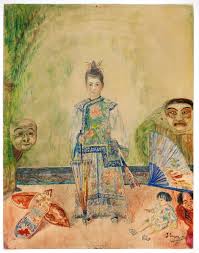 The mid 1790s witnessed the abdication of the Qianlong Emperor, who had ruled China for more than sixty years (1735–1796), as well as the last Western Embassy that traveled to China, organized by the Dutch East-India Company in 1794–95. Moreover, the decade saw the rapid rise of the opium trade, leading to an edict forbidding its use by the Jiaqing Emperor in 1799. The year 1911 marked the end of the Qing dynasty. By addressing the ‘long’ nineteenth century, the workshop is intended to explore a subject that has received comparatively less attention than East-West artistic relations during the eighteenth century, when most exchanges took place between the Beijing and European courts.
The workshop is aimed at investigating what happened when political relations between China and the West soured and when artistic contacts were no longer situated at the courts but largely took place in the context of international commerce and middle-class culture. By choosing a format that is less formal than a conference or symposium, we hope to attract to the Seton Hall workshop more speakers on a topic that has in the last few years emerged as one that is crucial for our understanding of East-West relations, and of international relations generally.
Held under the auspices of the American Council of Learned Societies, with funding from the Chiang Ching-kuo Foundation for International Scholarly Exchange, the workshop is co-sponsored by the University of Sydney and Seton Hall University. Its steering committee is comprised of Petra Chu (Seton Hall University), Yachen Ma (National Tsing Hua University), and Jennifer Milam (University of Sydney).
Attendance to the workshop is free, but registration is required. A simple registration form is found on the symposium website. Alternatively, call 973-761-7966.
◊ ◊ ◊ ◊ ◊
F R I D A Y , 30 O C T O B E R 2 0 1 5
8:30 Coffee
9:30 Opening of Proceedings
Welcome: Deirdre Yates, Dean, College of Communication and the Arts, SHU
Aims of the Workshop: Petra Chu (SHU) and Jennifer Milam (U of Sydney)
10:00 Keynote Address
Introduction of Keynote speaker: Dietrich Tschanz (Rutgers University)
Keynote: Elizabeth Chang (University of Missouri), Cultivating Chinoiserie: Organic Life and Exotic Design
11:15 Coffee Break
11:30 Panel Discussion
Cross-Disciplinary and Cross-Cultural Approaches: The Question of Exchange from the Chinese and Western Perspectives with Jennifer Milam (University of Sydney); Elizabeth Chang (University of Missouri); Stacey Sloboda (Southern Illinois University)
12:30 Lunch
1:30 Session 1: Chaired by Juergen Heinrichs, Seton Hall University
• Patricia Johnston (College of the Holy Cross, Worcester MA), The China Trade and Emerging Imperial Aesthetics in Federal America
• Kristel Smentek (Massachusetts Institute of Technology), Etienne Délécluze: Chinese Painting and Nineteenth-Century French Art
• Joyce Lindorff (Temple University), The Role of Music in George Macartney’s Embassy to China
Questions and Discussion (with coffee break)
3:30 Session 2: Chaired by Martha Easton, Seton Hall University
• Meredith Martin (New York University), Staging China and Siam in 1860s Paris
• Elizabeth Emery (Montclair State University), Appraising French Women ‘Collectors’ of Chinese Art in Fin-de-siècle France: Methods and Challenges
Questions and Discussion
5:00 Reception
S A T U R D A Y , 3 1 O C T O B E R 2 0 1 5
8:30 Coffee
9:30 Session 3: Chaired by Charlotte Nichols, Seton Hall University
• Maggie Cao (Columbia University), Copying in Reverse: China Trade Painting
• Sarah Cheang (Royal College of Art, London), Fashion and Chinoiserie: Material Translations between China, Japan, and Britain
• Tara Zanardi (Hunter College), Fabricating the ;Manton de Manila’ as National Dress
Questions and Discussion (with coffee break)
11:30 Panel Discussion
Introduction (Katherine Paul), Some Ching Enameled Vases in the Newark Museum
The Centrality of the Object in Artistic Relations between China and the West, with Petra Chu, (Seton Hall University); Katherine Paul (Newark Museum); Kristel Smentek (M.I.T.); Mei Rado (Metropolitan Museum of Art)
12:30 Lunch
1:30 Session 4: Chaired by Dong Dong Chen, Seton Hall University
• Roberta Wue (University of California, Irvine), Xugu Abstracts
• William Ma (University of California, Berkeley), Carving between Cultures: The Woodcarving Workshop at the Shanghai Jesuit Orphanage
Questions and Discussion
3:30 Visit Newark Museum Asian collections with Dr. Katherine Paul, Curator of Asian Art, Newark Museum (transportation on your own).










leave a comment