Symposium | Céramiques sans Frontières
From the symposium programme (which includes complete abstracts and speaker biographies). . .
The French Porcelain Society Symposium | Céramiques sans Frontières
The Wallace Collection, London, 19–20 June 2015
Organized by Sebastian Kuhn
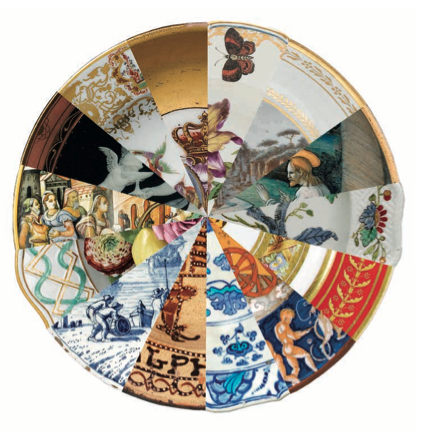 The 2015 French Porcelain Society Symposium examines the transfer of ceramic technologies and designs over the shifting borders of Europe. It represents something of a departure for the Society in that it explores the wider ceramic traditions of pottery and porcelain across the continent. We are thrilled to be able to present so many distinguished speakers, and to welcome members of the French Porcelain Society from around the world to London.
John Mallet will be giving the Sir Geoffrey de Bellaigue Lecture following the Annual General Meeting of the Society on Saturday 20th June. His subject, ‘The Travels of von Tschirnhaus’, will provide a fitting climax to two days of céramiques sans frontiers!
◊ ◊ ◊ ◊ ◊
F R I D A Y , 1 9 J U N E 2 0 1 5
9.45 Registration
10.15 Welcome
10.20 Antoinette Fay-Hallé, The influence of Japanese porcelain on the decoration of French ceramics
10.45 Rita Balleri, Copying, reworking and invention of the sculpture models at the Ginori Doccia factory in the 18th and 19th centuries
11.10 Tea and coffee
11.30 Monica Ferrero, The Royal porcelain manufactory of Vinovo: artists and sources
11.55 Angela Caròla-Perrotti, Naples porcelain in the time of Caroline Murat
12.20 Antoine d’Albis, Bartolomeo Ginori’s visit to Paris in 1771
12.45 Lunch
14.00 Jan Daniël van Dam, The three designers employed at the first porcelain factory in Weesp
14.30 Justin Raccanello, The transfer of the Istoriato maiolica tradition to France, part I (Italy)
14.55 Camille Le Prince, The transfer of the Istoriato maiolica tradition to France, part II (France)
15.20 Tea and coffee
15.50 Reino Liefkes, The Brühl Fountain
16.15 Martin Eberle, The porcelain cabinet of Luise Dorothea Saxe-Gotha Altenburg (1710–68)
16.40 Questions
17.00 Close of Day One
S A T U R D A Y , 2 0 J U N E 2 0 1 5
10.15 Welcome
10.20 Julia Weber, Boundless rivalry: Meissen and its competitors
10.50 María Ángeles Granados Ortega, Alcora’s French designs: a new approach to their source of inspiration and their influence in the Spanish ceramic of the 18th century
11.15 Tea and coffee
11.35 Maria Casanovas, Spanish porcelain and its international context
12.00 Rebecca Klarner, ‘Wedgwoodarbeit’: The influence of Wedgwood’s Jasperware on the German manufactories KPM and Meissen, 1750–1850
12.25 Rebecca Wallis, The French Connection: Minton and Sèvres in the 19th century
12.50 Lunch
14.00 Timothy Wilson, Antwerp and the tin-glaze diaspora in the 16th century
14.30 Tamara Préaud, Technical international exchanges to and from Sèvres, 18th and 19th centuries
14.55 Alfred Ziffer, The French influence on Nymphenburg porcelain in the early 19th century
15.20 Tea and coffee
15.50 Matthew Martin, Franco-Flemish models, English figures and Catholic consumers? The case of the Chelsea Virgin and Child and Pietà groups
16.15 Suzanne Lambooy, Dutch Delftware garden pots. A 17th-century royal fashion influenced by the formal French garden?
16.40 Questions and discussion
18.30 French Porcelain Society Annual General Meeting
19.00 The Sir Geoffrey de Bellaigue Lecture by J.V.G. Mallet, The Travels of von Tschirnhaus
John Mallet plans to discuss some of the places visited, and the people there who stimulated the Saxon nobleman, philosopher and mathematician Ehrenfried Walter von Tschirnhaus (1651–1708) and directed his attention to porcelain- making during the travels he undertook to European centres of learning such as Leiden, London, Paris and Milan. By the time Tschirnhaus involved Johann Friedrich Böttger in the researches that resulted in the invention of Meissen porcelain he had been in touch with many of the finest minds in Europe at a time when The Royal Society in London was only one of a number of academies stimulating scientific discovery, without regard to national frontiers.
20.00 The French Porcelain Society Annual Dinner at The Wallace Restaurant, The Wallace Collection (ticket only)
Colloquium | L’image Railleuse: La satire visuelle
From INHA:
L’image Railleuse: La satire visuelle du XVIIIe siècle à nos jours
Institut national d’histoire de l’art, Paris, 25–27 June 2015
En partenariat avec l’université du Québec à Montréal et le LARHRA-UMR 5190 de l’université de Lyon
La fonction critique des images s’incarne de manière privilégiée dans la satire. Si la satire s’est constituée en genre littéraire dès l’Antiquité, avant de gagner les beaux-arts et les arts graphiques à l’âge classique, ce sont les médias modernes – édition, presse, expositions, télévision, internet – qui, en élargissant progressivement sa sphère d’influence, ont renouvelé ses formes et ses objectifs tout en augmentant leur efficacité. Autorisant une diffusion planétaire et presque instantanée des images satiriques, internet et les technologies numériques n’ont pas seulement transformé la matérialité et les moyens d’action de cette imagerie et leurs effets socio-politiques, ils ont aussi affecté les formes de la recherche sur le satirique en donnant accès de plus en plus rapidement à des corpus extrêmement vastes. La satire est aujourd’hui partout, sans qu’aucun acteur ni canal de diffusion ne puisse prétendre en contrôler ses usages généralisés ni son effectivité. Ce colloque interroge la satire – entendue comme genre aussi bien que comme registre, selon que l’on s’intéresse à un type de représentations (caricaturale, en particulier) ou à une veine (le satirique) traversant de multiples champs, parmi lesquels celui de l’art contemporain – du point de vue de sa visualité, de ses objets, particuliers ou partagés, ses mécanismes et ses effets spécifiques. Les trois journées s’articuleront autour des Médiums, diffusion, réseaux, des Réflexivités satiriques, des Normes et modèles, des Violences satiriques et des Créativités satiriques. Une table-ronde finale réunira chercheurs et dessinateurs autour de l’actualité de la satire visuelle.
◊ ◊ ◊ ◊ ◊
J E U D I , 2 5 J U I N 2 0 1 5
8.30 Accueil des participants
9.00 Introduction, Laurent Baridon, Frédérique Desbuissons, Dominic Hardy
9.30 Médiums, Diffusion, Réseaux
Président de Séance: Laurence Grove
• Peggy Davis, La fureur de calicot : intermédialité et intervisualité de la satire
• Christina Smylitopoulos, Tegg’s Regency Satirical Books Reconsidered
• Erica Wicky, Caricatures de photographies et photographies caricaturales : la critique photographique dans la presse (1850–1870)
• Raphael Chavez, La satire au temps des imageboards : un humour punk ?
• Fabio Parasecoli, Eat it, don’t tweet it : l’alimentation et la satire vidéo aux États-Unis
12.30 Déjeuner
14.30 Réflexivités Satiriques
Président de Séance: Ségolène Le Men
• Kathryn Desplanque, L’autoréflexivité dans l’album comique. Les illustrateurs et les éditeurs contre eux-mêmes pendant la Restauration
• Sandro Morachioli, Le visage du journal. Stratégies d’auto-représentation et personnification de la presse satirique au xixe siècle
• Patricia Mainardi, Studio practice, art and caricature
• Miyuki Aoki-Girardelli, Self-Irony in context: Ito Chuta’s Caricature Works and the Beginning of Japanese Fûshi-Manga (satirical manga)
• Morgan Labar, Génération 1980 : affaiblissement du satirique et bêtise délibérée
V E N D R E D I , 2 6 J U I N 2 0 1 5
8.30 Accueil des participants
9.00 Normes et Modèles
Président de Séance: Annie Gérin
• Kate Grandjouan, La caricature et la « déqualification » de l’art : le cas de Henry Bunbury (1750–1810) et de Thomas Rowlandson (1756–1827)
• Ersy Contogouris, La mort de l’amiral Nelson représentée par James Gillray, Benjamin West et Ronald Searle
• Frédéric le Gouriérec, De la consubstantialité de l’art et de l’image railleuse en Chine, bien avant l’âge contemporain
• Aylin Koçunyan, La caricature ottomane entre art et préoccupations sociétales
• Juliette Bertron, Pères modèles, fils indignes. De quelques autoportraits parodiques, des années 1960 à nos jours
• Jean-Philippe Uzel, Art contemporain autochtone et satire visuelle
12.30 Déjeuner
14.30 Violences Satiriques
Président de Séance: Peggy Davis
• Barbara Stentz, Le motif du pressoir passé au crible de la caricature
• Brigitte friant-Kessler, L’encre et la bile : voyage dans les boyaux de Gulliver, de la caricature politique au roman graphique satirique
• Annie Gérin, Rire et dévastation : la rhétorique de la destruction dans la satire graphique soviétique et sa théorisation
• Yoann Moreau, Le rire du pire. Le tremblement de terre d’Edo (Japon, 1855)
• Ségolène Le Men, La Rue Transnonain, 15 avril 1834 de Daumier. La caricature au seuil de l’histoire
S A M E D I , 2 7 J U I N 2 0 1 5
8.30 Accueil des participants
9.00 Créativités Satiriques
Président de Séance: Philippe Kaenel
• Valentine Toutain-Quittelier, Le Diable d’argent et la Folie : enjeux et usages de la satire financière autour de 1720
• Laurence Grove, La caricature comme pilier du premier comic du monde : The Glasgow Looking Glass (1825)
• Frank Knoery, Le photomontage et la tradition satirique : subversion et propagande dans l’œuvre de John Heartfield
• Julie-Anne Godin-Laverdière, L’image raillée : les réponses ironiques, satiriques et parodiques à la censure de Robert Roussil, entre 1949 et 1965
• Josée Desforges, Cadrer la satire parodique. Repenser la théorie de la satire à partir du motif du cadre
• Clément De Gaulejac, Les dessins de l’eau tiède : petite fabrique d’agit-prop artisanale
12.30 Déjeuner
14.30 Synthèse et la Table Ronde
• Laurent Baridon, Frédérique Desbuissons, Clément de Gaulejac, Dominic Hardy, Martine Mauvieux
16.00 Conclusion
Objects from the Slave Ship São José To Be Displayed in D.C.
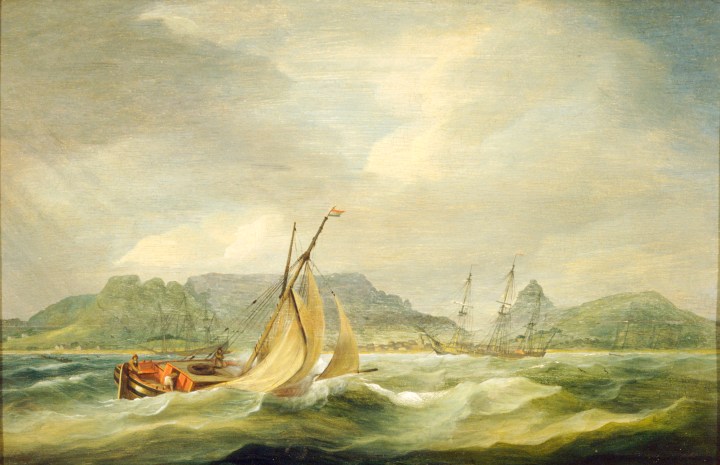
Thomas Luny, Table Bay Cape Town, 1790s, oil on panel (Iziko Social History Collections). Depiction of the port of Cape Town, South Africa where the São José slave ship planned to stop before continuing to Brazil. The ship wrecked near the Cape of Good Hope before arriving in Table Bay. Photo by Pam Warne.
◊ ◊ ◊ ◊ ◊
Press release (1 June 2015) from The Smithonian:
National Museum of African American History and Culture To Display Objects from Slave Shipwreck Found Near Cape Town, South Africa
Museum Joins Iziko Museums of South Africa and George Washington University in Slave Wrecks Research Project
Objects from a slave ship that sank off the coast of Cape Town in 1794 will be on long-term loan to the Smithsonian’s National Museum of African American History and Culture (NMAAHC). The announcement, scheduled for Tuesday, June 2, will take place at a historic ceremony at Iziko Museums of South Africa. The discovery of the ship marks a milestone in the study of the trans-Atlantic slave trade and showcases the results of the Slave Wrecks Project, a unique global partnership among museums and research institutions, including NMAAHC and six partners in the U.S. and Africa.
Objects from the shipwreck—iron ballast to weigh down the ship and its human cargo and a wooden pulley block—were retrieved this year from the wreck site of the São José-Paquete de Africa, a Portuguese slave ship that sank off the coast of Cape Town on its way to Brazil while carrying more than 400 enslaved Africans from Mozambique.
Lonnie G. Bunch III, founding director of NMAAHC, and Rooksana Omar, CEO of Iziko Museums, will join in the announcement of the shipwreck’s discovery and the artifact loan agreement.
“Perhaps the single greatest symbol of the trans-Atlantic slave trade is the ships that carried millions of captive Africans across the Atlantic never to return,” said Bunch. “This discovery is significant because there has never been archaeological documentation of a vessel that foundered and was lost while carrying a cargo of enslaved persons. The São José is all the more significant because it represents one of the earliest attempts to bring East Africans into the trans-Atlantic slave trade—a shift that played a major role in prolonging that tragic trade for decades.”
São José Wreck
The São José’s voyage was one of the earliest in the trans-Atlantic slave trade from East Africa to the Americas, which continued well into the 19th century. More than 400,000 East Africans are estimated to have made the Mozambique-to-Brazil journey between 1800 and 1865. The ship’s crew and some of the more than 400 enslaved on board were rescued after the ship ran into submerged rocks about 100 meters (328 feet) from shore. Tragically, more than half of the enslaved people perished in the violent waves. The remainder were resold into slavery in the Western Cape.
The São José wreck site is located between two reefs, a location that creates a difficult environment to work in because it is prone to strong swells creating challenging conditions for the archaeologists. To date, only a small percentage of the site has been excavated; fully exploring the site will take time.
Even the smallest artifact gives a clue into the shipwreck’s story:
1980s: Local amateur treasure hunters discovered a wreck near Cape Town and mistakenly identified it as the wreck of an earlier Dutch vessel. They applied for a permit under the legislation of the time and had to report their findings.
2008–2009: The Slave Wrecks Project (SWP) staff identified the São José as a target for location in its pilot project.
2010–2011: Jaco Boshoff, the co-originator of SWP, served as lead archaeologist for Iziko and primary investigator for the São José project. He discovered the captain’s account of the wrecking of the São José in the Cape archives. New interest was developed on the site. Copper fastenings and copper sheathing indicated a wreck of a later period, and iron ballast—often found on slave ships and other ships as a means of stabilizing the vessel—was found on the wreck.
2012–2013: SWP uncovered an archival document in Portugal stating that the São José had loaded iron ballast before she departed for Mozambique, further confirming the site as the São José wreck. Archaeological documentation of the wreck site began in 2013.
2014–2015: Some of the first artifacts are brought above water through a targeted retrieval process according to the best archaeological and preservation practices. Using CT scan technology because of the fragility of the site, the SWP identified the remains of shackles on the wreck site, a difficult undertaking because of extreme iron corrosion. Archival research locates a document in which a slave is noted as sold by a local sheikh to the São José’s captain before its departure, definitively identifying Mozambique Island as the port of departure for the slaving voyage. Archival and archaeological prospecting work was launched in Mozambique and Brazil in order to identify sites related to the São José story for future research.
2015–ongoing: Full archaeological documentation and retrieval of select items to help to tell of the São José wreck site continue; the search for descendant communities of Mozambicans from the wreck also continues.
A selection of artifacts retrieved from the São José wreck will be loaned by Iziko Museums and the South African government for display in an inaugural exhibition titled Slavery and Freedom at NMAAHC, opening fall 2016. Iziko Museums also plans an exhibition.
Memorial Service
On Tuesday, June 2, soil brought from Mozambique Island, the site of the São José’s embarkation, will be deposited on the wreck site by a team represented by divers from Mozambique, South Africa and the United States. A solemn memorial service will also be held close by and on shore honoring the 500 enslaved Mozambicans who lost their lives or were sold into slavery. SWP researchers, Cape Town dignitaries and delegations from the U.S. Consulate and South African government will attend the private ceremony.
Symposium
A daylong public symposium, Bringing the São José into Memory, will be held June 3 featuring a series of panel discussions focusing on the wreck, the slave trade, slavery, history and memory. The panels will take place at the Iziko Museums’ TH Barry Lecture Theatre and feature discussions and performances by scholars, curators, heritage activists, artists, hip-hop musicians and slave descendants from various academic, heritage and religious institutions, including Iziko, St. George’s Cathedral, NMAAHC, George Washington University, Syracuse University, Brown University, University of Western Cape, Cape Family Research Forum among others.
Maritime Archaeology and Conservation Workshop
The week’s activities will also include a conservation workshop for archaeologists, researchers and museum professionals from Mozambique, Senegal and South Africa to learn techniques in conservation and care for marine materials. This workshop, co-taught by Boshoff and George Schwarz of the U.S. Naval Heritage Command, is an opportunity to advance professional training and capacity for individuals and institutions, a core component of SWP’s mission. Representatives from Eduardo Mondlane University in Maputo, Mozambique, and Cheik Anta Diop University in Dakar, Senegal, will join with Smithsonian and Iziko professionals in a dialogue about current and future research and searches in their respective regions.
Slave Wrecks Project History
Founded in 2008, SWP brings together partners who have been investigating the impact of the slave trade on world history. It spearheaded the recent discovery of the São José wreck and the ongoing documentation and retrieval of select artifacts. In addition, extensive archival research was conducted on four continents in six countries that ultimately uncovered the ship captain’s account of the wrecking in the Cape archives as well as the ship’s manifest in Portuguese archives. Core SWP partners include George Washington University, Iziko Museums of South Africa, the South African Heritage Resource Agency, the U.S. National Park Service, Diving With a Purpose, a project of the National Association of Black Scuba Divers, and the African Center for Heritage Activities.
SWP, established with funding from the Ford Foundation, set a new model for international collaboration among museums and research institutions. It has been combining groundbreaking slave shipwreck investigation, maritime and historical archeological training, capacity building, heritage tourism and protection, and education to build new scholarship and knowledge about the study of the global slave trade.
Conference | Artistic Correspondences: Rome and Europe, 1700–1900
From the conference programme:
Artistic Correspondences: Rome and Europe in the 18th and 19th Centuries
Corrispondenze d’artista: Roma e l’Europa (XVIII-XIX secolo)
Koninklijk Nederlands Instituut Rome / Svenska Institutet i Rom, 15–16 June 201
Registration due by 11 June
Epistolary correspondence among artists is a privileged source to unravel the dynamics of intellectual exchange across regional and national boundaries, as it requires a research agenda necessarily focused on ‘mobility’, and a transnational approach and methodology avoiding the rhetorical pitfalls of past European historiography. By focusing on the cosmopolitan context of 18th- and 19th-century Rome as a paradigmatic field of enquiry, the research network Artistic Correspondences: Rome and Europe in the 18th and 19th Centuries convenes investigators and research groups working on the same topic throughout Europe in order to explore new opportunities for collaboration. The conference is free of charge, though registration is required (see the Svenska Institutet i Rom website for details).
◊ ◊ ◊ ◊ ◊
M O N D A Y , 1 5 J U N E 2 01 5
9.30 Saluti, Martin Olin, (Assistant Director, Svenska Institutet i Rom) & Mario De Nonno, (Direttore del Dipartimento di Studi Umanistici, Università degli Studi Roma TRE)
10.00 Plenary Session
Session Chair: Harald Hendrix (KNIR)
• Serenella Rolfi (Università degli Studi Roma TRE), Linee di una ricerca
• Elisabeth Oy-Marra (Gutenberg Universität Mainz), Lettere d’artista e le vite d’artisti: da Giovan Pietro Bellori a Giovanni Gaetano Bottari
• Cinzia Sicca (Università statale di Pisa), Rome as Competitive arena: The evolving nature of a friendship through the early eighteenth-century correspondence of John Talman and William Kent
• Martin Dönike (Martin-Luther-Universität Halle-Wittenberg), Rome in Weimar: The artistic correspondence between Goethe and German artists living in Rome around 1800
• Christoph Frank (Università della Svizzera italiana, Mendrisio), Da Grimm a Goethe: l’impatto di Parigi e Weimar sulle corrispondenze artistiche romane del ‘700
12:45 Pause
14:00 Session A1: Esperienza di Roma
Session Chair: Liliana Barroero (Università degli Studi Roma TRE)
• Raquel Gallego (Universitat de Barcelona), Il carteggio di Julien de Parme e la formazione degli artisti indipendenti a Roma
• Tomas Macsotay (Universitat Pompeu Fabra, Barcelona), Northcote, Theed, Tatham, Deare, Flaxman: Five British artists overcome Rome
• Sebastian Dohe – Malve Falk, Landesmuseum für Kunst und Kulturgeschichte), Oldenburg To princes, poets and painters: The ‘Tischbein bequest’ at Oldenburg
15.25 Session A2: Prospettive storiografiche
Session Chair: Susanne Adina Meyer (Università di Macerata)
• Raffaella Morselli (Università degli Studi di Teramo), Nostalgia di Roma: Riflessioni di Francesco Albani sulla pittura classicista nell’urbe
• Susanna Pasquali (Università degli Studi di Roma ‘La Sapienza’), Algarotti, Temanza e le lettere degli architetti nella prima edizione della ‘Raccolta’ di Bottari
• Stefano Ferrari (Accademia Roveretana degli Agiati di Scienze, Lettere e Arti), Il carteggio di Winckelmann con gli artisti
• Robert Skwirblies (Technische Universität Berlin), Lettere d’artista e ‘Künstlersozialgeschichte’: La dimensione storica e sociale nelle lettere giovanili di Johann David Passavant da Parigi e Roma a Francoforte
14:00 Session B1: Rapporti con le istituzioni
Session Chair: Maria Pia Donato, IHMC (CNRS-ENS-Paris 1)
• Emilie Roffidal (CNRS-Toulouse), Correspondances romaines d’une académie de province: l’Académie de peinture et de sculpture de Marseille, 1760–1790
• Adrian Fernandez Almoguera (Paris – Sorbonne Université), After the Antique: Correspondence between Rome’s Spanish artistic community and Madrid’s Academy, 1750–1820
• Michela Degortes e Maria Joao Quintas Lopes Baptista Neto, Universidade de Lisboa), La Real Accademia Portoghese di Belle Arti a Roma (1785–1798) nella corrispondenza dei diplomatici, degli artisti e del direttore Giovanni Gherardo De Rossi
15.25 Session B2: Contesti collezionistici e agenti
Session Chair: Christoph Frank (Università della Svizzera italiana)
• Matteo Borchia (Università degli Studi di Roma ‘La Sapienza’), Bartolomeo Cavaceppi e la corte di Berlino: stralci di una corrispondenza
• Johanna Selch (Ludwig-Maximilians-Universität München), An attentive glance at Rome: Ludwig I of Bavaria and his Roman correspondents
• Mathias Hofter (Ludwig-Maximilians-Universität München), Concetti del collezionismo nella corrispondenza di Ludovico I e Martin Wagner
• Ljerka Dulibi e Iva Tržec Pasini (Hrvatska akademija znanosti i umjetnosti, Zagreb), Artists in nineteenth-century Rome as mediators of cultural transfer of ideas and objects
18.30 Lecture
• Martin Olin (Svenska Institutet i Rom), Italian food and wine in letters and memoirs of Scandinavian artists
T U E S D A Y , 1 6 J U N E 2 0 1 5
9:30 Session A3: Corrispondenze cosmopolite
Session Chair: Ilaria Miarelli Mariani (Università di Chieti)
• Miguel Figueira de Faira (Universidade Autónoma de Lisboa), Rome, Paris, Lisbon: Political and Aesthetic Ideas in Portuguese artistic correspondence at the end of Ancient Regime
• Anna Frasca-Rath (Universität Wien), Antonio Canova nelle lettere di John Gibson
• Arnika Schmidt (Technische Universität Dresden), Nino Costa (1826–1903), A Roman painter and his cosmopolitan correspondence
9:30 Session B3: Pratiche artistiche e modelli
Session Chair: Carla Mazzarelli (Università della Svizzera italiana, Mendrisio)
• Valeria Rotili (Accademia di San Luca, Roma), Lo scultore al lavoro. Il carteggio Albacini per una geografia della prassi artistica
• Angela Windholz (Università della Svizzera italiana, Mendrisio), Lettere da Olevano Romano: La descrizione di un motivo ideale
• Rosalba Dinoia (Roma), Traduzione e migrazione del Rinascimento nella corrispondenza di Luigi Calamatta
11.00 Plenary Session
• Georg Schelbert (Humboldt Universität Berlin), Personal Networks and Biographical Data between Edition of Text Documents and Modeling of Historic Events
11:30 Roundtable
Chairs: Christoph Frank (Università della Svizzera italiana), Giovanna Capitelli (Università della Calabria)
• E. Jonas Bencard (Thorvaldsens Museum Copenaghen), The Thorvaldsens Museum Archives: An internet platform for primary written sources on Thorvaldsen & Co.
• Giulia Ericani, (Museo-Biblioteca-Archivio Bassano del Grappa), Il Fondo Canova
• Hannelore Putz (Ludwig-Maximilians-Universität München), Projekt Edition des Briefwechsels zwischen König Ludwig I. und Johann Martin von Wagner
• Amaya Alzaga Ruiz, Juan Antonio Yeves (Fundación Lázaro Galdiano, Madrid), La Literatura y las Artes en Epistolarios Españoles del siglo XIX
• Babette van Alphen (RKD Nederlands Instituut voor Kunstgeschiedenis), RKD Explore: Dutch artists and their societies in the databases of the RKD
Conference | The Enlightenment—Continuity, Challenge or Change?
From the forum flyer:
Benedictus Academic Research Forum 2015 | Continuity, Challenge or Change?
European Cultural and Intellectual Identity before and after the Enlightenment
Linnean Society, London, 19–20 June 2015
This year the Benedictus Academic Research Forum focuses on the Enlightenment, a pivotal moment in European culture and thought. Speakers from a wide range of disciplines including philosophy, music, art, theology and politics will introduce ideas and discuss contexts that enrich our understanding of the period and its continuing relevance. Tickets: £30 (both days), £15 (one day only) , includes entrance, drinks reception and Saturday lunch. Reservation essential; please email info@benedictus.org.uk or visit our website.
Sessions chaired by Thomas Pink (King’s College London), Anthony O’Hear (University of Buckingham), and Edward Chaney (Southampton Solent)
• Keynote presentation by Roger Scruton,
The Idea of a Secular Culture
• Adriano Aymonino (University of Buckingham),
The Classical Ideal from the Renaissance to the Nineteenth Century
• George Corbett (Trinity College Cambridge), Reframing the Seven Deadly Sins in the Christian Moral Life: Continuity and Change in Aquinas
• John Cottingham (Reading University
and Heythrop College London),
Descartes, God and Secularism
• Fernando Cervantes (University of Bristol),
The Ethics of Elfland: The Notion of Virtue in
Cervantes, Shakespeare and Montaigne
• Michael Lang (Heythrop College London),
Re-approaching Ritual and the Sacred in Late Modernity
• Peter Leech (Swansea University),
The Cultural Patronage of Cardinal Henry Benedict Stuart (1725–1807) in Rome
• Sebastian Morello (Centre for Catholic Formation),
Democracy and Royal Power: Nature and the Ideal of European Government
• Giuseppe Pezzini (Magdalen College, Oxford),
Receptions of Classical Texts from Late Medieval
to Early Modern Europe
• Clare Hornsby (Benedictus
) and Rafal Szepietowski (Manchester University),
Paintings of Astronomy in Early Eighteenth-Century Bologna
Young Scholars’ Competition
This year we launched the Benedictus Scholar’s Competition to give 6th form students the chance to present their ideas in front of an audience of international academics. Our two winners Shakil Karim (Harrow School) and Imogen Wade (Perse School) will be presenting their papers on Saturday morning.
Historic Buildings of Armagh and Monaghan in Context
◊ ◊ ◊ ◊ ◊
From the Irish Georgian Society:
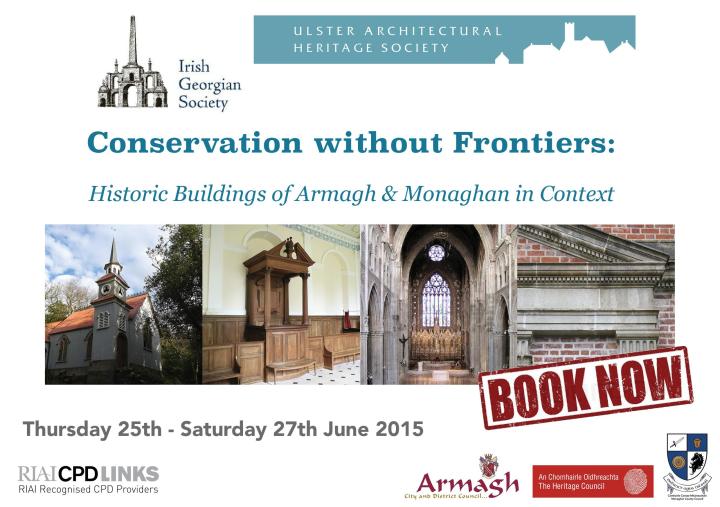
Conservation without Frontiers: Historic Buildings of Armagh and Monaghan in Context
Armagh and Monaghan, 25–27 June 2015
For the first time, the joint Ulster Architectural Heritage Society and Irish Georgian Society summer school will bring together students, enthusiasts and practitioners to explore, discuss and debate issues relating to our shared Irish heritage in the context of Armagh and Monaghan. A key theme of the event is conservation and regeneration for community benefit which will demonstrate the critical importance of built heritage in maintaining the distinctive qualities of the region and supporting the growth of tourism, economic development and prosperity. The summer school will provide a platform to showcase the best that both counties have to offer in terms of their history and heritage. Leaders will include well known academics, architectural historians, architects, planners, conservation and heritage officers. The support of both councils will also reinforce the positive developing relationship between them and our respective organisations. An Eventbrite payment has been set up to facilitate online bookings in euro or sterling. The summer school director is Kevin V. Mulligan, author of The Buildings of Ireland: South Ulster.
◊ ◊ ◊ ◊ ◊
T H U R S D A Y , 2 5 J U N E 2 0 1 5
Armagh
• Conservation Areas — the legislation and implementation
• New work and reordering: current practice in England
• Tour of cathedrals with Alistair Rowan
• Tour of Mall and Market Square with Alastair Coey
• Presentation on the work of Thomas Cooley and Francis Johnston by Judith Hill at Armagh Public Library
• Tour of Palace Demesne with Edward McParland
Speakers: Patrick Duffy, Michael O’Neill, Frederick O’Dwyer, Andrew Derrick, Marcus Patton
F R I D A Y , 2 6 J U N E 2 0 1 5
Monaghan
• Tour of Castle Leslie
• Introduction to heritage and housing
• Discussion on cross border heritage initiatives
• The Buildings of Ireland Series
• Tour of Glaslough
• Visit Lady Anne Dawson Mausoleum, Dartrey, St. Peter’s Church, Laragh and St. Macartan’s Cathedral, Monaghan
• Walking tour of Monaghan with Kevin Mulligan
• Discussion and debate at Market House, Monaghan
Speakers: Dawson Stelfox, Andrew McClelland, Alistair Rowan, Bishop Joseph Duffy
S A T U R D A Y , 2 7 J U N E 2 0 1 5
Annaghmakerrig
• Tour of Annaghmakerrig House
• Debate: Contemplating the Contemporary — Modernist vs. traditional approach to building in the historic environment in the 21st century, chaired by Frank McNally with speakers Aidan McGrath, Liam Mulligan, Nicholas Groves-Raines
• Results and viewing of student competition
• Presentation of Summer School Student Awards
• Conclusion with celebratory lunch
This course is approved for CPD by the Royal Institute of Architects of Ireland; the programme is subject to change.
Study Day | Close-up and Personal: Eighteenth-Century Gold Boxes
In conjunction with the exhibition Close-up & Personal, The Fitzwilliam is hosting a study day in June:
Gold Boxes: Manufacture and Marketing from the 18th Century to the Present Day
A Rosalinde and Arthur Gilbert Collection Study Day
The Fitzwilliam Museum, Cambridge, 26 June 2015
Lavish and intricate gold boxes of the eighteenth century are amongst the most beautiful objects ever made. These delicate and refined miniatures contained snuff—powdered tobacco. These boxes enjoy a unique status as objects of desire. Speakers including expert auctioneers, conservators, curators, goldsmiths, and scholars will celebrate their exquisite materials and subtle significance. The day is made possible through the generosity of the Gilbert Trust for the Arts, London. £10. Booking is essential: telephone 01223 332904 or email education@fitzmuseum.cam.ac.uk.
◊ ◊ ◊ ◊ ◊
 P R O G R A M M E
10:30 Registration and coffee
11:00 Welcome and introduction, Heike Zech, Senior Gilbert Curator, Victoria and Albert Museum
11:10 ‘Buying and Selling Gold Boxes’, Vanessa Brett, Independent Scholar, Wiltshire
11:35 ‘Swiss Automata of the Late Eighteenth and Early Nineteenth Centuries’, Julia Clarke, Independent scholar and consultant to Sotheby’s, London
12:00 ‘From London to St Petersburg: The Career of the Swiss Craftsman Jean-Pierre Ador’, Roger Smith, Independent scholar, London
12:25 ‘In a Rush: California’s Twentieth-Century Collectors of Gold Boxes’, Rosie Mills, The Rosalinde and Arthur Gilbert Foundation Associate Curator, Los Angeles County Museum of Art
12:50 Discussion
13.00 Lunch provided
14:00 ‘Attention to Detail: Case Studies’, chaired by Tessa Murdoch, Deputy Keeper, Sculpture, Metalwork, Ceramics and Glass
14:10 ‘Diamonds and Coloured Gems: What Lies Beneath’, Joanna Whalley, Gemmologist and Senior Metals Conservator Victoria and Albert Museum
14:30 ‘Micromosaics’, Heike Zech, Rosalinde and Arthur Gilbert Senior Curator, Victoria and Albert Museum
14:50 ‘Enamels’, Sheila McDonald, Enameller and Jeweller, in conversation with Mélodie Doumy, Rosalinde and Arthur Gilbert Assistant Curator, Victoria and Albert Museum
15:10 ‘Chasing Gold’, Rod Kelly, Contemporary goldsmith, Norfolk
15:30 Discussion
15:45 Tea and coffee
16:00 Study visit to Close-Up and Personal: Eighteenth-Century Gold Boxes from the Rosalinde and Arthur Gilbert Collection accompanied by the curators
16:45 Fitzwilliam Museum closes
Please be aware this programme may be subject to change.
◊ ◊ ◊ ◊ ◊
At the V&A’s blog, Assistant Curator Melodie Doumy also notes the following lunchtime talks at the Fitzwilliam Museum:
• ‘Snuff-taking, fashion and accessories‘ by Tessa Murdoch, 27 May 2015
• ‘François Boucher on enamelled snuffboxes: The art of adapting Rococo engravings‘ by Mélodie Doumy, 10 June 2015
• ‘Inside a Paris goldsmiths’ workshop: from design to gold box‘ by Heike Zech, 1 July 2015
Workshop | Collections in Use
From the conference website:
Collections in Use
Anatomy Lecture Theatre, King’s College London, 6 July 2015
Over the past few decades, material turns taking place across a number of disciplines have established the importance of placing objects within their broad geographical, conceptual, social and cultural contexts in order to understand the multiplicity of meanings with which they were invested within past societies. Objects are understood to have their own ‘social lives’, illustrated in the various ways in which they were exchanged, acquired, accumulated and displayed.
The history of collecting, in particular, has been a central node in discussions regarding the meanings of objects in the past, because it encompasses a range of activities within and across societies around the world. As such, scholars working on early modern material culture are amassing a great deal of knowledge regarding the precise motivations for collecting objects, how specific objects entered into collections, and which people facilitated this.
Much less is known, however, about what happened within collections, both to the objects and the people who interacted with them. In order to fully understanding the role of objects, collections and collectors within early modern society, therefore, we need to generate more discussion around this issue using the broadest possible sense of the word ‘collection’, including but not limited to: cabinets, museums, sculpture galleries, literary miscellanies, menageries, herbaria, gardens, and houses.
Collections in Use is a one-day workshop designed to bring together early modern scholars across several disciplines to showcase their work across a variety of collections: anatomical, medical, domestic, princely, antiquarian, natural historical, literary, and artistic. To book tickets and for more information, please go to the Eventbrite page.
◊ ◊ ◊ ◊ ◊
P R O G R A M M E
9:30 Registration and coffee
9:50 Welcome by Alice Marples and Victoria Pickering
10:00 Managing Collections: Collecting, Cataloguing, Curating
Chair: Felicity Roberts (King’s College London/British Museum)
• Bert van de Roemer (Universiteit van Amsterdam) – The Act of Assembling Objects
• Mia Jackson (Queen Mary University of London) – The Collections of the Illustres: Collections in Use in the Louvre
•Fabio Morabito (King’s College London) – In Search of His Own Signature: Luigi Cherubini’s Collection of Autographs by Other Composers
11:15 Coffee break
11:45 Experimental Collections: In, With, For
Chair: Alice Marples (King’s College London/British Library)
• Sally Osborn (University of Roehampton) – ‘To be placed with experements’: Developing Knowledge through the Collection and Use of Medical Recipes
• Helen McCormack (Glasgow School of Art) – Superb Cabinets or Splendid Anachronisms? ‘Experimental’ Collecting in Early Scientific Interiors
• Reese Arnott-Davies (Birkbeck University) – ‘Some Dark Emblem’: Visibility, Obscurity and Exhibiting Egypt at Montagu House
1:00 Lunch
2:00 Disseminating Collections: Publication and Practice
Chair: Victoria Pickering (Queen Mary University of London/Natural History Museum)
• Barbara Furlotti – Through Drawings and by Word of Mouth: Circulating Information on Antiquarian Collections in the Early Modern Period
• Isabelle Charmantier (The Linnean Society) – The Linnaean Workshop: Practices of Disseminating Botanical Knowledge
• Dominik Huenniger (University of Göttingen) – ‘Academies of Natural History’: Continental Utilisation of Collections in Eighteenth-Century Britain
3:15 Coffee break
3:45 Researching Collections: Current Methods
Chair: Martha Fleming (Reconstructing Sloane Project)
• Jed Foland (Bodleian Library) – Museums as Laboratories: Reenacting Scientific Discovery Using the Microscope
• Clare Hickman (King’s College London) – Reconsidering the Role of Botanic Gardens
• Alexandra Cook (University of Hong Kong) – Looking at the Herbarium as a Robust Scientific Object
5:00 Roundtable
Chair: Elizabeth Eger (King’s College London)
• Anne Goldgar (King’s College London)
• Alexander Marr (University of Cambridge)
• Mark Carnall (Grant Museum of Zoology)
• Lisa Skogh (Victoria and Albert Museum)
6:00 Wine reception
Conference | Orientality: Beyond Foreign Affairs

◊ ◊ ◊ ◊ ◊
From the conference website:
Orientality: Beyond Foreign Affairs
National Portrait Gallery, London, 2–3 June 2015
A biennial conference series developed by the Orientalist Museum, Doha
The inaugural conference Orientality: Cultural Orientalism and Mentality took place at Cambridge University in 2013. The subsequent conference is scheduled for the National Portrait Gallery, London, 2015. The only conference of its kind, Orientality gives international art and museum professionals an opportunity to come together and discuss the art, history, politics and future of the Orientalist art movement. The conference aims to develop understanding between east and west, and showcase the continued vibrancy of the Orientalist art movement in the 21st century.
The conference title orientality is a combination of two terms—orientalism and mentality. The term orientalism has been used in art history since the early nineteenth century in association with works of art on Middle Eastern and North African subjects pioneered by French artists. The term mentality is defined as “way of thinking of a person or a group,” and can be metaphorically translated as an “opinion,” formed and shaped, in our case, under various historical, political, social and cultural circumstances and environments, what allows the orientalism to be seen and interpreted in various ways by different societies. The theme of cultural orientalism and mentality captured the scholarly imaginations largely because we were able to articulate the dialog in both artistic and sociological terms, spanning the geographical area of orientalism and widening its historical borders.
We hope that our interpretation of orientality will influence many other disciplinary areas in the social sciences, humanities and beyond. Orientalism as a historical and cultural event has been uniting various aspects of cultural life for a number of centuries—literature, fine arts, architecture, music, philosophy—and generating an exotic image within our consciousness, one that had a right to its own existence.
Entry to the conference is free, and all are welcome. We do ask that you register your attendance ahead of time to ensure we have adequate seating available.
◊ ◊ ◊ ◊ ◊
T U E S D A Y , 2 J U N E 2 0 1 5
8:30 Coffee and registration
9:30 Opening and welcome
9:45 Art and Nation Building
• The Somerset House Painting of 1604: How a Turkey Carpet Became a Symbol of British Imperialism, Gerald MacLean
• Design Reform at the British Embassy: James Wild’s Arabesque Hall in Qajar Tehran, Moya Carey
• Ottoman Photography and Late Nineteenth-Century Modernity, Zeynep Çelik
11:45 Lunch break
13:15 Diplomatic Gifts
• Across Religious Borders: Diplomatic Gifts at the Mamluk Court, Doris Behrens-Abouseif
• Pearls, Bezoar Stones, Carpets and Diplomatic Gifts: The Portuguese Luxury Trade in the North of the Indian Ocean and the Gulf, Jean Michel Massing
• Illustrated Manuscripts as Persian Diplomatic Gifts to the Russian Court, Firuza Melville
W E D N E S D A Y , 3 J U N E 2 0 1 5
8:30 Coffee and registration
9:30 Opening and welcome
9:45 Art and Politics
• Bellini, Bronze and Bombards: Sultan Mehmed II’s Requests Reconsidered, Antonia Gatward Cevizli
• Collecting Arts for Imperial Needs: Acquisitions of Russian Military Men and Diplomats in Levant during the Russo-Turkish war of 1768–1774, Elena Borisovna Smilyanskaya
• The Von Celsing Family History and the Eighteenth-Century Collection of Ottoman Art at Biby, Anna-Sophia von Celsing
• Searching for the Meaning of the Rare Mughal Animal Carpet in David Wilkie’s Painting The Preaching of Knox before the Lords of the Congregation, 10th June 1559, Dorota Chudzicka
12:25 Lunch break
14:00 Oriental Encounters
• ‘Speak of Me as I Am’: A Portrait of a Moorish Ambassador to Queen Elizabeth I, Sophie Bostock
• Iconographies of the Levant, ca. 1800, Paolo Girardelli
• Mme Lucas-Robiquet’s Artistic Portrayal of Late Nineteenth-Century Algeria, Mary Healy
Colloquium | Perception Machines
From the University of Geneva:
Machines à Percevoir / Perception Machines
Université de Genève, 29–30 May 2015
Organised by Marie Theres Stauffer and Stefan Kristensen
Le colloque traite des différents types de machines construites entre le 17e et le 20e siècle et dont la fonction consiste à produire des expériences esthétiques. Il sera question, d’une part, des processus et phénomènes perceptifs déclenchés par les machines et, d’autre part, de la conception souvent complexe de ces dispositifs. La période historique très large, qui est envisagée, permettra de dégager des liens thématiques et structurels, de localiser des processus d’innovation et de discuter la signification de la conception, de l’usage et des transformations de l’usage de ces machines dans une perspective d’histoire des savoirs. Enfin, il s’agit également de dégager les différences entre les objets particuliers et leurs contextes historiques.
Le colloque réunira des perspectives de l’histoire des arts visuels et scéniques, de l’histoire des techniques, ainsi que de la philosophie. Il est organisé par l’Unité d’histoire de l’art et la Société suisse de théorie de la culture et de sémiotique.
L’entrée est libre et toute personne intéressée est la bienvenue.
◊ ◊ ◊ ◊ ◊
F R I D A Y , 2 9 M A Y 2 0 1 5
9:30 Welcome
9:45 Julia Zons, Universität Konstanz: Qui a tué le beau monstre noir? Life and death of the pantelegraph (1855–1867)
10:30 Veronica Peselmann, Freie Universität Berlin: The Kaiser-Panorama. Mobilizing spaces of perception in the late 19th century
11:15 Break
11:45 Benoît Turquéty, Université de Lausanne: Machines imageantes, machines- images
12:30 Lunch break
14:30 Guillaume Sibertin-Blanc, Université de Toulouse: Désir et perception chez Deleuze et Guattari
15:15 Bianca Westermann, Ruhr-Universität Bochum: Biomorphic automats in the 18th century
16:00 Break
16:30 Marie Theres Stauffer, Université de Genève: La reconstruction de machines catoptriques. L’intérêt et ses défis
17:15 Philip Ursprung, ETH Zürich: Olafur Eliasson’s machines
18:15 Assemblée générale de l’ASSC
S A T U R D A Y , 3 0 M A Y 2 0 1 5
9:30 Nina Zschokke, ETH Zürich: Machines, instructions, skills, rewards. Jon Kessler’s The Web (2012) and the production of perception in the 21st century
10:15 Dieter Dietz, EPF Lausanne: Immersive devices. The expanded eye in space
11:00 Break
11:30 Holle Rössler, Herzog August Bibliothek Wolffenbüttel: Spectacular Delusions. Perception Machines and the Perception of Machines in the History of Theater
12:15 Lunch break
14:00 Stefan Kristensen, Université de Genève: Les « machines à influencer » entre esthétique et psychopathologie
14:45 Felix Thürlemann, Universität Konstanz: Le miroir-transparent chez Lee Friedlander ou l’alternative rendue simultanée
15:30 Closing remarks










leave a comment