Symposium | Material World
This Saturday at Harvard Art Museums:
Material World
Harvard Art Museums, Cambridge MA, 26 September 2015
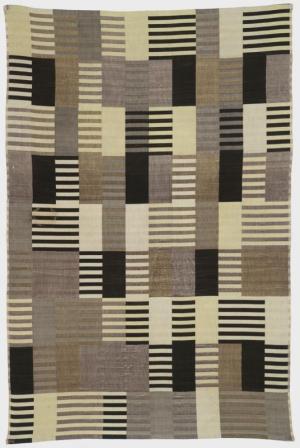 This one-day symposium considers the historical importance, artistry, and evolution of textiles, within the context of a world where traditional notions of textiles are constantly changing. The event is organized as part of the Andrew W. Mellon Postdoctoral Fellowship in Conservation Science.
S C H E D U L E
10:30 Welcome and introductory remarks by Georgina Rayner, Andrew W. Mellon Postdoctoral Fellow in Conservation Science, Harvard Art Museums
10:45 “Mentored by Textiles,” Mary Schoeser, Honorary President, The Textile Society, United Kingdom
11:35 “Textiles Matter: Theory through Practice,” Dinah Eastop, Honorary Senior Lecturer, Institute of Archaeology, University College London
12:25 Lunch break
1:50 “My Materials: Clothing, Fabric and Belonging,” Shinique Smith, Contemporary Artist
2:40 “Fashion in the Museum,” Valerie Steele, Director and Chief Curator, The Museum at FIT (Fashion Institute of Technology)
3:30 Break
4:00 “Textile Future: What Is a Textile?,” Matilda McQuaid, Deputy Director of Curatorial and Head of Textiles, Cooper Hewitt, Smithsonian Design Museum
4:50 Closing Remarks by Narayan Khandekar, Director of the Straus Center for Conservation and Technical Studies and Senior Conservation Scientist, Harvard Art Museums
The event will be held in Menschel Hall, Lower Level.
Journée d’étude | Du ‘portrait du roi’ aux portraits du Regent
As noted at H-ArtHist:
Du ‘portrait du roi’ aux portraits du Régent: Philippe II d’Orléans, entre pouvoir et légitimité
Université Paris I Panthéon-Sorbonne, 23 September 2015
À l’occasion du tricentenaire de l’avènement de la Régence en septembre 2015, cette journée d’étude est consacrée à la figure de Philippe II d’Orléans (1674–1723). Elle interroge l’image du Régent comme objet de tensions entre représentation politique du pouvoir et quête de légitimité dynastique.
La ‘régence absolue’ fait le lien entre le long règne de Louis XIV et celui, encore naissant, de Louis XV. Existe-t-il un portrait politique du Régent qui s’appuie sur l’iconographie du corps sacré du roi, que ce soit celle de son illustre aïeul comme de celle du jeune souverain mineur ? A contrario, quel rôle a pu jouer la question anthropologique dans la représentation de Philippe d’Orléans qui ne détient aucun pouvoir de droit divin ?
Les organisateurs souhaitent s’appuyer sur cette dualité pour développer une réflexion propre à l’histoire de l’art, dans le cadre spécifique de la représentation visuelle. La question des portraits du Régent sera abordée selon l’angle anthropologique, politique, de la diffusion et de la métaphore.
Comité d’organisation
Étienne Jollet (université Paris I Panthéon-Sorbonne)
Valentine Toutain-Quittelier (université de Poitiers)
Contact
Valentine Toutain-Quittelier: valentinetoutain@yahoo.fr
Université Paris I Panthéon-Sorbonne:
Galerie Colbert – Salle Vasari
2 rue Vivienne, 75002 Paris
Métro: Bourse ou Palais-Royal-musée du Louvre
◊ ◊ ◊ ◊ ◊
P R O G R A M M E
9.30 Accueil des participants
9.40 Ouverture de la journée, Étienne Jollet (université Paris I Panthéon-Sorbonne)
9.50 Introduction, Valentine Toutain-Quittelier (université de Poitiers)
10.10 I. TRAITS ET PORTRAITS
Présidence de séance et intervention liminaire: Véronique Meyer (université de Poitiers)
• Christophe Henry (université Paris I Panthéon-Sorbonne), Du duc d’Orléans au Régent
• Françoise Joulie (musée du Louvre), Les allégories du Régent
11.10 Pause
11.20 II. L’EXERCICE DU POUVOIR
Présidence de séance et intervention liminaire: Étienne Jollet (université Paris I Panthéon-Sorbonne)
• Valentine Toutain-Quittelier (université de Poitiers), Le Régent et le Dauphin au plafond de la Banque royale: une dualité impossible?
• Christine Gouzi (université Paris IV Sorbonne), Un portrait littéraire du Régent: Philippe II d’Orléans d’après le Dictionnaire des artistes de l’abbé de Fontenai (1776)”
12.30 Déjeuner
14.30 III. CIRCULATION DES MODELES
Présidence de séance et intervention liminaire: Pascal Bertrand (université Bordeaux III)
• Véronique Meyer (université de Poitiers), Portraits gravés du Régent
• Sébastien Bontemps (université Paris I Panthéon-Sorbonne), Les portraits sculptés du Régent
15.40 Pause
16.00 IV. DECOR ET METAPHORE
Présidence de séance et intervention liminaire: Étienne Jollet (université Paris I Panthéon-Sorbonne)
• Jean-François Bédard (université de Syracuse, USA), Le Palais-Royal, portrait architectural du Régent
• Michaël Decrossas (INHA), À la gloire du Régent. Projet de décor allégorique pour le château de Saint-Cloud
17.10 Conclusion de la journée, Valentine Toutain-Quittelier (université de Poitiers)
Symposium | Retail Realms in Eighteenth-Century Britain
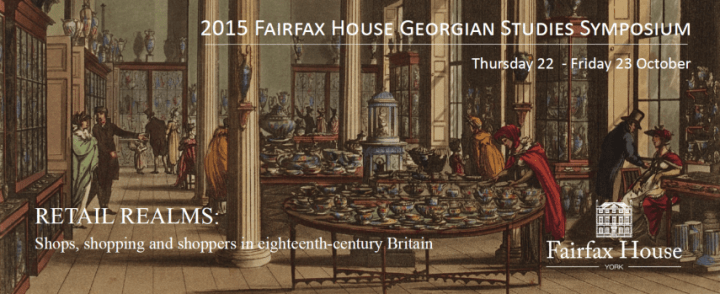
From the symposium flyer:
2015 Fairfax House Georgian Studies Symposium
Retail Realms: Shops, Shoppers and Shopping in Eighteenth-Century Britain, c.1680–1830
York Hilton Hotel and Fairfax House, York, 22–23 October 2015
The long eighteenth century was a transformative age for shops and shopping in Britain. Far-reaching changes took place in the way people shopped, the things they bought, the shops themselves and the ways in which they were run. For an increasing portion of Georgian ‘polite society’, shopping, from being primarily a matter of obtaining the necessities of life, became a pleasurable leisure activity in its own right, associated with sociability, sensory experience and the expression of identity. Many historians who have explored the social and cultural dynamics of shopping in the eighteenth century have argued that this period saw a ‘consumer revolution’.
The Georgian shopping experience was not just a social or economic process. Located in shops, showrooms and high streets, it extended to the assembly rooms and drawing rooms of polite society. It encompassed the way goods were packaged and advertised, included the strategic developments in shop design and was a contributing factor in the progressive refashioning of the urban environment. Indeed, the retail realm, as this symposium will examine, was a vital element in the physical reshaping of eighteenth-century British life.
Retail Realms: Shops, Shoppers and Shopping in Eighteenth-Century Britain (the third annual Fairfax House Symposium in Georgian Studies) will bring together research and material from museum professionals, academics, independent scholars and those with an interest in retail history or passion for Georgian studies. Linked to the museum’s exhibition Consuming Passions, the two-day conference will be focused around the core themes of consumerism, consumption and shopping in the long eighteenth century.
Registration details are available here»
◊ ◊ ◊ ◊ ◊
T H U R S D A Y , 2 2 O C T O B E R 2 0 1 5
9:15 Registration and coffee
9:45 Welcome and introduction by Hannah Phillip (Director, Fairfax House)
10:00 Panel 1: Objects of Desire
• In pursuit of oral perfection: dental retail in the eighteenth century, Rachel Bairsto (British Dental Association Museum)
• Mrs Bowes’ purchases in London, 1743–63, Howard Coutts (The Bowes Museum)
• Marketing quality in eighteenth-century England, Rachael Morton (University of Warwick)
• Shopping for shells, Beth Fowkes Tobin (University of Georgia)
11:40 Keynote Address
Retailing Luxuries: The Deards family’s toyshops in London, Bath and Yorkshire, Vanessa Brett (author of Bertrand’s Toyshop in Bath: Luxury Retailing 1685–1785)
12:30 Lunch break
13:30 Primary Materials: Parallel Discussion Sessions
• Mike Rendell – Richard Hall, Haberdasher, at No 1 London Bridge
• Valerie Jackson-Harris – The eighteenth-century trade card
14:10 Panel 2: The World of Consumption
• In pursuit of pastries, millinery and men: polite female consumption in eighteenth-century Bath, Rose McCormack (Aberystwyth University)
• Shopping for paintings in Georgian Bath, Amina Wright (Holburne Museum)
• A world of goods? Products, promotions and place names in English shops, 1740–1820, Jon Stobart (Manchester Metropolitan University)
15:20 Tea
15:40 Panel 3: Retail Environments
• ‘Behind great glass windows, absolutely everything one can think of is neatly, attractively displayed’: foreigners’ accounts of shopping in London, Alison O’Byrne (University of York)
• An ‘elegant, extensive, & convenient shew-room’: the architecture and interior design of the eighteenth-century shop, Ralph Harrington (University of Leeds)
• Antiquity and improvement: polite shopping Georgian York, Matt Jenkins (University of York)
16.50 Day 1 concluding remarks
17:30 Drinks reception and private view of the exhibition Consuming Passions: Luxury Shopping in Georgian Britain.
19:00 Conference dinner
F R I D A Y , 2 3 O C T O B E R 2 0 1 5
9:00 Registration
9:30 Panel 4: Branding Advertising, Display
• Josiah Wedgwood I – the salesman, Gaye Blake-Roberts (The Wedgwood Museum)
• Rethinking the eighteenth-century trade card: thoughts on their development, form and function, Elenor Ling (The Fitzwilliam Museum)
• Your humble and obedient servant, Sylvia Hogarth (textiles historian)
10:40 Coffee
11:00 Panel 5: Texts and the Retail Realm
• Catalogues of trivialities? Consumer experience in Austen’s writings, Jane Taylor (University College London)
• ‘Every employment delightful’: shops, self-sufficiency and feminine networks in Frances Burney’s Cecilia (1782) and The Wanderer (1814), Chloe Wigston Smith (University of Georgia)
• Browsing the past: Leigh Hunt and the memorial function of shopping, Markus Poetzsch (Wilfrid Laurier University)
12:20 Lunch break
13:20 Walking Tour: Exploring Georgian York’s Retail Realms
14:30 Keynote Address
Shopping & Sensibility, Helen Berry (Newcastle University)
15:30 Tea
15:50 Panel 6: Beyond Shopping
• ‘…the whole Consumpt of Scotland, or nearly so, has been Smuggled’: how tea smuggled from Gothenburgh dominated the market in the north east of England and Scotland, Derek Janes (University of Exeter)
• ‘Things that are not trifles’: purchasing, pilfering and peddling gloves in eighteenth-century England, Liza Foley (National College of Art and Design, Ireland)
• Sabine Winn and the art of long-distance shopping at Nostell Priory, 1775–1798, Kerry Bristol (University of Leeds)
17:00 Day 2 Concluding remarks
Please note that this programme is provisional and details are subject to change.
Colloquium | Think Small: Artistic Miniaturization
From the conference programme (with an English summary). . .
Think ‘Small’: Textual Approaches and Practices of Artistic Miniaturization from Antiquity to the Nineteenth Century / Penser le « petit » de l’Antiquité au XIXe siècle: Approches textuelles et pratiques de la miniaturisation artistique
Université Toulouse – Jean Jaurès Nouvelle Maison de la Recherche, 1–2 October 2015
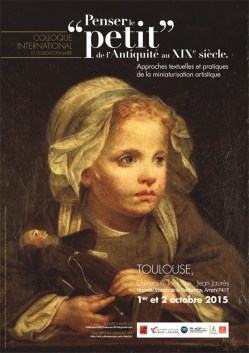 From Tanagra statuettes to the automata of the industrial age, there are many material manifestations of the ancient fascination with shapes, images, and tiny objects. Examples abound: carved micro-architectures of Gothic buildings, small engravings by Stefano della Bella or Sébastien Leclerc, eighteenth-century objects of vertu, and the Lilliputian creatures of children’s literature. Rare, however, are the historical sources that allow us to understand their cultural foundations. While the written sources usually consider the ‘small’ only in relationship to the ‘big’, the analysis of the consumption of these objects reveals a set of practical, symbolic, and artistic skills such as manoeuvrability, mobility, economy, poverty, preciousness, thoroughness, prettiness, and strangeness. Too often, the dominant sources focus on the size of the objects, which diminishes the presence of other considerations. At times miniaturization reduces the scale of a given object, while at other times it may be an independent creation governed by specific criteria. Whatever the case, miniaturization is based on a set of justifications, usages, and judgments that this conference aims to clarify.
◊ ◊ ◊ ◊ ◊
J E U D I , 1 O C T O B R E 2 0 1 5
Présidence de la journée : Jean-Marie Guillouët (université de Nantes)
9.00 Accueil par Sophie Duhem – Estelle Galbois – Anne Perrin Khelissa (université Toulouse – Jean Jaurès)
9.10 Introduction générale par Jean-Marie Guillouët (université de Nantes)
9.30 Techniques, esthétiques et fonctions du changement d’échelle
• Raffaella Da Vela (université de Bonn), Petit et très petit : miniaturisations des modèles grecs dans les ateliers de potiers et de sculpteurs de Volterra à l’époque hellénistique
• Véronique Sarrazin (université d’Angers), Le « format Collombat », ou comment le petit format d’un modeste livret est devenu une référence de goût et de commodité au XVIIIe siècle
• Cyril Lécosse (université de Lausanne), La vogue des grandes miniatures ou le développement d’une nouvelle catégorie de portrait autour de 1800
• Élodie Voillot (université Paris Ouest Nanterre), Un musée dans chaque foyer : les réductions de sculptures, du grand art au petit bibelot, 1839–1900
12.00 Pause déjeuner
14.00 Luxe, préciosité et réceptions de l’objet minuscule
• Alice Delage (Centre d’Études supérieures de la Renaissance de Tours), La microarchitecture dans l’orfèvrerie florentine : la Renaissance du « petit »
• Rori Bloom (université de Floride), « Voilà mon portrait que je vous donne » : Political, Gallant, and Aesthetic Uses of the Boîte à portrait in Two Seventeenth-Century French Texts
• Michel Sandras (université Paris – Diderot), « Le Poète est ciseleur » (Hugo). Histoire et signification d’un cliché : le terme « ciselé » appliqué au travail de l’écrivain
V E N D R E D I , 2 O C T O B R E 2 0 1 5
Présidence de la journée : Jan Blanc (université de Genève)
9.00 Accueil par Sophie Duhem – Estelle Galbois – Anne Perrin Khelissa (université Toulouse – Jean Jaurès)
9.10 Introduction générale par Jan Blanc (université de Genève)
9.30 Images et représentations du « petit » monde
• François Ripoll (université Toulouse – Jean Jaurès), « Si parua licet componere magnis » (Georg., IV, 176) : la dialectique du grand et du petit dans les chants III et IV des Géorgiques de Virgile
• Vincent Robert-Nicoud (université d’Oxford), Grand débat sur le « petit » monde : l’homme microcosme de Rabelais à Scève
• Sarah Grandin (université d’Harvard), « Cironalité » and Scale in Cyrano de Bergerac’s Les États et Empires de la Lune
• Nathalie Rizzoni (CNRS, université Paris – Sorbonne), « Les petits, toure lourirette / Valent bien les grands » : les enfants comédiens à Paris au XVIIIe siècle
12.00 Pause déjeuner
14.00 Pouvoirs mémoriels de l’objet miniature
• Audrey Dubernet (université Bordeaux – Michel de Montaigne), Souvenir d’une œuvre d’art ; les peintures et sculptures antiques transposées en glyptique
• Manuel Charpy (CNRS, université Lille 3), Fragments et réductions. Petites choses et espaces de l’intimité au XIXe siècle
• Manuel Royo (université François-Rabelais de Tours), Le « grand » dans le « petit », enjeux de la maquette d’architecture : le cas de Rome à la fin du XIXe siècle
• Claire Barbillon (université de Poitiers), Le paradoxe de la monumentalité en format réduit : la statuaire monumentale publique et la carte postale
15.40 Discussion et clôture du colloque
Symposium | Small Worlds: Dolls’ Houses
From the Bath Preservation Trust:
Symposium | Small Worlds: Dolls’ Houses from the 18th and 19th Centuries
Bath Royal Literary and Scientific Institution, Bath, 6 November 2015
Small Worlds, the current exhibition at No.1 Royal Crescent, aims to go beyond showing dolls’ houses simply as exquisite collector’s items by exploring wider themes, such as the part they played in girls’ education and women’s history, links with philanthropy (because toys for wealthy children were often furnished with the labours of the poorest), and their importance as material culture. We are holding a special day symposium to explore further some of these themes.
 To be chaired by Adrian Tinniswood and featuring Liza Antrim in conversation with Antique Roadshow’s Fergus Gambon, the event will bring together a panel of speakers who are experts in their fields. Kathryn Jones, Curator of Decorative Arts, the Royal Collection, will talk about Queen Mary’s Dolls’ House while curators from the V&A and the National Trust showcase other national treasures and their links with the English Country House. The idea of dolls houses as ‘emotional objects’ and their connection with philanthropy and the history of childhood is explored by Professor Joanne Bailey of Oxford Brooks and Dr. Mary Claire Martin of Greenwich University, while symbolic inspiration for film and literature, in particular the ghost story and all things gothic, is covered by Lucy Arnold of Leeds University in a splendidly named paper, ‘Shrinking in Terror’!
Tickets: £55, students £35. A limited number of bursary places are available to full or part time students. Click here for a link to our website and a copy of our bursary application form. Lunch and an exhibition drinks reception at No. 1 Royal Crescent is included within the ticket price. If you have any questions about
the symposium please email our Events Officer, Kate Rogers,
krogers@bptrust.org.uk.
◊ ◊ ◊ ◊ ◊
P R O G R A M M E
9.45 Registration
10.00 Welcome from Adrian Tinniswood
10.10 Liza Antrim and Fergus Gambon in conversation
10.40 The Voice of the House: Material Culture and Emotion, Joanne Bailey (Oxford Brooks University)
11.10 Questions
11.30 Coffee
11.45 The Utensil for Marriage? The Dutch Kitchen Cabinet and the Place of Women in the 17th Century, Rachel Barber
12.15 Furnishing the 18th-Century Baby House: A Working Country House in Miniature, Patricia Ferguson (National Trust external advisor on ceramics)
12.45 Questions
1.00 Lunch
2.00 Childhood and Philanthropy in Victorian England, Mary Clare Martin (University of Greenwich)
2.30 Upstairs, Downstairs: Queen Mary’s Dolls House as a Record of Edwardian England, Kathryn Jones (Curator of Decorative Arts, The Royal Collection)
3.00 Questions
3.15 Tea
3.45 Shrinking in Terror: Gothic and the Dolls House, Lucy Arnold (doctoral student at University of Leeds and administrator of Home, Crisis and the Imagination Network)
4.15 Small Stories: A Collection of Characters at the V&A Museum of Childhood, Alice Sage (Curator, V&A Museum of Childhood)
5.00 Questions
5.20 Summing Up by Adrian Tinniswood
6.00 Drinks reception and opportunity to view the exhibition at No.1 Royal Crescent
Conference | The Artist’s Studio in Eighteenth-Century Britain
From the Paul Mellon Centre for Studies in British Art:
The Painting Room: The Artist’s Studio in Eighteenth-Century Britain
Sotheby’s Institute of Art, London (Thursday), and Gainsborough’s House, Sudbury, Suffolk (Friday), 29–30 October 2015
 This two-day conference, sponsored by the Esmée Fairbairn Collections Fund and the Paul Mellon Centre for Studies in British Art, examines the role and character of artists’ painting rooms in the long eighteenth century. It is organised in association with an exhibition focusing on the painting room that is to be held at Gainsborough’s House between October 2015 and January 2016.
The conference aims to bring together current scholarship on the nature of the painting room, primarily in Britain but also in France, which was a constant model for British artists. The first day, to be held at the Sotheby’s Institute of Art, considers the varying character and function of the painting room in London, Bath and Paris: how it was used, how it was seen by outsiders, and how artists exploited it to create spaces for the display and sale of their work. Detailed studies of the painting rooms of Joshua Reynolds and Joseph Wright of Derby will help to illustrate these arguments. The second day of the conference, which will take place at Sudbury, will focus more particularly on the example of Thomas Gainsborough. Speakers will consider technical issues such as the use of materials, lay figures, drapery and costumes within the painting room, together with the role of the copy. This second day will also feature a discussion of the relationship between the painting room and the modern-day artist’s studio.
The aim of the conference as a whole is to explore the distinctive world of the Georgian painting room, and to complement the innovative recreation of such an environment within the exhibition at Gainsborough’s House.
Confirmed Speakers
Mark Bills (Gainsborough’s House)
Spike Bucklow (Hamilton Kerr Institute)
Matthew Craske (Oxford Brookes University)
Edwina Ehrman (Victoria & Albert Museum)
Karen Fielder (Portsmouth University)
Rica Jones (Independent Scholar)
Kristina Mandy (Hamilton Kerr Institute)
Peter Moore (Gainsborough’s House)
Jane Munro (Fitzwilliam Museum)
George Shaw (Artist)
Susan Sloman (Independent Scholar)
Hannah Williams (Queen Mary, University of London)
Jonathan Yarker (Lowell Libson Ltd)
Tickets
£30 Standard Ticket (for both days)
£20 Concession Ticket (students and senior citizens, for both days)
Tickets include refreshments, lunch and a drinks reception on both days. Tickets will not be sold separately for each day; attendees must commit to both days.
Please note your ticket does not include your travel to Sudbury on Day 2 and we kindly ask you to make your own way there. If you are travelling from London to Sudbury, the conference organisers will be travelling on the train stated on the timetable, if you wish to join them.
ISECS 2015, Rotterdam
I’ve sifted through this week’s fascinating ISECS program and pulled out many of the sessions specifically related to art in the eighteenth century. I’ve missed plenty, and the schedule as a whole looks terrific. The full schedule is available here. -CH
◊ ◊ ◊ ◊ ◊
14th International Congress for Eighteenth-Century Studies (ISECS 2015)
Rotterdam, 26–31 July 2015
M O N D A Y , 2 7 J U L Y 2 0 1 5
Art Markets
S002 / 11:00–12:30, Room: M1-08: Leuven: Van Der Goot Building
Marta Oracz — The Art Market in Eighteenth-Century Britain: Teaching Arts as a Profession and Occasion to Circulate Ideas
In eighteenth-century Britain practical knowledge of how to paint became a commodity for which demand seemed to be no smaller than the one for the works of art. Artists could count on regular income as they traded their knowledge. It became an occasion to ‘sell’ both, the practical knowledge / teach manual skill/ and to spread the ideas on art. It became fashionable for the middle class women to sketch hence they employed drawing masters. One of such teachers was William Gilpin, a pre-romantic landscape painter. Apart from the amateurs, who took courses in drawing as leisurely activity, there were those who were taught art with an intention of becoming professionals: students of art took up education in the Royal Academy of Arts in London (started just in the eighteenth century, in 1768). Its first President was Sir Joshua Reynolds, famous British eighteenth-century painter. Art became in the eighteenth century a subject in high schools. One of the high-school teachers was a pre-romantic British landscape painter Alexander Cozens. Gilpin, Reynolds and Cozens as the instructors in arts at schools or private houses, described the basics for their students in theoretical texts (Gilpin – travel journals, Reynolds- Discourses, Cozens – “A New Method…”). Their texts proved to be more than just manuals with mechanical instructions, since their authors pass on to the future painters also their ideas on art: the relationship between nature, art and imagination, the conception of artist, the nature of the creative process. Hence teaching profession, taken up as a paid job, acted for the aforementioned artists a trigger for their public theoretical debates on art. art, teaching, drawing masters, idea of art, imagination, theoretical texts.
Yi-chieh Shih — Chitqua: A Chinese Modeler’s Business in London Rediscovered
Chitqua, or sometimes written in ‘Chequa’, was a Chinese portrait modeler who travelled to London and worked directly for the British cliental from 1769 to 1772. Reaching the height of his success, and having exhibited in the Royal Academy of the Arts of London in 1770, Chitqua was the first Chinese artist who was presented as an artist- sculptor like the other British artists in London, while in China, he was almost anonymous. It was during the time that the British admired the figures that inherited the French Rococo and la Chinoiserie. Small bronze replicas of famous antique sculptures made in Florence, too, were very popular for their domesticity use, as well as the portraiture from the local artists. Chitqua’s portrait figures synthesize actually all of the above and were rapidly welcomed by the market for his highly personalized skills. Commissions from a tea dealer to the Royal Infantry show that Chitqua had been able to successfully run his business outside of China. One of his existent works is the portrait figure of Dr. Anthony Askew (1722–1774), now in the collection of the Royal College of Physicians in London. Unlike the one for his peer Dr. Richard Mead (1673–1754) that he ordered from the French sculptor L.-F. Roubiliac (1702–1762), Askew had his own made by Chitqua too, who was ‘a grateful Chinese patient’ around 1771. My paper is attempting to inquire the main taste of the domestic decoration’s market in London at that time. How was Chitqua able to fit in such a foreign market that was radically different from his Chinese origin? His encounters with local connoisseurs and entrepreneurs also gave us traces to comprehend his capacities to integrate this taste to satisfy the clients, and would be examined as well.
◊ ◊ ◊ ◊ ◊
Art Markets: Publishers’ and Collectors’ Policies
S005 / 11:00–12:30, Room: M1-19: Athene: Van Der Goot Building
Organizer / chair: Renata Schellenberg
Andrea Carlino — Trouble Printmakers: Remondini’s Giudizio Universale and the Persecution of a Roman Print-seller (1772–73)
April 21st 1772: Antonio Samonato the owner of a little shop in Rome was put in jail by the pontifical ‘birri’ and questioned by the Governor Court during the next few days. He was accused to sell a satirical print bearing the title Giudizio Universale, where the coat of arms of the Bourbons and the name of Charles III, King of Spain, appear in the lower portion of the image where the Hell with devils and damned is represented. This print, commissioned by Bonardel, a French merchant based in Cadiz, was printed by Remondini, a publishing house in Bassano, probably the biggest editorial enterprise in Europe at the time. The Spanish Ambassadors in Rome were convinced that the Giudizio Universale was part of the virulent anti-Spanish campaign led by the Jesuit (as a response to the expulsion of the order from Spain and all territories governed by the Bourbons), a campaign that—they suspected—could count on the collaboration, among others, also of the well-connected Remondini family. The affair involved the imprisonment of two other printsellers (in Turin and in Madrid), the exile of Remondini and endless diplomatic negotiations throughout Europe, until the Court of Spain acknowledged that a misinterpretation of the scene of the print occurred, due to the political turmoil generated by the expulsion of the Jesuits. This paper aims at pointing out the articulation of the microhistory of print selling with the larger frame of political and religious tensions in 1770s’ Catholic Europe. The archival material concerning Samonato and Remondini court-cases also provides the occasion to have an insights into the role played by different ‘market experts’ (print seller, big merchant, publisher and typographer) in the selection of themes and singular details to be represented in prints destined to a wide European public.
Catherin Parisian — Frances Burney’s The Wanderer and the Economics of Publishing
When Frances Burney published her fourth novel The Wanderer: Or Female Difficulties (1814), she and her publishers, Longman, Hurst, Rees, Orme, and Brown were optimistic for economic success. This novel, however, has gone down in literary history as an artistic and financial failure. As the story has been told, the first edition sold out before it hit the booksellers’ shops, and a second was immediately ordered. In the eighteen days between the two editions, reviewers’ and readers’ responses were negative. Critics complained that the plot was improbable, the characters stock, and the prose inflated. As a result, most of the second edition was wasted. This much one learns from Burney’s own letters. In the 1980s, critics like Maragaret Anne Doody, Janice Farrar Thadeus and others began to reassess this novel, finding in it more complex characters, more mature themes, and a more intriguing plot line. Such critics have also drawn attention to misogynist, ageist, and political biases in some of the early reviews. Yet questions Burney raises in her letters remain unanswered, questions such as how many editions the publishers actually printed, whether the publishers properly advertised the novel, and whether they paid Burney fairly in accordance with their contract. I draw on original archival research to answer these questions, bringing together evidence from relevant correspondence, printing house ledgers, and publisher’s records, to consider The Wanderer in the context of London’s 1814 publishing industry. I calculate how much Burney and her publishers profited from The Wanderer, and I consider the economics of publishing this novel in relation to other new novels published the same year. This approach to The Wanderer not only demonstrates more precisely its success as a financial endeavor, but it also supports a reconsideration of its place in literary history.
Camilla Pietrabissa — Painting for Amusement and Distraction: Landscape Pictures by Jean-Baptiste Oudry in the Marquis de Beringhen’s Cabinet
In 1744, Jean-Pierre Mariette complained about the lack of landscapists among French painters. He criticised contemporary artists for creating landscapes mostly for their ‘amusement and distraction’, following a classic trope on the genre that circulated since the Renaissance. However, Mariette also noted that landscapes by old masters and contemporary artists were sought after as decoration for the richest cabinets. These remarks reflect the double nature of the discourse on landscape representations during the period: while critics increasingly considered landscape as a fundamental talent of any artists and as an important feature of any picture’s composition, they still looked down on the genres that did not have a strong narrative or a clear morale. Under this light, Henri Camille de Beringhen (1693–1770), the son of a major collector of prints, can be considered as the prototype of the collector specialised in landscape pictures, bought or commissioned from contemporary artists such as Lancret or Boucher. Within his collection, a special position should be given to the series of seven landscapes commissioned to Jean Baptiste Oudry (1686–1755). An academician specialised in hunting pieces and the portrayal of animals, Oudry painted Beringhen’s portrait in 1722, and became the official painter of the royal hunts after the collector introduced him to Louis XV. The series of landscapes is exceptional in the painter’s production and received unprecedented public exposure: two paintings from the series were shown in the Salon of 1739, and all of them appear in the livret of 1743. Finally, Oudry himself engraved the Vue de Dieppe with a dedication to his patron. The paper asks what was the impact of such commission on the career of the peintre animalier, and proposes that landscape pictures constituted an alternative market for academicians at times of diminished interest in classic genres.
◊ ◊ ◊ ◊ ◊
For the Greater Glory of Portugal: Cultural Policy and Artistic Trade in the Age of Joao V
S014 / 11:00–12:30, Room: T3-16: Mandeville Building
Organizer / Chair: Pilar Diez del Corral Corredoira
Alessandro Spila — Lusitanian Rome: Portuguese Diplomats and the Colonna Family
The crisis that hit the Papal States in the eighteenth century led organs curial the urgency of specific strategies in foreign policy for the conservation of papal supremacy on the latest Catholic monarchies. Since Pope Clement XI, the first measures to halt the decline were concentrate to effort diplomatic relations with the monarchs of Spain, Portugal and the Kingdom of Naples. Within such strategies, the great interest in the Roman culture demonstrated by John V of Braganza in the early eighteenth century started an intense artistic exchange with the Lusitanian court. The Colonna family, which lineage boasted more than any other relationships with Braganza and Bourbon of Spain, played a crucial role in this context, especially through the cardinals Carlo and Girolamo II, elevated at different times to the office of Maestro of the Apostolic Palaces, and most powerful referents to foreign ambassadors: the court of the Stuart (Catholic pretenders to the throne of England); the Spanish ambassador Medinaceli and the Portuguese dignitaries also. Already in studies on Bernardino Ludovisi, sculptor of the Colonna family and at the same time active in Mafra palace and in the chapel of St. John the Baptist to St. Rocco in Lisbon, emerged the close relations between the noble Roman family and the Ambassador Sampajo. The project intends to present some new source emerged from the Colonna archive relating to Roman residences of Portuguese representatives at Colonna palaces and villas in Rome, as a privileged occasion of artistic exchange between the two cultures. Sampajo lived from 1746 in the Pilotta palace (among the famous ruins of the temple of Serapis) restored for the occasion by Nicola Salvi, and obtained a summer residence in Marino. To these must be added the famous residence of the Bishop of Oporto near Palazzolo.
Pilar Diez del Corral Corredoira — The Portuguese Academy in Rome: The King’s Trading Point or a Proper Academy?
This paper explores the brief and unknown life of the Portuguese Academy in Rome. It was openned following the lead of the Académie de France in the early 20s and on 1728 it was closed as a result of a breakdown in the diplomatic relations with the Holy See. The article will address how it was founded and how political events provoked its sudden closure. With this approach, it will become clear the particular essence of that institution, a place to get an artistic education and at the same time a trading point for the Portuguese monarchy. This paper will also consider how the academy met the political, cultural and artistic aspirations of the King of Portugal, who seek to display his project of international recognition as a catholic monarch with a strong presence in Rome.
◊ ◊ ◊ ◊ ◊
Art Markets (I)
S029(I) / 14:00–15:30, Room: T3-17: Mandeville Building
Organizer / Chair: Jan-Frans van Dijkhuizen
Camilla Murgia — (Un)fashionable Trades: Private Exhibitions as Art Market Strategies in Late Eighteenth-Century Paris
In 1776, French engraver Antoine Marcenay de Guy and German painter Johann Anton de Peters were responsible for opening a fine arts exhibition in the Colisée, a building located in one of Paris’s most known boulevards, the Champs-Elysées. Concerned with the success of the show, which too strongly recalled the Académie Royale’s Salons and potentially jeopardised them, the Comte d’Angiviller, France’s Interior Minister, ordered the business to close. Such a decision did not prevent, however, Parisians to develop a series of private exhibitions which offered parallel networks for artworks’ exchange at the end of the Ancien Regime. Indeed, these displays allowed the rise of alternative trade’s patterns going well beyond conventional art market commerce. In my paper, I will investigate these alternative practices, focussing on the impact they had on art commerce. To what extent did private exhibitions affect Parisian artistic world and determine its development? Why did art world’s professionals, such as painters, need alternative channels for artistic exchange? I’m interested in the diversity of trading these modalities generated. In a first instance, I will discuss the relationship between the number of private exhibitions of contemporary art which took place in late eighteenth-century Paris and the art market, in order to understand its impact on artworks’ circulation. These shows played a crucial role in artists’ careers inasmuch as a new perception of artworks developed. Functioning as a platform for contemporary art, private exhibitions represented a paramount trade strategy, leading to multiple issues relating to the art world, from artworks’ marketing to their recognition. In the second part of my paper, I will notably explore these values and their evolution. I will draw particular attention on the background allowing the rise of such a commercial policy and on the questioning of the art market they provoked.
Sune Schlitte — William Buchanan and the Emergence of a European Art Market in the Long Eighteenth Century
“West said that people were vain in being introducers of fine pictures to the country (William Buchanan).” In the long eighteenth century, collecting art was considered as an ornament of the developing states and served to enhance the symbolic capital of collectors and artists. William Buchanan a Scottish lawyer and son of a Glasgow hat manufacturer decided that “A small speculation might be entered into with every chance of success (Buchanan)” in the art market of the long eighteenth century. The overthrow of the French Revolution and the Napoleonic Wars flooded the London market with old master paintings from the continent. In this period of time, the structures of an international art market arises, Academies, Museums, the modern artist and art dealer got established. The paper will discuss the negotiation process of the value and valuation of art in three steps. After a short general overview of the international art market it analyses James Irvines and William Buchanans attempts to establish themselves as art dealers in an art market which developed mainly between France, Great Britain and Italy. The won insights of the eighteenth-century art market should show that modern economic history can gain new insights in the developing of markets and prices by imbedding their structures in the social space. In summary the paper argues that without examining the historical genealogy of artists and traders which is based on a common legitimation it is impossible to understand the current debate about the value of art.
Gernot Mayer — Creating Networks, Collecting Paintings: The Art Collection and Cultural Policies of Wenzel Anton von Kaunitz-Rietberg (1711–1794)
Wenzel Anton von Kaunitz was without a doubt one of the most important statesmen of the eighteenth century. As State-Chancellor he shaped the Habsburg Monarchy from 1753 to 1792 and as the author of the Renversement des alliances—the so called ‘Diplomatic Revolution’—he developed a new alliance-system in Europe. Whereas Kaunitz was always regarded as a key figure of the politics of his time, an important aspect of his life and work has been largely neglected: Kaunitz was an outstanding amateur des arts, patron and collector. The political ambitions of the head of the Austrian Enlightenment party included also cultural aspects: He had a deep influence on the court theatre, supported and reformed the academy of fine arts, redesigned the Emperor’s gardens of the Schönbrunn palace (Vienna) and was responsible for the remodelling of the Imperial gallery. In addition, Kaunitz himself was an important collector: Although nowadays nearly unknown, his collection was once, apart from the Liechtenstein gallery, the largest private collection in eighteenth-century Vienna. As far as we know from contemporary guidebooks, the collection encompassed up to 2000 paintings. Many of these paintings had already been part of the older family collection. This nucleus was systematically expanded by the State-Chancellor, who used his diplomatic network—subordinated ambassadors, envoys or officials—to purchase new paintings. Another way he acquired artworks was through agents and art dealers. One of them, Christian von Mechel, developed—under the auspices of Kaunitz—the new display of the Imperial collection in the Upper Belvedere, organized with a new scientific approach by schools and time periods. The paper will focus on strategies, taste and aims of Wenzel Anton von Kaunitz as an art collector and will discuss his contacts to the European art market.
Renata Schellenberg — Mapping the Market: German Art Catalogues in the Eighteenth Century
Collecting was a popular pastime in eighteenth-century Germany. People indulged in the acquisition of material culture and amassed objects for purposes of aesthetic enjoyment and education. They also wrote about objects in their possession, generating a series of texts that reflected their personal affection for the collected item. The literacy of the collecting process improved most dramatically with the emergence of an independent art market. In the eighteenth century the German art market had expanded to accommodate a socially diverse range of consumers. And as more people participated in the purchasing and exchange of artifacts, there was a growing demand for a standardization of expression that would allow them to understand the process as a whole. Sales catalogues chronicled the development of this type of discourse, because as source material they were in immediate contact with both the market and its customers. Designed with an economic objective in mind, they were meant to facilitate the factual sale of items, but in doing so they communicated much more, divulging tastes, trends, venues as well as the purchasing strategies inherent to collecting practices of the age. Furthermore, because they refer to actual items, and not models or brands (as a fair catalogue would) they reveal real patterns of collecting, providing an itemized trace of the availability of and aesthetic taste in material objects of the age. This paper analyzes a sample of sale catalogues from art markets in Hamburg, Dresden and Frankfurt, positing that these texts represent not only an important document of the age, but are a valuable commodity in their own right.
◊ ◊ ◊ ◊ ◊
Art Markets (II)
S029(II) / 16:00–17:30, Room: T3-17: Mandeville Building
Organizer / Chair: Jan-Frans van Dijkhuizen
Bárbara García Menéndez — Two Spanish Clients for the Neoclassical Painter Angelica Kauffman
The conclusions of our investigation of two paintings that the great neoclassical painter Angelica Kauffman (1741–1807) made for two Spanish clients will be presented in this paper. These canvases are especially singular, because their history has been fully documented from the moment on which they were commissioned in Rome, in very close dates at the end of the eighteenth century (1796 and 1797). They are also two of the very few works by the artist than can be seen nowadays in Spanish public collections. The first of these paintings, a beautiful canvas of Saint Joseph and the Child (Museum of Fine Arts of Asturias, Oviedo, Spain) has gone unnoticed to Kauffman’s historiography. But our study has gathered detailed references of its provenance, the consecutive Asturian owners, and also of its models and influences (Mengs’ style, known by Kauffman in Italy, and the huge presence of Murillo in eighteenth-century Britain, which she assumed in London via Sir Joshua Reynolds) and of three nineteenth-century copies of the painting. The other one is a portrait of the Spanish Jesuit and erudite Lorenzo Hervás y Panduro (1735–1809), that has been already published, but ignoring that Kauffman painted another copy. In 1797 the painter was hired by Hervás to have him portrayed, probably for a private Jesuit portrait gallery in Rome, but the whereabouts of this canvas remains currently unknown. The one that can be studied today is a replica that, regarding their friendship, Kauffman made and gave to her client. On his return to Spain, Hervás took the painting to his home, in Horcajo de Santiago (Cuenca). After his death, it remained in his family’s property until it was donated to the Royal Academy of History, in 1868, where it is still kept today.
Christine Gofroy-Gallardo — Paintings’ Exchanges during the Early Years of the Louvre Museum
Although they discreetly favor the dispersal of paintings in Paris, eighteenth-century amateurs refuse all comparison with professional dealers. These collectors take advantage of their network of correspondents abroad to acquire drawings, paintings or engravings from all Europe. They maintain relations of a so-called ‘honest business’, in which exchange or donation is often considered as the only acceptable economic practice. At that time, the exchange of paintings between amateurs is not only practiced in the context of private relations, but it also occurs within the new establishment of the Louvre. Due to the lack of financial resources, the first Museum’s curators do not hesitate to turn to this process in order to obtain the lacking masterpieces of their collection. Dealers and private individuals spontaniously suggest to administrators a procedure of exchange of exceptional paintings in return of paintings of less interest. Apart from private individuals, the Grand Duke of Tuscany does not hesitate to directly suggest to the Louvre an exchange of paintings of the royal gallery of Florence against an artwork of Le Sueur, which he desires fervently. Excited by this proposal, the Louvre’s administration seems ready to accept more exchanges to fill the Museum’s gaps. However, the extremely explicit lists of paintings of French commissioners shock the representative of the Grand Duke who wishes to give a friendly aspect to this negotiation. After the confiscation of noble immigrants’ possessions under the French Revolution, aristocrats such as Prince de Conti obtain by the government a restitution of requisitioned paintings and works of art. The arrival of Vivant Denon to the Louvre’s direction puts an end to the practice of the trade exchanges. Henceforth, no private individual should to boast to possess a painting subtracted from the public collections.
Maria Constança Peres Pissarra — Les Arts, le Commerce et les Lumières
Pour le XVIIIème. siècle, contre la disette et la misère, un bon gouvernement doit constituer des réserves de grains et encourager les cultivateurs. Celle-là c ́est une condition élémentaire du bonheur. Sans le luxe la civilization n ́est pas possible car le superflu c’est chose très nécessaire et rend heureux les hommes, au même temps que stimule l’industrie, l’agriculture, le commerce. Ceux- ci est la source du bien-être et de la prospérité et fait aussi la richesse et la forces des nations. Donc, la civilization trouve son couronnement dans les beaux-arts qui adoucissent les moeurs, et aussi sur les lettres que nourissent l’âme. Mais, selon le fragment Le luxe, le commerce et les arts, de Jean- Jacques Rousseau, “puisque le commerce et les arts ne sont dans une nation qu’une preuve de besoins et que l’argent n’est point une preuve de véritable richesse il s’ensuit que la réunion de toutes ces choses n’est point non plus une preuve de bonheur’. (Fragments, p. 523) Si Rousseau nous a déjá parlé dans le Discours sur les sciences et les arts sur les questions du luxe, du commerce et des arts par rapport aux moeurs, ça ne l’empêche pas de reprendre ces discussions dans le fragment ci- dessus, mais d’un autre point de vue, c ́est à dire, de la prospérité de l’État ou d’un point de vue politique. Pour mieux comprendre la question du commerce et des arts il faut retenir la critique de Rousseau au luxe: “De la société et du luxe qu ́elle engendre, naissent les Arts libéraux et mécaniques, le Commerce, les Lettres; et toutes des inutilités qui font fléá la curir l ́industrie, enrichissent et perdent les États”. (Discours sur l’inégalité, note IX). C ́est le but de cette communication.
◊ ◊ ◊ ◊ ◊
Art and Commerce. Continent Allegories in the Baroque Age: The Role of the Jesuit Order
S031 / 16:00–17:30, Room: M1-08: Leuven: Van Der Goot Building
Organizer / Chair: Wolfgang Schmale
Katrin Sterba — The Depiction of Allegories of the Four Continents in Prints and Baroque Ceiling Paintings in Jesuit Churches in Germany, Austria, and the Czech Republic
St Franz Xaver is the most popular missionary of the Jesuits. As a friar of St Ignatius of Loyola, he is often depicted in the interior decoration of Jesuit churches. Andrea Pozzo painted Franz Xaver’s Glorification on the ceiling frescos in the Jesuit church of Mondovi already 15 years before his masterpiece in the church of Sant’ Ignazio in Rome. In both paintings, the saints are surrounded by allegories of continents. But in the reception of this subject in the interior decoration of Jesuit churches in Germany, Austria or the Czech Republic—countries the Jesuits had successfully evangelised in the seventeenth and eighteenth century—St Franz Xaver is depicted baptising or evangelising Africans and Indians. However the portrayal of the indigenous people is influenced by the illustration of allegory of continents, which often appears together with St Ignatius. The most popular example for this subject is Pozzo’s Glorification of Saint Ignatius in Sant’ Ignazio in Rome. But Pozzo was not the inventor of this iconographical subject. It had already been established and spread by copperplate prints as the World mission of the Jesuits (1664) by Bartholomäus Kilian and Johann Christoph Storer or Ignatius of Loyola and the world mission of the Jesuits (1675) by Johann Kilian. Prints of allegories of continents were published in several books as e. g. in Mathias Tanner’s collection of the martyrdoms of Jesuit missionaries or in Heinrich Scherer’s description of the worldwide mission of the Jesuits. These illustrations of the allegories influenced also the baroque ceiling paintings in Jesuit churches in the evangelised countries; but they have been painted after the Catholic mission has already been done. Hence the monumental frescos and altarpieces show the successful mission of the Jesuits worldwide. Oba, Haruka: Using the Past for the Church “Present” and “Future”. The Remembrance of the Catholic Japan in Dramas and Arts in Southern Germany In the late sixteenth century, the missionary of the Jesuits were very successful in Japan. Many Japanese converted to Catholicism. However, the situation took a turn to the bad as the Japanese authority began to persecute these followers, which led to the twenty-six martyrs of Nagasaki. In Europe the Jesuits were taken by surprise of this development. In the seventeenth century, they began to refer to this history of Catholic Japan in dramas and arts related to the Jesuits school with the aim of promoting overseas missionary. This activity continued into the eighteenth century, although the Catholic Church could not see any more possibilities for reviving the missionary in Japan. Especially in Southern Germany, the Jesuit Drama about Japan belonged to the regular repertoire of Jesuits schools (e.g. in Konstanz) from the late 1730s to 1750s. At the same time the iconography of the four continents as well as the pictorial memorial of the Nagasaki martyrs in churches and the amount of applications for the Jesuit missionary abroad (esp. submitted by farmers, craftsmen, doctors from rural regions) flourished. Based on case studies concerning the Jesuit schools in Konstanz, Dillingen an der Donau and Landsberg am Lech, the presentation aims on the one hand by focusing on the relation between the Jesuit Drama on Japan and the pictures of the Japanese Martyrs to explain, how this constant revival of this Japanese past of the society is connected to the present and till this day unexplained prosperity of the iconography of the four continents and the applications for the Jesuit missionary abroad. On the other hand it will also be taken into consideration, how the jubilee of the Saint Francis Xavier in 1741, who had arrived in Goa 200 years ago and had become the patron for the missionary abroad since the seventeenth century, influenced the Jesuit Drama on Japan and the applications for the overseas missionary.
Claudio Ferlan — A Global Context for Communication Strategies in the Jesuits’ Colleges in Klagenfurt and Gorizia (XVII–XVIII centuries)
Since the early moments of its presence in Austria, the Jesuits had to face the problem of communicating in German as a matter of urgency in all the missionary areas. In regions dominated by Lutheranism they aimed at addressing people who were unable to speak and understand Latin. The Society of Jesus responded with different solutions to this pastoral urgency: recruitment of German speaking people, study, interactions based on gestures, symbols and images. Especially this last aspect is going to be explored in this paper by focusing on the Colleges of Klagenfurt (founded in 1604) and Gorizia (1615) and their forms of communication of the sacred. Starting out with an analyses of the first communication strategies used by the Jesuits in the two cities in the early years of settlement, the advancement of such strategies in the eighteenth century, when after the end of the Thirty Years’ War Lutheranism was apparently defeated, will be put at the center of my presentation. The eighteenth century was a time in which the pastoral urgency changes. The resistance to Lutheranism has been successful. Its growth has been stopped. There comes a time for teaching, catechizing, educating. The change of the political and religious context demanded new methods of presence within civil society. The Jesuits organized them through the development of techniques originated from their experience and tested worldwide. I will analyze in particular the use of theater, processions, preaching and catechesis. These communication tools are used outside the classroom in order to widen the contact of the Jesuits with the population, beyond the students’ audience. My aim is to describe the process of change in the Jesuit model of communication based on a comparative analysis of the two colleges, but constantly taking into account the reality of the mission in general.
Christoph Nebgen — The Influence of the New World’s Image on Religious Vocations on the Old World
The spirituality of the Society of Jesus is mainly based on the human capacity of imagination (spiritual exercises). When this religious order, founded by Ignatius of Loyola, became one of the most important actors in the field of Christian missions in Asia, Africa and America in the second half of the sixteenth century, imaginations and allegories of these new exotic fields of Christian—or better Roman Catholic—missions took place in its self-representation. In the great variety of already existing religious orders these overseas missions were a special trait for the SJ. Especially for young men interested in an ecclesial career it represented a particular possibility to realize their point of interest. To become a heroic missionary like Francis Xavier or José de Anchieta was one of the most favourable options for a young catholic in the baroque and post-tridentine mentality. The SJ used the presentation of their overseas missions in different media for a public representation of their own profile: in theatre, painting, martyrologies and even songs their commitment in the New World was mentioned. As a consequence, many people joined the SJ to once become an overseas missionary themselves.
◊ ◊ ◊ ◊ ◊
T U E S D A Y , 2 8 J U L Y 2 0 1 5
Art and Commerce: Continent Allegories in the Baroque Age
S056 / 11:00–12:30, Room: M1-09: Bergen: Van Der Goot Building
Organizer / Chair: Wolfgang Schmale
Josef Koestlbauer — Allegories of the Four Continents: Images as Historical Sources
Allegories of the four continents were a popular theme in the baroque era. In southern Germany, Tyrol and Alto Adige representations of the four continents can be found predominantly within sacral buildings, primarily in village churches. This stands in marked contrast to their occurrence in the East of the former Austrian hereditary lands where it was mainly the old orders of Benedictines, Augustinians, and Cistercians as well as the nobility, who favored this iconography for the decoration of their newly established monasteries and palaces. These allegories—even though they were of undoubtedly stereotypical character—transported learned knowledge about the world. Unfortunately the interpretation of these images poses serious methodological problems. To understand their symbolic and discursive functions we find ourselves in a paradoxical situation: the images are both the object of research and the most important source. This paper will present some approaches to tackling this problem. First, by tracing post-tridentine concepts of the significance and functions of images. Second, by looking at artists, patrons, and communities involved in commissioning images of the four continents in eighteenth-century Tyrolean churches. The systematic survey of allegories of the four continents is being currently documented in an interactive digital collection containing detailed photographic records and descriptions. The presentation will showcase cartographical and chronological visualizations, as well as tools for comparing and annotating pictorial sources.
Britta Kägler — Baroque Building Sites: The Links between Culture and Economy in Eighteenth-Century Germany
Baroque architecture is characteristic for Catholic regions of early modern territories, especially in the South of the Holy Roman Empire, e.g. in Bavaria, Tyrol and the Prince-Bishoprics of Freising, Augsburg and Würzburg. Though (art) historical research traditionally focussed on churches and monasteries, also parish churches were constructed and baroque architecture, with its ephemeral interaction of form, decoration, representation and their elements of scenery emerged since the 1680s experienced a breakthrough and led to constant competition between bishops, abbots, abbesses, princes, nobles and even commoners. For this reason, there was an increasing number of castles owned by nobles, town halls in the possession of commoners and privately‐owned palaces. This raises several questions: What did eventually lead to the (re‐)opening of baroque building sites and the transformation of earlier architectural forms along baroque lines? And how to raise money for the huge amount of construction sites facing the late seventeenth and especially the eighteenth century which had to deal with financial crises and a high pressure on modernisation? My paper deals with these links between economy and art. The process from initial planning to financing, on to the actual construction with native as well as foreign craftsmen will be analysed based on case studies from Bavaria and Swabia. Contrary to expectations, economic history of baroque architecture has not been systematically explored so far. Few fields of historical research have drifted as far apart as economic and cultural history. A wide-spread trend of de-historicisation of economic research and its equivalent, and a largely de-economised new cultural history is noticeable. With the ‘cultural turn’ in historiography many new topics have emerged. The spectrum spans history of discourse, history of mentalities and history of experience as well as history of the human body and history of madness.
Marion Romberg — Illud vero diligenter doceant episcopi: Allegories of the Four Continents in the Context of Catholic Teaching of Laymen
The iconography of the four continents dates back to the sixteenth and early seventeenth centuries, at a time when the European people were confronted with the foreignness of New Worlds in the scope of their discovery and conquest. At first used almost exclusively as an element of manorial decoration programs, it started to flourish in the eighteenth century. This involved a remarkable vertical transfer as the allegories of the four continents expanded from manors and palaces to village churches, especially so in the territories of southern Germany, Tyrol, and South Tyrol. The visual language of the elites infiltrates the province. Up till now interpretations of various interior programs neglected mostly the allegories because it seemed that the meaning and role of these allegories were clear: They represented the world. However, a closer look regarding their positioning as well as iconography and by placing them in a greater cultural, social, and political context on a macro- and microlevel provides new insights in their role of influencing public believes in the course of the fight against the reformation. Based on several examples from the diocese of Augsburg the presentation aims to scrutinize this iconography within sacred images as a tool to teaching laymen, as degreed by the Council of Trento in 1563. The focus lies on the special relationship of the clerical or noble principals, their mainly locally working artists and its rural audience in ordering, creating and examining this iconography.
◊ ◊ ◊ ◊ ◊
Critiquing the Rococo in the Century of Lights
S063 / 11:00–12:30, Room: T3-06: Mandeville Building
Organizer / Chair: Olaf Recktenwald
Gauvin Bailey — Rococo and Enlightenment in Late Colonial Brazil
In Brazil Rococo lasted longer than in any part of the world, still promoting the style as the very image of modernity as late as the late 1820s—less than a decade before the first Rococo revival movement, under King Louis-Philippe (1830–48) in France. It would be easy to dismiss this late manifestation of Rococo as the poor taste of uncultured colonials. Yet the level of intellectual engagement in the Enlightenment salons of places like Minas Gerais was far from uncultured and progressive patrons—including freedom-fighters in Brazil’s first independence movement, the Inconfidência Mineira (1788–89)—directly supported some of the greatest monuments of the international Rococo, such as the church of São Francisco in Ouro Preto (1766–1802), financed in part by Enlightenment poet Cláudio Manuel da Costa. The leading intellectuals of the day read the latest philosophical and religious treatises from Paris and modelled their lives—and, I argue, their approach to religion—on their examples. Brazil (and its Spanish neighbours to the South) had an exceptional understanding of Rococo: unlike in urban Europe where it came to be seen as outmoded and corrupt, Rococo appealed to a growing Enlightenment-inspired aesthetic in Brazil that sought a return to logic and clarity, especially in church design. Printed model altarpieces from Paris and Augsburg provided a lightness and transparency of structure that were a welcome escape from the heavy, ornament- saturated altarpieces of the Hispanic Baroque or even the bulky Rococo of Portugal—both popularly associated with colonialism. Rococo décor’s references to the natural world, luxury, and pleasurable sensations also harmonized with a new French-inspired theology of happiness promoted by reformist thinkers. The people of South America went further than any other region in acknowledging something that perhaps only rural Central Europe was willing to admit: Rococo’s essential modernity.
Carl Magnusson — Neither Rococo nor Neoclassical: The In-Betweens of the History of French Eighteenth-Century Styles
The historiography of French eighteenth-century art is founded upon the opposition between rococo and neoclassicism. This caricatural point of view is mainly due to a biased interpretation of the critical discourses that emerged around 1750 and targeted the so-called mauvais goût of contemporary French painting and interior decoration, in order to bring forth an artistic regeneration. The writings of La Font de Saint-Yenne, the abbé Le Blanc, Cochin, Blondel and Diderot, but also those of Winckelmann, have been used to define categories that rely upon a specious dichotomy, opposing superficiality to deepness, whimsicality to rationality and feminity to virility. A closer reading of these sources reveals an overall much more complex situation. The défenseurs du bon goût advocating for a radical change were in fact very few and most of them would have agreed with the words of
the marquis de Marigny : ‘’Je ne veux point de chicorée moderne ; je ne veux point de l’austère ancien ; mezzo l’uno, mezzo l’altro.’’ Convenance condemned austerity as much as whimsicality. My paper aims to show the impact of these misreadings on the definition of the historiographical status of objects produced during the second half of the eighteenth century. Most of them are regarded as not pure enough to be affiliated with neoclassicism. They are often described as by-products of a belated rococo spirit or as caricatures of truer neoclassicism (Honour, 1968). They are stuck inbetween two irreconciliable categories, which result from an unnuanced view of the Siècle des Lumières, and classified in various more or less fanciful categories, such as Louis XVI, Marie-Antoinette, Transition or, more recently, Antique fleuri. These sub-styles, however, far from lessening their already inessential status, tend to stress it.
Michael Yonan — Friedrich August Krubsacius, Enlightenment Formal Systems, and the Rococo Material World
This paper analyzes the ideas of the self-proclaimed Enlightenment critic Friedrich August Krubsacius (1718–1789), whose Gedanken von dem Ursprunge, Wachstume, und Verfalle der Verzierungen in den schönen Künsten exemplifies a broader eighteenth-century German critique of rococo design. My goal will be to explore two aspects of rococo art’s theoretical underpinnings by examining Krubsacius’s ideas. The first will be to demonstrate that in the visual and semantic complexity of rococo prints lies the conceptual basis of rococo design broadly conceived. The second will be to show that those prints achieve this through more than a simple exploration of formal qualities; they also engage in a proto-scientific examination of perception in the material world. By ‘material world’, I refer to represented objects, ranging from flowers to shells to leaves and even incorporating living or once living creatures. By asking viewers to approach the representation of things with a specific mindset—indeed, creating that mindset through the structures of representation employed—rococo prints invite them to assume specific stances toward art. Those who can assume that position find in the rococo a celebration of artistic ingenuity and, more profoundly, a theorization of human sensation. Those who could not would find their critical sensibilities stifled, confused, or at worse eradicated. Many eighteenth-century figures who chose to write about the rococo, including Krubsacius, fell into this latter category. He critiques the rococo as an art of aesthetic nonsense and pointless mixing, but I shall argue that he is wrong, and in the substance of his critique can be detected the broader terms of his Enlightenment aesthetics.
◊ ◊ ◊ ◊ ◊
Global Perspectives On the Enlightenment: Transnational Mediations
S092 / 16:00–17:30, Room: T3-17: Mandeville Building
Organizer / Chair: Rienk Vermij
Chihyin Hsiao — Chinese Porcelain for Some London Merchants: Their Business and Family Life in the Eighteenth Century
Predominately regarded as art collectors’ items, Chinese export porcelain has received limited attention from researchers of English social history. Only in the last decade have historians begun to recognize the potential of Chinese export porcelain as a social indicator and its significant impact on English material culture. In response to this novel approach, my research aims to contextualize a specific type of Chinese export porcelain commissioned by emerging London merchants and further investigate how Chinese porcelain are used as objects for social events such as company banquets, tea parties and drinking games in the eighteenth century. Large numbers of Chinese porcelain suggest business achievements and family alliances are two of the most celebrated genres. The subject matters reflect a thriving mercantile life when London became the entrepôt of Europe and the destination of world luxury. They record personal history as well as signifying merchants’ sense of self and a shared culture of belonging. I, therefore, propose to treat these porcelains as the early example of customized singular commodity. Principally, I will argue that Chinese export porcelain is an alternative material for London merchants who desired to own artifacts of greater refinement but not necessarily of opulence. Subsequently various ceramic productions are compared and discussed within this socio-economic setting.
Tetyana Kairova — Le texte épistolaire dans l’émergence d’un nouvel esprit à travers l’ Europe des Lumières
Comme les gens, à travers l’Europe, les formes et les idées circulent … (Martine de Rougemont) Dans sa communication, le Docteur ès lettres, maître de conférences au Département de Langues romanes de l’Université d’Etat de la région de la Mer Noire Petro Moghyla (Mykolaïv, Ukraine) présente les textes épistolaires comme un phénomène majeur et brillant de la vie dans l’Europe du XVIIIe siècle. en analysant sous l’angle linguistique et anthropologique la correspondance internationale, les tendances et les particularités de la communication à distance de la société européenne de l’époque, l’auteur examine la nature, les traits caractéristiques, les avantages et le fonctionnement du type de texte épistolaire tel que la lettre dans la vie des Européens, et s’efforce de pénétrer le mécanisme des contacts intellectuels à distance qui contribue à la propagation des nouvelles idées des Lumières en Europe et dans le monde. Plusieurs pays européens sont évoqués dans le récit : la France, la Russie, la Pologne et d’autres, ainsi que les ombres du grand et brillant Voltaire, de l’Impératrice russe Catherine II, de ses diplomates et de ses sujets, de Jean Potocki, aristocrate polonais, né en Ukraine, formé en France et en Suisse et ayant vécu au confluent des cultures européennes Ils surgissent devant nos yeux, entourés d’autres Européens, pour illustrer les réflexions de l’auteur sur l’influence des différentes cultures entre elles et le rôle des textes épistolaires dans l’émergence en Europe d’un nouvel esprit des Lumières. Cette correspondance, marquée par la connaissance des civilisations anciennes et modernes, permet d’observer la circulation de l’information dans l’espace et dans le temps en synchronie et diachronie et de dégager une image stéréoscopique du monde se reflétant dans son microcosme et faisant de ces textes épistolaires des carrefours de civilisations, ce qui nous permet de les considérer comme des objets de culture.
Julia Shapchenko — Polish Artistic Communities in the Russian Empire in the Late Eighteenth and Early Nineteenth Centuries
In the beginning – the 1st half of XIX century the community of Polish men in Saint Petersbourg was quite large and had an influence over Russian culture. The Polish art communities scaled step by step mostly because the St. Petersburg Academy of Arts drew many young people keen on arts. In the 1st tertial of XIX century the Academy became Alma Mater for many Poles, who studied there( I. Tylinsky, F. Slyuzhinsky, X. Kanev and others). After graduation from the Academy some of them painted members of the Russian royal family or devotional pictures while others declared for historical painting (J. Sukhodolsky, Kamiński, T. Gorki, L. Strashinsky). At the same time many mature artists of Russian Western provinces moved in St. Petersburg looking for a job. Though ome of them became gainfully employed, while others had to shorten their stay, such as C. Rusetsky with no patronage and money to spare. Many of the most independent Polish artists looked “to the West rather than to the East” preferred internship and work in Vienna, Munich and Paris. Among them were mature painters J. Kossak, P. Michael, H. Rodakovsky, A. Grotter, J. Matejko. Thanks largely to such famous Polish masters as R. Zhukovsky and I. Schedrovsky Russian genre enriched with scenes of Russian pot culture. Schedrovsky created albums of lithographs called “Here we are” and “Gold may be easily told “. Being a good cartoonist Zhukovsky collaborated with some popular magazines such as “Illustration”, “Spark”, “Splinter” and “Pantheon”. C. Yasevitch gained a reputation of book illustration and icon restoration master. Besides that he taught in the Academy of Arts supporting poor students. The most widely known both in Russia and Poland was a freelance artist and engraver A. Orlovsky, who depicted people of all social classes, from courtiers to peasants. Orlovsky one of the first painters created a lithographed series of nations living throughout Russian Empire.
◊ ◊ ◊ ◊ ◊
Markets and the Aesthetic in Scotland
E314 / 14:00–15:30, Room: M1-17: Tokyo: Van Der Goot Building
Panel of the Eighteenth-Century Scottish Studies Society
Chair: John Cairns
Endre Szecsenyi — The Aesthetic and Social Nature of Laughter in Francis Hutcheson
Laughter was an eminent moral philosophical and anthropological issue in the era of Francis Hutcheson, and its primary context was of enthusiasm and religious toleration, and of moral criticism. Hutcheson’s Reflections upon Laughter (1725), however, can also be fruitfully interpreted from the angle of his aesthetic thought elaborated in his Inquiry into the Original of our Ideas of Beauty and Virtue (1725) and Essay on the Nature and Conduct of the Passions and Affections (1728), especially if the scope of ‘aesthetic’ is not confined to the categories of beauty and harmony, or comedy and wit. Hutcheson seems to consider the topic of laughter as a new type of experience, as a new class of “innocent pleasures” associated with, and inspired by, Joseph Addison’s “pleasures of the imagination” (1712). While Addisonian beauty, greatness (sublimity), and novelty can be experienced in solitude, laughter is genuinely social and sociable. Hutcheson’s “sense of ridiculous,” one of our internal senses, by means of which laughter becomes possible, belongs to the tradition of (social) taste dating from at least Baltasar Gracián, and to that of the Roman Stoic sensus communis (from Marcus Aurelius to Shaftesbury), and not to that of epistemological or even artistic “imagination.” Modern aesthetic experience has several roots, one of which is undoubtedly the Italian, Spanish, French discourse of je ne sais quoi, which, though it also gains its paradigmatic examples from interpersonal relationships (love, friendship), expresses a kind of secret attraction, enchantment, charm. Addison’s aesthetic experience owes much to this conception. Laughter as aesthetic experience in Hutcheson’s essays, however, is an expansion of the Addisonian “aesthetic.” Here openness, sociability, eventually toleration can be felt and interiorized in the pleasure of laughter. This kind of “aesthetic” experience is not a rudimentary step toward morality but rather an inevitable frame and precondition of morality.
Michael Brown — The Aesthetics of Political Economy
The origins of political economy have rarely been connected to a concern for the beautification of the world. However the Scottish Enlightenment corpus on political economy has numerous writers who reflected on both economics and aesthetics in their work. This paper proposes that the two fields of intellectual enquiry were intimately related and that the process of reading them as a shared enterprise sheds surprising light on the conclusions drawn in the field of political economy (successful economic solutions were to be aesthetically pleasing) and on the literary presentation of economic writings (which evince an aesthetic concern for system and form). The paper will concentrate on Francis Hutcheson and Dugald Stewart, case studies which bookend the Scottish Enlightenment movement.
Cairns Craig — Plant Nurseries, Botanic Gardens and the Aesthetics of Nature
From the time of Philip Miller’s influence at the Chelsea Physic Garden in the 1720s, Scots gardeners in London played a key role in the introduction of new plants into British horticulture. Many of them, like Thomas Blaikie (1758–1838), went from gardening apprentices to international ‘plant hunters’ before establishing careers as garden designers—in Blaikie’s case in and around Paris in the 1780s. Garden design was shaped by the introduction of new plants and the major nursery for the propagation and sale of those new plants was the Lee and Kennedy Vineyard nursery in Hammersmith. James Lee, originally from Jedburgh, became an internationally recognized botanist as a result of popularization of the Linnaean system in his Introduction to Botany of 1760. It was to compete with the international collections of the Vineyard Nursery that the Earl of Bute established the gardens at Kew that would later become the center for British botanic collections. The evolution of the botanic garden and of garden design in the late eighteenth century would lead to the development of a style that the most influential Scottish writer on gardens in the nineteenth century, John Claudius Loudon, would designate the ‘gardenesque’—the presentation together of plants which had no natural affinity. This gardening revolution between the 1720s and 1790s is reflected in the role of gardens in the development of eighteenth century aesthetic theory in Scotland, from Francis Hutcheson’s An Inquiry Concerning Beauty, Order, Harmony, Design to Archibald Alison’s Essays on the Nature and Principles of Taste.
◊ ◊ ◊ ◊ ◊
W E D N E S D A Y , 2 9 J U L Y 2 0 1 5
Pictures in Motion: Portraiture around the World (II)
S104(I) / 11:00–12:30, Room: T3-06: Mandeville Building
Organizer / Chair: Jennifer Germann
Kee Il Choi — Face Time with the Qianlong Emperor: A Qing Imperial Portrait Completed at Sevres
In early 1773, the Qianlong emperor (r. 1736–95) granted three sittings to the Italian Jesuit painter, Jesuit Giuseppe Panzi (1734–1812). Father Joseph Amiot (1718–93) subsequently sent the resulting oil sketch to Henri-Léonard Bertin (1720–92), a French minister of state to both Louis XV and Louis XVI. This paper reconstructs how the portrait was first captured in China as a contextual preface for its reception in France. Though a European artist, Panzi was compelled to work within a strictly prescribed Qing imperial artistic practice, where such bust likenesses served as preparatory sketches for full length scrolls, which were then displayed in a pantheon of imperial virtue. In France, Bertin had the portrait translated twice by French artists at the Sèvres factory. The bust length model was directly copied on a painted porcelain plaque (1776); and a second derivative of Panzi’s original was adapted into a full-length sculpture in biscuit porcelain (1775–76) by Josse-François Leriche (174–1812). In this translation from two to three dimensions, the portrait was transmuted from a Qing imperial image of virtue into a European monument of an enlightened, learned ruler, a vision originally conceived and contextualized by Amiot within a larger project to promote within Europe the 100 most celebrated Chinese in history. This grand commemorative initiative evoked Titon du Tillet’s Parnasse François, and was directly contemporary with the Comte d’Angiviller’s project to promote the Grands Hommes of France, also for their virtuous service to the king. Henri Bertin expanded Amiot’s vision to encompass other porcelains that celebrated the Qianlong emperor as chief guardian of China’s ancient past as well as the responsible steward of the empire’s natural resources. This unheralded Sino-French material culture narrative permits us to consider the question, ‘How does portraiture help us to understand what it meant to be global in the eighteenth century?’
Christina Lindeman — Going Dutch: The Convergence of Fijnschilder Conventions in Self-Portraits of Eighteenth-Century German-Speaking Artists
In 1781, Sir Joshua Reynolds, president of the British Royal Academy, travelled through Holland, the Low Countries, and their neighboring Germanic states. While visiting the art collection of Johann Wilhelm, Elector of Palatine in the city of Düsseldorf, one painting in particular caught his eye, Gerrit Dou’s The Quack (1652). Of the painting Reynolds wrote, “It is very highly finished, but it has nothing interesting in it. Gerrit Dow himself is looking from a window with his palette and pencils in his hand.” Although Reynolds admired Dou’s technical skill it was the subject matter that disinterested him. One can surmise that Reynolds did not appreciate Dou’s realistic depiction of an artist’s life and instead preferred to idealize artistic life within the trappings of academia. Unlike Reynolds’s dismay over Dutch art, there were several German-speaking artists who adopted the fijnschilder convention of the artist in the windowsill in their own self-portraits. The importance of the window in seventeenth-century Holland is evident in portraits and genre scenes alike, making it a focal point of daily life. The image that Dou recreated of the seventeenth-century artist peering from his studio’s window onto a crowded city street demonstrated the interconnectedness of the artist’s growing profession within this rising urban culture. These paintings echoed the new economic and mercantilist growth in several German cities during the eighteenth century. This paper intends to examine the impact of seventeenth-century Dutch art on eighteenth-century artists particularly their adoption of the windowsill in their own self-portraits. In doing so, we turn attention to the circulation of Dutch art and collections within Germany, and the impact of travel to Holland and the Low Countries as sites for inspiration rather than the Grand Tour to Italy.
◊ ◊ ◊ ◊ ◊
Pictures in Motion: Portraiture around the World (III)
S104(II) /14:00–15:30, Room: T3-06: Mandeville Building
Organizer / Chair: Jennifer Germann
George Stringer — The Commodity of Myth: Anglo-Indian Portraiture at the Edge of Empire
For over a century and a half since the British East India Company first began trading in India, sending home accurate visual descriptions of the country seems to have had a low priority. India was a coastal resource with an unknown interior full of fabled riches. It was not until 1769 that Britain’s first professional artist arrived to practice there. Tilly Kettle’s inaugural on-site portrait of an Indian ruler (Muhammad Ali Khan, Nawab of Arcot, c.1770) impressed Londoners, signalling the start of an exclusive, exotic portrait trade. Kettle’s artistic identity was more fully tested in his ambiguous role as resident foreigner and first point of contact with local painters in the northern buffer state of Awadh. What marked this moment of cultural convergence? Perhaps the most natural impulse might have been to find common artistic ground, yet this shifted continually, as recent appraisals (by Eaton, Rajan, and others) suggest. In this paper, I argue that shared social values in portrait content were overshadowed by aesthetic alterity, their fluctuations reflecting the fortunes of the portrait trade itself. Beginning with a comparable domestic paradigm in children’s portraits, I show how the change in subject matter to more adult pastimes during the heyday of colonial portraiture echoed a wider loss of innocence, and metropolitan anxiety about Company corruption. What began as a moment of ‘anthropological’ clarity in Anglo-Indian portraiture soon became incongruous, hybridised; such part- observed portraits or conversation pieces veered uncomfortably close to reality, and had to make way for a more picturesque view of India which ultimately proved more widely marketable.
Lianming Wang — Giuseppe Castiglione (1688–1766) and Manchu Portraits Revisited
Shaped by unprecedented styles and techniques imported by European artists, a new type of Sino- European portrait painting for picturing the emperor as well as his family, emerged in Qianlong’s (1736–95) Manchu court. As one of the key figures, Giuseppe Castiglione’s (Ch. Lang Shining, 1688–1766) training in Italy stimulated radical changes that immediately distinguish his portrait works from all else; for the emperor, his children and concubines he produced a great number of portraits, including portraits that being included in the court interiors decorated according to pictorial schema derived from European illusionistic modes. This paper aims to address the transcultural exchange between China and Europe with a primary focus on Castiglione’s (illusionistic) portraits in light of Jesuit missionary environment and the Qing’s exposure to European science/arts (mathematics, Geometry/ central perspective, chiaroscuro and oil painting) in the eighteenth century. A key area that remains unresolved in the large scope of Sino-Jesuit exchange is an in-depth understanding of Castiglione’s own artistic formation in Italy (where he made portraits for the Duke of Genua) before his arrival in China and the precise tools and techniques that he learned from Andrea Pozzo. Questions that need attention are: What are the primary artistic and technical features of the school(s) from which Jesuit painters emerged that would specifically impact Qing portraits? What features of Castiglione’s training, which made it possible for him to translate techniques used in Christian sacred images into portraits for the Manchu court? How did Castiglione and his Chinese colleagues experiment with different materials, genres, techniques, and formats that encode certain attitudes? And ultimately, how did his technical skills inspire particular types of experimentation, e.g. the ‘illusionistic portraits’ at Manchu court?
Aneta Zahradnik — Travelling Portraits: The Collection of Austrian Archduchess Maria Anna (1738–89)
My paper will present the results of a recently completed research project investigating a newly discovered eighteenth-century portraiture collection which once belonged to the eldest surviving daughter of Maria Theresia, archduchess Maria Anna. The collection consists of 122 portraits, oil paintings and pastels, representing four generations of the Hapsburg family and contemporary clerics as well as numerous children’s portraits. The project’s main objectives were a contextualization of the artworks within regional and transregional art production and distribution. The study aimed to reconstruct their historical presentation at Maria Anna’s palace in Klagenfurt, in order to describe their representational and memorial functions. The collection reflects the strong impact of Maria Theresia’s interest in the representation of the Habsburg family, where continuity and serial production of portraits played a central role. It illustrates the information and exchange through portraiture between the different European courts as a means of proving the cohesion of the Hapsburg siblings who lived at various residences in France, Italy and Austria… A considerable number of these portraits repeats and cites well-known eighteenth-century (group) portraits sometimes kept elsewhere in the family, and brought to Maria Anna in order to maintain her connection to the family. Also, the portraits are always already conceived as existing in series and groups, quite differently from a notion of portraiture as expressing individualistic singularity. They clearly served to establish networks, group and family identities. Indeed, as I would like to argue, the collection is of special interest as a prime example of portraiture in circulation, touching upon issues such as exchange, reference and citation. The practices of citation and repetition should not only be perceived as marks of second-rate art. Instead, analyzing these may lead to insights into the culture of court portraiture and a better understanding of genre conventions.
◊ ◊ ◊ ◊ ◊
Selling Old Master Paintings on the European Art Market
S129 / 16:00–17:30, Room: M1-16: Heidelberg: Van Der Goot Building
Organizer / Chair: Frans Grijzenhout
Branko Aleksic — Giacomo Casanova sur le marché des arts au 18e siècle
Giacomo Casanova, frère de deux peintres, a entretenu les relations avec plusieurs marchands de l’art en Europe. La recherche des traces de ces liens – correspondance privée de Casanova, contrats et catalogues de vente de l’époque – permettent de cerner la circulation des oeuvres d’art à travers les échanges, achat, etc.
Frans Grijzenhout — Selling the Golden Age: The Rhetoric of Amsterdam Sales Catalogues, 1760–1780
At the apogee of activities on the Amsterdam art market, between 1760–1780, Dutch auctioneers had to compete with their colleagues in Paris, London and elsewhere to appraise their lots. This contribution analyses the rhetoric of Amsterdam auction catalogues as compared to those from Paris.
Everhard Korthals Altes — Caroline Louise von Baden’s Collecting Activities and the Dutch Art Market: The Sale of the Willem Lormier Collection in 1763
In a timespan of only 12 years, between 1761 and 1773, Caroline Louise von Baden acquired 57 paintings on the Dutch art market, which constituted a substantial part of her outstanding art collection. She bought 34 paintings at public sales and another 23 directly from dealers and collectors, using an extensive team of agents, informers and advisors in the Republic, with whom she regularly corresponded and from whom she received auction catalogues. Arguably the most important and largest auction of those days was the sale of Willem Lormier’s collection (1682–1758), which took place in The Hague on 4 July 1763. At the sale, her agent Treuer purchased six paintings for Caroline Louise for a total price of 1,206.10 Dutch guilders. In my lecture I will focus on this spectacular event in order to investigate the supply of paintings from which Caroline Louise could choose, and to find out who her fiercest competitors were during the auction. Comparison to her rivals’ acquisitions will allow us to judge Caroline Louise’s acquisition more accurately. Remarkably, some of the buyers at Lormier’s auction were selling paintings to Caroline Louise occasionally. Even more remarkable is the fact that a number of competitors belonged to the circle of her informers and advisors in the Republic.
Ingrid Vermeulen — Art Brokerage and Knowledge Production: The Dealings of Pieter and Jan Yver in Amsterdam with Carl Heinrich von Heineken in Dresden
Pieter Yver (1712–1787) and his son Jan (1747–1814) were art dealers and brokers in Amsterdam in the second half of the eighteenth century and early years of the nineteenth century. Lugt’s Répertoire online lists no less than 154 auctions entailing some of the most notorious art collections, such as Braamcamp’s. Although the Yvers were dealing in a wide variety of objects ranging from paintings to natural-historical objects, prints held a prominent place within their trade. This is explained not only by Pieter’s original training in the printmaker’s studio of Bernard Picart, but also by Jan’s assembling of an exquisite print collection during his lifetime. Moreover, Pieter was the much-appreciated author of the supplement to Gersaint’s seminal catalogue raisonné of Rembrandt’s prints (1756) which was based on the collection of Pieter Cornelis Baron van Leyden, the later founding collection of the Rijksmuseum Print Room in Amsterdam. In this paper I aim to shed light on the ways in which the international print trade of the Yvers contributed to the production of artistic knowledge, and that about Dutch art in a European context in particular. I will do this by analyzing the as yet unpublished international correspondence of the Yvers with Carl Heinrich von Heineken (1707–1791), which extended from 1768 to 1786. Heineken had been director of the print room of the Saxon rulers in Dresden and had contributed substantially to the acquisitions of their picture gallery. He seems to have initiated lifelong contact with the Yvers when he travelled to the Netherlands in 1768. To him the print trade was instrumental not only in selling and acquiring prints, but largely also in obtaining information about the foremost collectors and artists in the Netherlands. This information was directly processed for his publications on artists, art and print collecting.
◊ ◊ ◊ ◊ ◊
T H U R S D A Y , 3 0 J U L Y 2 0 1 5
Visual Culture in Eighteenth-Century France
S156 / 11:00–12:30, Room: M1-09: Bergen: Van Der Goot Building
Organizer / Chair: Heather McPherson
James Wehn — Printed Designs as Social Currency: The Etching of Juste-Aurèle Meissonnier’s Silver Tureens for the Duke of Kingston
In eighteenth-century France, architects and designers found an alternative market for their decorative designs in the form of reproductive prints, which depicted plans for domestic interiors, furniture, and household items. These prints appealed to members of the aristocracy and the wealthy middle class, whose taste in decorative arts was a matter of social display and closely linked to their roles as voracious consumers of these marketable goods. Inscribed illustrations in books like Jean Mariette’s multiple volume Architecture Françoise (1727–38) listed the designer’s name, specified the building project, and named the patron, thereby elevating the design to a form of social currency tied to celebrity and fashion. Closely related to these book illustrations, prints produced independently by architects and designers served to promote their work with even more immediacy. The royal architect and silversmith, Juste-Aurèle Meissonnier, began working with printmakers early in his career to market his decorative designs, which Gabriel Huquier later combined into a single volume. As a case study, this paper explores an etching by Huquier of Meissonnier’s plan for an elaborate silver centerpiece with two tureens made for the Duke of Kingston around 1735–40. As a document of Meissonnier’s realized designs or an accurate representation of his patron’s commission, the etching lacks verisimilitude. Yet the composition, which cleverly situates the viewer in the imaginative space of a luxurious rococo interior, suggests the etching should be read as an alluring and entertaining advertisement.
Heather McPherson — Celebrity as Currency in Late Eighteenth-Century Portraiture
Through the lens of Jacques-Louis David’s portraits of prominent women from the revolutionary and post-revolutionary era, my paper will examine how female celebrity functioned as artistic currency, contributing to the conflation of public and private identities and shifting semantics of portraiture as a culturally-engaged mode of representation in which fashion, history, and gender coalesced. David’s unfinished Portrait of Juliette Récamier (1800; Musée du Louvre), which helped launch a new portrait type—the reclining woman on a canapé—exemplifies portraiture’s close alignment with fashion and Neoclassical aesthetics. Widely renowned for her beauty and charm and the unadorned simplicity of her dress, Madame Récamier’s complicated public image was an artful construction that arguably left little room for artistic reinvention. As scholars like Mary Vidal and Philippe Bordes have demonstrated, David’s portraits constitute a complex socio-historical chronicle of pre- and post- revolutionary France that blurs traditional distinctions between portrait-painting and history, challenging aesthetic hierarchies. While David’s iconic history paintings have been exhaustively analyzed, his portraits, especially those of women, warrant further attention. There is every reason to believe that he envisaged his portraits as ambitious artistic statements that transcended mere likeness. David was keenly aware of the publicity value of portraiture and the aesthetic and ideological signification of costume. The Neoclassical dress in his female portraits, which was promoted by fashionistas such as Joséphine de Beauharnais and Thérèse Tallien, falls between fashion actualities and the antique ideal, echoing and reinforcing the complex dialogue between nature and artifice, the beau ideal and modern fashion. We know that David intended to exhibit Madame Récamier’s portrait with the recently completed Portrait of Madame de Verninac (1799) at the Salon. Intended to hang in Madame Récamier’s celebrated neo-grec apartments, her portrait would have complemented and competed with the décor and the sitter’s meticulously staged performance before her acolytes.
◊ ◊ ◊ ◊ ◊
Travels and Transformations of the Portrait Genre
S163 / 11:00–12:30, Room: T3-16: Mandeville Building
Organizer / chair: Lieke van Deinsen
Milica Cicmil — Portraits of the Poetess from the Academy of Arcadia in Rome
In accordance with the cultural tendencies of Grand Tour, eighteenth-century Rome had many pillars of culture, including the prominent literary Academy of Arcadia, the first Italian academy to admit women. This headquarters of intelect and art was a place where portraits of the most prominent Arcads had been gathered and preserved from the second half of the eighteenth century. Those are not only a visual memory of the poets, but also a testimony of visual identity of the individuals, group and entire cultural institution. The female portraits represent independent professional poetess who contributed to the shaping of Italian Enlightenment. Among them are portraits of Faustina Maratti Zappi (Aglauro Cidonia), Marilli Etrusca, Fidalma Partenide and Giacinta Orsini, made by some of the most important painters of the time, such as Pompeo Batoni and Angelika Kauffmann. Today, some of them are exposed as part of the gallery of portraits in Biblioteca Angelica, the seat of today’s Academy. Others belong to Museum of Rome in Palazzo Braschi. Unfortunately, only a few are exposed to the public.
Isabelle Masse — Mediating through Visual Form: Louis Tocqué’s Queenly Portraits in France, Russia, and Denmark
From 1756 to 1759, the French portraitist Louis Tocqué (1696–1772) undertook a journey that led him to the courts of Saint Petersburg and Copenhagen. In the wake of this journey, the artist left portraits of dignitaries, aristocrats and members of the Russian and Danish royal families, including the formal portraits of Empress Elisabeth of Russia (1758) and Juliane-Marie, Queen of Denmark and Norway (1762). These two monumental compositions are strikingly similar to a portrait of Marie Leszczinska, Queen of France, painted by the artist two decades earlier (1740). Not only do they share most of the codes and conventions characteristic of royal effigies, but more significantly, they replicate the painting’s formal organization. Three highly standardised images of sovereigns thus circulate between the French, Russian and Danish courts. This paper explores the links forged between Tocqué’s portraits, concentrating specifically on the pictures’ visual structure. It focuses on the impact of the cross-European migration of representation modes. Its aim is to rethink the mediating function of portraiture which is commonly associated in the literature with travelling objects. In the case of Tocqué’s paintings, the mediation operates less through the material artworks themselves, which as it happens are difficult to move, than through the dissemination across Europe of a visual and formal composition. In this light, the paper will examine how the three portraits bridge by visual means different political and cultural contexts and how they tend to smooth out the national distinctions between France, Russia and Denmark.
◊ ◊ ◊ ◊ ◊
F R I D A Y , 3 1 J U L Y 2 0 1 5
The International Thread: Lace and Commerce in Eighteenth-Century Europe
S226 / 14:00–15:30, Room: T3-06: Mandeville Building
Organizer / Chair: Michael Yonan, Tara Zanardi
Beth Walsh — Lace as Cultural Currency
Today, lace is often considered merely a frilly accessory, an inconsequential, feminine trimming. In the Europe of the long eighteenth century, however, ubiquitous lace was much more acutely observed and understood. When considering its position in commerce, attention should be given to these wider agencies. Lace was made in great quantities, crossed boundaries, had a part in national and international economics, was legislated for and against. What was it about lace that made it so valuable in so many different ways, not just the financial? This paper investigates the non-monetary ‘value’ of lace – its role as a pan-European cultural currency. It studies, for example, lace as a signifier of cleanliness and morality, as a tricky participant in debates about luxury and religion, as well as a more direct indicator of social status, wealth and fashionable taste. Lace was considered a suitable gift in a variety of circumstances, not just because of its high cost but because of the wider values it held. Its appropriation and display were crucial facets of its agency. These attributes made lace, or its representation, a suitable gift between princes as well as those far below them in social terms.
Elizabeth Davis — Lace, Prints, and the Dissemination of French Fashion
In this paper, I explore the relationship between the development of French lace as a tool for economic growth and the promotion of this luxury product as visualized in late seventeenth-century French fashion prints. Beginning with engravings found in the 1678 issues of the popular journal Le Mercure Galant, I trace the evolution of the imagery as French lace becomes increasingly popular and increasingly available. Over the next two decades, the number of French fashion prints would grow, as would foreign copies of these prints. Dutch printmakers who copied the French prints altered the titles and backgrounds, but the French fashions and French lace were retained. Obviously, these were central to the images’ appeal, even if they now sported a Dutch identity. French fashion prints were also copied by English printmakers, though with fewer changes to the overall imagery. All of these prints expanded the regional exposure of French fashion, and at the same time, much of this imagery depicted large quantities of lace. Questions arise regarding the effectiveness of fashion prints as propaganda for consumption of French fashion goods. With the dissemination of lace fashion information across a broad region, was there an accompanying benefit to the economies of northern French lacemaking regions? These and other issues will be discussed in this talk, which will be supported by illustrations of extant artifacts and artwork from various museum collections.
Carolina Brown Ahlund — Lace, Economy, and National Identity: Lace as a Problem in Eighteenth-Century Sweden
My paper is concerned with the shifting perspectives on lace in Sweden in the eighteenth century, and the various roles lace played in different contexts during the century, involving economical issues as well as questions of national identity. Taking its starting-point in the economical theory and debates in Sweden during the first half of the century, my paper presents the variety of arguments connected to the use and import of lace durig this period. I will also discuss how the arguments against the import of lace, identified as an economic burden to the country, led to the establishment of national production of lace in the mid-century. At this time imported craftsmanship, in the form of skilled lace-makers from Brabant, settled at Drottningholm and in Vadstena in Sweden, in order to train Swedish craftsmen/craftswomen and starting a national production of lace. This import of skilled laborers in order to educate Swedish workers and to start a national production can here be seen as a parallel to the strategy behind the decoration of the new palace in Stockholm, where French painters, sculptors and craftsmen were engaged for the very same reasons.
Tara Zanardi — The Fashioning of the Silk Lace Mantilla: Gender, Labor, and Elite
Consumption In eighteenth-century Spain, lace manufacture occurred outside the strictly guarded and male dominated guilds. Instead, female lace makers coordinated lace production on a semi-professional level set in informal spaces, such as artisanal workshops, which were typically family-operated. Men could participate in different aspects of lace fabrication and retail, but women directed its production, from pattern construction to design execution. Although lace was fabricated for a variety of decorative or sartorial objects, the silk lace known as Blonde (Blonda) was constructed almost exclusively for mantillas, the most archetypal of all Spanish female garb. While Spanish female lace makers produced much of the mantillas for native consumption, they also exported lace veils throughout Europe and to the Americas. In addition, Spanish women purchased both native and foreign laces, pointing to the international market for this textile. Despite the global network of lace and the site of the mantilla’s production, in visual examples, especially portraits of noblewomen, the lace mantilla epitomized a woman’s identity as Spanish. The incorporation of lace mantillas in female elite portraits is significant and relates to broader enlightenment trends of ap¬preciating autochthonous practices and clothing in a highly political climate after the French Revolution and subsequent upheavals. Prior to the 1790s, noblewomen customarily sported European, mostly French, fashions in portraits. The shift to including Spanish objects or the fusion of Spanish and European garments created new styles and indicates the mutability of the mantilla; it embodied both tradition and current fashions. Thus, the mantilla took on more explicit political, social and cultural implications when worn by elite women in portraits. From production to consumption, the Spanish lace mantilla was a loaded garment with direct associations to female labor and female fashionability.
◊ ◊ ◊ ◊ ◊
New Research in the History of the Eighteenth-Century Architecture
S229 / 14:00–15:30, Room: T3-35: Mandeville Building
Laura Facchin — Austrian Lombardy Aristocracy Patronage in the Last Quarter of the Eighteenth Century and the Ferdinand of Habsburg Court Model: Supporters and Critics
The role assumed by Milan as capital of the Habsburg Lombardy and centre of an archducal court in the second half of the eighteenth century determined a new cultural development not only for projecting and building the city and country palaces for archduke Ferdinand of Habsburg and his wife Maria Beatrice of Este, whose artistic and architectural features reflected those adopted in Wien, but also for the creation of a new équipe of court masters, selected among those who had been trained in Rome ‘Capital of the Arts’ to employ them also for the reformation of the artists’ training State institutions. They had to follow the same classicist programs assumed in the Empire capitals academies of Wien and Prague. Milan played a key-role inside the Hapsburg domains to define a Neoclassical language. The foundation of the Brera Academy or the constructions of the Scala Theatre and the Monza villa are just the most famous cases. The Lombard aristocracy adopted on a large scale the new style for remodelling their city palaces, including furniture, frequently in old fashioned Baroque o Rococo style, and country properties, including new English landscape gardens. Their active patronage reflected evidently their political positions on the Habsburg government. Nobles, most of recent nomination, supported completely the court art politics promoted in the country through the efficient action of the prime minister Carlo Gottardo Firmian, art collector and patron himself, in close relationship with staatkanzler Wenzel Anton von Kaunitz-Rietberg in Wien, requiring the same artists, from Piermarini toPollack and the Albertolli family. Others, as the famous Verri brothers, though involved in the Habsburg governance programme, shortly developed critical opinions and preferred to support different, though updated, masters as Cantoni or the Gerli brothers, promoting a vivid competition among artists using even the new means of printed propaganda.
Panu Savolainen — Unveiling the Lost Oeuvre of Architect Christian Friedrich Schröder (1722–1789)
Unrealised designs are relatively common issue in architectural history. On the contrary, lost architectural heritage without original designs or other visual documentary, is ordinarily out of reach of an architectural historian. However, textual documents may occasionally offer a glimpse to lost architectural work that no other material enlightens. The paper at hand is handling the possibilities to trace lost architectural heritage through textual record, namely fire insurance documents and building surveys. My case-study concentrates to the work of a German-Swedish architect Christian Friedrich Schröder (1722–1789). First educated in Stockholm, he was the only eighteenth-century professional architect in present-day area of Finland, and thus extremely influential to the early architectural history of the country. In 1756–1789, he acted as the town architect of Turku, the eighteenth-century capital of Finland, and was a central figure in the planning of several secular and sacral public buildings. Nevertheless, his major work was the manyfold housing of the rapidly growing capital, domestic architecture. Schröder was designing as well noble houses as the new housing of lower classes. Nowadays, Schröder’s work of residential buildings is known solely from noble manors from countryside. The fire of Turku, in 1827, destroyed 75% of the town area, and Schröder’s domestic town architecture went up in smoke, as well as almost all of his blueprints. Only few drawings of the pre-fire town are preserved. In my paper, I illustrate, how textual building surveys and fire policy insurances can be employed to reconstruct the lost town architecture. With the example of Turku and Schröder, I suggest, how the ideals of classisistic domestic houses and interiors reached the remote north of Europe. In general, I propose a method to reconstruct lost architectural heritage through textual record.
Conference | Sculpture and Parisian Decorative Arts in Europe
From H-ArtHist:
The Role of Sculpture in the Design, Production, Collecting,
and Display of Parisian Decorative Arts in Europe, 1715–1815
Mons, Belgium, 29 August 2015
An international conference on the occasion of Mons European Capital of Culture 2015 and Waterloo 1815–2015 on Saturday, 29 August 2015
Between 1715 and 1830 Paris gradually became the capital of Europe, “a city of power and pleasure, a magnet for people of all nationalities that exerted an influence far beyond the reaches of France,” as Philip Mansel wrote, or as Prince Metternich phrased it, “When Paris sneezes, Europe catches cold.” Within this historical framework and in a time of profound societal change, the consumption and appreciation of luxury goods reached a peak in Paris. The focus of this one-day international conference will be the role of the sculptor in the design and production processes of Parisian decorative arts—from large-scale furniture and interior decoration projects to porcelain, silver, gilt bronzes, and clocks.
In the last few years a number of studies were carried out under the auspices of decorative arts museums and societies such as the Furniture History Society and the French Porcelain Society. It now seems appropriate to bring some of these together to encourage cross-disciplinary approaches on a European level and discussion between all those interested in the materiality and the three-dimensionality of their objects of study. The relationships between, on the one hand, architects, ornemanistes and other designers, and on the other sculptors, menuisiers, ébénistes, goldsmiths, porcelain manufacturers, bronze casters, and other producers, as well as the marchands merciers, will be at the heart of the studies about the design processes.
A second layer of understanding of the importance of sculpture in the decorative arts will be shown in the collecting and display in European capitals in subsequent generations, particularly those immediately after the French Revolution, as epitomised by King George IV. Overall, the intention of this conference is to shed light on the sculptural aspect of decorative arts produced in Paris in the long 18th century and collected and displayed in the capitals of Europe. Without pretending to be exhaustive, this study day—and its publication—hopes to bring together discussions about the histories and methodologies that could lead to furthering the study of hitherto all too often neglected aspects of the decorative arts.
◊ ◊ ◊ ◊ ◊
S A T U R D A Y , 2 9 A U G U S T 2 0 1 5
Maison de la Mémoire de Mons, ancien couvent des Sœurs Noires, rue des Sœurs Noires 2, accessible via the porch on rue du Grand Trou Oudart, Mons
9.00 Registration and coffee
9.45 Welcome and introduction by Jean Schils/Werner Oechslin/Léon Lock
10.00 Session 1: Sculpture as a theme / sculpture as an object, within French decorative arts
Chair: Guilhem Scherf, Musée du Louvre, Paris
• Luca Raschèr, Koller Auktionen, Zürich, Humanité et bestiaire en bronze sur les meubles français du XVIIIe siècle
• Charles Avery, Cambridge, An elephantine rivalry: The ménagerie clocks of Saint-Germain and Caffiéri
• Virginie Desrante, Cité de la Céramique, Sèvres, Petite sculpture et objets de luxe, le biscuit de Sèvres: Une révolution esthétique
• Xavier Duquenne, Brussels, Le sculpteur de la cour Augustin Ollivier, de Marseille, au Palais de Charles de Lorraine à Bruxelles
12.15 Lunch
13.15 Session 2: The role of the sculptor within the design and production processes
• Jean-Dominique Augarde, Centre de Recherches Historiques sur les Maîtres Ébénistes, Paris, De Houdon à Prud’hon, la collaboration entre sculpteurs et bronziers d’ameublement de 1760 à 1820
• Audrey Gay-Mazuel, Musée des Arts Décoratifs, Paris, Du dessin au montage, les sculpteurs dans l’atelier de l’orfèvre parisien Jean-Baptiste-Claude Odiot (1763–1850)
• Jean-Baptiste Corne, Ecole du Louvre/Ecole Pratique des Hautes Etudes, Paris, Le sculpteur ornemaniste à la veille de la Révolution. Une condition sociale en mutation?
15.00 Coffee
15.30 Session 3: French sculptural decorative arts in international perspective
Chair: Werner Oechslin, ETH Zürich/ SBWO Einsiedeln
• Léon Lock, University of Leuven, Comment la rocaille parisienne conquit Munich: Le rôle de l’architecte et ornemaniste François Cuvilliés (Soignies 1695–Munich 1768)
• Guido Jan Bral, Brussels, Les ducs d’Arenberg, mécènes des arts décoratifs parisiens à Bruxelles (1765–1820)
• Timothy Clifford, Former Director, National Galleries of Scotland, Edinburgh, Title to be confirmed.
16.55 Conclusions and discussion
17.15 Reception
◊ ◊ ◊ ◊ ◊
Registration
Free for members of the Low Countries Sculpture Society and of the Maison de la Mémoire of Mons, but registration compulsory: info@lcsculpture.org. Seating is limited so book early to avoid disappointment. Non-members €25 per person.
Optional Lunch
Full sit-down on-site lunch €25 per person, to be booked and paid in advance. Closing date for lunch applications and payments: Wednesday 26 August 2015 at 12 noon.
Hotel Accommodation and Travel from Paris
Hotel rooms have been pre-booked for foreign participants. Anyone wishing to take over these reservations, please contact us. A limited number of train tickets from Paris to Valenciennes and back (with transfer by car to/from Mons) is also available.
Payments
By bank transfer or by credit card (details/forms available on request)
Gala Evening on Friday, 28 August
Those who register for the international conference, will receive an invitation to attend the Gala Evening organised the night before in a spectacular country house not far from Mons. This evening will see the launch of the European Sculpture and Decorative Arts Library Appeal.
Conference | Art and Science in the Early Modern Low Countries
Slang met een vlinder, anoniem, Johan Teyler, 1688–1698, gravure en ets à la poupée in blauw, rood, groen, bruin en zwart, met de hand gekleurd in rood, groen en zwart, h 173mm × b 488mm.
◊ ◊ ◊ ◊ ◊
Art and Science in the Early Modern Low Countries, 1560–1730
Rijksmuseum and Trippenhuis, Amsterdam, 17–18 September 2015
Registration due by 14 September 2015
Organized by the Rijksmuseum and the Huygens Institute for the History of the Netherlands
Prior to the eighteenth century, ‘art’ and ‘science’ were often considered complementary, rather than opposite, expressions of human culture. They enlightened one another: through comparable curiosity, knowledge and observation of the world, but also in their resulting products: paintings, prints, books, maps, anatomical preservations, life casts, and many others. Scholars, craftsmen and artists often engaged in observing and representing nature, in close cooperation. During the sixteenth and seventeenth century, it was the Low Countries that emerged as a center of artistic and scientific innovation and creativity, and as central points in the exchange of goods, knowledge and skill. It is certainly no coincidence that the outburst of artistic productivity in the Netherlands, both the South and the North, coincided with the ‘Scientific Revolution’.
The conference Art and Science in the Early Modern Low Countries wants to contribute to the dialogue between experts in the history of art, historians of science, and all those interested in the visual and material culture of the sixteenth and seventeenth-century Netherlands. The conference focuses on historical objects, images, works or art or texts that represent the combination of art and science, and looks at their origin and intended audience. Sessions are, amongst others, devoted to the culture of collecting; modes of representing living nature; the influence of new optical devices on the arts; and the impact of travels abroad on representations of the world. Although the emphasis of the conference will be on the Low Countries, both the South and the North, several contributions also include developments elsewhere in Europe. This way, it hopes to offer a broad overview of the way in which art and science came together in the early modern Low Countries. Admission and registration: €95 (both days), students: €45.
Keynote Speakers: Pamela H. Smith (Columbia University, New York) and Alexander Marr (University of Cambridge)
Organizing Committee: Eric Jorink and Ilja Nieuwland (Huygens Institute for the History of the Netherlands, The Hague), Jan de Hond, Gregor Weber, Gijs van der Ham, and Pieter Roelofs (Rijksmuseum, Amsterdam)
Scientific Committee: Joanna Woodall (The Courtauld Institute of Art, London), Karin Leonhard (Universität Konstanz), and Tim Huisman (Museum Boerhaave Leiden)
◊ ◊ ◊ ◊ ◊
T H U R S D A Y , 1 7 S E P T E M B E R , 2 0 1 5
Auditorium Rijksmuseum
9.00 Registration and coffee
9.30 Opening by Taco Dibbits (Director of collections, Rijksmuseum Amsterdam)
9.40 Eric Jorink (Huygens Institute for the History of the Netherlands, The Hague), ‘Introduction: Art and Science in the Early Modern Low Countries’
10.00 Keynote Lecture
• Pamela H. Smith (Columbia University)
10.45 Coffee
11.00 Session I: Representing Nature in New Media
• Marisa Anne Bass (Harvard University), `Portentous Nature: Frogs, Fossils, and Divine Disasters in Mid-Sixteenth-Century Antwerp’
• Marrigje Rikken (Leiden University), ‘Exotic Animals in Flemish Art: Representing New Species in a New Medium around 1600’
• Tonny Beentjes, Arie Pappot and Lisa Wiersma (Rijksmuseum / University Amsterdam), “Blommen ende Beestjens af te gieten’: Life-casting in the Netherlands’
12.15 Intermezzo I
Life-casting experiments Rijksmuseum
12.25 Lunch and opportunity to visit highlighted objects in the Rijksmuseum
14.00 Session II: Collecting and Communities of Discourse
• Nadia Baadj (Bern University), ‘The Cabinetization of Art and Science in the Early Modern Low Countries’
• Paul van Duin (Rijksmuseum Amsterdam), ‘A unique Matera Medica Cabinet with a Miniature Apothecary’
• Bert van der Roemer (University of Amsterdam), ‘Dutch Collectors and the Metaphor of Nature as an Embroidery’
15.15 Intermezzo II: Ways of Seeing, Ways of Knowing
(a.o. Presentation microscope and camera obscura by Museum Boerhaave Leiden)
15.35 Tea
16.00 Session III: The Body and the Eye
• Daniel Margócsy (Hunter College, City University of New York), tba
• Huib J. Zuidervaart (Huygens Institute for the History of the Netherlands, The Hague), ‘Mathematical and Optical knowledge in mid-17th-century Delft’
• Katrien Vanagt, (Huygens Institute for the History of the Netherlands, The Hague), ‘Vopiscus Fortunatus Plempius and the Working of the Eye’, followed by the movie ‘In Waking Hours’
17.15 Drinks
F R I D A Y , 1 8 S E P T E M B E R 2 0 1 5
Trippenhuis (Seat Royal Dutch Academy of Arts and Sciences)
9.30 Welcome
9.40 Session IV: Representing Anatomy (of animals and humans)
• Lisa Bourla (University of Pennsylvania), ‘Art, Anatomy, and Pedagogy between Flanders and Florence, ca. 1600’
• Gaëtane Maes (Université de Lille), ‘Between Nature, Anatomy and Art: Crispijn de Passe’s Methods to Draw Animals’
• Steven Nadler (University of Wisconsin-Madison), ‘Picturing Descartes’s Man: The Illustrations of the Traité de l’homme, 1662 and 1664’
10.55 Coffee
11.15 Keynote Lecture
• Alexander Marr (University of Cambridge), ‘Early Modern Epistemic Images’
12.00 Lunch and poster-presentations
13.00 Session V: The Small World
• Floriana Giallombardo (Univerity of Palermo), ‘Paolo Boccone’s Recherches et observations naturelles (Amsterdam, 1674): European Curiosity, Microscopic Anatomy and the Enigma of Figured Stones’
• Ann-Sophie Lehmann, Jeroen Stumpel, (University of Groningen / University of Utrecht), ‘Oil and Observation: Vision and Science in Willem Beurs’ Treatise on Oil Painting De groote waereld in ‘t kleen geschildert’
• Kay Etheridge (Gettysburg College), ‘Maria Sibylla Merian: Envisioning the Natural World’
14.15 Intermezzo III
10-minute presentations
14.35 Tea and poster-presentations
15.00 Session VI: The World at Large: Exploring Oversea
• Claudia Swan (Northwestern University, Chicago), “Al hetwelcke my een groote verwonderinge was’: Birds of Paradise in Dutch art, science, and trade’
• Thijs Weststeijn (University of Amsterdam), ‘The Chinese Challenge: East Asia in Nicolaas Witsen’s Collection’
• Esther Helena Arens (University of Cologne), ‘Between the Exact and the Economic: Material and Illustration in Rumphius’ Rariteitkamer and Kruid-boek, 1670s to 1740s’
16.15 Intermezzo IV
10-minute presentations
16.35 Discussion and concluding remarks
17.00 Drinks
Conference | Ways of Seeing
2015 Queen’s House Conference | Ways of Seeing
Royal Museums Greenwich, 17 July 2015
‘The relation between what we see and what we know is never settled’
John Berger, Ways of Seeing (1972)
Greenwich has long been a site intimately connected with processes of looking. From court pageantry to astronomical observation, perfection of a maritime art genre to the training of boys for naval duties, its buildings have developed around concerns for presentation and representation, seeing and being seen.
For the 2015 Queen’s House conference, we take our current contemporary art exhibition as inspiration to think about processes of looking and recording. Unseen: The Lives of Looking by Dryden Goodwin (on view from 5 March to 26 July 2015) considers seven modern and historic lives that have had a particular relationship with looking: an eye surgeon, planetary explorer, human rights lawyer, contemporary artist, astronomer royal, marine draughtsman, and astronomy assistant. Their lives emerge through Dryden Goodwin’s intense drawn and filmed portraits, the tools and papers of their trades, and objects from the museum’s collection. Building on the themes and characters of the exhibition, this one-day conference aims to bring an interdisciplinary perspective to bear on ways of seeing.
Conference fee: £35, concessions £25 (available to students and people over 60). The booking form is available here, or call 020 8312 6716.
◊ ◊ ◊ ◊ ◊
F R I D A Y , 1 7 J U N E 2 0 1 5
9.00 Registration, coffee, and viewing the exhibition Unseen: The Lives of Looking
10.00 Welcome and introduction by Katy Barrett (Royal Museums Greenwich)
10.10 Keynote Lecture by Dryden Goodwin
11.00 Coffee and tea
11.30 Session 1 | Seeing from Afar
• Luci Eldridge (Royal College of Art, London), A Glimpse of Mars through Fractured Illusion: The Materiality of the Stereo Image
• Emily Casey (University of Delaware), Seeing Empire in J.F.W. des Barres’s Atlantic Neptune (1777)
• William Nelson (University of Toronto), Learning to See from Above: Eye-witnessing, Disorientation, and the Aerial View
13.00 Lunch and time to visit exhibition
14.00 Session 2 | Seeing with the Body
• Angela Breidbach (Hochschule für bildende Künste, Hamburg), Cut and Connect: Some Parallels between Anatomical Section, Image Montage, and the Theatre of Memory
• Maria Hayes (visual artist), Cubist Ways of Seeing
• Quoc Vuong, Gabriele Jordan, Michael Cox, and Yoav Tadmore (Newcastle University), Are Sketches Good Visual Representations of the World?
15.30 Coffee and tea
16.00 Session 3 | Seeing at the Surface
• Sarah Chapman (University of Plymouth), ‘The Body which throbs’: Photography and Graphic Intervention
• Rahma Khazam (art critic and independent scholar), ‘Eluding the All-Seeing Eye’
• Jacqui Knight (University of Plymouth), The Contact Sheet in Close Up
17.30 Wrap up and discussion led by Damian Smith, RMIT University, Melbourne
18.00 Drinks reception










leave a comment