Conference | Archival Afterlives
From The Royal Society:
Archival Afterlives: Life, Death, and Knowledge-Making
in Early Modern British Scientific and Medical Archives
The Royal Society, London, 2 June 2015
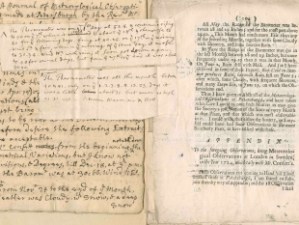
William Derham’s annotated proof of Philosophical Transactions (RS L&P/121/1/5)
Early modern naturalists collected, generated, and shared massive amounts of paper. Inspired by calls for the wholesale reform of natural philosophy and schooled in humanist note-taking practices, they generated correspondence, reading notes (in margins, on scraps, in notebooks), experimental and observational reports, and drafts (rough, partial, fair) of treatises intended for circulation in manuscript or further replication in print. If naturalists claimed all knowledge as their province, natural philosophy was a paper empire. In our own day, naturalists’ materials, ensconced in archives, libraries, and (occasionally) private hands, are now the foundation of a history of science that has taken a material turn towards paper, ink, pen, and filing systems as technologies of communication, information management, and knowledge production. Recently, the creation of such papers, and their originators’ organization of them and intentions for them have received much attention. The lives archives lived after their creators’ deaths have been explored less often. The posthumous fortunes of archives are crucial both to their survival as historical sources today and to their use as scientific sources in the past.
How did (often) disorderly collections of paper come to be “the archives of the Scientific Revolution”? The proposed conference considers the histories of these papers from the early modern past to the digital present, including collections of material initially assembled by Samuel Hartlib, John Ray, Francis Willughby, Isaac Newton, Hans Sloane, Martin Lister, Edward Lhwyd, Robert Hooke, and Théodore de Mayerne. The histories unearthed—of wrangling over the control and organization of the papers of dead naturalists (and by extension, of the legacies of the dead and the living), of putting the scraps and half- finished experiments cast off by fertile minds to work, of extending and preserving their legacies in print —serve not only as an index of the cultural position of scientific activity since the early modern period. They also engage us in thinking about genealogies of scientific influence, the material and intellectual resources that had to be deployed to continue the scientific project beyond the life of any one individual, the creation and management of scientific genius as a posthumous project, and scientific activity as a collective endeavor in which scribes, archives and library keepers, editors, digital humanists and naturalists’ surviving friends and family members had a stake.
◊ ◊ ◊ ◊ ◊
P R O G R A M M E
9:15 Registration and coffee
9:30 Welcome and Introduction by Vera Keller, Anna Marie Roos, and Elizabeth Yale
9:45 Session I | Archival Afterlives: Miscellanies and Method
Chair: Anna Marie Roos, University of Lincoln
• Vera Keller, University of Oregon: Scarlet Letters: The Mayerne Papers within the Royal Society Archives
• Richard Serjeantson, Trinity College, Cambridge University: University Natural Philosophy in the Archives
11:00 Tea and coffee
11:15 Session II | Archival Afterlives: Natural Histories
Chair: Felicity Henderson, University of Exeter
• Elizabeth Yale, University of Iowa: ‘A Dying Hand’: Crafting the Posthumous Legacies of John Ray
• Anna Marie Roos, University of Lincoln: ‘Fossilised Remains’: William Huddesford, and the Lhwyd and Lister Ephemera in the Bodleian Library
12:30 Lunch
1:45 Session III | Archival Afterlives: Script and Print in the Sloane Collections
Chair: Anne Goldgar, King’s College, London
• Arnold Hunt, King’s College London, Under Sloane’s Shadow: The Archive of James Petiver
• Alison Walker, British Library: Collecting Knowledge: Annotated Material in the Library of Sir Hans Sloane
3:00 Session IV | Archival Afterlives: Archiving for Future Pasts
Chair: TBA
• Leigh Penman, University of Queensland: ‘Omnium exposita rapinae’: A Biography of the Papers of Samuel Hartlib, 1662–2015
•Victoria Sloyan, Wellcome Library: Collecting Genomics: Archiving Modern, Collaborative Science
4:15 Tea and coffee
4.30 Commentary and discussion led by Michael Hunter, Birkbeck College, University of London
5:30 Plenary Session
• Lauren Kassell, Pembroke College, Cambridge: Stars and Scribes, Astrology and Archives (simulcast University of Oregon)
Abstracts are available here»
Conference | Representing the Habsburg-Lorraine Dynasty, c. 1618–1918
From the conference programme:
Representing the Habsburg-Lorraine Dynasty in Music,
Visual Media, and Architecture, c. 1618–1918
Institute of History of Art and Musicology, Austrian Academy of Sciences, Vienna, 8–10 June 2015
 This international conference will take place in Vienna from the 8th to the 10th of June 2015. It will be devoted to the new interdisciplinary research program ‘Representing Habsburg’—one of the main current research fields of the Institute for History of Art and Musicology (IKM) of the Austrian Academy of Sciences focusing on the history of fine arts and music in Austria and Central Europe in their general European context. Please register at:
kunstgeschichte@oeaw.ac.at.
◊ ◊ ◊ ◊ ◊
M O N D A Y , 8 J U N E 2 0 1 5
10:30 Registration
11:00 Opening, Werner Telesko, Director of the Institute of History of Art and Musicology
11:30 Topics and Media of Representation
Chair: Alexander Rausch, Werner Telesko
• Andrea Lindmayr-Brandl, University of Salzburg | Vom Volkslied zur Kaiserhymne: „Gott erhalte, Gott beschütze / unsern Kaiser, unser Land!“
• Friedrich Polleroß, University of Vienna | Repräsentation und Reproduktion. Der „Kaiserstil“ in den zeitgenössischen „Massenmedien“
13:00 Lunch Break
14:30 Topics and Media of Representation, Part 2
• Adriana De Feo, Mozarteum Foundation, Salzburg | Selbstdarstellung und höfische Repräsentanz: dramatische Sujets zur Glorifizierung des Geschlechts der Habsburger in der barocken Librettistik
• Irena Veselá, Moravian Museum, Brno | „Venga quel dì felice!“ Dynastisch-politische Botschaften in musikali- schen Huldigungswerken für Karl VI. und Elisabeth Christine (1723)
• Allison Goudie, The National Gallery, London | Habsburg Portraiture face-to-face with the French Revolution
• Olivia Gruber Florek, Delaware County Community College | The Absent Empress: Photomontage, the Habsburg Monarchy, and Celebrity in the Nineteenth Century
18:30 Evening Lecture
• Michael Yonan, University of Missouri, Columbia | Interdisciplinary Material Culture Studies and the Problems of Habsburg Representation
T U E S D A Y , 9 J U N E 2 0 1 5
9:00 Dynasty, State, and Nation
Chair: Richard Kurdiovsky, Stefan Schmidl
• Andrea Baotic-Rustanbegovic, University of Sarajevo | Presentation of the Habsburg Dynasty in Bosnia and Herzegovina under the Austro-Hungarian Rule, 1878–1918: The Case of Public Monuments
• Nataša Ivanovic, ́Research Institute for Visual Culture, Ljubljana | State and National Representation in the Case of Ljubljana Town Hall
• Timo Hagen, Kunsthistorisches Institut in Florenz | K.u.k. Militärbauten als Repräsentanten der Gesamtmonarchie in der siebenbürgischen „Peripherie“
• András Gero, Eötvös Loránd University, Budapest | Francis Joseph: The Hungarian Hero
12:30 Lunch Break
14:00 Agencies and Networks
Chair: Anna Mader-Kratky, Stefan Schmidl
• Milan Pelc, Institute of Art History, Zagreb | Leopold I. in der Sammlung Valvasor – Ikonographie des Kaisers aus der Perspektive eines Zeitgenossen
• Stefan Seitschek, Austrian State Archives, Vienna | Der Wiener Hof in den Tagebüchern Kaiser Karls VI.
• Martin Krummholz, The Czech Academy of Sciences, Prague | Habsburgische Propaganda in Rom zur Zeit des Botschafters Johann Wenzel von Gallas
• Jana Perutková, Masaryk University, Brno | Die von der mährischen Aristokratie in der ersten Hälfte des 18. Jahrhunderts veranstalteten musikdramatischen Aufführungen als Spiegel der musikalischen Feste am Wiener Kaiserhof
W E D N E S D A Y , 1 0 J U N E 2 0 1 5
9:00 Ceremonial Spaces and the „Public“
Chair: Elisabeth Hilscher, Herbert Karner
• Thomas Hochradner, Mozarteum University Salzburg | Spielball der Repräsentation? Überlegungen zur Kirchenmusik von Johann Joseph Fux
• Andrea Zedler, University of Regensburg / Michael Pölzl, University of Vienna | Tafelzeremoniell, „Schau-Essen“ und Musik als Mittel der Repräsentation im Zuge der Hochzeitsfeierlichkeiten von Erzherzogin Maria Amalia und Kurprinz Karl Albrecht in Wien (1722)
• Mirjana Repanic ́-braun, Institute of Art History, Zagreb | Representation of Habsburgs in the Croatian Historical Lands: Public Spaces and Art as Political Apparatus
• Anne-Marie Wurster, University of Freiburg i.B. | „Unter Trompetten- und Paucken-Schall“: Die Fronleichnamsfeierlich- keiten zur Zeit Maria Theresias als Demonstration imperialer Macht
12:30 Lunch Break
14:00 Ceremonial Spaces and the „Public,“ Part 2
• Peter Konecný – Miroslav Lacko, Slovak Academy of Sciences, Bratislava | Der Herrscher im Bergwerk: Die Visitationsreisen der Habsburg- Lothringer in die ungarischen (slowakischen) Bergstädte (1751–1852)
• Filip Šimetin Šegvic, University of Zagreb | Zagreb/Agram als zeremonieller Raum im Jahr 1895: Kaiser Franz Joseph und die dynastische Repräsentation
15:30 Concluding Discussion
Colloquium | Charles de La Fosse and the Arts in France, ca. 1700
I posted notice of the exhibition last week; here’s the programme for the colloquium, with additional information available from the Centre de recherche du château de Versailles. –CH
Charles de La Fosse et les arts en France autour de 1700
Château de Versailles, 18–19 May 2015
 En complément de l’exposition Charles de La Fosse, le triomphe de la couleur, le Musée national des châteaux de Versailles et de Trianon et le Centre recherche du château de Versailles ont souhaité organiser un colloque international sur l’artiste. L’exposition, organisée en cinq grandes sections (les commandes pour les maisons royales ; La Fosse dessinateur ; la tradition académique ; le triomphe du coloris ; un précurseur du XVIIIe siècle) a été l’occasion de faire le point sur un artiste majeur de la seconde moitié du règne de Louis XIV. Le colloque doit permettre, quant à lui, de mieux situer Charles de La Fosse (1636–1716) dans les enjeux de la pratique artistique autour de 1700 dont l’étude a été profondément renouvelée depuis les travaux d’Antoine Schnapper.
◊ ◊ ◊ ◊ ◊
L U N D I , 1 8 M A I 2 0 1 5
9:00 Accueil
9:30 Introduction
• Les enjeux du colloque, Béatrice Sarrazin, conservateur général du patrimoine, chargé des peintures du xviie siècle, musée national des châteaux de Versailles et de Trianon; et Olivier Bonfait, professeur en histoire de l’art moderne, université de Bourgogne, Centre Georges Chevrier (CNRS)
• Charles de La Fosse, dix ans après, Clémentine Gustin-Gomez, docteur en histoire de l’art
10:30 L’art de Charles de La Fosse
Présidents de séance : Clémentine Gustin-Gomez et Nicolas Milovanovic, conservateur en chef, département des Peintures, musée du Louvre, Paris
• Charles de La Fosse et la peinture d’histoire autour de 1700, Karen Chastagnol, docteur en histoire de l’art
• Between ‘coloris’ and ‘dessein’, Hector Reyes, Assistant Professor, University of Southern California, Los Angeles
• La peinture religieuse de La Fosse et de Jouvenet, ou les vicissitudes de la grâce, Aaron M. Wile, Ph.D. candidate, Harvard University, Cambridge
13:00 Pause
14:30 Charles de La Fosse et le grand décor
Présidents de séance : Thomas Kirchner, directeur, Centre allemand d’histoire de l’art de Paris et Béatrice Sarrazin
• Le décor plafonnant à l’époque de Charles de La Fosse: vers une émancipation des influences italiennes? Moana Weil-Curiel, docteur en histoire de l’art
• Les galeries de Charles de La Fosse, Bénédicte Gady, collaboratrice scientifique, département des
Arts graphiques, musée du Louvre, Paris
• Vendages de Malapeire, le décor de la chapelle du Mont-Carmel à Toulouse et sa description, Stéphanie Trouvé, docteur en histoire de l’art
M A R D I , 1 9 M A I 2 0 1 5
9:00 Accueil
9:30 Charles de La Fosse et la mythologie
Présidents de séance : Olivier Bonfait et Patrick Dandrey, professeur de littérature française du xviie siècle, université Paris-Sorbonne
• La tenture des Métamorphoses des Gobelins : émulation artistique et stratégies commerciales, Pascal-François Bertrand, professeur d’histoire de l’art, université Bordeaux Montaigne (EA 538)
• The Fall of Gods: Charles de La Fosse’s Allegory of Autumn as Theme and Variation, Tatiana Senkevitch, The Sarah Campbell Blaffer Foundation, Museum of Fine Arts, Houston, Research Associate Rice University, Lecturer
• Le royaume des dieux : la représentation de l’Olympe dans les grands décors de Charles de La Fosse, Nicolas Milovanovic, conservateur en chef, département des Peintures, musée du Louvre, Paris
12:00 Pause
14:00 Charles de La Fosse et les capitales artistiques
Présidents de séance : Pierre Rosenberg, de l’Académie française, président-directeur honoraire, musée du Louvre, Paris et Margret Stuffmann, conservateur émérite, Städel Museum, Francfort-sur-le-Main
• Jacques Rousseau et Charles de La Fosse chez le duc de Montagu à Londres, Virginie Bergeret, diplômée de master II, École du Louvre
• Nouvelles hypothèses sur le décor peint de la salle à manger de Pierre Crozat, François Marandet, enseignant, Institut Supérieur des Arts (IESA), Warwick
• Charles de La Fosse et Venise : regards croisés au xviiie siècle, Valentine Toutain-Quittelier, docteur en histoire de l’art, chargée de cours, université de Poitiers
16:30 Conclusion et synthèse
• Olivier Bonfait et Béatrice Sarrazin avec Pierre Rosenberg
Exhibition | Charles de La Fosse: The Triumph of Color
Now on view at Versailles:
Charles de La Fosse, le triomphe de la couleur
Château de Versailles, 24 February — 24 May 2015
Musée des Beaux-Arts, Nantes, 19 June — 20 September 2015
Curated by Béatrice Sarrazin, Adeline Collange-Perugi, and Clémentine Gustin-Gomez
 Although almost forgotten over the past two centuries, Charles de La Fosse (1636–1716) introduced a great many new ideas during the reign of Louis XIV, of whom he was a contempory. His work bears testimony to the artistic development of Charles Le Brun under whom he studied, and that of Antoine Watteau, a close friend. Considered to be one of the greatest painters of his time, Charles de La Fosse contributed to all the royal worksites at the Tuileries, the Palace of Versailles and the Invalides, while still devoting a large amount of time to private commissions. His body of work is equally exceptional for his numerous drawings, in particular those using the ‘trois crayons’ technique (black, red, white).
Charles de La Fosse’s work can be admired throughout the Palace, as an introduction to the monographic exhibition devoted to him in Madame de Maintenon’s Apartement. The display of major compositions in the Royal Chapel, the Diana Room and the Apollo Room—restored for the occasion—reveals La Fosse to be one of the main creators behind the decoration in Versailles.
The exhibition at the end of the tour of the State Apartments highlights the different aspects of the artist’s talent, inspired by the masters of the Académie (Poussin and Le Brun), and strongly influenced by contact with Venetian (Titian and Veronese) and Flemish (Rubens and Van Dyck) paintings to produce light seductive paintings with glowing colours. Preferring colour to lines, La Fosse’s work was extremly innovative and makes him one of the great pioneers of the 18th century.
A colloquium Charles de La Fosse et les arts en France autour de 1700 is scheduled for 18–19 May 2015 (see the website for the Centre de recherche du château de Versailles).
The full press packet for the exhibition is available as PDf file here»
◊ ◊ ◊ ◊ ◊
From Dessin Original:
Béatrice Sarrazin, Adeline Collange-Perugi et Clémentine Gustin, Charles de La Fosse (Paris: Somogy, 2015), 240 pages, ISBN: 978-2757209158, 35€.
 Publié à l’occasion de la première exposition monographique consacrée à Charles de La Fosse, l’ouvrage met en lumière les différentes facettes du talent de l’artiste qui, puisant ses racines chez les maîtres de l’Académie (Nicolas Poussin et Charles Le Brun), sait se renouveler au contact de la peinture vénitienne (Titien et Paul Véronèse) et flamande (Pierre Paul Rubens et Antoine Van Dyck) pour créer une peinture séduisante et légère, aux coloris chatoyants. Favorisant la couleur plutôt que la ligne, l’œuvre de La Fosse, extrêmement novatrice, fait de ce peintre l’un des grands précurseurs du XVIIIe siècle.
Quelque peu tombé dans l’oubli ces deux derniers siècles, Charles de La Fosse (1636–1716) est pourtant le grand introducteur des idées nouvelles sous le règne de Louis XIV dont il est l’exact contemporain. Son œuvre témoigne de l’évolution de la création artistique, de Charles Le Brun, dont il fut l’élève, à celle d’Antoine Watteau, un ami proche. Considéré comme l’un des meilleurs peintres de son temps, Charles de La Fosse participe à tous les chantiers royaux des Tuileries, du château de Versailles et des Invalides, tout en consacrant une grande part de son activité aux commandes privées. Son œuvre est aussi remarquable par ses nombreux dessins, notamment ceux à la technique des trois crayons (pierre noire, sanguine, rehauts de blanc).
◊ ◊ ◊ ◊ ◊
S O M M A I R E
Charles de La Fosse tel qu’en lui-même, ALAIN MÉROT
Charles de La Fosse: un parcours novateur, CLÉMENTINE GUSTIN-GOMEZ
Charles de La Fosse à Versailles, BÉATRICE SARRAZIN
Charles de La Fosse: de Le Brun à Louvois, NICOLAS MILOVANOVIC
Charles de La Fosse: Les amours des dieux, ADELINE COLLANGE-PERUGI
Entre ligne et couleur: Réflexions sur les dessins de Charles de La Fosse, BÉNÉDICTE GADY
Charles de La Fosse en son temps, FRÉDÉRIQUE LANOË
Un coup de tonnerre (ou plutôt un coup de foudre), PIERRE ROSENBERG
Colloquium | Ces architectes qui ont bâti l’Europe
From H-ArtHist:
Les Européens: Ces architectes qui ont bâti l’Europe, 1450–1950
Institut national d’histoire de l’art, Paris, 23–25 April 2015
Organisé avec le soutien de LabEx EHNE : Ecrire l’Histoire Nouvelle de l’Europe (Université de Paris-Sorbonne); Centre André Chastel (CNRS, Université de Paris-Sorbonne); et Centre Jean Pépin, THETA (CNRS-ENS, Paris)
2 3 A V R I L 2 0 1 5
9.30 Ouverture du colloque par Alexandre Gady, directeur du centre André Chastel et Dany Sandron, responsable du LabEx EHNE pour le centre André Chastel
10.00 Olga Medvedkova (CNRS, centre Jean Pépin, Paris), Les « vitae» des architectes-migrants et la notion de l’Europe architecturale
10.30 L’Europe face à l’Europe à l’époque de la Renaissance
Président de séance : Alexandre Gady
• Marco Folin (Université de Gènes), Le cosmopolitisme d’un artiste de la Renaissance: Léonardo da Vinci (1442–1519) en France
• Sabine Frommel (EPHE, Paris), A la cour de France : Sebastiano Serlio (1475-1554) et Francesco Primaticcio (1504–1570)
• Agnieszka Wiatrzyk (EPHE, Paris), Le problème de la ville idéale : Bernardo Morando (1540–1600) et Zamosc
13.00 Pause déjeuner
14.30 Les architectes-migrants auprès des Cours européennes du XVIIe siècle
Président de séance : Claude Mignot
• Hélène Vérin (CNRS, centre Alexandre Koyré, Paris), De Princes en Monarques : Salomon de Caus (1576–1626) et l’art des grottes, fontaines et jardins
• Linnéa Tilly (AUSser umr 3329), De maître maçon à architecte, Simon (1590?–1642) et Jean (1624-1696) de la Vallée en Suède
• Jorge Fernández-Santos Ortiz-Iribas (E.T.S.A. Universidad San Jorge, Saragosse), Un polymathe à la recherche de l’obliquité architecturale : Juan Caramuel Lobkowitz (1606–1682)
• Raphaël Tassin (EPHE, Paris), Un Milanais, architecte du duc de Lorraine : Giovan Betto (1642–1722)
2 4 A V R I L 2 0 1 5
9.30 L’Europe élargie au Siècle des Lumières
Président de séance : Pascal Liévaux
• Alexandre Gady (Université de Paris-Sorbonne), Faire l’Europe sans bouger : Robert de Cotte (1656–1735) et l’architecture royale
• Ekaterina Orekhova (Musée de l’Ermitage, Saint-Pétersbourg), Deux Italiens parisiens à Saint-Pétersbourg dans la première moitié du XVIIIe siècle : les Rastrelli, père et fils
• Jérôme de La Gorce (CNRS, centre André Chastel, Paris), Un artiste florentin dans l’Europe des Lumières : Jean Nicolas Servandoni (1695–1766)
• Dimitri Ozerkov (Musée de l’Ermitage, Saint Pétersbourg), Les antiquités romaines sans frontières : Vincenzo Brenna (1747–1820) en Pologne et en Russie
13.00 Pause déjeuner
14.30 L’Europe face au Monde Nouveau (XVIIIe et XIXe siècles)
Président de séance : Jean-Philippe Garric
• Emilie d’Orgeix (Université de Bordeaux-III), Un ingénieur, architecte, théoricien français à travers l’Amérique et l’Europe : Amédée Frézier (1682–1773)
• Alberto Garin (Universidad Francisco Marroquín Lives, Antigua Guatemala), L’ingénieur militaire espagnol, entre l’Antigua et la Nouvelle Guatemala : Luis Díez Navarro (1699–1776)
• Philippe Malgouyres (Musée du Louvre), Un architecte néoclassique espagnol au Mexique au crépuscule de l’empire espagnol : Manuel Tolsa (1757–1816)
• Pascal Dubourg-Glatigny (CNRS, centre Alexandre Koyré, Paris-Berlin), Un architecte-ingénieur français au service des méandres politiques de la Colonie du Cape : Louis-Michel Thibault (1750–1815)
2 5 A V R I L 2 0 1 5
9.30 Les architectes émigrés et la modernité architecturale du XXe siècle
Président de séance : Pierre Caye
• Orfina Fatigato (Laboratoire ACS, ENSA Paris-Malaquais – DiARC, Università degli Studi di Napoli Federico II), Un ‘gothique’ devenu ‘latin’ : Le Corbusier (1887–1965)
• Nabila Oulebsir (Université de Poitiers, Centre Georg Simmel, CNRS-EHESS), Un architecte moderne méditerranéen : Léon Claro (1899–1991)
• Martin Pozsgai (Stiftung Bibliothek Werner Oechslin), Entre Bauhaus et exile : Fred Forbát (1897–1972), un architecte hongrois en Allemagne et en Suède
• Anat Falbel (Instituto de Filosofia e Ciencias Humanas. Universidade Estadual de Campinas. IFCH/UNICAMP), Architecture, histoire et engagement politique : Anatole Kopp
• Clôture du colloque par Pierre Caye, directeur du centre Jean Pépin, CNRS-ENS
Exhibition | George Morland: In the Margins
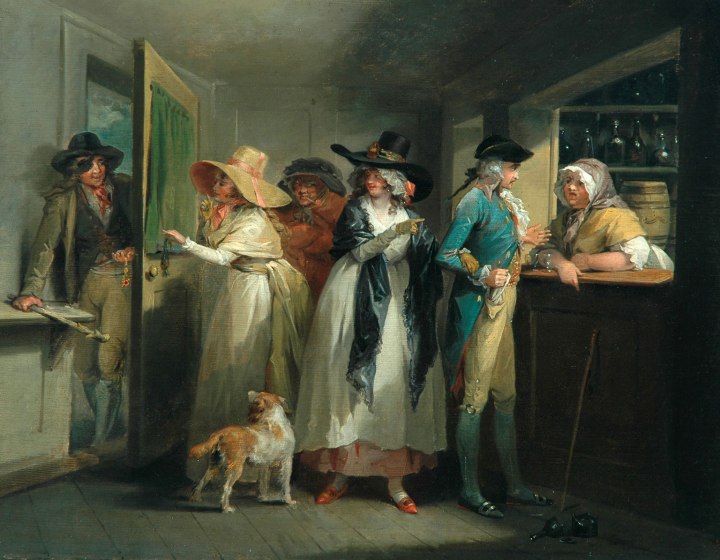
George Morland, Easy Money, 1788 (Huddersfield Art Gallery)
◊ ◊ ◊ ◊ ◊
Now on view at the University of Leeds:
George Morland: In the Margins
The Stanley & Audrey Burton Gallery, University of Leeds, 18 March — 11 July 2015
Curated by Nicholas Grindle
This exhibition looks at migrants and margins in the work of the painter George Morland (1763–1804), a popular painter whose lifestyle and early death earned him lasting notoriety. Over 250 of his works are held by public collections in the UK and US alone. His paintings of smugglers, gypsies, pedlars, soldiers, and families, which represent some of his best compositions, as well as how they mirrored his own life, raise compelling questions about who, and where, is ‘marginal’ in society. There has been no exhibition of his work since a small show in Reading in 1975 and no substantial discussion of his work since a thesis written in Stanford in 1977 and a chapter in John Barrell’s book Dark Side of the Landscape in 1980. His pictures resonate with contemporary issues such as migration and marginality in a way that was not evident thirty years ago.
The exhibition will run at The Stanley & Audrey Burton Gallery from 18 March 2015 until 11 July 2015, with a possible UK tour from August 2015 onwards.
◊ ◊ ◊ ◊ ◊
A symposium is scheduled for the end of May:
Bohemians and Marginal Communities in the 18th Century: George Morland in Context
The Stanley & Audrey Burton Gallery, University of Leeds, 29 May 2015
The Stanley & Audrey Burton Gallery presents a free symposium, bringing together academic discussion of the work of late 18th-century English painter George Morland. To coincide with our current exhibition George Morland: In the Margins, the Gallery is delighted to welcome experts and academics from a range of fields, to discuss the wider context of Morland’s work. These speakers will include the exhibition’s guest-curator Dr Nick Grindle (UCL); Professor of History of Art at Oxford Brookes University, Christiana Payne; social geographer, Dr Martin Purvis; independent art historian, Dr Anthony Lynch; and UEA MPhil student Francesca Bove.
The speakers will address representations of social margins in Morland’s artistic output and look at the parallels between his life and works. What can his representation of gypsies, smugglers, pedlars and families tell us about the societal conditions of the late 1800s and how do they reflect our own times? Morland was living on the brink of industrialisation, witnessing an increasingly capitalist culture and significant, sudden movements of people around the country; conditions which are still relevant to modern-day Britain. The worries of Morland’s contemporaries about the moral character and palatability of his works raises questions surrounding class relations and art’s role as social commentary and criticism.
Friday, 29 May 2015, 9:00–17:00. Free, though booking is essential. This event is kindly supported by the Paul Mellon Centre for Studies in British Art.
More information about programming for the exhibition is available here»
◊ ◊ ◊ ◊ ◊
The catalogue is available from the University of Leeds online bookstore:
Nicholas Grindle, ed., with essays by David Alexander, Kerry Bristol, Sue Ecclestone, Nicholas Grindle, and Martin Purvis, George Morland: Art, Traffic and Society in Late Eighteenth-Century England (Leeds: The Stanley & Audrey Burton Gallery, 2015), 99 pages, ISBN: 978-1874331544, £12.
 George Morland: Art, Traffic and Society in Late Eighteenth-Century England looks at the life and work of popular painter George Morland (1763–1804), whose remarkable talent, prodigious output, bohemian lifestyle and early death earned him lasting notoriety. Morland was the most infamous artist in Britain at the time of his death in 1804. His paintings enjoyed a stellar reputation, which was enhanced by stories about his fabulous earnings, prodigal spending, legendary drinking, and staggering debt. He was renowned for his associations with smugglers, gypsies and pugilists, as well as his constant attempts to evade his creditors. His best work is breathtaking in its ambition and execution, while the popularity of his drawings, paintings, and the prints after his work rose throughout his lifetime. Within months of his death, no fewer than four books had been published packed with anecdotes—many apocryphal—about his life and work. No other artist of the late eighteenth and early nineteenth centuries commanded such a profile.
Morland was reputed to have painted thousands of canvases and made hundreds of drawings. But in spite of his immense popular and critical stature, recent scholarly attention has been patchy, and this is the first publication to seriously review the artist in over thirty years. It includes five new essays which use recent perspectives in historical geography and studies of print and exhibition culture to help us look in new ways at his work and practice, as well as catalogue entries that bring scholarship on his paintings up to date.
Conference | Motion and Emotion in the French Enlightenment
From the conference program:
Body Narratives: Motion and Emotion in the French Enlightenment
Department of Art History, The University of Chicago, 10 April 2015
Organized by Susanna Caviglia
 8:30 Welcome, Christine Merhing, University of Chicago
8:40 Introduction, Susanna Caviglia, University of Chicago
9:00 Body Language: Narrative and Metaphor
Chair: Anne Leonard, Smart Museum of Art
• Anti-Pygmalion: Jean-Bernard Restout’s Diogenes Asking for Alms (1767) and the Question of Body Movement, Étienne Jollet, Université Paris 1 Panthéon-Sorbonne/Columbia University
• The Body Speaks: Anatomical Narratives in French Enlightenment Sculpture, Dorothy Johnson, University of Iowa
10:30 Coffee
11:00 The Mobile Body: Social Identity and Visual Dynamics
Chair: Nina Dubin, University of Illinois at Chicago
• Engaging Tapestries at the Hôtel de Soubise: Attention, Mobility, Intercorporeality, Mimi Hellman, Skidmore College
• Watching Her Step: Women and the Art of Walking after Marie-Antoinette, Melissa Hyde, University of Florida
12:30 Lunch
2:00 Body Temporality: Aesthetics of Walking
Chair: Robert Morrissey, University of Chicago
• Movement and Stasis: Mapping Cythera, Mary D. Sheriff, University of North Carolina at Chapel Hill
• Strolling Time, Ewa Lajer-Burcharth, Harvard University
3:30 Coffee
4:00 Roundtable
Chair: Rebecca Zorach, University of Chicago
• Basile Baudez, Université Paris-Sorbonne, Paris IV
• Richard Neer, University of Chicago
• Larry Norman, University of Chicago
• Andrei Pop, University of Chicago
5:30 Conclusions
6:00 Reception
Poster Image: Pierre Subleyras, Charon Ferrying the Shades (Paris: Louvre).
Conference | Origins and the Legitimacy of Architecture in Europe
From the research program’s website (it includes lots of interesting materials in addition to details of the upcoming conference). . .
Origins and the Legitimacy of Architecture in Europe, 1750–1850
Leiden University and the Rijksmuseum van Oudheden, Leiden, 1–2 May 2015
Organised by Maarten Delbeke, Sigrid de Jong, and Linda Bleijenberg
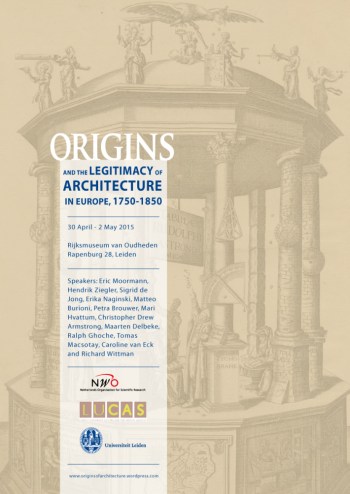 From Thursday 30 April to Saturday 2 May 2015 we will host an international conference at the Rijksmuseum van Oudheden in Leiden, to conclude our research program at the Leiden University Centre for the Arts in Society (LUCAS). Supported with generous funding from NWO, the project aimed at understanding how, between 1750 and 1850, changing views about the origins of civilization and the arts have affected the theory and practice of architecture in Europe. More in particular, the project aimed to understand how these views of origins, and especially the primitivism they often imply, have been adopted in architectural discourse to buttress the legitimacy of architecture in society.
The questions the conference wishes to address include: how do architectural origins relate to questions of architecture’s legitimacy as an artistic and cultural practice in the period under consideration? Why are origins deemed relevant to address these questions? To which particular architectural problems does the question of origins pertain? With which intellectual contexts and debates do architectural theory and practice enter in dialogue through the matter of origins? How do architectural origins relate to the primitivism that is manifest across a wide range of intellectual and artistic practices of the period? How do notions about origins sustained in historiography writ large affect architectural history and ideas about the historicity of buildings?
◊ ◊ ◊ ◊ ◊
F R I D A Y , 1 M A Y 2 0 1 5
9.30 Registration and coffee
10.00 Welcome by Maarten Delbeke
10.15 Session I. Myths
• Eric Moormann, ‘Mehr Modell und Puppenschrank als Gebäude’: How Pompeii Did Not Enhance Architectural Studies in the Eighteenth Century
• Hendrik Ziegler, Goethe and the Classical Canon in Architecture
• Sigrid de Jong, Myths of Origins: Stonehenge in the Royal Academy’s Architectural Histories
12.30 Lunch break
14.00 Session II. Histories
• Erika Naginski, On the Colonial Origins of Architecture: Building the ‘Maison Rustique’ in Cayenne, French Guiana
• Matteo Burioni, Imaginary Geographies and Imagined Beginnings: Pietro della Valle, Fischer von Erlach, Jean-Nicolas-Louis Durand
• Petra Brouwer, Origins of Architecture in the First Architectural History Survey Texts of James Fergusson, Franz Kugler, and Wilhelm Lübke
17.00 Book presentations, Sigrid de Jong and Caroline van Eck
18.00 Keynote Lecture
• Mari Hvattum, Heteronomic Historicism
19.00 Reception
S A T U R D A Y , 2 M A Y 2 0 1 5
9.30 Registration and coffee
10.00 Session III: Objects and Language
• Christopher Drew Armstrong, Theorizing the Orient: The Discourse on Origins, Language and Identity in the Paris Académie des Inscriptions
• Maarten Delbeke, Complexity and Contradiction in Architecture around 1820
• Ralph Ghoche, ‘La pensée simple que présente un cône’: Unity and Simultaneity in Simon-Claude Constant-Dufeux’s Tomb of Dumont d’Urville
12.15 Lunch break
13.45 Session IV: Religions and Rituals
• Tomas Macsotay, The Distracted Believer and the Return to the First Basilicae: Marqués de Ureña’s Reflexiones sobre la arquitectura, ornato, y música del templo (1785)
• Caroline van Eck, Quatremère de Quincy on the Origins of Architecture, Sculpture and Society: The Debate about Primitivism among Enlightenment Critics of Religion
• Richard Wittman, The Purity of Origins: Architecture in Rome after Napoleon
Exhibition | Treasured Possessions

Unidentified English maker, Trompe l’oeil folding fan, 1757
(Cambridge: The Fitzwilliam Museum)
◊ ◊ ◊ ◊ ◊
Assiduous readers of Enfilade may recall my fascination with puzzle jugs. And so in the spirit of April Foolishness, it’s the object from the exhibition I’m especially excited about—at least for today. There are more serious sorts of things from the eighteenth century also included (samples of which are available here), and the catalogue looks wonderful. -CH
From The Fitzwilliam:
Treasured Possessions from the Renaissance to the Enlightenment
The Fitzwilliam, Cambridge, 24 March — 6 September 2015
A dazzling journey through the decorative arts: from the hand-crafted luxuries of the Renaissance to the first stirrings of mass commerce in the Enlightenment. Each of the 300 beautiful and engaging objects was once a treasured possession, revealing the personal tastes and aspirations of its owner, and preserving precious memories. Witness the impact of global trade on European tastes: the lust for goods imported from the East, the revolutions caused by New World products like chocolate and sugar. European shoppers were lured by dazzling colours, intricate designs, constant technological innovation and the glamour of the exotic.
 This show is all about desire and possession. It explores how beautiful, curious and engaging objects were made, marketed, acquired, personalized and valued. Some objects shown here are undoubtedly masterpieces: works of dazzling design and innovative skill, long-prized as highlights of the Museum’s collection; others are more ordinary. The purpose of this exhibition is to move beyond conventional appraisals of artistic or monetary worth to appreciate how objects were crafted and what they were made from, and how possessions took on changing meanings for individual owners.
The Renaissance to the Enlightenment period is a long one (about 1400 to about 1800), which saw profound changes in the production and availability of goods. Over this time, we can chart the emergence of new luxuries and technological innovations, the importation and imitation of foreign artefacts such as porcelain or calico, the domestication of new world substances like chocolate or tobacco, and the first stirrings of mass production that
would transform the European home.
The objects in this new material world created new visual realities, and changed how people felt about themselves and others. Despite the rapid increase in the availability of non-essential goods, objects from this period were often charged with emotional significance and inscribed with sentimental value. Some of the things on display are named and dated so as to commemorate an important event such as a marriage or a death. Others show signs of persistent wear and tear and deliberate mending. There are home-made items, painstakingly created and handed down from one generation to the next. And there are showy pieces which flaunt the tastes, aspirations and fantasies of their past owners. Of course, we cannot always reconstruct the hidden history of an object; many of these treasures still hold their secrets tight.
I. A New World of Goods
The Renaissance witnessed an explosion of goods. Lists of household possessions, carefully recorded by scribes and preserved to this day, give a sense of the accumulated clutter in prosperous homes. Such inventories describe elaborate dinner services, glassware, furniture, linen, clothes, jewellery, ornaments and books. Equally striking is the presence of highly specialized items, such as hand-warmers or flower vases, often created to be beautiful as well as functional.
The great variety of objects in European homes testifies to new expectations of comfort, convenience, pleasure and taste. Here we find the new world of goods that Europeans discovered throughout the period: the age before industrialization and mass production, when non-essential commodities nevertheless became widely available across the social spectrum. While local craftsmen honed their skills to produce the innovative and intricate objects demanded by their clients, exotic foreign goods also entered the market. In turn, high-quality objects made at home were influenced, formally and stylistically, by global imports. The treasures displayed in this section give a taste of this astonishing period of innovation and experimentation.
II. Desiring and Acquiring Things

Trade card of James Wade, “Tea, Coffee, Chocolate and Snuff Seller”, Bristol, 1754 (Cambridge: The Fitzwilliam)
The Renaissance to Enlightenment period is often seen as an age of acquisitiveness, when Europeans tasted the pleasures of shopping for the first time. The reality of that experience was, however, a far cry from the sanitized world of today’s supermarkets and department stores. Buying and selling were activities subject to stern moral judgment and anxiety; fears of cheating and deception abound in literary accounts. Nor was it necessary to go to a shop in order to shop. Some of the treasured possessions exhibited here were commissioned directly from the maker; others were acquired from street vendors or markets.
In the eighteenth century, shopping became more than simply acquiring goods. It was a pastime and leisure activity, especially for the rising middling classes. Shops appeared in many British and continental European cities. They replaced market stalls and itinerant pedlars, offering a new experience for consumers increasingly allured by the goods displayed in their windows. At the same time, street sellers were the subjects of printed illustrations and expensive porcelain figures. Shopkeepers were also at the forefront of marketing innovation. They advertised their wares and services in newspapers and through trade cards and bill heads on customer receipts.
III. The Irresistible

Puzzle jug, English, probably London (either Lambeth Pottery or Rotherhithe Pottery), 1686. Tin-glazed earthenware, with pierced body containing a two-headed bird (Cambridge: The Fitzwilliam).
Antonio de Pereda’s painting Still Life with an Ebony Chest shows a mid-seventeenth-century Spanish vision of the irresistible: ebony from Africa, porcelain from China, chocolate and sugar from America, and lustreware from Valencia. The value of these enticing commodities lay not only with their rarity but also with their potential to generate pleasure. While ongoing anxieties about luxury and consumption did not disappear, Pereda’s image offers a meditation on the joys of living in ‘the here and now’.
The irresistible was inextricably linked to the expansion of Europe and the idea of the exotic, which changed constantly in response to the exploration of ‘new’ worlds. The Medici court in early Renaissance Florence desired the colourful and stylized designs of Iznik pottery and was, later on, the first European connoisseur of Chinese porcelain. Contact with America not only brought chocolate and sugar but also encouraged a new interest in the natural wonders of the New World. By the end of the eighteenth century, tobacco, chocolate, tea and coffee had all been ‘domesticated’ by Europeans. New objects, new behaviours and new social spaces were created for and
by the consumption of these novel stimulants.
IV. The Fashionable Body

Pair of shoes, English, c.1700–30. Yellow silk taffeta, bound with ribbon; floss silk embroidery in French knots, tied with ribbon. Design of scrolling stems with leaves and flowers (Cambridge: The Fitzwilliam)
The visual arts often dominate our sense of the Renaissance. Yet this cultural movement became visible to many through a new world of fashion. Tailoring was transformed by new materials and refined techniques of cutting and sewing, as well as by the demand for a tighter fit, particularly for men’s clothing. Enterprising merchants created larger markets for fashion innovations and ‘chic’ accessories. Artistic representations of the clothed body proliferated as never before. Mirrors enticed people to experiment with their appearance, as they caught sight of their reflections in looking-glasses on walls, or in small portable mirrors designed to be carried on the body.
This new type of consumption and aesthetic appreciation depended on the assemblage of a panoply of wearable goods from clothing and armour to accessories like hats, hair-pieces, feathers, toothpicks, rings, gloves, purses and shoes, which brought self-display to life. The tiny honestone portrait from the 1520s shows a woman at the height of fashion with a bonnet perched on her head. In turn, the earthenware male figure of 1606 sports an expensive modish slashed suit with belt, buttons and a flamboyant feathered hat. Even the style of facial hair could codify people and establish identities.
V. At Home and On Display
As Renaissance shoppers acquired more ‘stuff’, even ordinary homes became places of display, and new types of furniture evolved to store and show off the family treasures. During the period covered by this exhibition, traditional chests were replaced with front-opening cupboards, dressers and sideboards—versatile props on which ornamental items could be positioned. Meanwhile, cabinets containing small drawers allowed collectors to order their most precious objects, keep them safe under lock and key, and then draw them out to show selected visitors.
By the eighteenth century, technological changes, the expansion of global trade networks, and the growth of European markets had broadened the opportunities for buying and displaying goods in the home to a much wider group of people. Tea services were laid out and admired on sideboards, inkstands on desks, vases on mantelpieces, and scent-bottles and patch boxes on dressers. A whole range of ornamental porcelain items was available as well as equally coveted imitations in cheaper earthenware. The sub-division of interiors into specialized spaces resulted in new kinds of furniture such as the tea-table or secrétaire (‘writing desk for ladies’) used both to display fashionable objects and to hide its owner’s secrets.
◊ ◊ ◊ ◊ ◊
The catalogue is published by Philip Wilson:
Victoria Avery, Melissa Calaresu, Mary Laven, eds., Treasured Possessions from the Renaissance to the Enlightenment (London: Philip Wilson Publishers, 2015), 288 pages, hardback, ISBN: 978-1781300336, £40 / paperback £25.
This book is all about possession. It explores the significance of beautiful and engaging objects—chosen, acquired, personalised and treasured—to the people who once owned them. With over 300 works discussed, the book takes us on a dazzling visual adventure through the decorative arts, from Renaissance luxuries wrought in glass, bronze and maiolica to the elaborate tablewares and personal adornments available to shoppers in the Age of Enlightenment. En route the authors consider the impact of global trade on European habits and expectations: the glamour of the exotic, as witnessed in the lust for objects imported from the East, the ubiquity of New World products like chocolate and sugar, and the obsession with Chinoiserie decoration. They ask what decorative objects meant to their owners before the age of industrial mass production, and explore how technological innovation and the proliferation of goods from the sixteenth century onwards transformed the attitude of Europeans to their personal possessions.
Victoria Avery, FSA is Keeper of Applied Arts at The Fitzwilliam Museum, University of Cambridge. She has published extensively on Italian Renaissance sculpture, and was awarded the Premio Salimbeni 2012 for her monograph, Vulcan’s Forge in Venus’ City: The Story of Bronze in Venice, 1350–1650 (2011).
Melissa Calaresu is the Neil McKendrick Lecturer in History at Gonville and Caius College, Cambridge. She has written on the Grand Tour, autobiographical writing, urban space, political reform and, most recently the making and eating of ice cream in eighteenth-century Naples.
Mary Laven is Reader in Early Modern History at the University of Cambridge. She has written extensively about aspects of religion in Renaissance and Counter-Reformation Italy and is now working on ‘Domestic Devotions’, an interdisciplinary, collaborative project, funded by the European Research Council.
◊ ◊ ◊ ◊ ◊
From The Fitzwilliam:
Treasured Possessions Conference
St John’s College, Divinity School, Cambridge, 11 May 2015
Join scholars, curators and conservators for this day long event inspired by objects that once lay close to their owner’s hearts. Learn about the historical context of the exhibition, and the opportunity it provided for collaboration between curators, academics and makers. Key speakers include Peter Burke, Ludmilla Jordanova, Giorgio Riello and Evelyn Welch. The day closes with an early evening private view of the exhibition and drinks reception.
Monday, 11 May 2015, 9:00–17:00. Free but booking essential, tel: 01223 332904 or email: education@fitzmuseum.cam.ac.uk.
Symposium | The Romantic Eye, 1760–1860 and Beyond
From the YCBA:
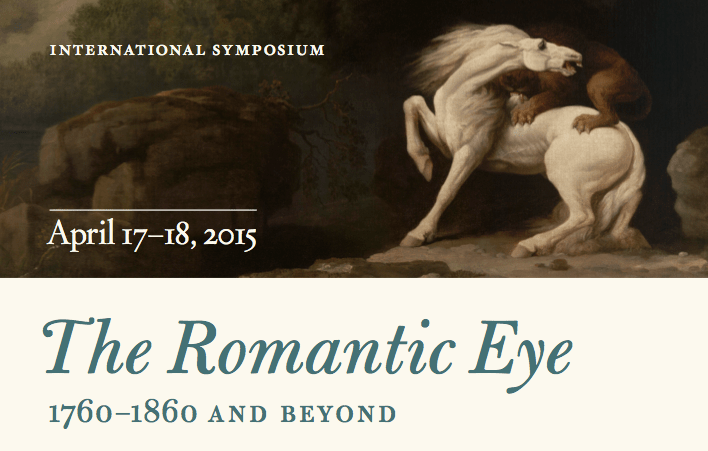
The Romantic Eye, 1760–1860 and Beyond
Yale University, New Haven, 17–18 April 2015
This two-day international symposium examines Romanticism as a shape-shifting cultural phenomenon that resists categorization. The symposium coincides with a major collaborative exhibition organized by the Yale Center for British Art and the Yale University Art Gallery, The Critique of Reason: Romantic Art, 1760–1860. Comprising more than three hundred works in a range of media, the exhibition features iconic artists including William Blake, John Constable, Honoré Daumier, Eugène Delacroix, Henry Fuseli, Théodore Géricault, Francisco de Goya, John Martin, and J. M. W. Turner.
The symposium is free and open to the public. Register online in advance (recommended) by April 15, or on-site at the event. For further information, contact ycba.research@yale.edu.
Cosponsored by the Yale Center for British Art, the Yale University Art Gallery, the Department of the History of Art at Yale University, and the Yale Student Colloquia Fund.
◊ ◊ ◊ ◊ ◊
F R I D A Y , 1 7 A P R I L 2 0 1 5
9:00 Registration and coffee
9:30 Welcome and curatorial remarks
10:00 Panel I: British Romanticism
Chair: Tim Barringer (Yale University)
• Paul Fry (Yale University), Peele Castle, Hadleigh Castle: Romantic Poetry and Painting
• Esther Chadwick (Yale University), “Copper in the Manner of Wood”: An Experimental Vignette by Thomas Bewick
• Terry Robinson (University of Toronto), Sarah Siddons and the Mediation of Spectatorship
12:00 Lunch break
1:30 Breakout Sessions
• A. Cassandra Albinson (Yale Center for British Art), The Child, the Portrait, and the Artist in the Romantic Period
• Nina Amstutz (Yale Center for British Art), Nature between Spectacle and Specimen: Robert John Thornton’s Temple of Flora and James Ward’s Two Extraordinary Oxen
• Gillian Forrester (Yale Center for British Art): “The origin of my fame”: The Visualizing “I”
in John Constable’s English Landscape Scenery and J. M. W. Turner’s Liber Studiorum Print Series c
• Scott Wilcox (Yale Center for British Art), The Rise of Watercolor Painting in Romantic Britain
2:30 Break
3:00 Panel 2: French Romanticism
Chair: A. Cassandra Albinson (Yale Center for British Art)
• Valérie Bajou (Versailles), Insolence and Insurrection in Romantic French Painting
• Mikolaj Getka-Kenig (University of Warsaw), The Fall of Napoleon and the Romantic Crisis of Heroic Representation
• Tamar Mayer (University of Chicago), Romanticizing the Neoclassical: Loss of Gravity in Jacques-Louis David’s Late Drawings and Artistic Procedures
5:00 Break
6:00 Andrew Carnduff Ritchie Keynote Lecture
• T. J. Clark (University of California, Berkeley), “Attempting Impossibles”: Hazlitt on Turner and Blake
7:00 Reception
S A T U R D A Y , 1 8 A P R I L 2 0 1 5
10:00 Panel 3: Romantic Pictorial Innovations
Chair: Nina Amstutz (Yale Center for British Art)
•Richard Maxwell and Katie Trumpener (Yale University), Romantic Panoramas: Robert Barker, Marquand Wocher, Eduard Gaertner
• Allan Doyle (Princeton University), Théodore Géricault and the Lithographic Picturesque
• Izabel Gass (Yale University), Portrait of the Artist as a Young Narcissist
12:00 Lunch break
2:00 Panel 4: Baudelaire and Romanticism
Chair: Colin Foss (Yale University)
• Tobias Kämpf (Ruhr University Bochum), Poetry as Art Criticism: Baudelaire’s Romantic Quest
• Carol Armstrong (Yale University), Baudelaire: Looking Back from 1863
3:30 Break
4:00 Panel 5: Afterlives—Modern Art and the Romantic Tradition
Chair: Harry Adams (Yale University)
• AnnMarie Perl (Princeton University), Mysticism, Striptease, Iconoclasm: Yves Klein’s Debut Performance of the Anthropometries in 1960
• Daniel Spaulding (Yale University), Death Keeps Me Awake: Joseph Beuys and the Conclusion of Romanticism










leave a comment