Symposium | The 2015 Newport Symposium
From The Preservation Society of Newport County:
North and South: Crosscurrents in American Material Culture
23rd Annual Newport Symposium, Newport, Rhode Island, 26–29 April 2015
Despite the sometimes irreconcilable differences that culminated in the Civil War (1861–65), Newport and other Northern cities maintained close social, economic, cultural, and artistic ties with the South from the Colonial period through the Gilded Age. The 2015 Newport Symposium, North and South: Crosscurrents in American Material Culture, invites a fresh look at regional differences in American furnishings, silver, textiles, painting, architecture, and interiors to reveal the complex exchange of ideas and enduring influences.
◊ ◊ ◊ ◊ ◊
S U N D A Y , 2 6 A P R I L 2 0 1 5
4:00 Opening Lecture
“Historic House Museums, North and South: Preserving Our Past, Enhancing Our Future,” George McDaniel (Executive Director, Drayton Hall, Charleston, SC)
In both the North and South, historic house museums are too often seen as staid institutions, stuck on giving only boring ‘velvet ropes’ tours and suffering from declining revenues and morale. While such examples do exist, there are also many house museums that are using their collections, their site, and their staff in innovative and strategic ways to reach out and make a difference in their communities and beyond, and to thereby play significant roles in preserving our past and enhancing our future.
5:00 Opening Reception at Rosecliff (1902)
M O N D A Y , 2 7 A P R I L 2 0 1 5
8:00 Registration and coffee
9:00 Welcome, Donald O. Ross (Chairman of the Board, The Preservation Society of Newport County)
9:30 “Pride & Prejudice: Understanding North and South,” Tom Savage (Director of Museum Affairs, Winterthur Museum)
At the first Williamsburg Antiques Forum in 1949, Joseph Downs, then curator of the American Wing at the Metropolitan Museum of Art, announced that “little furniture of artistic merit was ever produced south of Baltimore.” A southern matron asked politely but pointedly if Mr. Downs had spoken “out of prejudice or ignorance?” The battle cry that went out from that conference spawned the landmark 1952 exhibition Furniture of the Old South, 1640–1820 at the Virginia Museum and a special issue of The Magazine Antiques dedicated to southern furniture. In 1965, The Museum of Early Southern Decorative Arts (MESDA) opened in Winston-Salem, North Carolina. This lecture will examine the historiography of southern decorative arts research and the mythological perceptions that have pervaded our understanding of American material culture, both North and South.
10:30 Break
11:00 “He Went to War a Virginian But Came Home an American: General Washington’s Revolutionary Transformation of Mount Vernon,” Susan Schoelwer (Robert H. Smith Senior Curator, George Washington’s Mount Vernon)
George Washington’s wartime travels took him to countless communities in New England and the Middle States, giving him rich opportunities to compare country estates and city houses in these regions with more familiar examples in Virginia and Maryland. After the Revolution, he drew on these experiences to purposefully redesign Mount Vernon, his beloved home and estate on the Potomac River, to suit what he called his ‘Republican stile of living’. The resulting innovations—most notably the picturesque landscape surrounding the Mansion and the grand neoclassical interior that Washington called his ‘New Room’—vividly expressed his prescient vision for the future of the new American nation.
12:00 Lunch
1:30 Concurrent lectures and tours
“Beyond the Summer Colony: Exchange Between Charleston and Newport,” Brandy Culp (Curator Historic Charleston Foundation)
Because of its favorable climate and intellectual charm, Newport was a fashionable summer destination for many Charlestonians in the eighteenth and nineteenth centuries. In addition to being what some have called “the Bath of America,” Newport was an important partner in the coastal trade, and the two cities were economically linked. We will discuss the exchange of goods between Newport and Charleston facilitated by merchants such as Rhode Island native Nathaniel Russell, as well as the cultural connections that gave rise to Newport’s popularity among the southern colony.
“Elegant Boston Interiors 1789–1830,” Jane Nylander (President Emerita) and Richard Nylander, (Curator Emeritus, Historic New England, Boston, MA)
In two consecutive afternoon sessions, the Nylanders will discuss furnishings and interiors in the homes of Boston’s elite during the New Republic. Early nineteenth-century Boston witnessed changing styles of architecture and furniture, new technologies, increasing prosperity, and an expanded circle of world trade. Interiors featured both locally made and imported goods such as textiles and wallpaper, ceramics and glass, window curtains and carpets as well as paintings and sculpture, reflecting an increased interest in the fine arts.
3:00 Concurrent lectures and tours
“Finding the Sacred in the Secular: Eighteenth-Century Synagogue Architecture in Newport and Charleston,” Daniel Kurt Ackermann (Associate Curator, Museum of Early Southern Decorative Arts, Winston-Salem, NC)
Touro Synagogue in Newport, which opened in 1763, has long been held up as a symbol of religious tolerance in America. Indeed, both Touro and KKBE’s Synagogue in Charleston, South Carolina, were important buildings in their cityscapes. These two sacred buildings constructed in secular styles reflected the status and acceptance that Jews found in early America. They also reflected the webs of kinship, commerce, and faith that linked the Jews of Newport and Charleston to each other and to the rest of the Jewish Atlantic world.
“Elegant Boston Interiors 1789–1830,” Jane Nylander (President Emerita) and Richard Nylander, (Curator Emeritus, Historic New England)
In two consecutive afternoon sessions, the Nylanders will discuss furnishings and interiors in the homes of Boston’s elite during the New Republic. Early nineteenth-century Boston witnessed changing styles of architecture and furniture, new technologies, increasing prosperity, and an expanded circle of world trade. Interiors featured both locally made and imported goods such as textiles and wallpaper, ceramics and glass, window curtains and carpets as well as paintings and sculpture, reflecting an increased interest in the fine arts.
4:00 “Elegant Taking and Talking Tea: Gentility, Patriotism and Shared Conversations in Early America,” Martha Willoughby (Senior Specialist, Christie’s, London)
This lecture will look at the American tea party and its central role in social and cultural discourse during the eighteenth century. Throughout the colonies, the ritual of tea drinking and its symbolism of British tyranny during the Revolution provided a means for establishing and affirming bonds with neighbors, visitors and compatriots. A close look at the tea party’s guest of honor—the tilt-top tea table—will illustrate the lively and fruitful conversation of ideas between North and South.
5:00 Tea and refreshments
T U E S D A Y , 2 8 A P R I L 2 0 1 5
8:00 Registration and coffee
9:00 “North and South: Town & Country,” Trudy Coxe (CEO & Executive Director) and Laurie Ossman (Director of Museum Affairs, The Preservation Society of Newport County)
9:30 “‘Send None but the Finest Quality’: Art and Patronage in Early Maryland–The Edward Lloyd Family and Beyond,” Alexandra Kirtley (The Montgomery-Garvan Associate Curator of American Decorative Arts, Philadelphia Museum of Art)
Edward Lloyd settled on Maryland’s Eastern Shore in 1659. There he established a dynasty of gentleman farmers, whose lands eventually stretched the entire length of the Delmarva peninsula. The Lloyds patronized artists of the first order, from the finest silversmiths and furniture makers to British marine painter Dominic Serres and American portraitist Charles Willson Peale. The family crafted an extraordinary landscape and built exceptional manor houses to reflect the most current architectural styles of the day. The story of the Lloyd family art patronage typifies the social experience in Early Maryland and the Upper South.
10:30 Break
11:00 “Five Desks for Virginia: New England Furniture in the South and the Caribbean during the Eighteenth Century,” Brock Jobe (Professor of American Decorative Arts, Winterthur Museum)
Throughout the 1700s, many New England woodworkers built furniture for export to distant ports in the South, the Caribbean, and beyond. Craftsmen often entered into contracts with ship captains, who carried the furniture from port to port in search of a market; when the pieces were finally sold, the proceeds were used to purchase timber, coffee, and molasses. The first provided the raw material for the furniture-making; the latter two offered a source of cash for craftsmen. We will trace the furniture export trade in four New England communities: Portsmouth, Salem, Boston, and Newport.
12:00 Lunch
1:30 Concurrent lectures and tours
“The Cosmopolitan Middletons: A Family’s History as Told Through Their Collections,” George McNeely (Vice President for Strategic and International Affairs, World Monuments Fund, New York)
The Middleton family established themselves in South Carolina in the early 18th century and have been prominent in politics, international affairs, commerce and culture ever since. Their remarkably grand Jacobean-style seat was completed in 1741 and the unusual ‘butterfly’ lakes and extensive gardens in the following decades. Trace the family through triumphs and despair, from Charleston to Philadelphia to Newport to London and back, through a wonderful selection of paintings, furniture and decorative arts in the family collections.
“In Search of Respite: Natchezians at the Northern Resorts,” Jeff Mansell, Historian, Natchez National Historical Park
In an attempt to escape the blistering Southern summers, wealthy Natchez, Mississippi planters sought refuge at popular watering holes and fashionable Northern resorts. From June to October, in a seemingly steady progression, Natchezians moved from Niagara Falls and Seneca Lake to Saratoga and Cape May. In August, they descended on Newport and by 1860, one planter’s wife observed, “it seems to me all of Natchez is here.” While most Natchezians spent only a few weeks of the season in Newport, others built cottages and became fixtures in the social and cultural life of the town.
3:00 Concurrent lectures and tours
“Victoria Mansion: The 1860 Maine Summer Home of a New Orleans Hotelier,” Arlene Palmer Schwind (Curator, Victoria Mansion, Portland, ME)
Maine native Ruggles Sylvester Morse began his hotel career in Boston and New York, but by 1843 he settled in New Orleans where he quickly made a sizable fortune. Between 1858 and 1860 he constructed a magnificent summer home in Portland, Maine. This Italian villa style mansion is largely intact, with interiors that are exceptional for their brilliant wall and ceiling paintings, marble fireplaces, and stained glass. Over ninety percent of the original furnishings remain from 1860, including an important collection of furniture by Gustave Herter, who also supervised the design of the mansion’s sumptuous interiors. Learn how Morse’s background as a hotelier and a New Orleans resident influenced the design and furnishing of this unique example of pre-Civil War grandeur, a National Historic Landmark that has been a historic house museum since 1941.
“The North in the South: Furnishings in Antebellum Natchez,” Caryne Eskridge (Project Manager and Research Curator, The Classical Institute of the South, New Orleans)
In the mid-nineteenth century, the elite ‘Natchez Nabobs’ possessed the wealth, taste, and connections that allowed them to order the most fashionable furnishings from Philadelphia, New York, and Massachusetts. As a result, many of the parlors, dining rooms, and bedrooms in Natchez resembled what was found in elite households in the Mid-Atlantic and New England. These objects challenge the distinction of ‘northern’ versus ‘southern’ and reveal significant paths within the dynamic movement of goods and people. The presentation will highlight objects that remain extant in Natchez, in some cases in a nearly complete context.
7:00 Dinner at The Breakers (1895)
W E D N E S D A Y , 2 9 A P R I L 2 0 1 5
8:30 Registration and coffee
9:30 “‘The Largest Assortment Constantly on Hand’: Furniture in New Orleans, 1840–1900,” Stephen Harrison (Curator of Decorative Art and Design, The Cleveland Museum of Art)
Recent research suggests that the story of household furnishings in the South’s most prosperous port city is far richer in its associations with Europe and the American style centers of the North both before and after the Civil War than ever imagined before. This fully illustrated lecture will discuss the many furniture emporiums that lined Royal Street and the bounty they displayed. Familiar purveyors such as Barjon, Mallard, and Siebrecht will come to life again along with the storied plantations and fashionable city residences they furnished and adorned with furniture of ‘fancy and fashion’ they kept ‘constantly on hand’.
10:30 Break
11:00 “Painting in the American South, 1730–1790,” Carolyn Weekley (Juli Grainger Curator Emerita, Colonial Williamsburg)
Portraiture dominated the activity of painters who worked in the early South. Most artists were trained in trades techniques such as signboard and coach painting. Both resident and traveling painters were the chief providers of portraits, although Southerners occasionally commissioned pictures from artists elsewhere in America and abroad, chiefly in London. Most of the painters engaged by Southerners had contact with others in the trade. Some were directly trained by fellow painters while others imitated the idiosyncratic styles of other artists.
12:00 Lunch
1:00 Optional independent touring
Symposium attendees will be admitted free of charge by presenting their symposium badges at the following properties: Redwood Library and Athenaeum (1748), Newport Art Museum, J.N.A. Griswold House (1864), The International Tennis Hall of Fame, Newport Casino (1881), The Museum of Newport History at Brick Market. Preservation Society Properties: Chateau-sur-Mer (1852), Marble House (1892), The Breakers (1895), The Elms (1901), Rosecliff (1902)
Symposium | Robert Adam and His Brothers
From the conference programme and The Georgian Group:
Robert Adam and His Brothers
Burlington House, Piccadilly, London, 23–24 September 2015
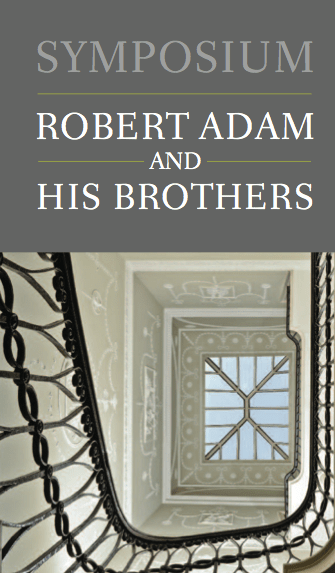
Adam Staircase Compartment of the 1770s, Mansfield Street, London, (Chris Redgrave, English Heritage)
The Adam style revolution transformed British architecture in the latter half of the eighteenth century. The brothers’ unique and inventive approach to design, based on a modern reinterpretation of the art of antiquity, found widespread popularity and was to have a lasting impact on European and American architecture. The movement and surface variety inherent in their buildings, combined with the lightness and informality of their interiors, set new standards of elegance and were widely imitated.
This two-day Georgian Group symposium, led by the architectural historians Colin Thom of UCL and Georgian Group Journal editor Dr Geoffrey Tyack, will highlight new research and findings on Robert Adam and his brothers across all aspects of their life and work, including architecture, interior decoration, the use of colour, the influence of classical sources, drawing office procedure, the art market, town-planning and building speculation. The symposium will offer interpretations by a mix of established scholars and a younger generation of historians and doctoral students, one of the main objectives being to stimulate further study on the Adams.
The Symposium papers will form the basis of a monograph to be published by Historic England in association with The Georgian Group. £100 per person for both days, or £60 for a single day. Buffet lunch included on both days. Book online or print and mail this form, with full payment, to: The Georgian Group, 6 Fitzroy Square, London W1T 5DX. Please make cheques payable to The Georgian Group. For further information, telephone 020 7529 8920.
◊ ◊ ◊ ◊ ◊
W E D N E S D A Y , 2 3 S E P T E M B E R 2 0 1 5
9.30 Registration and coffee
9.50 Opening address and welcome by Geoffrey Tyack and Colin Thom
10:00 Session 1: Scotland
• Alistair Rowan (University College, Cork), Johnie, the Eldest Adam Brother
• Simon Green (Royal Commission on the Ancient and Historical Monuments of Scotland), John, Robert and James Adam Build a House in Ayrshire
• Anthony Lewis (Curator of Scottish History, Glasgow Museums), The Adam Brothers and Their Building Tradesmen in Scotland
11:30 Tea and coffee
12:00 Session 2: Italy
• Jonathan Yarker (Lowell Libson Ltd, Art Dealers), ‘Antique Mad’: The Adam Brothers, Their Collection of Antiquities and the Roman Art Market in the Eighteenth Century
• Maria Celeste Cola (Department of Art History, Sapienza Università di Roma) Travelling to Naples: Drawings and Views by Robert Adam
1:00 Lunch
2:00 Session 3: Interior Design and the Adam Style: Antique and Etruscan
• Adriano Aymonino (Lecture in Art History, University of Buckingham), Robert Adam and the birth of the ‘true style of antique decoration’: the interiors at Kedleston Hall and their antiquarian sources
• John Wilton-Ely (Emeritus Professor in the History of Art, University of Hull) Piranesi and the Etruscan Style of Robert Adam: a Stylistic Revolution
3:15 Tea and coffee
3:45 Session 4: Interior Design and the Adam Style: Adam’s Painters and Chinoiserie
• Flaminia Conti (MA in History of Art, Sapienza Università di Roma), Reinvoking the Antique in Interior Design: The Work of Giovanni Battista Cipriani in the Houses of Robert Adam
• Katherine McHale (PhD candidate, School of Art History, University of St Andrews) Adam and the Academicians: The Contributions of Leading Italian Artists
• David Pullins (PhD candidate, Harvard University), Robert Adam’s Neoclassical Chinoiseries
T H U R S D A Y , 2 4 S E P T E M B E R 2 0 1 5
9:30 Tea and coffee
10:00 Session 5: Interior Design and the Adam Style: Light, Colour, and Theatre
• Richard Ireland (Conservator, historic paint and plaster), The Adam Brothers at Kenwood: Reconsidering
• Conor Lucey (Irish Research Council Elevate Postdoctoral Fellow, Trinity College Dublin), From Developed Surfaces to Misapprehended Plans: Robert Adam’s Interiors for Headfort House
• Miranda Hausberg (PhD candidate, University of Pennsylvania), Robert Adam’s Scenographic Interior
11:15 Tea and coffee
11:45 Session 6: Later Adam: Metropolitan Speculation, Villas, Castle Style and Picturesque
• Colin Thom (Senior Historian, Survey of London, UCL Bartlett School of Architecture), Portland Place: A Reassessment
• Sue Berry (Sussex Archaeological Society, former Associate Lecturer, Sussex University), Robert Adam’s Seaside Villa in Brighton
• Marrikka Trotter (PhD Candidate, Harvard University), Temporal Sublime: Robert Adam’s Castle Style and Picturesque Landscapes
1:00 Lunch
2:00 Session 7: Adam Drawings and Plans
• Stephen Astley (Curator of Drawings, Sir John Soane’s Museum), The Adam Office and Adam Drawings
• David King (Emeritus Professor, Economics, University of Stirling), The Ingenious Mr Adam
3:00 Session 8: The Adam Legacy
• Eileen Harris (historian and author), The Parent Style or the Original Sin? The Adam Revival in America
Conference | Challenging Materials: Joshua Reynolds
From The Paul Mellon Centre for Studies in British Art:
Challenging Materials: Joshua Reynolds and Artistic Experiment in the Eighteenth Century
The Wallace Collection, London, 15 May 2015
Organized by The Paul Mellon Centre for Studies in British Art and The Wallace Collection

Joshua Reynolds, Portrait of Mrs Mary Robinson, ‘Perdita’ , 1783–84 (London: The Wallace Collection)
This on-day conference, which accompanies the exhibition Joshua Reynolds: Experiments in Paint at the Wallace Collection, is designed to investigate and contextualise the artist’s famously experimental practice. Building upon the technical findings of the Reynolds Research Project at the Wallace Collection, and also on a range of recent conservation projects on Reynolds’s paintings, it will explore his distinctive manipulation of paint as a medium. Papers will explore new perspectives on Reynolds’s experimental forms of pictorial composition, narrative and allusion, and to look afresh at the dynamic interactions between the artist, his sitters and his models in the studio. As well as focusing on Reynolds’s own art in detail, the conference seeks to place his experimental activities within the context of wider artistic, cultural and scientific practices of the eighteenth century.
Confirmed Speakers: Mark Aronson, Helen Brett, John Chu, Cora Gilroy-Ware, Matthew C. Hunter, Rica Jones, Andrew Loukes, Martin Myrone, Marica Pointon, Martin Postle, Sophie
Reddington, Lisa Renne and Iris Wien.
The conference will take place on 15th May 2015 in London at The Wallace Collection. Tickets can be purchased via Eventbrite. General Admission: £65 (+ admin fee) / Concession Ticket: £45 (+ admin fee).
◊ ◊ ◊ ◊ ◊
F R I D A Y , 1 5 M A Y 2 0 1 5
9.00 Private view of Joshua Reynolds: Experiments in Paint
10.00 Introduction: Mark Hallett and Christoph Vogtherr
10:15 Session 1
• Marcia Pointon (Professor Emeritus in History of Art, The University of Manchester), Known Knowns, Known Unknowns and Unknown Unknowns: Finish and unfinish, in a portrait by Reynolds from the 1750s (?)
• Helen Brett (Painting Conservator, Tate and Martin Postle, Deputy Director, The Paul Mellon Centre), ‘New Light on an old Warhorse’: Joshua Reynolds’s portraits of Lord Ligonier
11:15 Coffee Break
11:45 Session 2
• John Chu (Research Cataloguer, Tate Britain), Experiment, Excess, Patronage: Joshua Reynolds and the 3rd Duke of Dorset
• Iris Wien (Marie Curie/IPODI Fellow, Technical University Berlin), Character as experiment: Reynolds’s A Strawberry Girl and his Boy Holding a Bunch of Grapes
• Rica Jones (Conservator of Paintings, formerly at Tate Gallery), ‘I can vouch for them to be authentick and just, either from my own experiments and observations, the information of persons of undoubted veracity who have practised them, or clear deductions from unquestionable principles’: An appraisal of Robert Dossie’s ‘Handmaid to the Arts’ and the climate in which it was produced in the 1750s
13:15 Lunch Break
14:15 Session 3
• Sophie Reddington (Paintings Conservator, Private Studio and Andrew Loukes, Curator of Exhibitions and Collections, Petworth House, National Trust), Toil and Trouble: The history, materials and restoration of Reynolds’s largest work
• Mark Aronson (Chief Conservator, Yale Centre for British Art), Canvas, a Time Based Media: Joshua Reynolds’s portraits revealed through X-radiography
• Elizaveta Renne (Keeper of British and Scandinavian Paintings at the State Hermitage Museum in St Petersburg), The painting which ‘might be called great if it were more correct: it might perhaps have been correct had it not attempted to be great’
16:00 Coffee Break
16:30 Session 4
• Matthew Hunter (Assistant Professor and Graduate Program Director, Department of Art History and Communication Studies, McGill University), ‘The Unique Art of Hightening and Preserving the Beauty of Tints to Futurity without a Possibility of Changing’: William Birch’s Chemical Gambits
• Cora Gilroy-Ware (from September 2015, Huntington Library/California Institute of Technology), ‘Her swelling breast palpitates’: Life and death in the works of William Hilton
• Martin Myrone (Lead Curator for Pre-1800 British Art, Tate Britain), Painting after Reynolds (around 1820)
18.00 Drinks Reception
Conference | Ordo inversus um 1800
From H-ArtHist:
Ordo inversus: Formen und Funktionen einer Denkfigur um 1800
Weimar, Goethe- und Schiller-Archiv, Weimar, 26–28 March 2915
Tagungsleitung: Andrea Albrecht, Franziska Bomski, Lutz Danneberg
Die Jahrestagung des Zentrums für Klassikforschung wendet sich der ideengeschichtlichen Zäsur des ordo inversus um 1800 zu. Diese Denkfigur meint eine zirkuläre Bewegung des Ausgehens von einem Anfangs- zu einem Endpunkt, der durch ein Zurückkehren wieder mit dem Ausgangspunkt verbunden wird. Als Methodenkonzept spielt der ordo inversus von der Antike über das Mittelalter und die Frühe Neuzeit eine zentrale Rolle in den verschiedensten Wissensbereichen und Disziplinen, in denen er vor allem epistemische Sicherheit garantiert. Der Verlust seiner Plausibilität im 18. Jahrhundert provoziert eine Reihe von Restitutionsversuchen, die sich auf vielfältige Weise nicht nur in der Naturphilosophie und Hermeneutik, sondern auch in Kunst, Literatur und Ästhetik niederschlagen. So lässt sich mit Beginn der ›Moderne‹ ein Funktionswandel des ordo inversus beobachten, der mit modifizierten Formen der Denkfigur einhergeht.
Diese Veränderungen sollen in ihrem historischen Kontext nachgezeichnet und analysiert werden. Ein wesentliches Ziel besteht dabei darin, das derzeit vor allem einzeldisziplinär behandelte Phänomen des ordo inversus in seinen grundlegenden, verschiedene Wissensbereiche gleichermaßen durchgreifenden Formen und Funktionen sichtbar zu machen und auf diese Weise einen disziplinenübergreifenden Einblick in den historischen Wandel im Übergang zur ›Moderne‹ zu liefern. Dabei sollen insbesondere Antike, Mittelalter und Frühe Neuzeit als ideengeschichtlich relevante Traditionen für die Verhandlung des Konzepts im späten 18. Jahrhundert und frühen 19. Jahrhundert deutlich gemacht werden.
Gäste sind herzlich willkommen, eine Anmeldung ist nicht erforderlich.
◊ ◊ ◊ ◊ ◊
D O N N E R S T A G , 2 6 M Ä R Z 2 0 1 5
14.00 Andrea Albrecht, Franziska Bomski, Lutz Danneberg, Begrüßung und Einführung
15.00 Christel Meier-Staubach, Reditus omnium quae in suas causas reversura sunt: Figurationen des ordo inversus in der pseudo-dionysischen Tradition
16.00 Kaffeepause
16.30 Anselm Steiger , Inversio: Zu einer Matrix der Theologie Martin Luthers und des frühneuzeitlichen Luthertums
20.00 Wolfgang Proß, Herders Epitaph: Anfang, Ordnung und Neuanfang in Kultur- und Geschichtsphilosophie der Neuzeit (1500–1800)
F R E I T A G , 2 7 M Ä R Z 2 0 1 5
9.00 Violetta L. Waibel, Denken und Fühlen: Zum ordo inversus in Hardenbergs »Fichte-Studien«
10.00 Andrea Albrecht, Zirkelschmiede und Sphärometer: Jean Pauls humoristischer Blick auf den ordo inversus
11.00 Kaffeepause
11.30 Maarten Bullynck, In und außer der Ordnung: Mathematische Denkfiguren der Klassik
12.30 Mittagspause
14.30 Mitgliederversammlung des Zentrums für Klassikforschung
17.00 Franziska Bomski, Revolutionen des Weltsystems: Empirie und Kalkül bei Kopernikus und Laplace
17.00 Tilman Venzl, Johann Wolfgang Goethe: »Urworte. Orphisch«
18.15 Britta Hochkirchen, Subversion oder Restitution einer Denkfigur? Christian Rohlfs Weimarer Landschaftsbilder
18.15 Thomas Lange, Zeit sichtbar machen: Überlegungen zur Veranschaulichung des Raum/Zeit-Komplexes in den vier Dimensionen von Runges »Zeiten«
20.00 Gemeinsames Abendessen
S A M S T A G , 2 8 M Ä R Z 2 0 1 5
9.00 Olav Krämer, Vom vollendeten Kunstwerk zu den allgemeinsten Prinzipien der Ästhetik und zurück: Wilhelm von Humboldts Versuch »Über Göthes Herrmann und Dorothea« (1799)
10.00 Pierfrancesco Basile, Emersons naturalistischer Idealismus
11.00 Kaffeepause
11.30 Laurenz Lütteken, ›Zeit seines Lebens nicht an seinem Platze‹ Rochlitz und Mozart
Informationen und Kontakt
Klassik Stiftung Weimar
Referat Forschung und Bildung
Burgplatz 4 | 99423 Weimar
forschung.bildung@klassik-stiftung.de
The Architectural Drawing: From the Document to the Monument
From the press kit for the art fair:
Salon du Dessin 2015
Palais Brongniart, Paris, 25–30 March 2015 / Symposium, 25–26 March 2015
 Created in 1991 by a small group of art dealers, the Salon du dessin is now a leader in its field. A frontrunner for many reasons, the fair possesses all the ingredients of a success story: the exceptional quality of the works selected by the exhibitors, its undeniable commercial dynamism, its capacity to attract the most important collectors and curators from around the world, and its ability to gather together institutions to celebrate drawings. Thanks to its unprecedented position in the art world, the Salon du dessin resolutely pursues its mission, which is to ardently promote the art of drawing. In 2014, 13,000 visitors assembled in the magnificent Palais Brongniart around their shared passion for drawings.
A Showcase for the Drawings of the Bnf
Since its creation in the 17th century the Bibliothèque nationale de france has gathered numerous drawings by renowned architects such as Mansart, Brongniart and Viollet-le-Duc. Gradually enriched throughout the centuries and then inventoried, deciphered and classified, this collection is now ready to be unveiled. The department of Prints and Photographs has selected the most significant sheets, which will be given a preview at the Salon.
The Semaine du Dessin: Uniting Drawing Enthusiasts
From 23rd until 30th March, the most important museums from Paris and its surroundings will open the doors to their graphic art departments, presenting a special display or organising, in conjunction with the Salon, an exhibition on the theme of drawing. In partnership with the City of Paris, more than twenty prestigious institutions will participate in this celebration of drawing in all its forms and from all periods. Among the shows not to be missed is: drawings by the artist Jean Gorin, a native of Nantes and a proponent of neo-plasticism, at the drawings department of the Centre Pompidou; Italian masters from the renaissance from the Städel museum in frankfurt on show at the Custodia Foundation; drawings by the discreet yet prolific painter and decorator Charles Lameire at the musée d’orsay, and the homage given at the musée Carnavalet to “monsieur Barrée, architect and speculator in Enlightenment Paris.”
◊ ◊ ◊ ◊ ◊
International Symposium
The Architectural Drawing: From the Document to the Monument
Le Dessin d’architecture: document ou monument?
Palais Brongniart, Paris, 25–26 March 2015
The Salon has more than a solely commercial dimension. On 25th and 26th March a series of twelve lectures will present the work of a wide range of academics researching the field of architectural drawing. Inaugurated last year under the auspices of Claude Mignot, professor emeritus at the University of Paris Sorbonne, this series of lectures will focus on the topic with a new light: The Architectural Drawing: From the Document to the Monument. The proceedings of the symposium, now a reference, will be published in the fall.
The lectures begin at 2:30pm and conclude at 6:00pm (in the small auditorium). It is free for those visiting the fair, though please note that seating is limited. The fair entrance fee is 15€ and includes a copy of the catalogue.
W E D N E S D A Y , 2 5 M A R C H 2 01 5
Claude Mignot (Professor Emeritus, Paris-Sorbonne University), Introduction
Tim Benton (Professor Emeritus of Art History, the Open University, Milton Keynes), On the Difficult Birth of Le Corbusier’s Project
Guido Beltramini (Director of the Centro Internazionale di Studi di Architettura Andrea Palladio), Freedberg’s Question: On the Beauty of the Drawings by Andrea Palladio
Gordon Higgott (Independent Historian, London), Documenting the Design of St Paul’s Cathedral in Drawings and Engravings: The Contribution of Simon Gribelin (1661–1733)
Olivia Horsfall Turner (Curator, Victoria & Albert Museum), Documenting Monuments: Antiquaries and Architectural Drawing in 17th-Century England.
Jérôme de La Gorce (Senior Researcher at the CNRS), A Little-known Project by Servandoni: The Décor of Fireworks for the Birth of a New Heir to the Throne (1732)
Charles Hind (Chief Curator and H. J. Heinz Curator of Drawings, RIBA British Architectural Library), A Classical or Gothic Monument: Proposals for Reconstructing the Houses of Parliament, 1735–1835
T H U R S D A Y , 2 6 M A R C H 2 0 1 5
Emmanuelle Brugerolles (Chief Curator, ENSBA Paris), From Architecture to Document: The Example of Drawings by Jean-Michel Chevotet for l’Architecture Française by Jean Mariette
Basile Baudez (Associate Professor, History of Modern and Contemporary Heritage, University Paris-Sorbonne), On the Use of Tracing Paper in Late 18th-Century Architecture: A Tool for Conception or Memory of Representations
Jean-Philippe Garric (Professor of History of Contemporary Architecture, University Paris 1 Panthéon-Sorbonne), The Monument to La Pérouse: To Document Labrouste’s Drawing
Marc Le Cœur (Art Historian, Teacher at the Ecole spéciale d’Architecture), Architects’ Drawings in the Print Department of the BnF: An Exceptional Yet Little-known Collection
Magnus Olausson (Head of Collections and Director of the Swedish National Portrait Gallery, Nationalmuseum, Stockholm), The Architect’s Practice in the Nationalmuseum of Stockholm Collections: Between Dream and Reality
Simon Texier (Professor at the Université de Picardie Jules-Verne), The Technical Drawings of the Perret Brothers: A Way towards the Monument
Symposium | Surfaces, 15th–19th Centuries
From NYU’s Institute of Fine Arts:
Surfaces, 15th–19th Centuries
Institute of Fine Arts, New York University, 27 March 2015
Organized by Noémie Etienne, Mellon Postdoctoral Fellow, Institute of Fine Arts-NYU
This one-day symposium addresses the issue of surface in paintings, architecture and photography in Europe between the 15th and 19th centuries. The focus of this reflection is an examination of how
surfaces function: how do their specific properties challenge representation or the viewer? How do they determine the consumption and engagement with the object? Later variations such as graffiti, repairs, or traces of multiple hand, may also be of interest in understanding how the surface of an artwork is redefined over time.
P R O G R A M M E
9:30 Introduction, Noémie Etienne (Andrew W. Mellon Postdoctoral Fellow, Institute of Fine Arts-NYU)
9:45 Session I: An Anthropology of Surfaces
• Charlotte Guichard (Researcher, Centre National de la Recherche Scientifique (CNRS), Paris), Scratched Surfaces: Graffiti in Early Modern Rome
• Catherine Girard (Lecturer and Andrew Mellon Postdoctoral Fellow, Columbia University), Ambiguous Ref(l)ection: Experiencing French Rococo Paintings of Hunting Meals
• Juanita Solano (PhD Candidate) and Laura Panadero (MA Candidate in Conservation, Institute of Fine Arts-NYU), Search of Depth: Deterioration and Consumption of Daguerreotype and Albumen Photographs
11:45 Lunch Break
1:00 Session II: Making and Seeing
• Diane Bodart (Assistant Professor, Department of Art History and Archaeology, Columbia University), Los borrones de Ticiano: The Venetian Brushstroke and Its Spanish Translations
• Francisco Chaparro (PhD Candidate) and Matthew Hayes (PhD Candidate, Institute of Fine Arts-NYU), ‘Distant Strokes’: The Surface and the Painter in Las Meninas
• Daniella Berman (PhD Candidate) and Kari Rayner (MA Candidate in Conservation, Institute of Fine Arts-NYU), ‘Is this the stuff of painting?’: The Question of Finish in Eighteenth-Century France
3:00 Break
3:30 Session III: Surface as Contact Zone: Texture and Touch
• Étienne Jollet (Professor, Paris 1 Panthéon-Sorbonne), The Touch of Things: Surface Contacts in Chardin’s Still-lives
• Christina Ferando (Visiting Assistant Professor, Williams College, Williamstown), The Deceptive Surface: Perception and Sculpture’s Skin
• Susan Sidlauskas (Professor, Department of Art History, Rutgers, University), John Singer Sargent and the Physics of Touch
Conference | James Gillray@200: Caricaturist without a Conscience?
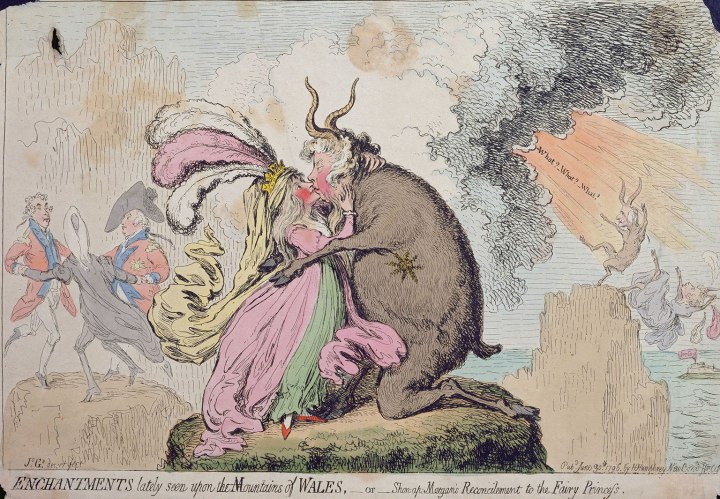
James Gillray, Enchantments Lately Seen upon the Mountain of Wales, 1796
(New College, Oxford)
◊ ◊ ◊ ◊ ◊
From New College, Oxford:
James Gillray@200: Caricaturist without a Conscience?
Ashmolean Museum, Oxford, 28–29 March 2015
Organised by Todd Porterfield, Université de Montréal; Martin Myrone, Tate Britain; and Michael Burden, New College, Oxford; with Ersy Contogouris, Université de Montréal
To commemorate the 200th anniversary of Gillray’s death, and in conjunction with the Ashmolean Museum’s exhibition, Love Bites: Caricatures of James Gillray, based on New College’s outstanding collection, we are organizing a two-day symposium at the Ashmolean Museum to hear and see the latest Gillray scholarship.
James Gillray’s reputation in the two centuries since his death has been as varied and layered as his prints. Trained at the Royal Academy, he failed at reproductive printmaking, yet became, according to the late-eighteenth-century Weimar journal London und Paris, one of the greatest European artists of the era. Napoleon, from his exile on St Helena, allegedly remarked that Gillray’s prints did more to run him out of power than all the armies of Europe. In England, patriots had hired him to propagandize against the French and touted him as a great national voice, but he was an unreliable gun-for-hire. At a large public banquet, during the heat of anti-Revolutionary war fever, he even raised a toast to his fellow artist, the regicide, Jacques-Louis David. Gillray produced a highly individual, highly schooled, and often outlandish body of work with no clear moral compass that undermines the legend of the caricaturist as the voice and heart of the people.
◊ ◊ ◊ ◊ ◊
S A T U R D A Y , 2 8 M A R C H 2 0 1 5
10.00 Registration and coffee
10:30 Session I: Gillray in the Media Age
• Douglas Fordham, University of Virginia, ‘A Media Critic for the Intaglio Age’
• Esther Chadwick, Yale University, ‘Gillray’s Tree of Liberty: Political Communication and Epistolary Networks in the Radical 1790s’
• Kate Grandjouan, Visiting Associate Professor, Department of Art History, University of Belgrade, ‘Gillray’s French Jokes: The “Sick-list” Casualties of the 1790s’
12.00 Lunch
1:00 Session II: Gillray in the Colonial Networks: Positionings on Race and Slavery
• Julie Mellby, Graphic Arts Curator within Rare Books and Special Collections at Firestone Library, Princeton University, ‘The Sale and Resale of English Beauties in the East Indies’
• Amanda Lahikainen, Aquinas College, ‘James Gillray and Representations of Napoleon’s Egyptian Campaign: Islam as Republican Sacrilege’
• Katherine Hart, Senior Curator of Collections & the Barbara C. and Harvey P. Hood 1918 Curator of Academic Programming, Hood Museum of Art, Dartmouth College, ‘James Gillray, Charles James Fox, and the Abolition of the Slave Trade: Caricature and Displacement in the Debate over Reform’
2.30 Coffee
3:00 Session III: The Artist and Formal Means
• Ersy Contogouris, Université de Québec à Montreal, ‘Gillray’s Preparatory Drawings’
• Cynthia Roman, The Lewis Walpole Library, Yale University, ‘James Gillray and the Satiric Alternative to Painting History’
6.30 Reception
7.00 Dinner
S U N D A Y , 2 9 M A R C H 2 0 1 5
9.00 Visit to the exhibition, Love Bites: Caricatures of James Gillray
10:15 Session IV: The Artist and Literary Means
• David Taylor, Assistant Professor, Department of English and Comparative Literary Studies, University of Warwick, ‘Gillray, Milton, and the “Caricatura Sublime”’
• Rachel M. Brownstein, Professor of English, City University of New York, ‘James Gillray and Jane Austen: Aesthetic Affinities’
11.15 Coffee
11:45 Session V: Gillray, the People, the Academy and Revolution
• Vic Gatrell, Caius College, Cambridge, ‘Gillray Reconsidered: ‘The Voice and Heart of the People’?
• Katarzyna Murawska-Muthesius, Associate Lecturer, Department of History of Art, Birkbeck College, University of London, ‘Caricature’s Unconscious: James Gillray and the Academy’
• Ian Haywood, Professor of English Co-Director, Centre for Research in Romanticism University of Roehampton, London, ‘Gillray’s Valediction: The Life of William Cobbett’
1.15 Lunch
Symposium | Exotic Anatomies: Stubbs, Banks, and Natural History

George Stubbs, Portrait of the Kongouro (Kangaroo) from New
Holland, 1772 (Greenwich: National Maritime Museum)
◊ ◊ ◊ ◊ ◊
From Royal Museums Greenwich in connection with the exhibition The Art and Science of Exploration:
Exotic Anatomies: Stubbs, Banks, and the Cultures of Natural History
Royal Museums Greenwich, London, 9 March 2015
When Joseph Banks returned from Cook’s first voyage of exploration, he brought with him a new world. Not only did he bring collections of specimens that would occupy him and his assistant Daniel Solander for a lifetime, but he brought images and accounts of the South Pacific that changed forever how Europeans saw the world.
One of the oddest was the pelt of a kangaroo, a new animal encountered by the expedition in Australia, which would tax scientists and fascinate the public for decades. Banks commissioned George Stubbs to paint the animal’s portrait, reconstructed from the inflated or stuffed skin, drawings and descriptions. The painting then hung in his house in Soho Square, part of a domestic and scholarly space that soon became a virtual institution where the scientific community gathered.
Further afield, Banks’s specimens were dissected and analysed by the famous surgeon brothers William and John Hunter. They became anatomical objects in the same spaces where the Hunters taught and studied human anatomy, and where they displayed their collections, including others of Stubbs’s ‘exotic’ animal paintings. Stubbs’s kangaroo was rapidly engraved for the published public account of Cook’s voyage, while Cook and his successors brought back live kangaroos for royal menageries and popular entertainments.
Considering the interrelationship between Stubbs, Banks, Cook and the Hunter brothers, this symposium will place Stubbs’s kangaroo at the centre of a number of burgeoning cultures of natural history in 18th-century London. From the gentleman-scholar’s fashionable home, to the practical and controversial space of the anatomy theatre, to the hyperbolic public entertainment, the kangaroo brought a new ‘exoticism’ to natural history.
Fee: £10 | Concessions £7.50. Download the booking form.
◊ ◊ ◊ ◊ ◊
P R O G R A M M E
9.30 Registration and refreshments
10.00 Session 1: Stubbs In Soho Square with the Bankses
• Getting To Know You: Joseph Banks, Australia and the Kangaroo after Stubbs — Jordan Goodman (University College London)
• Science and Sociability: Sarah Sophia Banks and the Domestic Quarters at 32 Soho Square — Arlene Leis, (University of York)
Chair/comment: Simon Schaffer (University of Cambridge)
11.30 Coffee and tea
12.00 Session 2: Stubbs in the Anatomy Theatre with the Hunter Brothers
• William Hunter, George Stubbs, and the Pursuit of Nature — Helen McCormack (The Glasgow School of Art)
• John Hunter (1728–93): Dr Jekyll or Dr Dolittle? — Wendy Moore (author and freelance journalist)
Chair/comment: Katy Barrett (Royal Museums Greenwich)
13.30 Lunch
14.30 Session 3: Stubbs in the London Exhibition Hall with the Public
• The Kangaroo as Scientific Curiosity and Public Spectacle in the Late 18th Century: From Sydney Cove to London — Markman Ellis (Queen Mary, University of London)
• Wonders From Down Under: Kangaroos in Popular Menageries — Helen Cowie (University of York)
Chair/comment: Christine Riding (Royal Museums Greenwich)
16.00 Round Up and Response Session
Richard Dunn (Royal Museums Greenwich)
Geoff Quilley (University of Sussex)
16.30 Curator-led tour of The Art and Science of Exploration
17.00 Wine reception
Workshop | On Site: Western Travellers Sketching in the Ottoman Empire
From H-ArtHist:
On Site: Western Travellers Sketching Topographies in the Ottoman Empire
Freie Universität Berlin, 19 February 2015
In the 17th and 18th centuries, the relations between the European countries and the Ottoman Empire were characterised by an increase in economic and diplomatic relations, but at the same time by military conflicts and aspirations. Europeans travelling to the Ottoman Empire in the 17th and 18th centuries were thus motivated by a variety of reasons and interests, which could be of a diplomatic, military, economic, religious, antiquarian or scholarly nature. Drawings and sketches were produced in these contexts both by travelling artists and by amateur draughtsmen.
The workshop investigates the activity of topographical sketching of landscapes or cityscapes during these travels with a particular focus on the implications of on-site sketching. The central question is how this artistic practice of sketching in a transcultural setup can be understood and conceptualised in art historical terms. We invite papers that deal with aspects of the following three fields.
Iconography
How did travelling draughtsmen choose their subjects and viewpoints? Which landscapes and cityscapes were considered significant and for what reasons (military, religious, antiquarian, aesthetic)? Did the permanent presence of conflict, both military and religious, between the Ottoman Empire and various European states, have an impact on the production and interpretation of these drawings?
Authenticity
Did these pictorial renderings aim at authenticity, and if so, how? How did travelogues testify to the authenticity of images? How did the knowledge, the preconceptions, the expectations and the fantasies of alterity that the travellers brought with them inform their practice of sketching on site; Or rather: In which way were such notions visually negotiated and thereby transformed?
Practices, Techniques, and Modes of Representation
How was the practice of drawing on site (i.e. outside, in a foreign country, as a stranger) conceived of and dealt with? Which practices, techniques and modes of representation were applied under these conditions? What effects did sketching bans and a fear of pictures and their producers have on travelling draughtsmen? How were these situations described and reflected in travellers’ writings?
Concept: Ulrike Boskamp, Annette Kranen
Venue: Freie Universität Berlin, Koserstraße 20, 14195 Berlin, Room A 163
◊ ◊ ◊ ◊ ◊
P R O G R A M
13.15 Ulrike Boskamp (Berlin), Welcome and Introduction
13.30 Palmira Brummett (Providence), Mapping the Ottomans: Moving from Narrative to Image at the ‘Limits’ of Empire
14.30 Irini Apostolou (Athens), The Representation of the Levant by French Travellers in the Seventeenth and Eighteenth Centuries
15.30 Coffee Break
16.00 William Kynan-Wilson (Berlin/Cambridge), Mediating Images in Jacques Carrey’s View of Athens (1674)
17.00 Annette Kranen (Berlin), Presenting Travel: Movement, Space and Places in Seventeenth-Century Western Images of the Ottoman Territories
18.00 Final Discussion
Conference | Tracing the Heroic through Gender: 1650, 1750, 1850
As posted at H-ArtHist:
Heroes—Heroizations—Heroisms: Tracing the Heroic through Gender
Freiburg Institute for Advanced Studies, 26–28 February 2015
In most societies the heroic is in many ways gendered. When considering the heroic, attributes of masculinity might first come to mind. Yet, from a historical perspective it becomes apparent that heroizations also often have feminine connotations. The social and cultural production of the heroic cannot be analyzed exclusively in terms of masculinity; nor can we regard women or femininity merely as exceptions in this field. Rather, we need to reconsider the relational character of the category gender. We propose to use gender as an analytical tool in a new way. Metaphorically speaking, gender as a ‘tracer’ can help us uncover new aspects of heroic ideas and concepts. In natural science experiments, a ‘tracer’ passes through different environments and reacts to each of them in a different way. Hence, the tracer is not the object of study, but is used to examine a third element: our conference shall try to use gender systematically to ‘trace’ various historical ‘environments’ of the heroic. By using gender as a tracer, the conference will explore forms, mediums and processes of heroization as well as discourses of heroic transgression, exceptionality or veneration. The conference will focus on three points in time (1650, 1750, 1850) and the continuities and transformations that may become apparent from interrelating the tracing results in a diachronic perspective.
Please register by an informal e-mail: info@sfb948.uni-freiburg.de. More information is available at the research program website. Questions may be directed to Andreas Friedrich, andreas.friedrich@sfb948.uni-freiburg.de.
◊ ◊ ◊ ◊ ◊
T H U R S D A Y , 2 6 F E B R U A R Y 2 0 1 5
14:00 Introduction
Panel 1: 1650
14:30 Women in writings on the heroic in 17th-century academic instruction, Joseph Freedman (Montgomery, Alabama)
15:15 Anti-heroes: Masculinity and civic ethics in literary academies of 17th-century Florence, Eva Struhal (Québec)
16:30 Gendering fear: Transformations of courage and masculinity in heroic drama, Christiane Hansen (Freiburg)
17:15 Testing times for anxious he-roes: Tracing the end of a heroic figuration in England and France, ca. 1650, Andreas Schlüter (Freiburg)
Evening Lecture
18:30 From viragos to valkyries: Transformations of the heroic woman from the 17th to the 19th century, Helen Watanabe-O’Kelly (Oxford)
F R I D A Y , 2 7 F E B R U A R Y 2 0 1 5
Panel 2: 1750
9:30 (Keynote lecture) When heroes sigh… Sentimental heroism in 18th-century opera, Melanie Unseld (Oldenburg)
11:00 A reigning woman as a heroic monarch? Maria Theresa and the roles of emperor, wife and mother, Anne-Marie Wurster (Freiburg)
11:45 Creating and subverting German models of ‘Galanterie’? Heroes and heroines in texts by Christian Friedrich Hunold and Maria Aurora von Königsmarck, Madeleine Brook (Oxford)
Panel 3: 1850
14:00 Heroism of a melancholy look from blue eyes, Petra Polláková (Prague)
14:45 What is the Polish peasant hero’s gender? Representations of peasant citizenship in Polish culture, ca. 1850, Alicja Kusiak-Brownstein (Ann Arbor, Michigan)
15:30 Untangling the heroic from the sacrifice: Malwida von Meysenbug’s attempt to appropriate a common female topos in and for her political novel Phädra (1885), Birgit Mikus (Oxford)
Lecture and Round-table Discussion
16:45 Rethinking the heroic: Difference as a tracer?, Monika Mommertz (Freiburg)
Concert Talk
20:00 ‘En travesti’ The female as male in early 19th-century operas, Thomas Seedorf (Karlsruhe/Freiburg)
Mezzosoprano: Felicitas Brunke / Piano: Freya Jung
S A T U R D A Y , 2 8 F E B R U A R Y 2 0 1 5
Panel 4: Connections
9:30 Gendering the operatic sound of the heroic: 1647 – 1749 – 1843, Anke Charton (Leipzig)
10:15 Victorian male heroes and romance in Elizabeth Bowen’s short fiction, Laura Lojo-Rodríguez (Santiago de Compostela)
11:15 The tragic hero and the gendered imaginary in early modern German drama, Barbara Becker-Cantarino (Columbus, Ohio)










leave a comment