ASECS 2015, Los Angeles
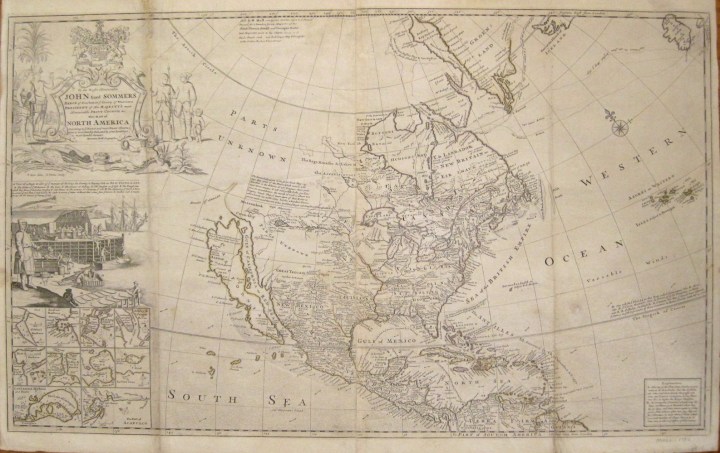
Herman Moll, To the Right Honourable John Lord Sommers…This Map of North America according to ye Newest and most Exact observations, 23 x 38 inches (London: H. Moll, ca. 1715). “California was depicted on maps as an island. . . even after Father Kino established its penisularity about 1705,” The Philadelphia Print Shop. The official date for the founding of the city of Los Angeles is September 4, 1781.
◊ ◊ ◊ ◊ ◊
2015 American Society for Eighteenth-Century Studies Conference
Los Angeles, 19–21 March 2015
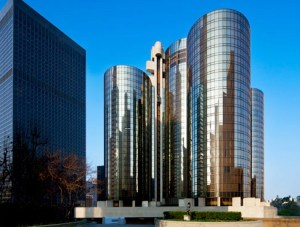
Finished in 1976, the 35-story Westin Bonaventure Hotel is the largest hotel in the city, the work of John Portman, one of the world’s most influential hotel architects.
The 2015 ASECS conference takes place in Los Angeles, March 19–21, at the Westin Bonaventure. HECAA will be represented by two panels, on Friday, chaired by Amy Freund and Noémie Etienne and Meredith Martin. Our annual luncheon and business meeting is also scheduled for Friday. A selection of additional panels is included below (of the 221 sessions scheduled, many others will, of course, interest HECAA members). For the full program, see the ASECS website.
H E C A A S E S S I O N S
Anne Schroder New Scholars’ Session (HECAA)
Friday, 20 March, 11:30–1:00, Santa Anita C
Chair: Amy FREUND, Southern Methodist University
1. Iris MOON, Metropolitan Museum of Art, “Sedimentations of the Self: A Stratigraphic Reading of Maurice Quentin de La Tour’s Pastel Portraits of Jean-Jacques Rousseau, Citizen of Geneva”
2. Joanna M. GOHMANN, University of North Carolina, Chapel Hill, “Woman’s Best Friend: The Visual Work of Madame de Pompadour’s Dogs”
3. Ashley BRUCKBAUER, University of North Carolina, Chapel Hill, “Ambassadeurs à la turc: Assimilation and Dissimulation in Eighteenth-Century Images of Franco-Ottoman Diplomacy”
4. Elizabeth Bacon EAGER, Harvard University, “Between Looking and Making: The Early Drawing Curriculum at West Point”
◊ ◊ ◊ ◊ ◊
Pilgrim Arts of the Eighteenth Century (HECAA)
Friday, 20 March, 4:15–5:45, San Fernando
Chairs: Noémie ETIENNE, Institute of Fine Arts AND Meredith MARTIN, New York University and Institute of Fine Arts
1. David PULLINS, Harvard University, “Multiple Hands: Workshop Practice and Masters of Eighteenth-Century French Painting”
2. Dipti KHERA, New York University and Institute of Fine Arts, “Invitations to Travel: Circulating Pontiffs, Pilgrims and Pictures in the Bazaars of Early Modern India”
3. Kristel SMENTEK, Massachusetts Institute of Technology, “Moving Across Media: The Mobile Image and Eighteenth-Century Sino-French Encounter”
4. Matthew FISK, Boston Architectural College, “A Vernacular Orientalism: Exoticizing Discourse and Amateur Japanning in the Northern Connecticut Frontier, 1725–1735”
O T H E R S E S S I O N S R E L A T E D T O T H E V I S U A L A R T S
T H U R S D A Y , 1 9 M A R C H 2 0 1 5
New Approaches to Material Culture
Thursday, 19 March, 8:00–9:30, San Gabriel B
Chair: Chloe WIGSTON SMITH, University of Georgia
1. Elizabeth Kowaleski WALLACE, Boston College, “The Things Things Don’t Say: Reconsidering the Rape of the Lock”
2. Karen LIPSEDGE, Kingston University, “Men at Home: Men, Domestic Space, and the Novels of Richardson”
3. Robbie RICHARDSON, University of Kent, “‘British valour, opposed to tomahawk cruelty’: First Nations Material Culture in the British Imaginary”
4. Laura ENGEL, Duquesne University, “Staging Desire: Performance, Memory, and Re-enactment in Thomas Lawrence’s Portraits of Sally, Sarah, and Maria Siddons”
◊ ◊ ◊ ◊ ◊
Fans and Fandoms in the Eighteenth Century
Thursday, 19 March, 8:00–9:30, Santa Barbara B
Chair: Kate HAMILTON, Carnegie Mellon University
1. Jade HIGA, Duquesne University, “Mary Crawford’s Fan(ny) Base: Fan Behavior and the Female Body of Austen’s Mansfield Park”
2. Stephanie KOSCAK, Wake Forest University, “The Monarchy in the Marketplace: Royal Signs and Loyalist Fandoms in Eighteenth-Century London”
3. Diana SOLOMON, Simon Fraser University, “The Quality of Fanfare: The Starring Role of Audiences in Eighteenth-Century London Theatre”
4. Whitney ARNOLD, University of California, Los Angeles, “Rousseau and His Fans: Celebrity and Autobiographical Representation”
◊ ◊ ◊ ◊ ◊
A Sum of Its Parts: Symmetry in the Eighteenth Century
Thursday, 19 March, 8:00–9:30, San Pedro
Chairs: Daniella BERMAN, New York University AND Changduk (Charles) KANG, Columbia University
1. Sarah GRANDIN, Harvard University, “Desportes’ Buffet à l’Orfèvrerie and Symmetrical Display”
2. Benjamin H. BAKER, University of Pennsylvania and Université de Paris IV – Sorbonne, “Retrospective Rewriting, Affective Symmetry and Dispositive Disarray in Prévost’s Cleveland”
3. Clare HAYNES, University of Tulsa, “A Beauteous Symmetry: The Expression of Godly Order in the Church of England, 1660–1800”
◊ ◊ ◊ ◊ ◊
The Eighteenth Century in Hollywood (ASECS Executive Board Sponsored Session)
Thursday, 19 March, 9:45–11:15, Catalina Ballroom
Chair: Kathleen WILSON, State University of New York, Stony Brook
1. Paula BYRNE, Advisor and Historian, “Belle”
2. Jeffrey HATCHER, Screenwriter, “The Duchess”
3. Stella TILLYARD, Author and Historian, “Aristocrats, Tides of War, A Royal Affair”
◊ ◊ ◊ ◊ ◊
Scientists, Artists, and Artisans in the Eighteenth Century
Thursday, 19 March, 2:30–4:00, La Cienega
Chair: Dena GOODMAN, University of Michigan
1. Hannah WILLIAMS, University of Oxford, “Artists and Scientists in the Churches of Paris”
2. Mia JACKSON, Queen Mary, University of London, “Illustrious Times: Clock-Makers and Cabinet-Makers in the Louvre”
3. Paola BERTUCCI, Yale University, “Savants, Artisans, and Artistes: The Société des Arts in Early-Eighteenth Century Paris”
4. Nina Rattner GELBART, Occidental College, “Mlle Biheron’s Cabinet, Mlle Basseporte’s Jardin: Savantes-artistes and their Spheres of Sociability”
◊ ◊ ◊ ◊ ◊
Empires and Oceans (Race and Empire Caucus) (Roundtable)
Thursday, 19 March, 4:15–5:45, Santa Barbara C
Chair: James MULHOLLAND, North Carolina State University
1. Betty JOSEPH, Rice University, “Piratical Discourse and the Interspaces of Empire”
2. Daniel J. O’QUINN, University of Guelph, “Theatrum Pacis: Where Does Peace Happen?”
3. Dwight CAREY, University of California, Los Angeles, “Trans-Colonial Style: The Architecture of Empire in Eighteenth-Century Louisiana and Mauritius”
4. Gretchen J. WOERTENDYKE, University of South Carolina, “Meditations on Critical Regionalism, the Sea, and Comparative Literary Studies”
5. Vanessa SMITH, University of Sydney, “Imperialism in Oceania”
6. Steven PINCUS, Yale University, “The Stamp Act in Global Perspective”
F R I D A Y , 2 0 M A R C H 2 0 1 5
Educating Women in France, 1780–1814
Friday, 20 March, 8:00–9:30, Santa Anita C
Chair: Melissa HYDE, University of Florida
1. Mary TROUILLE, Illinois State University, “Mme de Genlis’s Challenge to Rousseau’s Views on Female Education”
2. Sévérine SOFIO, CNRS-Université Paris 8, “L’intérêt social exige d’encourager l’émulation des femmes / Teaching Art to Women During the French Revolution: A National Issue?”
3. Susan TAYLOR-LEDUC, Parsons Paris The New School, “From Servant to Teacher: Madame Campan’s Vision for Educating Women”
4. Lindsay DUNN, Texas Christian University, “Educating an Empress: Art Education and Marie-Louise, House of Habsburg-Lorraine”
◊ ◊ ◊ ◊ ◊
The Cultures of Sport in the Eighteenth Century
Friday, 20 March, 8:00–9:30, San Fernando
Chair: Alexis TADIÉ, Université of Paris, Sorbonne
1. Sharon HARROW, Shippenburg University, “Satire and Ideology in Eighteenth-Century Sports Poetry”
2. John WHALE, University of Leeds, “The Culture of Eighteenth-Century Pugilism”
3. Amy FREUND, Southern Methodist University, “Gun and Game: The Art of Shooting in Eighteenth-Century France”
◊ ◊ ◊ ◊ ◊
Textiles and the Long Eighteenth Century
Friday, 20 March, 8:00–9:30, Los Feliz
Chair: Heidi A. STROBEL, University of Evansville
1. Kimberly CHRISMAN-CAMPBELL, Independent Scholar, “Borrowed Plumes: Feathered Textiles at the French Court”
2. Kristin O’ROURKE, Dartmouth College, “Tactility and Textiles in Portraits of Madame de Pompadour”
3. Emily M.N. KUGLER, Center for the Study of Slavery and Justice, Brown University, “From Calico Madams to Osnaburg-Shrouded Slaves: Textiles for Laboring Women, 1719–1831”
4. Ashley SCHOPPE, University of Tulsa, “‘Richly Dressed in our Own Manufacture’: Public Perceptions of Princess Augusta’s Patronage of British Textiles”
Respondent: Lauren MISKIN, Southern Methodist University
◊ ◊ ◊ ◊ ◊
Teaching the Eighteenth Century: A Poster Session
Friday, 20 March, 11:30–1:00, Santa Monica D
Chair: Diane KELLEY, University of Puget Sound
1. Caroline BREASHEARS, St. Lawrence University, “‘You’re an Austen Hero!’ Teaching about Masculinity in Jane Austen’s Novels”
2. Sharon HARROW, Shippensburg University of Pennsylvania, “Teaching Adaptations”
3. Heather KING, University of Redlands, “Mixing it Up: Balancing Curricular Options and Institutional Limits”
4. Elizabeth KRAFT, University of Georgia, “Restoration Courtship Comedies and Hollywood Comedies of Remarriage”
5. Heidi KRAUS, Hope College, “Women, Art, and Society in Eighteenth- and Nineteenth-Century France: Engaging the Undergraduate Audience”
6. Crystal MATEY, University of North Carolina, Greensboro, “Depictions of Fictional Scientists in the Long Eighteenth-Century”
7. Sarah NICOLAZZO, University of California, San Diego, “Pirates, Pickpockets, Police: Teaching Law and Literature in the Eighteenth-Century Classroom”
8. Véronique OLIVIER AND Yelena LIEPERT, Chapman University, “The Representation and Role of Women in Eighteenth-Century Society”
9. Theresa Marie RUSS, University of California at Santa Barbara, “Teaching ‘Knowledge Work in the Long Eighteenth Century’: Visually, Aurally, Interactively”
◊ ◊ ◊ ◊ ◊
Alta and Baja: California in the Eighteenth Century (ASECS Executive Board Sponsored Session)
Friday, 20 March, 11:30–1:00, Santa Barbara B
Chair: Pamela HUCKINS, Southern New Hampshire University
1. James MIDDLETON, Independent Scholar, “Dress in the Codex Pictoricus Mexicanus of Fr. Ignaz Tirsch, S.J.”
2. David RICHARDSON, Camino Real de las Misiones, “Mission Santa María de los Angeles, The Last Jesuit Mission of Baja California”
3. Yve CHAVEZ, University of California, Los Angeles, “Eighteenth-Century Accounts of Indigenous Art and Culture at the Alta California Missions”
4. Jonathan C. LAURSEN, University of California, Riverside, “The ‘Leyenda negra’ on the Pacific Coast”
◊ ◊ ◊ ◊ ◊
Anne Schroder New Scholars’ Session (Historians of Eighteenth-Century Art and Architecture)
Friday, 20 March, 11:30–1:00, Santa Anita C
Chair: Amy FREUND, Southern Methodist University
1. Iris MOON, Metropolitan Museum of Art, “Sedimentations of the Self: A Stratigraphic Reading of Maurice Quentin de La Tour’s Pastel Portraits of Jean-Jacques Rousseau, Citizen of Geneva”
2. Joanna M. GOHMANN, University of North Carolina, Chapel Hill, “Woman’s Best Friend: The Visual Work of Madame de Pompadour’s Dogs”
3. Ashley BRUCKBAUER, University of North Carolina, Chapel Hill, “Ambassadeurs à la turc: Assimilation and Dissimulation in Eighteenth-Century Images of Franco-Ottoman Diplomacy”
4. Elizabeth Bacon EAGER, Harvard University, “Between Looking and Making: The Early Drawing Curriculum at West Point”
◊ ◊ ◊ ◊ ◊
Digging Italy (Italian Studies Caucus)
Friday, 20 March, 11:30–1:00, San Gabriel C
Chair: Wendy Wassyng ROWORTH, University of Rhode Island
1. Jeffrey COLLINS, Bard Graduate Center, “From Ditch to Nitch: Digging the Villa of Cassius”
2. Lauren DI SALVO, University of Missouri, “Unearthing Ancient Mosaics and their Translation into Contemporary Souvenirs”
3. Ulf R. HANSSON, University of Texas at Austin, “Non-Marrying Men and the Lure of Antiquity: Philipp von Stosch and his Florentine Museo”
4. Carolyn GUILE, Colgate University, “Warsaw’s Italy: Poland’s Last King and the Making of Royal Łazienki, 1764–1795”
◊ ◊ ◊ ◊ ◊
The Eighteenth Century on Film (Northeast American Society for Eighteenth-Century Studies)
Friday, 20 March, 11:30–1:00, Catalina Ballroom
Chair: John H. O’NEILL, Hamilton College
1. Dorothée POLANZ, University of Virginia, “Portrait of the Queen as a Celebrity: Marie Antoinette on Screen, 1934–2012”
2. Melissa BISSONETTE, St. John Fisher College, “‘Too light & bright & sparkling’: The BBC Pride and Prejudice and the Secret of Style”
3. Ellen MOODY, American University, “Screenplays and Shooting Scripts (not Novels) into Films”
4. Steven W. THOMAS, Wagner College, “The Assurance of Belle, the Insurance of the Zong, and the Speculation of Cinema”
◊ ◊ ◊ ◊ ◊
Epistolarity: Contested / ‘Contexted’ and Contextualized Letters, Part I
Friday, 20 March, 11:30–1:00, Santa Barbara A
Chair: Mark MALIN, Randolph-Macon College
1. Nina DUBIN, University of Illinois at Chicago, “Epistolarity at the Salon of 1793: Cicero, Moitte, Janinet”
2. Kelsey RUBIN-DETLEV, University of Oxford, “‘Elle a écrit de sa propre main’: Catherine the Great’s Letters in Periodicals and Polemics of Eighteenth-Century France”
3. Tamara L. HUNT, University of Southern Indiana, “Letters, Seditious Libel, and the Press in Early Eighteenth-Century England”
4. Shang-yu SHENG, City University of New York, Graduate Center, “Responding to Mr. Spectator: Communication Structures in The Spectator’s Hypertexts”
◊ ◊ ◊ ◊ ◊
HECAA Luncheon and Business Meeting
Friday, 20 March, 1:00–2:30, Beaudry B
◊ ◊ ◊ ◊ ◊
Pilgrim Arts of the Eighteenth Century (Historians of Eighteenth-Century Art and Architecture)
Friday, 20 March, 4:15–5:45, San Fernando
Chairs: Noémie ETIENNE, Institute of Fine Arts AND Meredith MARTIN, New York University and Institute of Fine Arts
1. David PULLINS, Harvard University, “Multiple Hands: Workshop Practice and Masters of Eighteenth-Century French Painting”
2. Dipti KHERA, New York University and Institute of Fine Arts, “Invitations to Travel: Circulating Pontiffs, Pilgrims and Pictures in the Bazaars of Early Modern India”
3. Kristel SMENTEK, Massachusetts Institute of Technology, “Moving Across Media: The Mobile Image and Eighteenth-Century Sino-French Encounter”
4. Matthew FISK, Boston Architectural College, “A Vernacular Orientalism: Exoticizing Discourse and Amateur Japanning in the Northern Connecticut Frontier, 1725–1735”
◊ ◊ ◊ ◊ ◊
Twenty-First Century Approaches to Eighteenth-Century Quixotes and Quixotisms: Don Quijote II (1615–2015), Part I (Ibero-American Society for Eighteenth-Century Studies)
Friday, 20 March, 4:15–5:45, La Cienega
Chair: Catherine JAFFE, Texas State University
1. Jonathan CRIMMINS, Augustana College, “The Worth in Every Clime: Historical Tincture in Harlequin and Quixotte: or The Magic Arm”
2. Aaron R. HANLON, Georgetown University, “Quixotism as Global Heuristic”
3. Brittany LUBERDA, The Frick Collection, “Don Quixote by Charles-Antoine Coypel”
4. Elizabeth LEWIS, University of Mary Washington, “Maps, Travelers, and the ‘Real’ Don Quixote de la Mancha”
◊ ◊ ◊ ◊ ◊
UCLA William Andrews Clark Memorial Library Excursion
Friday, 20 March, 5:30–7:00, UCLA bus departs from the Westin Bonaventure Hotel at 5:00.
(Free bus transportation is limited to the first 50 people who register for this excursion)
Free for ASECS conference participants and their guests; please register by 6 March as capacity is limited.
This excursion is hosted by the UCLA William Andrews Clark Memorial Library and Center for 17th- & 18th-Century Studies. It includes a private guided tour of the elegant Clark Library and presentations by the library staff about the collections. Following the tour, guests will enjoy a special reception. The bus will depart the Clark Library at 7:00 p.m. and return to the hotel.
For details about bus or rail transportation options, please visit http://www.metro.net
Free parking is available for those traveling by car or taxi. For directions or a Google map, visit http://www.clarklibrary.ucla.edu/visit
About the Clark Library
The Clark is an off-campus rare book library specializing in the seventeenth and eighteenth centuries. It also has a renowned collection centering on Oscar Wilde and his era and significant holdings of modern fine printing and Western Americana. Other collections include French literature, a major collection devoted to Pietro Aretino, and a recent major gift strengthened considerably the Clark’s holdings of sixteenth- and early seventeenth-century books. Currently the library has about 110,000 books, as well as manuscripts, archives, maps, prints, and other material. Bequeathed to UCLA in 1934 by William Andrews Clark, Jr. (1877–1934), a prominent book collector and philanthropist, this extensive collection is housed in an historical building standing on the spacious grounds of the old Clark estate in the West Adams district of Los Angeles (near downtown L.A.).
How to RSVP
To register, please send an email to c1718cs@humnet.ucla.edu with ‘ASECS- Clark Excursion’ in the subject line, and include the name, email, and phone number for each guest that will attend and indicate whether you need a bus reservation. The free bus transportation is limited to 50 people and reservations are provided on a first-come, first-served basis by email. The RSVP deadline is 6 March.
S A T U R D A Y , 2 1 M A R C H 2 0 1 5
The Habsburgs, 1740–1792, Part I
Saturday, 21 March, 8:00–9:30, Los Catalina Ballroom
Chair: Rebecca MESSBARGER, Washington University in St. Louis
1. Heather MORRISON, State University of New York, New Paltz, “International Scientific Competition and European Diplomatic Relations during the Habsburg Monarchy’s Botanical Expedition of 1783–1788”
2. Michael YONAN, University of Missouri, “Habsburg Artistic Exchange In and Out of the Austrian Netherlands”
3. Julia DOE, Columbia University, “Marie Antoinette et la Musique: Habsburg Patronage and French Musical Culture: 1770–1789”
◊ ◊ ◊ ◊ ◊
Classroom as Coffeehouse: Encouraging Critical Thinking and Debate in Discussion of Primary Sources
Saturday, 21 March, 8:00–9:30, San Gabriel B
Chair: Birte PFLEGER, California State University, Los Angeles
1. Sharlene SAYEGH, California State University, Long Beach, “Reading through the Chatter: Finding the Social in Eighteenth-Century Legal Records”
2. Anne WOHLCKE, California Polytechnic State University, Pomona, “Filtering Eighteenth-Century Content for Twenty-First Century Consumption: Teaching Enlightenment through the Lens of an English Coffeehouse”
3. Kristen CHIEM, Pepperdine University, “Lessons from the Garden: Discussing Gender in Eighteenth-Century Chinese Art”
◊ ◊ ◊ ◊ ◊
Form and Feeling: Materiality in Eighteenth-Century History and Literature
Saturday, 21 March, 8:00–9:30, San Fernando
Chairs: Lisa Foreman CODY, Claremont McKenna College AND Julie PARK, California Institute of Technology and Vassar College
1. Sarah ERON, University of Rhode Island, “Misrecognition: The Case of Evelina”
2. Dahlia PORTER, University of North Texas, Denton, “Feeling the Archive: Objects, Print, and the Materiality of Research”
3. Ryan WHYTE, OCAD University, “Facsimile King: The Crisis of Materiality in Representations of Louis XV”
4. Paula RADISCH, Whittier College, “Two Case Studies in High Art: Quentin de La Tour and Chardin”
◊ ◊ ◊ ◊ ◊
The Circuit of Apollo: Women’s Tributes to Women in the Long Eighteenth-Century, Part II (Roundtable) (Women’s Caucus Scholarly Panel)
Saturday, 21 March, 9:45–11:15, San Pedro
Chair: Laura L. RUNGE, University of South Florida
1. Julie Candler HAYES, University of Massachusetts, Amherst, “Women on Women: Writing Women’s Literary History in France”
2. Julie MURRAY, Carleton University, “Remembering Mary Wollstonecraft: Mary Hays’ Late Style”
3. Deborah WEISS, University of Alabama, “The Tribute of Critique: Amelia Opie and Mary Wollstonecraft”
4. Jessica FRIPP, Parsons The New School for Design, “Honoring Geoffrin: Joséphine and Lemonnier’s The First Reading of Voltaire’s Tragedy L’Orphelin de la Chine in the Salon of Madame Geoffrin in 1755”
5. Jocelyn HARRIS, University of Otago, “Jane Austen’s Homage to Fanny Burney in Mansfield Park”
6. Katharine KITTREDGE, Ithaca College, “Friendship as Platform for Reinvention: Melesina Trench and Mary Leadbeater”
◊ ◊ ◊ ◊ ◊
Clifford Lecture
Saturday, 21 March, 11:30–12:30, Catalina Ballroom
Presiding: Felicity A. NUSSBAUM, University of California, Los Angeles
Ann BERMINGHAM University of California, Santa Barbara, “Coffee-House Characters and British Visual Humor at the End of the Eighteenth Century”
◊ ◊ ◊ ◊ ◊
American Latium: American Artists in and around Rome in the Age of the Grand Tour” (Italian Studies Caucus)
Saturday, 21 March, 2:00–3:30, San Gabriel A
Chair: Karin WOLFE, British School at Rome
1. Christopher M.S. JOHNS, Vanderbilt University, “John Singleton Copley in Rome: The Challenge of the Old Masters Accepted”
2. Tommaso MANFREDI, Università Mediterranea di Reggio Calabria, “The Rome of Charles Bulfinch: A Cultural Itinerary of 1786”
3. Vincent PHAM, University of California, San Diego, “Transatlantic Transactions: Benjamin West, the Grand Tour and The American School in London”
◊ ◊ ◊ ◊ ◊
Flipping the Grand Tour: The Italian Response
Saturday, 21 March, 3:45–5:15, Santa Anita C
Chairs: Blair DAVIS, University of California, Santa Barbara AND
Carole PAUL, University of California, Santa Barbara
1. Peter Björn KERBER, J. Paul Getty Museum, “Foreigners and Festivals in Settecento Venice”
2. Shirley SMITH, Skidmore College, “Goldoni and Baretti: Italian Vacations in the Eighteenth Century”
3. Clorinda DONATO, California State University, Long Beach, “Correcting the Grand Tour Gaze: Domenico Caminer Reviews De La Lande’s 1766 Voyage en Italie”
◊ ◊ ◊ ◊ ◊
Beyond Orientalism: Consumer Agency and Producer Adaptation in Asia Exchanges with Europe and the Americas
Saturday, 21 March, 3:45–5:15, Santa Barbara B
Chair: Samara CAHILL, Nanyang Technological University
1. Sofía SANABRAIS, University of Southern California, “‘…desired and sought by the rest of the world’: The Philippine–Asia Trade and its Impact on Spanish Colonial Artistic Production”
2. Rachel Tamar VAN, California Polytechnic State University, Pomona, “A Market for Fakes: Knock-Offs, Adulteration, & Faux Masterpieces between China & Early America”
3. Susan SPENCER, University of Central Oklahoma, “Ihara Saikaku: Literary Artistry Meets the Art of the Deal”
Respondent: Emily M.N. KUGLER, Center for the Study of Slavery and Justice, Brown University
◊ ◊ ◊ ◊ ◊
The Royal Mistresses of Eighteenth-Century France
Saturday, 21 March, 3:45–5:15, Los Cerritos
Chair: Mary TROUILLE, Illinois State University
1. Kathleen WELLMAN, Southern Methodist University, “Keeping it in the Family: The Nesle Sisters in the Reign and Reputation of Louis XV”
2. Ashley MASON, University of Iowa, “The Marquise de Maintenon or La Scarron: Manipulative Dissimulator or Ideal maîtresse du roi?”
3. C. Ryan HILLIARD, University of California, Los Angeles, “The Female Networks of a Royal Mistress: The Correspondence of Madame de Maintenon and the Princesse des Ursins”
4. Amanda STRASIK, University of Iowa, “Madame de Pompadour, François Boucher, and the Pastoral Child”
CAA 2015, New York
103rd Annual Conference of the College Art Association
New York Hilton Midtown, 11–14 February 2015
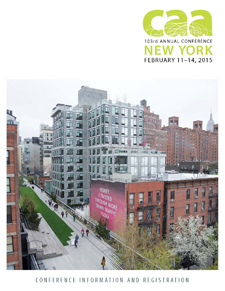 The 2015 College Art Association conference takes place in New York, February 11–14, at the New York Hilton Midtown (1335 Avenue of the Americas).
An ASECS session on materiality, chaired by Kristel Smentek and Michael Yonan, is scheduled for Friday at 12:30; and a HECAA session in honor of Donald Posner, chaired by Andria Derstine and Rena Hoisington, is slated for Saturday at 12:30. As 90-minute panels, both are free and open to the public with no conference registration required.
This year there’s also a HECAA reception scheduled for Thursday, from 5:30 to 7:00 in the Lincoln Suite on the fourth floor of the Hilton. With a cash bar, it’s an open invitation; so please bring friends (and, as with the lunch sessions, attendance requires neither CAA membership nor conference registration).
Other sessions that may be of interest for dixhuitièmistes are also listed. A full schedule of panels is available here»
◊ ◊ ◊ ◊ ◊
Historians of Eighteenth-Century Art and Architecture
Donald Posner and the Study of Seventeenth- and Eighteenth-Century French and Italian Art
Saturday, 14 February, 12:30–2:00, Sutton Parlor North
Chairs: Andria Derstine, Allen Memorial Art Museum, Oberlin College; Rena M. Hoisington, The Baltimore Museum of Art
- A Return to Loreto: Guido Reni, Caravaggio, and Donald Posner
Rachel McGarry, Minneapolis Institute of Arts - The Portrait d’apparat after Rigaud: Iconographical and Ideological Variations in Images of Louis XV and Marie Leszczynska, ca. 1723–1747
Todd L. Larkin, Montana State University - Nicolas Lancret: Île de France or Île de Cythère?
Mary Tavener Holmes, independent scholar - Giambattista Tiepolo’s Two Designs for the Triumph of Hercules
William Barcham, independent scholar
◊ ◊ ◊ ◊ ◊
American Society for Eighteenth-Century Studies
The Materiality of Art and Experience in the Eighteenth Century
Friday, 13 February, 12:30–2:00, Beekman Parlor
Chairs: Kristel Smentek, Massachusetts Institute of Technology; Michael E. Yonan, University of Missouri–Columbia
- Other-Worldly Encounters: Materiality and Religious Experience
Hannah Williams, University of Oxford - ‘Neither Antique nor Gothic’: The Uncertainty of Sèvres Porcelain
Susan Michele Wager, Columbia University - A Visual Material Turn
Anne Higonnet, Barnard College
◊ ◊ ◊ ◊ ◊
O T H E R S E S S I O N S R E L A T E D T O T H E 1 8 T H C E N T U R Y
Original Copies: Art and the Practice of Copying
Wednesday, 11 February, 9:30–12:00, Sutton Parlor South
Chair: Stephanie Porras, Tulane University
- ‘A Miracle of a Copy’: Original Reproductions and Authentic Copies in the Holbein Dispute
Lena Bader, German Centre for the History of Art in Paris (DFK) - Producing Reproducibility: John Flaxman’s Designs between Classicism and Commerce
Brigid von Preussen, Columbia University - ‘The Duplication of Genius’: Domenico Brucciani (1815–80) and the Authorship and Agency of Plaster Casts, Rebecca Jayne Wade, Henry Moore Institute
- Remaking the Readymade: Marcel Duchamp and Man Ray’s Editioned Replicas
Adina Tamar Kamien-Kazhdan, The Israel Museum, Jerusalem - On Originality: Photography vs. Glass Painting in Twentieth-Century Senegal
Giulia Paoletti, Columbia University
◊ ◊ ◊ ◊ ◊
The Global History of Design and Material Culture
Thursday, 12 February, 9:30–12:00, Sutton Parlor North
Chair: Paul Stirton, Bard Graduate Center
- Writing and Editing the New History of Design: Decorative Arts and Material Culture 1400–2000
Patricia Anne Kirkham, Bard Graduate Center - Writing a World History of Design: What I Have Learned
Victor Margolin, University of Illinois at Chicago - Design Worlds: National Design Histories in an Age of Globalization
Grace Lees-Maffei, University of Hertfordshire; Kjetil Fallan, University of Oslo - A Global History of Design: Assembling Fragments
Daniel J. Huppatz, Swinburne University - The Canon and Beyond: A Proposal for Teaching the History of Modern Design
David Raizman, Drexel University
◊ ◊ ◊ ◊ ◊
Unfolding the Enlightenment
Thursday, 12 February, 9:30–12:00, Beekman Parlor
Chairs: Alyce Mahon, University of Cambridge; Nebahat Avcioglu, Hunter College, City University of New York
- William Hogarth’s ‘Bathos’ and the End of Beauty
Thomas R. Beachdel, The Graduate Center, City University of New York - Embodied Cognition: Vitalism and Neoclassical Fashion
Amelia F. Rauser, Franklin & Marshall College - Enlightenment Thought and the Visual Arts in Qajar Iran
Maryam D. Ekhtiar, The Metropolitan Museum of Art - Producing Monsters: Eric Avery’s Prints, The Sleep of Reason from Behind and Chimera
Rena M. Hoisington, The Baltimore Museum of Art - Ordnung und Reinlichkeit
Stefaan Vervoort, Ghent University
◊ ◊ ◊ ◊ ◊
Historians of British Art
Home Subjects: Domestic Space and the Arts in Britain, 1753–1900
Thursday, 12 February, 12:30–2:00, Rendezvous Trianon
Chairs: Morna O’Neill, Wake Forest University; Anne Nellis Richter, American University
- Astonishing Moderation: Robert Lord Clive at Claremont
Stephen M. Caffey, Texas A&M University - Housing the Art of the Nation: The Home as Museum in Gustav F. Waagen’s Treasures of Art in Great Britain
Emilie Oléron Evans, Queen Mary University of London - ‘An Alien in the Decorative Community’: The Problem of Pictures in British Domestic Advice Literature
Nicholas Tromans, Watts Gallery - Discussant: Melinda R. McCurdy, The Huntington Library, Art Collections and Botanical Garden
◊ ◊ ◊ ◊ ◊
Association for Latin American Art
Emerging Scholars of Latin American Art
Thursday, 12 February, 12:30–2:00, Regent Parlor
Chair: Margaret Jackson, University of New Mexico
- Filling the Lacuna: The Guatemalan Black Christ and New Spanish Art History
Elena FitzPatrick Sifford, Louisiana State University - The Queen of Heaven and the Prince of Angels: Saintly Rivalry in Colonial Mexico
Aubrey Hobart, University of California, Santa Cruz - Violence and Virtue in the Northern Provinces of New Spain: The Politics of Franciscan Martyr Portraits during the Period of Bourbon Reforms
Emmanuel Ortega Rodríguez, University of New Mexico
◊ ◊ ◊ ◊ ◊
The Meaning of Prices in the History of Art
Thursday, 12 February, 2:30–5:00, Regent Parlor
Chairs: Christian Huemer, Getty Research Institute; Hans J. Van Miegroet, Duke University
- Prices for Paintings and Buyer Preferences in Eighteenth-Century Paris
Hilary Coe Cronheim, Duke University; Sandra van Ginhoven, Duke University - Market Valuation of Provenance: An Analysis of Collections Sold at Drouot between 1911 and 1925
Géraldine David, Université Libre de Bruxelles; Kim Oosterlinck, Université Libre de Bruxelles - The Dutch Art Market during the Second World War: A New Art Price Index Using Hedonic Regression
Jeroen Euwe, Université Libre de Bruxelles - The ‘Bildung’ of the American Collector
Titia E. Hulst, Institute of Fine Arts, New York University - Transmission of Value through Prices: Competition and Value Formation on the Art Market
Viktor Oliver Lorincz, Université Paris 1 Pantheon–Sorbonne and ELTE Budapest
◊ ◊ ◊ ◊ ◊
Artistic Exchange between the Spanish and British Empires, 1550–1900
Friday, 13 February, 9:30–12:00, Madison Suite
Chairs: Michael Brown, San Diego Museum of Art; Niria E. Leyva-Gutierrez, Long Island University, Post
- Medical Astrology in the Codex Mexicanus, from Britain to Spain to New Spain
Lori B. Diel, Texas Christian University - British Export Goods and Material Culture in Eighteenth-Century Spanish America
James Middleton, independent scholar - Learning from Las Palmas: Spanish Architectural Influence in the British Empire
George Alexander Bremner, University of Edinburgh
◊ ◊ ◊ ◊ ◊
The Art of Travel: People and Things in Motion in the Early Modern Mediterranean
Friday, 13 February, 9:30–12:00, Regent Parlor
Chair: Elisabeth Fraser, University of South Florida
- Spolia and Souvenirs: Refashioning Ottoman Tents in Early Modern Poland
Ashley M. Dimmig, University of Michigan - Redeeming the Redeemer: Religious Images and Captivity between Spain and North Africa
Daniel Hershenzon, University of Connecticut - The Sun King at Sea: Maritime Art and Slavery in the Seventeenth-Century Mediterranean
Gillian Weiss, Case Western Reserve University; Meredith S. Martin, New York University - Collecting Carthage: Thomas Reade as Cultural Intermediary for the Tunisian Elite
Ridha Moumni, Aix–Marseille University - The Photographic Mediterranean: Circulation and Mobility in Nineteenth-Century Photography
Michele A. Hannoosh, University of Michigan
◊ ◊ ◊ ◊ ◊
The Double-Sided Object in the Renaissance
Friday, 13 February, 9:30–12:00, Rendezvous Trianon
Chair: Shira Brisman, University of Wisconsin
- Dealing Honestly with Two-Faced Paintings: Thinking the Paragone Beyond Deception
Christopher J. Nygren, University of Pennsylvania - The Other Side of the Mirror
Diane Bodart, Columbia University - Verso vs. Versa
Maria H. Loh, University College London - Equivalence: Acts of Weighing in the Renaissance
Allison Stielau, Yale University - Double-Take: The Renaissance Print in Eighteenth-Century Germany
Gabriella K. Szalay, Columbia University
◊ ◊ ◊ ◊ ◊
American Society for Eighteenth-Century Studies
The Materiality of Art and Experience in the Eighteenth Century
Friday, 13 February, 12:30–2:00, Beekman Parlor
Chairs: Kristel Smentek, Massachusetts Institute of Technology; Michael E. Yonan, University of Missouri–Columbia
- Other-Worldly Encounters: Materiality and Religious Experience
Hannah Williams, University of Oxford - ‘Neither Antique nor Gothic’: The Uncertainty of Sèvres Porcelain
Susan Michele Wager, Columbia University - A Visual Material Turn
Anne Higonnet, Barnard College
◊ ◊ ◊ ◊ ◊
Global Baroques: Shared Artistic Sensibilities in the Seventeenth and Eighteenth Centuries
Friday, 13 February, 2:30–5:00, Sutton Parlor North
Chair: Ünver Rüstem, University of Cambridge
- The Tree of Life and the World of Wonder: South Asian ‘Ajā’ib Imagery as Baroque Grotesque
Sylvia Houghteling, Yale University - Images of Exotic Animals between East and West: The Case of an Eighteenth-Century Korean Folding Screen
Rangsook Yoon, Cornell Fine Arts Museum, Rollins College - An Imperial Chinese Baroque at Yuanming Yuan
Greg M. Thomas, University of Hong Kong - A Slippery Surface: The Global Aesthetic of Blue-and-White at the Shrine of Sunan Gunung Jati, Java
Marsely L. Kehoe, Columbia University - Discussant: Ünver Rüstem, University of Cambridge
◊ ◊ ◊ ◊ ◊
White People: The Image of the European in Nonwestern Art during the Age of Exploration, 1400–1750
Friday, 13 February, 2:30–5:00, Gramercy A
Chairs: James Harper, University of Oregon; Philip Scher, University of Oregon
- The Auspicious Other: ‘White People’ on Sri Lankan Ivories
Sujatha Arundathi Meegama, Nanyang Technological University - Perfect Nobodies: Representations of Europeans in the Imperial Illustrations of Tributaries
Daniel Greenberg, Yale University - Cusco School Defense of the Eucharist Paintings: A Tribute to Tinku
Annick Marcela Benavides, Museo Pedro di Osma - Intimate Foreigners: Miniature Painting of Awadh, 1650–1770
Natalia Angela Di Pietrantonio, Cornell University
◊ ◊ ◊ ◊ ◊
Historians of Eighteenth-Century Art and Architecture
Donald Posner and the Study of Seventeenth- and Eighteenth-Century French and Italian Art
Saturday, 14 February, 12:30–2:00, Sutton Parlor North
Chairs: Andria Derstine, Allen Memorial Art Museum, Oberlin College; Rena M. Hoisington, The Baltimore Museum of Art
- A Return to Loreto: Guido Reni, Caravaggio, and Donald Posner
Rachel McGarry, Minneapolis Institute of Arts - The Portrait d’apparat after Rigaud: Iconographical and Ideological Variations in Images of Louis XV and Marie Leszczynska, ca. 1723–1747
Todd L. Larkin, Montana State University - Nicolas Lancret: Île de France or Île de Cythère?
Mary Tavener Holmes, independent scholar - Giambattista Tiepolo’s Two Designs for the Triumph of Hercules
William Barcham, independent scholar
Conference | Animating the 18th-Century Country House
From The National Gallery:
Animating the 18th-Century Country House
The National Gallery, London, 5 March 2015
When we visit a Georgian country house and wander through its interiors, the impression we get is of a moment frozen in time. In fact the country house was anything but a static, unchanging entity. This one-day scholarly conference encourages fresh thinking about 18th-century country houses as environments that were always evolving, animated by interactions between objects and people.
The conference will look at the ways in which objects, when placed on display within a particular space, entered into different kinds of dialogue with the contents, decoration and associations of that space. It will also explore the ways in which the evolving environment of the country house, and the forms of display found within it, were experienced; by those who lived in the house, by those who visited as tourists or invited guests, and by those who engaged vicariously through the process of ‘armchair travel’.
Organised by the National Gallery, Birkbeck (University of London), and the Paul Mellon Centre, the conference is designed for art historians and scholars of 18th-century fine and decorative arts, architecture, and garden history; curators and custodians of historic houses; and the general public interested in historic houses of the period.
• Buying, collecting and display: the purchase, commissioning, inheritance, gifting of works of art, furniture, books and other materials; picture hangs; room arrangements.
• The country house as a complete environment: the total effect of the 18th-century country house, and the ways in which its various elements—works of art, furniture, decorative schemes—worked together to create a complete experience.
• The country house and visitor experience: country house tourism; visitor experience of houses and gardens; the multifarious literature related to country houses, including guidebooks, regional guidebooks, and periodical articles.
Book tickets here»
◊ ◊ ◊ ◊ ◊
P R O G R A M M E
10.00 Registration
10.30 Welcome and Introduction by Nicholas Penny
10.45 Panel 1: Buying, Collecting and Display
Chair: Jonathan Yarker
• Silvia Davoli, Paul Mellon Centre Research Curator at Strawberry Hill and Susan Walker, Head of Public Services at the Lewis Walpole Library, Yale University, ‘Horace Walpole’s Strategies as a Collector and the Movement of Objects at Strawberry Hill over Fifty Years’
• Karin Wolfe, Research Fellow at the British School at Rome, ‘New Rome Animates Old Britain: The Contemporary Art Acquisitions Made in Rome by John Cecil, 5th Earl of Exeter (1648–1700), for Burghley House’
• Jon Stobart, Professor of Social History at the University of Northampton, ‘Remaking an English Country House: Craftsmen, Furnishings and Taste at Stoneleigh Abbey in the 1760s’
12.15 Lunch break
13.15 Panel 2: The Country House as a Complete Environment
Chair: Sebastian Edwards
• Richard Johns, Lecturer in History of Art at the University of York, ‘Mind the Step: Animating the Country House Staircase’
• Laurel O. Peterson, doctoral candidate in the History of Art at Yale University, ‘Decorating for the Decorated: Louis Laguerre’s Murals in the Saloon at Blenheim’
• Alison Yarrington, Professor of Art History, Dean of the School of Arts at Loughborough University, ‘Light, Camera, Action: The 6th Duke of Devonshire and the Evolution of Chatsworth’
14.45 Refreshment break
15.15 Panel 3: The Country House and Visitor Experience
Chair: Stephen Lloyd
• Anthony Geraghty, Senior Lecturer in History of Art at the University of York, ‘Experiencing Castle Howard’
• Stephen Bending, Senior Lecturer in English at the University of Southampton, ‘Experiencing the Country House Pleasure Garden’
• Jocelyn Anderson, Visiting Lecturer at the Courtauld Institute of Art, ‘Visitors’ Experiences and Travellers’ Writings: The 18th-Century Country House as Tourist Attraction’
16.45 Closing comments and thanks from Susanna Avery-Quash, Research Curator in the History of Collecting, National Gallery and Kate Retford, Senior Lecturer in Eighteenth- and Early Nineteenth-Century Art, Birkbeck, University of London
Conference | The Legacy of Carlo Fontana
As posted at H-ArtHist:
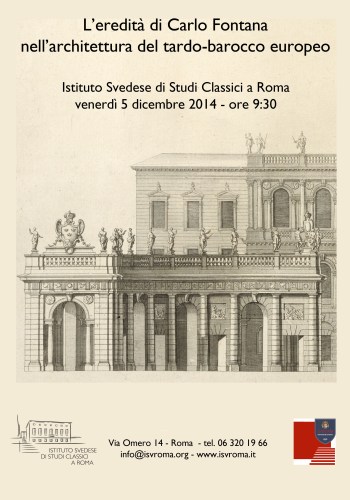
L’eredità di Carlo Fontana nell’architettura del tardo-barocco europeo
Istituto Svedese di Studi Classici, Rome, 5 December 2014
Convegno organizzato da: Istituto Svedese di Studi Classici, Roma -Svenska Institutet i Rom.
Con la collaborazione di: Università degli Studi di Camerino; Dipartimento di Ingegneria dell’Impresa, Università di Roma “Tor Vergata”
 9:30 I sessione | La famiglia Fontana e l’Europa
Coordina Elisabeth Kieven (Bibliotheca Hertziana)
• Giuseppe Bonaccorso (Università degli Studi di Camerino), I Fontana dopo Fontana. L’epilogo di una dinastia familiare: da Mauro Fontana ai numerosi “nipoti” in Europa
• Antonio Russo (La Sapienza, Università di Roma), Architettura e scenografia negli altari a tabernacolo di Carlo Fontana: persistenze, innovazione e fortuna
• Jasenka Gudelj (Università di Zagabria), Carlo Fontana e l’Adriatico orientale: il caso di Dubrovnik
• Andrzej Betlej (Jagiellonian University, Kraków), The Current State of Research on the Influence of Carlo Fontana and His Pupils on Art in the Polish-Lithuanian Commonwealth
• Francesco Amendolagine, Abdul Kader Moussalli (Università degli studi di Udine), La famiglia Fontana all’estero: architetture e decorazione in terra polacca
14:00 II sessione | Cultura e professione architettonica nel Settecento europeo
Coordina Aloisio Antinori (Università degli Studi del Molise)
• Martin Olin (Istituto Svedese di Studi Classici), Architectural Culture in Northern Europe During the Eighteenth Century
• Aloisio Antinori (Università degli Studi del Molise), Circolazione e uso delle stampe romane di architettura al tempo di Carlo Fontana e durante il XVIII secolo
• Mauro Volpiano (Politecnico di Torino), Formazione e aggiornamento degli architetti sabaudi a Roma tra Seicento e primo Settecento
• Simonetta Ciranna (Università degli Studi dell’Aquila), L’eredità di Carlo Fontana nella formazione dell’architetto-ingegnere di fine Settecento. Disegno e geometria nel lavoro di un professionista
integrale
Workshop | The Enlightenment and Sacred Space

◊ ◊ ◊ ◊ ◊
From the Kunsthistorisches Institut at Tübingen:
Aufklaerung und sakraler Raum
Ästhetische Strategien und religiöses Wissen im katholischen Milieu des 18. Jahrhunderts
Eberhard Karls Universität Tübingen, Kunsthistorisches Institut, 29 November 2014
In Kooperation mit dem Graduiertenkolleg 1662 „Religiöses Wissen im vormodernen Europa (800–1800)“
Der Workshop thematisiert theologische und ästhetische Strategien der Kirchenerneuerung im monastischen Milieu der zweiten Hälfte des 18. Jahrhunderts. Im Austausch zwischen kunst- und kirchenhistorischer Forschung werden Ausstattungen sakraler Räume und Predigttexte im Kontext einer katholisch motivierten Aufklärung in den Jahrzehnten vor der Säkularisation diskutiert: die Rolle von Bildern, Objekten und Dekorationen, theologischen und künstlerischen Konzepten bei der Vermittlung religiösen Wissens in Auseinandersetzung mit im weitesten Sinne aufklärerischen Denkmustern und Handlungsfeldern.
Die Entscheidungen über die Neuordnung der Kirchenräume hingen von diversen thematischen, formalen und liturgischen Postulaten ab. Über eine Dichotomie von Barock und Klassizismus hinaus geraten Bildordnungen und Raumstrukturen, die Inszenierung figürlicher Darstellungen, ihre Einbindung oder Nichteinbindung in rituelle Praktiken und die offensive Zurschaustellung historischer Überlieferung im Spannungsfeld von institutioneller Legitimation und inhaltlicher Neubewertung in den Blick. Im Fokus der Beiträge stehen konkrete Phänomene – Predigten, ortsfeste und mobile Ausstattungen, Fresken, Stuck, Altarbilder, Grabmonumente und liturgisches Mobiliar bzw. ihre diskursive Reflexion –, die auf ihre mediale Funktion hin untersucht werden.
P R O G R A M M
9.10 Birgitta Coers und Markus Thome (Tübingen), Begrüßung und Einführung
9.30 Florian Bock (Tübingen), Inszenierung oder Entzauberung der Liturgie? Katholische Predigten und Kirchenraum zwischen 1650 und 1800
10.40 Dörte Wetzler (Jena), Aufgeklärte Wies? Überlegungen zum Einfluss der katholischen Aufklärung auf das Bild- und Ausstattungsprogramm der Wallfahrtskirche zum gegeißelten Heiland (1745–1754)
11.30 Lorenz Enderlein (Tübingen), „Umbettungen“. Retrospektive Sepulturen in barocken Klosterkirchen
14.00 Ute Engel (München), „Simplicitet, welche mit sanfter Gefaelligkeit verschwetert“. Deckengemälde von Johann Baptist Enderle in Kurmainz
15.10 Katinka Häret-Krug (Mainz), Die Ausstattung der Bronnbacher Klosterkirche in der zweiten Hälfte des 18. Jahrhunderts – Reaktion auf die katholische Aufklärung in den Bistümern Mainz und Würzburg?
16.00 Meinrad von Engelberg (Darmstadt), Aufklärung und Renovatio – Ergebnisse und Abschlussdiskussion
Organisation
Dr. Birgitta Coers
Jun.-Prof. Dr. Markus Thome
Conference | Diocletian’s Palace for Adam, Clérisseau, and Cassas
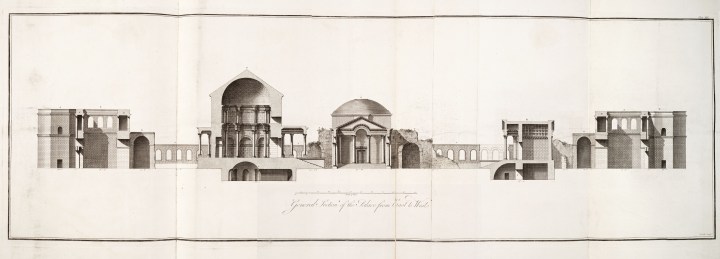
Robert Adam, Ruins of the Palace of the Emperor Diocletian at Spalatro in Dalmatia (1764), Plate XIX, general section of the palace from east to west. Image from the University of Wisconsin’s Digital Library for the Decorative Arts and Material Culture; click here for higher resolution.
◊ ◊ ◊ ◊ ◊
As noted at H-ArtHist:
Diocletian’s Palace in the Works of Adam, Clérisseau, and Cassas
Split City Museum, Split, Croatia, 27–29 November 2014
This international conference organized by the Institute of Art History at Cvito Fiskovic Centre Split arises out of the installation research project Dalmatia: A Destination of the European Grand Tour in the 18th and the 19th Centuries (2014–17) of the Institute of Art History, under the aegis of the Croatian Science Foundation. The conference is financed by the Croatian Ministry of Science, Education and Sports, and the City of Split. Researchers from several countries responded to the invitation to explore the role of Diocletian’s Palace in the work of Robert Adam, Charles-Louis Clérisseau, and Louis-François Cassas, as well as the influence of Diocletian’s Palace on the development of European neo-classicism.
The papers are divided into four groups. The section Reading the Place brings together papers devoted primarily to the ways in which the space is understood and recorded in image and word, based on the direct observation of the monuments and their surroundings. Representing the Past collects works in which the emphasis is placed on depictions of Diocletian’s Palace as sources for scholarship. From today’s perspective, they are important documents for the state of the monument of that time. Here there is also a contribution about the only extant specimen of the Livorno edition of Adam’s Diocletian’s Palace. The third section Diocletian’s Palace and the Adam Style presents works in which there is discussion of the direct influence of Diocletian’s Palace on the work of Robert Adam, while Lessons of Diocletian’s Palace focuses on the later influences of the works of Adam, Clérisseau, and Cassas about the Palace on neo-classicist architecture and culture, as well as on later periods and on the conservation of the palace itself.
Scientific Committee
Josko Belamaric (Institute of Art History – Centre Cvito Fiskovic Split)
Milan Pelc (Institute of Art History Zagreb)
Pierre Pinon (ENSA de Paris-Belleville, École de Chaillot, Institut national d’Histoire de l’Art Paris)
John A. Pinto (Princeton University)
Ana Sverko (Institute of Art History – Centre Cvito Fiskovic Split)
Organizing Committee
Josko Belamaric, Milan Pelc, Ana Sverko
Assistants
Marina Horvat, Ivana Tadic
◊ ◊ ◊ ◊ ◊
T H U R S D A Y , 2 7 N O V E M B E R 2 0 1 4
9.00 Registration
10.00 Welcome
10.30 I: Reading the Place (Moderators: Frances Sands and Milan Pelc)
• Heather Hyde Minor, Robert Adam as Author
• Angelo Lorenzi, The Adam Point of View
• Ana Sverko, ‘The View from the Palace Is No Less Beautiful’: The Context of Diocletian’s Palace in Ruins of the Palace of the Emperor Diocletian at Spalatro in Dalmatia
• Isabelle Warin, The Ornamentation of Diocletian’s Palace in the Work of Louis-François Cassas (1756–1827)
12.10 Coffee
12.40 Discussion
13.30 Lunch
16.00 II: Representing the Past (Moderators: Flora Turner-Vucetic and John Pinto)
• Josko Belamaric, The Split Peristyle as Interpreted by Robert Adam
• Krasanka Majer Jurisic, The Eighteenth-Century Graphics of the Porta Ferrea and the Communal Square In
• Ivan Mirnik, Ante Rendic-Miocevic, Another Look at the Livorno Edition of Adam’s Diocletian’s Palace
17.15 Discussion
17.45 Coffee
18.30 Lecture by John Pinto, ‘The Most Glorious Place in the Universal World’: Rome in the Age of the Grand Tour
F R I D A Y , 2 8 N O V E M B E R 2 0 1 4
9.30 III: Diocletian’s Palace and the Adam Style (Moderators: Heather Hyde Minor, Ante Rendic-Miocevic)
• Frances Sands, Reconstructed and in Ruins: The Influence of Diocletian’s Palace within the Drawings of Robert Adam
• John Pinto, ‘The Beautiful Spirit of Antiquity’: Robert Adam and Diocletian’s Palace
• Colin Thom, ‘Spalatro’ on Thames: Or How Diocletian’s Palace Inspired Robert Adam’s Most Audacious Development – the Adelphi
• Elke Katharina Wittich, Variety and Elegance: Details of Diocletian’s Palace in Architectural Decorations
11.15 Coffee
12.15 IV: Lessons of Diocletian’s Palace (Moderators: Barbara Vujanovic, Fabien Bellat)
• Annie Gilet, Dessins et gravures du Palais de Dioclétien à Split par Louis-François Cassas, un exercice préparatoire aux relevés des grands sites archéologiques du Levant en 1785
• Amanda Green, Experiential Neoclassicism and the Adam ‘Revolution’ in English Architecture
• Stephen Caffey, Imperial Capriccio: The Palace of Diocletian and England’s Visual Cultures of Empire
14.30 Lunch
16.30 IV: Lessons of Diocletian’s Palace (Moderators: Elke Katharina Wittich, Josko Belamaric)
• Viktor Lorincz, Local Antiquities and Architecture in Eighteenth-Century Central-Europe: The Case of Cardinal Migazzi and I.M.A. Ganneval
• Olivia Sara Carli, The Influence of Adam, Clérisseau, and Cassas on Diocletian’s Palace Restoration
• Fabien Bellat, Stalinists Avatars of Diocletian Palace
18.15 Coffee
18.45 Lecture by Ivan Mirnik, Ante Rendic-Miocevic, Sheila Mc Nally and Excavations of Diocletian’s Palace, 1968–75
S A T U R D A Y , 2 9 N O V E M B E R 2 0 1 4
9.30 Walking Tour of Diocletian’s Palace
12.30 Conference Summary
◊ ◊ ◊ ◊ ◊
Note (added 23 November 2014) — The full conference programme with abstracts is available here. More information is available here regarding the larger research project Dalmatia: A Destination of the European Grand Tour in the 18th and the 19th Centuries (2014–17).
Conference | Memoria and Souvenir, 1700–1800
From H-ArtHist:
Memoria and Souvenir: Mediality and Materiality of Remembering in the Arts, 1700–1800
Memoria und Souvenir: Medialität und Materialität des Erinnerns in den Künsten, 1700–1800
Universität Zürich, 5–6 December 2014
This conference aims at discussing historical concepts of memory and remembering with a focus on seventeenth- and eighteenth-century painting, art theory, and science. In suggesting that a fundamental shift in traditional concepts of human memory in relation to changing information management systems took place in the long eighteenth century, focus will be placed upon questions of how changing theories of remembering and forgetting were reflected within new artistic topics and media as well as in art theoretical discourses. Our intention is to explore the pictorial modes of displaying souvenirs, personal memories, and knowledge management by taking into account both eighteenth-century memory theories and the cultural role and development of external memory storage systems. Key issues include the interrelationship of the history of memory and the culture of seeing, the role of memoria within the context of rhetoric and art theory, scientific and artistic reflections on new paradigms of systematization and on the problem of dealing with large quantities of information, and the role of portrait genres and personal souvenirs.
Concept and Organisation: Bettina Gockel and Miriam Volmert (Kunsthistorisches Institut, Universität Zürich)
◊ ◊ ◊ ◊ ◊
F R I D A Y , 5 D E C E M B E R 2 0 1 4
19.00 Abendvortrag, Katia Saporiti, Universität Zürich, “Erinnerung und Repräsentation”
S A T U R D A Y , 6 D E C E M B E R 2 0 1 4
9.00 Bettina Gockel und Miriam Volmert, Begrüssung und Eröffnung der Tagung
9.15 Miriam Volmert, “Introduction: Art, Memory and Knowledge in the Seventeenth and Eighteenth Centuries”
9.30 I: Concepts of Memory and Knowledge Transfer, 1600–1800
• David Allan, University of St Andrews, “Remembering Reading: The British Commonplace Book in the Long Eighteenth Century”
• Valeska von Rosen, Ruhr-Universität Bochum: “Historiographie und Wissensspeicherung: Überlegungen zu Giovanni Pietro Belloris Viten”
11.00 Coffee
11.30 II: Memoria in Art Theory and Science around 1700
• Jan Blanc, Université de Genève: “Mémoire volontaire ou involontaire? Pratiques et débats autour de l’emprunt (borrowing) dans les arts en France et en Grande-Bretagne au XVIIIe siècle”
• Reinhard Wegner, Friedrich-Schiller-Universität Jena: “Strategien visueller Erinnerung: Karl Philipp Moritz und das Bildgedächtnis”
13.00 Lunch
14.30 III: Eighteenth-Century Concepts of Memory and Remembrance in the Arts
• Andreas Gormans, RWTH Aachen: “Vergessene Bilder, erinnerte Metaphern: Mediengeschichtliche Kontinuitäten und Brüche zwischen memoria passionis und encyclopédie”
• Michael Thimann, Georg-August-Universität Göttingen: “Religiöse Empfindung: Bilderbibelprojekte um 1800 und ihr wissensgeschichtlicher Kontext”
16.00 Coffee
4.30 IV: Between Memory and Souvenir: Visual Memories around 1800
• Allison Goudie, The National Gallery, London: “Wax and the Materiality of Memory in Royal Portraiture of the French Revolutionary Period”
• Patrizia Munforte, Universität Zürich: “Remembered by the Pose: Nineteenth-Century Mourning Portraits”
Colloquium | Smyrna: The Eye of Asia

William Pars, Sepulchral Monument at Mylasa, 1765
◊ ◊ ◊ ◊ ◊
From The British Museum:
The British Museum Classical Colloquium | Smyrna: The Eye of Asia
The British Museum, London, 5–6 December 2014
This colloquium over two days, in honour of Charles Sebag-Montefiore, will celebrate the 250th anniversary of the first Ionian expedition to the west coast of Turkey, commissioned by the Society of Dilettanti. The travellers were to settle at Smyrna, modern Izmir, the home of the Levant Trading Company, traditionally an international centre for foreigners travelling in the Ottoman world. Together with its unscheduled sequel in mainland Greece, the expedition was one of the most important cultural enterprises of the 18th century. It comprised a team of three talented men: the Classical scholar Richard Chandler, the architect Nicholas Revett, and the young painter and draughtsman William Pars. The published record of their experience had far- reaching consequences for modern understanding of Classical Turkey.
◊ ◊ ◊ ◊ ◊
F R I D A Y , 5 D E C E M B E R 2 0 1 4
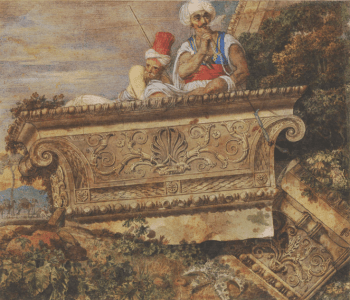
Pilaster capitals from the Temple of Apollo at Didyma, drawn by William Pars, 1765 (London: British Museum)
Starting at 5:30, two lectures and a musical performance:
Compound Eyes: A ‘Prehistoric’ Perspective on Mediterranean Cosmopolitanism,
Professor Cyprian Broodbank (John Disney Professor of Archaeology, McDonald Institute, University of Cambridge)
Smyrna: The Eye of Asia, Dr Philip Mansel (Institute of Historical Research)
Reception, book signing and musical performance by PAKAW!
S A T U R D A Y , 6 D E C E M B E R 2 0 1 4
9.30 Registration
10.00 Welcome and opening remarks by Lesley Fitton (Department of Greece and Rome, British Museum)
10.15 This Wonderful Day, Ian Jenkins (Department of Greece and Rome, British Museum)
10.30 A New Species of Human Being, Tuğba Tanyeri Erdemir (Centre for Science and Society, Science and Technology Museum, Middle East Technical University, Ankara)
11.30 Coffee
12.00 The Society of Dilettanti and Mediterranean Archaeology in the Eighteenth Century, Jason Kelly (Director, Indiana University-Purdue University Indianapolis Arts and Humanities Institute, Associate Professor of British History, IUPUI)
12.30 Travels with Richard Chandler, Alastair Blanshard (School of History, Philosophy, Religion & Classics, The University of Queensland)
13.15 Lunch
14.30 Chandler the Epigrapher, Robert Pitt (Athens)
15.00 The Troad, Lesley Fitton (Department of Greece and Rome, British Museum)
15.30 Quorum Pars Magna Fui: The Role of William Pars, Kim Sloan (Department of Prints and Drawings, British Museum)
16.00 Discussion and concluding remarks by Charles Sebag-Montefiore
Throughout the break periods a captioned slide show of William Pars drawings assembled by Celeste Farge will play in the auditorium.
Exhibition | Glitterati: Portraits & Jewelry from Colonial Latin America
From the DAM:
Glitterati: Portraits & Jewelry from Colonial Latin America
Denver Art Museum, 7 December 2014 — 27 November 2016

Young Woman with a Harpsichord (detail), Mexico, 1735–50 (Denver Art Museum).
During the Spanish Colonial period in Latin America (1521–1850), precious gold and silver were crafted into elegant jewelry then embellished with emeralds from Colombia, coral from Mexico, and pearls from Venezuela. Wanting to demonstrate their wealth and status, people were painted wearing their finest dress and elaborate jewelry.
Women were adorned with tiaras, necklaces with pendants, and prominent earrings. Men proudly displayed hat ornaments, rings, watch fobs, and chatelaines (decorative belt hooks) with small tools similar to the modern Swiss Army knife. Priests wore gold crucifixes and rosaries while nuns had miniature paintings of the Virgin Mary and saints crafted into brooches, called nun’s badges. Inlaid and lacquered chests and boxes were used to store these luxury goods.
The portraits, furniture, and jewelry that are exhibited in Glitterati, drawn from the DAM’s world-renowned Spanish Colonial collection, tell the fascinating story of people and luxury possessions in the New World.
◊ ◊ ◊ ◊ ◊
From the conference page:
New England / New Spain: Portraiture in the Colonial Americas, 1492–1850
Denver Art Museum, 23–24 January 2015
The 14th Annual Mayer Center Symposium is organized by Dr. Donna Pierce, Mayer Curator of Spanish Colonial Art, Denver Art Museum, and Dr. Emily Ballew Neff, Saxon Director & Chief Curator, Fred Jones Jr. Museum of Art, University of Oklahoma.
Portraiture was an important art form in the Spanish colony of New Spain (Mexico) and in the British colonies of North America. Today, details in portraits—such as clothing, jewelry, and decorative arts—often reveal clues to the lives of both artists and sitters. At the symposium, scholars from both fields of study will present tandem talks addressing the evolution of portraiture as well as the similarities and differences in the colonial experience of the two regions.
S P E A K E R S
• Michael A. Brown (San Diego Museum of Art | San Diego) — Pieces of Home? How ‘Colonial’ Portraiture Developed in the Spanish and British Americas
• Elizabeth Mankin Kornhauser (The Metropolitan Museum of Art | New York) — The New England Portraits of Ralph Earl: Fashioning a Style for the New Citizens of the Young Republic
• Clare Kunny (Director, Art Muse | Los Angeles) — In His Own Image: A Humanist Portrait of Antonio de Mendoza
• Karl Kusserow (Princeton University Art Museum | Princeton) — Pride of Place: Selfhood and Surroundings in Early American Art
• James Middleton (Independent Scholar | New York) — Reading Dress in New Spanish Portraiture
• Paula Mues Orts (National School of Conservation, Restoration and Museography | Mexico City) — Corporate Portrait in New Spain: Social Bodies, the Individual, and their Spaces of Display
• Susan Rather (University of Texas | Austin) — Copies or Resemblances of Nature: The Limitations of Portrait Painting in Colonial British America
• Michael J. Schreffler (Virginia Commonwealth University | Richmond) — Cortes and Moctezuma: Words, Pictures, and Likeness in Sixteenth-Century New Spain
• Jennifer Van Horn (George Mason University | Fairfax) — Regional Tastes in a Transatlantic Market: Joseph Blackburn in New England and Bermuda
• Kaylin Haverstock Weber (Museum of Fine Arts, Houston | Houston) — Colonial Ambition Abroad: Benjamin West’s Portraits, 1763–1783
◊ ◊ ◊ ◊ ◊
Note (added 1 February 2016) — The catalogue has just been published by the University of Oklahoma Press:
Donna Pierce and Julie Wilson Frick, Companion to Glitterati: Portraits and Jewelry from Colonial Latin America at the Denver Art Museum (Norman: University of Oklahoma Press, 2016), 96 pages, ISBN: 978-0914738756, $15.
Exhibition and Symposium | Portrait of a Lady?
From One Royal Crescent in Bath:
Portrait of a Lady? Ruin & Reputation in the Georgian Era
One Royal Crescent, Bath, 16 May — 14 December 2014
Curated by Hallie Rubenhold
This exhibition features a private collection of mezzotints of Georgian women from different levels of society including actresses, courtesans and duchesses. The theme of the exhibition is to look at the status of different women in the 18th century, how they viewed themselves and were viewed by society. It also looks at the social fluidity of the 18th century, where a prostitute or actress might rise through the ranks to become a celebrated courtesan and then marry into nobility, or conversely where a woman born into wealth and status might be damned as a ‘whore’ for having a relationship outside of marriage.
◊ ◊ ◊ ◊ ◊
From the symposium programme:
Portrait of a Lady? Symposium
Bath Royal Literary and Scientific Institution, Queen Square, Bath, 14 November 2014
 To coincide with the current exhibition at No.1 Royal Crescent this symposium brings together academics, curators and writers to consider how women were viewed, adored or condemned in the 18th century, in particular through the medium of the mezzotint. Speakers include: writer and broadcaster Dan Cruickshank, Exhibition Curator Hallie Rubenhold, and Professor Emeritus at the Courtauld Institute of Art Aileen Ribeiro. The symposium will be followed by an open invitation to delegates to visit the exhibition at No. 1 Royal Crescent for a drinks reception.
P R O G R A M M E
9.15 Registration
9.30 Welcome by Adrian Tinniswood, writer and historian and Edward Bayntun-Coward, chairman of Bath Preservation Trust
9.40 Portrait of a Lady? by Hallie Rubenhold, curator, writer and broadcaster
10.25 ‘Miss Macaroni and Her Gallant at a Print Shop’: A New Market for Mezzotints by Sheila O’Connell, Assistant
Keeper, British Prints before 1800, British Museum
11.10 Coffee
11.25 The Secret History of Georgian London by Dan Cruickshank, writer and broadcaster
11.55 Queen of the Courtesans: Fanny Murray by Barbara White, former Dean and Director of Advanced Studies in England
12.40 Lunch (provided)
2.00 Behind the Mask: Women and Cosmetics in the Georgian Era by Aileen Ribeiro, Professor Emeritus at the Courtauld Institute of Art
2.30 The First Actresses by Gill Perry, Open University
3.00 Portrait of a Parricide in the Eighteenth Century: Unveiling Miss Blandy’s Image by Garthine Walker, University of Cardiff
3.45 Tea
4.00 Elections and Entertainments: Elite Women and Politics in the Eighteenth Century by Elaine Chalus, Bath Spa University
4.30 The First Sexual Revolution and the Birth of Sexual Celebrity by Faramerz Dabhoiwala, Exeter College, Oxford
5.30 Summing up by Adrian Tinniswood
6.00 Drinks reception and exhibition at No.1 Royal Crescent










leave a comment