Study Day | Josephine and the Empire of Fashion
From H-ArtHist:
Joséphine et l’Empire de la Mode
Archives Nationales Hôtel Soubise, Paris, 24 June 2014
Marie-Joseph-Rose de Tascher de la Pagerie, impératrice des Français sous le nom de Joséphine, est née aux Trois-Ilets en Martinique le 23 juin 1763, et décédée au château de Malmaison le 29 mai 1814. L’année 2014 célèbre Joséphine au titre des commémorations nationales. Deux grandes expositions lui sont consacrées, Joséphine au musée du Luxembourg à Paris, et Joséphine, la passion des fleurs et des oiseaux au musée national du château de Malmaison. L’inventaire fait après le décès de Joséphine comprend celui d’une importante garde-robe, dont le château de Malmaison conserve quelques témoignages. C’est à propos des choix textiles, du goût et du style de Joséphine que s’articule la journée d’étude Joséphine et l’Empire de la mode, initiée par l’association ART & LUXE.
Sur inscription dans la limite des places disponibles par courriel à l’adresse suivante: Art-luxe@live.fr
◊ ◊ ◊ ◊ ◊
P R O G R A M M E
13:30 Accueil
14:00 Corinne Thépaut-Cabasset (historienne de la mode, Paris), L’image de la mode dans la presse : Le ‘costume parisien’, 1800–1815
14:30 Alain Pougetoux (conservateur en chef, domaine national des châteaux de Malmaison et Bois-Préau), La boutique à paris sous le Premier empire
15:00 Céline Meunier (conservateur en chef, Domaine national des châteaux de Malmaison et Bois-Préau), Joséphine : en quête d’une garde-robe
15:30 Fiona Ffoulkes (Université de Southampton, professeur associé Université des arts de Bournemouth et université américaine, Paris) Muse, cliente et amie ? L’importance de la relation de l’impératrice Joséphine avec Leroy, marchand de modes
16:00 Marguerite Coppens (Chef de département, Musées royaux d’art et d’histoire, Bruxelles), Les commandes dentellières de la maison impériale
16:30 Carole Damour (archiviste textile, Société Tassinari & Chatel, Paris), Des palais impériaux au château de la Malmaison : Les choix textiles de Joséphine
17:00 Discussion
Conference | George I 300 Years On
From the conference website:
George I 300 Years On: Reconstructing the Succession
Bath Royal Literary and Scientific Institution, 18–20 June 2014
This interdisciplinary conference takes the theme of the accession of the first Hanoverian king, George I. It will examine not just the end of the Stuart era, but the defining characteristics, outcomes and consequences the Hanoverian succession.
W E D N E S D A Y , 1 8 J U N E 2 0 1 4
2:00 Registration and afternoon tea
Welcome from Elaine Chalus (Bath Spa University), Nichola Hayton (Mannheim Universität), and Stefano Weinberger (Cultural Attaché for the German Embassy in London)
3:45 Opening Plenary, Dominic Aidan Bellenger (Abbot of Downside Abbey), George I and the Catholics
Drinks reception; delegates may wish to visit the Georgian exhibition at the Fashion Museum or take a walking tour of Bath.
7:30 Conference Dinner
T H U R S D A Y , 1 9 J U N E 2 0 1 4
9:00 Tea and coffee
9:30 Panel I, chaired by Elaine Chalus
• Ruth Paley (History of Parliament), Seditious Libel in the Last Years of Anne
• Robin Eagles (History of Parliament), The Duke of Shrewsbury and the Politics of Succession in the Last Days of Anne
• Matthew Kilburn (History of Parliament), The Missing Queen
11:00 Tea and coffee
11:30 Panel II, charied by Kevin Grieves
• Mark Walker (University of Essex), The Bittersweet Death of Queen Anne, 1714
• Noel Cox (Aberystwyth University), The Law of Succession
• Heike Bormuth (Universität Mannheim), From Georg Ludwig to George I: An Absolutistic Elector in the English Parliamentary Monarchy. The Settling in of the Hanoverian Dynasty
• Richard Johns (University of York), ‘A New Breed of Men’: George I and his Progeny at Greenwich
1:30 Lunch
3:00 Panel III Postgraduate Panel, chaired by Georgina Moore
• James Camp (Bath Spa University), By Royal appointment: Bath and the Reception of Royalty, 1660–1714
• Kate James (Bath Spa University), Newton Park and the Country House in Transition
• Kelly Yates (University of Manchester), Jeffrey the Jacobite Poltergeist
F R I D A Y , 2 0 J U N E 2 0 1 4
9:30 Tea and coffee
10.00 Panel IV, chaired by Andrew Thompson
• James Caudle (Yale University), A Revolution in Political Broadcasting: The Political Sermon in the Hanoverian Revolution, 1714–16
• Ralph Stevens (Fitzwilliam College, University of Cambridge), ‘King George’s Religion’: The Religious Politics of the Hanoverian Succession
• James Lees, Schism, Succession: Chaplains of George Augustus and Caroline as Prince and Princess of Wales, 1714–27
11:30 Tea and coffee
12:00 Panel V, chaired by Arnd Reitemeier
• Kevin Grieves (Bath Spa University), The London Press and the Succession
• Stewart Tolley (University of London), A Popular Rail? Press and Public Interest in George I’s Ministers, 1714–27
• Benjamin Bühring (Göttingen University), An Expatriate Community: The London German Court of George I
1:30 Lunch
2:45 Panel VI, chaired by Jackie Collier
• Philip Loft (University of London), Parliament, Petitioning, and the Public, 1714–20
• Pauline Chakmakjian (Independent Scholar), A Sociable King: George I and the Rise of Speculative Freemasonry
• Nigel Aston (University of Leicester), A Mixed Ministry? The Tories in government, 1714–16
4:45 Closing Plenary, Clarissa Campbell Orr (Anglia Ruskin University), Life and Culture at Court in England and Hanover: An Anglo-German Comparison
Conference | The Images and Texts of Alexander Pope
Originals, Translations, and Imitations:
The Images and Texts of Alexander Pope
Waddesdon Manor, Buckinghamshire, 12 July 2014
 A one-day conference organized by Waddesdon Manor (the Rothschild Foundation) in collaboration with The Paul Mellon Centre for Studies in British Art
This conference will explore some central themes running through the exhibition, Fame and Friendship: Pope, Roubiliac, and the Portrait Bust in Eighteenth-Century Britain, organised jointly by the Rothschild Foundation and Waddesdon Manor with the Yale Center for British Art. At the heart of the exhibition are eight portrait busts of the poet Alexander Pope by Roubiliac along with various replications of this model. These images imitate classical portrait busts, translating the conventions of the originals into an eighteenth-century mode. At the same time, the replications translate Roubiliac’s original into other media, such as plaster or ceramic. At Waddesdon these various images will not only shown not only alongside both some of the most celebrated painted portraits of the poet and examples of his printed texts, but also juxtaposed with French works celebrating Pope and other writers. These various processes of imitation and translation could hardly be more appropriate for a subject whose contemporary fame rested partly on his own translations of Homer and whose poetry constantly imitated classical models. In its turn, Pope’s work was itself translated into French. All the papers in this conference will address different aspects of imitation and translation, in the form of both images and texts. The fee for the day is £40. To book a place, please ring the booking line on 01296 653226. Please let us know of any dietary requirements.
◊ ◊ ◊ ◊ ◊
P R O G R A M M E
9:45 Coffee and registration in the Manor Restaurant with the exhibition open for viewing
10.30 Welcome by Sarah Weir (Chief Executive, Waddesdon Manor)
10:45 Text, Image, and Translation (Chair: Alastair Laing)
• Nigel Wood (Loughborough University), Pope as the Translator of Homer and Horace
• James McLaverty (Keele University), Pope in his Pastorals: Manuscript and Print
• Valerie Rumbold (Birmingham University), The Use of Art in Alexander Pope’s “To Mr. Addison, Occasioned by Dialogues on Medals”
12:45 Lunch
1:50 Pope and the Image (Chair: Martin Postle)
• Caroline Pegum (Independent Scholar), Charles Jervas and Pope’s Portraits
• Malcolm Baker (University of California, Riverside), For Friends and Admirers: The Sculptural Replication of Pope’s Image
• Juliet Carey (Waddesdon Manor), Pope and the Ceramic Canon
3.50 Tea
4:20 Pope, Writers, and France (Chair: Malcolm Baker)
• Russell Goulbourne (Kings College, London), Voltaire’s Pope
• Guilhem Scherf (Musée du Louvre), French Sculptors and the Image of the Writer
5:45 Drinks reception (Parterre or Manor Restaurant, depending on weather) during which the exhibition will again be open for viewing.
Conference | Bound for Greatness: Books, Libraries, and Book Collecting
The National Trust and Waddesdon Manor (Rothschild Collections) Annual Conference
Bound for Greatness: Books, Libraries, and Book Collecting in the 18th and 19th Centuries
Waddesdon Manor, Buckinghamshire, 1 July 2014
Organised by Mark Purcell, Christopher Rowell, and Pippa Shirley

The Morning Room at Waddesdon Manor, with a view of the collection of illustrated books and bindings and a portrait of the collector Baron Ferdinand de Rothschild. Photo: John Bigelow Taylor © The National Trust, Waddesdon Manor
The annual National Trust/Waddesdon Manor Conference this year is on the subject of books, libraries, and book collectors and collecting, prompted by the publication in 2013 of the Waddesdon catalogue of Printed Books and Bookbindings. Our distinguished speakers are drawn from across the book world—from libraries, universities, historic house collections, and the book trade. There will also be an opportunity to view the special exhibitions in the manor, including Royal Spectacle: Ceremonial and Festivities at the French Court. This exhibition features the lavishly illustrated books that document the many extravagant festivities and ceremonies staged for the French court during the 17th and 18th centuries.
The day will begin with coffee at 9:45 and end with a drinks reception finishing around 6:00. The £25 conference fee includes tea and coffee on arrival and a two-course lunch. To book a place, please ring the booking line on 01296 653226, Monday to Friday (except Bank Holidays), 10am–4pm, or email: bookings.waddesdon@nationaltrust.org.uk.
◊ ◊ ◊ ◊ ◊
P R O G R A M M E
9:45 Registration and Coffee in the Manor Restaurant
10:15 Christopher Rowell (Furniture Curator, National Trust) and Pippa Shirley (Head of Collection, National Trust / Waddesdon Manor), Welcome and Introduction
10:15 Paul Quarrie (Maggs and former Senior Director of Sotheby’s Department of Rare Books and Manuscripts), ‘The Changing Fortunes of the “Rare Book” in France around 1800: A Chapter in the History of Taste’
10:45 Raphaële Mouren (Librarian and Deputy Directory, The Warburg Institute), Title TBC
11:15 Robert Betteridge (Rare Books Curator, National Library of Scotland), ‘The Library of the Dalrymples of Newhailes’
11:45 David Adshead (Head Curator, National Trust), Architecture of Libraries
12:15 Questions and Discussion
12:30 Lunch in the Manor Restaurant
1:30 Mirjam Foot (Emeritus Professor of Library & Archive Studies, University College London), ‘Two 19th-Century Collectors: A Shared Love of Bookbindings?’
2:00 John O’Brien (Professor in the School of Modern Languages and Cultures, Durham University), Anglo-French
2:30 Mark Purcell (Libraries Curator, National Trust), ‘The Lost Library at Clumber Park’
3:00 Rachel Jacobs (Assistant Curator, Waddesdon), ‘The Royal Spectacle at Waddesdon Manor: An Exhibition of 17th- and 18th-Century French Festival Books’
3:20 David Pearson (Director of Culture, Heritage and Libraries, City of London Corporation), ‘Emerging Themes in the Study of the Private Library’
3:45 Tea in the Manor Restaurant with an opportunity to visit the shop (3:45–4:30 only), the Manor, and special exhibitions
5:00 Reception on the Terrace
Conference | The Mobile Spectator
From H-ArtHist:
The Mobile Spectator: Viewing on the Move International Conference
University of Nottingham, 4–5 July 2014
This interdisciplinary conference brings together speakers from the UK, Europe and North America to examine the ways in which our experiences of art, vision and movement are inseparable. Travel is often a prerequisite to putting oneself in a position to be able to see something, or to see it properly; physical effort is required to address the object or image appropriately. Conference papers ranging from classical antiquity to today on artefacts and environments in Europe, East Asia and the United States will examine the mobilisation of spectators as well as objects in various media.
Conference fee: £20 (includes tea, coffee) for both days or £10 for one day.
Conference dinner: £18 (includes wine); must be booked in advance.
Contact: ting.chang@nottingham.ac.uk and richard.wrigley@nottingham.ac.uk
◊ ◊ ◊ ◊ ◊
F R I D A Y , 4 J U L Y 2 0 1 4
10:00
• William Leveritt (Classics, University of Nottingham, “Controlling the Viewer’s Gaze: the Case of Roman Sarcophagi”
• Katharina Lorenz (Classics, University of Nottingham), “The Pergamon Altar: An Itinerary of the Divine”
11.30 Coffee
11.50
• Tina Bawden (Art History, Kunsthistorisches Institut, Freie Universität Berlin), “Moving from Seeing to Feeling and Back: Encounters at the Door, Medieval and Beyond”
• Jeannet Hommers (Art History, Kunsthistorisches Institut, Universität zu Köln), “Moving and Viewing, Discovering and Believing: Physical Movement in Romanesque Churches on the Way to St James”
1.15 Lunch
2.00
• Jeffrey Moser (Art History and Communication Studies, McGill), “Compositional and Experiential Motion in the Qingming Handscroll”
• Rachel Saunders (East Asian Languages and Civilizations, Harvard), “Temporal Kinetics: Movement and Stasis in the Viewing of Japanese Narrative Scrolls”
3.30 Coffee
4.00
• Katharina Eck (Mariann Steegmann Institute for Art and Gender, University of Bremen), “Viewing and Living on the Move: Scenic Wallpapers”
5.00 Keynote
• Bronwen Wilson (School of Art History and World Art Studies, University of East Anglia), “Moving Pictures: Inscription, the Horizon and Melchior Lorck’s Prospect of Constantinople”
S A T U R D A Y , 5 J U L Y 2 0 1 4
9.30
• Susanna Caviglia and Niall Atkinson (Art History, University of Chicago), “Wandering in Rome in the Eighteenth Century: The Aesthetics of the Mobile Gaze”
• Sarah Betzer (Art History, University of Virginia), “Vernon Lee’s Rome: Sculpture, Archaeology, and Empathy”
11.00 Coffee
11.30
• Michaela Giebelhausen (School of Philosophy and Art History, University of Essex), “Game or Prey: Movement and Meaning in the Museum of Natural History”?
• Ellery Foutch (Courtauld Institute of Art, London), “Moving Pictures: Magic Lanterns and Urban Advertising in the Nineteenth Century”
1.00 Lunch
2.00
• Jessen Kelly (Art and Art History, University of Utah), “Mutable Perspectives: Fortune and the Viewer in Renaissance Games of Chance”
• Michael Gott (Romance Languages and Literatures, University of Cincinnati), “Travelling Beyond the Frame: Cinematic Speed and Perception in French-Language Comics”
3.30 Coffee
4.00
• Tatiana Senkevitch (Sarah Blaffer Foundation, Museum of Fine Arts, Houston), “Et in Pictura Ego: Alexander Sokurov’s Visual Elegies”
• Richard Taws (Art History, University College London), “Moving Histories: Revolutionary Scenography in Eric Rohmer’s L’Anglaise et le duc”
Conference | Dresden’s Academy of Fine Arts Turns 250
If only more conferences included World Cup parties. . . . As noted H-ArtHist:
„Die Geister, die ich rief…“ 250 Jahre Kunstakademie Dresden
Dresden, 12–13 June 2014
Die Kunstakademie Dresden feiert in diesem Jahr ihr 250-jähriges Bestehen. Dieses ist Anlass, einen Blick in die Vergangenheit zu werfen und damit Überlegungen zu Gegenwart und Zukunft der Hochschule anzustoßen. Die zentrale Ausstellung geradezu momentan, ein essayistisch konzipierter Parcours durch die Geschichte der Hochschule, wird abgerundet durch eine Tagung, die einflussreiche Künstler- und Lehrerpersönlichkeiten wie Christian Ludwig von Hagedorn, Giovanni Casanova oder Gotthardt Kuehl ins Zentrum rückt. Zur Sprache kommen die Entwicklung der Akademieausstellungen und die Geschmacksbildung im ausgehenden 18. Jahrhundert ebenso wie kulturpolitische Richtungsdebatten im 20. Jahrhundert etwa am Beispiel des Malers und Rektors Richard Müller.
Organisiert von Bettina Uppenkamp und Dietmar Rübel
◊ ◊ ◊ ◊ ◊
D O N N E R S T A G , 1 2 J U N I 2 0 1 4
17.00 (Oktogon), Führung durch die Ausstellung geradezu momentan mit Susanne Greinke und Dietmar Rübel (HfBK Dresden)
19.00 (Aktsaal) Begrüßung durch Bettina Uppenkamp (Dresden)
19.15 Roland Kanz (Bonn), Die frühe Kunstakademie als Soziotop
21.00 Grillen und WM-Party
F R E I T A G , 1 3 J U N I 2 0 1 4
9.30 Matthias Flügge (Dresden), Geist und Geister. Zur aktuellen Situation der Kunstakademien
10.00 Bärbel Kovalevski (Berlin), „Es ist eine Ehre sich auf dem Niveau der großen Künstler zu sehen.“ (Rosina de Gasc 1768) – Künstlerinnen an der Kunstakademie Dresden
10.45 Dirk Syndram (Dresden), Christian Ludwig von Hagedorn oder von der Nützlichkeit der Kunst
11.30 Kaffeepause
11.45 Anke Fröhlich (Dresden), Altargemälde, Aktstudien, Kurfürstenporträts, Porzellanentwürfe und Genreszenen. Johann Eleazar Zeissigs, genannt Schenau an der Akademie in Dresden
12.30 Mittagspause
14.00 Harald Marx (Dresden), Reflexe der frühen akademischen Kunstausstellungen in der zeitgenössischen Presse
14.45 Jürgen Müller (Dresden), Von den Strategien der Moderne – Gotthardt Kuehl und der deutsche Impressionismus
15.30 Stephan Weber (Dresden), Überzeugungstäter und Mitläufer. Die Professoren der Dresdener Kunstakademie im Schatten des Nationalsozialismus
16.15 Kaffeepause
17.00 (Oktogon), Richard Müller zwischen Kunst und Politik. Diskussion mit Ralf Lehmann; Bettina Uppenkamp und Dietmar Rübel in der Ausstellung geradezu momentan.
Conference | Enlightenment Cosmopolitanisms and Sensibilities
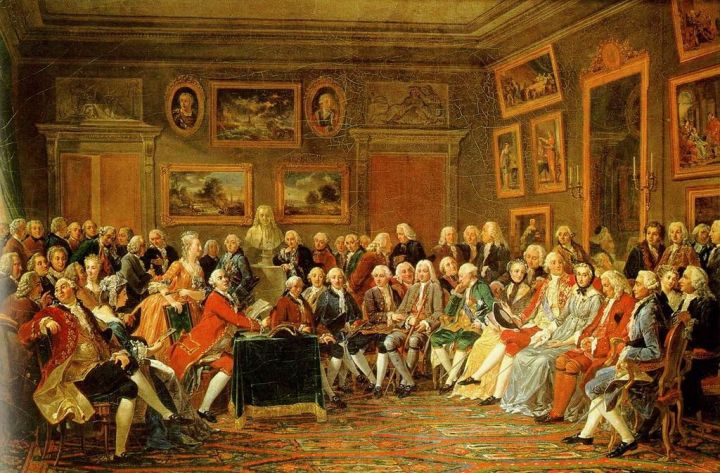
Anicet Charles Gabriel Lemonnier, Salon de Madame Geoffrin,
1812 (Château de Malmaison)
◊ ◊ ◊ ◊ ◊
From the Sydney Intellectual History Network, with the workshop programme:
Enlightenment Cosmopolitanisms and Sensibilities
Sancta Sophia College, The University of Sydney, 11–12 June 2014
The character of practiced cosmopolitanism during the Enlightenment often appears to amount to little more than an extension of early modern courtly internationalism infused with a new language of ideas. Further investigation reveals the desire on the part of Enlightenment cosmopolites to open borders in the name of economic, political, intellectual and artistic progress. This workshop explores cosmopolitanism in practice during the long eighteenth century in Europe and, through circulation, beyond its borders. It seeks out lived experiences of cosmopolitanism in the evidence of visual, social and textual expressions, and then asks how to interrogate this evidence. What were the opportunities through which border crossings became fixed in the minds of participants and observers? How was Enlightenment cosmopolitanism in practice inflected with different forms of sensibility?
W E D N E S D A Y , 1 1 J U N E 2 0 1 4
9:30 Welcome
9:45 Session 1: Languages of Cosmopolitanism
• David Garrioch (History, Monash University), Cosmopolites and their Critics: the Eighteenth-Century Language of Cosmopolitanism
• Jennifer Milam (Art History, University of Sydney), Visual Cosmopolitanism
11:15 Morning Tea
11:30 Session 2: Rome and Cosmopolitan Aesthetics
• David Marshall (Art History, University of Melbourne), Cosmopolitanism and Non- Antiquarian Taste in Early Eighteenth-Century Rome
• Mark Ledbury (Art History, University of Sydney), Cosmopolitanism and Anti- Cosmopolitanism in Rome
1:00 Lunch
2:00 Session 3: Rousseau and Cosmopolitanism
• Anik Waldow (Philosophy, University of Sydney), Rousseau, Theatre and Civic Identity
• Ian Coller (History, LaTrobe University), Rousseau’s Turban
3:30 Afternoon Tea
3:45 Session 4: Cosmopolitan Circulations
• Alexandra Cook (Philosophy, University of Hong Kong), Eighteenth-Century Botanical Cosmopolitanism: Books, Seeds and Herbaria
• Peter McNeil (Design History, University of Technology, Sydney), ‘Beauty in Search of Knowledge’: Eighteenth-Century Fashion and the Uses of Print
• Melissa Hyde (Art History, University of Florida), Wertmüller, National Identity and the Cosmopolitan Circulation of the Artist
T H U R S D A Y , 1 2 J U N E 2 0 1 4
9:30 Session 5: Open Borders: Europe and Beyond
• Simon Burrows (History, University of Western Sydney), Books Crossing Borders: Material Traces and Enlightenment Cosmopolitanism
• Jennifer Ferng (Architecture, University of Sydney), Maritime Voyages: Siege and Sovereignty at Galle Fort, Ceylon, 1729–1796
11:00 Morning Tea
11:15 Session 6: Revolutionary Exchanges
• Peter McPhee (History, University of Melbourne), Cosmopolitanism, Robespierre and the French Revolution
• Richard Taws (Art History, University College London), Chains of Command: Telegraphing Liberty in Lemonnier’s Le Commerce
12:45 Lunch
Cosmopolitan Moments: Instances of Exchange
in the Long Eighteenth Century, Emerging Scholar Sessions
In these sessions, emerging scholars explore discrete instances of cultural interaction in the long eighteenth century (visual, textual, political, philosophical, social). How do we define the nature of the exchange? Is it cosmopolitan? Areas of analysis include roles of actors and agents, bi-lateral or unilateral action, acceptance, rejection and the medium of transmission.
1:45 Session 7
• Garritt Van Dyk (History, University of Sydney), Before the Parisian Café: Cosmopolitanism and the Franco-Ottoman Alliance
• Mark Shepheard (Art History, University of Melbourne), The Cosmopolitan Castrato: Farinelli and the Visual Arts
• Warren Andrews (Art History, University of Sydney), An Ambush in Print
3:15 Afternoon Tea
3:30 Session 8
• Emma Gleadhill (History, Monash University), Lady Holland’s House: ‘The House of all Europe’
• Katja Abramova (Art History, The University of Sydney), Botany as a Cosmopolitan Pursuit for Women: The Case of the Maria Feodorvna
• Laura Jocic (History, University of Melbourne), Anna King’s Dress: Trade and Consumption in the Early Years of Settlement in Australia
• Janet Healy (Music, Monash University), Mozart in a Revolutionary Context
Conference | Idols in the Museum: Sculpture and Historiography
From the conference programme:
Les Idoles Entrent au Musée: La sculpture, son historiographie, sa muséographie, 1650–1880
École du Louvre, Paris, 10–12 June 2014
La participation au colloque Les idoles entrent au musée. La sculpture, son historiographie, sa muséographie, 1650–1880 est gratuite mais subordonnée à une inscription préalable obligatoire à colloques@ecoledulouvre.fr.
Comité scientifique: Caroline van Eck (Leyde), Pascal Griener (Neuchâtel), Maarten Delbeke (Gand/Leyde)
M A R D I , 1 0 J U I N 2 0 1 4
Première partie : Des histoires visuelles de la sculpture
Président de la session : Pascal Griener
13.00 Accueil
13.30 Ouverture du colloque (Philippe Durey/Caroline van Eck)
14.00 Frits Scholten (Conservateur en chef du département de la sculpture, Rijksmuseum Amsterdam), ‘The Amsterdam ivories of Francis van Bossuit (1635–1692): reception and transformation in the 18th century’ [‘Les ivoires d’Amsterdam de Francis van Bossuit (1635–1692) ; réception et transformation au XVIIIe siècle’]
14.45 Erin Downey (Doctorante Temple University. Kress Fellow Université de Leyde), ‘Sculptures in print: the Galleria Giustiniana as exemplar and agent of taste in early modern Europe’ [‘Sculptures imprimées : la Galleria
Giustiniana comme exemple et agent de goût en Europe prémoderne’]
15.30 Pause
16.00 Anne Ritz-Guilbert (docteur en histoire de l’art, membre de l’équipe de recherche de l’Ecole du Louvre), ‘La sculpture comme source historique : les dessins de la collection de François-Roger de Gaignières (1642–1715)’
16.45 Guilhem Scherf (Conservateur en chef du département de la sculpture, Musée du Louvre), ‘Une collection révélée par le livre : Les Monumens érigés en France à la gloire de Louis XV de Pierre Patte (1765)’
M E R C R E D I , 1 1 J U I N 2 0 1 4
Deuxième partie : La muséographie de la sculpture
Présidente de la session : Caroline van Eck
10.00 Accueil
10.30 Ruurd Halbertsma (Conservateur en chef du départment des sculptures Grecques, Musée National d’Antiquités. Professeur en muséologie Université de Leiden), ‘Admiration and indignation: calvinistic approaches to classical sculpture in the Netherlands’ [‘Admiration et indignation : les approches calvinistes de la sculpture aux Pays-Bas’]
11.15 Claire Mazel (Docteur en histoire de l’art, CRHIA, université de Nantes), ‘Désenchantement et réenchantement de la sculpture européenne dans la collection de Robien’
12.00 Thomas Beaufils (Maître de conférences à l’université Lille 3, actuellement en détachement à l’Institut français des Pays-Bas. Membre de l’Institut de Recherches Historiques du Septentrion (IRHiS) – UMR CNRS 8529 – Lille 3), ‘Manque-t-il quelque chose ? L’incompréhensible statuaire de l’île indonésienne de Nias dans les musées de France et des Pays-Bas’
12.30 Pause
14.00 Cecilia Griener Hurley (Docteur en histoire de l’art. Membre de l’équipe de recherche de l’Ecole du Louvre), ‘La présentation du paragone dans les dispositifs muséaux au XIXème siècle’
14.45 Bram van Oostveldt (Postdoc Université de Leyde. Maître de conférences Université d’Amsterdam), ‘La mise en scène de la sculpture aux visites nocturnes du Louvre comme au théâtre’
15.30 Pause
17.00 Visite collections de sculpture du Musée du Louvre
J E U D I , 1 2 J U I N 20 1 4
Troisième partie : le statut de la sculpture
Président de la session : Maarten Delbeke
14.30 Stijn Bussels (Directeur du programme ERC Elevated Minds : The sublime in the public arts in 17th-century Paris and Amsterdam, Université de Leyde), ‘»We are still trembling when we think of it »’ Honouring the sculptures of the Amsterdam Town Hall’ [‘« Nous tremblons encore quand nous y pensons » : comment rendre honneur aux scultures de l’Hôtel de Ville d’Amsterdam ?’
15.15 Pascal Griener (Professeur en histoire de l’art et muséologie, Université de Neuchâtel), ‘Les idoles au musée. Pour revisiter la description de l’Apollon Belvédère par Johann Joachim Winckelmann (1764).’
16.00 Tomas Macsotay (Postdoc Université Autonome de Barcelona, Département d’histoire de l’art et musicologie), ‘Baron D’ Hancarville’s Recherches on the evolution of sculpture: submerged emblems and the collective self’ [Baron d’Hancarville’s Recherches sur l’évolution de la sculpture : emblèmes sousmergés et le soi collectif’]
16.45 Caroline van Eck (Professeur en histoire de l’art et de l’architecture prémodernes, Université de Leyde), ‘Une histoire visuelle de la sculpture. Présence matérielle et trompe l’oeil dans le programme de décoration du Musée Charles X.’
17.30 Conclusion du colloque
Conference | Workshops and Manufactures in France, 1789–1815
From the conference programme:
« Les progrès de l’industrie perfectionnée »
Ateliers et manufactures de la Révolution française au Premier Empire, 1789–1815)
Workshops and Manufactures in the Years between the
French Revolution and the Napoleonic Empire, 1789–1815
Institut national d’histoire de l’art and Centre allemand d’histoire de l’art, Paris, 13–14 June 2014
 Entre la réunion des États généraux et la fin du Premier Empire, vingt-cinq ans s’écoulent pendant lesquels bouleversements politiques, économiques, sociaux et culturels créent un contexte d’instabilité pour le secteur du luxe et du demi-luxe français. Les ateliers et les manufactures sont confrontés à des conditions matérielles et organisationnelles difficiles. Le manque de matières premières, la détérioration des finances et la diminution du personnel en raison du départ des jeunes hommes aux armées ont un impact négatif sur la production artisanale. L’incertitude générale que représente cette période d’instabilité politique et de conflits armés n’empêchent pourtant pas l’émergence de modes. De nouveaux marchés s’ouvrent et offrent de riches opportunités aux artistes et artisans pour diversifier et élargir leurs créations.
La période révolutionnaire a souvent été considérée comme un temps de rupture, en particulier dans le domaine du luxe dont elle remet en cause les fondements. Il s’agira ici, au contraire, de l’envisager dans sa continuité, à la jonction des XVIIIe et XIXe siècles. La reprise de la production des objets de luxe s’observant dès le Directoire et s’épanouissant avec l’Empire, les mutations de la société et du travail posent la question du développement de nouveaux paradigmes. À quels évènements et à quels changements les manufactures d’État, les ateliers de renom ainsi que les producteurs régionaux doivent-ils faire face entre l’Ancien Régime et la Restauration des Bourbons ? De quelle manière les artistes et les artisans réussissent-ils – ou échouent-ils – à s’adapter ? Mais aussi comment, de ces situations complexes, émergent les facteurs mêmes d’une évolution possible d’un secteur en processus d’industrialisation ?
Le présent colloque entend faire le point sur cette période charnière de l’histoire des arts décoratifs en France, l’objectif étant de mieux comprendre comment, au sein d’une actualité foisonnante, porteuse de transformations, ont fonctionné des ateliers et des manufactures établis à Paris et sur l’ensemble du territoire français. Pluridisciplinaire, croisant en particulier l’histoire de l’art, l’histoire sociale, l’histoire économique, l’histoire culturelle et l’histoire des techniques, le colloque cherchera autant à affiner la périodisation de son sujet d’étude qu’à fournir les clefs de lecture d’une analyse plurielle des objets, en complément d’une approche stylistique déjà éprouvée.
◊ ◊ ◊ ◊ ◊
V E N D R E D I , 1 3 J U I N 2 0 1 4
9.00 Accueil par Philippe SÉNÉCHAL (INHA, Paris)
Organiser les ateliers et les manufactures
Présidence de séance Odile NOUVEL (musée des Arts décoratifs, Paris)
9.10 David CELETTI (université de Padoue) « Filer le luxe. Manufactures, ateliers et travail domestiques à l’aube de l’industrialisation »
9.30 Stéphane PIQUES (université Toulouse – Jean Jaurès, FRAMESPA, UMR 5136) « L’organisation de la production dans l’industrie céramique sous la Révolution : l’exemple du territoire industriel de Martres-Tolosane (Haute-Garonne) »
9.50 Élodie VOILLOT (université Paris Ouest Nanterre La Défense, INHA, Paris) « Des canons aux statuettes. L’industrie du bronze au tournant du XIXe siècle »
10.10 Pause
10.50 Camilla MURGIA (université d’Oxford) « The Elusive Link : Fine Arts and Industry Exhibitions under the Consulate and the Empire »
11.10 Christiane DEMEULENAERE-DOUYÈRE (Centre Alexandre Koyré, UMR 8560, CNRS-EHESS-MNHN, Paris) « Le luxe sous l’Empire. Entre pénurie de matières premières et recherche de substituts »
11.30 Discussion
12.30 Pause
Créer de nouveaux objets et de nouveaux styles
Présidence de séance Patrick VERLEY (université de Genève)
14.00 Piedade DA SILVEIRA, Michelle SAPORI (Paris) « Louis-Hyppolite Leroy et son atelier de modes de 1793 à 1815 »
14.20 Marie-Agnès DEQUIDT (université Paris-Est Créteil) « Horlogerie et Révolution : continuer à tourner dans un monde en bouleversement, 1789–1815 »
14.40 Bernard JACQUÉ (musée du papier peint de Rixheim) « Des décors de luxe en papier peint pendant la Révolution française »
15.00 Pause
15.40 Justin BEAUGRAND-FORTUNEL (École Pratique des Hautes Études, Paris) « Le mobilier de campagne de Napoléon Ier. L’artisanat au service de l’Empereur »
16.00 Discussion
S A M E D I , 1 4 J U I N 2 0 1 4
9.15 Accueil par Thomas KIRCHNER (Centre allemand d’histoire de l’art, Paris)
9.30 Un double bilan historiographique en histoire de l’art et en histoire
Philippe BORDES (université Lumière Lyon 2, LARHRA, UMR 5190) et Anne PERRIN KHELISSA (université Toulouse – Jean Jaurès, FRAMESPA, UMR 5136) ¬- Jean-François BELHOSTE (École Pratique des Hautes Études, Paris) et Natacha COQUERY (université Lumière Lyon 2, LARHRA, UMR 5190)
Diffuser et promouvoir la production à l’international
Présidence de séance Anne DION-TENENBAUM (musée du Louvre, Paris)
10.00 Valeria MIRRA (Archives du Moderne de Mendrisio, université de la Suisse italienne) « Labor omnia vincit. La Manufacture Piranesi de vases et ornements en terre cuite de Mortefontaine »
10.20 Ludmila BUDRINA (musée des Beaux-Arts d’Ekaterinburg) « Lapidaires parisiens aux services de Nicolas Demidoff : la collection des objets en bronze doré et malachite avec des mosaïques en reliefs des pierres dures réalisés par Thomire (d’après les documents inédits et les collections européennes) »
10.40 Pause
11.20 Hans OTTOMEYER (Munich)« Innovation by Design as Strategy for Luxury Goods »
11.40 Iris MOON (Sterling and Francine Clark Art Institute in Williamstown) « The Immutable Décor : Revolutionary Aesthetics and Material Transformations in Interior Decoration at the cabinet de platine, ca. 1800 »
12.00 Discussion (more…)
Conference | Enlightenment Senses?
From the conference website:
Enlightenment Senses? Eighteenth-Century Sensorium(s), Theory and Experience
Centre for Enlightenment Studies at King’s, King’s College London, 13 June 2014
Registration due by 7 June 2014
Organized by William Tullett, Alice Marples, and Marlee Newman
The conference brings together those concerned with the social and cultural history of the senses in the period from 1650 to 1790 as well as those working on literary or intellectual histories of the senses in an attempt to encourage a more active dialogue between these areas. It aims to link ‘sensory histories’, concerned with embodied sensory experience and representation, with ‘histories of the senses’ in which the intellectual and medical understandings of the senses are foregrounded.
◊ ◊ ◊ ◊ ◊
P R O G R A M M E
8:30 Registration
9:15 Panel 1: Describing Sensory Experience
Chair: William Tullett (KCL)
• Helen Slaney (St Hilda’s, Oxford), ‘A Sense of History: Haptic Perceptions of Ancient Sites in Eighteenth-century Italy’
• Felicity Roberts (King’s College London & British Museum), ‘The Science of Describing in Early Eighteenth-century England’
• Alice Marples (King’s College London & British Library), ’An Enlightened Approach to Sensory Information: Collecting and Circulating Knowledge’
10:30 Panel 2: Race and the Senses
Chair: Alice Marples (KCL)
• William Tullett (King’s College London), ‘Race and Smell in the Eighteenth-century British Atlantic’
• George Newberry (University of Sheffield), ‘Skin Colour, Insensitivity and the Roots of Enlightenment Racial Anatomy’
11:30 Coffee
12:00 Panel 3: Music and the Senses
Chair: Felicity Roberts (KCL)
• James Kenneway (Newcastle University), ‘Medical Conceptions of Hearing and Enlightenment Music’
• Miranda Stanyon (Christ’s, Cambridge), ‘Enlightening Rauschen: Sublime Hearing from Locke to Klopstock’
• Danielle Grover (University of Surrey), “Music Untouched by Unseen Hands Breathed Around’: Music as a Sensory Experience in Fiction’
13:15 Lunch
14:00 Panel 4: Inner Senses and Emotions
Chair: Marlee Newman (KCL)
• Yuriy Khalturin (Moscow), “Inner senses’ in the Russian Mysticism of the Eighteenth Century’
• Tobias Gabel (Justus-Liebig-Universität Giessen), ‘Ears Intent: Hearing, Listening and Insight in Milton’
• Richard Firth Godbehere (Queen Mary UL), ‘Aesthetics, Taste, and the Birth of Disgust’
15:15 Panel 5: Pain, Illness and the Senses
Chair: Sophie Mann (KCL)
• Rachel Brownstein (City University of New York), ‘Pointed Details: Feeling Gillray’s Pain’
• Marlee Newman (King’s College London), ‘’Fortresses of Solitude: The Material Experience of the Plague at Home’
• Lisa Toland (Indiana Wesleyan University), ‘Sensibility and the Diseased Body: The Senses in Moments of Crisis in Eighteenth-century Family Life’
16:30 Coffee
16:45 Roundtable: Enlightenment and the Senses
Chair: William Tullett (KCL)
• Mark Jenner (University of York)
• Clare Brant (King’s College London)
• Thomas Irvine (University of Southampton)
• Elizabeth Eger (King’s College London)
18:15 Wine reception










leave a comment