Conference | Collecting Prints & Drawings
From the conference flyer:
Collecting Prints & Drawings
Kloster Irsee, 13–16 June 2014
Registration due by 6 June 2014
Organized by Andrea M. Gáldy, Sylvia Heudecker, and Angela M. Opel
 Excursions to Staatliche Graphische Sammlung München on 13 June and to Burg Trausnitz, Landshut on 16 June
Cabinets of prints and drawings belong to the earliest art collections of Early Modern Europe. Some of them achieved astounding longevity such as the Florentine Gabinetto Disegni e Stampe at the Uffizi. The fame which they acquired then demanded an ordered and scientific display. Keepers were employed to ensure that fellow enthusiasts as well as visiting courtiers, diplomats and also artists might have access to the print room. Documenting an encyclopaedic approach to knowledge, prints and drawings often depicted parts of the collection in the form of a paper museum. They spread its fame, and with it the renown of its owner, across Europe and into new worlds of collecting.
Themes of this conference include the importance of such collections for the self-representation of a prince or connoisseur; the reliability of the presentation of a gallery’s picture hang in prints and drawings; differences in the approach to collecting, presentation and preservation of prints and drawings in diverse parts of the world; as well as the afterlife of such collections to the present day.
◊ ◊ ◊ ◊ ◊
F R I D A Y , 1 3 J U N E 2 0 1 4
2.00 Speakers and delegates meet at the Staatliche Graphische Sammlung München (SGSM), Katharina-von-Bora-Str. 10, Munich (nearest tube station Königsplatz U2)
Welcome address by Michael Semff (Director SGSM)
Angela M. Opel (Hochschule Augsburg, Hochschule München), Dürer, Raphael, Rembrandt: The Reconstruction of the Display Collection of Drawings of the Electoral Cabinet of Drawings and Prints Mannheim (1758–1793)
Visit to the collections with presentation of some drawings from the Mannheim display collection in the Print Room
5.00 Travel to Kloster Irsee
6.30 Dinner
8.00 Michael Stoll (Hochschule Augsburg), Postcards from Treasure Island: Collecting Explanatory Information Graphics
S A T U R D A Y , 1 4 J U N E 2 0 1 4
9.00 Registration and Welcome
9.30 Order, Preservation, and Reconstruction
• Dimitri Ozerkov (The State Hermitage Museum, St. Petersburg), The Print Collection of Cathrine II (1762–1796) in the Hermitage
• Joyce Zelen (Rijksprentenkabinet, Rijksmuseum, Amsterdam), The Zobel Album: The Reconstructed Print Album of Johann Georg Zobel von Giebelstadt, ca. 1568
• Borbála Gulyás (The Hungarian Academy of Sciences, Budapest), ‘Achtet casten, darinnen allerlei bücher’: Prints and Manuscripts in the Kunstkammer of Ferdinand II of Tyrol
11.00 Coffee and Tea
11.30 Art Historical Approaches to Canon Building
• Valérie Kobi (Université de Neuchâtel), From Collection to Art History: The Recueil of Prints as a Model for the Theorisation of Art History
• Laura Aldovini (Università Cattolica del Sacro Cuore, Milano), Luigi Malaspina Di Sannazaro and the ‘Accessories’ to a Print Collection
• Corina Meyer (Technische Universität Berlin), ‘Unschätzbare Dinge. Eins immer besser gedacht und ausgeführt als das andre’: J. F. Städel’s Print Collection, ca. 1500 in Frankfurt a.M./ Germany
1.00 Lunch
2:30 Documentation and Academic Education
• Ralf Bormann (Niedersächsisches Landesmuseum Hannover), Wallmoden’s Drawings Collection at Hannover-Herrenhausen: Towards the Reconstruction of a Baroque Aemulatio of the Uffizi
• Anne Harbers (University of Sydney), The Macleay Family of Colonial New South Wales, 1767–1891: Public Figures Private Collectors—Drawings from the Collection
• Camilla Murgia (Independent Scholar), ‘But the Question is: Who is the Connoisseur?’ Pierre-Marie Gault de Saint Germain’s Collection of Drawing, 1752–1842
16.00 Coffee and Tea
16.30 Keynote/Public Lecture by Kate Heard (Royal Library, The Royal Collections, Windsor Castle), ‘That is Treason, Jonny’: The British Royal Family as Collectors of Satirical Prints, 1762–1901
19.00 Conference dinner
S U N D A Y , 1 5 J U N E 2 0 1 4
9.00 Artists as Collectors
• Alisa Carlson (University of Texas at Austin), Collecting Himself: Hans Holbein the Elder’s Portrait Drawings
• Donato Esposito (Metropolitan Museum of Art), Sir Joshua Reynolds (1723–1792) as a Collector of Prints and Drawings
• Wendy Wassyng Roworth (University of Rhode Island), A Painter’s Print Collection: Angelica Kauffman in Eighteenth-Century Rome
10.30 Coffee and Tea
11.30 Princely Collections
• Miriam Hall Kirch (University of North Alabama), In My Most Gracious Lord’s Study and Beyond: Ottheinrich’s Print Collection
• Eva Michel, (Albertina, Vienna), Collecting in the Age of Enlightenment: The Collection of Duke Albert of Saxe-Teschen
• Cathrine Phillips (Independent Scholar), Catherine the Great and the Cabinet of Drawings of the Hermitage Museum
12.30 Lunch
2.00 Image and (Re-)presentation
• Maria López-Fanjul y Diez del Corral (Staatliche Museen zu Berlin), Drawings Collections and Self-fashioning in Seventeenth-century Spain
• Sebastian Fitzner (Ludwig-Maximilians-Universität München), Collecting Architectural Drawings and Prints: Self-Representation of Princes in the Northern Renaissance
• Sabine Peinelt-Schmidt (Universität Dresden), The Collection of a Dealer: Carl Christian Heinrich Rost (1742–1798) and His Collection of Prints and Drawings
3.30 Coffee and Tea
4.00 Display and Displays
• Ivo Raband (Universität Bern), A Forgotten Original or an Original Copy? On MS. Douce 387 in the Bodleian Library: Collecting Early Modern Festival Books
• Beatrice Hidalgo (Madrid), The Cabinet Room, Artworks on Display: Interior Decoration Influence on Madrid’s Drawing and Print Collectors Choices during the Second Half of the Eighteenth Century
• Ronit Sorek (The Israel Museum Jerusalem), Everything in Order: The Prints and Drawings Collection at the Israel Museum, Jerusalem
6.30 Dinner
M O N D A Y , 1 6 J U N E 2 0 1 4
9.00 am Transport to Burg Trausnitz, Landshut
Visit of the castle Burg Trausnitz and the Kunstkammer:
Guided tours (ca. 45 minutes) of the castle 1.00 and 1.30
Guided tour of the Kunstkammer (ca. 60 minutes)
Travel to Munich airport/train station (more…)
Journées d’études | Questioning the Frame in Decorative Systems
From the INHA:
Jeux et enjeux du cadre dans les systèmes décoratifs à l’époque moderne
Institut national d’histoire de l’art, Paris, 9–10 May 2014
Pouvant être considérés comme de véritables systèmes, les décors modernes s’imposent comme un phénomène propre de la pratique artistique, qu’il convient d’étudier comme tel. Le décor atteint en effet entre les XVe et XVIIIe siècles un degré d’élaboration et de complexité tout particulier, multipliant les dispositifs de présentation du discours visuel tout en intégrant les contraintes spatiales imposées par ses supports.
Ces journées d’études entendent appréhender l’originalité de ce phénomène à travers la question du cadre. Souvent laissé à la marge des études sur le décor, le cadre en constitue pourtant l’une des dimensions essentielles, qui en conditionne non seulement les modes de perception mais permet aussi d’en comprendre les mécanismes de fonctionnement. En effet, si les systèmes décoratifs sont par excellence, à l’époque moderne, le lieu d’une expérimentation des frontières entre l’espace réel et celui de la représentation, c’est notamment à travers des jeux d’encadrement subtils et variés, que nous aurons à cœur d’explorer au cours de cette rencontre.
Organisées par le Centre d’histoire de l‘art de la Renaissance, HiCSA, Université Paris I Panthéon-Sorbonne ; le Centre de recherches François-Georges Pariset, Université Bordeaux Montaigne ; et le Groupe d’analyse culturelle de la première modernité, Université catholique de Louvain.
V E N D R E D I , 9 M A I 20 1 4
10.00 Accueil des participants
10.15 Ouverture des journées d’études par Philippe Morel (Université Paris I Panthéon-Sorbonne)
10.30 Introduction et présentation des journées d’études par Nicolas Cordon, Édouard Degans, Elli Doulkaridou et Caroline Heering
Session 1: Autonomie du cadre
Président de séance : Pascal Bertrand (Université Bordeaux Montaigne)
11.00 Caroline Heering (UCL), Un ornement mobile et détachable : le cartouche dans les systèmes décoratifs modernes
11.20 Laurent Paya (CESR, Tours), Les « Compartiments » et « Bordures » des jardins maniéristes : dynamiques ornementales et glissements métonymiques
11.40 Vincent Dorothée (Université Paris I Panthéon-Sorbonne), La Pompe funèbre de Charles III ou les mensonges du cadre
12.00 Discussion
12.30 Déjeuner
Session 2: Encadrer l’écrit
Président de séance : Agnès Guiderdoni (FNRS UCL)
14.00 Marina Vidas (The Royal Library, Copenhagen), Framing strategies in three Italian fifteenth-century illuminated manuscripts
14.20 Elli Doulkaridou (Université Paris I Panthéon-Sorbonne/INHA), Dans la marge, à travers le cadre et au-delà : dispositifs d’encadrement dans les manuscrits enluminés romains, de Léon X à Paul III
14.40 Discussion
15.10 Pause
15.40 Annelyse Lemmens (FNRS UCL), Le frontispice comme encadrement : statuts et fonctions d’un système décoratif (Anvers, XVIe-XVIIe siècles)
16.00 Gwendoline de Mûelenaere (FNRS UCL), Les encadrements gravés des affiches de thèse dans le décor des soutenances publiques (XVIIe-XVIIIe siècles)
16.20 Discussion
S A M E D I , 1 0 M A I 2 0 1 4
Session 3 : Perméabilité et transgression du cadre
Président de séance : Philippe Morel (Université Paris I Panthéon-Sorbonne)
9.30 Édouard Degans (Université Bordeaux Montaigne/Università degli Studi di Firenze), Portes, cadres, ornements et figures feintes dans les systèmes décoratifs maniéristes
9.50 Kristen Adams (Ohio State University), Tapestries Real and Feigned: Framing Devices in Rubens’s Triumph of the Eucharist Series
10.10 Discussion
10.40 Pause
11.00 Sandra Bazin (Université Paris IV Sorbonne), Des « tableaux mouvants » : rôles et enjeux de l’encadrement des miroirs dans la mise en scène des grands décors aristocratiques en Europe (XVIIe- XVIIIe siècles)
11.20 Maria do Rosario Salema De Carvalho (Lisbon University), The frames of Portuguese Baroque Azulejos’
11.40 Lauren Cannady (Centre allemand d’Histoire de l’art), Framing nature: rococo decoration for a cabinet de curiosités
12.00 Discussion
12.30 Déjeuner
Session 4 : Cadre, mur et relief
Président de séance : Ralph Dekoninck (UCL)
14.00 Nicolas Cordon (Université Paris I Panthéon-Sorbonne), L’Ignudo de Michel Ange et sa version de stuc : le cadre comme attribut
14.20 Émilie Passignat (Université de Pise), La sculpture encadrée : observations sur l’encadrement dans les ensembles sculptés aux XVIe et XVIIe siècles
14.40 Discussion
15.10 Pause
15.40 Catherine Titeux (École Nationale supérieure d’Architecture de Montpellier), Cadres et encadrements dans l’architecture française des XVI et XVII siècles
16.00 Discussion
Comité organisateur : Nicolas Cordon, Édouard Degans, Elli Doulkaridou, Caroline Heering
Comité scientifique : Pascal Bertrand, Nicolas Cordon, Édouard Degans, Ralph Dekoninck, Elli Doulkaridou, Caroline Heering, Philippe Morel, Victor Stoichita
Journées d’étude | Animals and the Limits of Still Life
As noted at INHA:
L’Animal, ou la Nature Morte à ses Limites
Musée de la Chasse et de la Nature, Paris, 15–16 May 2014
 Journées d’étude organisées par l’Institut national d’histoire de l’art en partenariat avec le musée de la Chasse et de la Nature
Au sein du genre pictural si délicat à définir en soi qu’est la nature morte, « l’animal » constitue un objet paradoxal qui semble fragiliser sa définition même, et, au-delà, celle des genres et de leurs hiérarchies. En effet, si la catégorie de « l’animal » peut être considérée comme un lieu commun permettant aux hommes de se distinguer entre toutes les espèces et de s’accorder une prééminence parmi les êtres vivants, il revient à la nature morte de contribuer à son élaboration tout en questionnant sa validité, celle du système classificatoire dans lequel il s’inscrit et de l’idéologie qui les fondent tout deux. Sous la triple forme de l’être vivant, du cadavre et de la viande, les figures animales perturbent l’ordonnancement des objets inanimés qui caractérise la nature morte. Vivant, l’animal détonne parmi l’amoncellement de matière inerte et rivalise avec la figure humaine dans sa capacité à raconter et émouvoir. Mort, il force la prise en compte du sens le plus littéral de la terminologie française, ouvrant le genre à la représentation triviale de la mort, en deçà des méditations du memento mori, notamment lorsqu’il s’associe à la chasse et à la dévoration qu’elle présage. Entier, la multiplicité de ses formes – loup, cerf, cygne, faisan, lapin, mouton, serpent, poisson, homard, huître… – questionne le principe même de l’unité du règne animal. Ouvert, démembré et présenté en morceaux sur une quelconque table, il se métamorphose en viande et s’invite dans la culture alimentaire. Cette journée d’études examinera les perturbations spatiales, temporelles et critiques qu’introduit la présence animale dans la nature morte, opérant à ses limites et les troublant.
Comité d’Organisation
Raphaël Abrille, conservateur-adjoint, musée de la Chasse et de la Nature
Claude d’Anthenaise, directeur du musée de la Chasse et de la Nature
Frédérique Desbuissons, conseillère scientifique, INHA
Catherine Girard, doctorante à Harvard University, boursière Kress à l’INHA
Marie-Christine Prestat, conservateur-adjoint, musée de la Chasse et de la Nature
Emmanuel Ussel, chargé d’études et de recherches, INHA
Musée de la Chasse et de la Nature
Hôtel de Mongelas
62, rue des Archives 75003 Paris
Métro Hôtel de Ville ou Rambuteau
Bus 29 ou 75
J E U D I , 1 5 M A I 2 0 1 4
10.00 Accueil des participants
10.15 Introduction par Frédérique Desbuissons, conseillère scientifique, INHA
10.30 Ouverture par Claude d’Anthenaise, directeur du musée de la Chasse et de la Nature, Enjeux de la figuration de la mort animale dans l’art contemporain
Variété et multiplicité
Modératrice : Anne Lafont, rédactrice en chef de Perspective. La revue de l’INHA
11.30 Étienne Jollet, professeur d’Histoire de l’art moderne, université Paris I Panthéon- Sorbonne, Aux limites de l’humanité : absence de l’homme, présences de l’animal dans les natures mortes des Temps modernes
12.30 Pause
Corps et morceaux
Modératrice : Catherine Girard, INHA
14.30 Raphaël Abrille, conservateur-adjoint, musée de la Chasse et de la Nature, Trophées de chasse peints en France aux XVIIe et XVIIIe siècles
15.30 Valérie Boudier, maître de conférences en Histoire de l’art moderne, université Lille III, et Anne-Elène Delavigne, ethnologue, chercheuse associée, UMR 7206 CNRS-MNHN Éco-anthropologie et ethnobiologie, Le motif de la tête animale comme trophée : perceptions spéculaire de la mort, rapport aux animaux
V E N D R E D I , 1 6 M A I 2 0 1 4
Surfaces et intériorités
Modératrice : Daniela Gallo, professeure d’histoire de l’art moderne, université Pierre Mendès- France Grenoble 2
9.00 Tom Balfe, Visiting Lecturer, Courtauld Institute of Art, Londres et University of Warwick, Fake Fur: The Animal Body Between Pleasure and Violence
10.00 Sarah Cohen, professeur d’histoire de l’art, University at Albany, State University of New York, Ecocriticism as a critical strategy applied to animal still lives: Chardin
11.00 Pause
11.30 Catherine Girard, doctorante en histoire de l’art, Harvard University, boursière Kress, INHA, Refuge animal. Le devenir d’Anne Vallayer-Coster dans la nature morte
12.30 Pause
Portraits d’animaux
Modératrice : Frédérique Desbuissons
14.00 Emmanuelle Héran, conservateur en chef du patrimoine, chargée de mission au musée du Louvre, Derniers portraits d’animaux
15.00 Izabel Gass, doctorante en histoire de l’art, Yale University, Le Chat mort : Théodore Géricault’s subversion of the French Still Life Tradition
16.00 Pause
16.30 Johanne Lamoureux, professeur d’histoire de l’art contemporain, Université de Montréal, Le regard de la viande. Magritte entre les genres
17.30 Conclusion par Catherine Girard
Symposium | Exploring Maria Sibylla Merian
As noted by Hélène Bremer, from the conference website:
Exploring Maria Sibylla Merian
Artis Library, University of Amsterdam, 26–28 May 2014
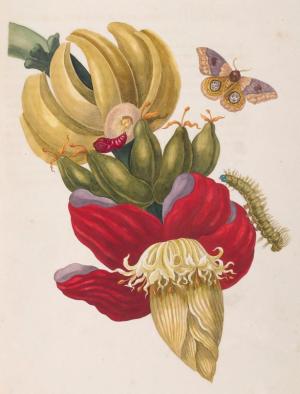
Banana (Musa × paradisiaca) with moth and larva of the bullseye moth (Automeris liberia); plate 12, M.S. Merian, 1719, Over de voortteeling en wonderbaerlyke veranderingen der Surinaemsche insecten (University of Amsterdam)
Artis Library (Special Collections of the University of Amsterdam) will host a three-day symposium titled Exploring Maria Sibylla Merian on May 26–28, 2014. The program will open on the evening of May 26 with a reception and presentation and continue the following day with panels of invited scholars who will discuss their research on Merian’s life and her work in both art and science. On the third day the discussion will focus on the challenges and future of research on Merian. The themes of the symposium will be Merian’s biography, her work in the context of early modern entomologists and artists, the biology/ecology in Merian’s work, and her influence on both art and science. This symposium also aims to be the starting point for the preliminary work on an international conference in 2017, the 300th anniversary of the death of Merian.
If you are interested in attending the symposium (the cost will be 50 Euros), please contact Florence Pieters at the email address below. Space is very limited and so we also ask that you let us know if you must cancel for any reason.
F.F.J.M.Pieters@uva.nl
◊ ◊ ◊ ◊ ◊
2 6 M A Y 2 0 1 4
Opening reception and presentation of parts of the Maria Sibylla Merian documentary film in progress. Filmmakers Jo Francis and John Fuegi will discuss their work in researching the film.
2 7 – 2 8 M A Y 20 1 4
Speakers will present 20-minute papers and time will be allotted for discussion. The order is not finalized, but capsule descriptions of the topics are below.
Presenting Merian, Kurt Wettengl
The talk will reflect on the Merian exhibition in Nürnberg 1967 and the exhibition in Frankfurt in 1997, touching on questions about the background of the exhibitions and the different intentions of exhibitions. This presentation will also reflect on the necessity of new investigations into Merian’s life and work.
Studying Insects before Merian: Johannes Goedaert en Johannes Swammerdam, Eric Jorink
Two Dutchmen, Johannes Goedaert (1617-1668) and Johannes Swammerdam (1637–1680) brought insects, considered as the ‘less esteemed of God’s creatures’, to the center of scientific and artistic attention. Basing themselves on philosophical and religious arguments, both argued that insects were among nature’s most intricate and ingenious creatures, showing the Creator’s magnificence par excellence, and their books were largely responsible for arousing interest in collecting and studying insects.
From Lay Expert to Fabulist: Merian’s scientific reputation in the eighteenth and nineteenth centuries, Brian Ogilvie
Maria Sibylla Merian’s engraved works on insects were widely circulated in the eighteenth century and were used and cited favorably by leading naturalists, but in the 19th century, her mistakes were often cited as grounds for rejecting her authority entirely. This paper will examine how this shift in naturalists’ assessment of Merian is related to changes in European society and in the organization and practice of entomology.
Merian’s holistic view of the tiny, Katharina Schmidt-Loske
Merian developed a unique style of drawing insects and their development stages and is famous for depicting the caterpillars’ food plants. Her perspective, details of the insects’ structure, and documentation of parasitic cycles characterize her work. This presentation will compare Merian’s still life studies, her ‘Studienbuch’, caterpillar book and entomological watercolours with those of Johannes Goedaert, Wenceslaus Hollar, Herman and his son Anton Henstenburgh, and Johannes Bronckhorst.
The Ecology of the Raupen books, Kay Etheridge
Merian’s Raupen (caterpillar) books contain a wealth of insightful observations on interactions among the species portrayed – the very foundation of the study of ecology. This presentation will focus on her study of factors central to ecological science, including her descriptions of environmental effects on insect development and abundance, and her observations on insect food choice and feeding behavior.
Challenges in transcribing Merian’s correspondence, Florence F.J.M. Pieters
This presentation is linked to that of Brigitte Wirth, who discovered a major transcription error in a letter written by M.S. Merian in 1711. Brigitte’s correction throws new light on the coloring procedures in Merian’s atelier. Furthermore, the letter helps to clarify price differences between several types of hand-colored copies of her books.
Maria Sibylla Merian, Baltasar Scheid and Richard Bradley: Some remarks on their letters and on the struggle with incorrect transcriptions and translations, Brigitte Wirth
In several letters the Amsterdam trader Baltasar Scheid (circa 1660–1724 ) wrote to J.G. Volkamer about Merian’s Metamorphosis, describing its development in a few words from the early beginning to the end. With the details given in these letters it is possible to specify the time of production of this book. The English botanist Richard Bradley, who visited Merian in 1714, mentioned original drawings and hand-colored books he saw in her house in his correspondence with James Petiver. The presentation will also discuss how comparison of transcriptions and translations of Merian’s letters revealed differences in meaning that should be corrected.
The printing history of Merian’s Metamorphosis Insectorum Surinamensium, Leslie Overstreet
In 1705 Merian published her classic work Surinam work in two languages and with plates in four modes: uncolored on paper, hand-colored on paper, and hand-colored counter-proofs on either paper or vellum. Through the 18th century, five further ‘editions’ were produced, again in several languages both uncolored and colored. This presentation will demonstrate how surviving copies provide evidence of significant divergence of later editions from the original coloring, raising questions about the scientific reliability of those versions.
Contemporary clients for Merian’s colored copies, Truusje Goedings
Merian advertised and sold both colored and uncolored copies of her heavily illustrated books. Hand-colored books were highly profitable and must have been a major source of income for Merian. This paper will examine some of her contemporary clients for these rather expensive materials, their interests, and what they bought.
Portfolio Wiesbaden, Joos van de Plas
This contemporary artist will address her research in which she investigated the alleged link between specimens in the Wiesbaden Gerning Collection and Merian’s work. Van de Plas visually compared the dried insects in the Gerning Collection with the life-size depictions in Merian’s Metamorphosis Insectorum Surinamensium; she verified her findings using computer comparisons and by additional comparisons with specimens in other 17th- and 18th-century collections. Van de Plas also will relate how her decade-long investigation profoundly influenced her own art.
Speaker information is available here»
Symposium | The Collector and His Circle
From The Seminar on Collecting and Display:
The Collector and His Circle
Institute of Historical Research and The Wallace Collection, London, 1–2 July 2014
This two-day workshop presents new research in the area of collecting and art markets in the early modern era (1700–1900). Speakers examine the mutual interests of collectors and art patrons; the client relationships between dealers and collectors; the roles of advisers, museum curators and critics; and the importance of art publications.
◊ ◊ ◊ ◊ ◊
T U E S D A Y , 1 J U L Y 2 0 1 4
Institute of Historical Research
10.00 Registration and coffee
10.25 Welcome from Adriana Turpin, IESA/University of Warwick
10.30 The Early 18th Century
• Charles Avery, Historian of Sculpture and Independent Fine Art Consultant, ‘The sculptor Soldani and the marketing of Baldinucci’s collection of paintings’
• Christophe Guillouet, PhD candidate, Université Paris IV Sorbonne, ‘Genre painting in the circles of Parisian collectors’
• Franny Brock, PhD candidate, The University of North Carolina at Chapel Hill, ‘‘‘Chez Monsieur Huquier’’: the role of Gabriel Huquier’s collection in interactions among artists, dealers, and collectors’
12.00 The Role of the Print Market
• Donato Esposito, independent scholar, Birmingham, ‘Charles Rogers (1711–1784) and his circle’
• Lucy Peltz, Curator, 18th Century Collections, National Portrait Gallery, London, ‘‘‘Brother Chalcographimanians’’: extra-illustration, the Sutherland Clarendon and the print market c. 1790–1840’
13.00 Lunch
14.15 The Collector and His Advisors in the Early 19th Century
• Sarah Bakkali, PhD candidate, Université Paris X Nanterre, ‘John Trumbull’s “speculative” adventure: circles of collecting between Paris and London during the French Revolution’
• Rufus Bird, Deputy Surveyor of The Queen’s Works of Art, The Royal Collections Trust, ‘The Prince and the pâtissier: François Benois’ acquisitions in Paris for the Prince Regent’
• Susanna Avery-Quash, Curator (History of Collecting), National Gallery, London, ‘John Julius Angerstein: an 18th-century London financier and his circle of art advisers’
• Rebecca Lyons, Christie’s Education, London, and PhD candidate, University of Cambridge: ‘Connoisseurship and commerce: the relationship between the Prince Regent and the 3rd Marquess of Hertford’
16.15 Coffee
16.45 Late 19th-Century Collecting
• Dora Thornton, Curator of the Waddesdon Bequest and Curator of Renaissance Europe, The British Museum, ‘Baron Ferdinand Rothschild and the Waddesdon Bequest in the British Museum: a new look’
• Elena Greer, National Gallery, London, ‘Sir Frederic Burton and his Trustees: the politics of collecting for the nation in the late nineteenth century’.
18.00 Reception
W E D N E S D A Y , 2 J U L Y 2 0 1 4
The Wallace Collection
9.30 Registration and coffee
9.55 Welcome from Christoph Vogtherr, Director, The Wallace Collection
10.00 Jeremy Warren, Collections and Academic Director, The Wallace Collection, ‘Patrons and collectors: new acquisitions for the history of collecting at the Wallace Collection’
10.30 Curators, Antiquarians and Archaeologists
• Judy Rudoe, Curator of Nineteenth- and Twentieth-Century Collections, The British Museum, ‘The role of a remarkable curator: letters from Justus Brinckmann to Charles Hercules Read’
• Elizabeth Norton, Collaborative Doctoral Award Student, The University of Southampton and The British Museum, ‘Polished axes: viewing networks behind the construction of prehistory at the British Museum’
• Francesca de Tomasi, PhD candidate, Università di Roma Tor Vergata, ‘The archeologia mondana and its protagonists’
• Ulf R. Hansson, Research Fellow, Department of Classics, The University of Texas at Austin, ‘Adolf Furtwängler and the culture of professional and amateur collecting in Munich around the turn of the century 1900’
12.30 Lunch and opportunity to see a display of new acquisitions for the history of collecting at the Wallace Collection
14.00 Artists and Collectors
• Annalea Tunesi, PhD candidate, University of Leeds, ‘Stefano Bardini and Riccardo Nobili’
• Patricia de Montfort, Lecturer in History of Art, University of Glasgow, ‘Collecting women’s works: Louise Jopling, the Rothschilds and their circle’
• Annie Pfiefer, PhD candidate, Department of Comparative Literature, Yale University, “‘The American Invasion”: Henry James and the collecting of Europe’
15.30 Coffee
16.00 Keynote address: Frank Herrmann, independent scholar and author of The English as Collectors, ‘Lady Charlotte Schreiber: a truly remarkable woman’
16.30 Round table and concluding remarks
Symposium | Enlightened Princesses: Caroline, Augusta, Charlotte
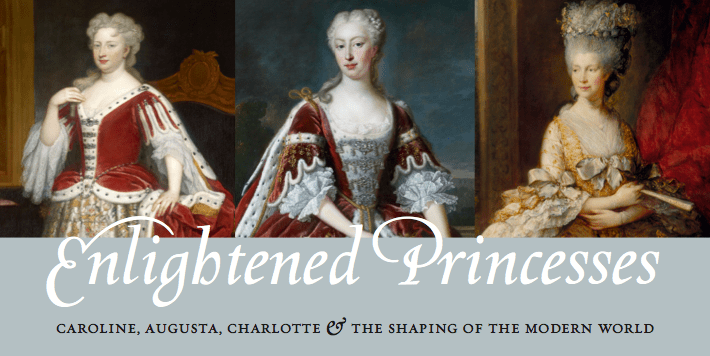
Left: Sir Godfrey Kneller, Queen Caroline of Ansbach, when Princess of Wales (detail), 1716; center: Jean-Baptiste van Loo, Augusta, Princess of Wales (detail), 1742; right: Thomas Gainsborough, Queen Charlotte (detail), ca. 1781; all: Royal Collection/© Her Majesty Queen Elizabeth II 2014.
◊ ◊ ◊ ◊ ◊
From the symposium flyer:
Enlightened Princesses: Caroline, Augusta, Charlotte & the Shaping of the Modern World
Hampton Court Palace, London, 7–9 July 2014
This three-day international symposium, taking place at Hampton Court Palace and associated sites, brings together eminent academicians and museum scholars to examine the roles played by Queen Caroline of Ansbach; Augusta, Princess of Wales; and Queen Charlotte in the promotion of the arts and sciences in eighteenth-century Britain. The themes that will be addressed are pertinent to exhibitions scheduled to open in 2017 at the YCBA and in London. The princesses’ individual and collective interests in art, botany and gardens, natural philosophy and medicine, and the education of their children will be explored in relation to a dramatically changing social, political, and technological milieu, as will their roles in the encouragement of the British Enlightenment. The symposium is timed to take advantage of the period when various London institutions will be commemorating the anniversary of the Hanoverian Succession and aims to contribute in a major way to the general public discourse around that event.
The program includes two full days of lectures, themed panels, and special tours and events, followed by a day devoted to tours of two sites important in the lives of these royal women: Kew Palace and its gardens, and Kensington Palace. The fee for attending the conference is £100. Reductions are available for a limited number of students on application to the conference organizer. To register, visit the HRP website. Questions may be addressed to the conference organizer at ycba.research@yale.edu.
Co-organized by the Yale Center for British Art, Historic Royal Palaces, and the Paul Mellon Centre for Studies in British Art, London
◊ ◊ ◊ ◊ ◊
From the provisional schedule:
M O N D A Y , 7 J U L Y 2 0 1 4
9:00 Arrival and coffee
9:30 Introduction
Amy Meyers, Yale Center for British Art
John Barnes, Historic Royal Palaces
9:45 Joanna Marschner, Historic Royal Palaces, Three German Princesses: Caroline, Augusta, Charlotte, and Cultural Politics at the English Court in the Eighteenth Century
10:30 Break
10:45 Session 1: The Princesses and Their World
Chair: Amanda Vickery, Queen Mary, University of London
• Andrew Thompson, University of Cambridge, The Hanoverians: Crafting a New Dynasty
• Stephen Taylor, Durham University, Court Politics and Religion
• Berta Joncus, Goldsmiths, University of London, The Court, Music and Theatre
• Rosemary Harden, Fashion Museum, Bath, Dressing the Hanoverian Court
13:00 Lunch
14:00 Session 2: The Princesses’ Gardens and Architectural Projects
Chair: Michael Snodin, Strawberry Hill Trust
• Mark Laird, Harvard University, The Princesses’ Collecting and Display of Exotic Flora and Fauna
• Todd Longstaffe-Gowan, landscape historian, Royal Gardens: The Role of the Princesses
• Wolf Burchard, Royal Collection Trust, The Palaces of the Hanoverian Consorts
• Lee Prosser, Historic Royal Palaces, Kew and its Built Heritage
16:00 Tea
16:30 Board buses for London/Queen’s Gallery
18:00 Desmond Shawe-Taylor, Surveyor of the Queen’s Pictures, Tour of the Queen’s Gallery exhibition The First Georgians; Art and Monarchy 1714–1760
T U E S D A Y , 8 J U L Y 2 0 1 4
9:00 Arrival and coffee
9:30 Clarissa Campbell Orr, Anglia Ruskin University, The Hanoverian Court and Europe
10:15 Break
10:30 Session 3: The Princesses’ Art and Other Collections
Chair: Desmond Shawe-Taylor, Surveyor of the Queen’s Pictures
• Cassandra Albinson, Yale Center for British Art, Creating the Royal Image: Royal Princesses and Portraiture
• Cynthia Roman, Lewis Walpole Library, The Princesses in Print: Character and Caricature
Malcolm Baker, University of California, Riverside, Royal Sculpture Commissions
• John Goldfinch, British Library and Emma Jay, The National Archives, The Princesses and their Books
• Jane Roberts, formerly Librarian, Windsor Castle, Royal Collection Trust, The Princesses as Artists
13:00 Lunch
14:00 Session 4: Natural Philosophy and Medicine
Chair: Lucy Worsley, Historic Royal Palaces
• Kim Sloan, British Museum, The Role of the Court in the English Enlightenment
• Patricia Fara, Clare College, Cambridge, Royal Women and Natural Philosophy
• Craig Ashley Hanson, Calvin College, Royal Patronage and Medical Practices
• 4th Speaker TBD
16:00 Tea
17:00 Historic Royal Palaces Curators, Tour of the Queen’s Apartments, Hampton Court Palace
18:00 Drinks, reception, and concert with music from the Hanoverian Court
W E D N E S D A Y , 9 J U L Y 2 0 1 4
9:00 Meet at speakers’ hotel for tours
10:00 Kensington Palace, Historic Royal Palaces Curators, Tour of King’s Apartments
12:00 Kew, Historic Royal Palaces Curators, Tour of Kew Palace and the Royal Kitchens
14:00 Close of symposium
Conference | The Sculpture of the Écorché
From the Henry Moore Institute:
The Sculpture of the Écorché
Henry Moore Institute, Leeds, 7 June 2014

Thomas Mewburn Crook ‘Stage 9a: Anatomical Studies of the Human Figure from the Flat’ 1893 Pencil, ink and watercolour on paper Leeds Museums & Galleries (Henry Moore Institute Archive)
This one-day conference takes the écorché as its subject, reconsidering the many ways that models of the flayed figure have been understood from the sixteenth century to the present day. Across seven papers, the conference addresses the écorché variously as a teaching object for the education of sculptors, as a scientific model crucial to the understanding of anatomy, as a sculptural process and as a sculptural object in its own right.
The écorché has frequently operated across disciplinary boundaries and registers of respectability. Makers of wax écorchés in the eighteenth century, such as the Florentine Clemente Susini (1754–1814), were highly acclaimed during their lifetimes, with their work sought by prestigious collectors. By the nineteenth century, however, wax had come to be seen as a merely preparatory, or even a disreputable, medium for sculpture with its capacity for forensic detail and mimetic reproduction of bone, muscle and skin operating against the prevailing neoclassical tendency towards ideal form. As a result of this change in taste, the écorché in plaster of Paris became the primary teaching object for anatomical studies in European academies and schools of art into the twentieth century.
The conference will be chaired by Professor Fay Brauer (University of East London/University of New South Wales College of Fine Arts), Dr Nina Kane (University of Huddersfield) and Dr Rebecca Wade (Henry Moore Institute). Advanced booking is required for this event. Book here.
◊ ◊ ◊ ◊ ◊
S A T U R D A Y , 7 J U N E 2 0 1 4
10.30 Registration
11.00 Introduction
11.10 Panel 1: Cigoli and Ceroplastics: Wax Écorché in Seventeenth-Century Italy
• Roberta Ballestriero (Open University), Under the Wax Skin: Representation of the Écorché in the Art of
Ceroplastics
• Lisa Bourla (University of Pennsylvania), Cigoli’s Écorché, Giambologna’s Studio and the ‘Poe Paradox’
12.20 Lunch
1.30 Panel 2: Dissection as Sculptural Practice: Criminality, Pathology, and the Academy
• Meredith Gamer (Yale University), ‘A necessary inhumanity’: William Hunter’s Criminal Écorchés
• Naomi Slipp (Boston University), Thomas Eakins and the Écorché: Understanding the Human Body in Three
Dimensions
• Natasha Ruiz-Gómez (University of Essex), In Sickness and in Health: Doctor Paul Richer’s Écorché at the École
des Beaux-Arts
3.30 Tea
4.00 Panel 3: Écorché, Modernism, and the Sculptural Canon
• Elena Dumitrescu (National University of Arts, Bucharest), The Écorché by Brancusi and Gerota: An Artwork Created at the School of Fine Arts of Bucharest
• Stefan Grohé (University of Cologne), An Anatomy of Sculpture: The ‘Ecorche, dit de Michel-Ange’ and its Transformations in Modern Art
5.20 Closing remarks
Smithsonian American Art Museum’s 2014 Fellows Lectures
All three afternoons look interesting; I include only Amy Torbert’s talk here only because most of the sessions address the nineteenth and twentieth centuries. -CH
Smithsonian American Art Museum’s 2014 Fellows Lectures
Smithsonian American Art Museum, Washington, D.C., 7–9 May 2014
The Fellowship Program at the Smithsonian American Art Museum cordially invites you to attend three afternoons of lectures in American art delivered by Smithsonian art history research fellows. The talks will be held in the museum’s McEvoy Auditorium, located at 8th and G Streets NW, Washington, D.C. This event is open to the public and no reservations are required. For further information, please contact Amelia Goerlitz at (202) 633-8353 or email AmericanArtFellowships@si.edu.
Thursday, 8 May, 2:00
Amy Torbert, Predoctoral Fellow (National Portrait Gallery), University of Delaware
“Robert Sayer’s Empire: The Geographies of Prints, 1770–1800”
A full list of speakers is available here»
Symposium | The Disciplined Past: The Study of the Middle East
While I’m not sure how much eighteenth-century content to expect from the papers, the issues of periodization and the implications of how we connect (or disconnect) historical periods strike me as crucial eighteenth-century problems with present-day stakes for exploring a global eighteenth century. -CH
From Harvard’s Mahindra Humanities Center:

The Disciplined Past: Critical Reflections on the Study of the Middle East
Mahindra Humanities Center, Harvard University, 4–5 April 2014
Registration due by 3 April 2014
Organized by Mirjam Brusius
The symposium aims to reassess the study and the representation of the Middle East in scholarship and museums today. Studying the Middle East in the current Western academic and museological discourse entails encountering a history of dichotomies and contradictions. A manifest example, both physically and metaphorically, is provided by a visit to some art museums in the Western world: while, for example, art from ancient Mesopotamia—which occupied the same space as much of modern day Iraq, Syria and Iran—is often presented in direct proximity to objects deeply embedded in the Western canon, such as Classical Greek sculpture, objects from the very same region that derive from after the coming of Islam are often separated from their more ancient geographical counterparts, for instance in Islamic Art departments.
The epistemological consequence has been denounced before: this type of taxonomy creates a narrative of the Middle East that suggests a period of decline from the seventh century A.D. onwards, while prevailing European narratives link their historical present to mythical beginnings in the Middle East via the notions of a classical Graeco-Roman Antiquity. These canonical ideas have been shaped in Western European readings and injected into notions of progress and decline, into the organization of historical time, and scholarly disciplines themselves. They do so with restricted notions of key concepts in history of science, such as ‘origin’ and ‘discovery’, which only account for a single and teleological narrative rather than for dynamic flows of exchange between spaces and a plurality of accounts. What counts as canonical in Western traditions and what is subject to alienation is thus a temporal rather than geographical dichotomy.
The recent restructuring of some museum spaces reflects discomfort with this status quo, though not always in favour of a more even and unifying approach. The ‘ethnologization’ of Islam still pushes the Middle East to the margins, while the ‘religionization’ of the Middle East often does the same in academic contexts. Often they also run the risk of presenting an alternative orientalist trope: that of the ‘eternal, unchanging East’. Even though critical voices have critiqued these legacies of formerly colonial structures in recent decades, the ancient Near East and the modern Middle East remain neatly separated from another. Archaeology as a mediating discipline connecting the present with the past is both a perpetrator and victim of this discourse but its role in this discourse has not yet been fully explored in spite (or because) of its political power.
Finally, the naming of university departments throughout the world tells a story of its own: How religious does the Middle East have to be in order to be studied as the “science of Islam” (Islamwissenschaft)? How universal to be simply “oriental”? How ancient does the Near East have to be in order to be “Near”? How ancient Western Asia in order to be “Western”? How modern the Middle East, in order to be in the “Middle”? How much in the middle does the East have to be in order to be “modern”? The symposium seeks to bring historians of the modern Middle East, scholars of the ancient Near East, Egypt and Western Asia, archaeologists, anthropologists, historians of science and of archaeology, as well as historians of Islamic and Western art in dialogue with one another to assess the current states of affair.
◊ ◊ ◊ ◊ ◊
F R I D A Y , 4 A P R I L 2 0 1 4
2.00 Introduction, Mirjam Brusius (Harvard University)
2.30 Heritage and Museums
• Alexander Nagel (Smithonian Institution): The Order of Things According to Washington DC: Reading Middle Eastern Materials in the Smithsonian Institution
• Ian Straughn (Brown University): On Heritage Crusades and other Cultural Rescue Missions in the Middle East
• Melania Savino (KHI Florenz): Ancient Near Eastern Antiquities in the Italian Museums: Travels, Collections, Displays
4.30 In discussion: Section participants with Irene Winter (commentator, Harvard University) and Eleanor Robson (University College London)
S A T U R D A Y , 5 A P R I L 2 0 1 4
9.00 Ruptures and Turning Points
• Avinoam Shalem (Columbia University): Troubling Monochronic Time: Revisiting the Myth of the ‘Origin’ of Islamic art
• Katharine Park (Harvard University): Teaching and Writing across Regional Boundaries: A History of Arabic and Latin Science
10.00 Coffee break
10.30 In discussion: Section participants with Roy Mottahedeh and Chad Kia (Harvard University)
12.00 Lunch break
1.00 Empire and Knowledge
• Erin Hyde Nolan (Boston University): Ottomans Abroad: The Translation and Circulation of Nineteenth-Century Portrait Photography from Istanbul to Europe and the United States
• Daniela Helbig (University of Sydney): Whose Wonderland? Aviation and Aerial Archaeology in Syria and Lebanon under the French Mandate
2.00 In discussion: Section participants with Marwa Elshakry (commentator, Columbia University) and Adam Mestyan (Harvard University).
Symposium | In Circulation: John Singleton Copley and Benjamin West
Reminder that this webinar event starts tomorrow (Friday) at 11:15am (Eastern Daylight Time) . . .
In Circulation: John Singleton Copley and Benjamin West in England, France, and America
The Paul Mellon Centre, London, 28 March 2014
This symposium and webinar explores aspects of the work and careers of the American-born artists Benjamin West and John Singleton Copley, focusing in particular on the ways in which they engaged with the exhibition and print cultures of their day, particularly in Britain, but also in France and America. The program relates to the international loan exhibition American Adversaries: West and Copley in a Transatlantic World, which was on display at the Museum of Fine Arts, Houston (MFAH), from October 6, 2013 through January 20, 2014.
The Yale Center for British Art is live streaming this daylong conference, which is also available for free on the MFAH website, shortly before the program begins. Join the conversation on Twitter using the handle @PaulMellonCentr. Hosted in London by the Paul Mellon Centre for Studies in British Art, the symposium is made possible through support from the Terra Foundation for American Art.
More information, including the schedule (according to GMT), is available here»










leave a comment