Conference | Travel and the Country House

From the conference programme:
Travel and the Country House: Places, Cultures, and Practices
University of Northampton, 15–16 September 2014
Registration due by 31 August 2014
Keynote speakers: Roey Sweet (University of Leicester) and Margot Finn (University College London)
Travel has long played a vital role in shaping the country house, opening up horizons and exposing both house and owner to a variety of external influences. Travel impacted upon values, tastes, material culture and money, and helped to articulate the flow of ideas, information, goods and capital. The importance of the Grand Tour and Empire to the country house has long been recognised, but domestic tourism and travel for more mundane purposes—to visit family or friends, engage in political life or go to town—were also significant. In this conference, we wish to explore a wide range of travel experiences and consider how these impacted on the country house. How were travel choices made and how were impacts articulated? How did new influences mesh with existing tastes and goods? What impact did its status as a place to visit have upon the country house? And how do we communicate the importance of travel to those visiting country houses today?
This conference addresses these questions and others, drawing together research from Sweden, Hungary, the Netherlands and Ireland as well as all corners of England. It thus offers a comparative perspective on the relationship between travel and the country house, and an opportunity for academics, curators and managers to discuss the ways in which travel continues to shape the ways in which country houses are interpreted, presented and experienced.
For more details and a booking form, contact Professor Jon Stobart at jon.stobart@northampton.ac.uk or visit the Consumption and Country House website.
◊ ◊ ◊ ◊ ◊
M O N D A Y , 1 5 S E P T E M B E R 2 0 1 4
10.00 Registration and coffee
10.40 Welcome and introduction
10.45 Keynote: ‘The Italian Grand Tour and the 18th-Century Country House’, Roey Sweet (University of Leicester)
11.45 Session 1: The Practicalities and Pleasures of Travel
• ‘Visiting London for business and pleasure in the years 1599–1623: On the road (and the Thames) with William Cavendish, 1st Earl of Cavendish’, Peter Edwards (University of Roehampton)
• ‘Travelling for Pleasure: Carriages and the country house’, Lizzy Jamieson (Independent Scholar)
• ‘“Wintering in the ‘shires”: Foxhunting and travel’, Mandy de Belin (University of Leicester)
1.00 Lunch
2.00 Session 2: European Travel, Networks, and Influences
• ‘The Grand Tour and Episcopal domesticity: The case of Martin Benson, Bishop of Gloucester (1735–52)’, Michael Ashby (University of Cambridge)
• ‘“Antiquity mad”: The Earl Bishop and the translation of continental style in an Irish context’, Rebecca Campion (National University of Ireland at Maynooth)
• ‘Centre and periphery: The world brought to the ironmasters’ mansions’, Marie Steinrud (Stockholm University)
• ‘The English Rothschild family and their country houses: A distinctive style’, Nicola Pickering
3.45 Tea and coffee
4.15 Session 3: Views of England from Overseas Travellers
• ‘The English country house as (proto) museum: Dutch travel accounts explored, 1677–1750’, Hanneke Ronnes (University of Amsterdam)
• ‘“… enjoying country life to the full—only the English know how to do that!”: Appreciation of the British country house by Hungarian aristocratic travellers’, Kristof Fatsar (Corvinus University of Budapest)
• ‘Stourhead: All roads lead to Rome—and back again’, John Harrison (Open University)
• ‘A Dutch view on the English country house and landscape garden’, Hélène Bremer (University of Leiden)
6.30 Reception
7.30 Dinner
T U E S D A Y , 1 6 S E P T E M B E R 2 0 1 4
9.30 Session 4: The Mobile House
• ‘Manors, towns and spas: A household on the move in late 18th-century Sweden’, Göran Ulväng (University of Uppsala)
• ‘The travels of an aristocratic family in the early 19th century: The Braybrookes of Audley End, Essex’, Andrew Hann (English Heritage)
• ‘Moving households: Problems, choices and new possibilities facing the country house family in the 1820s and 1830s’, Pamela Sambrook (Independent Scholar)
10.45 Tea and coffee
11.15 Session 5: Travel, Tourism, and Guides
• ‘Domestic tourism, the country house, and the making of respectability in the travel journals of Caroline Lybbe Powys’, Freya Gowrley (University of Edinburgh)
• ‘Country house visiting and improvement at Herriard House in Hampshire, 1794–1821’, Nicky Pink (Independent Scholar)
• ‘Arthur Young’s Tours: Architecture, painting, sculpture, and the art of adorning grounds’, Jocelyn Anderson (The Courtauld Institute of Art)
• ‘The representation of the country house in individual books and guides, 1720–1845’, Paula Riddy (University of Sussex)
1.00 Lunch
2.00 Keynote: ‘Duleep Singh and the Country House Tradition: Making and Unmaking the Victorian Global Home’, Margot Finn (UCL)
3.00 Session 6: Looking beyond Europe
• ‘Travel to the East- and West-Indies and Groningen country house culture in the 18th Century’, Yme Kuiper (University of Groningen)
• ‘Appuldurcombe House and the ‘Museum Worsleyanum’: Sir Richard Worsley’s forgotten collection’, Abigail Coppins (Independent Scholar)
• ‘Diaries, decoration and design: The Courtaulds’ travels and the effects on Eltham Palace’, Annie Kemkaran-Smith (English Heritage)
4.15 Closing comments and discussion
Conference | Fifth Annual Feminist Art History Conference
From the conference webpages:
Fifth Annual Feminist Art History Conference
American University, Washington, D.C., 31 October — 2 November 2014
The Fifth Annual Feminist Art History Conference, sponsored by the Art History Program of American University, offers participants a space in which to engage with the expanding legacy of Norma Broude and Mary D. Garrard, two pioneering feminist art historians and professors emerita of art history at AU. This year’s conference includes sixty-eight papers in seventeen sessions. The papers have a global focus that spans a broad range of topics and time periods; together they illustrate the diverse ways in which feminist research and interpretation continue to inform art historical analysis and scholarship.
All events this year will take place on the American University campus. Please see the 2014 program posted online. This year’s keynote speaker, Dr. Lisa Gail Collins, is Professor of Art History at Vassar College. Her talk, titled “Here Lies Love: Feminism, Mourning, and a Quilt from Gee’s Bend,” is drawn from her current book project on history, memory, creativity, and community.
◊ ◊ ◊ ◊ ◊
The eighteenth-century offerings are modest, but these two caught my attention. –CH
• Heather Belnap Jensen, “Parures, Pashminas, and Portraiture, or, How the Bonaparte Women Fashioned the Napoleonic Empire”
• Anne Nellis Richter, “The Marchioness of Stafford and the Cleveland House Gallery, 1812”
Conference | Political Portraiture in the United States and France
From the Smithsonian’s National Portrait Gallery:
Political Portraiture in the United States and France, 1776–1814
Smithsonian’s National Portrait Gallery, Washington, D.C., 25–26 September 2014
 The Montana State University Foundation and the Smithsonian’s National Portrait Gallery are pleased to invite scholars, students, connoisseurs, and friends of American-French cultural exchange to attend an international conference, Political Portraiture in the United States and France during the Revolutionary and Federal Eras, ca. 1776–1814.
The conference will mark the bicentennial of an important historical event: British capture of Washington, D.C. in 1814 and the burning of the Capitol along with Congress’s state portraits of Louis XVI and Marie-Antoinette. European and North American scholars from universities and museums will discuss aspects of diplomatic strategy, democratic representation, and republican identity as promoted in portraits.
The conference is made possible by generous support from the Terra Foundation for American Art, the Samuel H. Kress Foundation, and the Henry Luce Foundation. This event is free and open to the public. Seating is limited, so please make a reservation at your earliest convenience.
◊ ◊ ◊ ◊ ◊
T H U R S D A Y , 2 5 S E P T E M B E R 2 0 1 4
9:00 Welcome and Opening Remarks
Kim Sajet, Director of the National Portrait Gallery
Waded Cruzado, President of Montana State University
Brandon Brame Fortune, Chief Curator of the National Portrait Gallery
Todd Larkin, Associate Professor of Montana State University
9:45 Session 1. State Portraits in the United States and France
Chair: Olivier Bonfait, Professeur d’histoire de l’art moderne, Université de Bourgogne
• Cristina Martinez, University of Ottawa, “Allan Ramsay’s Portrait Enterprise: The Propagation and Reception of a Ruler’s Image”
• David O’Brien, University of Illinois, “Republicanism in Portraits of Napoleon Bonaparte”
• Heather McPherson, University of Alabama, “Man + Horse: Repurposing the Equestrian Portrait in the Post-Revolutionary Era”
11:30 Session 2. The Portrait Copy, Painted and Printed
Chair: Xavier Salmon, Conservateur général, Directeur du département des arts graphiques, Musée du Louvre
• Wendy Bellion, University of Delaware, “Romans in New York: British Statuary and Atlantic Revolutions”
• Laurent Hugues, Monuments historiques, Direction régionale des affaires culturelles de Languedoc-Roussillon, “Les dons de portraits du roi sous Louis XVI”
• Stéphane Roy, Carleton University, “Prints, Paintings and National Characters: Washington’s Likeness in a Transnational Perspective”
• Xavier Salmon, Musée du Louvre, “Portraiturer les souverains entre 1800 et 1831: L’exemple de François Gérard”
1:30 Lunch Break
3:00 Session 3. The Portrait as a Diplomatic Gift
Chair: Brandon Brame Fortune, Chief Curator, National Portrait Gallery, Washington, D.C.
• Ellen Miles, National Portrait Gallery, “Gilbert Stuart’s Lansdowne Portrait of George Washington: From Private Diplomatic Gift to State Portrait”
• Todd Larkin, Montana State University, “What Ever Happened to the U.S. Congress’s State Portraits of Louis XVI and Marie-Antoinette? The Politics of Pictorial Display, Displacement, and Destruction at the Capitol, 1800–1814”
• Gaye Wilson, Robert H. Smith International Center for Jefferson Studies, “Preparations for Diplomacy: Gilbert Stuart’s Pendant Portraits of President Jefferson and Secretary Madison”
• Cyril Lécosse, Université de Strasbourg, “Rivalries and Dissentions within the Maison de l’Empereur: The Portraitists of Napoleon and the Production of Diplomatic Gifts”
F R I D A Y , 2 6 S E P T E M B E R 2 0 1 4
9:00 Session 4. Republicanism and the Politician’s Portrait
Chair: Philippe Bordes, Professeur d’histoire de l’art moderne, Université de Lyon
• Matthew Fisk, Independent Scholar, “The Semiotic Origin—and Paradox—of the Federalist Ideal in John Trumbull’s Portrait of General George Washington (1780)”
• Guillaume Mazeau, Université de Paris, “The Physionotrace in Europe and North America (1780–1800): A Tool for Visualizing a New Political Culture”
• Gerrit Walczak, Technical University Berlin, “Representative Democracy and Popular Insurgency: Collective Portraiture under the National Convention”
• Kathryn Calley Galitz, Metropolitan Museum of Art, “Signs of Power: Bonaparte and the Concordat of 1801”
11:15 Session 5. Patriotism and the Family Portrait
Chair: Amy Freund, Assistant Professor of the History of Art, Texas Christian University
• Melissa Hyde, University of Florida, “Family Matters in French Royal Portraiture”
• Kevin Murphy, Vanderbilt University, “Family Ties in the Revolutionary Atlantic: The Lafayettes and Washingtons, LaGrange and Mt. Vernon”
• Marlen Schneider, University of Leipzig, “Politicizing Portraiture: Formal Aspects of French Family Portraits between the Ancien Régime and the Republic”
• Todd Porterfield, Université de Montréal, “Against Portraiture: Representative and Planetary Bodies”
1:15 Lunch Break
2:45 Session 6. The Face and Body of Paris, Philadelphia, New York, and Washington: Splendor and Squalor, Leisure and Labor in the Early Modern Metropolis
Chair: Margaretta Lovell, Professor of the History of Art, University of California
• Jeffrey A. Cohen, Bryn Mawr College, “A Tale of Four Cities: Representations, Fabric, and Ambitions”
• Min Kyung Lee, College of the Holy Cross, “From Portrait to Plan: Mapping Capital Cities in the Late Eighteenth Century”
• Laura Turner Igoe, Temple University, “Corruption and Failure in the Body Politic: John Lewis Krimmel’s Images of the Centre Square Waterworks and the Bank of Pennsylvania”
• Dell Upton, University of California, “On the Back of the Engraving: Obverse and Reverse in Philadelphia’s Federal-Era Urban Imagery”
4:45 Closing Remarks
Conference | A Head for Fashion: Hair, Wigs, Cosmetics, Jewelry
From The Colonial Williamsburg Foundation:
A Head for Fashion: Hair, Wigs, Cosmetics, and Jewelry, 1600–1900
Colonial Williamsburg, 14–16 November 2014
 Colonial Williamsburg is celebrating the 75th anniversary of the opening of the Kings Arms Barber and Wig Shop by hosting a conference on wigs, hair, makeup, and accessories of the seventeenth, eighteenth, and nineteenth centuries. The program will examine how ‘fashion from the neck up’ changed over time, reflecting changes in taste, the personal images people wished to present, affluence and class, and sheer practicality. Colonial Williamsburg wigmakers and other tradespeople, historians and interpreters, will be joined by noted guest speakers to present talks on wigs, hairstyles, cosmetics, jewelry, and related topics. These presentations will be interspersed with demonstrations and panel discussions.
As we put this program together, we realized that there is little published information specifically about these topics, and it is difficult to find anything that brings them all together. This conference will help to fill that gap, for scholars, curators, museum interpreters, reenactors, theatre costumers, and anyone who is just plain interested. We are looking forward to a diverse and enthusiastic audience who will bring their perspectives to the conversation. And we plan to have fun!
Conference | 400 Years of Chocolate: Aztec to Artisanal
From The Colonial Williamsburg Foundation:
400 Years of Chocolate: Aztec to Artisanal
Colonial Williamsburg, 2–4 November 2014
 Come join us on a journey with one of the world’s favorite plants: cacao. We will discover the amazing paths through time and space that this plant and its products have traveled. From early uses as a ceremonial beverage and important crop in Mesoamerica, to its transformation to one of the most popular foodstuffs in the world, chocolate has crossed oceans, been carried up mountains, and even flown into outer space. How did the seeds of this humble plant become so popular?
Join Colonial Williamsburg’s Historic Foodways staff, curators, and distinguished guest scholars as they explore how this plant is grown and processed and how the seeds are transformed into a product that conquers the food world. Learn how people of the past used and altered chocolate from a beverage into a candy and beyond.
Guest speakers will include Dr. Howard-Yana Shapiro, one of the world’s top cacao scientists. He is Global Director of Plant Science and External Research, Mars Incorporated, and Adjunct Professor in the College of Agriculture and Environmental Sciences, The University of California at Davis. Dr. Shapiro also helped map the cacao gene and is one of the foremost scholars in the field of cacao propagation. Dr. Michael Coe, Professor Emeritus, Department of Anthropology, Yale University, will present the place of chocolate in early Mesoamerica. Ruby Fougère, Curator of Furnishings, Collections and Conservation Supervisor, Parks Canada, will complement a Foodway’s staff presentation on chocolate in seventeenth- and eighteenth-century Europe and North America, with a look at chocolate in French Canada. Dr. Deanna Pucciarelli, Program Director, Hospitality and Food Management Program, Ball State University, will explore how chocolate production methods evolved during the nineteenth century, and John and Tracy Anderson of Woodhouse Chocolate in St. Helena, California, will delve into modern artisanal chocolate making.
And, of course, no program on chocolate would be complete without a chance to eat some! Chef Rhys Lewis and the Colonial Williamsburg Lodge culinary team will present us with delicious chocolate concoctions of the past, present, and future. So, come learn, smell, taste, and follow chocolate on its journey through history.
Colloque | Conservation and Restoration of Historic Theaters
From the Centre de recherche du château de Versailles:
Conserver et Restaurer les Théâtres Historiques (XVIIIe – XIXe siècles) : Pour qui, pour quoi ?
Institut National du Patrimoine, Paris, 23–24 October 2014
Colloque organisé par l’Institut national du patrimoine et le Centre de recherche du château de Versailles dans le cadre du cycle « Rencontres européennes du patrimoine ».

Vue de la scène de l’Opéra royal de Versailles, après les travaux de 2009. © Château de Versailles / Jean-Marc Manaï
La conservation et la restauration des théâtres anciens dans leur état d’origine est un défi. Ces lieux vivants ne sont pas de simples ensembles architecturaux, l’entretien et l’usage de la scène, des décors, des installations techniques et de la machinerie impliquent des connaissances précises dont la préservation est un enjeu.
Outre l’intérêt historique et artistique de ces témoins de la vie cutlurelle d’une époque, se pose la question de leur usage actuel. Comment maintenir le caractère vivant de ces lieux sans transiger sur les nécessités de la conservation ? Quels projets peuvent être envisagés pour faire vivre ou revivre ces anciens lieux de spectacle ? La réflexion sera conduite à partir d’exemples français et internationaux et portera sur les théâtres de cour et les théâtres de ville.
Le colloque aura lieu à l’Institut national du patrimoine, auditorium de la Galerie Colbert, 2 rue Vivienne, 75002 Paris.
Conference | Textile Spaces: Silk in 18th-Century Courtly Interiors
From H-ArtHist:
Textile Spaces: Silk in 18th-Century Courtly Interiors /
Textile Räume: Seide im höfischen Interieur des 18. Jahrhunderts
Potsdam, 17–20 September 2014
Registration due by 1 September 2014
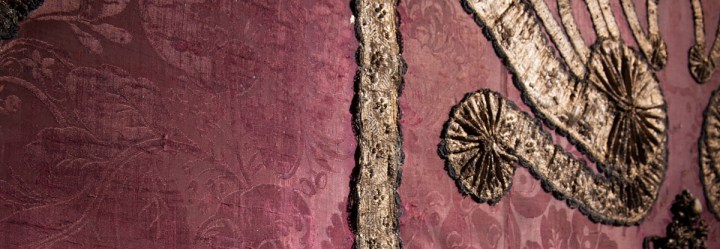
During the reign of Frederick II Berlin became a European centre of silk-production. Up to the present day the Prussian palaces give an impression of the high quality of decorative silks from the Berlin and Potsdam manufactures. On the occasion of the publication of the scholary catalogue about Prussian silks and textile decoration, the Prussian Palaces and Gardens Foundation Berlin-Brandenburg (SPSG) holds an international conference in Potsdam from September 17th to 20th. International speakers, including scholars, curators and conservators examine the importance of textile decoration and put the Prussian silks into a European context.
The conference is a co-operation with the Association of Conservators (Verband der Restauratoren). Guided tours through the New Palace at Sanssouci, the Orangery Palace and Cecilienhof Palace are on offer. If you wish to attend, please note that registration and advance payment are required. The fee includes guided tours, lunches and refreshments. Registration ends at September 1st.
◊ ◊ ◊ ◊ ◊
W E D N E S D A Y , 1 7 S E P T E M B E R 20 1 4
9:30 Introduction by Samuel Wittwer, Director of Palaces and Collections, Prussian Palaces and Gardens Foundation Berlin-Brandenburg (SPSG)
9:45 Susanne Evers (Potsdam), Berliner Seiden in den Schlössern Friedrichs II
10:10 Corinne Thépaut-Cabasset (Paris), Silk for Versailles, 1680s–1780s
10:35 Marzia Cataldi Gallo (Genua), Genoese Textiles for Interior Decoration
11:00 Discussion
11:25 Tea and coffee
11:50 Tatjana Lekhovich (St. Petersburg), Textile Decoration of the 18th Century in Russian Palaces: From National Traditions to Grand European Styles
12:15 Bo Vahlne (Stockholm), Velvet, Damask and Taffeta in the Swedish Royal Palaces during 18th Century
12:40 Discussion
13:00 Lunch
14:00 Sabine Schneider (Dresden), Das Paradeappartement Augusts des Starken von 1719 im Dresdner Residenzschloss – Textile Ausstattung und Zeremoniell
14:25 Margitta Hensel (Dresden), Überlegungen zur textilen Ausstattung der Appartements im Sächsischen Palais zu Warschau unter König August III
14:50 Lieselotte Hanzl-Wachter (Wien), “von roth und gelb geflamten Dafend” – Textilien aus Schloss Hof
15:15 Discussion
15:40 Tea and coffee
16:10 Anika Reineke (Zürich), Von der Tapisserie zum Damast. Bild- und Raumrezeption seidener Wandbespannungen im 18. Jahrhundert
16:35 Anna Jolly (Riggisberg), „en suite“ – Ausdrucksformen eines textilen Gestaltungskonzeptes
17:00 Discussion
19:00 Dinner
T H U R S D A Y , 1 8 S E P T E M B E R 2 0 1 4
8:30 Karin Thönnissen (Krefeld), A la mode – eine gewebte Chinoiserie als Wandbespannung
8:55 Sjoukje Colenbrander, (Amsterdam), Chinese Silks Imported to Europe
9:20 Friederike Wappenschmidt (Neuwied), Chinesische Tapeten aus Seide und Papier – Ästhetische Differenz, Materialbewertung und Rezeption
9:45 Discussion
10:10 Tea and coffee
10:40 Silke Kreibich (Berlin), Posamenten in den preußischen Schlössern – Entwicklung und Datierung der Muster des 18. Jahrhunderts
11:05 Viktoria Pisareva (Dresden), Posamenten in den spätbarocken Innenausstattungen Augusts des Starken (reg. 1694–1733)
11:30 Annabel Westman (Richmond), A Luxury Necessity: The Use of Trimmings on 18th-Century State Beds in Britain
11:55 Discussion
12:20 Lunch
13:30 Isa Fleischmann-Heck (Krefeld), Angebot und Nachfrage – Produktpalette und Angebotspolitik aufstrebender Seidenfirmen in den preußischen Provinzen am Niederrhein im 18. Jahrhundert
13:55 Jens Bartoll (Potsdam), Berliner Seiden – Naturwissenschaftliche Untersuchung der Farbstoffe und Pigmente
14:20 Christa Zitzmann (Potsdam), Entwicklungsstand der preußischen Seidenweberei nach Auswertung gewebetechnischer Analysen
14:45 Nadja Kuschel (Potsdam), Die goldenen Posamente aus dem Tressenzimmer von 1768. Restaurierung und Kopie
15:10 Discussion
15:35 Tea and coffee
17:30 Guided tour through the New Palace at Sanssouci
For the programme for Friday and Saturday (19–20 September), please consult the conference website.
Conference | Houses as Museums / Museums as Houses
From H-ArtHist:
Houses as Museums / Museums as Houses
The Wallace Collection, London, 12–13 September 2014
Registration due by 31 August 2014
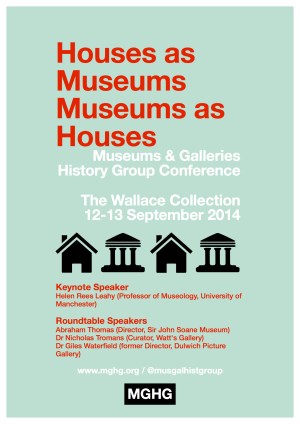 The relationship between museums and domestic spaces is a long and complex one. Museums were born in the houses of collectors, while the reconstruction of the house or domestic room—of ‘home’, effectively—continues to be an influential if controversial model for museum display. On the other hand, museums have at times invested heavily in the idea of their spaces as public, scientific and definitively non-domestic. The line between house and museum is therefore also one between public and private, scientific and domestic; and house-museums/museum-houses have acted both to confirm, to alter, and to undermine this line completely.
The 2014 Museums and Galleries History Group (MGHG) conference seeks to understand the historical development of this relationship by investigating the ways in which museums have acted as houses, and houses have acted as museums. It will also explore the ways in which house-museums and museum-houses have been positioned in boundary zones of space and time, and what effect they have had on those boundaries. The programme
can be viewed and tickets can be purchased here.
◊ ◊ ◊ ◊ ◊
F R I D A Y , 1 2 S E P T E M B E R
10.00 Registration and refreshments
10.30 Introduction
10.45 1: The Early Modern Legacy (Chair: Stephanie Bowry)
• Theda Jurjens, ‘Artists’ houses: spaces of knowledge, artistic production and social reputation’
• Cristiano Guarneri (IUAV University, Venice), ‘A private display for a public space: The Statuario Pubblico (1587–96), a Venetian approach to the display of ancient sculpture’
• Thomas Schauerte (City of Nuremberg Art Collections), ‘From memorial to museum: The Dürer house in Nuremberg’
12.15 Curator’s introduction to the Great Gallery rehang
12.30 Private view of Great Gallery
13.15 Lunch break
14.30 2: Architecture and Museums / Houses (Chair: Sarah Longair)
• Jeremy Aynsley (University of Brighton), ‘Curating Bauhaus houses, 1923–2019’
• Maria D’Annibale Williams (Ohio University), ‘Museum space in Fascist Verona and the display of social identity: A case study’
• Jane Whittaker (Bowes Museum), ‘Mrs Bowes’s mansion and galleries at Barnard Castle, Durham’
16.00 Tea and coffee
16.30 Roundtable: ‘Curating Houses as Museums’ with Abraham Thomas, Nicholas Tromans, and Giles Waterfield (Chair: Mark Westgarth)
17.30 Wine reception
S A T U R D A Y , 1 3 S E P T E M B E R
10.00 Tea and coffee
10.30 Keynote lecture by Helen Rees Leahy, ‘The pleasures and paradoxes of house museums’
11.30 3: Concepts and Approaches (Chair: Elena Greer)
• Sophie Forgan (Captain Cook Memorial Museum), ‘Interpretation and anthropological approaches to the historic house museum’
• Lydia Brandt (University of South Carolina), ‘George Washington’s Mount Vernon: America’s First House (museum)’
• Helen Williams (Northumbria University), ‘The literary house museum: An eighteenth-century invention?’
13.00 Lunch break
14.15 4: Modern Spaces, Art and Houses / Museums (Chair: Barbara Lasic)
• Flaminia Gennari Santori (Syracuse University Florence), ‘Tropical baroque – Vizcaya: A Venetian-inspired house museum in Miami’
• Angela Bartholomew (VU University Amsterdam), ‘Chambres d’amis and the mediation of site (1986)’
• Louise Shannon (V&A), ‘Creating “Tomorrow”: Norman Swann moves into the V&A’
15.45 Tea and coffee
16.15 5: Science at Home and on Display (Chair: Ilja Nieuwland)
• Elisabeth Hoffman (University of Kassel), ‘Art and science: the interior of Wilhelm von Humboldt’s home as a museological and epistemological concept’
• Helen McCormack (Glasgow School of Art), ‘The anatomist at home: The Great Windmill Street Anatomy School and Museum’
• Caroline Morris (University of the West of England), ‘”…Fit like a snail to its shell”‘
All conference sessions except the Great Gallery view take place in the lecture theatre. Tea and coffee are provided in the Meeting Room. Wine reception takes place in the Café. Lunch is not provided, but there are many places for lunch very close to the Wallace Collection. The Wallace collection opens at 10.00 so please do not arrive earlier.
Conference | The Cabinet of Paintings of Karoline Luise von Baden
As noted at H-ArtHist (click for the German version). . .
Aufgeklärter Kunstdiskurs und Höfische Sammelpraxis:
Das ‘Mahlerey-Cabinet’ Karoline Luise von Baden (1723–1783) im Europäischen Kontext
Enlightened Discourse in Art and Courtly Collecting Practices:
Caroline Louise of Baden’s (1723–1783) ‘Cabinet of Paintings’ in a European Context
Staatliche Kunsthalle Karlsruhe, 10–12 September 2014
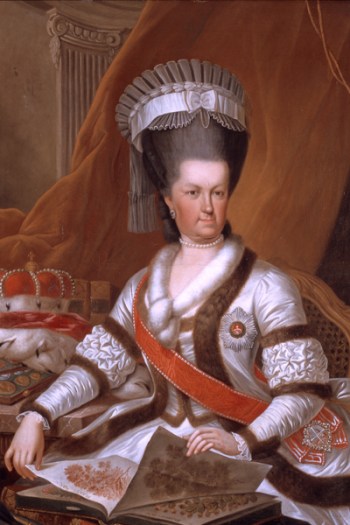
J.W. Hauwiller, Portrait of Margravine Caroline Louise of Baden (1723–1783)
This research project is an interdisciplinary cooperation between the Staatliche Kunsthalle Karlsruhe, the Generallandesarchiv Karlsruhe and the University of Mendrisio (Switzerland). The project focuses on the comprehensive study into the history of art and ideas of Caroline Louise’s ‘cabinet of paintings’, an extensive collection that once included more than 200 paintings.
Participating at the conference are eighteen academics from Germany, Switzerland, France, England, Sweden and the Netherlands who will be investigating in four separate sections the central questions of this research project. To some extent, the conference’s scholarly impulses will also benefit the exhibition concept of the upcoming Baden Wurttemberg State Exhibition Caroline Louise of Baden (1723–1783): A Collector of European Standing. This exhibition will be on display at the Staatliche Kunsthalle Karlsruhe for the 300th anniversary of the city’s founding from 30 May to 6 September 2015. The conference is open to public and participation is free of charge. Please confirm by sending us an email with the subject heading ‘Conference Enlightened Discourse’ to Sarah Salomon at salomon@kunsthalle-karlsruhe.de.
◊ ◊ ◊ ◊ ◊
W E D N E S D A Y , 1 0 S E P T M B E R 2 0 1 4
19.00 Christoph Frank (University of Mendrisio, Switzerland),’Where Europe Ends: Caroline Louise, Her Agents and Correspondents’ (Lecture in German)
T H U R S D A Y , 1 1 S E P T E M B E R 2 0 1 4
9.00 Introduction by Wolfgang Zimmermann, Generallandesarchiv, Karlsruhe
1. Regionalism and European Perspective during the Ancien Régime
9.30 Wilhelm Kreutz (University of Mannheim), ‘Enlightenment along the Upper Rhine: People, Societies, and Institutions’ (Lecture in German)
10.00 Wolfgang Zimmermann (Generallandesarchiv, Karlsruhe), ‘Political Alliances—Grand Rivalry—Cultural Ambitions: The Upper Rhine Valley in the Mid-18th Century’ (Lecture in German)
10.30 Thorsten Huthwelker (Generallandesarchiv, Karlsruhe), ‘The Correspondence Network of Caroline Louise of Baden’ (Lecture in German)
11.00 Coffee

Jean-Étienne Liotard, Portrait of Princess Caroline Louise of Hessen-Darmstadt, 1745 (Staatliche Kunsthalle Karlsruhe)
2. Connoisseurship and Artistic Practice
11.30 Charlotte Guichard (CNRS – École Normale Supérieure, Paris) ‘“Amatrice “: Women in the Arts during the Age of Enlightenment in Europe’ (Lecture in French)
12.00 Katharina Weiler (Staatliche Kunsthalle Karlsruhe), ‘The Art of Copying: Caroline Louise of Baden and the Loans from the Electoral Painting Cabinet of Mannheim’ (Lecture in German)
12.30 Lunch
14.30 Sarah Salomon (Staatliche Kunsthalle Karlsruhe), ‘Seeing and Knowing: The Cabinet of Paintings—a Laboratory of Pictures?’ (Lecture in German)
15.00 Astrid Reuter (Staatliche Kunsthalle Karlsruhe),’The Significance of Jean-Etienne Liotard and Pastel Painting for Caroline Louise’ (Lecture in German)
15.30 Coffee
19.00 Bénédicte Savoy (Technical University Berlin) ‘Temples of Art: Collections and their Audiences in the 18th Century’ (Lecture in German)
F R I D A Y , 1 2 S E P T E M B E R 2 0 1 4
3. The Art Market and the Development of Taste in the 18th Century
9.00 Everhard Korthals Altes (Delft University of Technology), ‘Caroline Louise’s Collecting Activities and the Dutch Art Market: The Role of Catalogues, Letter Correspondences and Agents’ (Lecture in English)
9.30 Holger Jacob-Friesen (Staatliche Kunsthalle Karlsruhe), ‘Caroline Louise and her Agent in The Hague, Gottlieb Heinrich Treuer’ (Lecture in German)
10.00 Max Tillmann (Staatliche Kunsthalle Karlsruhe), ‘Caroline Louise of Baden and the French Enthusiasm for Netherlandish Painting in the 18th Century’ (Lecture in German)
10.30 Coffee
11.00 Thomas Kirchner (German Forum for Art History, Paris), ‘Caroline Louise of Baden and Contemporary French Painting’ (Lecture in German)
4. Representation and Aesthetics: Form and Function of European Art Collections
11.30 Ulrike Grimm (formerly Schlösserverwaltung, Baden-Württemberg) ‘”… Enfin cet appartemênt fera mes délices …” – Caroline Louise’s Apartments in the Palace of Karlsruhe’ (Lecture in German)
12.00 Dietmar Lüdke (formerly Staatliche, Kunsthalle Karlsruhe) ‘Form and Function of the Picture Frames in the Apartment of Margravine Caroline Louise of Baden’ (Lecture in German)
12.30 Lunch
14.00 Christoph Vogtherr (The Wallace Collection, London), ‘Caroline Louise of Baden and Frederick II of Prussia: Two Royal Art Collectors of the Ancien Régime in Comparison’ (Lecture in English)
14.30 Merit Laine (The Swedish Royal Collections, Stockholm),'”Y avoir tout ce qu’on peut s’imaginer” The Painting Collection of Queen Lovisa Ulrika Collection of Sweden and its Context at Drottningholm Palace’ (Lecture in English)
15.00 Coffee
15.30 Frédéric Bußmann (Museum of Fine Arts, Leipzig), ‘Parisian Collections in the Second Half of the 18th Century: Between Connoisseurship and Representation’ (Lecture in German)
16.00 Concluding remarks
◊ ◊ ◊ ◊ ◊
Note (added 9 July 2014) — The lovely portrait by Liotard was not included as part of the original posting.
Conference | Textile Society of America Symposium, 2014
From the Textile Society of America:
Textile Society of America’s 2014 Symposium
New Directions: Examining the Past, Creating the Future
Los Angeles, 10–14 September 2014
The theme of the symposium, New Directions: Examining the Past, Creating the Future, explores change and innovation in textiles in the past while looking at the state of the field of textiles, textile study, production and creativity, today and for the future. Where have we been and where are we going? What are the moments that encapsulate change? What are the shifts in direction for cultures, technology, creativity and knowledge? And how do these shifts effect our understanding of textiles?
The program includes two full days of multiple concurrent sessions on the UCLA campus and a full day of plenary sessions at LACMA on Saturday. In addition to the sessions, there will be receptions, special exhibitions, an awards ceremony, and a series of dynamic pre- and post-conference workshops and study tours to local and regional art institutions, collections, and artist studios.
Full symposium registration includes Wednesday night opening reception, Friday Awards Banquet Dinner, and lunches and coffee on Thursday, Friday, and Saturday.
Program details, including lots of eighteenth-century offerings, can be found at the Textile of America’s website:










1 comment