Study Day | Autour de Rose Bertin: Les marchands de mode à Paris
From the study day programme:
Autour de Rose Bertin : Les marchands de mode à Paris
Hôtel Rohan-Soubise, Paris, 17 December 2013

◊ ◊ ◊ ◊ ◊
Les commémorations nationales 2013 rendent hommage à Rose Bertin, pionnière de la mode. Organisée dans le cadre du comité des célébrations nationales, une journée d’étude « Autour de Rose Bertin, les marchands de mode à Paris » aura lieu le mardi 17 décembre 2013 dans l’hôtel Rohan-Soubise, 61 rue des Francs-Bourgeois à Paris. Cette manifestation est organisée par Michelle Sapori, historienne et biographe de Rose Bertin, et Corinne Thépaut-Cabasset, historienne de la mode.
Rose Bertin est notamment connue pour les liens privilégiés qu’elle entretenait avec la reine Marie-Antoinette, et le rôle qu’elle a joué dans l’invention du métier de styliste de la garderobe royale. Mais Rose Bertin est surtout devenue une figure historique emblématique de l’univers de la mode et du luxe, qu’elle contribua à créer et dans lequel elle innova dès le milieu du 18e siècle.
C’est autour de cette personnalité que s’organise la journée d’étude, avec les interventions de spécialistes internationaux, conservateurs et historiens de la mode du 18e au 21e siècle, reprenant tour à tour l’invention d’un métier, les outils, matériaux et les lieux marchands, et se concentrant sur quelques hommes et femmes qui ont fait de cette activité professionnelle un véritable atelier de création et un outil de négoce efficace.
La langue du colloque est le Français. Inscription préalable obligatoire, dans la limite des places disponibles.
Participation de 10€. Les pré inscriptions peuvent être faites par courriel sur la triple adresse :
michellesapori@hotmail.fr ; c_thepaut@hotmail.com ; rduperray78@gmail.com.
P R O G R A M M E
13h30 Accueil et café
14h15 Ornements et agréments : faire la mode au 18e siècle
Johannes Pietsch (historien du costume, Bayerisches Nationalmuseum Münich)
14h45 Soieries françaises, matière première des marchands de modes 1747–1789
Lesley E. Miller (conservateur en chef, département Textile et Mode, Victoria & Albert Museum Londres)
15h15 La boutique de mode au 18e siècle : Le mannequin de Mlle de Saint-Quentin, rue Saint-Honoré à Paris
Corinne Thépaut-Cabasset (chercheur, HERA/V&A Fashioning the Early Modern: Creativity and Innovation in Europe 1500–1800)
15h45 Avant Rose Bertin, La Duchapt …
Michelle Sapori (historienne et biographe de Rose Bertin)
16h15 De Rose Bertin à Christian Dior : de la marchande de modes à la maison de couture
Florence Müller (historienne et commissaire des expositions Yves Saint-Laurent, et Christian Dior)
16h45 Clôture de la journée par la présentation d’un portrait inédit au pastel de Rose Bertin
Une élégante simplicité : un portrait de Rose Bertin par Joseph Boze
Barbara Lasic (attachée de conservation, Galeries Européennes 1600–1800, Victoria & Albert Museum Londres)
17h30 Pièce musicale pour violoncelle baroque donnée par l’association Jeunes Talents
Conference | Working Wood in the 18th Century: Dining in Style
In January at Colonial Williamsburg. . .
Working Wood in the 18th Century: Dining in Style
Colonial Williamsburg, 19–22 and 23–26 January 2014
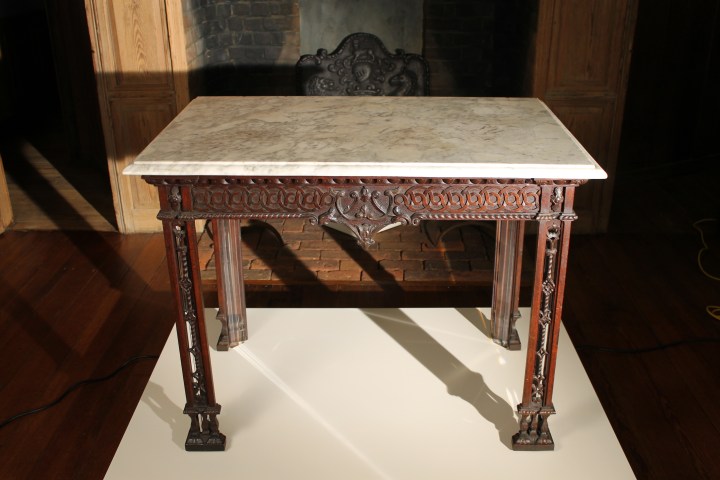
William Buckland (designer) and William Bernard Sears (carver), sideboard made for the Tayloe family of Mount Airy plantation (MESDA collection at Old Salem in Winston Salem, North Carolina). Photo from the Williamsburg blog Anthony Hay’s, Cabinetmaker; click on the image for more information.
◊ ◊ ◊ ◊ ◊
Colonial Williamsburg, The Museum of Early Southern Decorative Arts (MESDA), and Fine Woodworking
present the 16th annual Working Wood in the 18th Century conference at Williamsburg, January 19–22 and 23–26, 2014. Projects and presentations will explore the design and construction of dining room furniture, based on original pieces selected from the collections of the Museum of Early Southern Decorative Arts at Old Salem Museums and Gardens in Winston-Salem, North Carolina.
The pieces to be built cover a range of complexities. Colonial Williamsburg’s Hay Shop staff will reproduce one of the icons of Virginia and southern high-style furniture, the elaborate sideboard table made by William Buckland and William Bernard Sears for the Tayloe family of Mount Airy plantation. The Hay Shop also will make a turned, gate-leg, walnut table, based on the earliest southern gate-leg table known. Steve Latta will demonstrate constructing and decorating a veneered and inlaid, Winchester, Virginia, sideboard. Brian Coe of Old Salem will produce a corner cupboard from the Davidson County, North Carolina, Swisegood school of cabinetmakers. Colonial Williamsburg joiner Ted Boscana will complement Brian’s presentation with a joiner-made, paneled cupboard from the Virginia Eastern Shore. And, Robert Leath, MESDA’s chief curator (first session), and Daniel Ackermann, MESDA’s associate curator (second session), will start things off with an introduction to dining rooms and their furnishings. Partnering with MESDA gives us a chance to focus on southern regional styles and construction, a theme of the new “Masterworks” gallery being installed in the DeWitt Wallace Decorative Arts Museum. Yet, the overall form and decoration of these pieces, whether Baroque in inspiration—drawn directly from Chippendale—or inspired by neo-classical taste, offer approaches and detailing applicable to many examples of Anglo-American furniture made throughout the 18th and into the early 19th centuries.
As last year, Session One runs Sunday through Wednesday and Session Two Thursday through Sunday.
Speakers Include
Daniel Ackermann, associate curator, the Museum of Early Southern Decorative Arts, Old Salem, Winston-
Salem, North Carolina
Ted Boscana, supervisor, journeyman joiner and carpenter, Colonial Williamsburg
Brian Coe, director of exhibition buildings and furniture maker, Old Salem, Winston-Salem, North Carolina
Steve Latta, educator and craftsman, Thaddeus Stevens College, Lancaster, Pennsylvania, and contributing
editor, Fine Woodworking magazine
Robert Leath, chief curator and vice president of collections and research for the Museum of Early Southern
Decorative Arts, Old Salem, Winston-Salem, North Carolina
Kaare Loftheim, journeyman cabinetmaker, Colonial Williamsburg
Bill Pavlak, apprentice cabinetmaker, Colonial Williamsburg
Brian Weldy, apprentice cabinetmaker, Colonial Williamsburg
As always, the conference will be informal. Participants’ comments and questions are welcomed. During morning and afternoon breaks, speakers display their work, tools, and materials; demonstrate techniques; and chat with participants. To include more participants while keeping the conferences small enough for everyone to be involved, two identical programs are offered.
More information is available here»
Symposium | Painters and Paintings in the Early American South
From Colonial Willamsburg:
Painters and Paintings in the Early American South
Colonial Williamsburg, 3–5 November 2013

Robert Feke, Portrait of William Nelson, 1749–51
(Colonial Williamsburg)
The groundbreaking exhibition Painters and Paintings in the Early American South opened March 23, 2013 at the Art Museums of Colonial Williamsburg. The exhibition is the first of its kind to explore in-depth the scope of early art in this region and the myriad connections between art and artists of the early South, New England, the Middle Atlantic, and Europe. It features more than 80 works created in or for the South between 1735 and 1800, 40 of which are on loan from well-known and respected museums and private collections. Painters and Paintings in the Early American South is made possible by generous support from The Grainger Foundation of Lake Forest, Illinois. In conjunction with the exhibition, the Colonial Williamsburg Foundation will sponsor a symposium November 3–5, 2013, featuring lectures on the painters who created the objects and the people they depicted. Speakers will include Graham Hood, Carlisle H. Humelsine Chief Curator Emeritus, Colonial Williamsburg; Ellen G. Miles, curator emerita, Department of Painting and Sculpture, Smithsonian National Portrait Gallery; Angela Mack, executive director and chief curator, Gibbes Museum of Art, Charleston, South Carolina; and Maurie D. McInnis, vice provost for academic affairs and professor of art history, University of Virginia. The conference begins with a keynote lecture and reception Sunday evening followed by two days of lectures, Monday and Tuesday. We are offering a discounted student rate of $250 to qualifying full-time students. For more information on the event and/or to register, please visit the symposium website.
◊ ◊ ◊ ◊ ◊
S U N D A Y , 3 N O V E M B E R 2 0 1 3
5:00 Keynote address, Introduction to the Theme, by Graham Hood, Carlisle H. Humelsine Chief Curator Emeritus, Colonial Williamsburg
6:00 Reception
M O N D A Y , 4 N O V E M B E R 2 0 1 3
9:00 Welcome and opening remarks, Ronald L. Hurst, vice president, collections, conservation, and museums, and Carlisle H. Humelsine Chief Curator, Colonial Williamsburg
The Social and Cultural Importance of Painting in the South, Maurie D. McInnis, vice provost for academic affairs and professor of art history, University of Virginia, Charlottesville
Charlestonians Abroad: Painters and Paintings in the Carolina Low Country, Angela Mack, executive director and chief curator, Gibbes Museum of Art, Charleston, South Carolina.
10:45 Coffee break
11:15 Back in the Day: The Mystery Behind the Watercolor of Drayton Hall, Matthew Webster, director, historic architectural resources, Colonial Williamsburg
John Drayton’s Watercolors, Margaret Pritchard, senior curator, and curator of prints, maps, and wallpaper, Colonial Williamsburg
Jeremiah Theus: A Swiss Artist in Colonial Charleston, Laura Pass Barry, Juli Grainger curator of paintings, drawings, and sculpture, Colonial Williamsburg
12:00 Lunch break
1:30 Degrees of Separation: English Portraiture and the American South, Ellen G. Miles, curator emerita, Department of Painting and Sculpture, Smithsonian National Portrait Gallery, Washington, D.C.
2:15 Wollaston and Hesselius: Their Art and Influence in the Early South, Carolyn J. Weekley, Juli Grainger Curator Emerita, Colonial Williamsburg
3:00 Robert Feke, William Dering, and Other Case Studies in the Conservation of Early Southern Art, Shelley Svoboda, paintings conservator, Colonial Williamsburg
4:00 Gallery tours with curators and conservators in exhibition.
T U E S D A Y , 5 N O V E M B E R 2 0 1 3
8:30 Thomas Coram: Charleston’s Earliest Landscape Artist, Sara Arnold, curator of collections, Gibbes Museum of Art, Charleston, South Carolina
Charles Willson Peale in Maryland and Virginia, Carol Soltis, project associate curator, Peale Collection Catalog, Philadelphia Museum of Art
Southern Synergy: The Philadelphia – Charleston Connection, Elle Shushan, Elle Shushan Fine Portrait Miniatures, Philadelphia
10:15 Coffee break
10:45 Early Virginia Paintings at the Virginia Historical Society, William M. S. Rasmussen, lead curator and Lora M. Robins Curator, Virginia Historical Society, Richmond
John Durand: His Origins Revealed, Carolyn J. Weekley
Frederick Kemmelmeyer: From Hessian Soldier to American Artist, Arthur Nicholas Powers, fellow, Winterthur Program in American Material Culture, Winterthur, Delaware
12:00 Lunch break
1:30 Early Portraiture in the South and the West Indies, Katelyn Crawford, doctoral candidate, University of Virginia, Charlottesville
José Francisco Xavier de Salazar y Mendoza and the Visual Culture of Spanish Colonial New Orleans, Cybèle Gontar, doctoral candidate in American art, Graduate Center, City University of New York
3:00 Coffee break
3:30 Art Collecting in Virginia and Maryland, 1790–1830: Expectations and Aspirations, Lance Humphries, independent scholar, Baltimore, Maryland
Southern Culture: Where Scholarship is Heading, Robert Leath, chief curator and vice president, Museum of Early Southern Decorative Arts, Winston-Salem, North Carolina
Colloquium | Sculpture: Exchanges in Northern Europe
Penser la Sculpture: Échanges artistiques et culturels dans le Nord de l’Europe, XVIe–XVIIIe
Paris, 2–4 December 2013
Colloque international organisé par Frédérique Brinkerink (Rijksmuseum/ Galerie Perrin/ GHAMU) & Gaylord Brouhot (Université Paris 1 Sorbonne/ HICSA/ CHAR). Sous la direction de Colette Nativel avec la collaboration de Luisa Capodieci (Université Paris 1 Sorbonne/ HICSA/ GRANIT) Avec la participation d’Alexander Dencher (Université Paris 1 Sorbonne/ HICSA/ GRANIT) Avec le soutien de la Fondation Custodia
Depuis quelques années, une réflexion de fond a été engagée sur la nature et les modalités des échanges entre les artistes du Nord de l’Europe aux XVIe, XVIIe et XVIIIe siècles. Cette question de l’interaction artistique relève d’un enjeu majeur puisqu’elle entend notamment faire la lumière sur les liens qui se sont tissés entre la France et les Pays-Bas et qui ont participé à entrelacer leurs identités culturelles. Au sein d’une telle approche, l’art de la sculpture, trop rarement étudié pour cette période, hors du champ italien, permet de porter un regard original sur une création qui dépasse les frontières territoriales et l’évolution chronologique des styles.
Nombreuses sont les œuvres inventées et sculptées dans le Nord et entre le Nord et le Sud à révéler une vision transnationale de l’art qui touche les sources d’inspiration, les méthodes de travail, les stratégies de carrière du sculpteur. Il s’agira de préciser l’impact de ces échanges artistiques et culturels sur une transversalité des disciplines qui s’initie dans l’Europe des Temps Modernes, en particulier sur la façon dont les artistes sculpteurs mettent en dialogue littérature, peinture, architecture et sculpture.
Des spécialistes de ces divers champs de recherche enrichiront la réflexion autour de plusieurs thématiques : du réseau d’influences entre les différentes disciplines aux modes de création dans le contexte politico-culturel du Nord de l’Europe, de l’invention de l’oeuvre d’art à sa réception, sans oublier le statut de l’artiste et ses stratégies de carrière.
Le bicentenaire de la mort du sculpteur français Joseph Chinard (1756–1813) est un moment propice pour discuter ces questions : suite à une découverte récente, se pose la question du lien entre l’oeuvre de jeunesse de Chinard et une des œuvres majeures du sculpteur anversois Artus Quellinus le vieux (1609–1668).
Cette rencontre franco-néerlandaise sera aussi l’occasion d’honorer la mémoire de deux grandes historiennes d’art : Madeleine Rocher-Jauneau, conservatrice émérite du Musée des Beaux-arts de Lyon, et Marijke Spies, professeur émérite à la Free University d’Amsterdam.
◊ ◊ ◊ ◊ ◊
2 D E C E M B R E 2 0 1 3
Auditorium de la Galerie Colbert
13.30 Ouverture, Colette Nativel, directrice du GRANIT Groupe de Recherches sur l’Art du Nord. Images-Textes (Université Paris 1 Sorbonne/ HICSA)
14.00 Session 1 | Au-delà du métier : la transversalité des disciplines
Modérateur : Christian Michel (Université de Lausanne)
• Oliver Kik (Katholieke Universiteit Leuven), Defining Boundaries of Sculptural Design in the Sixteenth-century Low Countries
• Bertrand Bergbauer (Musée national de la Renaissance – Château d’Ecouen) & Pauline Lurçon (Institut national du Patrimoine), La circulation en France des plaquettes de bronze des Pays-Bas du XVe au XVIIe siècle
• Eelco Nagelsmit (Université de Leyden), Parading a Palladium: Jacques Francart’s Reliquary Altar of the Blessed Sacrament of Miracles in Brussels and the Siege of Valenciennes in 1656
16.30 Session 2 | Aux frontières de la création : études de cas
Modérateur : Daniel Rabreau (Université Paris 1 Sorbonne)
• Christophe Henry (Université Paris 1 Sorbonne/ GHAMU), Plaisirs de l’homologie : la copie par Bourchardon du Faune Barberini
• Sabine Cartuyvels (GHAMU), Souvenirs romains, sources égyptiennes : des projets de fontaines d’Edme Bouchardon dans « La Théorie et la Pratique du Jardinage »
3 D E C E M B R E 2 0 1 3
Fondation Custodia
9.30 Ouverture, Ger Luijten, directeur de la Fondation Custodia
10.00 Session 3 | Transmission et diffusion des modèles
Modérateur : Gaylord Brouhot (Université Paris 1 Sorbonne/ CHAR)
• Cécile Tainturier (Fondation Custodia), Leçons de dessin ? Moulages de sculpture représentés dans les scènes d’atelier hollandaises du XVIIe siècle
• Guilhem Scherf (Musée du Louvre), Sources d’inspiration et nouveaux thèmes chez Jean-Baptiste Stouf (1742–1826)
• Muriel Barbier (Musée national de la Renaissance – Château d’Ecouen), De la gravure au meuble : l’interprétation des modèles par les artisans de la Renaissance
• Frédérique Brinkerink (Rijksmuseum / Galerie Perrin), Une œuvre de Quellinus dans les collections de Joseph Chinard ? Modèles et inspirations
14.30 Session 4 | Spécialités et thèmes de prédilection
Modérateur : Ger Luijten (Fondation Custodia)
• Aleksandra Lipinska (Technische Universität Berlin), Landscape with King Numa Pompilius and Nymph Egeria: The Development of the Genre of all Antica Relief in the Netherlands and France in the Sixteenth Century
• Étienne Jollet (Université Paris 1 Sorbonne), Les bustes en hermès dans l’œuvre de Chinard
• Tomas Macsotay (UAB, Barcelona), Character, enargeia and the Return of Flemishness in the Salons of 1699 and 1704
17.00 Hans Buijs (Fondation Custodia), Lettres autour de la sculpture dans le fonds Custodia
18.00 Visite libre de l’exposition Hieronimus Cock : La gravure à la Renaissance
4 D E C E M B R E 2 0 1 3
Auditorium de la Galerie Colbert
9.30 Session 5 | Au-delà des frontières : réseaux politiques et artistiques
Modérateur : Luisa Capodieci (Université Paris 1 Sorbonne/ GRANIT)
• Alain Jacobs (Bibliothèque Royale de Belgique), La statue royale ou princière élevée dans les Pays-Bas méridionaux
• Frits Scholten (Rijksmuseum), Etienne-Maurice Falconet (1716–1791) in Holland
• Leon Lock (Université de Leuven), Quelques réflexions sur les relations de travail entre sculpteurs des anciens Pays-Bas et de France aux XVIIe et XVIIIe siècles
• Stéphanie Levert (Université Paris IV / RKD), La présence des sculpteurs des Pays-Bas en France : méthodologie et recherches
14.00 Session 6 | Déterminations du goût
Modérateur : Philippe Bordes (Université Lyon 2)
• Alexander Dencher (Université Paris 1 Sorbonne / GRANIT), Inventer pour le Roi-Stadhouder : la sculpture dans l’oeuvre de Daniel Marot
• Charles Avery (Victoria & Albert Museum), Collecting Gerard van Opstal’s Sculpture and Ivories
• Aline Magnien (Musée Rodin), Le temps des œuvres : l’exemple de Rodin
Colloquium | Choosing Paris: Large Museum Donations
From Paris Musées:
Choisir Paris: Les grandes donations aux musées de la Ville de Paris
Institut national d’histoire de l’art et Petit Palais, Paris, 11–12 October 2013
L’Institut national d’histoire de l’art organise en collaboration avec Paris Musées un colloque intitulé Choisir Paris: Les grandes donations aux musées de la Ville de Paris. Il aura lieu le vendredi 11 octobre à l’Inha et le samedi 12 octobre au Petit Palais.
La Ville de Paris est l’un des premiers collectionneurs de France. Ses quatorze musées, réunis depuis 2013 au sein de l’établissement public Paris Musées conservent une part importante de ce patrimoine. Nées de l’intérêt porté par la Ville à sa propre mémoire et à sa vie artistique, ces collections sont aussi le fruit du rapport passionné que de nombreux amateurs et collectionneurs ont entretenu avec la capitale, qu’ils ont choisie pour conserver leurs trésors patiemment assemblés. Ce « choix de Paris » répond à des motifs qui, pour divers qu’ils soient, font sens et écrivent une manière d’histoire de l’art. Hommage aux donateurs, ce colloque se donne pour objectif de mieux faire connaître cette histoire, d’éclairer la genèse des collections des musées de la Ville de Paris et de témoigner de l’actualité de la recherche sur les grandes donations qui les ont enrichis. Il témoigne aussi du souhait de Paris Musées de renforcer la recherche au sein de
ses différentes activités.
◊ ◊ ◊ ◊ ◊
V E N D R E D I , 1 1 O C T O B R E 2 0 1 3
Institut national d’histoire de l’art – Salle Vasari
9.00 Accueil des participants
9.30 Ouverture du colloque par Antoinette Le Normand-Romain (directeur général de l’INHA) et Delphine Levy (directrice générale de Paris Musées)
9.45 Introduction : La formation des musées de la ville de Paris et le développement de l’administration des Beaux-Arts. Georges Brunel (conservateur général du patrimoine honoraire)
Matinée présidée par Pascal Griener (professeur à l’Université de Neuchâtel) À l’origine des musées de la Ville de Paris
10.45 Carnavalet, une collection à l’origine de plusieurs musées. Jean-Marc Léri (conservateur général,directeur du musée Carnavalet, de la crypte archéologique et des Catacombes)
11.15 Pause
11.30 Jules Cousin et la création du musée Carnavalet. Thierry Sarmant (conservateur en chef, musée Carnavalet)
11.50 Le comte de Liesville, collectionneur. Jean-Marie Bruson (conservateur général, musée Carnavalet)
12.15 Débat et questions. Bilan de la matinée par Pascal Griener Après-midi présidée par Chantal Georgel (conseiller scientifique à l’INHA) Les donations fondatrices de musées
14.30 Quand donner c’est créer. Paul Meurice et la Maison de Victor Hugo. Gérard Audinet (conservateur général, directeur des Maisons de Victor Hugo, Paris/Guernesey)
14.50 La collection Cognacq, entre legs et dispersion. Benjamin Couilleaux (conservateur, musée Cognacq-Jay)
15.10 A l’origine du musée Bourdelle : 1949, une donation fondatrice. Amélie Simier (conservateur en chef, directrice des musées Bourdelle et Zadkine)
15.30 Débat et questions
16.15 Pause
16.30 La donation Valentine Prax, fondatrice du musée Zadkine. Véronique Gautherin (responsable des collections du musée Zadkine)
16.40 Le legs de la famille Jean Moulin. Christine Levisse-Touzé (conservateur en chef, directrice du musée du général Leclerc de Hauteclocque et de la Libération de Paris – musée Jean Moulin)
17.00 Débat et questions. Bilan de l’après-midi par Chantal Georgel
S A M E D I , 1 2 O C T O B R E 2 0 1 3
Petit Palais, Auditorium
9.00 Accueil des participants
9.30 Ouverture de la journée par Christophe Leribault (conservateur général, directeur du musée du Petit
Palais)
Matinée présidée par François-René Martin(professeur à l’École nationale supérieure des Beaux-Arts) Donations décisives et Donations complémentaires
9.40 La collection des frères Dutuit. Deux vies, un musée. José de Los Llanos (conservateur en chef, directeur du musée des Beaux-arts de Bordeaux) et Paulette Hornby (conservateur en chef, musée du Petit Palais)
10.00 La Société de l’histoire du costume et le Palais Galliera. Pascale Gorguet-Ballesteros (conservateur en chef, Palais Galliera) et Marie Bonin (étudiante chercheuse), avec la collaboration de Charlotte Piot (responsable du service de conservation-restauration, Palais Galliera)
10.20 Débat et questions
10.40 Pause
11.10 Le legs Girardin ou la collection d’un amateur. Sophie Krebs (conservateur en chef, musée d’Art moderne de la Ville de Paris)
11.25 « Témoigner de l’effort de nos sculpteurs modernes » : Henry Lapauze et l’acquisition de fonds d’atelier au Petit Palais. Cécilie Champy (conservateur, musée du Petit Palais)
11.45 Débat et questions. Bilan de la matinée par François-René Martin
Après-midi présidée par Jean-Marc Léri (directeur du musée Carnavalet)
Fin de la session : Donations décisives et Donations complémentaires
14.30 Le fonds Théophile Gautier de la Maison de Balzac. Candice Brunerie (chargée des collections et de la communication de la Maison de Balzac)
14.50 Les Donations de peintures chinoises, anciennes et contemporaines, au musée Cernuschi. Maël Bellec (conservateur, musée Cernuschi)
15.10 Pause
15.30 La donation de la garde-robe d’Alice Alleaume au Palais Galliera. Sophie Grossiord (conservateur général, Palais Galliera)
15.50 « Il n’y a pas de beauté exquise sans une certaine étrangeté. » La singularité de la donation Michael Werner. Julia Garimorth (conservateur, musée d’Art moderne de la Ville de Paris)
16.10 Débat et questions. Bilan de l’après-midi par Jean-Marc Léri
16.35 Bilan et conclusions générales du colloque par Dominique Poulot (professeur, université de Paris 1 Panthéon-Sorbonne)
17.30 Cocktail
Fashioning Identities: Types, Customs, and Dress in a Global Context
From the conference website:
Fashioning Identities: Types, Customs, and Dress in a Global Context
Hunter College, City University of New York, 17–19 October 2013
 Pictorial imagery of local types, traditions, and dress has a long history. From costume books and street criers to travel albums and Hispanic costumbrismo, such representations captured people and daily life in a purportedly realistic manner, often emphasizing specificity over universal themes. Popular types, customs, and dress served as both sources of national pride and exotic spectacles of regional traditions. These depictions of local color often valued certain practices, regions, or types over others and were directed to native and foreign audiences alike. They came to have a global reach, serving as authoritative vehicles to disseminate values and beliefs about an individual place or people and cementing imperial ambitions, political ties, and economic networks. This symposium will explore the nuanced and complex ways in which such representations of peoples, places, and cultures—sometimes viewed as portraying a static or conservative vision—simultaneously engaged with the increasingly industrialized and global world.
T H U R S D A Y , 1 7 O C T O B E R 2 0 1 3
7:00 pm, Kossack Lecture Hall, Hunter North 1527
Keynote Address: Natalia Majluf (Director of the Museo de Arte de Lima), Materiality: José Gil de Castro and the Portraiture of Things
F R I D A Y , 1 8 O C T O B E R 2 0 1 3
Ida K. Lang Recital Hall, Hunter North 424
9:30–11:15 Ethnographies
Heather A. Hughes (University of Pennsylvania), Good Habits, Bad Habits: The Global Order in Robert Vaughan’s Months
Mariana Françozo (Leiden University and the National Museum of Ethnology, The Netherlands), Early Modern Comparative Ethnography: The ‘Locke Drawings’ Collection and the Representation of Indigenous Peoples in Global Perspective, c. 1680–1750
Deborah Dorotinsky (Instituto de Investigaciones Estéticas, UNAM, Mexico City), It Is Written in Their Faces: Seri Women and Facial Painting in Photography
11:15 Coffee
11:30–1:00 Intersections of Tradition & Modernity
Vanesa Rodríguez-Galindo (UNED, Madrid), Contemporary Customs in Late Nineteenth-Century Madrid: Points of Convergence between the Popular and the Modern in the Illustrated and Comical Press
Lynda Klich (Hunter College, CUNY), Circulating Indigenism in Mauricio Yáñez’s Postcards from Mexico
Denise Birkhofer (Allen Memorial Art Museum, Oberlin College), Enrique Díaz’s Parade of Progress: Fashioning a Streamlined Mexican Future
1:00–3:00 Lunch
3:00–5:00 Exoticism & Empire
Matthew Keagle (Bard Graduate Center), Uniform Schemas: The Abstraction of Dress and The Unity of Uniforms
Elisabeth Fraser (University of South Florida), The Ottoman Costume Album and Inclusive Empire: Louis Dupré in Ottoman Greece
Victoria L. Rovine (University of Florida), Fashion at the Intersection of French and African Colonial Cultures
S A T U R D A Y , 1 9 O C T O B E R 20 1 3
Ida K. Lang Recital Hall, Hunter North 424
9:30–11:00 Gender Anxieties
Ann Jones (Smith College), Merchandising Gender: Women’s Dress and Women’s Duties in Two Sixteenth-Century Costume Books, Jost Amman’s Frauenzimmer/Gynaeceum and Cesare Vecellio’s Habiti antichi et moderni (1590 and 1598)
Leyla Belkaïd (University of Lyon), A Stylistic Change and Its Pictorial Representation: The Algiers Dress in Western Imagery
Maya Jiménez (Kingsborough Community College, CUNY), The Myth of the Bahiana in Nineteenth-Century Photography
11:00 Coffee
11:30–1:00 Social & Civic Life
Eugenia Paulicelli (Queens College and The Graduate Center, CUNY), Performing Dress: Love, Politics and “venezianità” in Giacomo Franco’s Habiti d’huomini et donne venetiane
Sarah Buck (Florida State University), Les Costumes grotesques (c. 1695): Prints and Professional Habits in the ancien régime
Emily Morgan (Iowa State University), ‘True Types of the London Poor’: Street Life in London‘s Transitional Typology
1:00–3:00 Lunch
3:00–5:00 Masquerade & Appropriation
Ashley Bruckbauer (University of North Carolina at Chapel Hill), Playing the Ambassador and the ‘Other’: Cultural Cross-dressing and French Foreign Policy in the Eighteenth and Early-Nineteenth Centuries
Tara Zanardi (Hunter College, CUNY), The Mantón de Manila at the Crossroads of Identity
Teresa Eckmann (University of Texas at San Antonio), Playing the Devil’s Advocate with a Twist: Julio Galán and Lo mexicano
Charlene Lau (York University), Sartorial Remembrance: Bernhard Willhelm and Tirolean Folk Dress
Conference | The Hurt(ful) Body before Diderot: Pain and Suffering
From the conference website:
The Hurt(ful) Body before Diderot: Pain and Suffering
in Early Modern Performance and the Visual Arts, c. 1600–1790
Royal Flemish Academy of Belgium for Science and the Arts, Brusssels, 21–22 November 2013
On the occasion of Diderot’s three-hundredth birthday, the present conference invites papers by historians of both visual arts and performance arts, to address the hurt and hurt-causing body in early modern and eighteenth-century visual culture. The point is better to address spectacles of pain and suffering before Diderot, whereby before is to be understood both physically and chronologically, in terms of images he saw and those that belong to a wider Ancien Régime visual and performance culture.
Seventeenth- and eighteenth-century medicine, philosophy and works of fiction treated pain and suffering as contents of consciousness. Hurt and grief fixed the self in a state of disaffection and refusal, as opposed to the appetites or ‘sociable’ affects of love or admiration. During this time, the hurt body found itself at the apex of art theory (from Lomazzo to Le Brun), informing academic aesthetics, while the genre of tragedy, climaxing in the plays of Racine, was shaping the image of the actor’s craft. Images of saintly suffering were a fixture of post-Trentian Catholic life, but after 1600 they were incrementally visible in both civic theatre and popular imagery as well as aristocratic collecting. All of this culminates in the writings of Diderot, who was an assiduous admirer of spectacles of grief, pest scenes and other sujets de fracas. Such affinities, as present in his criticism as his commentaries on the tableau and the self-possessed actor, seem now more difficult to place, in part because so little is known of the rationale of the spectacle of hurt in the 150 years that preceded him, especially in relation to its socio-historical and performative context. Moreover, accounts of the period tend to segregate semiotic or iconographical developments (explaining continued interest for the Le Brun’s Traité de Passions and its plates) from historical clues that speak to the peculiar positionality of bodies in and of hurt. The disjunctive image of pain and suffering is today too often regarded as simply ‘emotive’, an expression like any other for artists and actors to master.
Through the impact of scholars like Jonathan Sawday, Erika Fischer-Lichte and Amelia Jones, present-day historians are familiar with problems of performativity and ephemerality, of body presence and the spectator’s participative witnessing and intervention. The hurt body can accommodate new diverse and perceptive approaches of the early modern body, as a body in withdrawal, a ‘communicative’ body in flux, or a body split in its desire to escape alterity and a corporeal ‘prison’. Time seems ripe for a self-standing history of the hurt(ful) body, illustrated through staging practices as well as material images (paintings, sculptures, prints), and addressing practices of making, acting and viewing; censorship and divulgation; collecting, directing and interpreting. The conference invites papers that revisit historical forms, practices and pressures of the hurt body, from the staging of blood and the representations of Hercules’ self-immolation to distressed audiences. Maintaining an interdisciplinary focus, speakers might address imaginaries of the hurt body recovered through stage praxis, visual representation and dramatic text. It welcomes papers exploring archival sources documenting (theatrical) communication between audiences and ‘hurt bodies’, or exploring public and elite spaces of performance, urban events and exhibition sites where Diderot and Ancien Régime audiences experienced such encounters.
◊ ◊ ◊ ◊ ◊
T H U R S D A Y , 2 1 N O V E M B E R 2 0 1 3
9.30 Registration and coffee/tea
10:00 Welcome and introduction by Karel Vanhaesebrouck (Université Libre de Bruxelles, Vrije Universiteit Brussel), Tomas Macsotay (Universitat Autònoma de Barcelona) and Kornee van der Haven (Ghent University)
10:30 Keynote Lecture by Jonathan Sawday (Saint Louis University), Three forms of Renaissance Pain: Michel de Montaigne, John Donne, and Robert Burton
11:30 Coffee/tea break
12:00 Session 1: Discourses of Pain I
• Jürgen Pieters (Ghent University), Hurtful Hamlet: The tragedy of consolation
• Christel Stalpaert (Ghent University), We don’t even know what the hurt(ful) body is capable of: Some reflections on Spinoza and the corporeal turn
13:30 Lunch
14:30 Session 2: Discourses of Pain II
• Frans-Willem Korsten (Leiden University), How Injustice Hurts: Physical Pain, Immaterial Grounds and the Cause of Justice
• Inger Leemans (VU Amsterdam), Clashing Bodies: The physicality of the Amsterdam Stock Exchange, 1650–1750
16:00 Coffee/tea break
16:30 Session 3: Acting the Victim
• Stijn Bussels (Leiden University), ‘No knife, no sting is sharper, than this feeling that cuts through the heart’: Performing Pathos in Vondel’s Brethren (1641)
• Charlotte Bouteille-Meister (Paris X-Nanterre), “Flamme qui m’est un doux zéphire, / Parmi l’ardeur de mon martyre” (Céciliade, 1606): Does the martyr’s ambiguous suffering allow any pathetic response?
• Bram Van Oostveldt (University of Amsterdam), Flying, diving and dying bodies: Corneille’s pièces à machines between the marvelous and the sublime
F R I D A Y , 2 2 N O V E M B E R 2 0 1 3
10:00 Keynote Lecture by Christian Biet (Paris X-Nanterre), Bloody suffering, performed suffering and recited suffering in the French 17th and 18th centuries: Spectacle and text
11:00 Coffee/tea break
11:30 Session 4: The Visual Culture of Hurt
• Koen Jonckheere (Ghent University), The meaning of the pose: Hurting the divine body in an age of Iconoclasm
• Jetze Touber (Ghent University), Engineering empathy: Inventions of martyrology in the Confessional Age
13:00 Lunch
14:00 Roundtable Discussion: Early Modern Theatricality and the Hurt Body
15:00 Coffee/tea break
16:00 Session 5: Enlightenment Purifications
• Aris Sarafianos (University of Ioannina), Unable to bear the light: Sore eyes, sensory deprivation, multi-media shows and extraordinary cures in late eighteenth-century Britain
• Tomas Macsotay (Universitat Autònoma de Barcelona), A technology of audience response: Sightlessness, disorientation and corporeal Pathos in the Paris Academy, 1700–1760
17:30 Concluding remarks
Study Day | Art, Animals, and Politics at Knowsley Hall
From the conference programme:
Art, Animals, and Politics: Knowsley and The Earls of Derby
Knowsley Hall, Merseyside, 9 October 2013
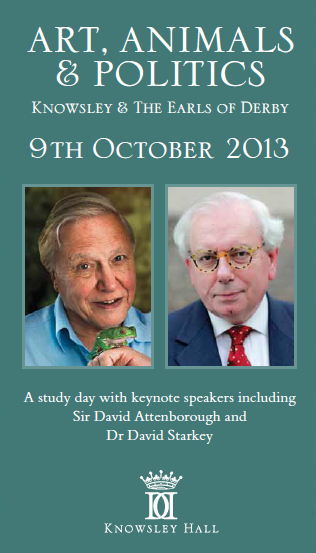 Historians, art historians and natural historians will be presenting exciting new research on three of the outstanding legacies of the Earls of Derby and the Stanley family: the art collection, the natural history library and the political archive. Emphasis will be also be placed on the family’s considerable historical and social influence in the north-west of England, as well as their political impact on the national and international stages, notably throughout the 18th and 19th centuries and the first half of the 20th century. For more information or to register, please email events@knowsley.com.
◊ ◊ ◊ ◊ ◊
Keynote Address
David Starkey, The political and cultural significance of Lady Margaret Beaufort, Countess of Richmond and Derby
Session 1: Art
· Elspeth Graham (Liverpool John Moores University), The Shakespearean stage: Prescot, Lathom and Knowsley
· Richard Stephens (University of York), The 10th Earl as a collector of old master paintings and patron of the arts at Knowsley during the 1720s
· Jonny Yarker (Trinity College, University of Cambridge), Hamlet Winstanley as an artist, copyist and art-agent for the 10th Earl
· Xanthe Brooke (Walker Art Gallery, National Museums Liverpool), Aspects of the old master picture collection at Knowsley during the 18th century
· Gill Perry (Open University), The image of Eliza Farren, Georgian comic actress and Countess of Derby
Session 2: Animals and Edward Lear
· David Attenborough, Edward Lear’s natural history watercolours and prints for the 13th Earl
· Colin Harrison (Ashmolean Museum, University of Oxford), Edward Lear’s landscape watercolours in the Derby Collection
Session 3: Politics
· Angus Hawkins (University of Oxford), The forgotten Prime Minister: The 14th Earl Douglas Hurd, Lord Hurd of Westwell: The 15th Earl’s career as Foreign Secretary
· Bendor Grosvenor (Philip Mould Ltd), The Eastern Question and the 15th Earl’s foreign policy
· Jennifer Davey (University of East Anglia), The Invisible Politician: The political career of the 15th Countess of Derby
Symposium Bringing Art into Being in the Early Modern Period
From The Courtauld:
Bringing Art into Being in the Early Modern Period
The Courtauld Institute of Art, London, 26 October 2013
Organised by Anya Matthews and Giulia Martina Weston
Complex narratives spanning months, years or even decades exist behind the single bracketed date attached to artworks to indicate their moment of execution or completion. This one-day symposium will explore the ‘ante-natal’ development of early modern art from its conception to its ‘quickening’ and eventual birth. The process fascinated contemporary theorists and continues to raise questions for modern art historians. For example, when was an artistic project considered finished or unfinished? What terms were used to indicate the various stages of bringing an artwork into being, and what implications did these terms have for authorship and authenticity? The creation of art is not the work of a moment or achieved at a single stroke; it involves a series of transpositions from idea to study or plan, from sketch to painting, from plan to building and so on. How did early modern art reflect on the process of its own making?
Ticket/entry details: £16 (£11 students, Courtauld staff/students and concessions). Book online. Or send a cheque made payable to ‘The Courtauld Institute of Art’ to: Research Forum Events Co-ordinator, Research Forum, The Courtauld Institute of Art, Somerset House, Strand, London WC2R 0RN, stating ‘Fifth Early Modern Symposium’. For further information, email ResearchForumEvents@courtauld.ac.uk.
◊ ◊ ◊ ◊ ◊
P R O G R A M M E
9.00 Registration
9.30 Introduction – Anya Matthews and Giulia Martina Weston (The Courtauld Institute of Art)
9.40 Session 1: Inspiration and the Artistic Idea
• Nikola Piperkov (Université Paris I Panthéon, Sorbonne), V(isita) I(nteriora) T(errae) R(ectificando) I(nvenies) O(ccultum) L(apidem): Pieter Brueghel the Elder’s and Adriaen de Vries’ Mercury and Psyche, an Allegory of Artistic and Alchemical Creation
• Anne Bloemacher (University of Münster), Raphael on Invention: Work in Progress Before the Materialisation of the Object
• James Hall (Independent art historian and critic), Sex and Genius: Raphael and Titian as Competing Models of the Creative Artist
• Vasco Nuno Figueiredo de Medeiros (University of Lisbon), Between Heuresis and Mimesis: Artistic Science and the Iconopoiesis as Mediators of the Creative Process
11.30 Coffee and Tea Break
12.00 Session 2: Breaking Boundaries
• Joris Van Gastel (University of Warwick), The Sculptor’s Drawing: An Embodied Approach
• Sefy Hendler (Tel Aviv University): A Paragone in Progress: Parmigianino Recto-Verso Study for Moses
• Claire Gapper (Independent architectural historian), Designing and Executing Decorative Plasterwork in the 16th and 17th Centuries
13.20 Break for lunch
14.20 Session 3: Out of Time
• Carolin Behrmann (Kunsthistorisches Institut in Florence -Max-Planck-Institut), In/action: The Non-Finito as Sculptural ‘Actio’
• David Gilks (Queen Mary, University of London), An Impossible Monument: Bringing the French Pantheon Into Being, 1791-94
• Foteini Vlachou (University of Lisbon), The ‘Trial’ and Tribulations of Sequeira’s Allegory of Junot Protecting
the City of Lisbon
• Letha Chien (University of California, Berkeley), The Frustrated Ongoing Saga of the Decorations at the Scuola Grande di San Marco
16.10 Coffee and tea break
16.40 Session 4: Artistic Experimentalism: Practices and Methods
• Kamini Vellodi (Independent art historian and practicing artist), Tintoretto’s Stage-Method: A Modern Constructivism
• Carrie Anderson (Massachusetts College of Art and Design, Boston), Translation and Translocation: Rethinking the Materiality of the ‘Old Indies’ Series
• Stefan Albl (University of Vienna), From Drawing to Painting: The Genesis of Pietro Testa’s Adorations of
the Shepherds and Some Considerations on His Working Methods
18.00 Reception
Symposium | Courtly Rococo in Thuringia
As noted at the Portal Kunstgeschichte:
Höfisches Rokoko in Thüringen: Kunst um Krohne und Pedrozzi
Schloss Heidecksburg, Rudolstadt, Thüringen, 25–26 October 2013
Registration due by 8 October 2013
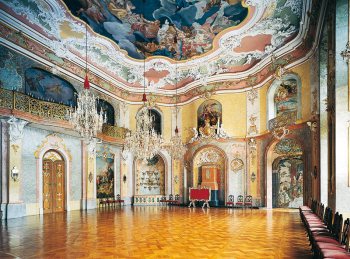 Der Blickpunkt des Symposiums richtet sich vornehmlich auf das architektonische Werk Gottfried Heinrich Krohnes (1703–1756) und Giovanni Battista Pedrozzis (1711–1778), das den Höhepunkt des Rokoko in Thüringen markiert. Die zu untersuchenden Architekturen und Ausstattungen werden dabei insbesondere nach den zugrunde liegenden Strategien und Intentionen herrschaftlicher Repräsentation befragt.
◊ ◊ ◊ ◊ ◊
F R E I T A G , 2 5 O K T O B E R 2 0 1 3
10.00 Begrüßung durch die Veranstalter Helmut-Eberhard Paulus und Peter-Michael Hahn
10.15 Helmut-Eberhard Paulus (Stiftung Thüringer Schlösser und Gärten), Einführung I: Rokoko – Stil oder Epoche?
10.30 Peter-Michael Hahn (Universität Potsdam), Einführung II: Kulturtransfer und Modernität. Ein altes Herzogtum rüstet auf
10.45 Ernst Badstübner (Berlin), Krohne und seine Auftraggeber in Thüringen
11.15 Heiko Laß (Hannover), Krohnes Lustschlosstypus – Dornburg und die Folgen
11.45 Vinzenz Czech (Universität Potsdam), Die Heidecksburg und das Zeremoniell am Rudolstädter Fürstenhof im 18. Jahrhundert
12.15 Diskussion
12.30 Mittagspause
13.30 Lutz Unbehaun (Thüringer Landesmuseum Heidecksburg), Führung durch Schloss Heidecksburg zum Thema „Schloss Heidecksburg als Zeichen und Symbol territorial-herrschaftlicher Macht in Thüringen“
14.45 Wolfgang Jahn (Ebermannstadt), Pedrozzi in seiner Bayreuther Zeit
15.15 Verena Friedrich (Julius-Maximilians-Universität Würzburg), Rocaillen für Rudolstadt. Der Rokokostuck Giovanni Battista Pedrozzis auf Schloss Heidecksburg in Rudolstadt
15.45 Diskussion
16.15 Kaffeepause
16.45 Eva Krems (Universität Münster), Raumstrukturen im höfischen Rokoko
17.15 Katja Heitmann (Philipps-Universität Marburg), A la mode – Raumkunst des Rokoko am Rudolstädter Hof
17.45 Abschlussdiskussion
18.30 Festvortrag Ulrich Schütte (Philipps-Universität Marburg) „Künstler und Architekten bey Hofe“
S A M S T A G , 2 6 O K T O B E R 2 0 1 3
8.30 Abfahrt nach Dornburg
10.00 Führung durch das Rokokoschloss Dornburg
11.45 Abfahrt nach Jena
12.30 Mittagessen im Schwarzen Bären, Jena
14.00 Weiterfahrt nach Molsdorf
15.30 Führung durch Schloss Molsdorf
16.30 Rückfahrt nach Rudolstadt Ankunft gegen 17.30 Uhr










leave a comment