Exhibition | American Adversaries: West and Copley
Press release (19 June 2013) from the MFAH:
American Adversaries: West and Copley in a Transatlantic World
Museum of Fine Art, Houston, 6 October 2013 — 5 January 2014
 This October, the Museum of Fine Arts, Houston, presents American Adversaries: West and Copley in a Transatlantic World, an extensive exhibition charting the rise and spectacular success of contemporary history painting in the 18th century through the lives and experiences of two colonial American innovators: Benjamin West (1738–1820) and John Singleton Copley (1738–1815). West and Copley—initially friends and eventually bitter rivals—gained phenomenal fame from their theatrical paintings that romanticized current events and captured the imaginations of the art-viewing public. American Adversaries is on view from October 6, 2013, to January 20, 2014.
American Adversaries: West and Copley in a Transatlantic World traces the ambitious, competitive and highly successful lives of West and Copley through oil paintings, works on paper, sculptures and artifacts. At the core of the exhibition are two paintings that catapulted West and Copley into international fame: West’s The Death of General Wolfe (1770; 1779 version) and Copley’s Watson and the Shark (1778). The paintings have not been presented together in more than 60 years and never before in this context.
“This is a remarkable opportunity for Museum visitors to see in the same exhibition these two iconic paintings in the history of art, The Death of General Wolfe and Watson and the Shark,” said MFAH director Gary Tinterow. “Painted nearly 250 years ago and considered strikingly modern in their day, the issues addressed with such dramatic flair have the power to still resonate with viewers today.”
“Long before Jackson Pollock drew international acclaim for his innovative Abstract Expressionist paintings in the mid-twentieth century, West and Copley held center stage in the international art world of the 18th century centered in London,” said Emily Ballew Neff, MFAH curator of American painting and sculpture. “The exhibition addresses how it is that these two colonial artists on the margins of empire come to have such phenomenal success.”
Both born in the same year (1738) in the American Colonies of Pennsylvania and Massachusetts, Benjamin West and John Singleton Copley crossed the Atlantic in pursuit of international fame and fortune. London, the cultural and political capital of the empire, attracted and swayed both artists to stay to develop their careers as history painters and neither returned home to America.
West and Copley established a new genre of painting known as contemporary history painting with The Death of General Wolfe and Watson and the Shark. These dramatic large-scale canvases featured compositional elements derived from antique and Old Master sources, yet instead of portraying biblical, mythological or literary heroes, they depicted real people from contemporary life. This exhibition examines these paintings and the period in which they were painted to animate a past that is unfamiliar to many today. It restores the dynamism and modernity of this particular artistic moment as it happened, rather than through the lens of what we later have come to know. These works point to a world informed by the powerful agency of the Iroquois (Haudenosaunee) Confederacy in the Great Lakes region; the scientific and imperial exploration of the seas; the rising role of the media and its relationship to history painting; and the stagecraft involved in managing the perception of a successful artistic career in 18th-century London. In the exhibition, the two key paintings are joined by works of art from all over the Atlantic World, which give them greater context and meaning.
A fully illustrated catalogue, published by the Museum of Fine Arts, Houston, distributed by Yale University Press and designed by Studio Blue, accompanies the exhibition and features essays by international scholars. The catalogue for this exhibition receives generous funding from Furthermore: a program of the J. M. Kaplan Fund.
American Adversaries: West and Copley in a Transatlantic World is organized by the Museum of Fine Arts, Houston. An indemnity has been granted by the Federal Council on the Arts and the Humanities. The exhibition is made possible through support from the Terra Foundation for American Art.
◊ ◊ ◊ ◊ ◊
38th Annual Ruth K. Shartle Symposium
American Adversaries: West and Copley in a Transatlantic World
Museum of Fine Art, Houston, 5 October 2013
This one-day symposium includes talks by prominent scholars addressing themes developed in the exhibition. Following the symposium, guests are invited to a reception and a viewing of the exhibition. More information is forthcoming. Visit www.mfah.org/calendar for updates.
◊ ◊ ◊ ◊ ◊
From Yale UP:
Emily Ballew Neff with Kaylin H. Weber, American Adversaries: West and Copley in a Transatlantic World (New Haven: Yale University Press, 2013), 272 pages, ISBN: 978-0300196467, $75.
American artists and innovators Benjamin West (1738–1820) and John Singleton Copley (1738–1815) changed the way history was recorded in the 18th century and became America’s first transatlantic art superstars. Initially friends but eventually bitter rivals, the artists painted contemporary events as they happened, illustrating the transformation of imperial power through diplomacy between British Americans and the Iroquois, and through transatlantic trade, exploration, and the natural history of the West Indies.
Focusing on two iconic works, West’s The Death of General Wolfe (1770) and Copley’s Watson and the Shark (1778), American Adversaries charts the rise of contemporary history painting, and offers a compelling examination of American history and New World exploration. Featuring more than two hundred color reproductions of paintings, works on paper, and objects that informed the artists, this handsome volume also includes essays that shed new light on, among other subjects, West and Copley within the context of the Royal Academy and the use of Western and Native American objects in cultural diplomacy.
Emily Ballew Neff is curator of American painting and sculpture, and Kaylin H. Weber is assistant curator of American painting and sculpture, both at the Museum of Fine Arts, Houston.
Symposium | Interwoven Globe: The Worldwide Textile Trade
From The Met:
Symposium: Interwoven Globe: The Worldwide Textile Trade, 1500–1800
The Metropolitan Museum of Art, New York, 4 October 2013
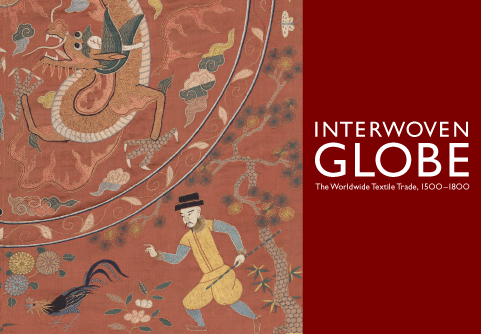 International scholars explore the impact of the burgeoning textile trade in the early modern period, focusing on specific aspects of how trade textiles influenced global economics, social history, and design aesthetics. The program is presented in conjunction with the exhibition Interwoven Globe: The Worldwide Textile Trade, 1500–1800 and made possible in part by the Clara Lloyd-Smith Weber Fund. Free with museum admission.
P R O G R A M
10:30 Amelia Peck — Welcome and Introduction
10:45 Louise Mackie — Ottoman Turkish Silks in Italian and Russian Trade and Diplomacy
11:15 Rudi Matthee — The Dutch East India Company and Asian Raw Silk: From Iran to Bengal via China and Japan
11:45 Jessica Hallett — Textiles, Trade, and Taste: Portugal and Asia in the Sixteenth and Seventeenth Centuries
12:15 Masako Yoshida — The International Expansion of Textiles with Flower, Bird, and Animal Designs
12:45 Break for lunch
2:30 Ebeltje Hartkamp-Jonxis — Aspects of the Luxury Trade in Indian Chintzes for the Dutch Market
3:00 John Styles — East Meets West: Everyday Fashion in Eighteenth-Century London
3:30 Colleen E. Kriger — Lost and Found in Translation: West African Textiles and Atlantic Trade
4:00 Donna Pierce — Popular and Prevalent: The Impact of Asian Textiles on Colonial Mexico
Conference | The Lives of Objects
From the conference website:
The Lives of Objects
Wolfson College, Oxford, 20–22 September 2013
 The relationship between life-writing and objects marks a growing trend in biographical studies. In the first major international conference on the subject, the Oxford Centre for Life-Writing (OCLW) will bring together scholars and curators at the forefront of research in this dynamic area. The conference’s premise is that objects can have lives of their own. Object biographies raise important methodological issues relating to life-writing, and interrogate the fundamental concept of ‘life’. Object biographies also reveal the importance of life-writing to curatorship: the conference will foreground research questions relating to museum management.
The application of life-writing to objects lies at the heart of many recently published biographies, memoirs and histories, including Neil MacGregor’s A History of the World in 100 Objects (2010), Edmund De Waal’s The Hare with Amber Eyes: A Hidden Inheritance (2010), Steven Connor’s Paraphernalia: The Curious Lives of Magical Things (2011), Mark Kurlansky’s Salt: A World History (2003) and Lorraine Daston’s Biographies of Scientific Objects (2000). Biographies of objects raise important methodological issues pertinent to life-writing, regarding narrative, structure and chronology; the representation of change and improvement; and the influence of objects in human lives, communities and material history. The study of ‘object biographies’ continues to generate fruitful areas of academic research, including Bill Brown’s work on ‘thing theory’ (2001); Chris Gosden and Yvonne Marshall’s 1999 study of ‘the cultural biography of objects’ (in relation to archaeology); and explorations of value and exchange of objects in cultural and material history, such as the essays included in Arjun Appadurai’s edited volume The Social Life of Things: Commodities in Cultural Perspective (1986). OCLW’s Conference on The Lives of Objects will bring together scholars and curators at the forefront of research into particular aspects of the theme, and will provide an environment in which fruitful interdisciplinary conversations will occur. Over the three-day event, delegates will enjoy:
• the History Faculty Plenary Lecture by Neil Macgregor (director of the British Museum and author of History of the World in 100 Objects); the English Faculty Plenary Lecture by Jenny Uglow (author of The Lunar Men and The Pinecone); and the John Fell Plenary Lecture by Edmund De Waal (author of The Hare with Amber Eyes: A Hidden Inheritance)
• over fifty 20-minute papers from a wide range of backgrounds. Papers will offer biographical accounts of particular objects (including, but not limited to, portraits, sculpture, scientific instruments, archaeological finds, domestic artefacts and items of clothing); papers reflecting on the methodology of object biographies or outline existent projects concerned with objects’ lives; papers considering the influence of life-writing on material history and/or archaeology; papers exploring the relationship between curating and auto/biography; the history of the book; the history of museums; and further facets of the conference theme
• an informal workshop, in which delegates will present and discuss the lives and meanings of individual objects
• tours of the Ashmolean Museum, the Pitt-Rivers Museum and the Museum of the History of Science, Oxford, with talks by keepers and museum-directors about objects from the museum’s collections
• special conference sessions on ‘The Letter as a Material Object’ by Professor Hugh Haughton (University of York) and ‘The Private (and Public) Life of an Opera Aria’ by Professor Michael Burden (University of Oxford)
• opportunities to socialise with scholars working on this area during the conference, including at conference meals, drinks receptions, a gala conference dinner and other social events
The complete programme is available for download as a PDF file.
Conference | Kent Symposium: Re–presenting Kent
From the Bard Graduate Center:
Kent Symposium: Re–presenting Kent
Bard Graduate Center, New York City, 7 October 2013

William Aikman, Portrait of William Kent, ca. 1723–25 (London: National Portrait Gallery)
Organized in conjunction with the exhibition William Kent: Designing Georgian Britain, on view at the Bard Graduate Center Gallery (September 19, 2013 through February 16, 2014) and the Victoria & Albert Museum (March 22 through July 13, 2014), this international symposium will bring together scholars and curators to examine the life and career of one of the most influential designers of eighteenth-century Britain.
The symposium and related exhibition will explore Kent’s art over three decades (1719–1748)—a period when Britain was defining itself as a new nation and overtaking France as the leading world power. Kent’s versatility and artistic inventiveness set the style of his age and asserted the status of the modern British artist at a time when most patrons and collectors looked to Italy for their art and design. Kent devised a style that catered to the alumni of the Italian Grand Tour and recreated the splendors of Roman palazzi.
The symposium is free. It will take place in the Lecture Hall at 38 West 86th Street, between Columbus Ave. & Central Park West, in New York City. RSVP is required. Please contact academicevents@bgc.bard.edu. Since our Lecture Hall can accommodate only a limited number of people, please come early to assure yourself a seat.
◊ ◊ ◊ ◊ ◊
P R E S E N T A T I O N S
Susan Weber (Founder and Director, Bard Graduate Center), “William Kent: A Historiography”
Julius Bryant (Keeper of Word and Image, Victoria & Albert Museum), “Exhibiting William Kent: Curation and Interrogation”
David Watkin (History of Architecture, University of Cambridge), “Changing Attitudes to Kent from Sustained Hostility to Acceptance in the Twentieth Century”
Matthew Hirst (Arts & Historic Collections, the Devonshire Collection, Chatsworth), “A Country House Repository of Design: William Kent in the Devonshire Collection”
David Jacques (Independent Scholar, Sugnall Hall), “William Kent and the Landscape Garden”
Conference | The Enlightened Gaze in Eighteenth-Century Russia
From the symposium program:
The Enlightened Gaze: Gender, Power, and Visual Culture in Eighteenth-Century Russia
Georgia Museum of Art, The University of Georgia at Athens, 1–2 November 2013

Round Box with Catherine II as Minerva, Paris, 1781–82, gold
verre eglomisé, 7.3 cm (Hillwood Estate, Museum & Gardens)
◊ ◊ ◊ ◊ ◊
Organized in conjunction with the exhibition Exuberance of Meaning: The Art Patronage of Catherine the Great, Georgia Museum of Art (21 September 2013 – 5 January 2014). This exhibition’s assembly of imperial portraits, liturgical vessels, icons, books, and dinnerware provides insight into Russian visual culture from the second half of the eighteenth century and illustrates the complex dynamic between the collecting of historical art and the commissioning of new works of art. Friday evening’s lecture and all sessions of the symposium are open to the public and will take place at the M. Smith-Griffith Auditorium, Georgia Museum of Art, 90 Carlton Street, Athens, GA 30602.
◊ ◊ ◊ ◊ ◊
F R I D A Y , 1 N O V E M B E R 2 0 1 3
6:00 The Shouky Shaheen Lecture by Priscilla Roosevelt (Princeton), “Serfdom and Splendor: The World of the Russian Country Estate”
7:00 Reception at the Georgia Museum of Art
S A T U R D A Y , 2 N O V E M B E R 2 0 1 3
8:00 Coffee and pastries
8:30 Opening remarks by William U. Eiland
9:00 Session One: Gender and Power in Eighteenth-Century Europe
Presenter and moderator, Alisa Luxenberg (UGA, School of Art)
• Marcus Levitt (University of South California), “On Catherine’s Greatness”
• Michael Yonan (University of Missouri), “How to Be an Empress in Eighteenth-Century Europe: Maria Theresa of Austria and Catherine the Great Compared”
• Emily Everhart (UGA, School of Art), “Enduring Friendship: The Legacy of the Marquise de Pompadour at the Château de Bellevue”
10:30 Coffee break
11:00 Session Two: Verbal and Pictorial Texts
Presenter and moderator, Priscilla Roosevelt
• Jennifer Palmer (UGA, Department of History), “Picturing Slavery in the Eighteenth Century”
• Elizaveta Renne (State Hermitage Museum, St. Petersburg), “A ‘Toy’ Castle: The Whim of an Ambitious Owner, Chesme Palace and Its Portrait Gallery”
• Edward Kasinec (Columbia University, Harriman Institute), “Two ‘Royal Doors’ from the Reign of Catherine the Great and Their Twentieth-Century Fate”
12:30 Discussion
1:00 Lunch and gallery tour
2:30 Session Three: Intentions and Happy Accidents: The Total Design Environment
Presenter and moderator, Shelley Zuraw (UGA, School of Art)
• Mimi Hellman (Skidmore College), “Lost in Decoration: Thoughts on Intentionality and Visuality in Eighteenth-Century Interiors”
• Asen Kirin (UGA, School of Art), “The Guiding Gaze of the Enlightened Empress: The Architecture of Lookout Spaces”
3:30 Coffee break
4:00 Session Four: The Attitudes to Byzantium after Catherine II
Presenter and moderator, Kristen Regina
• Yuri Saveliev (The Russian Academy of Arts, Moscow), “The Byzantine Idea in the Imperial Patronage of Russian Architecture”
• Yuri Pyatnitski (State Hermitage. St. Petersburg), “The Shadow of Byzantium Over Nineteenth= and Twentieth-Century Russia: A Historical-Mythological Paradox”
5:00 Discussion
Conference | Georgian Pleasures
From the conference website:
Georgian Pleasures
Bath Royal Literary and Scientific Institute and The Holburne Museum, Bath, 12–13 September 2013
 Georgian Pleasures is an interdisciplinary two-day conference which takes the diversity of the experience of pleasure as its theme. Georgian pleasures were myriad. Some were exclusive — specific to certain classes, ages or genders — others were inclusive and/or overlapping. High life or low life, licit or illicit, private or public, domestic or commercial — there were pleasures to suit all tastes and circumstances. This conference will explore what it was that people of the period enjoyed and what we, as academics, re-enactors and period performers, can learn about society and culture from a better appreciation of pleasure, Georgian-style.
The conference will take place in Bath on 12–13 September 2013. On the 12th the conference will be held in the impressive Queen’s Square home of the Bath Royal Literary and Scientific Institute and on the 13th in the recently refurbished Holburne Museum, itself the centre-piece of Sydney Gardens, the last of Bath’s famous Georgian Pleasure Gardens. On Thursday evening, there will be a launch for Bath History Journal, volume 13, and the conference will end on Friday evening with a gala musical concert in the grounds of the Holburne Museum. We welcome academics of all disciplines and interested non-specialists. All are welcome!
Keynote speakers:
John Strachan, Bath Spa University
Cynthia Hammond, Concordia, Montreal
Adrian Teal, author of The Gin Lane Gazette
◊ ◊ ◊ ◊ ◊
T H U R S D A Y , 1 2 S E P T E M B E R 2 0 1 3
9:15 Registration and coffee
9:30 Plenary 1
• John Strachan (Bath Spa University), ‘The Pleasures of the Chase’: The Literature of Late Georgian Fox-Hunting
10:30 Pleasure and Moral Order
• Paul Holden (NT Lanhydrock), ‘The weakest woman sometimes may, the wisest man deceive’: Mary Toft and the Pleasures of Humiliation
• Steve Poole (University of the West of England), Pleasure … and Shame: Reputation and Respectability in Sydney Gardens, Bath, 1820–30
11:50 Theatricality
• Anna Meadmore (Royal Ballet School), John Weaver: The ‘Father of English Pantomine’
• Bill Tuck, From Carnival to Pleasure Garden: The Venetian Connection
12:50 Lunch
14:00 Music
• Nicola Pink (University of Southampton), The Experience of Domestic Vocal Music for Young Gentry Women, 1790–1830
• Andrew Clarke (Bristol University), Loder and Sons, Bath: A Band of Musicians
• Madeline Goold, A Portrait of Mrs Luther, ‘…a Lady of taste and of great discernment.’ Harpsichords, Pianoforte, and Subscription Concert Society in Georgian London
15:20 Tea
15:45 Satire and Conviviality
• Jessica Monaghan (Exeter University), Simulation and Satire: Feigned illness and the Georgian Health Resort in the Works of Christopher Anstey and His Imitators
• Heather Carroll (University of Edinburgh), Pleasure in Excess: Corporeality and Hedonism in the Satirical Prints of Albinia, Countess of Buckinghamshire
• Jeremy Barlow, The Sublime Society of Beefsteaks: Contexts, Traditions, and Early Membership
17:05 Spectacle
• Matthew Spring (Bath Spa University), Bath’s Grand Gala Concerts: A Combination of Pleasure ‘after the Manner of Vauxhall’
• Mike Rendell (London Historians), Roll up, roll up, the Greatest Show on Earth
• Vicky Vanruysseveldt (Vrije Universiteit), Travelling Entertainers and the Use of Public Space in Brabantine Cities
19:00 Wine and nibbles sponsored by Bath History / Launch of Bath History, volume 13
F R I D A Y , 1 3 S E P T E M B E R 2 0 1 3
9:15 Plenary 2
• Cynthia Hammond (Concordia University), ‘The Gardens will be Illuminated’: Gendered and Georgian Pleasures in the Sydney Gardens, Bath
10:15 Fashionable Consumption
• Elenor Ling (Fitzwilliam Museum), The Allure of Luxury Shops: The Blathwayt Family in London
• Mike Baldwin (London Metropolitan University), Consuming the Harp in Late Georgian England: Products, Services and Customers of the Erat Manufactory, 1821–24
11:15 Coffee — Charles Wiffen will be playing the Schantz fortpiano (1795)
11:30 Healthy Living
• Sarah Spooner (University of East Anglia), ‘Fields of Corn make a Pleasant Prospect’: Gardening and Agriculture in Georgian England
• Linda Watts (Cleveland Pools Trust), The Cleveland ‘Pleasure Baths’: Secluded Pleasures in a Spa City
• Robin Jarvis (University of the West of England), Hydromania: The Natural and Unnatural Pleasures of Swimming in Late Georgian England
13:00 Lunch
14:00 Dance
• Barbara Segal, Dance: A Most Popular Georgian Entertainment
14:30 Music in the Air
• Peter Holman, Politics in the Pit: Directing from the Keyboard [or Not] in the Georgian Theatre
• Andy Lamb (Oxford University), Stealing from the French: The Rise of Wind Harmony Music
• William Summers, Music, Naturalism, and Royal Power Struggles Surrounding Hampton Court Palace, 1716–21
15:30 Tea
15:50 Popular Culture
• Kevin Grieves (Bath Spa University), The Female Bruisers: Women Prizefighters of the Eighteenth Century
• Nick Nourse (Bristol University), Controlling Georgian Pleasures: Music and Entertainment, Legislation and the Law
• Nick Rogers (York University, Toronto), ‘Pleasures for the Poor?’ The Dilemma of Gin Drinking
17:30 Adrian Teal, The Gin Lane Gazette
During the conference Steven Parsons, Diana Russell and Kate James, PGR students at Bath Spa University, will be presenting a poster session.
19:00 Georgian Pleasures — An evening’s entertainment in the manner of a Georgian Garden Gala concert with a pleasure gardens band (The Vauxhall Players) in a specially constructed and lit ‘orchestra’, plus singers, a troupe of entertainers performing a comic intermezzo piece – The Death of Pulcinella, and strolling wind band performing in the gardens between items. The concert will take place outdoors in the Sydney Gardens (Holburne) or at Burdall’s Yard (7a Anglo Terrace, Bath, BA15NH), if the weather is inclement.
Conference | Interdisciplinary Seventeenth-Century French Studies
Thanks to by Kimberly Chrisman-Campbell for drawing my attention to this one. And yes, by definition, this takes us to the seventeenth century, but the gala reception just seems to require us to take note. -CH

◊ ◊ ◊ ◊ ◊
Society for Interdisciplinary Seventeenth-Century French Studies Conference
Los Angeles, 8–10 November 2013
Entertainment, show, and the arts are the lifeblood of Los Angeles — just as they were central to the court of Louis XIV of France. International scholars studying French literature, the arts, and history during this incredible monarchy form the membership of the Society for Interdisciplinary Seventeenth-Century French Studies (SE-17) that will hold its annual conference at two Los Angeles academic Institutions: UCLA’s William Andrews Clark Library and California State University, Long Beach, November 8–10, 2013.
Period literature, art, and music will be central to the academic program. 17th-century French theater as spectacle along with spectacular fashion will also be at the heart of the 2013 meeting’s events. This year, SE-17 plans to embrace the area’s artistic community and include a gala reception around the theme of “What Would Louis Do (in 2013)?”
Proceeds from the reception and meeting will be donated equally to support: (1) graduate students’ travel scholarships to attend upcoming SE-17 events; and (2) travel scholarships for students of the French for Hispanophones program at CSULB, a unique program specially conceived to accelerate the learning of French for Spanish speakers.
Conference | Collections in Flux: Dynamic Spaces and Temporalities
From the University of California’s research group for The Material Cultures of Knowledge, 1500–1830:
Collections in Flux: The Dynamic Spaces and Temporalities of Collecting
UCLA Clark Library, Los Angeles, 9–10 May 2014
Organized by Adriana Craciun and Mary Terrall
This interdisciplinary conference explores how collections shift their meanings and uses with motion through time and space, as well as how layers of meanings can inhabit a single collection in a specific time and place. We hope to bring new light to bear on how spaces of display and representation mapped onto geographical and political spaces, and how concerns about permanence and stability shaded rapidly into dissolution and reorganization and, sometimes, re-use. As Collections in Flux will demonstrate, the activity of collecting becomes more than the expression of curiosity, the desire for order, or the policing of boundaries. Collections in flux, considered dynamically and globally, through the agency of Europeans and indigenous people, can become a forum for rethinking the relation of centers to peripheries, of alien and native, of exotic and mundane.
Keynote Speakers
Miles Ogborn, Professor and Head of School of Geography, Queen Mary, University of London
Nicholas Thomas, Professor of Anthropology and Director, Cambridge Museum of Archaeology and Anthropology, Cambridge University
Conference Participants
Malcolm Baker, UC Riverside
Adriana Craciun, UC Riverside
Lucia Dacome, University of Toronto
Alessa Johns, UC Davis
Stacy Kamehiro, UC Santa Cruz
Mi Gyung Kim, North Carolina State University
Stacey Sloboda, Southern Illinois University
Mary Terrall, UCLA
Conference details and registration information will be available on the webpages of the UCLA Center for 17th and 18th Century Studies and the Clark Library. This conference is organized in collaboration with the University of California Multi-campus Research Group on “The Material Cultures of Knowledge, 1500–1830.”
Conference | Politeness and Prurience: Situating Transgressive Sexualities
From the conference website:
Politeness and Prurience: Situating Transgressive Sexualities in the Long Eighteenth Century
Edinburgh College of Art, University of Edinburgh, 2–3 September 2013
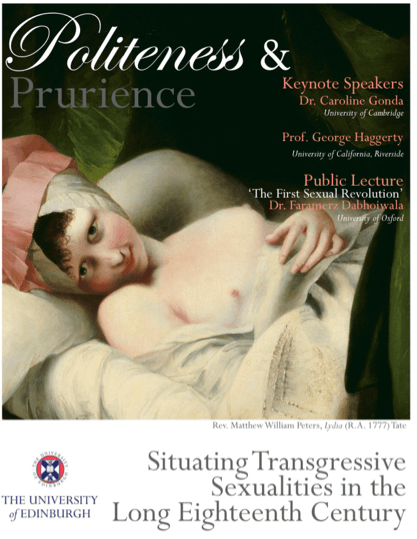 A major, two-day, international, and multidisciplinary conference hosted by the History of Art department (Edinburgh College of Art, University of Edinburgh) which focuses on the cultural history of sexuality, particularly as embedded in polite culture in Britain in the long eighteenth century.
Featuring major scholars in the history of sexuality, eighteenth-century culture, and gender studies, this conference will present illicit sexuality as having a crucial, yet understated, presence in polite culture. Drawing across visual, material and literary cultures, we hope to provide a multi-faceted and challenging platform for thinking about the role of sexualities in aspects of history in which they have often seemed absent.
The conference will include keynote addresses from Professor George Haggerty (University of California Riverside) and Dr. Caroline Gonda (University of Cambridge), as well as an associated public lecture from Dr. Faramerz Dabhoiwala. Conference fees: £40 standard price, £20 students and wnwaged. Booking for the public lecture is free but essential.
◊ ◊ ◊ ◊ ◊
2 S E P T E M B E R 2 0 1 3
9:00 Registration
9:30 Keynote address by George Haggerty (University of California, Riverside), Penile Politeness: The Society of Dilettanti, Richard Payne Knight and Horace Walpole
10:30 Refreshments
11:00 Panel 1: Staging Sexualities: Mounting the ‘Fop’
• Matthew Kinservik (University of Delaware), Men Writing about Men in the Theatre: Male Eroticism on (and off) the Eighteenth-Century Stage
• Robert Jones (University of Leeds), Performing the Fop: Effeminacy and Performance on the Georgian Stage
12:30 Lunch
13:30 Panel 2: Interfaces: Politeness and Prurience
• Lawrence Klein (University of Cambridge), Polite Sex
• Sarah Betzer (University of Virginia), Polite, Queer, Taste
• Barrett Kalter (University of Wisconsin-Milwaukee), Antiquarianism and Queer Time
15:30 Refreshments
16:00 Panel 3: [A]dressing the Subject: Dress, Undress, Cross-Dress
• Peter McNeil (University of Technology, Sydney), ‘Things of a peculiar species’: Macaronism and Fashion in Eighteenth-Century Theatre
• Dawn Hoskin (Victoria & Albert Museum), ‘Nature turned topsy-turvy’: Cross-dressing, Effeminacy and Sodomitical Inclinations at London Masquerades
• Liza Foley (National College of Art and Design, Ireland), ‘Soft, stretched and soiled’: Eroticizing the Glove in Eighteenth-Century England
19:00 Public lecture by Faramerz Dabhoiwala (Exeter College, Oxford; author of The Origins of Sex), The First Sexual Revolution
3 S E P T E M B E R 2 0 1 3
9:30 Keynote address by Caroline Gonda (University of Cambridge), The Epitome of Sapphism and the First Modern Lesbian: Anne Damer and Anne Lister
10:30 Refreshments
11:00 Panel 1: Scandal, Gossip and Sexual Reportage
• Katrina O’Loughlin (ARC Centre of Excellence for the History of the Emotions, University of Western Australia), ‘Strolling Roxanas’: Sexual In/continence, Travel and Scandal
• Rachel Cleves (University of Victoria), ‘Malicious Tongues’: Sex and Slander in the Early American Republic
12:30 Lunch
13:30 Panel 2: Subversive Unions – Alternative Marriages
• Helen Berry (University of Newcastle), A Queer Marriage in Eighteenth-Century England: The Castrato, His Wife, Her Child and Her Lover
• Ana Clara Santo-Santana (University of York), The Criminal Marriage Plot in Henry Fielding’s The Female Husband
• Freya Gowrley (University of Edinburgh), ‘Damned Sapphists’? Que(e)rying the Gothic at Plas Newydd, Llangollen
15:30 Refreshments
16:00 Panel 3: Peering, Leering, Ogling: Varieties of Viewing
• Jordan Mearns (University of Edinburgh), The Wandering Gaze: Perception, Prurience and the Practice of Connoisseurship in Late Eighteenth-Century Britain
• Lydia Syson (Independent Scholar), Dr. Graham’s Ocular Turn: A Look at the Origins of the Celestial Bed
17:30 Drinks Reception
Journée d’étude | For the Love of Art, Amateurs in the Enlightenment
As noted at Le Blog de L’ApAhAu (with a PDF file of the programme available here) . . .
Pour l’amour de l’art: Les enjeux de la pratique amateur
de l’art dans l’Europe au siècle des Lumièress
Centre de la Méditerranée Moderne et Contemporaine, Campus Carlone, Nice, 13 September 2013
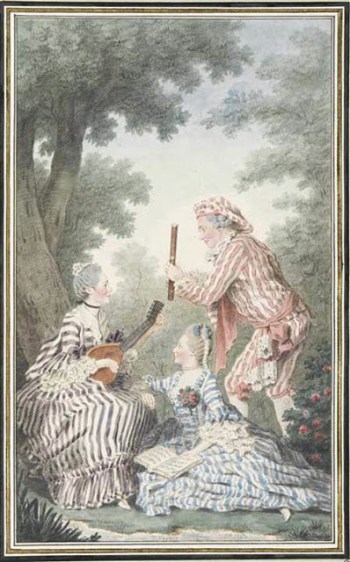 Au siècle des Lumières, le conflit qui oppose Diderot à Caylus, la figure indépendante du critique d’art face à l’amateur protecteur des artistes et juge de leur production, désormais bien étudié, est exemplaire. Dans le cadre de cette journée d’études, il ne s’agira pas de s’interroger sur la pratique de l’artiste professionnel ou semi– professionnel et sur les lieux de sociabilité qu’il fréquente, mais bien sur la pratique artistique d’un public amateur, en mettant l’accent sur le développement de ces pratiques d’amateurs comme marques de distinction sociale, culturelle et symbolique, sur les espaces sociaux et relationnels propres à l’amateurisme (hôtels particuliers, campagnes et châteaux d’agrément, villes d’eau… pourront donner lieu à des études de cas et à des études comparées), et sur la palette des arts pratiqués par ces amateurs qui jaugent leurs performances respectives (pour jouer du théâtre, il faut bien souvent savoir danser et jouer d’un instrument de musique). Cette rencontre voudrait également interroger la diffusion du modèle de l’amateur d’art dans les couches intermédiaires de la société, comme dans l’ensemble de la hiérarchie urbaine, et pas seulement dans les capitales et métropoles régionales.
Dès leur plus jeune âge, les héritiers de l’aristocratie et de ceux qui dans la haute bourgeoisie aspirent à y parvenir sont sensibilisés aux différentes formes artistiques, tant dans la sphère domestique que dans les institutions d’éducation. Cet engouement pour l’art a bouleversé sa pratique en la diversifiant et en la rendant beaucoup plus personnelle. La forme artistique s’est alors insérée dans les espaces privés et intimes de la vie des élites européennes. Cependant, dans une société où les apparences conditionnent la vie sociale, où les comportements sont réglés par des codes respectant une hiérarchie établie, la pratique désintéressée de l’art semble difficile à concevoir, car ceux qui font vivre l’art pratiquent avec maîtrise et assurance les jeux de distinction sociale que la « vie de société » recèle. Au-delà des valeurs esthétiques, par quels intérêts sont poussées ces élites dans leur pratique amateur de l’art ? Volonté de se distinguer socialement, désir de sociabilité ? Quelles logiques les conduisent à développer émulation et compétition dans la pratique amateur de l’art ? Que nous apprennent les écrits des protagonistes de ces jeux de société sur leur pratique et celle du monde dans lequel ils rivalisent ? Que nous disent-ils à travers le prisme de la pratique amateur de l’art sur les acteurs qui sont aussi les juges des performances des « sociétés » auxquelles ils appartiennent ?
Au siècle des Lumières, le conflit qui oppose Diderot à Caylus, la figure indépendante du critique d’art face à l’amateur protecteur des artistes et juge de leur production, désormais bien étudié, est exemplaire. Dans le cadre de cette journée d’études, il ne s’agira pas de s’interroger sur la pratique de l’artiste professionnel ou semi– professionnel et sur les lieux de sociabilité qu’il fréquente, mais bien sur la pratique artistique d’un public amateur, en mettant l’accent sur le développement de ces pratiques d’amateurs comme marques de distinction sociale, culturelle et symbolique, sur les espaces sociaux et relationnels propres à l’amateurisme (hôtels particuliers, campagnes et châteaux d’agrément, villes d’eau… pourront donner lieu à des études de cas et à des études comparées), et sur la palette des arts pratiqués par ces amateurs qui jaugent leurs performances respectives (pour jouer du théâtre, il faut bien souvent savoir danser et jouer d’un instrument de musique). Cette rencontre voudrait également interroger la diffusion du modèle de l’amateur d’art dans les couches intermédiaires de la société, comme dans l’ensemble de la hiérarchie urbaine, et pas seulement dans les capitales et métropoles régionales.
P R O G R A M M E
9:00 Accueil des participants
9:15 Introduction de la journée par David Rousseau et Marie Villion (Université de Nice Sophia-Antipolis, CMMC)
9:30 Alberto Frigo (Université de Caen-Basse Normandie, EA Identité et subjectivité), « La science du connaisseur »
10:05 Nadège Langbour (Université de Rouen, CEREdI), « Diderot et le paradoxe de l’amateur d’art »
10:40 Pause
11:00 Thomas Fouilleron (Archives et bibliothèque du Palais Princier de Monaco, CMMC), « Homme de goût ou goût de prince ? Jacques Ier de Monaco (1689–1751) amateur d’art »
11:35 Aude Gobet (Musée du Louvre), « De la difficile reconnaissance des amateurs d’art au sein de l’Académie des Sciences, Belles-Lettres et Arts de Rouen 1741–1791 »
12:10 Déjeuner
14:00 Thomas Vernet (Conservatoire à Rayonnement Régional de Paris), « « Cet art scientifique avoit toujours été l’amusement de récréation le plus à mon goût » – Nicolas-Louis Ledran (1687–1774), figure singulière d’un amateur de musique »
14:35 Vincent Gray (Université Toulouse II – Le Mirail, ERRAPHIS), « Le Projet concernant de nouveaux signes pour la musique et la Dissertation sur la musique moderne de Jean-Jacques Rousseau : de nouveaux signes musicaux pour un peuplede musiciens amateurs »
15:10 Pause
15:30 Michelle Garnier-Panafieu (Université Rennes 2, EA Histoire et critique des arts), « L’amateur dans la vie musicale parisienne durant la seconde moitié du XVIIIe siècle »
16:05 Isabelle Baudino (ENS Lyon, LIRE), « Les femmes artistes amateurs en Grande-Bretagne au XVIIIe siècle : une noble pratique ? »
16:40 Conclusions de la journée, Pierre-Yves Beaurepaire (Université Nice Sophia Antipolis, CMMC, Institut Universitaire de France)










leave a comment