Conference | Liquid Intelligence and the Aesthetics of Fluidity
From the conference website:
Liquid Intelligence and the Aesthetics of Fluidity
McCord Museum, Montréal, 25–26 October 2013
Caroline Arscott (Courtauld Institute of Art) • Fabio Barry (University of St. Andrews) • Matthew C. Hunter (McGill University) • Yukio Lippit (Harvard University) • Jeffrey Moser (McGill University) • Alexander Nemerov (Stanford University) • Jennifer L. Roberts (Harvard University) • Itay Sapir (UQAM)
In an influential essay, contemporary artist Jeff Wall has sketched a suggestive genealogy linking chemical photography to a range of fluid processes and their modes of “liquid intelligence.” By Wall’s telling, wet procedures done in the dark historically connect photography to a vast, subterranean network of primordial acts of chemical transformation like dyeing and bleaching. But, the pull of liquids on art and aesthetic imagination runs deeper still. From the unctuous stains of Titian’s macchie to Ed Ruscha’s “liquid word” paintings—from Kenneth Anger’s filmic imagination of the Renaissance garden’s ritualized, watery flows to the “boggy, soggy, squitchy” picture that flummoxes Ishmael at Melville’s Spouter-Inn—the urge to sound the fluid image abides. Where Walter Pater would explain Leonardo’s strange imaginings as like sight “in some brief interval of falling rain at daybreak, or through deep water,” no less central a theorist of pictorial ontology than Leon Battista Alberti appealed to the myth of Narcissus. “What is painting,” Alberti asks, “but the act of embracing by means of art the surface of the pool?”
Hosted through the Department of Art History and Communication Studies at McGill University and Media@McGill, this conference aims to thematize liquid intelligence and the broader aesthetics of fluidity in which it moves. Drawing together leading, international scholars, the conference seeks to open conversations around conceptions of photography, painting, and other fluid strategies made perceptible by pushing upon liquid intelligence. Can an ingenuity of liquid realization be constructively compared, we might ask, to the raw, “fluid” smarts that psychologists oppose to formal, “crystallized” intelligence? Might the theoretical heuristic of liquid thinking devised for a recent, proximate past help flush out the modalities of more distant minds responsible for, say, the oozing, oil-spotted glazes of medieval tenmoku tea wares or the inky insubstantiality of Zen patriarch portraits? If we, like the intergalactic researchers in Andrei Tarkovsky’s Solaris, are influenced by the hegemonic, fluid images we study, how might those subtle currents work to dissolve the dry media genealogies and hoary theoretical constructs that continue inform much thinking on relations between photography, painting and other arts past and present?
F R I D A Y , 2 5 O C T O B E R 2 0 1 3
8:30 Coffee/Registration
9:00 Introduction
Session I
9:30 Fabio Barry, TBA
11:00 Jeff Moser, “Fire-Star and Secret Hue: The Molten Mind in Song-Yuan Ceramics”
Session II
2:00 Matthew Hunter, “The Cunning of Sir Sloshua: Reynolds, the Navy and Risk”
3:30 Jennifer Roberts, “Veins of Commerce: Nature-Printed Currency in Colonial North America”
S A T U R D A Y , 2 6 O C T O B E R 2 0 1 3
Session III
9:00 Itay Sapir, “Contained Liquidity: Fluid Intelligence and Rock-Solid Framing in the Port Scenes of Claude Lorrain”
10:30 Alexander Nemerov, “Rubens’ Adoration of the Magi at the Prado”
Session IV
1:00 Yukio Lippit, “Inky Painting”
2:30 Caroline Arscott, “Dyeing, Bleaching, Printing: Morris and Abundance”
Session V
4:00 Responses/General Discussion
Symposium | Threads of Feeling Unraveled
From the conference program:

Threads of Feeling Unraveled
DeWitt Wallace Decorative Arts Museum, Colonial Williamsburg, 20–22 October 2013
In association with the loan exhibition Threads of Feeling, which opens at the DeWitt Wallace Decorative Arts Museum on May 25, 2013, Colonial Williamsburg is hosting a symposium that will explore these objects in context. When a mother left her infant at the Hospital during the mid-eighteenth century, she sometimes provided a token that was attached to the paper record, allowing her to later identify and reclaim her own child if her circumstances improved. Most of the tokens took the form of scraps of fabric, ribbons, or cuttings from the baby’s own clothing, identified in the record by their period names. The textile swatches are an invaluable source for identifying everyday textiles and the clothing of infants. As part of the symposium, exhibit guest curator and noted author John Styles will present two lectures. His keynote lecture will give a ‘behind-the-scenes’ look at the development of the Threads of Feeling exhibition that received rave reviews in London. Styles will also discuss the history of the Foundling Hospital, the London scene, what is known about the identity of the infants, and the various meanings that can be unraveled from the evocative tokens. Other lectures will discuss clothing for infants and children, what women wore during pregnancy, childhood and orphans in America, and the use of similar textiles by adults in Britain and America. (more…)
Conference | Charakterköpfe: Portrait Busts in the Enlightenment
From the conference program:
Bildnisbuesten der Aufklaerung
Germanisches Nationalmuseum, Nuremberg, 11—13 September 2013
Registration due by 30 August 2013
 Begleitend zur Sonderausstellung „Charakterköpfe. Die Bildnisbüste in der Epoche der Aufklärung“ (6.6.–6.10.2013) behandelt eine internationale Fachtagung das plastische Porträt am Ende des 18. Jahrhunderts, ein Zeitalter großer geistiger und politischer Spannungen und Umbrüche. Vorgestellt und diskutiert werden unter anderem Fragen zur Funktion von Porträtbüsten im privaten und öffentlichen Raum, die seit der zweiten Hälfte des 18. Jahrhunderts leidenschaftlich geführte
Debatte zur Physiognomik und Charakteristik sowie die florierende Wachsplastik. Einzelstudien beleuchten die Gleichzeitigkeit gegensätzlicher Stile, die sich in den Bildnissen von Regenten, Bürgern, Künstlern und Gelehrten zwischen Ideal und Individualität bewegen wie in kaum einer anderen Epoche. Bislang war das plastische Porträt als repräsentatives Medium ausschließlich dem fürstlichen Stand vorbehalten, in den Jahren nach 1780 gelangt es auch in bürgerlichen Kreisen zu großer Popularität. Die Tagung richtet den Blick außerdem auf die neuen Materialien und Techniken, die diese Verbreitung bis hin zur Anlage umfangreicher Bildnisgalerien förderten.
Bitte melden Sie sich verbindlich bis 30. August an. Es werden keine Tagungsgebühren erhoben. Information und Anmeldung: Dr. Frank Matthias Kammel, charakterkoepfe@gnm.de.
◊ ◊ ◊ ◊ ◊
1 1 S E P T E M B E R 2 0 1 3
14:00 G. Ulrich Großmann (Generaldirektor des Germanischen Nationalmuseums): Begrüßung
14:15 Frank Matthias Kammel (Nürnberg): Blickwechsel. Warum man sich mit Bildnisbüsten beschäftigen sollte
14:45 Ulrich Söding (München): Die Heiligenbüste im 18. Jahrhundert. Funktionale und typengeschichtliche Aspekte
15:30 Andrea M. Kluxen (Nürnberg): Gibt es eine aufgeklärte Herrscherbüste? Absolutistische Inszenierung und aufgeklärter Legitimationswechsel
Kaffeepause
16:45 Karin Tebbe (Heidelberg): Das Haupt des Kurfürsten und andere Köpfe aus der Kurpfalz
17:30 Claudia Maué (Nürnberg): Die Porträtbüsten des Kurfürsten Maximilian III. Joseph von Roman Anton Boos
Pause
19:00 Roland Kanz (Bonn): Öffentlicher Abendvortrag:Physiognomik versus Charakteristik. Rollenmodellierungen in Porträtbüsten um 1800
1 2 S E P T E M B E R 2 0 1 3
9:00 Axel Christoph Gampp (Zürich): Ein Wiener Charakterkopf: Franz Christoph von Scheyb (1704–1777)
9:45 Mariana Scheu (Salzburg): Die Hervorhebung des Individuums – Johann Baptist Hagenauers Porträtbüsten in St. Peter in Salzburg
Kaffeepause
11:00 Peter Husty (Salzburg): Porträt des Porträtisten. Ein Blick ins Antlitz des Künstlers und Kunstmäzens Franz Laktanz Graf Firmian (1709–1786)
11:45 Anna Seidel (Hamburg): Bildnisbüsten von Bartolomeo Cavaceppi. Herzog Carl I. von Braunschweig-Lüneburg und König Friedrich II . von Preußen
Mittagspause
14:00 Beatrize Söding (München): Grabmal und plastisches Porträt. Die Denkmäler des 18. Jahrhunderts in der Wiener Schottenkirche
14:45 Ingeborg Schemper (Wien): Gelehrte Köpfe in Wien. Zu den Anfängen ehrenhalber aufgestellter Bildnisbüsten im 18. Jahrhundert und ihrem Kontext
Kaffeepause
16:00 Frank Matthias Kammel (Nürnberg): Der Garten als Denkmalort. Bildnisbüsten in Parks
16:45 Bernd Ernsting (Köln): Wie den Jungen der Tod gebildet. Karl Friedrich Wichmanns Zimmerdenkmal für Henriette Jordan im Kontext privater Memorialkultur um 1800
17:30 Yasmin Doosry (Nürnberg): Papierne Büsten. Die Bildnisbüste im Spiegel von Zeichnung und Druckgraphik
1 3 S E P T E M B E R 2 0 1 3
9:00 Anna Pawlik (Nürnberg): Christian Benjamin Rauschner. Zur Materialvielfalt von bossierten Wachsbildnissen im späten 18. Jahrhundert
9:45 Elisabeth Taube (Nürnberg): Alles nur Wachs? Eine kunsttechnische Studie zu den Wachsbildnissen des 18. Jahrhunderts im Germanischen Nationalmuseum
Kaffeepause
11:00 Doris Lehmann (Bonn): Die Guillotine als Porträtmaschine? Madame Tussauds Wachsköpfe und ihre Vermarktung
11:45 Petra Rau (Frankfurt am Main): Über den Handel mit prominenten Köpfen. Die Kunstmanufakturen in Leipzig, Weimar und Gotha/Altenburg
Mittagspause
13:15 Stefan Schnöll (Wien): Porträtbüsten der Kaiserlichen Porzellanmanufaktur Wien
14:00 Jürgen Klebs (Berlin): Die plastischen Bildnisse Goethes aus seiner Lebenszeit
14:45 Hans Ottomeyer (Berlin): Genies und Heroen. Europäische Galerien und andere Geschichtsforen
15:30 Schlusswort
Conference | Materializing the Spirit: Art and Women Religious
From the conference programme:
Materializing the Spirit: Spaces, Objects, and Art in the Cultures of Women Religious
Histories of Women Religious of Britain and Ireland (HWRBI) 2013 Conference
Institute of Historical Research, Senate House, London, 5–7 September 2013
 This conference explores architecture, art, and design produced by and for women religious in Britain and Ireland from the Middle Ages to the present. Keynote speakers are Mary Schoeser on textiles and interiors, and Julian Luxford on medieval convents. Presenters include Emily Gee (English Heritage), Tim Knox (Fitzwilliam Museum), and Helen Hills (York). The conference also includes a thematic tour of the V&A’s collections. Additional information is available at the HWRBI website.
◊ ◊ ◊ ◊ ◊
T H U R S D A Y , 5 S E P T E M B E R 2 0 1 3
2.00 – 3.30 Women Religious and the Arts at the V&A
Tessa Murdoch (Acting Keeper of Metalwork, Sculpture, Ceramics and Glass, V&A) will lead a tour of the museum’s collections. Places are limited. Further information on registration.
F R I D A Y , 6 S E P T E M B E R 2 0 1 3
9.00 Registration and Refreshments
9.30 Welcome and Introduction
9.45 Session I: Place and Purpose, chaired by Caroline Bowden (QMUL)
• Roderick O’Donnell FSA, ‘The Pugins’ Houses of men and women contrasted’
• Michael O’Boyle (Bluett & O’Donoghue Architects), ‘The nature and character of convent buildings in Ireland in the eighteenth and nineteenth centuries’
• Sue Acheson RSCJ, ‘Space for the Heart: Representing Devotion in the Chapel of the Sacred Heart, Roehampton’
11.15 Break
11.30 Session II: Patrons and Subjects, chaired by Dominic Janes (Birkbeck)
• Tim Knox (Fitzwilliam Museum), ‘A Soldier and a Nun: Two “Ancestral Portraits” of English Sitters by Pietro-Tommaso Labruzzi’
• Patricia Harris CJ, ‘The Mystery of the “Painted Life” of Mary Ward’
• Anselm Nye (QMUL), ‘Artistic and Comic: The cartoon as historical memory amongst the English Dominican Sisters’
1.00 Lunch
2.00 Session III: Material and Immaterial, chaired by Carmen Mangion (Birkbeck)
• Susan O’Brien (Cambridge), ‘A Spirituality Represented: Images of the Holy Child in the Society of the Holy Child Jesus, England since 1846’
• Helen Hills (York), ‘Making Religion Matter?’
3.00 Break
3.15 Teaching and Publishing Session
“…Nuns are a remote reality, detached from the world”: The Challenges of Teaching and Researching Female Religious Life, (Session sponsored by History Lab Plus, IHR & Higher Eduction Academy)
5.00 Break
5.15 Keynote I | Mary Schoeser (President, The Textile Society), ‘Fair and beautiful to behold’
6.15 Reception and H-WRBI Annual Meeting
8.00 Conference Dinner
S A T U R D A Y , 7 S E P T E M B E R 2 0 1 3
9.00 Registration and Refreshments
9.30 Session IV: Space and Context, chaired by Lynne Walker (IHR)
• Ellie Pridgeon (Leicester), ‘Space and Location: The Cloister Paintings at Lacock Abbey’
• Deirdre Raftery (UCD), ‘ “Cover the Earth with Houses”: The form and function of the convents of the Society of
the Sacred Heart in nineteenth-century Ireland, North and South’
• Brenda King (The Textile Society), ‘Stitch and Stone’
11.00 Break
11.30 Session V: Symbolism and Devotion, chaired by Jane Hamlett (RHUL)
• Kate Jordan (UCL), ‘Artists Hidden from Human View: Mysticism and Art in the Victorian Convent’
• Ayla Lepine (Yale), ‘”The Story of a Life”: Nuns at the Epicentre of Modern Visual Culture’
12.30 Lunch
1.30 Session VI: Heritage and Preservation, chaired by Emily Gee (English Heritage)
• Abbot Geoffrey Scott (Catholic Archives Society), ‘The Archives and Collections of English Nuns Deposited at Douai Abbey’
• Frederick O’Dwyer (Conservation architect), ‘Historic Irish Convents, Redundancy and Reuse’
• Sophie Andreae (Vice Chair, Bishop’s Conference Patrimony Committee), ‘Important Artefacts: Some Recent Case Studies’
• Emily Gee (English Heritage, Head of Designation), ‘Reflections on the Heritage Landscape’
3.30 Break
4.00 Keynote II | Julian Luxford, (St Andrews), ‘Nuns, Art and Patronage in Later Medieval England’
5.00 Closing remarks
5.15 Reception
To register online, visit the HWRBI Eventbrite page.
Conference | The Eighteenth-Century Gothick
From the symposium website:
Eighteenth-Century Gothick Symposium
University of Oxford, 7 August 2013
 The Gothick Revival in eighteenth-century Britain is a multi-faceted phenomenon, simultaneously liminal and mainstream, historical and modern, whimsical and serious. This international and interdisciplinary symposium is supported by the Georgian Group and the University of Oxford, and comes thirty years after the landmark Gothick conference held by the Georgian Group at the Victoria and Albert Museum, London. It will bring together current high-quality research by scholars and students on the revival and explore its many dimensions.
Conference registration is now open. Further details can be found on the symposium’s website.
◊ ◊ ◊ ◊ ◊
Oleksandr Golozubov, Laughter and Evil in the English Pre-Romanticism
Alice Labourg, The Pictorial Gothic in Ann Radcliffe’s Novels: From Decorative Details to Picturesque Tableaux
Jenny McAuley, English Literature and the Eighteenth-Century Gothic Revival: The Example of Ann Radcliffe
Thomas Willette, Horace Walpole’s Gothick Cellini
Cathryn Spence, King Alfred’s Hall, Cirencester
Oliver Cox, Back in the Summer of ’69 — Alfred’s Castle and Alfred’s Tower
Ruth Musielak, Gothic and Classical: Gothic Ornaments at Marino, Co Dublin
Peter N. Lindfield, Dicky Bateman, Shobdon Church and Kentian Gothic: The Great Mystery
Jonathan Kewley, Eighteenth-Century Gothick in the Regency: The Career of Thomas Brine
Jean-Marie Guillouët, Pursuing Historiographical Myths during the Eighteenth Century: English and Irish Art Historians and the Late Gothic Architecture in the Iberian Peninsula
Dustin Frazier, Samuel Pegge: A Reassessment
James Marsden, Thomas Leland, Gothic Novelist, Gothic Historian and Classical Educator
Philip Aspin, Enlightened Reactionaries? Gothic Revival thought in late Georgian England
Conference | Torino Britannica: Political and Cultural Crossroads
From the Seminar on Collecting and Display:
Torino Britannica: Political and Cultural Crossroads on the Grand Tour in the Early Modern Age
The British School at Rome and the Centro Studi Reggia di Veneria Reale in Turin, 19-21 June 2013
Traditional views of the cultural and political phenomenon broadly known as the ‘Grand Tour’ focus on a stereotype of the eighteenth-century British aristocratic traveller resolute on acquiring both cultural artefacts and diplomatic and political know-how from the antique European states, especially those in Italy. More detailed analysis of specific features of the Grand Tour allows for a more insightful assessment of this important historic development during the sixteenth to eighteenth centuries. This conference will introduce and explore a significant aspect of the Grand Tour long neglected by scholars but which formed an integral part of the education and cultural formation of many British travellers: their sojourn at Turin, capital of the Savoy-Piedmont Polity. The conference will also address another overlooked, yet critical feature of this international movement – the Italian side of and contribution to the Grand Tour experience – a phenomenon which may be called a ‘reverse’ Grand Tour; namely, the movement of artists, writers and other protagonists travelling from Turin to Britain and enriching the cultural exchanges between the two.
Visitors to Turin were confronted with an entirely different experience from that of the other classic Grand Tour sites, including Florence, Rome, Naples and Venice. While these obligatory stopovers were famous for viewing (and purchasing) antiquities, for studying the great repositories of cultural treasures, and for participating in society, a sojourn at Turin, by contrast, became regarded as exceptional, offering the visitor an altogether more pragmatic learning experience. The Savoyard capital boasted important modern royal urban and architectural enhancements, public features that placed Turin in the vanguard of European capitals. Due to the tight controls the Savoy dynasty exercised – by way of a highly efficient bureaucracy – over all cultural, military, religious, ceremonial and social activities throughout its realm, but particularly in Turin, the city was also admired as a model of public functionality and even rationality not seen elsewhere in Italy. The biggest draw for British visitors, however, was undoubtedly the Turin Royal Academy (l’Accademia Reale), which offered an up-to-date and prestigious education in military and diplomatic culture to a wide range of young Europeans who frequented it for extended periods, permitting a cosmopolitan exchange among future statesmen.
As a military power and a flourishing princely court of strategic diplomatic stature, Turin was fully integrated into European affairs, including its important diplomatic and cultural relations with Britain, which peaked in the century following the foundation of the Royal Academy in 1678. Foreigners began to flock there, and the manner in which these European elites shared a common culture formed by their mutual experience of the Academy is one of the questions the conference will address. A model example of an elite military school, the Academy taught not only martial arts and equitation but also mathematics, geography, history, languages (Italian and French), continental social skills and gentlemanly virtues necessary for diplomacy and salon conversations of fashionable society. Fundamentally different from the other Italian Grand Tour sites, which were visited primarily for their historical art treasures, antiquities, musical and theatrical offerings, or even landscape and climate, Turin offered a course of study for the modern man. Torino Britannica will explore these differences while illuminating the significance of the Torinese experience of the Grand Tour in the larger historical narrative of this important British political and cultural phenomenon. In line with the most recent scholarship on the Grand Tour, its intention is to highlight the need to recover these less celebrated and previously underappreciated pathways along which cultural and artistic trends were spread across Europe in the early modern period.
◊ ◊ ◊ ◊ ◊
W E D N E S D A Y , 1 9 J U N E
Rome, British School at Rome
9.15 Opening Remarks, Christopher Smith (British School at Rome) and Andrea Merlotti (Centro Studi, Reggia di Venaria Reale)
Session 1 — Britain in Turin: Politics at the Savoy Court / Britannia a Torino: politica alla corte dei Savoia
Chair: Paola Bianchi (Università della Valle d’Aosta)
9.30 Edward Chaney (Southampton Solent University), Torino Britannica and the Cultural Memory of Egypt: Stuarts, Savoys and the Divine Right of Kings
10.00 Toby Osborne (Durham University), England and Savoy: The Culture of Dynastic Affinity
10.30 Andrea Pennini (Università di Torino), Un’altra via possibile? Progetti matrimoniali fra Stuart e Savoia nel Seicento
11.00 Break
11.30 Edward Corp (Université de Toulouse), The Court of Turin and the English Succession, 1712-1720
12:00 Christopher Storrs (University of Dundee), British Diplomats at the Savoy Court and International Politics
12.30 Paolo Cozzo (Università di Torino), “La metropolitaine des catoliques”. La cappella dell’ambasciata di Savoia nella Londra di Giorgio II.
13.00 Lunch
Session 2 — Turin: Gateway to the British Grand Tour / Torino: porta del Grand Tour britannico
Chair: Karin Wolfe (British School at Rome)
14.30 Paola Bianchi (Università della Valle d’Aosta), Cosmopolitismo e pragmatismo confessionale: gentiluomini britannici in Accademia Reale
15.00 Andrew Moore (Attingham Trust and Paul Mellon Senior Fellow, 2011-13), Thomas Coke: Playhouse, Rope Dancing and the Venaria Real
15.30 Andrea Merlotti (Centro Studi Reggia di Venaria Reale), Salotti, conversazioni, logge. I viaggiatori inglesi nella sociabilità aristocratica torinese del Settecento
16.00 Discussion
16.30 Break
17.00 Exhibition: James Hakewill’s Grand Tour Drawings in the British School at Rome Library
18.00 Keynote address: Cesare De Seta (Università degli studi di Napoli Federico II), Viaggi, viaggiatori e pittori a Torino tra Sei e Settecento
19.30 Reception
20.00 Dinner
T H U R S D A Y , 2 0 J U N E
Rome, British School at Rome
Session 3 — The British in Turin: Art and Diplomacy / Britannici a Torino: arte e diplomazia
Chair: Joanna Kostylo (British School at Rome)
10.00 Karin Wolfe (British School at Rome), John Molesworth: British Envoy and Cultural Intermediary in Turin
10.30 James Rothwell (National Trust), Silver from London and Turin: The Collection of the 2nd Earl of Bristol, Envoy Extraordinary to the Court of Savoy 1755-58
11.00 Break
11.30 Jonny Yarker (British School at Rome), Domenico Duprà: A Turinese Painter and the British
12.00 Christopher Johns (Vanderbilt University), Chinoiserie in Piedmont: An International Language of Diplomacy and Modernity
12.30 Discussion
13.00 Lunch
14.30 Departure from the British School at Rome for Turin
F R I D A Y , 2 1 J U N E
Turin, Reggia di Venaria, Aula magna del Centro restauro
Session 4 — Britain and Turin: Architectural Crossroads on the Grand Tour / Britannia e Torino: percorsi architettonici del Grand Tour
Chair: Costanza Roggero (Politecnico di Torino)
10.00 Tommaso Manfredi (Università Mediterranea di Reggio Calabria), Architetti e Re nell’Europa del Grand Tour: da Wren a Juvarra
10.30 Cristina Ruggero (Bibliotheca Hertziana, Roma), L’album juvarriano per Lord Burlington a Chatsworth
11.00 Giuseppe Dardanello (Università di Torino), Esperienze dell’Inghilterra nella cultura architettonica e figurativa nel Piemonte del Settecento
11.30 Edoardo Piccoli (Politecnico di Torino), Englishmen in Turin, 1747-1748
12.00 Paolo Cornaglia (Politecnico di Torino), Il giardino inglese in Piemonte a fine Settecento: declinazioni pittoresche, anglo-cinesi e paesaggistiche
12.30 Discussion
13.00 Lunch
Session 5 — Turin in Britain: Cultural Exchange in the Age of the Grand Tour / Torino in Britannia: scambi culturali nell’età del Grand Tour
Chair: Andrea Merlotti (Centro Studi della Reggia di Venaria)
15.00 Alastair Laing (National Trust), A Plurality of Pluras: Members of the Plura Family and Their Work for the British
15.30 Olga Zoller (Independent Scholar), Crossing Professional and National Limits: the Pioneering Role of the Versatile Architect-Engineer Giovanni Battista Borra (1713-1770)
16.00 Cristina Bracchi (Archivio delle Donne in Piemonte), Baretti inglese: la didattica e la critica
16.30 Francesca Fedi (Università di Parma), Alfieri in Inghilterra
17.00 Annarita Colturato (Università di Torino), Con talento e intraprendenza: musicisti piemontesi a Londra nel secondo Settecento
17.30 Discussion
18.00 Concerto: Benvenuto Robbio di San Raffaele (1735-1794), Sonate 1, 2, 3 e 5 dalle Sei Sonate a Violino o Cembalo Solo — Silvia Colli, violino; Gioele Gusberti, violoncello; Mario Tonda, clavicembalo
Symposium | The Botany of Empire in the Long Eighteenth Century
This fall at Dumbarton Oaks (as noted by Courtney Barnes at Style Court) . . .
The Botany of Empire in the Long Eighteenth Century
Dumbarton Oaks Research Library and Collection, Washington, D.C., 4–5 October 2013

◊ ◊ ◊ ◊ ◊
This two-day symposium will bring together an international body of scholars working on botanical investigations and publications within the context of imperial expansion in the long eighteenth century.
The period saw widespread exploration, a tremendous increase in the traffic in botanical specimens, significant taxonomic innovations, and horticultural experimentation. We aim to revisit these developments from a comparative perspective that will include Europe, the Ottoman Empire, Africa, Asia, and the Americas.
Main themes for discussion are global networks of plant discovery and transfer; the quest for medicinal plants and global crops such as ginseng, tea and opium; the economies of gift, trade, patronage, and scientific prestige in which plants circulated; imperial aspirations or influences as reflected in garden design; and visual strategies and epistemologies. Individual papers will explore the contributions of naturalists such as William Bartram (North America), Paul-Émile Botta (Levant), and François Le Vaillant (South Africa).
The symposium is timed to coincide with the fiftieth anniversary of the Rare Book Room at Dumbarton Oaks, and will feature an exhibit of botanical works from our collections [with an online sample already available]. Registration for the symposium is now open.
◊ ◊ ◊ ◊ ◊
From the program:
Notice sur un Voyage dans L’Arabie Heureuse: Politics and Scientific Authority in the Work of Paul-Emile Botta
Sahar Bazzaz, College of the Holy Cross
Thomas McDonnell’s Opium: Circulating Plants, Patronage and Power in Britain, China and New Zealand, 1830s-1850s
James Beattie, University of Waikato
Botanical Conquistadors: Plants and Empire in the Hispanic Enlightenment
Daniela Bleichmar, University of Southern California
Bricolage of Flowers and Gardens: Agents of Early Modernization in Ottoman Istanbul
Deniz Çalış-Kural, Istanbul Bilgi University
On Diplomacy and the Botanical Gift: France and Mysore in 1788
Sarah Easterby-Smith, University of St. Andrews
François Le Vaillant: Accidental Botanist
Ian Glenn, University of Cape Town
The Geography of Ginseng and the Strange Alchemy of Needs
Shigehisa Kuriyama, Harvard University
Humboldt’s Gifts and a Bountiful Harvest from the Tropical Lowlands of Western South America
Colin McEwan, Dumbarton Oaks
William Bartram’s Drawing of a New Species of ‘Arethusa’ (1796): The Portrait of a Life
Amy Meyers, Yale Center for British Art
Emblems of the Creation and Destruction of All Things: The Lives and Deaths of Robert Thornton’s Medical Plants
Miranda Mollendorf, Harvard University
Making ‘Mongolian’ Nature: Medicinal Plants and Qing Empire in the Long Eighteenth Century
Carla Nappi, University of British Columbia
Ornamental Exotica: Transplanting the Aesthetics of Tea Consumption
Romita Ray, Syracuse University
Visions of Empire: Eighteenth-Century Western Accounts of Chinese Gardens
Bianca Rinaldi, University of Camerino
Echoes of Empire: Redefining the Botanical Garden in Eighteenth-Century Tuscany
Anatole Tchikine, Dumbarton Oaks
New Strategies of Vision in Botanical Illustration and Botanical Art in the Eighteenth Century
Lucia Tongiorgi, University of Pisa
Workshop | Synergies: The Role of Collectors, Critics, Curators
From the The University of York:
Synergies: The Role of Collectors, Critics, and Curators in Artistic Practice, c. 1780-1914
Humanities Research Centre, The University of York, 26 June 2013
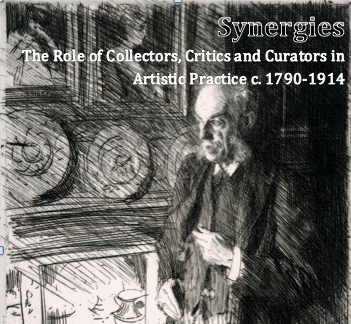 In May 1884 the art critic Marion Harry Spielmann wrote in defence of the often criticised profession of art criticism: ‘The critic – (I am not now referring to the mere notice writer of daily journalism) – spends his life in devotion not only to art but to artists: and, so far as public recognition is concerned, he reaps his reward in sneers and ‘chaff’: sneers from painters, thoughtless and irresponsible, like Mr Whistler; indifference from others less splenetic and querulous’. Spielmann, a prolific author, editor and arts administrator, was an advocate for and close friend of numerous contemporary artists. Along with the collectors and curators whom he frequently worked with and wrote about, he was an active and influential participant in contemporary art practice in late-Victorian London.
Relationships between artists, collectors, critics and curators are often considered in isolation but rarely in tandem. Drawing upon a diverse range of case studies, covering a variety of local and global contexts, this afternoon workshop aims to unpick consistencies, changes and crossovers in the sometimes fraught but often productive relationships between artists, collectors, critics and curators in the long nineteenth century. By bringing together students, early-career researchers and established academics and curators, we hope to provide an informal but stimulating forum for conversation, debate and interdisciplinary exchange about the nineteenth-century art world and its constituents.
Admission is free, but places are limited. Please email collectorscriticscurators2013@gmail.com to register.
Conference | Sensing the Sacred: Religion and the Senses
From The University of York:
Sensing the Sacred: Religion and the Senses, 1300–1800
The University of York, 21-22 June 2013
 Keynote addresses from Chris Woolgar (University of Southampton), Nicky Hallett (University of Sheffield), and Matthew Milner (McGill University)
Religion has always been characterised as much by embodied experience as by abstract theological dispute. From the sounds of the adhān (the Islamic call to prayer), to the smell of incense in the Hindu Pūjā (a ritual offering to the deities), the visual emblem of the cross in the Christian tradition, and the ascetic practices of Theravada Buddhism, sensation is integral to a range of devotional practices. At the same time, the history of many faiths is characterised by an intense suspicion of the senses and the pleasures they offer.
This international, interdisciplinary conference, to be held at the University of York will bring together scholars working on the role played by the senses in the experience and expression of religion and faith in the pre-modern world. The full conference opens on Friday 21st June, but there will be an opportunity to register early on Thursday evening, plus some informal events,
including a Workshop for Postgraduates and a walking tour of
York; see the programme for details.
Conference and Festival | Encounters, Affinities, Legacies
From the conference website:
Encounters, Affinities, Legacies: The Eighteenth Century in the Present Day
The King’s Manor, University of York, 28-29 June 2013
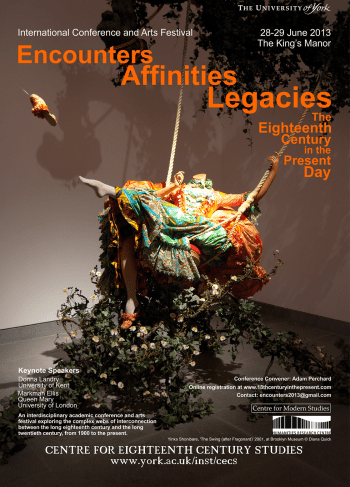 As the field of eighteenth-century studies continues to boom within the academy, the eighteenth century – invoked around names like Rousseau, Voltaire, and Adam Smith – is becoming an increasingly frequent interlocutor in contemporary debates in the international media about society, democracy, human rights, and the economy. Whilst social and political commentators are reading our present in dialogue with our eighteenth-century past, cultural appetites for the eighteenth century on page, stage, and screen continue to grow: powerful suggestions that intertwined discourses like (E)nlightenment and modernity, central to so much eighteenth- and twentieth-century thought, remain vital to the social, political and cultural construction of our contemporary moment.
This interdisciplinary academic conference and arts festival seeks to explore the complex webs of interconnection between the long eighteenth century and the ‘long’ twentieth century, from 1900 to the present.
Over the course of two days, the historic King’s Manor in the centre of York will play host to leading academics, early-career scholars, and postgraduate students from around the world, as well as showcasing the work of exciting young artists, photographers, designers, and performers from across the UK.










leave a comment