Conference | Furniture History Society Research Seminar
Furniture History Society Research Seminar
The Wallace Collection, London, 23 November 2012
The concept of this event is to present current studies of research on furniture history, design, construction, conservation and the history of interiors by MA and PhD students, and museum/heritage curators and professionals at an early stage of career development. The seminar will provide useful insights into current trends of research in the educational and museum world. Each talk will last 15 minutes with questions immediately after.
◊ ◊ ◊ ◊ ◊
10.00 Coffee
10.30 Adriana Turpin (Chairman of the Tom Ingram Memorial Fund Committee), Introduction
10.40 Mia Jackson (PhD student Queen Mary, University of London), André-Charles Boulle as a Collector of Prints and Drawings
11.00 Antonia Brodie (PhD student Queen Mary, University of London), A Room of One’s Own? Unlocking the Closet 1650-1730
11.20 Wolf Burchard (PhD student Courtauld Institute of Art/ Curatorial Assistant The Royal Collection), Charles Le Brun: Unity and Hierarchy in the ‘Visite du Roy aux Gobelins’
11.40 Naomi Luxford (post-doctoral research fellow University College London), Has it Changed? Is it Damaged? A Study of Veneer and Marquetry Surfaces
12.00 Elizabeth Bisley (MA, Assistant Curator Furniture Textiles & Fashion, V&A), Painted Decoration and the Cultures of Imitation: Study of an Eighteenth-Century Tyrolean Cupboard
12.20 Shari Kashani (MA, Christies Furniture Department London), Imitation/Presentation: Some Observations on Médalliers and Coquillers in Eighteenth-Century France
12.45 Lunch
2.00 Barbara Lasic (Assistant Curator, Europe: 1600-1800 gallery project, V&A), Salon Tales: A Set of Mid-Eighteenth-Century Panelling Depicting the Fables of Aesop in the Collections of the Victoria and Albert Museum
2.20 Peter Nelson Lindfield-Ott (PhD student University of St Andrews), Georgian Gothic Furniture: A New Pathway to Interpreting British Gothic Furniture, 1740-1840
2.40 David Oakey (MA, Assistant to the Surveyor of the Queen’s Works of Art), Henry Holland and Furniture
3.00 Diana Davis (PhD student the Wallace Collection& University of Buckingham), Wily Brocanteurs: Retailing Curiosity in the Regency
3.20 Christopher Maxwell (PhD student Glasgow University with the Virtual Hamilton Palace Trust), The Dispersal of the Furniture from the Hamilton Palace Collection
3.40 Myriam Tondeur (PhD student, University of Sorbonne), The Architects and Creators of Furniture in the Belgian Modernism Movement of the 1920s
4.00 Closing Remarks from the Chair, followed by tea and coffee
Any ticket booking queries should be addressed to Clarissa Ward, FHS Grants Secretary, 25 Wardo Avenue, London SW6 6RA, tel. 0207 384 4458, email grantsfhs@gmail.com.
Organised by the Tom Ingram Memorial Fund Committee with generous support of the Oliver Ford Trust.
Conference | National Trust Libraries: Mobility and Exchange
National Trust Libraries: Mobility and Exchange in Great House Collections
Gonville and Caius College, Cambridge, 1 February 2013
Hosted by the University of Cambridge Centre for Material Texts
This one-day event will take as its starting point the recent opening to wider research of a number of significant great house private libraries in the United Kingdom, thanks to the on-going cataloguing work being undertaken by the National Trust. Papers and discussion will treat themes including the migration of books and ideas in and out of libraries; communities of the library (how ‘private’ was a private library?); libraries as repositories of cultural history. Attendance is free, but registration is required. Please contact Dunstan Roberts (dcdr2@cam.ac.uk) or Abigail Brundin (asb17@cam.ac.uk) for more information.
◊ ◊ ◊ ◊ ◊
Some background from the Centre for Material Texts at Cambridge:
National Trust Libraries: Pilot Project at Belton House, Lincolnshire
The National Trust owns and manages over 150 properties in the UK that contain collections of books, the majority still housed in the buildings where they were assembled and read by their original owners. Between forty and fifty of the libraries in National Trust properties have been described as being of ‘major national significance’ (Purcell and Shenton, 2005), constituting an unparalleled resource for the study of the history of private book ownership in the United Kingdom. The process of cataloguing the major libraries is ongoing, and the results are being made available to researchers on the COPAC Catalogue as they become available. This pilot study showcases the research potential of these exciting collections, which form an important part of our national cultural heritage.
The study investigates the place of Italian books in an English great house, Belton House in Lincolnshire. Belton houses the Trust’s second largest library (over 11,000 titles), assembled by successive generations of the Brownlow family, and the collection has now been fully catalogued. 229 works are in Italian, published between 1500 and 1800, across a variety of genres and subjects. Analysis of the Italian holdings will form the basis for two themed workshops. The first, to be hosted by the CMT in Cambridge in the summer of 2012, will explore the curatorship of great house libraries, in discussion with the curators themselves. The second, to be held at Belton early in 2013, will explore the theme of cultural mobility in the early modern library, considering the social, cultural and intellectual histories of continental books in English collections. An exhibition of Italian books will be held at Belton, displaying the connections between book and place for a general audience.
The PI for this project is Abigail Brundin (Department of Italian). The RA is Dunstan Roberts.
Update (15 June 2012): The AHRC has just awarded us a Research Networking Grant in relation to this project… more information to follow.
Conference | Domes: Past, Present, and Future
From the Architecture, Space and Society Network:
Domes: Past, Present and Future
Cinema, Birkbeck School of Arts, London, 29 November 2012
A symposium exploring continuities and ruptures in the use and meanings of the dome across periods and media.
• Peter Draper, Visiting Professor of History of Architecture, Birkbeck
The Early Exploration of Domes: Typology, Symbolism and Decoration
• Caspar Pearson, Lecturer, Department of Art History and Theory, University of Essex
From Renaissance Urbanism to the Urban Renaissance: Domes and the Making of Cultural History
• Barry Curtis, Emeritus Professor of Visual Culture, Middlesex University, and London Consortium
Utopian Domes: Buckminster Fuller and ‘Spaceship Earth’
• Nick Lambert, Lecturer in Digital Art and Culture, Department of History of Art and Screen Media, Birkbeck
From the CAVE to Fulldome: Virtual Space Returns to its Roots
This event is free, but booking is required.
Conference | Art and Its Afterlives
Conference program from The Courtauld:
Fourth Early Modern Symposium: Art and Its Afterlives
The Courtauld Institute of Art, London, 17 November 2012
Organised by Laura Sanders and Francesca Whitlum-Cooper
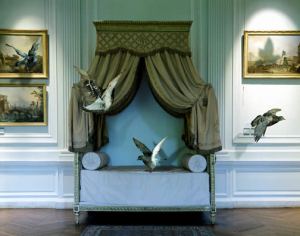
Karen Knorr, The Green Bedroom of Louis XVI. © Eric Franck Fine Art
Art and Its Afterlives aims to address the ways in which the work of art continues to resonate after its creation. While much art history takes as its focus the initial facture of the work of art, this one-day symposium explores what happens to early modern art after the moment of its making. How did early modern works continue to be created in their display, preservation, and reception from the moment of their creation on? Papers will examine how art is shaped by its afterlives – whether these collect, curate, cut up, cut out, copy or correct it – and the ways in which art both persists and changes through time as a material object, a field of generative meaning, and a subject of debate and interpretation.
The question of afterlife is an pertinent topic for art history in general, where the work of art is uniquely tied to a particular assemblage of materials which inevitably change with time, rendering fraught questions of preservation, the presence or possibility of copies, the idea of original state, and how a work of art is staged for a viewer. Less material but no less concrete, the interactions between the work and the viewer, and between the work and the its assumed referent are not stable but open to change. The question of afterlife is particularly relevant for the early modern period, when emergent art markets and cultures of collection allowed not only the circulation of artworks, but also their appropriation and adaptation. Taking as its point of departure Bourdieu’s encouragement to investigate ‘not only the material production of the work but also the production of the value of the work’, this symposium privileges the afterlives of art and the alternative histories they present. Art and Its Afterlives is the fourth symposium of The Courtauld’s Early Modern Department.
Book online or send a cheque made payable to ‘Courtauld Institute of Art’ to: Research Forum Events Co-ordinator, Research Forum, The Courtauld Institute of Art, Somerset House, Strand, London WC2R 0RN, stating the event title: Art and Its Afterlives. For further information, email ResearchForumEvents@courtauld.ac.uk
◊ ◊ ◊ ◊ ◊
P R O G R A M M E
9.00 Registration
9.30 Introduction – Laura Sanders and Francesca Whitlum-Cooper (The Courtauld Institute of Art)
9.40 Session 1: Finding the Original
• Stephanie Knöll (Heinrich-Heine-Universität Düsseldorf): Holbein’s Images of Death and the Construction of Authorship and Authenticity in Nineteenth Century Art Historical Discussions
• Antonia Putzger (Technische Universität, Berlin): What (or Who) Makes an Original? Maximilian I of Bavaria as Collector and Creator of German Renaissance Art
• Gabriella Szalay (Columbia University, New York): Wipe It With a Damp Cloth! Restoring Early Netherlandish Paintings
11.00 Coffee/Tea
11.30 Session 2: Contexts of Reception
• Christina Ferando (Columbia University, New York): From Altarpiece to Masterpiece: Titian’s ‘Long Unnoticed’ Assumption of the Virgin
• Giulia Weston (The Courtauld Institute of Art): Salvator Rosa’s British Afterlives
• Edward Houle (McGill University, Montreal): The Petits Appartements at Versailles and the Vicissitudes of Heritage
• Owen Hopkins (Royal Academy of Arts): Hawksmoor in the Twentieth Century
13.10 Lunch
14.10 Session 3: Appropriation and Re-making
• Jason Nguyen (Harvard University, Boston): Translation, Illustration, and Transmutation: Authorship and Authority in Claude Perrault’s Les dix livres d’architecture de Vitruve (1673)
• Amy Concannon (Tate Britain, London): Cut, Paste, and Copy: Hubert Robert, François Boucher and the Culture of Appropriation Amongst French Artists in the Eighteenth Century
• Heike Zech (Victoria and Albert Museum, London): From Sacred to Profane? The Afterlife of a Seventeenth Century Augsburg Masterpiece
• Sian Bowen (Northumbria University, Newcastle): Capturing the Ephemeral: Materiality and Transience Through Drawing Practice
15.50 Coffee/Tea
16.20 Session 4: Display and Preservation
• Anna Bortolozzi (National Museum, Stockholm): Notes from the Underground: The Afterlife of Old St. Peter’s in the Vatican Grottos and Other Stories
• Noémie Etienne (Barnard College, New York): From the Wall to the Museum: Material and Symbolic Transformations of Paintings in Paris in the Eighteenth Century
• Ronit Milano (Ben-Gurion University, Israel): On Trojan Dogs and Long-Lasting Artistic Quarrels: The Case of Jeff Koons in Versailles
17.45 Reception
Conference | Global Commodities Conference
The early registration deadline has been extended until Monday, 5 November. From Warwick:
◊ ◊ ◊ ◊ ◊
Global Commodities: The Material Culture of Early Modern Connections, 1400-1800
Global History and Culture Centre, University of Warwick, 12-14 December 2012

Tilly Kettle (1734-1786), “Portrait of Two English Boys in Asian Clothing,” 1780s (Peabody Essex Museum)
Material culture created and was created by connections with ‘others’ in the era before the global exchange of people, political ideas and economic processes intensified through industrialization. The exchange of goods and the culture of commodities played central roles in forging enduring and transformative global connections.
This conference seeks to explore how our understanding of early modern global connections changes if we consider the role material culture played in shaping such connections. In what ways did material objects participate in the development of the multiple processes often referred to as ‘globalisation’? How did objects contribute to the construction of such notions as hybridism and cosmopolitanism? What was their role in trade and migration, gifts and diplomacy, encounters and conflict? What kind of geographies did they create in the early modern world? What was their cultural value vis-à-vis their economic value? In short, we seek to explore the ways in which commodities and connections intersected in the early modern world.
This conference wishes to bring together scholars with expertise across a range of disciplines and geographic areas that came into direct contact in the early modern period, by which we mean the world between ca. 1400 and 1800. Of course many areas of the humanities and social sciences have expanded their enquiries in disciplinary and spatial terms, but truly global and interdisciplinary approaches still have to rely heavily on dialogue and collaboration between scholars. We hope that this conference will present an opportunity to bring together scholars from very different geographical and disciplinary backgrounds, who all share an interest in exploring commodities in global contexts.
◊ ◊ ◊ ◊ ◊
W E D N E S D A Y , 1 2 D E C E M B E R 2 0 1 2
13.00 Registration
14.00 Welcome by Anne Gerritsen and Giorgio Riello (University of Warwick)
14.15 Plenary Lecture 1
Dana Leibsohn (Smith College), “Trans-Atlantic, Trans-Pacific: Oceanic Exchange and the Visual Cultures of Colonial Latin America.”
15.15 Coffee Break
15.45 Session 1 | Mixed Media
Chair: Glenn Adamson (V&A Museum)
• Christine Guth (Royal College of Art / V&A Museum), “Towards a Global History of Shagreen”
• Tim Stanley (V&A Museum), “Gloss Goes Global”
• Anna Wu (V&A Museum), “Chinese Painted Wallpaper: The Life-cycle of a Global Aesthetic”
15.45 Session 2 | Consuming Conflicts and Resistance in Iberian Empires
Chair: Bartolomé Yun-Casalilla (European University Institute, Italy and Universidad Pablo de Olavide, Spain)
• Bethany Aram (Universidad Pablo de Olavide), “The Fortunes of Caribbean Hides and Ginger, c. 1559-1650”
• Igor Pérez Tostado (Universidad Pablo de Olavide), “Attraction and Resistance: The Borderline Effects of New Atlantic Products on the Island of Hispaniola”
• Rebecca Earle (University of Warwick), “Indigenous Reactions to Old-world Foods from Rejection to Adoption”
17.30 Reception
T H U R S D A Y , 1 3 D E C E M B E R 2 0 1 2
9.00 Session 3 | Migration and Material Culture: Confronting East India Company Service
Chair: David Garrioch (Monash University, Australia)
• Helen Clifford (University of Warwick and University College London), “Objects, Movement and Concepts of Home in Eighteenth-Century England”
• Kate Smith (University College London), “Arranging Home and Understanding India in East India Company Households”
• Stephanie Barczewski (Clemson University), “Commodities, Collecting and Cosmopolitanism: Three Discourses of Empire in British Country Houses, 1750-1800”
• Ellen Filor (University College London), “Books as Global Objects: Reading Communities in India and Scotland”
9:00 Session 4 | Gifts, Luxuries and the Diplomacy of Material Exchange
Chair: Marta Ajmar (V&A Museum)
• Antonia Gatward Cevizli (Sotheby’s Institute of Art), “Portraits, Turbans and Cuirasses: Material Exchange between Mantua and the Ottomans in the 1490s”
• Corinne Thepaut-Cabasset (V&A Museum), “En Route: The Travels of Royal Gifts and Luxury Goods in the Seventeenth and Eighteenth Centuries”
• Claudia Swan (Northwestern University), “Birds of Paradise for the Sultan: The Exchange of Rarities in the Early Modern World”
• Michael Talbot (School of Oriental and African Studies, London), “The Culture of Diplomatic Gift-Exchange in Eighteenth-Century British-Ottoman Relations”
• Nuno Senos (CHAM, Universidade Nova de Lisboa), “The Empire in the Duke’s Palace. Portugal, c. 1563”
11.00 Coffee Break
11.30 Plenary Lecture 2
Michael North (University of Greifswald), “European and Chinese Art Objects in the Indian Ocean: Cross Cultural Connections”
12.30 Lunch
14.00 Session 5 | Immaterial Commodities: Exchanging Knowledge in English Networks Overseas, 1590-1650
• Edmond Smith (Magdalene College, University of Cambridge), “A Global Exchange: Trading Experience in the East India Company”
• John Gallagher (Emmanuel College, University of Cambridge), “Languages of Exchange: The Role of Communication in Establishing International Trade”
• Richard Blakemore (Selwyn College, University of Cambridge), “Ships and Seafaring: Understanding the Infrastructure of Maritime Trade”
14:00 Session 6 | Precious Commodities: Jade, Diamonds and Coral
• Yulian Wu (Stanford University), “Seeking Black Jade from China’s New Territory: Technology, Musical Instrument, and the Construction of Qing Empire in Eighteenth-Century China”
• Karin Hofmeester (International Institute of Social History, Amsterdam), “Diamonds and Global Connections in the Early Modern Period”
• Pippa Lacey (University of East Anglia), “The Coral Network: The Trade of Red Coral to the Qing Imperial Court in the Eighteenth Century”
15.30 Coffee Break
16.00 Session 7 | Bad Habits: Tobacco, Coffee and Sugar
Chair: Ghulam Nadri (Georgia State University and LSE)
• Matt Romaniello (University of Hawai‘i at Mānoa), “Influencing Habits of Consumption: Tobacco in the Russian Empire”
• Louise Carson (University of Nottingham), “Outlandish Confections’: Exoticism, Sugar and Power at the Court of Henry VIII”
• Christine Fertig and Ulrich Pfister (Universität Münster), “Coffee, Mind and Body: Stories of Globalization and Consumption: Hamburg in the Eighteenth Century”
• Urmi Engineer (Colby College, Waterville, ME), “Sugar Revisited: Sweetness and the Environment in the Early Modern World”
16.00 Session 8 | Rarities World Wide: Early Modern Objects between the Global and the Local
• Mariana Françozo (Leiden University), “The Case of Brazilian featherwork in Northern European Court Festivals”
• Anna Grasskamp (Leiden University), “Foreign Objects as In-Betweens: The Case of Coral in Ming Dynasty China and Renaissance Europe”
• Ching-fei Shih (National Taiwan University), “The African Ivory in the Qing Court and Canton”
• Ulrike Körber (University of Evora, Portugal), “A Special Production for the Portuguese, Involving Different Manufacturing Centres, and Even Asian Lacquer Coatings”
F R I D A Y , 1 4 D E C E M B E R 2 0 1 2
9.00 Session 9 | Material Encounters between Local and Global
Chair: Luca Molà (European University Institute, Italy)
• Paula Bessa (University of Minho, CITCEM/Portugal), “Eastern Algarve Parish Churches and the Empire”
• Kévin Le Doudic (University of South-Brittany / European University of Brittany), “Encounter Around the Object: French and Indian Consumers in the Eighteenth-Century Pondicherry”
• Nadia Fernandez-de-Pinedo (Universidad Autónoma de Madrid), “Dress, Eat and Show Off in the City: Consumption in Madrid, c. 1750”
9.00 Session 10 | Material and Artistic Exchange
Chair: Adam Clulow (Monash University, Australia)
• Natasha Eaton (University College London), “Art, Colour and the Mana of the Commodity in Britain and India”
• Christina Hellmich (de Young Museum, San Francisco), “ ‘… a Royal Robe…’ and its Journey from the Hands of a Unangan Seamstress to a Hawaiian King and a New England Sea Captain in the early Nineteenth Century
• Sabitha Thekke Prakkottuthody (University College London), “Globalizing the Souvenir: The Album as Commodity in Colonial India”
10.30 Coffee Break
11.00 Session 11 | Objects and Colonial Encounters in the Early Modern World
Chair: Christina Anderson (Oxford University)
• Susan Broomhall (University of Western Australia), “Beads, Mirrors and Tobacco Boxes for Giants, Gold and Water: The Dutch East India Company’s Aspirational Encounters with Indigenous Peoples in Australia”
• Jacqueline Van Gent (The University of Western Australia), “Cultural Geographies, Elite Consumption and the Swedish East India Company”
• Mårten Snickare (Stockholm University), “Displaying the Others: Non-European Objects at Skokloster Castle”
11.00 Session 12 | Tradesman’s Objects: Goods, Sailors and Traders
Chair: Karina Corrigan (Peabody Essex Museum)
• Eugénie Margoline-Plot (University of South-Britanny / European University of Brittany), “Appropriating a Part of Asia in Brittany: The Sailor of the French East India Company, a Middleman between Bretons and Asian Commodities in the Eighteenth Century”
• Caroline Mawer (Independent Scholar, London), “An Armenian Merchant and the Vasa Tapestries”
• Marieke Hendriksen (Leiden University), “Treasure Troves: Eighteenth-Century Ship’s Surgeons’ Medicine Chests”
12.15 Lunch
13.15 Session 13 | Global Objects from Enlightenment to Revolutions
• Ashli White (University of Miami), “The Material Culture of Counterrevolution in the Late Eighteenth-Century Atlantic”
• Kee Il Choi Jr (New York), “Father Amiot’s Cup, Henri-Léonard Bertin and Fashioning ‘Antiquity’ at Sèvres”
• Richard Flamein and Philippe Romanski (Université de Rouen), “‘Voltaire en son meuble’: Material Economics in the Age of Enlightenment”
13.15 Session 14 | Textiles, Trade and the Material Culture of Appearances
Chair: Evelyn Welch (Queen Mary College)
• Colette Establet (IREMAM, Aix en Provence), “Indian textile consumption in the Ottoman Empire at the End of the Seventeenth Century ”
• Suraiya Faroqhi (Bilgi University, Istanbul), “All over the Ottoman Central Provinces: The Acem Tüccarı in the Early Eighteenth Century”
• Kirsten Toftegaard (Designmuseum, Copenhagen), “Lost in Translation – A Chinese Interpretation of a European Motif”
14.45 Coffee Break
15.15 Plenary Lecture 3
Pamela Smith (Columbia University), “Itineraries of Matter and Knowledge in the Early Modern World”
16.15 Final Discussion
Chairs: Anne Gerritsen and Giorgio Riello
◊ ◊ ◊ ◊ ◊
If you have any further questions, please contact: Anne Gerritsen and Giorgio Riello at: ghcc.conferences@warwick.ac.uk
Organising Bodies and Sponsors
The Arts and Humanities Research Council
The AHRC ‘Global Commodities’ International Network
The Warwick Global History and Culture Centre
The ERC ‘Europe’s Asian Centuries’ Project
Adam Matthews Publishing
The Economic History Society
The University of Warwick
The Victoria & Albert Museum
Bilgi University, Istanbul
Peabody Essex Museum
Conference | The Interior at European Courts
From the conference program (PDF). Also see the website: interior-unibe.ch.
Im Spiegel der Dinge – Objektkultur und Interieur an den Höfen Europas
Institut für Kunstgeschichte Universität Bern, 16 November 2012
Leitung: Birgitt Borkopp-Restle
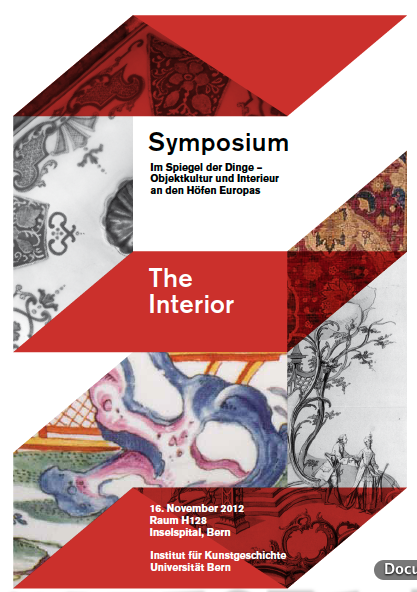 Höfische Feste und Zeremonien der Frühen Neuzeit ereigneten sich in Räumen, die oft eigens für den gegebenen Anlass eingerichtet wurden. Die Konfiguration solcher Interieurs unterlag zumeist den Regeln des geltenden Zeremoniells; immer musste sie dem Repräsentationsanspruch eines fürstlichen Hauses, gelegentlich auch politischen Interessen oder Absichten Rechnung tragen. Das Symposium untersucht die Objekte, die als Konstituenten höfischer Interieurs zugleich komplexe Botschaften vermittelten – als Bildmedien konnten sie Geschichte vergegenwärtigen, durch ihre Materialität Rang und Reichtum sichtbar machen; sie konnten Tradition oder Innovation betonen und schliesslich auch dem Interesse an fernen Ländern Ausdruck geben.
◊ ◊ ◊ ◊ ◊
8:30 Willkommen (Kaffee)
9:00 Begrüssung: Christine Göttler (Universität Bern) / Einführung: Birgitt Borkopp-Restle, Universität Bern
Teil I
Moderation: Birgitt Borkopp-Restle
9:30 Michael Yonan (University of Missouri, Columbia/MO)
Keynote: Asian Objects and Interiors at the Habsburg Imperial Court under Empress Maria Theresia
10:30 Kaffeepause
11:00 Birgit Franke – Barbara Welzel (Technische Universität Dortmund)
Ereignis-Interieurs am Hof der Herzöge von Burgund
12:00 Hanns Hubach (Universität Zürich)
Empörende Bildteppiche – oder: Von der Kunst provokativer Diplomatie
13:00 Mittagspause
Teil II
Moderation: Christine Göttler
14:00 Ariane Koller (Universität Bern)
Objektwelten – Kartographie der Machtentfaltung am Hof des Kurfürsten Johann Georg I. von Sachsen
15:00 Alumni et Amici laden zum Afternoon Tea
15:45 Daniela Antonin (Hetjens-Museum Düsseldorf)
Zeremoniell und Porzellanbesitz am kurbayerischen Hof im 18. Jahrhundert
16:45 Birgitt Borkopp-Restle (Universität Bern)
Carpettes of sylke to ley upon the table – Oriental Carpets in European Court Ceremonies
17:45 Abschlussdiskussion
Conference | The Cultural History of Cartography
From the conference website:
The Cultural History of Cartography
University of Michigan, Ann Arbor, 25-26 October 2012
This two-day interdisciplinary symposium on the cultural history of cartography intends to facilitate discussion among scholars of history, art history, literary criticism, area studies, and architecture and urban planning. To develop comparative modes of inquiry, each panel will address specific concerns across geographical spaces and temporal periods. Topics include the relations of mapmaking, map reception, and map use to perception, fantasy, temporality, indigeneity, travel, migration, the slave trade, colonialism, citizenship, costume books, and poetry and drama. The symposium is free and open to the public.
◊ ◊ ◊ ◊ ◊
T H U R S D A Y , 2 5 O C T O B E R
Palmer Commons, Forum Hall
9:00 Welcome
Valerie Traub, Karl Longstreth, Brian Dunnigan, and Kevin Graffagnino
9:15 Travel, Commerce, Tourism
Chair: Scotti Parrish
• Jordana Dym: “‘A Prick’d Line’: Route Maps and Travel Accounts, 1600-1930”
• Laura Williamson Ambrose: “Moved to Travel: Dislocation and Domestic Mobility in Anna Trapnel’s Report and Plea”
• Jyotsna Singh:“Cartographies of the Guinea Coast and the Early Modern Slave Trade”
• James Akerman: “Rivers, Roads, and Rails: Travelers and Maps in the Early United States”
11:15 Break
11:30 Technologies
Chair: Mary Pedley
• Stephanie Leitch: “Us and Them: Vespucci’s Triangle and the Geometry of Difference”
• Lydia Soo: “Early Modern Maps of London”
12:30 Lunch
1:30 The History of Cartography Project
Chair: Karl Longstreth
• Mary Pedley
• Matthew Edney
2:00 Difference, Similarity, Classification
Chair: Ellen Poteet
• Marjorie Rubright: “The Il-logic of Location: Getting Lost in Early Modern Atlases”
• Susan Schulten: “Mapping the Population in the Aftermath of the American Civil War”
• Martha Jones: “Race, Space, and Citizenship in Antebellum Detroit: Rethinking the Power of Maps”
3:30 Break
3:45 Ornamentation
Chair: Betsy Sears
• Kathryn Will: “Mapping the Heraldic Field”
• Ann Rosalind Jones: “Allegories of the Continents in Sixteenth-Century Costume Books”
F R I D A Y , 2 6 O C T O B E R
University of Michigan Museum of Art, Helmut Stern Auditorium
10:00 Welcome
Valerie Traub and Karl Longstreth
10:15 Maps, Theater, and the Literary
Chair: Valerie Traub
• Gavin Hollis: “‘Bed Work, Mappery, Closet War’: Shakespearean Anti-Cartography”
• Julia Carlson: “Poetry, Print Culture, and the Making of the ‘Lake-District’”
• Jonathan Zwicker: “Stage and Spectacle in an Age of Maps: Kabuki and the Cartographic Imagination in Nineteenth-Century Japan”
11:45 Relocate to 1014 Tisch Hall for panel and lunch
12:00 Mapping the Americas
Chair: Michael Witgen
• Neil Safier: “Fugitive Landscapes in Deep Time: Mapping Indigenous Migrations in Amazonia”
• Jon Parmenter: “The Spatial Reconnaissance of Iroquoia, 1600-1775: Who Knew What, and When Did they Know It?”
• Martin Brückner: “Cartography and the Gigantic: Wall Maps, Aesthetics, and Technology in Nineteenth-Century America”
2:00 Relocate to Art Museum
2:30 Perception, Fantasy, Time
Chair: Celeste Brusati
• Gottfried Hagen: “Time and Narrative in Ottoman Maps”
• Bronwen Wilson: “Insular Navigations”
• Tom Conley: “The Baroque Hydrographer”
• Anne Herrmann: “‘Naive Geography’: Aleksandra Mir’s ‘Switzerland and Other Islands’”
Conference | Guglielmo Du Tillot and the Enlightenment
From the University of Parma:
Tillot e i Ministri delle Arti nell’Europa dei Lumi
Parma e Colorno, 25-27 October 2012
Convegno organizzato da Gianfranco Fiaccadori, Alessandro Malinverni, e Carlo Mambriani
A due anni di distanza dalle celebrazioni in onore della duchessa di Parma Luisa Elisabetta di Borbone, la Fondazione Cariparma, in collaborazione con il Dipartimento di Ingegneria Civile, Ambiente, territorio e Architettura dell’Università di Parma, prosegue l’approfondimento della storia dei ducati parmensi nel Settecento, attraverso un doppio appuntamento dedicato al ministro riformatore Guglielmo Du Tillot e al suo ruolo nello sviluppo delle arti a Parma negli anni Sessanta.
L’evento, che prepara e apre la mostra, è il convegno internazionale di studi Guglielmo Du Tillot e i ministri delle arti nell’Europa dei Lumi, articolato su tre giorni: 25 ottobre (Biblioteca Palatina), 26 ottobre (Reggia di Colorno) e 27 ottobre (Università, Aula dei Filosofi). Il convegno offrirà una panoramica esaustiva del secondo decennio di dominazione borbonica a Parma e un raffronto tra i principali ministri delle arti in Europa. Di storia, letteratura, pittura, musica, architettura e urbanistica, arti decorative e costume tratteranno una trentina di studiosi, afferenti a centri di ricerche e atenei italiani ed esteri.
◊ ◊ ◊ ◊ ◊
Giovedì, 25 Ottobre 2012 – Parma, Biblioteca Palatina
PARMA 1759-1771: L’«ATENE D’ITALIA»
9.00 Accoglienza e registrazione dei Relatori
Saluti delle Autorità, CARLO MAMBRIANI (Università degli Studi di Parma), Introduzione
9:30 Presiede Sabina Magrini, Direttrice della Biblioteca Palatina
• GIUSEPPE GALASSO (Accademia Nazionale dei Lincei), L’Italia degli anni Sessanta
• MARCELLO VERGA (Università degli Studi di Firenze), Modelli di governo e politiche riformatrici negli stati italiani (gli anni Sessanta del XVIII secolo)
• MARC FUMAROLI (Académie Française, Collège de France), La Parma illuminista e neoclassica nelle geopolitica di Choiseul
14.45 Presiede Giuseppe Galasso, Accademia Nazionale dei Lincei
• CLAUDIO MADDALENA (Università degli Studi di Padova), Le riforme amministrative ed ecclesiastiche: forza e debolezza del governo Du Tillot
• GIOVANNI FRACASSO (Università degli Studi di Bologna), La politica economica di Du Tillot: riforme e sostegno alla manifattura
• MERCEDES SIMAL LÓPEZ (Istituto Universitario La Corte en Europa, Madrid), Le nozze di Luisa Maria di Parma con il principe delle Asturie: un’altra parmigiana alla corte di Spagna
• GIORGIO FEDERICO SIBONI (Università degli Studi di Milano), Giochi di potere. Du Tillot e il matrimonio di don Ferdinando con Maria Amalia
• GIUSEPPE BERTINI (Parma), La cultura francese a Parma dopo la caduta di Du Tillot
Venerdì, 26 Ottobre 2012 – Colorno, Reggia, Sala Grande
DU TILLOT REGISTA DELLE ARTI
9.15 Saluti delle Autorità
9.30 Presiede Maria Letizia Sebastiani, Direttrice della Biblioteca Nazionale Centrale di Firenze
• CARLO MAMBRIANI (Università degli Studi di Parma), Le strategie architettoniche e urbane di Du Tillot
• ALESSANDRO MALINVERNI (Università degli Studi di Milano), Du Tillot e la pittura a Parma 1759-1771
• GUILHEM SCHERF (Musée du Louvre), La scultura a Parma tra 1749 e 1771
• FRANCESCA FEDI (Università degli Studi di Parma), Il teatro e le lettere a Parma
• CLAUDIO TOSCANI (Università degli Studi di Milano), La musica nei ducati
• CHIARA TRAVISONNI (Università degli Studi di Parma), Du Tillot, Valdrè e Palmieri: un collezionista e i suoi pittori tra Parma e Parigi
15.00 Presiede Maria Utili, Soprintendente per i Beni Storici, Artistici ed Etnoantropologici di Parma e Piacenza
• ENRICO COLLE (Firenze), Du Tillot e la promozione delle arti decorative a Parma
• CRISTINA CAMPANELLA (Milano), La Real Fabbrica della Maiolica e Vetri e la ceramica nel Settecento a Parma
• ANDREINA GALLEANI D’AGLIANO (Roma), Ordinativi di porcellana per i duchi di Parma (1755-1770): un confronto con le principali corti europee
• FRANÇOISE TETART VITTU (Musée Galliera, Paris), La mode à Parme entre 1749 et 1771
Sabato, 27 Ottobre 2012 – Parma, Università, Aula dei Filosofi
I MINISTRI DELLE ARTI NELL’EUROPA DEI LUMI
9.00 Saluti delle Autorità
9.15 Presiede Carlo Mambriani, Università degli Studi di Parma
• CHRISTOPHE HENRY (Groupe Histoire Architecture Mentalités Urbaines, Paris), Une renaissance manufacturière des arts : la contribution de Philibert Orry et de Guillaume du Tillot à la théorie économique des Lumières (1730-1774)
• ALESSANDRO MALINVERNI (Università degli Studi di Milano), Tournehem e la Direction des Bâtiments du Roi (1745-1751)
• MARIE-LAURE DE ROCHEBRUNE (Château de Versailles), Le duc de Choiseul et les arts
• XAVIER SALMON (Château de Fontainebleau), Madame de Pompadour et les arts
• CHRISTOPHE MORIN (Université de Tours), Marigny entre cour et jardin: le goût d’un ministre des arts à la ville et aux champs
• JOSÉ Luis SANCHO (Patrimonio Nacional, Madrid), I “ministri delle arti” in Spagna da Filippo V a Carlo III
14.45 Presiede Bruno Adorni, Decano del DICATeA, Unversità di Parma
• IMMA ASCIONE (Archivio di Stato di Napoli) e GINA ASCIONE (Palazzo Reale di Napoli, Appartamento storico), Le arti a Napoli durante la Reggenza (1759-1767) nelle lettere di Bernardo Tanucci e Domenico Cattaneo
• PAOLO CORNAGLIA (Politecnico di Torino), Intendenti Generali delle Fabbriche e Governatori dei Reali Palazzi alla corte di Torino: 1737-1783
• LAURA FACCHIN (Università degli Studi di Verona), Carlo Gottardo Firmian ministro plenipotenziario della Lombardia Asburgica: politiche artistiche tra Milano e Vienna
• ORONZO BRUNETTI (Università degli Studi di Parma), Il potere e le arti in Toscana
• CRISTINA RUGGERO (Bibliotheca Hertziana, Roma), Il conte Heinrich von Brühl, primo ministro del principe elettore di Sassonia
• GIANFRANCO FIACCADORI (Università degli Studi di Milano), Chiusura del convegno
18.00 Inaugurazione della Mostra Guglielmo Du Tillot Regista delle Arti nell’Età dei Lumi
Conference | New Perspectives on the Romantic Period
From the conference website:
New Perspectives on the Romantic Period
Tate Britain, London, 6 -7 November 2012
Registration deadline: 26 October 2012
A student-led conference in association with the Tate Research Centre: British Romantic Art
The Tate Research Centre: British Romantic Art aims to promote research on British art from around 1770 to 1850. Tate’s collection of watercolours and drawings, and major holdings of the work of William Blake and John Constable is among the greatest in the world. With a special focus on Blake, Constable and Turner, the Centre offers a programme of events and activities aimed at encouraging research on these artists and on the Romantic era as a whole, as well as the legacy of Romantic art and culture in Britain and around the world.
This two-day conference, organised by PhD students in collaboration with Tate, will feature papers by British and international post-graduates working on the Romantic period with contributions focusing on British art and visual culture of the period c.1770–1850. Papers will offer new perspectives on the iconic artists of the Romantic period: Turner, Constable, Blake, David Wilkie, Edwin Landseer, John Sell Cotman, John Martin, James Barry and Benjamin Robert Haydon, all of whom are represented in the Tate collection. Themes under discussion in the conference will include the material concerns of artists, examining the use of different media artists’ multidisciplinary interests and approaches, and their self-representation and identity, as well as landscape and travel, political and religious themes, and cross-period connections.
The conference will make use of Tate Britain’s resources, with the chance to get up close to works in the collection and see items that are rarely shown in public. Attendance to the conference is free and open to current students. Places are limited, so please book early to secure a place: newperspectives@tate.org.uk
Join the Twitter conversation at: #britishromanticart
◊ ◊ ◊ ◊ ◊
P R O G R A M M E
6 November 2012, 11.30-18.00
Session 1: Travel and Romantic journey
• Sarah Moulden, Cotman in Yorkshire: Patronage, Pencil, Resistance
• Aneta Lipska, Word-painting and 19th-century aesthetic discourses in Marguerite Blessington’s Journals
Session 2: Turner’s multidisciplinary practice
• Marion Martin, Mingling voices: Turner’s early exhibited works
• Christine Lai, ‘Perpetual Revolution’: J. M. W. Turner & Romantic Architecture
Session 3: Prints
• Hayley Flynn (née Morris), Landscape in Blake: the Job Illustrations
• Esther Chadwick, Experiments in Liberty: Barry’s Phoenix and late-18th-century artists’ prints in Britain
Session 4: Iconography of space and place
• Vivien Estelle Williams, The bagpipe as a national identifier: English v. Scottish Romantic portrayals
• Jordan Mearns, Romancing the Past: Mary, Queen of Scots and Sentimental Historiography in Late Eighteenth-Century British History Painting
• María Egea García, Artists’ Studios in English Painting: 1770-1850
7 November 2012, 10.00-16.00
Session 5: Material matters
• Sarah Gould, The Paradigm of texture in the works of Constable and Turner: redefining matter
• Alice Coombs, Glass and Paper: Manufacturing Experience in John Martin’s The Last Judgement, The Great Day of His Wrath and The Plains of Heaven
• Gabriella Szalay, Material Matters: Jan van Eyck in the Age of Romanticism
Session 6: The body
• Thomas Ardill, Healing Miracles in British Art, c.1812-1823
• Cora Gilroy-Ware, Turner’s Reclining Venus, 1828
Session 7: Romantic legacy
• Lee Hallman, Frank Auerbach, Leon Kossoff and the Legacy of British Romanticism
• Shannon Rollins, Anachronism as Aesthetic: Steampunk and J.M.W. Turner
• Laura Kuch, The Seed of Romanticism: In Search of the Blue Flower: Exploring the relevance of the German Romantics’ ideas in artistic creation today – An artist’s (re)search
Conference | Attingham Looks to the Future of the Country House
Looking Ahead: The Future of the Country House
The Attingham Trust 60th Anniversary Conference
The Royal Geographical Society, London, 12-13 October 2012

◊ ◊ ◊ ◊ ◊
The Attingham Trust celebrates its sixtieth anniversary with a conference considering the current state of historic houses and house museums across three continents, in the United Kingdom, the Republic of Ireland, the United States and Australia. With the generous support of the Paul Mellon Centre for Studies in British Art speakers from each of those countries discuss successful current developments as well as the varying problems that each country faces – including the rapid decline of the traditional house museum in the USA, the attempts to preserve houses in the Republic of Ireland, and the developing role of the historic house in Australian conservation. The British country house is studied from the point of view of private and public owners including impressive case studies and depressing cuts in funding, and illuminated from an academic, curatorial and dramatic perspective, from Nikolaus Pevsner to Downton Abbey.
This conference is open to all (alumni and non-‐alumni) and promises to be a very stimulating event and we hope to see as many of you there as possible. The cost of the conference is £55 per day, to include all refreshments. The programme, a booking form and our Paypal link (if you wish to pay this way) can be found on the Conference page of our website. Alternative payment methods are detailed on the booking form. NB: Every booking and payment must be accompanied by a fully-‐ completed and returned booking form.
There will be a special rate of £30 per day for students (under-‐graduate and post-‐graduate) studying History of Art, Architecture, Heritage Studies or a related subject. Places are limited. Please apply stating your place of study and subject.
There will be an alumni event on the Friday evening at the House of Lords. A ticket for this event is included with attendance on at least one day of the conference. If you are an alumnus and unable to come to the conference but want to come to the evening event, you are extremely welcome but please note that you will need to purchase a ticket for £55. Places at this event are limited so please apply for a ticket from Rebecca Parker sooner rather than later. For all further enquiries please contact Rebecca Parker at rebecca.parker@attinghamtrust.org or +44 20 7253 9057.
◊ ◊ ◊ ◊ ◊
F R I D A Y , 1 2 O C T O B E R 2 0 1 2
9.00 Registration and coffee
9.45 Welcome
John Lewis, Chairman, The Attingham Trust and Annabel Westman, Director, The Attingham Trust
10.00 Confessions of a Country House Snooper: Tim Knox interviews John Harris
Tim Knox, Director, The Sir John Soane’s Museum John Harris, Architectural Historian
Session – Changing Perceptions of the Country House in Britain
Chair: Martin Postle, Assistant Director, Paul Mellon Centre for Studies in British Art
10.50 Studying the Country House: Views from the Academy
Giles Waterfield, The Attingham Trust
11.25 The Country House in The Buildings of England, 1951-‐2011
Charles O’Brien, Series Editor, Pevsner Architectural Guides
12.00 Country House Collections: What Do They Mean Today?
Christopher Ridgway, Curator, Castle Howard
12.45 LUNCH
Session – New Visions for Old Houses: The Private Perspective
Chair: Edward Harley, President of the Historic Houses Association
14.00 Introduction
Edward Harley, President of the Historic Houses Association
14.15 The Buccleuch Estates
The Duke of Buccleuch and Queensberry, KBE DL
14.50 Burghley House in the Twenty-‐First Century
Miranda Rock, Burghley House
15.45 Perspectives on the Historic House
Julian Fellowes, Writer and broadcaster
17.00 Close
Alumni Drinks at the House of Lords
S A T U R D A Y , 1 3 O C T O B E R 2 0 1 2
9.00 Registration and coffee
Session – Houses in Trust: The Country House in Public/Charitable Ownership
Chair: Giles Waterfield, The Attingham Trust
9.30 The Crisis of the Country House in Local Government Care
Jeremy Musson, Architectural Historian
10.05 The National Trust and Its Country Houses
Lisa White, Chairman of the National Trust Arts Panel
10.40 Presenting the Historic House
Anna Keay, Director, The Landmark Trust
Session – The Irish Country House
Chair: John Redmill, Irish Georgian Society
11.45 “Tombstones of a departed ascendancy”: The Irish Country House since Independence
Terence Dooley, Director of CSHIHE, National University of Ireland, Maynooth
12.20 The Work of the Irish Heritage Trust
Kevin Baird, Director, Irish Heritage Trust
13.00 LUNCH
Session – Time to Rethink? The House Museum in the United States
Chair: Peter Trippi, Editor, Fine Art Connoisseur
14.15 Falling Down: The Current State of the Historic House in America
Sean Sawyer, Executive Director, The Royal Oak Foundation
14.40 Newport: A Case Study in Preserving Great Houses, Great Landscapes and a Great City
John Tschirch, Director of Museum Affairs, Newport Preservation Society
15.15 The American House Museum in Historical Perspective
Craig Hanson, Associate Professor, Calvin College, Michigan
Session – The Australian Country House: Past and Future
Chair: His Excellency Mr John Dauth, High Commissioner for Australia
16.00 The Country House in Australia: Setting the Scene
Gini Lee, Professor, University of Melbourne
16.30 The Country House in Contemporary Australia
Mark Taylor, Professor, University of Newcastle, Australia










leave a comment