Conference | The Trade in Luxury & Luxury in Trade
From the conference programme:
Le Commerce du Luxe – Le Luxe du Commerce: Production, Exposition et Circulation
Musée Gadagne, Lyon, 21-23 November 2012
Le colloque international pluridisciplinaire Le commerce du luxe – Le luxe du commerce, organisé par le LARHRA (UMR 5190 Laboratoire de Recherche Historique Rhône-Alpes), se tiendra aux musées Gadagne, 1 place du petit Collège, à Lyon, les mercredi 21, jeudi 22 et vendredi 23 novembre 2012. Tant par le sujet, la date que le lieu choisis, le colloque prendra place, à part entière, dans les manifestations de l’Automne de la soie 2012. Nous voulons exprimer ainsi, de manière visible, l’engagement des historiens de l’Université de Lyon dans la valorisation de l’héritage des industries de la soie, industrie de luxe s’il en est, une des richesses emblématiques de la métropole rhodanienne.
Ces industries ont en effet fortement participé à la structuration de l’espace régional par les flux de capitaux, de matières et d’hommes qu’elles ont générés autour de la métropole lyonnaise dans une vaste zone couvrant totalement ou partiellement les départements de l’actuelle région Rhône-Alpes et même au-delà. Elles ont contribué à l’adaptation progressive des populations aux exigences de l’industrie, à l’accumulation de savoir-faire et au développement de l’esprit d’entreprise. Enfin, le commerce des soieries et celui des soies, dont les horizons ont très tôt dépassé les limites nationales, ont été des facteurs majeurs de l’ouverture de Lyon et de la région Rhône-Alpes aux horizons internationaux.
ARGUMENTAIRE
Comment se produisent, s’exposent, se diffusent et se consomment les produits du luxe ? Le but du colloque est de revenir sur la question de la spécialisation progressive d’un commerce voué aux objets précieux qui concourent à l’embellissement de la personne ou du cadre de vie. Il entend être une manifestation largement ouverte d’un point de vue chronologique, spatial et disciplinaire, faisant appel à des spécialistes d’horizons différents.
Cette approche interdisciplinaire du marché du luxe sur la longue durée, de la fin du Moyen Age à nos jours, permettra de confronter les expériences et de mettre en relief les permanences et les mutations. Le luxe a souvent été cantonné aux productions des beaux-arts ; il s’agira ici de montrer la richesse et la diversité de ce qui était (et reste) compris sous cette appellation et d’observer comment se sont progressivement mis en place des marchés spécialisés. Ce colloque développera trois approches spécifiques: la circulation spatiale du luxe (marchands et marchandises), l’économie du luxe (concevoir, produire, vendre), les circulations sociales du luxe (luxe et demi-luxe).
◊ ◊ ◊ ◊ ◊
M E R C R E D I , 2 1 N O V E M B R E 2 0 1 2
I — MARCHANDS ET MARCHANDISES. LA CIRCULATION SPATIALE DU LUXE
9:00 Accueil
9:30 Discours introductifs
10:00 Ingrid HOUSSAYE MICHIENZI, (FRAMESPA-UMR 5136, Toulouse Le Mirail) –De L’Afrique Subsaharienne aux Marchés Européens: Les Compagnies Marchandes Florentines et le Commerce des Plumes d’Autruche (Fin XIVe — Début XVe Siècle)
10:30 Wilfried ZEISLER (Université Paris IV) — De New York à Saint-Pétersbourg: Le Commerce International du Luxe à La Belle-Époque
11:00 Pause
11:30 Lavinia MADDALUNO (Université de Cambridge) — Scenarios of Trade: Eighteenth-Century British Watches, Clocks, Telescopes, and the Two ‘Easts’
12:00 Fabienne MOREAU (Veuve Clicquot, Groupe LVMH) — Le Commerce du Champagne au XIXe Siècle: Sur la Piste des Bouteilles de Champagne Veuve Clicquot Découvertes dans une Épave de la Mer Baltique en 2010
12:30 Discussion
13:00 Déjeuner
14:30 Diego DAVIDE (Université de Naples Suor Orsolo Benincasa) — Production, Circulation, and Consumption of Gold and Silver in the XVIIIth Century in the Kingdom of Naples
15:00 Anne MONTENACH (Aix-Marseille Université) — Vendre le Luxe en Province: Circuits Officiels et Réseaux Parallèles dans le Dauphiné du XVIIIe Siècle
15:30 Pause
15:45 Federica VERATELLI (Université Paris-Est Créteil Val de Marne) — Les Marchés du Luxe et Leurs Réseaux à la Renaissance: Le Cas des Hommes d’Affaires Italiens dans les Flandres, 1477-1530
16:15 Nadia MATRINGE (European University Institute) — Le Commerce du Luxe à Lyon au Milieu du XVIe Siècle: Un Monopole Italien?
16:45 Discussion
J E U D I , 2 2 N O V E M B R E 2 0 1 2
II — L’ÉCONOMIE DU LUXE : CONCEVOIR, PRODUIRE, VENDRE
8:30 Accueil
9:00 Eugénie BRIOT (Université Paris-Est Marne-la-Vallée) — La Parfumerie Parisienne du XIXe Siècle: Fabrique d’Une Industrie Delux
9:30 Florence CHARPIGNY (CNRS-LARHRA, Lyon) — Luxe en Images, Images du Luxe: Les Soieries F. Ducharne dans l’Officiel de la Couture et de la Mode, 1921-1972
10:00 Ekaterina BULGAKOVA (Université d’État de Moscou Lomonossov) — Le Commerce de Luxe Français à Moscou et Saint-Pétersbourg du XIXe Siècle: Topographie, Exposition, Perception
10:30 Pause
10:45 Stéphane LEMBRÉ (Université d’Artois-IUFM Nord-Pas de Calais) — Former les Ouvriers du Luxe: La Société d’Encouragement à L’Art et à l’Industrie au Service du Savoir-Faire, 1889-1973
11:15 Anne PERRIN-KHELISSA (Université catholique de l’Ouest, Angers) — De l’Agrément au Goût: Justifier les Manufactures d’État sous la Révolution — Sèvres, Gobelins, Savonnerie
11:45 Discussion
12:30 Déjeuner
14:30 Sophie RAUX (Université Lille 3) — François Verbeelen: Un Entrepreneur Exceptionnel du Loteries d’Oeuvres d’Art et d’Objets de Luxe dans les Flandres à Fin du XVIe Siècle et au Début du XVIIe Siècle
15:00 Barbara FURLOTTI (The Warburg Institute, Londres) — Mapping the Market for Antiquities in Early Modern Italy: Networks and Practices
15:30 Maud VILLERET (Université de Nantes) — Les Confiseurs au XVIIIe Siècle: Les Stratégies de Vente d’Un Luxe Sucré
16:00 Pause
16:15 Anne WEGENER-SLEESWIJK (Université Paris I) — Corruption, Vice et Vin: La Lutte pour un Marché de Luxe Traditionnel aux Provinces-Unies, XVIIIe Siècle
16:45 Philippe MEYZIE (Université Bordeaux 3) — Produits des Terroirs et Marché du Luxe Alimentaire XVIIIe-Début XIXe Siècle
17:15 Discussion
V E N D R E D I , 2 3 N O V E M B R E 2 0 1 2
III — LUXE ET DEMI-LUXE. LES CIRCULATIONS SOCIALES DU LUXE
8:30 Accueil
9:00 Manuel CHARPY (CNRS-IRHIS, Lille 3) — La Rareté Partagée: Commerces et Consommations des Antiquités et des Curiosités au XIXe Siècle — Paris, Londres, et New York
9:00 Sabine PASDELOU (Université Paris-Ouest Nanterre la Défense) — Le Japonisme Popularisé des Manufactures de Céramique: La Diffusion du Demi-Luxe en France entre 1880 et 1950
10:00 Marcia POINTON (Université de Manchester) — The Diamond Engagement Ring and the Relativity of Luxury
10:30 Pause
10:45 Audrey GLÉONEC (Université Paris-Ouest Nanterre la Défense) — La Démocratisation du Mueble de Style au XIXe Siècle
11:15 Camille MESTDAGH (Université Paris IV) — Curiosités et Luxe dans l’Ameublement du XIXe Siècle: Le Commerce et l’Oeuvre des Beurdeley
11:45 Discussion
12:30 Déjeuner
14:30 Katie SCOTT (The Courtauld Institute of Art, Londres) and Hannah WILLIAMS (St John’s College, Oxford) — Everyday Lives and Luxury Objects: François Boucher’s Shells and Charles-Antoine Coypel’s Watch
15:00 Jon STOBART (Université de Northampton) — The Luxury of Learning: Books, Knowledge, and Display in the English Country House, 1730-1800
15:30 Pause
15:45 Amanda PHILLIPS (Institute of Iranian Studies, University of St Andrews in Scotland) — The Sincerest Form of Flattery: Ottoman Furnishing Velvets and Their Imitators, 1600-1800
16:15 George LAZAR (Institut d’Histoire N. Iorga, Bucarest) — Les Marchands de Luxe, Le Luxe des Marchands dans l’Europe Orientale, XVIIe-XVIIIe Siècles
16:45 Discussion
Conference | Writing Materials: Women of Letters
Writing Materials: Women of Letters from Enlightenment to Modernity
King’s College London and V&A, 29-30 November 2012
This interdisciplinary colloquium will explore the tools and environments of women’s writing in the eighteenth and nineteenth centuries. It aims to create new connections between texts and material objects, linking intellectual history with its material medium–paper, quills, desks, letter-cases, ink and inkwells.
Speakers and participants:
Pamela Clemit (University of Durham)
Dena Goodman (University of Michigan)
Peter Stallybrass (University of Pennsylvania)
Karen Harvey (University of Sheffield)
Clare Brant (King’s College London)
To make sure of a place register now for this one and a half day conference. The first day at King’s College, London is free and open access to all. To register, please email: k.spiller@Swansea.ac.uk. The full day at the V&A is very reasonably priced at £25 or less so you are advised to book now to avoid disappointment.
◊ ◊ ◊ ◊ ◊
Note (added 30 October 2012) — The final programme is available as a PDF here»
Huguenot Conference October 6
From The Huguenot Society of Great Britain and Ireland:
London’s Huguenot Heritage: A Colloquium in Honour of Robin Gwynn
Orange Street Congregational Church, London, 6 October 2012
Robin Gwynn is one of the most prolific and capable historians of the Huguenots in England, dealing (among other things) with patterns of migration, the nature of the Huguenot community, and the relationship between the Huguenots and their fellow citizens. He has also sought to integrate the findings of his detailed research into a coherent overall picture, and to highlight the contribution of the refugees to English life, which (he has suggested) has traditionally been underestimated. Much of Dr Gwynn’s work has been on Huguenots in London, which makes London’s Huguenot Heritage an appropriate title for a conference to celebrate his achievements.
The conference takes place on Saturday, 6 October 2012, starting at 10:00am at the Orange Street Congregational Church, the site of the former Leicester Fields French Church (Orange Street, London WC2H 7HR). For details and a booking form click here»
◊ ◊ ◊ ◊ ◊
P R O G R A M M E
• Robin Gwynn — Conformity and non-conformity: Refugees’ dilemma, historian’s nightmare
• Anthony and Daniel Chamier — Daniel Chamier (1660/61-1698): A founder minister of Leicester Fields
• Greig Parker — Through the keyhole: Seeking Huguenot identity through domestic material culture
• David McKinley — Huguenot silversmiths in London
• Tessa Murdoch — A French noble household in London: Montagu House, Bloomsbury 1689-1709
• Charles Littleton — Huguenots in London scientific communities: From medical guilds to the Royal Society
• Barry Hoffbrand — Dr John Misaubin, Hogarth’s ‘quack’
• Angela Lloyd — ‘The Stage is my world’: David Garrick, Shakespeare and the making of modern theatre
Conference | Castles and Manor Houses in the Baltic Sea Region
From the Verband Deutscher Kunsthistoriker:
Castles and Manor Houses in the Baltic Sea Region: Components of a European Cultural Heritage
Greifswald, 3-6 October 2012
The post-medieval castles and manors, up to the present, are a central piece of the cultural landscape of the Baltic Sea region. They are spread over altogether 10 countries: Germany, Poland, Russian region Kaliningrad, Lithuania, Latvia, Estonia, Finland, Sweden, Norway and Denmark. The central theme of the symposium (Schlösser und Gutshäuser in der Ostseeregion: Bausteine einer Europäischen Kulturlandschaft) will be the characteristic architecture of castles and manor houses in the Baltic Sea region from the early modern period to the present. Furthermore the symposium will focus on history and cultural history. The functional, sociological and political differences and similarities of the manors of the landed gentry in the different countries will be analysed as well as the cooperation of architects and other artists. It will be examined if there is a transcultural history of art of castles and manor houses in the Baltic Sea region and, finally, how the reception and adoption of castles and manors in the different countries is proceeding.
◊ ◊ ◊ ◊ ◊
W E D N E S D A Y , 3 O C T O B E R 2 0 1 2
16.00 Begrüßung
16.15 Führung durch Herrenhaus und Gutskapelle
17.30 Abendvortrag: Göran Ulväng (Uppsala), Manor House Building and Economic Growth in Sweden in the 18th and 19th Centuries
19.00 Empfang
T H U R S D A Y , 4 O C T O B E R 2 0 1 2
Typologien und Perioden
9.00 Dorota Piramidowicz (Warschau), Seats of a Lithuanian Magnate in the First Half of the 17th Century
9.30 Carsten Porskrog Rasmussen (Aarhus), Epochen der Gutsbauten in Dänemark und ihr gesellschaftlicher Hintergrund
10.00 Diskussion
10.30 Pause
10.45 Ulrich Lange (Göteborg), Aspects on Closed and Open Forms in the Nordic Manors Renaissance and Neo-Renaissance Period
11.15 Diskussion
Das ‘internationale’ 18. Jahrhundert
11.30 Ants Hein (Tallin), From War Destruction to the Golden Era: The Development of the Architecture of Estonian Manor Houses in the Beginning and in the Middle of the 18th Century
12.00 Diskussion
12.15 Mittagspause
14.00 Anna Oleska (Warschau), Maisons de plaisance in 18th-Century Poland: Fashionable Architecture, New Social Mode
14.30 Sigrid Puntigam (Schwerin), Ludwigslust – Schlossbau in der Spätphase des Ancien Régime
15.00 Diskussion
15.30 Pause
Verspätungen – Traditionalismen – Anachronismen
15.45 Vytautas Volungevicius (Vilnius), Das 16. Jahrhundert und die Entstehung der Adelsburg im Großfürstentum Litauen: soziopolitische Umstände und ‚verspätetes‘ Phänomen
16.15 Malgorzata Buchholz-Todoroska (Sopot), The Pomeranian Manors at the Turn of 19th and 20th Centuries: Living a Peaceful Life in the Picturesque Landscape
16.45 Michael Lissok (Greifswald), Letzte Vertreter einer anachronistischen Baugattung: Beispiele für die Landschloss- und Herrenhausarchitektur der 1920er und 1930er Jahre in Brandenburg und Pommern
17.15 Diskussion
F R I D A Y , 5 O C T O B E R 2 0 1 2
Transkulturalitäten im Ostseeraum?
9.00 Carsten Neumann (Schwerin), Das Herrenhaus Bothmer in Klütz – Ein englisch-holländischer Landsitz in Mecklenburg
9.30 Cynthia Osiecki (Apeldoorn), A Cultural History of the Baltic Area: The Sixteenth-Century Migration of Dutch Sculptors into the Baltic Area
10.00 Diskussion
10.30 Pause
10.45 Ojars Sparitis (Riga), Beziehungen zwischen der Familie von Behr und dem Hof von Rudolph II. und deren Auswirkung auf die Kultur Kurlands
11.15 Rafal Makala und Monika Frankowska-Makala (Stettin), Das Residenzschloss der Herzöge von Pommern in Stettin als Kunstwerk und Ort von Kunstsammlungen
11.45 Diskussion
12.15 Mittagspause
Funktionswandel in der Moderne: Umnutzungen und Aneignungen
14.00 Dorota Sikora (Warschau), Historic Residences of the Puck (Putzig) Region and the Wejherowo (Neustadt) Region: Their Present Condition, Function and Surroundings
14.30 Herle Forbrich (Hamburg), Herrenhäuser ohne Herren. Ostelbische Geschichtsorte im 20. Jahrhundert
15.00 Diskussion
15.30 Pause
Erberezeption – Erbediskussion
15.45 Michael Paarmann (Kiel), Historische Gutsanlagen in Schleswig-Holstein – Ein ausgeschlagenes Erbe oder Chance für die Zukunft?
16.15 Salvijus Kuleviiius (Vilnius), Cultural Memory and Reconstruction of Castles in Lithuanian in the Second Half of the 20th and 21st Centuries
16.45 Diskussion
18.00 Führung durch Herrenhaus (in zwei Gruppen)
19.00 Abendvortrag: Sabine Bock (Schwerin), Haben Häuser einen Stammbaum? Wie sich der Bautyp ‚Herrenhaus’ entwickelt hat Kleiner Empfang
S A T U R D A Y , 6 O C T O B E R 2 0 1 2
9.30 Malgorzata Rozbicka (Warschau), Manor Houses of the Lower Landed Gentry in Village Inventory Albums from the Collection of the Department of Polish Architecture, Warsaw University of Technology
10.00 Kilian Heck (Greifswald), Von der Ordensburg zum Barockschloss. Steinort/Sztynort in Masuren
10.30 Oliver B. Hauck und Piotr Kuroczynski (Frankfurt am Main), Virtuelle Rekonstruktion des kulturellen Erbes – Ein räumliches Informationssystem
11.00 Abschlussdiskussion
12.30 Exkursion auf die Insel Rügen — Geplant sind Besichtigungen unter anderem folgender Häuser: Boldevitz, Kartzitz, Spyker, Venz
Bard Graduate Center’s 2012-2013 Seminar Series
The following list offers a sample of events at the Bard Graduate Center during the 2012-13 academic year that might be of interest to Enfilade readers. A flyer listing all events is available as a PDF file here.
◊ ◊ ◊ ◊ ◊
Bard Graduate Center’s Seminar Series
Bard Graduate Center, New York City, 2012-2013
 All events take place in the Lecture Hall at 38 West 86th Street, between Columbus Avenue and Central Park West, in New York City. Seminars begin at 6pm. RSVP is required. For general information or to reserve your place, please visit the BGC website.
September 27-29
Symposium — Beyond Representation: an Interdisciplinary Approach to the Nature of Things
October 15
Symposium — Circus and the City: New York, 1793–2010
November 14
Steven Pincus (History, Yale University) — Spanish American Trade, Patriot Politics and the Shaping of the British Empire
November 27
Laura Auricchio (Art History/Humanities, The New School) — Hero and Villain: Lafayette’s Legacies
February 12
Tobias Locker (Art History, Saint Louis University-Madrid) — Paris / Potsdam / Paris: Gilt Bronzes ‘à la française’ in Prussia and the Circulation of Knowledge
February 13
Christopher Brown (Director, Ashmolean Museum of Art and Archaeology, University of Oxford) — The New Ashmolean
February 20
Béla Kapossy (History, University of Lausanne, Switzerland) — Rousseau’s, and Other Relics: Material Memories in Later Eighteenth-Century Switzerland
Colloquium | We Need to Talk about ‘Things’
From the CRASSH website:
We Need to Talk about ‘Things’: Concluding Colloquium
CRASSH, University of Cambridge, 27-28 September 2012
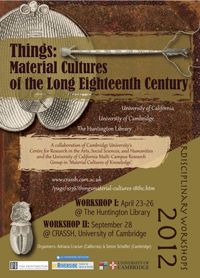 This year CRASSH has hosted a Graduate Research Group concerned with ‘Things: Material Cultures of the Long Eighteenth Century’. Our speakers have considered specific eighteenth-century objects ranging from coins to ships, porcelain to plants, from different disciplinary perspectives. We have discussed how these objects allow us to tell complex. inter-disciplinary stories about consumption, production and display in this period. This colloquium pulls together the speakers and themes that have defined the series. The day will consist of several papers with invited responses, as well as space for discussion. The colloquium is preceded by a keynote lecture by Professor Ludmilla Jordanova on Thursday evening, Talking about Things.
Both keynote lecture and colloquium talks on Friday 28 September are open to everyone. The lecture is free to attend and no registration is required. However, registration is required for the colloquium. The fee is £20 (including lunch and refreshments at the colloquium) with a reduced £10 charge for students. For information about the event and the graduate research group please contact Katy Barrett or Sophie Waring.
◊ ◊ ◊ ◊ ◊
P R O G R A M M E
Thursday, 27 September
18.00 Keynote Lecture, Ludmilla Jordanova (King’s College London) — Talking about Things
19.00 Drinks reception at CRASSH
Friday, 28 September
9.00 Registration and coffee
9.30 Welcome and Introduction — Sophie Waring (University of Cambridge) and Katy Barrett (University of Cambridge)
9.45 Session 1: W R I T T E N T H I N G S — Chair: Dr Luisa Calè (Birkbeck College, London)
• Sarah Kareem (University of California, Los Angeles) — Romantic Bubbles, Fictional Worlds
• Leanna McLaughlin (University of California, Riverside) — “A Lampoon Put on his Door”: Poetry and Politics, 1678-1689
11.15 Coffee break
11.45 Session 2: F A M I L I A R T H I N G S — Chair: Dr Melissa Calaresu (University of Cambridge)
• Sara Pennell (University of Roehampton) — Familiarity Breeds Contempt? ‘Everyday’ Objects and ‘Small Things Forgotten’ in the early modern English Household
• Melanie Keene (University of Cambridge) — Title tbc
13.15 Lunch
14.15 Session 3: G E N D E R E D T H I N G S — Chair: Dr Elizabeth Eger (Kings College London)
• Catherine Eagleton (British Museum) — Sarah Sophia Banks: Money, Medals and a ‘Collection of Scraps’
• Mary Brooks (University of Durham) — Curiosities from Female Hands
15.45 Tea Break
16.15 Session 4: T R A V E L L I N G T H I N G S
• Mary Terrall (University of California, Los Angeles) — The Dynamics of Natural History: Collecting and Collections in the Eighteenth Century
• Jonathan Eacott (University of California, Riverside) — Few Constitutions Can Stand Against East Indian Luxury: Tropical Lifestyles and the Health of Britain’s Global Power
Conference | Histories of British Art, 1660-1735
From the University of York:
Histories of British Art, 1660-1735
King’s Manor, University of York, 20-22 September 2012
Organized by Claudine Van Hensbergen
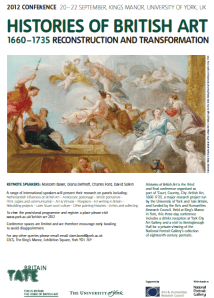 Histories of British Art is the third and final conference organised as part of Court, Country, City: British Art 1660-1735, a major research project run by the University of York and Tate Britain, and funded by the Arts and Humanities Research Council. Held at the King’s Manor in York, this three-day conference includes a drinks reception at York City Art Gallery and a visit to Beningbrough Hall (built 1716) for a private viewing of the National Portrait Gallery’s collection of over a hundred artworks from the period.
Keynote speakers: Malcolm Baker, Diana Dethloff, Charles Ford, and David Solkin
Conference spaces are limited and we therefore encourage early booking to avoid disappointment. For any other queries please email email clare.bond@york.ac.uk
◊ ◊ ◊ ◊ ◊
P R O G R A M M E (more…)
Conference | Emblems of Nationhood: Britishness 1707-1901
From St Andrews:
Emblems of Nationhood: Britishness 1707–1901, A Multidisciplinary Conference
University of St Andrews, 10-12 August 2012
 National identity is a central point of enquiry that is repeatedly called upon in contemporary social and political rhetoric. Our conference, Emblems of Nationhood, 1707–1901, will address the roots of this theme by discussing depictions of Britain and Britishness in literature, philosophy, and art between the Act of Union in 1707 and the death of Queen Victoria in 1901. Over the course of this multidisciplinary conference, we aim to explore how expressions of nationalism have moulded both critical perspectives on national identity and their creative products.
Discussing emblems of nationhood in 2012 is a fitting way to mark the twentieth anniversary of Linda Colley’s seminal account of Britishness, Britons: Forging the Nation, and coincides with the Queen’s Diamond Jubilee. Several broad questions could potentially be explored in the course of the conference: What did Britishness mean in the eighteenth and nineteenth centuries, and how was it represented and perceived? To what extent is nationalism tied with military events and empire building? How “British” was Britain before the launch of the Empire? How did concepts of nationalism enter the public consciousness, both within the British Isles and abroad? What is the impact of artistic and cultural depictions of Britain and Britishness in domestic and international contexts? How can these historical ideas of Britishness enhance our contemporary understanding of the concepts of nationalism and national identity?
Speakers include: Colin Kidd, Emma Major, Linda Colley, and Calum Colvin
Details on the full programme and registration are available at the conference website.
CAA International Travel Grant Program for 2013
International Travel Grant Program for the 2013 CAA Conference
New York, 11-16 February 2013
Applications due by 15 August 2012
CAA invites individuals to apply to the International Travel Grant Program, generously supported by the Getty Foundation. This program provides funding to twenty art historians, museum curators, and artists who teach art history to attend the 101st Annual Conference, taking place February 13–16, 2013, in New York. The grant covers travel expenses, hotel accommodations, per diems, conference registrations, and one-year CAA memberships. For 2013, CAA will offer preconference meetings on February 11 and 12 for grant recipients to present and discuss their common professional interests and issues.
The goal of the program is to increase international participation in CAA and to diversify the organization’s membership (presently seventy-two countries are represented). CAA also wishes to familiarize international participants with the submission process for conference sessions and to expand their professional network in the visual arts. As they did last year, members of CAA’s International Committee and the National Committee for the History of Art have agreed to host the participants.
Are You Eligible? (more…)
Conference | Curiosly Drawn: Eary Modern Science as a Visual Pursuit
From the Royal Society’s website:
Curiously Drawn: Early Modern Science as a Visual Pursuit
Royal Society, London, 21-22 June 2012
Science produces some of the most intriguing and arresting images in modern culture, from wildlife photographs to scanning electron microscope images. Yet the historical links between scientific research and visual representation are not always apparent. This conference brings together historians of science and art in order to examine the relationship between science and visual culture in the first hundred years of the Royal Society. We hope that the meeting will demonstrate how art, artists, and print-makers enabled creativity and innovation in science, and the extent to which naturalists and natural philosophers, in turn, transformed visual resources and strategies into something of their own.
This meeting is supported by the AHRC as part of an international network on ‘Origins of science as a visual pursuit: the case of the early Royal Society’. Relevant printed books and manuscripts from the Royal Society’s collections will be on display during the meeting.
Registration details are available here»
◊ ◊ ◊ ◊ ◊
Thursday, 21 June
10:00 Registration and coffee
10:30 Sachiko Kusukawa (University of Cambridge), Welcome and Introduction
11:00 Paula Findlen (Stanford University), The Specimen and the Image: John Woodward, Agostino Scilla, and the Depiction of Fossils
12:00 Kim Sloan (The British Museum), Sir Hans Sloane’s Pictures: The Science of Connoisseurship or the Art of Collecting?
1:00 Lunch
2:00 Domenico Bertoloni-Meli (Indiana University, Bloomington), Disease in the Philosophical Transactions
3:00 Urs B. Leu (Zentralbibliothek Zürich), Swiss Mountains and English Scholars: Johann Jacob Scheuchzer’s Contributions to the Philosophical Transactions of the Royal Society
4:00 Tea
4:30 Scott Mandelbrote (University of Cambridge), Illustrating the History of the Earth
5:30 Opportunity to view the exhibition
6:00 Public lecture by John Barrow (FRS), Pictures, Images, and Visualization in Science
Friday June 22
9:30 Nathan Flis (Oxford University), Barlow’s Pursuits: Pictures of Birds and Beasts before the Era of Modern Scientific Illustration
10:30 Coffee
11:00 Lorraine Daston (Max-Planck Institute for the History of Science, Berlin), Super-Vision: Weather Watching across Space and through Time at the Early Royal Society and Académie Royale des Sciences
12:00 Matthew Hunter (McGill University), Joshua Reynolds, the Royal Society, and the Temporally-Evolving Chemical Object in the British Enlightenment
1:00 Lunch
2:00 Michael Hunter (Birkbeck, University of London, Emeritus), Commentary
3:00 Further avenues of research
◊ ◊ ◊ ◊ ◊
Correction: An earlier version of this posting, following a preliminary programme, did not include the title for John Barrow’s talk, and Matthew Hunter’s presentation was described as ‘Commentary’.










leave a comment