Graduate Conference | Beyond Borders
From the conference website:
Beyond Borders: The Impact of Cultural Exchange in Art History
Magdalene College, University of Cambridge, 10-11 May 2012
Conference registration due by 1 May 2012
 The University of Cambridge History of Art Graduate Conference, Beyond Borders: The Impact of Cultural Exchange in Art History will be held on 10-11 May 2012 at Magdalene College, University of Cambridge. The two-day conference will address cross-cultural influences within the various art disciplines over a far-reaching geographical and chronological spectrum. The aim of the conference is to provide, and promote, an interdisciplinary forum for scholars investigating issues from appropriation of styles and motifs, to collecting and patronage. For more information and to register to attend, please visit: www.artconference2012.com. Please note that registration closes 1 May and seats are limited. For any queries, please contact us at: info@artconference2012.com
Keynote Speakers: Professor Partha Mitter (University of Sussex) and Dr. Sarah Turner (University of York)
◊ ◊ ◊ ◊ ◊
Thursday, 10 May 2012
9:30 Registration
10:00 Welcome address
10:05 Professor Partha Mitter, Introduced by Professor Jean Michel Massing
11:00 Panel I: India and Cultural Exchange, Chair: Professor Jean Michel Massing
• Kimia Shahi, ‘Translation and Transformation: Bernard Picart and Mughal Indian Miniatures’
• Rashmi Viswanathan, ‘The Tressider Album: A Case Study of a Private Ethnography’
• Krista Gulbransen, ‘Rao Surjan Singh and the Origins of Painted Portraiture in Bundi’
12:30 Lunch
1:30 Panel II: Architecture and Interiors, Chair: Dr. Frank Salmon
• Ellen Hurst, ‘The Reinvention of Russian Architecture: Italians in the Service of Vasily III, 1505-33’
• Hank Johnson, ‘Palladio Might with Envy View It? Eighteenth-Century British Design, British Self-Perception, and Italian Architecture’
• Josefine Baark, ‘”Small, Fat and Paunchy”: Chinoiserie Figures in Rosenborg Castle, Denmark’
3:00 Coffee
3:15 Panel III: Gift and Commercial Exchange, Chair: Dr. Meredith Hale
• Lejla Bajramovic, ‘A European Artist Collecting Non-European Art: Emil Preetorius’
• Andrew Chen, ‘Simone Martini’s Orsini Polyptych: A Gift from the Avignon Pope Clement VII to Philip the Bold, Duke of Burgundy, and the Politics of the Western Schism c. 1390′
• Antonia Gatward Cevizli, ‘The Marquis and the Sultan: Mantuan-Ottoman Cultural Exchange in the 1490s’
Friday, 11 May 2012
9:30 Registration
10:00 Panel IV: The Ancient World to 1000AD, Chair: Ms. Aurelie Petiot (PhD candidate)
• Samar Faruqi, ‘Orientalist Painting and the Victorian Art Market: Edwin Long’s Babylonian Marriage Market (1875)’
• Einav Zamir, ‘The Empire of Bacchus: Exchange from West to East’
• Theodore Van Loan, ‘From Symbol to Text: The Contingency of Influence in Umayyad Coin Design’
11:30 Coffee
11:45 Dr. Sarah Turner, Introduced by Dr. Polly Blakesley
12:30 Lunch
1:30 Panel V: Identity and Exchange, Chair: Mr. Duncan Robinson
• Liz Renes, ‘Sargent and His Mentors: Carolus Duran, Henry James and the Fostering of a Cosmopolitan Identity’
• Jill Baskin, ‘Picturing Freedom’s Shores: The Visual Culture of African Americans in Liberia, 1821-1865’
• Galina Mardilovich, ‘Rembrandt’s Shadow in Late Nineteenth-Century Russia’
• Loyd Grossman, ‘Benjamin West’s Confused Nationality’
3:30 Closing Address
Colloquium | Chardin at Waddesdon Manor
Colloquium | Taking Time: Chardin’s Boy Building a House of Cards and Other Paintings
Waddesdon Manor, 14 July 2012
 On 14 July 2012, Waddesdon Manor will host a colloquium to mark the closing of the exhibition Chardin’s ‘Boy Building a House of Cards’ and Other Paintings. A conference fee of £40 will include coffee, tea, lunch, and drinks reception. For further details and application to attend, please contact Diane Bellis, Collections Department, Waddesdon Manor, Nr. Aylesbury, Buckinghamshire, HP18 0JH: diane.bellis@nationaltrust.org.uk. Places will be limited to 60 persons, and bookings will be taken strictly on a first come- first-served basis.
◊ ◊ ◊ ◊ ◊
Confirmed Speakers
Colin Bailey – Upstairs/Downstairs: Dress, Status, and the Imaginary in Chardin’s Genre Paintings
Emma Barker – Chardin’s Images of Women: Representing Domesticity
John Chu – Chardin, Hayman and Britain
René Démoris – subject to be confirmed
Charlotte Guichard – Des écritures ordinaires? Les signatures de Chardin
Anna Grundberg – The Archival Hunt for the Trail of the Destroyed Rothschild Chardins
Rachel Jacobs – Play and Learning: An Introduction to the 18th-century jeux de société at Waddesdon Manor
Humphrey Wine – Observations on the National Gallery Chardins
Conference | Johan Zoffany and His International Contexts
From The Paul Mellon Centre:
Johan Zoffany and His International Contexts
The Royal Academy of Arts and the Geological Society, Burlington House, London, 14 May 2012
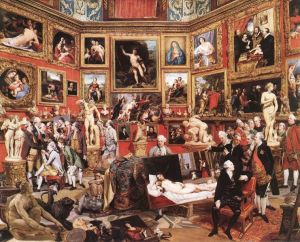
Johan Zoffany, "The Tribuna of the Uffizi," ca.1772-77. Oil on canvas. Royal Collection
The Paul Mellon Centre for Studies in British Art, the Royal Academy of Arts, London, and the Yale Center for British Art, New Haven, will be co-hosting a conference on Monday, May 14, 2012, to accompany a major exhibition on the eighteenth-century Anglo-German artist Johan Zoffany (1733–1810). The exhibition, Johan Zoffany RA: Society Observed, is curated by Martin Postle (Paul Mellon Centre), with Gillian Forrester (Yale Center for British Art) and MaryAnne Stevens (Royal Academy); it was on view at the Yale Center for British Art from October 27, 2011, to February 12, 2012, and can be seen at the Royal Academy from March 10 to June 10, 2012. The conference aims to address Zoffany’s art in the context of four locations that were central to his practice: Germany, England, Italy, and India.
Born in Frankfurt in 1733, Johan Zoffany trained as an artist in Germany and Italy. In 1760 he moved to London, where he adapted brilliantly to the indigenous art culture and patterns of patronage, creating virtuoso portraits and subject pictures that proved to be highly desirable to a wide range of patrons. Of all the major artists working in eighteenth-century England, none explored more inventively the complexities of Georgian society and British imperial rule than Zoffany. Yet, despite achieving considerable success there, he remained in many ways an outsider, looking dispassionately at British society. Resisting complete integration into his adopted country, Zoffany traveled for extended periods in Europe and spent six years in northern India. His body of work offers unique perspectives on key British and European institutions, including the art academy, the royal court, the theatre, and the families of the aristocracy and bourgeoisie. In India, Zoffany constructed new idioms for portraying the emerging colonial society in both public and private spheres, as well providing a nuanced account of the complex network of power relations, race, and culture at a critical moment in British imperial history.
Tickets for the conference and a conference program (pdf, 109 kb) are now available (also see below). To purchase tickets, and for further details about how to register, please visit the Paul Mellon Centre, London.
◊ ◊ ◊ ◊ ◊
P R O G R A M M E
Geological Society of London
9:00 Registration
9:30 Amy Meyers (Yale Center for British Art) Welcome and opening remarks
9:40 Martin Postle (Paul Mellon Centre for Studies in British Art) “Zoffany and his International Contexts: An Introduction to the Exhibition and Conference”
9:50 Morning session introduced and chaired by Robin Simon (University College, London)
9:55 Craig Hanson (Calvin College, Michigan) “Zoffany‟s Virtuosic Ambitions and the Theatre of Natural History”
10:25 Helen McCormack (University of Glasgow) “Zoffany and William Hunter: ‘Where Art May Join with Nature and with Sense'”
10:55 Questions
11:05 Coffee
11:35 Steffen Egle (Staatsgalerie, Stuttgart) “Johan Zoffany and Germany: Early Training and Later Reception”
12:05 Kate Roach (Virginia Commonwealth University) “Johan Zoffany’s Tribuna of the Uffizi: An International Visual Lineage”
12:35 Questions
12:45 Lunch
14:00 Afternoon session introduced and chaired by Kate Retford (Birkbeck College, University of London)
14:05 Anna Maria Massari (University of Urbino ‘Carlo Bo’, Palazzo Albani) “A Rediscovered Zoffany Madonna for the Grand Duke of Tuscany”
14:35 Kenneth Bendiner (University of Wisconsin, Milwaukee) “Johan Zoffany in Italy: The Beginning of Visual Dissonance”
15:05 Richard Leppert (University of Minnesota) “Zoffany and the Visual Politics of Private Musical Culture in England and India”
15:35 Questions
15:45 Tea
16:15 William Pressly (University of Maryland) “The Artist’s Role as Social Commentator: Zoffany’s Scathing Condemnation of Gillray as well as Hogarth in Plundering the King’s Wine Cellar”
16:45–17:30 Response, and discussion chaired by MaryAnne Stevens (Royal Academy of Arts)
Royal Academy of Arts
17:45 Drinks reception in the Reynolds Room
18:15–20:00 Private view of Johan Zoffany RA. Society Observed in the Sackler Galleries
Colloquium | Herder and the Arts
As noted at Le Blog d’ApAhAu:
Herder und die Künste: Ästhetik, Kunsttheorie, Kunstgeschichte
Herder et les arts: esthétique, théorie et histoire
Centre Marc Bloch, Berlin, 19-20 April 2012
 Dans l’histoire de la pensée esthétique, les travaux de J. G. Herder (1744-1803) ont une importance centrale. Herder est en effet un lecteur assidu des théories de l’art produites par les auteurs de l’Antiquité et par les penseurs européens des XVIIe et XVIIIe siècles. Contemporain de Diderot, Lessing et Winckelmann, inspirateur du jeune Goethe, Herder réfléchit tant sur l’histoire des arts que sur les fondements et limites de l’esthétique que Baumgarten, vers 1750, avait cherché à constituer en discipline philosophique à part entière. Le présent colloque cherche à éclairer les principaux textes que Herder a consacrés à l’histoire et à la théorie des arts.
19 April 2012
14h00 – 18h00
Élisabeth Décultot (CNRS/Centre Marc Bloch, Berlin) : Introduction
Gérard Raulet (Sorbonne, Paris) : Die Kunst “an die Seele zu gehen” — Kraft und
energeia in Herders erstem Kritischen Wäldchen
Daniel Dumouchel (Université de Montréal, Canada) : Fictions de pensée : origine de l’expérience esthétique et genèse de l’art dans Plastik de Herder
Wolfgang Adam (Universität Osnabrück) : Herder und die Plastik. Theorie und Autopsie
Léa Barbisan (Centre Marc Bloch, Berlin) : Von der taktilen zur haptischen Rezeption: Der Tastsinn in den visuellen Künsten von Johann Gottfried Herder bis Walter Benjamin
20 April 2012
10h00 – 13h00
Mario Marino (Adam Mickiewicz Universität Poznan) : Kunst, Geschichte und Gesellschaft. Zur Verschränkung von Ästhetik und Geschichtsphilosophie bei Herder
Elisabeth Décultot (CNRS et Centre Marc Bloch, Berlin) : “Voll vortrefflicher Grundsätze ; aber …. ”. Herders Auseinandersetzung mit Winckelmann
Ayse Yuva (Centre Marc Bloch, Berlin) : Ecriture et histoire : le caractère anti-systématique des Sylves critiques
15h00 – 18h00
Christian Helmreich (Universität Göttingen/Université Paris 8) : Herders Lyrik. Über die Möglichkeit von Poesie im philosophischen Zeitalter der Sprache
Carlotta Santini (Centre Marc Bloch, Berlin) : L’enfance des Grecs et l’épos homérique. Poésie et chants imaginés du monde dans la pensée herderienne
Ralph Häfner (Universität Freiburg) : Herders Ästhetik im Spiegel seiner Bibliothek
◊ ◊ ◊ ◊ ◊
Lieu : Centre Marc Bloch, Friedrichstrasse 191, 10117 Berlin (métro : Stadtmitte), 3e étage, Georg-Simmel-Saal
Le colloque est organisé avec le soutien du programme « Aisthesis » de l’ANR et de la DFG
Coordination : Elisabeth Décultot (CNRS, Centre Marc Bloch, Berlin) et Gerhard Lauer (Universität Göttingen)
Conference | Desiring Fashion
From the conference website:
Desiring Fashion: The Consumption and Dissemination of Dress 1750-1850
King’s Manor, University of York, 23 June 2012
Convenor: Serena Dyer
 This day conference brings together academic and curatorial work on the desire to dress fashionably in the eighteenth century. From faces to feet, the fashionable men and women of the eighteenth century strove to achieve aesthetic perfection. This series of papers explores the process of fashion dissemination, production and consumption which enabled the fulfilment of these desires, and how this related to the concepts of desire, gender and beauty. The papers to be presented cover subjects such as cosmetics and beauty, fashion plates, silk manufacture and the relationship between dressmaker and client. A small exhibition of fashion plates and accessories from the period will accompany the conference.
Aileen Ribeiro (Courtauld) Desiring Beauty: Women and Cosmetics in the Eighteenth Century
Elisabeth Gernerd (Edinburgh) Pulled Tight and Gleaming: The Stocking’s Position within Eighteenth-Century British Masculinity
Lesley Miller (V&A) Material Marketing: How Lyonnais Manufacturers Sold Their Silks in the 18th Century
Hilary Davidson (Museum of London) Recreating Jane Austen’s Pelisse-Coat
Catherine Flood (V&A) Fashion in Print and the Pleasures of Picturing Modern Life: Fashion Plates and Fashion Satires
Serena Dyer (York) A Beautiful Bargain: Lady Sabine Winn’s Relationship with Fashion
◊ ◊ ◊ ◊ ◊
Registration
The registration fee is £12. This includes a simple sandwich lunch, tea and coffee. Registration is now available via our online store. For Members of the University of York, registration is free, but please email cecs1@york.ac.uk to register; the (optional) lunch is £5.
ASECS 2012, San Antonio
2012 American Society for Eighteenth-Century Studies Conference
San Antonio, 22-24 March 2012

Mission San Francisco de la Espada at San Antonio, ca. 1750s
Photo by Travis Witt, 2010, Wikimedia Commons
◊ ◊ ◊ ◊ ◊
The 2012 ASECS conference takes place in San Antonio, March 22-24, at the Hyatt Regency San Antonio Riverwalk. This year’s annual HECAA luncheon and business meeting will be held on Friday at nearby Boudro’s restaurant. In terms of sessions, HECAA will be represented by two panels, also on Friday, chaired by Melissa Hyde and Heidi Kraus and Heidi Strobel and Amber Ludwig, with Christopher Johns serving as a respondent. In addition to these, a wide selection of sessions are also included below (there are, of course, lots of others that will interest HECAA members). For the full program, see the ASECS website. Elle Decor, incidentally, featured San Antonio in its March 2012 issue.
◊ ◊ ◊ ◊ ◊
HECAA New Scholar’s Open Session
Friday, 23 March 2012, 11:30-1:00, Bowie C
Chair: Melissa HYDE, University of Florida, and Heidi KRAUS, University of Iowa
1. Katherine ARPEN, University of North Carolina, Chapel Hill, “Touch, Sensation, Imagination: Étienne-Maurice Falconet’s Bather”
2. Zirwat CHOWDUHRY, Northwestern University, “Incongruously Indian: The Joke behind George Dance the Younger’s Guildhall Façade”
3. Amanda STRASIK, University of Iowa, “Portraying the (Future) Queen: Le Portrait de Marie-Joséphe de Saxe et Le Duc de Bourgogne”
4. Hyejin LEE, University of North Carolina, Chapel Hill, “The Language of Magic in Jean-Baptiste-Siméon Chardin’s Food Still Lifes”
◊ ◊ ◊ ◊ ◊
HECAA Luncheon and Business Meeting
Friday, 23 March 2012, 1:00
Boudros, 205 Presa St. at Charles Court (between Market and Commerce) — ask for the event space at Charles Court; see comments below for directions.
◊ ◊ ◊ ◊ ◊
Exoticisms: Global Commodity Exchange in the Long Eighteenth Century, (HECAA)
Friday, 23 March 2012, 4:15-5:45, Bowie C
Chairs: Heidi STROBEL, University of Evansville, and Amber LUDWIG, Honolulu Academy of Arts
1. Dana LEE, Art Institute of Atlanta, “Between Worlds: Performing Gender and Class through Exoticism in Madame de Pompadour’s Boudoir Turq”
2. Adrienne CHILDS, Independent Scholar, “The Taste for Blackness: Coffee, Race, and Exoticism in Eighteenth Century Luxury Objects”
3. Alden GORDON, Trinity College, “A Golden ‘Chinese’ Interior in Italy made of Imported Rock Crystal and Lacquer: The Commodities and Language of Global Exoticism in the Decorative Arts and in Engraving”
4. Elizabeth WILLIAMS, Los Angeles County Museum of Art, “Familiarizing the Foreign: Chinoiserie and Eighteenth-Century English Silver”
Respondent: Christopher JOHNS, Vanderbilt University
◊ ◊ ◊ ◊ ◊
OTHER SESSIONS RELATED TO THE VISUAL ARTS
T H U R S D A Y , 2 2 M A R C H 2 0 1 2
8:00-9:30
Audiences, Observers, Spies, & Witnesses: Types of Attention in the Eighteenth Century, Bowie A
Chair: Cheryl WANKO, West Chester University
1. Kathleen E. URDA, Bronx Community College, CUNY, “Theatrical Spectatorship and Jane Austen’s Mansfield Park”
2. Fiona RITCHIE, McGill University, “Sentimental Attention: Women Watching Shakespeare in the Mid-Eighteenth Century”
3. David Francis TAYLOR, University of Toronto, “Spectators at the Print Shop Window: Caricature and the Corporate Gaze”
◊ ◊ ◊ ◊ ◊
9:45-11:15
Aesthetic Reception, Sensibility, and Social Engineering: Interrogating the Effects of the Work of Art in the Long Eighteenth Century, Pecos
Chair: Julia SIMON, University of California, Davis
1. Jean MARSDEN, University of Connecticut, “Sentimental Drama as Social Engineering”
2. Philipp SCHWEIGHAUSER, Universität Basel, “Sympathy Control: Sentimental Literature and Early European Aesthetics”
3. Peter ERICKSON, University of Chicago, “Conversion in the Museum: Friedrich Schlegel at the Louvre, 1802-1804”
4. Laurence LEMAIRE, University of California, Davis, “Rousseau, Writing and Aesthetics: a Moral Agent at Work”
◊ ◊ ◊ ◊ ◊
Directing Light and Adjusting Outlooks: Mirrors, Lenses, Windows, Reflections, Refractions, Translucencies, (South Central Society for Eighteenth-Century Studies) Frio
Chair: Kevin L. COPE, Louisiana State University
1. Robert CRAIG, Independent Scholar, “Zur Farbenlehre- Goethe’s Theory of Colors: Goethe versus Newton – and the Winner Is . . . ?”
2. Laura MILLER, University of West Georgia, “Light, Space, and Masculinity in Newtonian Optical Experiments”
3. William STARGARD, Pine Manor College, “Scientific and Divine Light in Bernard Vittone’s Architecture for the Poor Clares”
4. Jeremy WEAR, University of Illinois at Urbana-Champaign, “Lilbertine Philosophy and the Error of the Eyes in Aphra Behn’s The Emperor of the Moon”
◊ ◊ ◊ ◊ ◊
The Aesthetics of Science and the Science of Aesthetics – I, Rio Grande Center
Chair: Peter MESSER, Mississippi State University
1. Bryan HURT, University of Southern California, “Laurence Sterne and the Science of True Feeling”
2. Paula BROWN, Louisiana Tech, “Edmund Burke’s Philosophical Enquiry into the Origin of Our Ideas of the Sublime and the Beautiful: Ethics and Empiricism ‘Confounded’”
3. Jessica DECKARD, Indiana University, “The Lily Adeline: Botany and Botanical Knowledge in Radliffe’s The Romance of the Forest”
◊ ◊ ◊ ◊ ◊
Home Away from Home: Transient Artists in the Eighteenth Century, Bowie A
Chair: Christina LINDEMAN, Pima Community College
1. Catherine M. SAMA, University of Rhode Island, “‘On the Road’: Rosalba Carriera in Paris, Modena, and Vienna (1720-30)”
2. Wendy Wassyng ROWORTH, University of Rhode Island, Benjamin West’s First Tour of England: Speculations on an Anonymous Sketchbook”
3. Jennifer VAN HORN, Towson University, “‘Straggling Adventurers of the Brush’: Transatlantic Artists and the Making of the British Empire”
4. Elisabeth FRASER, University of South Florida, “Mediterranean Self-Fashioning: Louis-François Cassas, Itinerant Artist in the Ottoman Empire”
◊ ◊ ◊ ◊ ◊
11:30-1:00
The British Grand Tour, Pecos
Chair: Alison O’BYRNE, University of York
1. Alistair DURIE, University of Stirling, “The Home Tour Revisited”
2. Denys VAN RENEN, University of Illinois, Urbana-Champaign, “Salvaging British Identity in Johnson’s Journey to the Western Islands of Scotland”
3. Gordon TURNBULL, Yale University, “Boswell’s Jaunts: A Britain ‘Yet Minutely Diversified’”
4. Susan EGENOLF, Texas A&M University, “‘There’s a View in My Soup’: Wedgwood’s Green Frog Service and the Promotion of the British Picturesque”
◊ ◊ ◊ ◊ ◊
Roundtable: Demystifying the Academic Journal (Professionalization Panel Sponsored by the Graduate Student Caucus) Live Oak
Chair: Nicholas E. MILLER, Washington University in St. Louis
1. Cristobal SILVA, Columbia University, The Eighteenth Century: Theory and Interpretation
2. Marion L. RUST, University of Kentucky, Early American Literature
3. Downing A. THOMAS, University of Iowa, Studies in Eighteenth-Century Culture
4. Hazel GOLD, Emory University, PMLA
5. Julia SIMON, University of California, Davis, Eighteenth-Century Studies
6. Jonathan Beecher FIELD, Clemson University, Common-place: The Interactive Journal of Early American Life
◊ ◊ ◊ ◊ ◊
The Aesthetics of Science and the Science of Aesthetics – II, Rio Grande Center
Chair: Peter G. DEGABRIELE, Mississippi State University
1. Tili Boon CUILLÉ, Washington University in St. Louis, “From Scientific Principle to Aesthetic Practice: The Natural Laws of Artistic Composition”
2. Peter MESSER, Mississippi State University, “Jeremy Belknap’s Sublime Science of Natural History”
◊ ◊ ◊ ◊ ◊
Art and Life: Cultural Practices of Animation in the Eighteenth Century (The Role of the Viewer/Reader/Observer) – I, Regency East
Chair: Amelia RAUSER, Franklin and Marshall College
1. Sarah R. COHEN, University at Albany, State University of New York, “Expert Brutes: Animating Artistry in Eighteenth-Century Painting”
2. Keith BRESNAHAN, OCAD University, “Parallax Views: Animating Architecture in Eighteenth-Century France”
3. Hannah Vandegrift ELDRIDGE, University of Chicago, ‘“No time there is, no power, can decompose /The minted form that lives and living grows’: Goethe’s Animated Forms”
4. Sarah BETZER, University of Virginia, “Shadow Play: Ingres, Sculpture, and Spectacle”
◊ ◊ ◊ ◊ ◊
2:30-4:00
Art and Life: Cultural Practices of Animation in the Eighteenth Century (The Life Force as Spark) – II, Bowie C
Chair: Amelia RAUSER, Franklin and Marshall College
1. Wendy BELLION, University of Delaware, “Speaking Statues”
2. Erin M. GOSS, Clemson University, “Animated Dialogue: Bentham’s Corpse Play”
3. Bendta SCHROEDER, Brandeis University, “Erasmus Darwin’s ‘Amorous Ocean’: Organic Sexuality in The Loves of the Plants”
4. Emily Hodgson ANDERSON, University of Southern California, “Animating Perfection: Sarah Siddons’s Hermione”
◊ ◊ ◊ ◊ ◊
The Wit and Wisdom of Eighteenth-Century Thought, (Northwest Society for Eighteenth-Century Studies – NWSECS), Llano
Chair: Ken ERICKSEN, Linfield College
1. Pamela PLIMPTON, Warner Pacifi c College, “Laughing on the Dark Side: Theory of Mind [Reading] in Matthew Lewis’s The Monk”
2. Johann REUSCH, University of Washington. “Wit Lies in Brevity: Christoph Georg Lichtenberg’s Aphorisms as Cosmopolitan Wisdom”
3. Robert MODE, Vanderbilt University, “Juxtapositions and Parodies in Hogarth’s The Enraged Musician”
4. Marvin LANSVERK, Montana State University, “The Comedy in Blake’s Divine Comedy Illustrations”
◊ ◊ ◊ ◊ ◊
The Medical Gothic, (Western Society for Eighteenth Century Studies), Rio Grande East
Chair: Lisa Forman CODY, Claremont McKenna College
1. Sara LULY, Kansas State University, “A Gothic Science: Gothic Motifs in the Medical Texts of Eighteenth-Century German Magnetists”
2. Dana Gliserman KOPANS, State University of New York, Empire State College, “Nymphomania, or the Horrors of Female Desire”
3. Kevin CHUA, Texas Tech University, “Fuseli and Gothic Preformation”
4. Christine CROCKETT, Claremont McKenna College, “Dreadful Portraits: Medical Gothic and the Regulation of Desire”
◊ ◊ ◊ ◊ ◊
4:15-5:45
Innovative Course Design, Pecan
Chair: Paula LOSCOCCO, Lehman College, City University of New York
1. Susan LANSER, Brandeis University AND Jane KAMENSKY, Brandeis University, “London in the Long Eighteenth Century: People, Culture, City”
2. Janie VANPÉE, Smith College, Re-Membering Marie Antoinette”
3. Zach HUTCHINS, Brigham Young University, “American Love Letters”
◊ ◊ ◊ ◊ ◊
F R I D A Y , 2 3 M A R C H 2 0 1 2
8:00-9:30
Life and Luxury: Material Culture and Decorative Arts, Blanco
Chair: Denise Amy BAXTER, University of North Texas
1. Kevin JUSTUS, Independent Scholar/University of Phoenix Humanities, “The Chime of a Clock and the Scratch of a Pen: Louis XV’s Astronomical Clock and Roll Top Desk –A King of Art, Science and Industry Decorative Art as Portrait”
2. Chloe NORTHROP, University of North Texas, “Colonial Exchanges of Material Goods: The Case of Pauline Bonaparte Leclerc and Maria Nugent”
3. Dana LOUGHLIN, University of British Columbia, “Laughing at Gilded Butterfl ies: Essai de Papilloneries Humaines and the Ornamentation of Social Spaces in Eighteenth-Century France”
4. Heidi STROBEL, University of Evansville, “Portraiture and the Art of Mary Linwood”
◊ ◊ ◊ ◊ ◊
9:45-11:15
Pompeii and Herculaneum in the Eighteenth Century, Bowie C
Chair: Julie-Anne PLAX, University of Arizona
1. Bernadette FORT, Northwestern University, “The Discoveries at Herculaneum and the Debate on Ancient Painting”
2. Sandra BARR, Independent Scholar, “A Spot of Bother! Naples and the Grand Tour Penchant for Disaster Imagery”
3. Amelia RAUSER, Franklin and Marshall College, “Performing Antiquity: Emma Hamilton’s ‘Attitudes’ and the Fragments of Pompeii and Herculaneum”
4. Leslie REINHARDT, Independent Scholar, “The Endurance of the Literary: A Cestus of Venus in Anglo-American Art”
◊ ◊ ◊ ◊ ◊
11:30-1:00
New Scholar’s Open Session, (Historians of Eighteenth-Century Art and Architecture), Bowie C
Chair: Melissa HYDE, University of Florida, AND Heidi KRAUS, University of Iowa
1. Katherine ARPEN, University of North Carolina, Chapel Hill, “Touch, Sensation, Imagination: Étienne-Maurice Falconet’s Bather”
2. Zirwat CHOWDUHRY, Northwestern University, “Incongruously Indian: The Joke behind George Dance the Younger’s Guildhall Façade”
3. Amanda STRASIK, University of Iowa, “Portraying the (Future) Queen: Le Portrait de Marie-Joséphe de Saxe et Le Duc de Bourgogne”
4. Hyejin LEE, University of North Carolina, Chapel Hill, “The Language of Magic in Jean-Baptiste-Siméon Chardin’s Food Still Lifes”
◊ ◊ ◊ ◊ ◊
The Cultural Life of Things: Material Culture in the Long Italian Eighteenth-Century, (Italian Studies Caucus), Rio Grande East
Chair: Sabrina FERRI, University of Notre Dame
1. Rebecca MESSBARGER, Washington University in St. Louis, “Anatomy of the Venus de Medici in Peter Leopold’s Science Museum”
2. Paola GIULI, Saint Joseph’s University, “The Rare and the Marvelous: Leone Strozzi’s Cabinets of Natural and Artistic Curiosities”
3. Francesca SAVOIA, University of Pittsburgh, “Window Shopping in Eighteenth-Century London: Giuseppe Baretti and Alessandro Verri”
4. Irene ZANINI-CORDI, Florida State University, “Natural Wonders and Ingenious Inventions in Margherita Sparapani Gentili Boccapadule’s Viaggio d’Italia”
◊ ◊ ◊ ◊ ◊
4:15-5:45
Exoticisms: Global Commodity Exchange in the Long Eighteenth Century, (Historians of Eighteenth-Century Art and Architecture), Bowie C
Chairs: Heidi STROBEL, University of Evansville, and Amber LUDWIG, Honolulu Academy of Arts
1. Dana LEE, Art Institute of Atlanta, “Between Worlds: Performing Gender and Class through Exoticism in Madame de Pompadour’s Boudoir Turq”
2. Adrienne CHILDS, Independent Scholar, “The Taste for Blackness: Coffee, Race, and Exoticism in Eighteenth Century Luxury Objects”
3. Alden GORDON, Trinity College, “A Golden ‘Chinese’ Interior in Italy made of Imported Rock Crystal and Lacquer: The Commodities and Language of Global Exoticism in the Decorative Arts and in Engraving”
4. Elizabeth WILLIAMS, Los Angeles County Museum of Art, “Familiarizing the Foreign: Chinoiserie and Eighteenth-Century English Silver”
Respondent: Christopher JOHNS, Vanderbilt University
◊ ◊ ◊ ◊ ◊
S A T U R D A Y , 2 4 M A R C H 2 0 1 2
8:00-9:30
Deep in the Art of Texas, Llano
Chair: Amy FREUND, Texas Christian University
1. Heather MACDONALD, Dallas Museum of Art, “Stormy Weather: Joseph Vernet’s A Mountain Landscape with an Approaching Storm at the Dallas Museum of Art”
2. C.D. DICKERSON, Kimbell Art Museum, “Bringing the Eighteenth Century to Texas: Bertram Newhouse and the Kimbells”
3. James CLIFTON, Museum of Fine Arts, Houston, “Paolo de Matteis and the Artist’s Profession: On Two Paintings in Houston”
4. Nicole ATZBACH, Meadows Museum, “Richard Worsam Meade: Vicente López’s Portrait of an American Entrepreneur and Collector in Spain”
5. Iraida RODRIGUEZ-NEGRON, Institute of Fine Arts, New York University and Meadows Museum, ‘“Quiere un retrato de S.M. para Sortija:’ Introducing the Portrait Miniatures at the Meadows Museum by Francisca Meléndez, Portraitist at the Court of Charles IV”
◊ ◊ ◊ ◊ ◊
9:45-11:15
Publishing the Past: History and Eighteenth-Century Print Culture – II, Frio
Chair: Hannah DOHERTY, Stanford University
1. Mark TOWSEY, University of Liverpool, “ ‘A Table of the Human Passions’: Learning to Read the Past in Eighteenth-Century Britain”
2. Jeff STRABONE, Connecticut College, “The Middle Scots Poets in the Eighteenth Century: Creating a Usable Past for Scotland”
3. Crystal B. LAKE, Wright State University, “Surrounded by the Congenial Elements of Books and Dirt: Women Antiquaries in the Long Eighteenth Century”
4. Adam BUDD, University of Edinburgh, “History of India in the Scottish Enlightenment: Methods and Vision”
◊ ◊ ◊ ◊ ◊
2:00-3:30
Théâtre et actualité(s) avant la Révolution- I, Blanco
Chair: Yann ROBERT, Stanford University AND Logan J. CONNORS, Bucknell University
1. Pannill CAMP, Washington University in St. Louis, “‘Belle Horreur:’ Hubert Robert’s Architectural Fantasies and the Paris Opera Fire of 1781”
2. Olivier FERRET, Université Lyon 2, “Faire des ‘applications’ au théâtre sous l’Ancien Régime”
3. Jack IVERSON, Whitman College, “Performing Beaumarchais’s Benevolence: Norac et Javolci and the Institut de bienfaisance pour les mères-nourrices”
4. Jennifer TAMAS, Stanford University, “De l’alcôve à la tribune: déclaration des sentiments et déclaration des droits”
◊ ◊ ◊ ◊ ◊
3:45-5:15
Roundtable: Disciplinary Approaches to Eighteenth-Century Material Culture, Frios
Chair: Michael YONAN, University of Missouri
1 Denise Amy BAXTER, University of North Texas
2. Barbara M. BENEDICT, Trinity College
3. Jennifer GERMANN, Ithaca College
4. Karen HILES, Muhlenberg College
5. Chloe WIGSTON SMITH, University of Georgia
HECAA’s Young Scholars Session at ASECS, 2012
With CAA now behind us, ASECS is just around the corner in San Antonio, 22-24 March. More to come soon, but here’s HECAA’s New Scholar Session:
HECAA New Scholars Open Session
Chairs: Melissa Hyde (University of Florida) and Heidi Kraus (The University of Iowa)
- Katherine Arpen (University of North Carolina at Chapel Hill), “Touch, Sensation, Imagination: Étienne-Maurice Falconet’s Bather“
- Zirwat Chowduhry (Northwestern University), “Incongruously Indian: The Joke behind George Dance the Younger’s Guildhall Facade”
- Amanda Strasik (The University of Iowa), “Portraying the (Future) Queen: Le Portrait de Marie-Joséphe de Saxe et Le Duc de Bourgogne“
- Hyejin Lee (University of North Carolina at Chapel Hill), “The Language of Music in Jean-Baptiste-Siméon Chardin’s Food Still Lifes”
Material World Conference at Peabody Essex Museum
From the PEM:
A Material World: The Art and Culture of Global Connections
Peabody Essex Museum, Salem, Massachusetts, 22 March 2012
 Join us for a dynamic symposium that explores how the global movement of objects — luxury goods, traded commodities and diplomatic gifts — created an increasingly interconnected world from the 1500s to the 1800s. How did these works shape people’s ideas about the wider world? What can these works continue to tell us about early global networks? Nine international speakers focus on different cross-cultural connections in this daylong program highlighting works of art from PEM’s collection.
◊ ◊ ◊ ◊ ◊
S P E A K E R S
Donna Pierce (Denver Art Museum), Chinese Export Silk and Porcelain in Colonial Mexico
Daniel Finamore (Peabody Essex Museum), Mexican Featherwork Fan for the Spanish Market, Early 1600s
Susan Stronge (Victoria and Albert Museum, London), Foreign Luxuries at the Mughal Court
Giorgio Riello (Warwick University), Portrait of Two English Boys in Asian Clothing by Tilly Kettle, 1780s
Jean Michel Massing (University of Cambridge, England), Luso-African Ivories: A New Provenance
Karina Corrigan (Peabody Essex Museum), Chinese Export Lacquer and Enamel Furniture, 1730s
Timon Screech (School for Oriental and African Studies, London), Linnaeus and the Origin of Japanese Numismatics
Christina Hellmich (Fine Arts Museums of San Francisco), Alaskan Overcoat Owned by the King of the Hawaiian Islands, Given to PEM before 1821
Anne Gerritsen (Warwick University, England), Things in Global Context: Mr Nobody Comes Home
◊ ◊ ◊ ◊ ◊
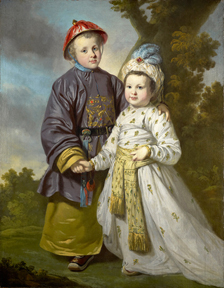
Tilly Kettle (1734-1786), "Portrait of Two English Boys in Asian Clothing," 1780s (Peabody Essex Museum)
This daylong program concludes with a cocktail reception. Registrants will also have the opportunity to attend PEM’s mid-winter Evening Party and opening for FreePort [No. 005]: Michael Lin following the reception. Learn more about FreePort [No. 005]: Michael Lin
Reservations by March 15
Members $85, nonmembers $95, students with ID $20
For more information, call 978-542-1625 or email symposium@pem.org
Related lecture — Timothy Brook, Vermeer’s Hat: The Seventeenth Century and the Dawn of the Global World, Wednesday, March 21.
A Material World: The Art and Culture of Global Connections is sponsored in part by a grant from the Arts and Humanities Research Council (UK). The AHRC grant has funded a two-year international academic partnership exploring global commodities and the material culture of early modern connections, 1400-1800. Partner institutions include Warwick University, Coventry, England; The Victoria and Albert
Museum, London, England; Bilgi University, Istanbul, Turkey; and the
Peabody Essex Museum, Salem, Massachusetts, USA.
Art, Agency, Empire: India in Global Contexts
From the YCBA:
Art, Agency, Empire: India in Global Contexts — Graduate Student Symposium
Yale Center for British Art, New Haven, 11 February 2012

Edward Lear, "Kangchenjunga from Darjeeling," detail, 1879 (New Haven: Yale Center for British Art)
This one-day graduate student symposium is informed by the recent proliferation of projects on India’s visual and material culture, including two exhibitions that opened at the Center in the fall of 2011: Johan Zoffany RA: Society Observed (October 27, 2011– February 12, 2012), which includes a substantial section devoted to the works the artist produced during his residence in India, between 1783 and 1789; and Adapting the Eye: An Archive of the British in India, 1770–1830 (October 11–December 31, 2011), which concentrated on the complex networks of British and Indian artists, patrons, and scholars in the late eighteenth and early nineteenth centuries.
Art, Agency, Empire: India in Global Contexts explores how, in a postcolonial period, it has become increasingly pressing to reevaluate India as a site of multifarious cultural (indeed intercultural) production, which has provoked global responses across media. The symposium is free and open to the public; registration is required. Online registration is available from January 16 to February 9, 2012. Onsite registration is available on February 11 from 8:30 am.
The program will include papers by graduate students (listed here) as well as breakout sessions in the Johan Zoffany exhibition and Center’s collections.
◊ ◊ ◊ ◊ ◊
Keynote Lecture, 5:30 pm
Gillian Forrester (Curator of Prints and Drawings Yale Center for British Art)
In the Cock-Pit: Zoffany and the Performance of Empire in India
CAA 2012, Los Angeles
The 2012 College Art Association conference takes place in Los Angeles, February 22-25, at the Los Angeles Convention Center. HECAA will be represented by two panels, as listed here. The following sessions may also be of interest for dixhuitièmistes. A full list of panels is available here»
H E C A A E V E N T S
Pictures in Place: Depicting Location and the Siting of Representation in the Eighteenth Century
Friday, February 24, 2:30–5:00, Concourse Meeting Room 408B
Chair: Craig Ashley Hanson (Calvin College)
- Dawn Odell (Lewis and Clark College) Place as a Thing: Chinese Screens in Dutch Colonial Contexts
- Hannah Williams (University of Oxford), From Salon to Altar: Relocating Religious Art in Eighteenth-Century Paris
- Julie M. Johnson (University of Texas at San Antonio), A Surplus of Frames: Allegorizing Collecting in the 1720 Stallburg Installation
- Jocelyn Anderson (Courtauld Institute of Art), Paintings in Country Houses and the Development of British Cultural Heritage
- Heather McPherson (University of Alabama at Birmingham), Branding Shakespeare: Boydell’s Shakespeare Gallery and the Politics of Display
◊ ◊ ◊ ◊ ◊
New Scholars Session
Saturday, February 25, 12:30–2:00, West Hall Meeting Room 501ABC
Chair: Kevin Chua (Texas Tech University)
- Lauren Cannady (Institute of Fine Arts, New York University), The Garden Landscape and the French Interior
- Christina Smylitopoulos (University of McGill), “Last Visit from the Doctors Assistant”: Thomas Rowlandson’s Tribute to the “Dying Nabob” and the Birth of the British Body Abroad
- Abigail Zitin (Trinity University), Hogarth among the Moderns
◊ ◊ ◊ ◊ ◊
O T H E R S E S S I O N S R E L A T E D T O T H E 1 8 T H C E N T U R Y
Where the Bodies Lie: Landscapes of Mourning, Memory, and Concealment
Wednesday, February 22, 9:30–12:00, West Hall Meeting Room 501ABC
Chairs: Cynthia Mills (Smithsonian American Art Museum, emeritus) and Kate C. Lemay (Georgia O’Keeffe Museum Research Center); Discussant: Petra ten-Doesschate Chu (Seton Hall University)
- Jennifer Van Horn (Towson University), Civilizing Cemeteries: Portrait Gravestones in Colonial Charleston
- Caterina Y. Pierre (Kingsborough Community College, CUNY), The Corpse Revealed: The Gisant and Modern Memorials at the Fin de Siècle
- Karen Shelby (Baruch College, CUNY), In Flanders Fields: Collection Cemeteries for the German Dead
- Emily Mark-Fitzgerald (University College Dublin), Remembering the Irish Famine: Commemorating the Famine Graveyard and Workhouse, 1990-2011
- Patricia Cronin (Brooklyn College, CUNY), Until Death Do Us Part: National Politics, Modern Love, and “Memorial to a Marriage”
◊ ◊ ◊ ◊ ◊
Icons of the Midwest: Henry Fuseli’s Nightmare (Midwest Art History Society)
Wednesday, February 22, 12:30–2:00, Concourse Meeting Room 405
Chairs: Laura D. Gelfand (Utah State University) and Judith W. Mann (Saint Louis Art Museum)
- Salvador Salort-Pons (Detroit Institute of the Arts), Living with Fuseli’s “Nightmare”
- Beth S. Wright (University of Texas at Arlington), “As I Was Perpetually Haunted by These Ideas”: Fuseli’s Influence on Mary Shelley’s Mathilda and Frankenstein
- Scott Bukatman (Stanford University), Dreams, Fiends, and Dream Screens
◊ ◊ ◊ ◊ ◊
Feminism and Early Modern Art (Society for the Study of Early Modern Women)
Wednesday, February 22, 12:30–2:00, Concourse Meeting Room 407
Chair: Andrea Pearson (American University); Discussant: Mary D. Garrard (American University)
- Jane C. Long (Roanoke College), Shaping Feminine Conduct in Renaissance Florence
- Sarah Joan Moran (Universität Bern), The Word of God on Women’s Shoulders? Pulpits in the Beguine Churches of the Southern Low Countries, ca. 1650-1725
- Corine Schleif (Arizona State University), From Early Modern to Postmodern, from Female to Feminisms to Feminizing: Where Do We Find Our Subjects and Ourselves after 100 Years in the College Art Association?
◊ ◊ ◊ ◊ ◊
Future Directions in the History of British Art (Historians of British Art)
Thursday, February 23, 2:30–5:00, Concourse Meeting Room 403B
Chair: Peter Trippi, Fine Art Connoisseur and Projects in 19th-Century Art, Inc.; Discussant:Kimberly Rhodes, (Drew University)
- Roberto C. Ferrari (The Graduate Center, CUNY), Reconsidering John Gibson, Remolding British Sculpture
- Cristina S. Martinez (University of Toronto ), Legal Thinking: The Rise of Eighteenth-Century British Art
- Corey Piper (Virginia Museum of Fine Arts), Doing the Thing and the Thing Done: The Social World of the British Sporting Print, 1750-1850
- Irene Sunwoo (Princeton University), From the “Well-Laid Table” to the “Market Place”: The Architectural Association Unit System
- Amy M. Von Lintel (West Texas A&M University), Art within Reach: The Popular Origins of Art History in Victorian Britain
◊ ◊ ◊ ◊ ◊
National Endowment for the Humanities Funding Opportunities (NEH)
Thursday, February 23, 5:30–7:00, Concourse Meeting Room 406AB
Chair: Danielle Shapiro (National Endowment for the Humanities)
- Linda Komaroff (Los Angeles County Museum of Art)
- Amy Lyford (Occidental College)
◊ ◊ ◊ ◊ ◊
How to Get Published and How to Get Read: (Arts) Journals in the Digital Age
Friday, February 24, 12:30–2:00, Concourse Meeting Room 404B
Chair: Loren Diclaudio (Routledge, Taylor & Francis Group)
- Jennifer Roberts (Routledge, Taylor & Francis Group)
- Christine L. Sundt (Visual Resources: An International Journal of Documentation)
- Natalie Foster (Routledge, Taylor & Francis Group)
◊ ◊ ◊ ◊ ◊
New Research in the Early Modern Hispanic World (American Society for Hispanic Art Historical Studies)
Saturday, February 25, 9:30–12:00, West Hall Meeting Room 511BC
Chairs: Michael A. Brown (Denver Art Museum) and Sofia Sanabrais (Los Angeles County Museum of Art)
- Laura Leaper (Institute of Fine Arts, New York University), Old Meets New: Classicizing Visions in Diego de Valadés’s “Rhetorica Christiana”
- Niria Leyva-Gutiérrez (Institute of Fine Arts, New York University), Soldier Ecclesiasticus: Images of the Archangel Michael in New Spain
- Sylvia Shorto (American University of Beirut), Dovetailed Cultures
- Luis Gordo-Peláez (University of Texas at Austin), “A Palace for the Maize”: The Granary of Granaditas in Guanajuato and the Neoclassical Civic Architecture in Colonial Mexico
- Daniela Bleichmar (University of Southern California), Visible Empire: Science, Imperial Knowledge, and Visual Evidence in the Hispanic World
◊ ◊ ◊ ◊ ◊
Art and Architecture in Europe: 1600-1750
Saturday, February 25, 9:30–12:00, Concourse Meeting Room 408A
Chair: John Beldon Scott (University of Iowa)
- Karen J. Lloyd (Tulane University), A New Samson: Scipione Borghese and the Representation of Nepotism in the Vatican Palace
- Jason Ciejka (Agnes Scott College), Rhetoric and Narrative in the Architecture of Carlo Rainaldi
- Sabina de Cavi (Getty Research Institute), Artistic Practices and Raw Materials for the Collaborative Art Form of the Festino in Baroque Palermo (1625-1750)
- Robin L. Thomas (Pennsylvania State University), The Bourbon Theater of State: Decorating the Royal Palace at Portici (1744-1745)
- Simone Zurawski (DePaul University), Revealing the Crossroads of Paris at the Cusp of the Revolution: The Works of Henri-Louis Duhamel du Monceau at the Clos Saint-Lazare
◊ ◊ ◊ ◊ ◊
“Useful to the Public and Agreeable to the King”: Academies and Their Products in Spain and New Spain (American Society for Hispanic Art Historical Studies)
Saturday, February 25, 12:30–2:00, Concourse Meeting Room 402AB
Chair: Kelly Donahue-Wallace (University of North Texas)
- Andrew Schulz (University of Oregon), Shifting Attitudes toward Cultural Patrimony in the Madrid Royal Academy of San Fernando, 1755-1808
- Kelly Donahue-Wallace (University of North Texas), Jerónimo Antonio Gil and the Formation of a Director General
- Susan Deans-Smith (University of Texas at Austin), “Open the Door so that Misery Can Leave”: The Rhetoric of Public Utility of the Royal Academy of San Carlos and Public Responses in Late Colonial Mexico
◊ ◊ ◊ ◊ ◊
New Approaches to Post-Renaissance Florence, ca. 1600–1743
Saturday, February 25, 2:30–5:00, Concourse Meeting Room 404A
Chairs: Eve Straussman-Pflanzer (The Art Institute of Chicago) and Eva Struhal (Université Laval)
- Morten Steen Hansen (Stanford University), Ariosto’s Florentine Fortune
- Nina E. Serebrennikov (Davidson College), Manipulating the Miniscule: The Case of Jacques Callot
- Rebecca J. Long (Indianapolis Museum of Art), Florentine Paintings for a Spanish Queen: The Medici Gift in the Convento de las Descalzas Reales, Valladolid
- Elena Ciletti (Hobart and William Smith Colleges), “Ne Posteri Ignorent Quid Factum Sit”: Anna Maria Luisa de’Medici at San Lorenzo
- Jacqueline Marie Musacchio (Wellesley College), Florence, the Medici, and Bianca Cappello through the Eyes of Horace Walpole










leave a comment