Study Day: Sculpture for the Academy
As noted at H-ArtHist:
Morceau de reception, Dono, and Diploma Piece
Histories of a Self-reflective Genre of Sculpture
Kunstakademie, Düsseldorf, 18 May 2012
Organized by Tomas Macsotay and Johannes Myssok
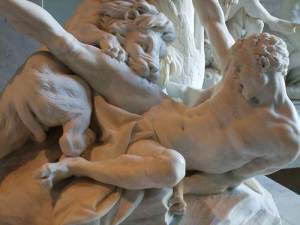
Étienne-Maurice Falconet, "Milo of Croton," marble, 1754 (Paris: Louvre)
In the seventeenth and eighteenth centuries, the significance of a practice of sculpture was to a great extent determined by the incorporation of individual sculptors into royal academies and city guilds, powerful institutions of Ancien Régime society fueled by conflicting socio-economic interests, ethic convictions and aesthetic creeds. For sculptors, the centerpiece of such acts of consecration consisted in marble carvings executed in reduced scale and rendering noble subjects that ranged from the Saints to Ovid and Roman History. As guilds lost ground and influence to academies, the figures became an indispensable means of forging a reputation: they grew increasingly complex and in a few cases, as with Falconet’s Milo, Sergel’s Othryadès and Banks’ Falling Titan, strike the modern viewer as being strangely at odds with stylistic mainstreams of baroque and neo-classicism. What resulted is one of the first forms of sculpture produced independently from overt purposes of noble representation or religious experience, and therefore capable of being called ‘autonomous’. Often lodged within or close to the spaces where academy members convened and held seminars, academic marbles come closest to representing a programmatic statement on the nature of sculpture at the dawn of modernity.
The study day will examine the converging histories of the dono, the morceau de réception and the diploma piece. An international array of scholars will venture into the difficult task of identifying what (if anything) these pieces purport to teach the viewer about the art of sculpture. What are the origins of its typical conventions — among the
private genres of the reproductive bronze, the ivory and the ornamental relief, or among the public sculpture on permanent display in churches, townhouses and squares — and what support is provided modern scholars by academic theoretical discourses? The insistent three-dimensionality of the French morceau de réception seems particularly predictive of a now familiar paradigm of the medium, with its understanding that sculptural objects display non-pictorial properties that fuel a relationship with the beholder through modalities of hard, handled
substance, through the play of spatial presence and multiple viewpoints, and through quasi-architectural framing elements and supports such as pedestals and niches. But does this Ancien Régime embodiment of sculpture really anticipate a modern sensibility to sculptural form?
Admission to the study day is free. Registration is not required.
◊ ◊ ◊ ◊ ◊
P R O G R A M M E
9:00 Reception and coffee
9:25 Johannes Myssok, Welcome and introduction
SESSION 1: Between the Individual and the Institutional, chaired by Johannes Myssok
9:40 Susanne Adina Meyer (Rome): “Die Akademie in der ‘Akademie der Welt’: Wettbewerbe und bildhauerische Aufnahmestücke der Accademia di San Luca in Rom im 18. Jh.”
10:10 Marjorie Trusted (London), “The Beginnings of the Royal Academy in London: Diploma Pieces in the Eighteenth Century”
10:40 Discussion and coffee Break
SESSION 2: Falconet: Exception or Rule?, chaired by Guido Reuter
11:10 Kristina Dolata (Berlin): “Naturstudium und ‘horreur’. Falconets Milon von Kroton”
11:40 Tomas Macsotay (Barcelona), “The Free-standing Morceau de Réception and the Community of Experiment: Thoughts on De Piles and Falconet”
12:10 Discussion
12:30 Lunch
SESSION 3: Sculpture about Sculpture: An Academic Aesthetics, chaired by Tomas Macsotay
14:00 Ursula Ströbele (Berlin): “Vom bas-relief zum ronde-bosse. Narration und Zeitlichkeit bei den Bildhaueraufnahmestücken der königlichen Akademie in Paris”
14:30 Martin Myrone (London), “Extravagance, Excess, Expertise: Thomas Banks’s Falling Titan”
15:00 Discussion and break
15:40 Additional contribution by Magnus Olausson and/or respondent (to be confirmed); final discussion
Conference: The British Monarchy and Modernity
The Making of a Monarchy for the Modern World
Kensington Palace, London, 6-8 June 2012
 There will soon be only five kings left – the Kings of Diamonds, Heart, Spades and Clubs, and the King of England.
– King Farouk of Egypt
For this conference our big theme is the British monarchy and its relationship to the modern world. Papers will address a range of inter-related topics covering the period from 1688 to the present day, including:
- the difference between British and Continental monarchies
- the global reach of the British monarchy
- the relationship between royalty and the media
- monarchical dress and material culture
- the portrayal of monarchs in film and theatre
Delegates will also have the opportunity to attend an exclusive
tour of Kensington Palace, a musical performance and a gala
dinner in the King’s State Apartments.
Keynote speakers for the conference are:
Professor Sir David Cannadine (Princeton University)
Professor Maya Jasanoff (Harvard University)
Professor Emeritus Aileen Ribeiro (Courtauld Institute of Art)
A full programme is available here»
◊ ◊ ◊ ◊ ◊
Note (added 1 July 2012) — Many of the presentations are now available as podcasts from the Historic Royal Palaces and some for viewing at YouTube.
Session on Cosmopolitanism and Nationalism at AAH 2012
A former Enfilade intern, Freya Gowrley, is organizing a session at this year’s AAH meeting at the Open University in Milton Keynes (29-31 March) with Viccy Coltman. The session, on ‘Conflicting Art Histories’, has its own website with presentation abstracts. The site raises an interesting question of how one might maximize the effectiveness of a conference session generally, along with the possibility that it might sometimes mean venturing beyond (or at least supplementing) the normal conference parameters of communication . . . -CH
◊ ◊ ◊ ◊ ◊
CONFLICTING ART HISTORIES: DIALOGUES OF COSMOPOLITANISM AND NATIONALISM IN EIGHTEENTH-CENTURY BRITISH CULTURE (more…)
Conference: Pope Benedict XIV
The Enlightenment Pope: Benedict XIV (1675-1758)
St. Louis, 30 April — 2 May 2012

Pierre Subleyras, "Benedictus XIV" (Château de Versailles), photo from Wikimedia Commons
The conference The Enlightenment Pope: Benedict XIV (1675-1758), hosted by Saint Louis University, Washington University and the Missouri History Museum, will bring together for the first time in the United States eminent international scholars expert in Pope Benedict XIV’s lifework and papacy. During a pontificate of eighteen years, Benedict advanced experimental and medical science, women’s authority in academic institutions, urbanism, museology, and the arts and culture to a remarkable degree.
One of the symposium’s chief goals is to help integrate ecclesiastical issues in general and the accomplishments of Benedict XIV in particular into the broader stream of research on the European Enlightenment. General themes of the conference include: the question of the compatibility of faith and science, women’s place in the realm of sanctity and the public sphere, the mission of the Church in the New World, church doctrine and liturgical reforms, and papal patronage of the arts.
More information, including a complete conference program, is
available here»
Early Registration for CAA Ends Friday
Early registration for CAA’s 100th Annual Conference, taking place February 22–25, 2012, in Los Angeles, ends this Friday, December 16, 2011. To secure the lowest rates, register for the conference and book your travel accommodations today!

Williamsburg Conference: Working Wood in the Eighteenth Century
From Colonial Williamsburg:
Working Wood in the Eighteenth Century: Furniture of George and Martha Washington
Colonial Williamsburg, 22-25 and 26-29 January 2012
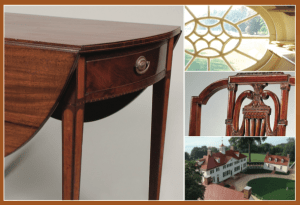 George Washington’s Mount Vernon will partner with Colonial Williamsburg and Fine Woodworking to present the 14th annual Working Wood in the 18th Century conference at Colonial Williamsburg. Mount Vernon curators and restoration staff will explore Washington’s home and the furniture he and Martha acquired to furnish it. Cabinetmakers from Colonial Williamsburg’s Hay Shop will build two pieces at Mount Vernon today: a lady’s knee-hole dressing table made in Williamsburg at the Peter Scott shop, sold to Daniel Parke Custis, Martha Washington’s first husband, in 1754, and brought by Martha to Mount Vernon after she married Washington in 1759; and, an elaborate sculptural candle stand, or torchère, that George Washington purchased for £ 3.10 on December 2, 1759, from the Scottish cabinetmaker James Allan who was then working in Fredericksburg, Virginia.
Guest cabinetmakers Dan Faia of The North Bennet Street School and Jeff Headley and Steve Hamilton of Mack S. Headley and Sons will lead us into the Federal period. Jeff and Steve will reproduce one of the Washingtons’ dining chairs made by John Aitken of Philadelphia in 1797, and Dan will construct a delicate, inlaid Pembroke, or breakfast, table. Colonial Williamsburg’s joiners will demonstrate sash construction by reproducing the famous bull’s-eye window in the pediment of the Mansion.
Along with the conference in Williamsburg, Mount Vernon is planning special interest Mansion, museum, and behind-the-scenes tours for conference participants on January 26 and 30. More information to come as details are in place. If in the meantime, you want to take a look at some of the pieces, they can be viewed at the Mount Vernon website: www.mountvernon.org
Note: The program is the same number of days as previous years but is scheduled later in January and session one runs Sunday through Wednesday and session two Thursday through Sunday.
An event brochure is available here»
Conference: Art Against the Wall
From The Courtauld:
Art against the Wall
The Courtauld Institute of Art, Somerset House, London, 19 November 2011
Organized by Thomas Balfe and Jocelyn Anderson
 Art against the Wall is the third symposium of The Courtauld’s Early Modern department. The symposium will provide an occasion for established and emerging scholars to present and discuss their research together. This one-day symposium will explore the relationship between walls and art in early modern visual culture. During the period 1550-1850 the interplay between work and wall became increasingly complex as art objects began to pull away from the walls which had previously defined them. The enduring association between artistic skill and craft production meant that many art works were often still regarded as elements in overarching decorative schemes; paintings installed in eighteenth-century English domestic interiors, for example, continue to be described as part of the ornamentation, even as the furniture, of a room. Conversely, walls now had the power to redefine art works, giving them a new meaning through a new context; thus, in late sixteenth-century debates on the status of the religious image, walls – which map the division between sacred and secular space – take on crucial importance. Yet the wall could also become art, as the numerous examples of trompe l’oeil wall illustration to be found in seventeenth-century architecture and garden design suggest. Taking as its point of departure Derrida’s insight that there can be no clear separation of ergon (work) from parergon (not-the-work, ‘wall’), the symposium will attempt to investigate the rich questions raised by the phenomenon of art against the wall.
To book a place: £15 (£10 students) Please send a cheque made payable to ‘Courtauld Institute of Art’ to: Research Forum Events Co-ordinator, Research Forum, The Courtauld Institute of Art , Somerset House, Strand, London WC2R 0RN, clearly stating that you wish to book for the ‘Art against the Wall’ symposium. For credit card bookings call 020 7848 2785 (9.30 – 18.00, weekdays only). For further information, send an email to ResearchForumEvents@courtauld.ac.uk
◊ ◊ ◊ ◊ ◊
P R O G R A M M E
9:30 Registration
10:00 Introduction – Jocelyn Anderson and Thomas Balfe (The Courtauld Institute of Art)
SESSION 1: Work, Wall and Space: How Does Art Fit In?
10:15 Rodrigo Cañete (The Courtauld Institute of Art), Velazquez’s Wall Hermeneutics or How Only His Role as Palace Superintendent Can Allow Us to Unlock The Meaning of His Paintings
10:35 Dario Donetti (Scuola Normale Superiore, Pisa), ‘Quattordici cappelle a canto al muro’: Some Architectural Issues Concerning Santa Croce in Florence under Cosimo I de’ Medici
10:55 Catherine McCormack (UCL), Caravaggio’s Madonna of the Pilgrims or Just Another Brick in the Wall?
11:15 Discussion
11:30 COFFEE/TEA BREAK
SESSION 2: Domestic Displays: Art in London Residences
12:00 Adriano Aymonino (Getty Research Institute), The Integration of the Arts in British Neoclassical Interiors: Aesthetics and Meaning
12:20 Susannah Brooke (Queens’ College, Cambridge), Issues of Display: a Private Picture Collection in London, c. 1795-1820
12:40 Gerry Abalone (Tate), Painting, Frame and Setting
13:00 Discussion
13:15 LUNCH (not provided)
SESSION 3: The Wall Transformed: Monumental Illusionism
15:15 Meriel May Geolot (independent scholar), Unravelling the Tapestries: The Gobelin’s Tentures de Boucher in the Late Georgian English Country Home
14:35 Marika T. Knowles (Yale University), Pierrot and the Wall-Mask, or How the Wall Became a Character
14:55 Kristina Kleutghen (Washington University, St Louis), Contradictions of Illusion and Immateriality: Psycho-Pictorial Disjunctions in Early Modern Chinese Wall Paintings
15:15 Discussion
15:30 COFFEE/TEA BREAK
SESSION 4: Ergon/Parergon: Grand Schemes in Palaces
16:00 Kevin Childs (British School at Rome), ‘…piena di grazia, di bellissime fantasie e di molte capricciose…’ Michelangelo’s Sistine Chapel Ceiling and the Wall that is no Wall in late sixteenth-century Roman Fresco Decoration
16:20 Francesco Freddolini (Getty Research Institute), The Eloquent Walls: Stucco Decoration and Display of Art in Seventeenth-Century Rome
16:40 Friederike Drinkuth (Stately Palaces and Gardens Mecklenburg) and Tobias Locker (Technische Universität, Berlin), Reconsidering the Frederican Rococo: The Discovery of Mirow Palace
17:00 Discussion and concluding remarks
17:30 RECEPTION
Abstracts of the talks are available as a PDF file here»
Journée d’étude: Alexandre Lenoir, histoire et collections
As noted at Le Blog de ApAhAu:
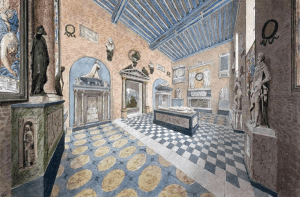
Le musée des monuments français et la construction de l’histoire
Institut national d’histoire de l’art, Paris, 17 November 2011
 8:30 Accueil des participants
9:00 Roland Recht (Collège de France), ouverture de la journée
9:15 Anne Ritz-Guilbert (École du Louvre), François Roger de Gaignières (1642-1715) : collection, méthodes, finalites
10:00 Jean-René Gaborit (conservateur général honoraire, musée du Louvre), Pour l’histoire de la sculpture française. Emeric David versus Alexandre Lenoir : la théorie et le pragmatisme
10:45 Odile Parsis-Barubé (université Charles-de-Gaulle-Lille 3/IRHIS – UMR CNRS 8529), Entre culture de l’inventaire et approche romantique des vestiges : le réveil historien de la province au lendemain de la Révolution (1800-1830)
11:30 Emmanuel de Waresquiel (École pratique des hautes études), Ecrire l’histoire sous la Restauration
12:15 Mary B. Shepard (Friends University, Wichita, Kansas), Alexandre Lenoir et George Grey Barnard : la perspective artistique et la construction de l’histoire
1:00-2:30 pause déjeuner
2:30 Valérie Montalbetti (fondation Pierre de Coubertin, Saint-Rémy-lès-Chevreuse), Alexandre Lenoir, Jean Goujon et la création d’un imaginaire artistique national
3:15 Claire Mazel (C.R.H.I.A., université de Nantes), Alexandre Lenoir, histoire de l’art et politique des arts
4:00 Pascal Griener (université de Neuchâtel), Alexandre Lenoir et le modèle anglais. La politique et l’histoire après la Révolution
4:45 Claude Rétat (CNRS UMR 5611-LIRE), Alexandre Lenoir et les formes du christianisme : art et religion chrétienne dans l’œuvre muséographique et dans le corpus maçonnique (musée des monuments français, œuvre maçonnique publiée et manuscrite)
Conference: Juvarra, Architect for the Savoy, Architect for Europe
From EAHN:
Filippo Juvarra (1678-1736): Architetto dei Savoia, architetto in Europa
La Venaria Reale, Turin, 14-16 November 2011

Filippo Juvarra, Great Stables at La Venaria Reale, Turin, 1722-27. In the eighteenth century, the stables (140 meters in length) could accommodate up to 160 horses.
The third conference of the series Architettura e potere: Lo Stato sabaudo e la costruzione dell’immagine in una corte europea is dedicated to Filippo Juvarra (1678-1736), the abbé from Messina who trained in Rome in the studio of Carlo Fontana and at the Accademia di San Luca, and went on (in 1714) to become first architect of the Savoy court, indissolubly linking his name with that of the capital of the kingdom, Turin. Despite numerous scholarly initiatives dedicated to his activity, knowledge of Juvarra’s work is still open to expansion. The greater part of both Italian and international scholarship has been consistently focused on the Turin-Madrid axis, in consideration prevalently of the executed architecture and its associated projects (whether of a permanent or an ephemeral nature), as well as of his role as a great artistic director. Beyond this core area, which is itself always open to further study, however, several fundamental themes for the activity and influence exercised by Juvarra in the European ambit remain to be investigated. Among these are his travels, which together with the albums of drawings now conserved in Italian and foreign collections were important vehicles for the dissemination of ideas, his heterogeneous architectural activity in other centers in Italy and in Europe (for example in Messina, Naples, Lucca, Como, Mantua, Brescia, Lisbon), and his projects for the decoration of royal and villa gardens and their links to contemporary treatise literature.
The scope of the conference is to approach themes that will generate new contributions, also from the point of view of methodology, aimed at a more comprehensive definition of the figure of Filippo Juvarra, both biographically and by approaching the dynamics and strategies – adopted more or less consciously – that allowed him to leave Sicily, passing through papal Rome (with all the positive and negative aspects of this experience) and arriving in Turin and then in Madrid, in an on-going endeavor to secure commissions in the international ambit.
◊ ◊ ◊ ◊ ◊
The conference program (as a PDF file) is available here»
Conference: The First Actresses at the NPG
The National Portrait Gallery exhibition, The First Actresses, opened last week in London. Here’s information on the exhibition conference:
The First Actresses: Gender, Representation, and Performance
National Portrait Gallery, London, 11 November 2011
Tickets: £35/£30/£20

John Hoppner, "Mrs. Robinson as 'Perdita'," 1782 © Chawton House Library, Hampshire
This one-day conference is organised by the National Portrait Gallery in partnership with The Open University to accompany the exhibition The First Actresses: Nell Gwyn to Sarah Siddons (20 October 2011-8 January 2012). The event brings together the research skills of an international group of academics working in the different disciplines of theatre and performance studies, literature, music and art history and provides a forum in which to address the role of visual and material culture in the formation, promotion and reception of women performers in this period. With its emphasis on the visual culture of the eighteenth-century actress, we hope that the conference will generate stimulating discussions around the exhibition and its themes.
The First Actresses will explore the vibrant yet controversial relationship between art, gender and the theatre in eighteenth-century England. It will chart the emergence of the profession of actress after 1660 by examining the public lives, reputations and representations of female performers during the long eighteenth century. The exhibition will explore the ways in which ambitious portraits and more intimate works, and a growing market for prints and mass-produced objects, were central to the eighteenth-century struggle to professionalize and expand the theatre and develop its close relationship with fine art. The show will argue that the remarkable visibility of portraits of women players, sometimes replete with symbolic and allegorical functions, was crucial to this process. Nevertheless, the public spectacle of these women on display (on stage and in paint) provoked passionate debates on moral and sexual decorum. Commissioned portraits by leading artists, satirical prints and commemorative objects fed these concerns and contributed to the growth of a lively celebrity culture, which has been seen to anticipate the modern ‘star system’. The exhibition will explore some of the aesthetic, gender and class questions which are raised by portraits of actresses, including performers such as Peg Woffington, Sarah Siddons, Dorothy Jordan, Frances Abington, Elizabeth Linley and Giovanna Baccelli.
The exhibition explores the ways in which visual images and written biographies combined to create popular myths, ambiguous histories and sexual scandals. It explores how theatrical portraits can provide traces, fragments and reconstructions of lives and performances. Given its chronological range, it also explores historical shifts in the structure and culture of the theatre, the evolution and popularity of particular roles for women, their creative ambitions and their representations through visual imagery. This is also one of the first exhibitions to explore the roles of music and dance in the repertoire of female performers, considering the close relationship between these genres in eighteenth century theatre and their visual representation.
Combining some well-known paintings and little-known works by artists such as Johann Zoffany, Francis Hayman, William Hogarth, Joshua Reynolds, Thomas Gainsborough, John Hoppner, Samuel de Wilde and Thomas Lawrence such as , this exhibition will also examine the ways in which actresses and artists used portraiture to enhance their reputations and increase their popularity and professional status.
Taking the exhibition as its starting point, the conference will develop the following research themes through individual papers, Q&As and a roundtable:
• What was the role of visual representation in the construction of eighteenth-century celebrity culture and ‘star actresses’?
• How did actress portraits contribute to ideas of ‘public intimacy’ and imagined offstage personalities?
• How did the representation of female roles contribute to eighteenth-century definitions of femininity in the public sphere, and how did actresses use visual imagery to gain cultural authority and earning power?
• What was the relationship between the performance culture of the patent theatres and so-called ‘amateur theatricals’, and how did these associations inform perceptions and representations of women players?
• How did the British taste for Eastern ‘otherness’ and ‘oriental’ plays in the Georgian theatre affect perceptions of women players, their roles and representations?
• How was the eighteenth-century rage for musical theatre (such as operettas, pantomimes, musical comedies) represented through visual representation?
• How were political and cultural issues and concerns with British national identity mediated through women’s roles and their visual representations?
• How did the close relationship between the fine, applied and dramatic arts inform contemporary ideas of spectacle, performance and ‘character’?
◊ ◊ ◊ ◊ ◊
C O N F E R E N C E P R O G R A M M E (more…)










leave a comment