Conference: Secularization and the Libraries of Europe
The primary concerns of this Bodleian conference are neither art historical nor even visual, but there are lots of eighteenth-century offerings around a fascinating topic that is, I think, often understood exclusively as a problem for the sixteenth and seventeenth centuries. In addition to providing the following description, the conference website includes a full list of speakers and paper titles. -CH
◊ ◊ ◊ ◊ ◊
How the Secularization of Religious Houses Transformed the Libraries of Europe
St. Anne’s College, Oxford, 22-24 March 2012
 The dissolution of religious houses transformed both the physical and intellectual spaces in which books and manuscripts were held. The process broke the Church’s earlier dominance in learning and libraries. All of Europe felt these changes between the 16th and 19th centuries, but the results were different in each country. In some cases libraries were scattered or destroyed; in other cases books were taken over as state property. This was an epochal change, affecting thousands of libraries and millions of books, and it transformed the shape of libraries and widened access to heritage books. It increased turnover in the book-market, opened a new interest in collecting books, and fostered the growth of public libraries.
This conference draws together international scholars to examine, for the first time in comparative perspective, the impact that the secularization of
libraries had on the intellectual patrimony of Europe. For registration
information and to see the full list of speakers and themes, visit the
conference website.
Exhibition and Colloquium: The Hôtels Particuliers of Paris
As noted by Hélène Bremer, from the museum’s website:
The Townhouse: A Parisian Ambition / L’hôtel particulier: Une ambition parisienne
Cité de l’Architecture & du Patrimoine, Palais de Chaillot, Paris, 6 October 2011 — 19 February 2012
Curated by Alexandre Gady
The townhouse is a key part of Paris’s architectural character, and we can trace the story of the capital by studying the development of the townhouse in different districts of the city.
 The Parisian townhouse made its first appearance in the Middle Ages and became more popular during the 16th century when, thanks to François I, Paris again became the political capital where the monarchic state assembled and settled. It was important to be at court, near the king, and, therefore, at Paris. This golden age continued throughout the 17th, 18th and 19th centuries. The last of the townhouses were built in the period between the two world wars, marking the end of a long history, but they still exist in today’s 21st-century Paris and are very much in use: (museums, embassies, ministries). This exhibition aims to explore this history and takes the visitor on three complementary and illuminating journeys, in a bid to discover the secret of the Parisian townhouse.
The first section features a small reconstructed townhouse, between garden and courtyard, with different authentically decorated rooms for the visitor to explore. In this way, each visitor can enjoy a sense of familiarity with, and ownership of, the building. The building is not an exact replica of an existing townhouse but aims rather to convey a general impression, an overall picture, with each “external” and internal space specifically designed for educational purposes.
In the second section of the exhibition, the visitor will take a journey through the history of the townhouse, this time organized chronologically, from the Middle Ages to the Belle Epoque. This part of the exhibition, displayed in a vast open space, presents a series of large models of townhouses, specifically chosen for their distinctive characteristics – hôtels de Cluny, Lambert, Thélusson and finally the Palais-Rose (these last two buildings no longer exist) – complete with an interactive terminal with wonderfully illustrated information on some 300 town houses.
The last section offers themed reading, examining the Parisian hotel as an architectural object. Three “alcoves” will be devoted to the relationship between the city and the townhouse – a relationship which was both passionate and destructive. A further three sections allow the visitor to explore the external architecture of the townhouse (façades overlooking gardens and courtyards), its interior décor, gardens and finally internal layout. To complete the display, there is a multi-touch screen on the layout and organization of the townhouse, presented in a fun way.
Alexandre Gady, L’hôtel particulier de Paris: Du Moyen Age à la belle époque, second edition (Paris: Parigramme, 2011), 320 pages, ISBN: 9782840967040, €49.
◊ ◊ ◊ ◊ ◊
Colloquium: L’hôtel particulier des capitales régionales, une ambition française
Cité de l’Architecture & du Patrimoine, Palais de Chaillot, Paris, 2-3 December 2011
Ce colloque placé sous la direction scientifique de Pascal Liévaux, conservateur en chef à la Direction générale des patrimoines et Alexandre Gady, professeur à l’université de Nantes, commissaire de l’exposition L’Hôtel particulier. Une ambition parisienne, fait écho à cette manifestation.
Il propose d’en élargir la thématique à l’ensemble du territoire national et donnera la parole à des chercheurs et à des professionnels du patrimoine. Ces spécialistes témoigneront des dernières avancées dans la connaissance, la conservation, la restauration et la mise en valeur de ces édifices complexes qui, associant au plus haut niveau d’excellence l’architecture, l’art des jardins et celui du décor, témoignent de trois siècles de vitalité et de diversité de l’architecture urbaine sur l’ensemble du territoire national.
Conference in The Hague: Dutch Emotions
From the Huizinga Instituut (as noted by Hélène Bremer) . . .
Cool, Calm, and Collected: The Dutch and Their Emotions in Pre-Modern Times
Koninklijke Bibliotheek, The Hague, 4 November 2011
Conference organizers: Wessel Krul, Herman Roodenburg, and Catrien Santing
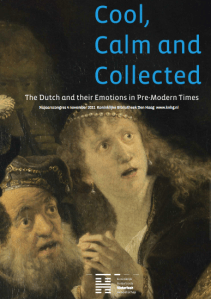 The conference Cool, Calm and Collected aims to enhance the burgeoning history of emotions in the Netherlands. Speakers at the conference will present their current research, integrating the study of emotional standards in advice literature with the study of actual emotional practices in ego documents, chronicles or archival sources. The fields covered will range from politics, philosophy and the urban feud to religion, the stage and the visual arts. The conference will not only be of interest to specialists in the history of emotions but also to the greater historical community.
Although the history of emotions was already suggested as an interesting topic by Lucien Febvre and Johan Huizinga it has been taken up seriously as a subject of historical study only fairly recently. Initially, historians limited themselves largely to the study of documents that prescribed emotional ideals and standards. Researchers are now going beyond such texts. They are currently identifying transformations in emotional ‘communities’ and ‘styles’ on the basis of letters, autobiographies and memoirs, as well as a variety of narrative, archival and visual sources. Historians are also emphasising performativity, what emotions actually do. At the institutional level, in Europe two important research centres have been started: in London the Queen Mary Centre for the History of the Emotions (Thomas Dixon, director); in Berlin the ‘Forschungsbereich Geschichte der Gefühle’ (Ute Frevert, director). This conference seeks to establish a more solid footing for the history of emotions in the Netherlands and join in with these international trends.
The speakers at the conference will discuss the emotional styles of the Modern Devouts and the cult of pugnacity in Late Medieval feuds. Focusing on the seventeenth century, they will reconsider the performativity accorded to the emotions in painting, the theater, and pietist religious movements. For the eighteenth century, speakers will analyse the Dutch ‘cult of sensibility’, the contemporary appreciation and navigation of the sentiments. The day will be closed with a lecture by Dorothee Sturkenboom. She is a pioneer in the study of emotions in the Netherlands and will relate the emotional history of the Dutch to contemporary and more recent views on their ‘national character’. The conference’s keynote lecturer, the well-known English historian Thomas Dixon, will discuss the latest developments in the field.
The conference fee is €30 (€25 for members of the KNHG and €15 for students and PhD students) and includes lunch. The conference fee should be transferred to account number 6934391 of Nederlands Historisch Genootschap in The Hague. Registration by way of an e-mail to: info@knhg.nl, or by telephone: +31 (0)70 3140363.
Conference: Feminist Art History
What a lovely policy for conferences — free and open to the public!
The Second Annual Feminist Art History Conference
American University, Washington, D.C., 4-6 November 2011
Keynote Address:
Mary D. Sheriff, “The Future of Feminist Art History: Where Have We Come From, Where Are We Going?”
The Art History Program of American University (Department of Art, College of Arts and Sciences) presents our second annual Feminist Art History Conference which will take place from Friday November 4 to Sunday November 6, 2011. Corollary events begin on Friday afternoon (12:00-6:00 pm) at the National Portrait Gallery in Washington DC with a lunch, tour, and program in conjunction with the exhibition Seeing Gertrude Stein: Five Stories. Events continue on Friday evening at American University, with a reception and concert of choral music entitled “Gender Settings.” The conference sessions will take place on the American University (AU) campus in Northwest Washington, D.C. on Saturday (9:30 am to 5:30 pm) and Sunday (10:00 am until 12:30 pm). The keynote address will be presented on Saturday evening at 7:00 pm, following a reception.
This second annual Feminist Art History Conference (FAHC) continues to explore the legacy of two pioneering feminist art historians, Norma Broude and Mary D. Garrard, who are now professors emerita of art history at AU. This year’s conference had more than 90 proposal submissions and will include 51 papers in twelve sessions. The papers will span a broad range of topics and time periods, from the medieval era to contemporary art. Together they will demonstrate the myriad ways in which feminist research and interpretation have spread globally and across the spectrum of art historical analysis and scholarship.
The keynote address will be presented by Mary D. Sheriff, W.R. Kenan Jr. Distinguished Professor of Art History at the University of North Carolina, Chapel Hill. Her talk is entitled “The Future of Feminist Art History: Where Have We Come From, Where Are We Going?” In addition to her first book, Fragonard: Art and Eroticism (1990), Sheriff has published The Exceptional Woman: Elisabeth Vigee-Lebrun and the Cultural Politics of Art (1997), Moved by Love: Inspired Artists and Deviant Women in Eighteenth Century France (2008), edited the anthology Cultural Contact and the Making of European Art Since the Age of Exploration (2010), and written numerous articles and reviews. As a deeply engaged feminist art historian, Sheriff has motivated numerous graduate students at UNC-CH to develop feminist-focused dissertations and other research projects, and her publications have inspired feminist scholarship internationally.
At the first FAHC in 2010, participants found a lively forum in which to share views, debate issues, and network in an exciting synergy of feminist interchanges. The impressive number of proposals submitted for this second conference demonstrates the ongoing centrality of the issues raised by feminist art history—a testimony to the continuing vitality of research by feminist scholars developed over the past four decades. Given that Washington, D.C., is becoming a center for the nexus of gender and art, with the AU Art History Program’s longstanding emphasis on feminist methodologies, and the active presence of the National Museum of Women in the Arts, conference planners hope that the annual Feminist Art History Conference at American University will function as a worthy successor to the Barnard College Feminist Art History Conference in New York, which was an important forum for feminist scholarship throughout the 1990s.
The conference is free and open to the public. Advance registration (before 5 pm EST, Friday, October 28) is recommended. Please visit the conference website for more detailed information about the program, registration online, hotels, etc.
A full conference schedule is available here»
Furniture Restoration and Conservation: Stichting Ebeniste
This year’s event , as noted at Onderzoeckschool Kunstgeschiedenis, is held in Dutch (€85 / Students, €70), but next year it will be in English. For students of furniture, it might be a useful organization. As noted at the Stichting Ebeniste website:
The Ninth National Symposium for Wood and Furniture Restoration, Stichting Ebeniste
Amsterdam, 7 October 2011
The Stichting Ebenist is a non-profit organisation with the aim to provide a symposium about wood- and furniture conservation and restoration on a yearly basis. Each year alternating, the symposium is either national (in Dutch) or international (in English). After every symposium the lectures are gathered and published.
The aim of Stichting Ebenist is to learn and broaden our knowledge within the professional field. We want to be a platform where restorers and colleagues from neighbouring fields can meet to share information, experience and research. With these objectives we intend to promote discussion and new channels of communication. This will improve the standards of conservation and restoration, and thereby help us maintain our cultural heritage in the best possible way.
The symposium is attended by approximately 150 to 200 participants. The international symposium is usually spread across two days and includes excursions, while the national symposium lasts one day. The organisation is run by a group of 7 people, all from the restoration and conservation field. Several musea such as the Rijksmuseum and the Amsterdam Historical Museum have given us their support over the years. Also the Stedelijk Museum Amsterdam and the Van Gogh Museum have supported the symposium by providing accommodation. Other institutes such as the Technical University in Delft, the Gelders Oudheidkundig Contact, and auction houses such as Christie’s and Sotheby’s have enabled us to achieve our goals. The ICN and VeRes have helped us through the years to make the symposia possible up to this day. We look forward to seeing you at the next symposium.
Fashioning the Early Modern: Creativity and Innovation
◊ ◊ ◊ ◊ ◊
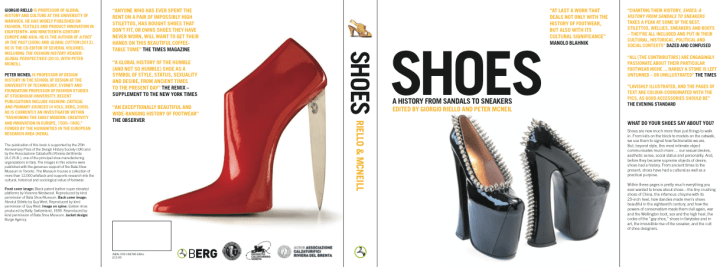
To judge from reactions to the Enfilade posting on the eighteenth-century shoe workshop, I would guess a number of you are quite keen on the topic. If so, you may be interested in this essay by Peter McNeil and Giorgio Riello, “Walking the Streets of London and Paris: Shoes in the Enlightenment,” in Shoes: A History from Sandals to Sneakers, edited by Giorgio Riello and Peter McNeil (London: Berg, 2006), which has just been released in paperback (448 pages for $30).
I learned of the book while perusing the ‘News’ section of the website, Fashioning the Early Modern: Creativity and Innovation in Europe, 1500-1800. The site is the public face of a multi-stage scholarly project. Workshops #3 and #4 are taking place in October and November in Copenhagen and Stockholm with a symposium to be held next year in London. -CH
◊ ◊ ◊ ◊ ◊
The following summary comes from the site:
Why did men from Spain to Sweden start to shave their heads and wear someone else’s hair in the mid-seventeenth century? Why did women decide that it was necessary to wear masks and other full-face coverings in public towards the end of the century? What was the economic and social impact of the sudden proliferation of ribbon-making machines?
Funded by the Humanities in the European Research Area (HERA), this project takes fashion seriously, asking the simple question: how and why did certain goods such as wigs, new textiles, ribbons, ruffs and lace become successful in early modern Europe while others failed? How far did these goods travel and how were they transmitted across linguistic, social and geographic borders? These are questions that remain relevant and our project demonstrates how a study of creativity and innovation as an economic and cultural force in the past can help our understanding of the same issues today.
Clark Conference in LA: Vision and Knowledge
Vision and Knowledge in the Seventeenth and Eighteenth Centuries
William Andrews Clark Memorial Library, UCLA, Los Angeles, 14-15 October 2011
Registration due by 7 October 2011
Conference Organized by Lynn Hunt and Ann Jensen Adams
 “To see is to know,” wrote Aristotle. Even today, “I see” can mean “I understand.” Aristotle understood the connection between sight and knowledge to be physical, however. Before the seventeenth century, the eye was believed to be connected directly to the spirit: an impression of objects seen were understood as physically impressed upon the soul. Sight was, therefore, both the most powerful and the most dangerous of senses. Its perceived power lay behind the explosion of image creation in a wide variety of forms and media in the early modern period; and its perceived danger lay behind the iconoclastic fury of the Protestants who destroyed images in Catholic churches in the Low Countries in 1566. Between the sixteenth and eighteenth centuries in Europe, in a paradigm shift sometimes referred to by the much discussed term the “Scientific Revolution,” a space was opened between vision and the soul, with new attention to the imperfect ocular apparatus, and such voluntary activities as reflection and reason, articulated memorably by Descartes’ “I think, therefore I am.” Empirical experience, enhanced by the invention of such optical devices as the microscope and telescope, took on new meaning, which in turn had a dramatic impact upon beliefs about the nature of images, their function in knowledge production, and the role of makers in their creation.
This conference investigates this moment so crucial to our modern world view through the perspectives of historians of art, of science, and of material culture, in the seventeenth and eighteenth centuries. Our participants examine contemporaneous understandings of sight, and the resulting epistemological status and function of images in producing knowledge, from optics and the practice of fine art, its display, religion, to diagrams and natural history, architecture, travel illustration, colonialism, revolution, and the telegraph.
P R O G R A M
Friday, October 14th
9:30 Morning coffee
9:55 Barbara Fuchs (UCLA), Welcoming and Opening Remarks
10:00 Session I: Religious and Scientific Dimensions of Vision
• Stuart Clark (University of Wales, Swansea), The Discernment of Spirits: Vision and Knowledge in a Religious Context
• Jeanette Peterson (University of California, Santa Barbara), The Science of Optics, Materiality, and the Visionary in Seventeenth- and Eighteenth-Century New Spain
• Lyle Massey (University of California, Irvine), Against the ‘statue anatomized’: Debates over Representation, Dissection, and Vision in Early Modern Anatomy
1:00 Lunch
2:00 Session II: Vision and Representation
• Ann Jensen Adams (University of California, Santa Barbara), Painted Surfaces and the Mechanisms of Sight
• Alexander Marr (University of Southern California), ‘Broken reflections of shapes in Sleepe’: Vision and Knowledge in Richard Haydocke’s Oneirologia
• Erica Naginski (Harvard University), Rococo Vision and the ‘Sonorous Body’ of Architecture
5:00 Reception
Saturday, October 15th
9:30 Morning Coffee
10:00 Session III: Vision, the Body, and Experience
• Elmer Kolfin (University of Amsterdam), When Africans Became Black: The Changing Image of Africans in Early Modern Netherlandish Prints (c.1500–1700)
• Bronwen Wilson (University of British Columbia), Inscription, the Horizon, and Early-Modern Journeys to Constantinople
• Annemieke Hoogenboom (Utrecht University), The Pictorial Diary of Christiaan Andriessen: The Snapshot View of an Eighteenth-Century Painter
1:00 Lunch
2:00 Session IV: Vision and the Political
• Lynn Hunt (University of California, Los Angeles), French Revolutionary Prints and the Discovery of Social Categories
• Richard Taws (University College, London), The Telegraphic Image in Revolutionary France
Williamsburg Symposium on Maps and Prints of Early America
From The Colonial Williamsburg Foundation:
Symposium: More than Meets the Eye: Maps and Prints of Early America
DeWitt Wallace Decorative Arts Museum, Williamsburg, VA, 16-18 October 2011
 In conjunction with the exhibition More than Meets the Eye: Maps and Prints of Early America, Colonial Williamsburg will sponsor a symposium from October 16-18, 2011 that will feature lectures focusing on the men who created these objects, how they assembled and disseminated their information, and the factors that motivated them to create powerful and influential images. Speakers will include Philip Burden, Paul Cohen, Louis De Vorsey, Matthew Edney, William Gartner, and Henry Taliaferro. The conference begins with an opening reception Sunday evening followed by two days of lectures, Monday and Tuesday.
The conference brochure is available for download here»
Exhibition & Symposium: Drawings from the Louvre at the Morgan
I noted the show back in February, but I’m afraid tomorrow afternoon’s lecture series nearly slipped by me. From The Morgan:
◊ ◊ ◊ ◊ ◊
David, Delacroix, and Revolutionary France: Drawings from the Louvre
The Morgan Library and Museum, New York, 23 September — 31 December 2011
Curated by Louis-Antoine Prat and Jennifer Tonkovich with assistance from Esther Bell

ISBN: 9780875981598, $40
From the time of the French Revolution of 1789 through the reign of King Louis-Philippe and the establishment of the Second Empire in 1852, an incredible concentration of artistic talent brought its collective skill to bear on one of the most turbulent times in French history. This exhibition features some of the greatest examples of works on paper of the period from Paris’s famed Musée du Louvre. Included are eighty drawings by such noted artists as David, Prud’hon, Ingres, Géricault, Delacroix, and Corot.
Rarely does the Louvre allow such a major group of drawings, with so many iconic works, to travel. The exhibition will offer visitors a singular opportunity to experience the mastery of the era. The Morgan is the only venue for this important show.
David, Delacroix, and Revolutionary France: Drawings from the Louvre is organized by Louis-Antoine Prat, curator in the Department of Graphic Arts at the Musée du Louvre and Jennifer Tonkovich, curator in the Department of Drawings and Prints at The Morgan Library & Museum, with the assistance of Esther Bell, Moore Curatorial Fellow, The Morgan Library & Museum.
◊ ◊ ◊ ◊ ◊
Symposium — Drawing in the Age of Revolutions: New Perspectives
The Morgan Library and Museum, New York, 24 September 2011
This symposium coincides with the exhibition David, Delacroix, and Revolutionary France: Drawings from the Louvre, which offers the American public a rare opportunity to view some of the most celebrated French drawings from the Louvre. Through a series of brief talks, leading scholars will explore the diversity of draftsmanship during the period and present new research in the field. The program will conclude with a gallery conversation with curators and speakers, allowing for a closer examination of works on view.
The Art Market, Drawings Galleries, and Collectors
Louis-Antoine Prat, Curator, Department of Graphic Arts, Musée du Louvre, and Professor, Ecole du Louvre
Between Language and Painting: the Function of Drawing in the Later Work of Jacques-Louis David
Thomas Crow, Rosalie Solow Professor of Modern Art, and Associate Provost for the Arts, Institute of Fine Arts, New York University
The Louvre Drawings: A Cultural Historian’s Perspective
Stéphane Gerson, Associate Professor of French and French Studies, New York University
Drawing’s Stepchild: The Printed Image from David to Delacroix
Patricia Mainardi, Doctoral Program in Art History Graduate Center, City University of New York
In-Gallery Talks:
“Petits Souvenirs de Bonne Amitié”: Drawings and Friendship in Nineteenth-Century France
Esther Bell, Moore Curatorial Fellow, Department of Drawings and Prints, Morgan Library & Museum
Place and Memory in Nineteenth-Century French Drawings
Alison Hokanson, Research Assistant, Department of Drawings and Prints, Metropolitan Museum of Art
Winterthur Exhibition & Conference: ‘With Cunning Needle’
As noted at A Fashionable Frolick, Winterthur explores the past four centuries of embroidery with the exhibition and conference, With Cunning Needle:
With Cunning Needle: Four Centuries of Embroidery
Winterthur Museum, Delaware, 3 September 2011 — 8 January 2012

Apron, England, 1730-40, silk with gold and silver on silk. Winterthur Museum, 1987.84
In 2006 Plimoth Plantation in Massachusetts began an exciting and innovative project to accurately re-create a 17th-century embroidered woman’s jacket. The process of designing and making what has become known as the Plimoth Jacket has shed new light on the tools and methods employed by the skilled embroiderers of the 1600s. Using the Plimoth Jacket as a touchstone, With Cunning Needle delves into the designs, materials, techniques, and makers of embroidery over four centuries.
Explore each step in the process of creating needlework, from skeins of silk and pattern books to embroidered bed covers and silkwork pictures. Learn about the women and men who made these beautiful objects for themselves, their friends and families, and commercial sale. Discover “lost” skills that have been revived through the Plimoth Jacket project.
With Cunning Needle explores the history of embroidery and invites visitors to take a closer look at the wide array of styles, technology, and people reflected by this art form.
◊ ◊ ◊ ◊ ◊
From the conference webpage:
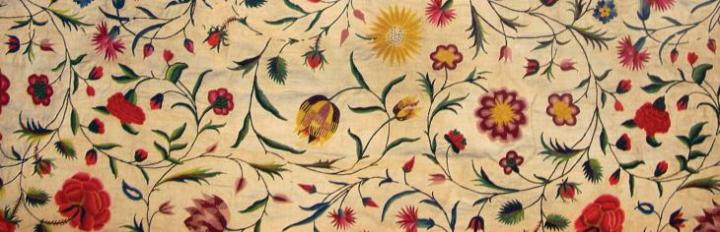
Embroidered petticoat fragment (detail), France, early 1700s. 2010.15. All Winterthur objects pictured on this page were purchased by the museum with funds provided by the Henry Francis du Pont Collectors Circle .
With Cunning Needle: A Winterthur Needlework Conference
Winterthur Museum, Delaware, 21-22 October 2011
L E C T U R E S (more…)










leave a comment