Conference at Edinburgh: Enlightenment Aesthetics and Beyond
Enlightenment Aesthetics and Beyond
University of Edinburgh, 15-16 December 2011
 The Enlightenment Aesthetics and Beyond conference will bring together scholars in aesthetics and the history of philosophy to explore aesthetic theory in the Enlightenment, the reception of British aesthetic theory in Germany, and the significance of these ideas for contemporary debates in aesthetics and other fields.
The conference will address a range of topics, including: taste and judgment; expressivism; the sublime; aesthetics of nature; the intersection of aesthetics and moral philosophy; rationalist and empiricist approaches to aesthetics; and the theories of Du Bos, Hume, Reid, Kant, Schopenhauer and Hegel, among others.
The conference builds upon projects carried out during the National Endowment of the Humanities research seminar, ‘Scottish Enlightenment Aesthetics and its German Reception’, held in St Andrews, Scotland, 2007. The conference is part of a series of events across the University of Edinburgh marking the tercentenary of David Hume’s birth (2011): ‘Celebrating Connections‘.
Keynote Speakers: Paul Guyer (Murray Professor of the Humanities, University of Pennsylvania) and Peter Jones (University of Edinburgh)
P R O G R A M M E
Thursday, December 15th
9:00 Registration
9.30 Jason Gaiger (Oxford University), ‘Du Bos and the “Democratisation” of Taste’
10:30 Coffee
11:00 James Shelley (Auburn University) ‘Hume on Choosing an Author’
12:00 Rachel Zuckert (Northwestern University) ‘Reid’s Expressivist Aesthetics’
13:00 Lunch
14:00 Keynote: Paul Guyer (University of Pennsylvania), ‘”A Treasure Chamber of the Human Soul”: Baumgarten, Mendelssohn, and Herder’
15:00 Tea
15:30 Jonathan Friday (University of Kent), TBA
17:30 Reception and Beholder art exhibition, Talbot Rice Gallery, Old College
19:30 Conference Dinner
Friday, December 16th
9:30 Keynote: Peter Jones (Emeritus Professor, University of Edinburgh), ‘Once More Back to the Contexts’
10:30 Coffee
11:00 Alex Neill (University of Southampton), ‘Schopenhauer and 18th-Century British Philosophy’
12:00 Lunch
13:00 Alison Stone (Lancaster University), ‘Early German Romanticism, Aesthetics, and Nature’
14:00 Closing discussion
Saturday, December 17th
9:30 Historic City Tour with Charles Withers (Professor of Historical Geography, University of Edinburgh), registration required
BGC Study Day: Conserving Hats
From the BGC:
Study Day: The Conservation of Historic Hats
Bard Graduate Center, New York, 14 October 2011

Henry Pickering, "Portrait of Eleanor Frances Dixie, daughter of Wolstan Dixie, 4th Baronet," 1753 (Nottingham City Museums & Galleries)
This study day introduces rate examples of headwear from the collection of the Metropolitan Museum of Art including: Tudor flat caps, a straw hat purported to be a gift from Henry VIII, and hats by Philip Treacy. Textile conservator Chris Paulocik will discuss the conservation and storage of these unique objects. After lunch at the BGC, artist and textile historian Edward Maeder will demonstrate the construction of selected hats from the eighteenth through twentieth centtury. Participants will learn stitching techniques using straw, ribbons, floral decoration and feathers.
Chris Paulocik is a textile conservator at the Metropolitan Museum of Art.
Edward Maeder is an artist, textile historian, and former curator of costumes and textiles at the Los Angeles County Museum of Art.
$130 Adult / $100 Students and Seniors — Registration fee includes a supply kit.
The Wallace Collection’s Reynolds Research Project
Exciting news from The Wallace Collection (22 July 2011) . . .

X-Ray Image of the Portrait of 'Mrs Jane Braddyll', Wallace Collection, 2011
The Wallace Collection Reynolds Research Project is a three year project funded by The Paul Mellon Centre for Studies in British Art. A collaboration between the Wallace Collection and the Conservation and Scientific Departments at the National Gallery, its purpose is to investigate the techniques and materials used by Reynolds by examining twelve of his paintings, which are in the Wallace Collection; and use this research as a basis for their conservation.
To examine the paintings, images are captured using high resolution digital photography, infrared and x-ray, and small paint samples are taken. Initial results have already revealed how complex Reynolds’ technique really was!
This very exciting project will continue to yield new and surprising results, with all the research being made publicly available later in the project. Alongside this, the Wallace Collection will continue to provide updates as new discoveries are made. The first restored painting has already arrived back at the Collection: Mrs Elizabeth Carnac, which can now be seen in the Great Gallery. The project will culminate in an exhibition, catalogue and scholarly conference at the Collection in 2014, which is sure to be well worth the wait!
North American Conference on British Studies, November 2011
Annual Meeting of the North American Conference on British Studies
Denver, 18-20 November 2011
 Registration is now open for the 2011 annual meeting of the North American Conference on British Studies, hosted by the Western Conference on British Studies. The conference will take place November 18-20, 2011, at the Sheraton Downtown Denver, right in the heart of the city. Details are available here»
Third Anglo-Italian Conference at York
This interdisciplinary conference is devoted to investigations of ‘the Marginal and the Mainstream’ in and between Italy and Great Britain in the eighteenth century. A number of sessions may be of interest to HECAA members, particularly the ‘Cultural Transfers’ and ‘Taste in the Arts’ panels. For registration details and accommodation information, see the Centre for Eighteenth-Century Studies website. –FG
◊ ◊ ◊ ◊ ◊
Third Anglo Italian Conference: The Marginal and the Mainstream in the Eighteenth Century
King’s Manor, York, 13-14 September 2011
Event Organisers: Frank O’Gormanand Lia Guerra
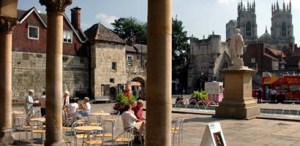 The counterpoint between the marginal and the mainstream has been for many decades a compelling and an important one. The idea of a ‘mainstream’ or ‘major stream’ may have an aquatic origin but in recent centuries has come to be associated with the idea of important or principal matters in hand, implying also the notion of something important, mighty, or even popular. In recent decades, the implication of ‘scholarly fashion’ may also have been added. Down to the sixteenth century the notion of ‘the marginal’ referred to the margin of a text, the space between the edge of the book and the text itself. Later, this idea admitted the concept of a boundary and later still the notion of the contour and border beyond which something ceases to be possible and desirable. Today, most scholars recognise a yet further extension to these definitions, the idea of dissident ideas, practices or opinions existing on the sidelines of the majority. (more…)
Exhibition: ‘The First Actresses’ in London
Press release rom the NPG:
The First Actresses: Nell Gwyn to Sarah Siddons
National Portrait Gallery, London, 20 October 2011 — 8 January 2012
Curated by Gill Perry, supported by Lucy Peltz

John Hoppner, "Mrs. Robinson as 'Perdita'," 1782 © Chawton House Library, Hampshire
The first exhibition to explore art and theatre in eighteenth-century England through portraits of women will open at the National Portrait Gallery in October 2011. With 53 portraits, some brought together for the first time and others not previously seen in public, the exhibition will show the remarkable popularity of actress-portraits and provide a vivid spectacle of eighteenth-century femininity, fashion and theatricality. The First Actresses: Nell Gwyn to Sarah Siddons will show large paintings of actresses in their celebrated stage roles, intimate and sensual off-stage portraits and mass-produced caricatures and prints, and explore how they contributed to the growing reputation and professional status of leading female performers.
The exhibition will combine much-loved works by artists such as Joshua Reynolds, Thomas Gainsborough, John Hoppner, Thomas Lawrence, Johann Zoffany and James Gillray, with some newly discovered works such as the National Portrait Gallery’s new acquisition of the Three Witches from Macbeth by Daniel Gardner.
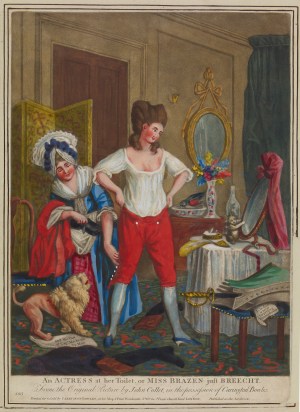
After John Collett, "An Actress at Her Toilet or Miss Brazen just Breecht," ca. 1779
Actresses featured in the exhibition include Nell Gwyn, Kitty Clive, Hester Booth, Lavinia Fenton, Peg Woffington, Sarah Siddons, Mary Robinson, Dorothy Jordan, Elizabeth Farren, Giovanna Baccelli and Elizabeth Linley. Highlights include a little known version of Reynolds’s famous portrait of Sarah Siddons as the Tragic Muse, Hogarth’s The Beggar’s Opera, Gainsborough’s portraits of Giovanna Bacelli and Elizabeth Linley. Important loans include works from the Garrick Club Library, the Royal Shakespeare Company, the National Gallery of Art, Washington, The Fitzwilliam Museum, Cambridge, Tate Britain, the V&A, as well as Petworth, Kenwood and Longleat Houses.
Starting with the emergence of the actress’s profession in the late seventeenth century, The First Actresses: Nell Gwyn to Sarah Siddons will show how women performers, in drama, as well as music and dance, were key figures within a spectacular celebrity culture. Fuelled by gossipy theatre and art reviews, satirical prints and the growing taste for biography, eighteenth-century society engaged in heated debate about the moral and sexual decorum of women on stage and revelled in the traditional association between actress and prostitute, or ‘whores and divines’. The exhibition will also reveal the many ways in which women performers stimulated artistic innovation and creativity and provoked intellectual debate.
As well as focusing on the eighteenth-century actress as a glamorous subject of high art portraits, and the ‘feminine face’ of eighteenth century celebrity culture, the exhibition will look at the resonances with modern celebrity culture and the enduring notion of the actress as fashion icon. As a counterpoint to the exhibition, an accompanying display will show photographic and painted portraits, drawn from the Gallery’s permanent collections, of some of today’s actresses, some of whom have agreed to be the exhibition’s ‘Actress Ambassadors’. A full list will be published prior to opening.
◊ ◊ ◊ ◊ ◊
An exhibition conference will take place on Friday, 11 November 2011.
Exhibition catalogue: Gill Perry with Joseph Roach and Shearer West, The First Actresses: Nell Gwyn to Sarah Siddons (London: National Portrait Gallery, 2011), 160 pages, ISBN: 9781855144118, £30.
Exhibition and Conference: ‘Palladio and His Legacy’
This show which was at the Morgan last summer opens at Notre Dame with a full conference this weekend. My sense is that the exhibition functions rather differently in these two venues — one might think not only about the reception of Palladio but also the reception of the exhibition. From the Snite website:
Palladio and His Legacy: A Transatlantic Journey
The Morgan Library and Museum, New York, 2 April — 1 August 2010
National Building Museum, Washington D.C., 2 September 2011 — 30 January 2011
Snite Museum of Art, Notre Dame, 5 June — 31 July 2011
Carnegie Museum of Art, Pittsburgh, 3 September — 31 December 2011
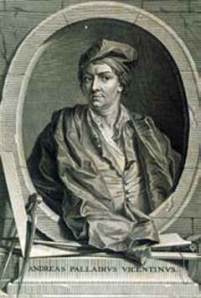
Conjectural portrait of Andrea Palladio, ca. 1715, engraved after Sebastiano Ricci (RIBA British Architectural Library)
This traveling exhibition organized by the Royal Institute of British Architects in association with the Centro Internazionale di Studi di Architettura Andrea Palladio, Vicenza, offers a rare opportunity to see thirty-one drawings by the famous 16th-century architect, Andrea Palladio, along with seven books, fifteen models of related buildings, and eight bas-reliefs of some of the drawings (3-D projections of architectural drawings).
The Late Italian Renaissance master Andrea Palladio (Italian, 1508–1580) is the most influential architect of the last 500 years. His architecture synthesized the lessons of the ancient Romans with the achievements of his predecessors and contemporaries, including Bramante, Raphael, and Michelangelo. Palladio’s mastery of the classical orders, proportion, and harmony was unparalleled. His projects in Venice and the surrounding region set new standards in design and redefined the potential of the art form, especially for domestic structures.
◊ ◊ ◊ ◊ ◊
From Vernacular to Classical: The Perpetual Modernity of Palladio
University of Notre Dame School of Architecture, 10-12 June 2011
Bringing together scholars, practitioners, educators, and students from various disciplines, the conference will explore how the Palladian tradition inspires the evolution of classical architecture. One of the most influential architects in history, 16th-century Italian Andrea Palladio’s impact is evident throughout the United States. Buildings such as the White House, the U. S. Capitol, the U.S. Supreme Court, and the National Gallery of Art bear his imprint. Thomas Jefferson’s Virginia home, Monticello, is modeled after Palladio’s famed Villa Rotonda in Vicenza, Italy. Conference participants will reconnect Palladian ideals to the living tradition that has informed these icons of American democracy and continue to shape vital paradigms for sustainable architecture and urbanism. Two exhibitions, Palladio and His Legacy: A Transatlantic Journey at the University of Notre Dame’s Snite Museum of Art and the New Palladians, an exhibition of 50 international classical architects’ work in the Bond Hall Gallery, also will be held in conjunction with the conference.
C O N F E R E N C E S C H E D U L E (more…)
Conference at York: The Portrait and the Country House
From York’s Centre for Eighteenth-Century Studies:
Placing Faces: The Portrait and the Country House in the Long Eighteenth Century
King’s Manor, York, 11 June 2011
Postgraduate Organisers: Jordan Vibert and Hannah Lyons
This interdisciplinary conference is concerned with the complex relationship between eighteenth-century portraits and the places they were so often ultimately destined for – the country houses of Britain’s landed elites. These grand houses were vast public spaces, used by their owners to systematically showcase their political power and social status. Commissioning and displaying portraits was one way in which a family could aggrandize themselves, whether by making a genealogical link to a military hero or a royal relative, or by making a broader national claim to political allegiance or imperial dominance. But portraits could also interact with country houses in other quite surprising ways, drawing together seemingly disparate contexts and narratives to create new and unexpected meanings. A portrait of a woman, for example, could vastly complicate seemingly confident masculine displays of martial heroism and political power, while a depiction of a dead child might forge unsettling connections between private grief and public narratives of bloody warfare and imperial dominion. It is these complex interactions between the portrait and the wide array of familial and national narratives at work in the country house that this conference sets out to unravel. Our speakers are a mixture of established academics, professional curators and young researchers working in a range of disciplines and environments.
P R O G R A M M E Printer-friendly programme (Word. doc)
10.30 Registration and tea/coffee
11.00 Session 1: The Portrait and the Estate
- Keynote Speaker – Dr Kate Retford (Birkbeck College, University of London) ‘The Topography of the Conversation Piece – A Walk around Wanstead’
- Dr Leslie Johansen (Council for British Archaeology) ‘A Look into the Prospect Beyond: The Portrait and the English Designed Landscape’
12.30 Lunch
1.25 Session 2: Collection and Display
- Desmond Shawe-Taylor (Surveyor of the Queen’s Pictures) ‘George IV as a Collector of full-length Portraits’
- Professor Marcia Pointon (University of Manchester) ‘The Woburn Abbey Portraits’
2.40 Tea/coffee
3.10 Session 3: Gendered Displays
- Professor Gill Perry (Open University) ‘Dirty Dancing at Knole: Portraits of Giovanna Baccelli and the Performance of ‘Public Intimacy’
- Jordan Vibert (University of York) ‘Lady Anne Stanhope and Sir Francis Blake Delaval at Ford Castle: Female Sociability, Military Masculinity and the Seven Years’ War’
The conference fee is £12 (£10 for registrations received before 31st March). This fee includes tea, coffee and a simple sandwich lunch.
For details concerning registration, consult the CECS website.
20 Grants for Traveling to 2012 CAA in Los Angeles
Given that many of Enfilade’s readers are not based in the U.S., this announcement may be useful, especially for readers “from developing countries or from nations not well represented in CAA’s membership.” It would be nice to see a scholar of the eighteenth century among the recipients, and we would love to see you at the HECAA events. From CAA News:
The Getty Foundation has awarded a $100,000 grant to CAA in support of international travel for twenty applicants to attend the 100th Annual Conference and Centennial Celebration, taking place February 22–25, 2012, in Los Angeles. Through the new Getty Foundation Travel Grant Program, CAA will provide funds for travel expenses, hotel accommodations, per diems, and conference registrations. Recipients will also receive one-year CAA memberships. Applicants may be art historians, artists who teach art history, and art historians who are museum curators; those from developing countries or from nations not well represented in CAA’s membership are especially encouraged to apply.
The goal of the project is to increase international participation in CAA and to diversify the organization’s membership (presently sixty-five countries are represented). CAA also wishes to familiarize international participants with the submission process for conference sessions and to expand their professional network in the visual arts. Members of CAA’s International Committee have agreed to host the participants, and the National Committee for the History of Art will also lend support to the program.
CAA will publish an official call for grant applications on its website on Friday, July 8, 2011; the program will also be publicized in CAA News. A jury will select the twenty grant recipients.
First Annual Art History Festival at Fontainebleau
Thanks to Melissa Hyde for pointing this out. From the festival website:
Festival de l’histoire de l’art
Fontainebleau, 27-29 May 2011
 Le festival, c’est une série de conférences, de débats, de concerts, de lectures, autour d’un thème et d’un pays invité, qui changeront chaque année. Pour cette première édition, le choix s’est porté sur la Folie et l’Italie. Mais c’est aussi un ensemble de rendez-vous pérennes: un forum traitant des questions d’actualité en histoire de l’art, un salon du livre et des revues d’art, et un festival du film d’art. De plus, accompagnant l’introduction de l’histoire de l’art dans les programmes du primaire et du secondaire, l’université de printemps de l’Éducation Nationale s’associe au festival. Vous trouverez ci-dessous les programmes de toutes ces manifestations.
Details, including a full program, are available here»










leave a comment