Exhibition | Taming Traders: Origins of the New York Stock Exchange
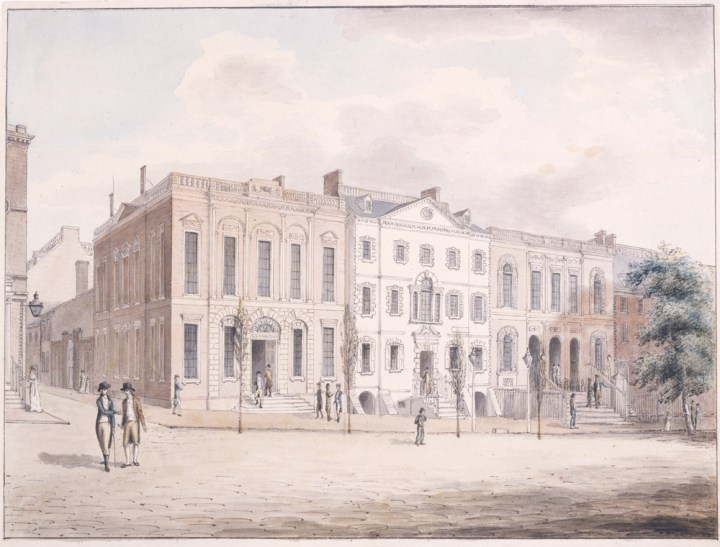
Archibald Robertson, View up Wall Street, ca. 1798; watercolor, black ink, and graphite on paper
(New-York Historical Society)
◊ ◊ ◊ ◊ ◊
Now on view at the New-York Historical Society:
Taming Traders: Origins of the New York Stock Exchange
New York-Historical Society, 31 March — 11 June 2017
Curated by Michael Ryan
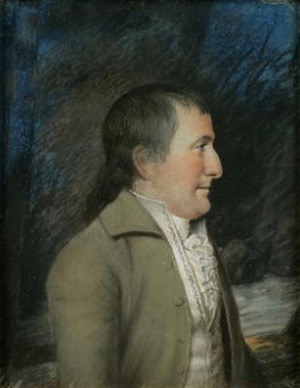
James Sharples Sr., Portrait of Leonard Bleecker, ca. 1796–1801; pastel on paper (New-York Historical Society).
On May 17, 1792―under a buttonwood tree, the site of street trading at the time―24 stock brokers signed an agreement that regulated aspects of trading, thus creating the New York Stock Exchange. Before then, in the early days of the new republic when the United States was deeply in debt, it was Alexander Hamilton’s job as the first Secretary of the Treasury to persuade his colleagues in the first Congress that debt could be a beneficial commodity that could be sold and traded. But rampant speculation in war debt and bank stock turned to financial panic and provided the cautionary backdrop for the drafting of the Buttonwood Agreement in May 1792, which would change global commerce forever.
On the 225th anniversary of the New York Stock Exchange, Taming Traders: Origins of the New York Stock Exchange charts the development of this crucial trading institution. Objects on display include early bond and stock certificates, correspondence, portraits of traders, and views of Wall Street and the Tontine Coffee House. Also on view will be video clips from New-York Historical’s major oral history project, Remembering Wall Street, 1950–1980. The exhibition is curated by Dr. Michael Ryan, New-York Historical vice president and director of the Patricia D. Klingenstein Library.
Conference | Winckelmann and Switzerland
From H-ArtHist, with the program available as a PDF file here:
Winckelmann und die Schweiz
Schweizerisches Institut für Kunstwissenschaft, Zurich, 18–19 May 2017
Registration due by 12 May 2017
 1778 erschien in Zürich bei Orell, Gessner, Füesslin und Compagnie die von Leonhard Usteri herausgegebene Sammlung «Winckelmanns Briefe an seine Freunde in der Schweiz», ein sprechendes Zeugnis der in den 1750er Jahren begründeten und stetig bedeutender werdenden Beziehungen zwischen Johann Joachim Winckelmann und einzelnen Schweizer Persönlichkeiten, namentlich Johann Caspar Füssli, Heinrich Füssli, Salomon Gessner, Christian von Mechel, Leonhard Usteri und Paul Usteri.
Winckelmann, wie viele europäische Intellektuelle des 18. Jahrhunderts ein begeisterter Verehrer der «freien» eidgenössischen Schweiz, plante wiederholt eine Reise in das Alpenland mit römischer Vergangenheit, doch am Ende hat er die Schweiz nie besucht. Dessen ungeachtet waren sein Werk und seine Person nicht nur in Zürich anerkannt. Anlass zu gegenseitiger Wertschätzung gaben jenseits des brieflichen Austausches auch persönliche Begegnungen wie die mit Angelika Kauffmann; weitere Kontakte schufen Winckelmanns Führungen für Schweizer Reisende in Rom, die im Frühjahr 1761 in seinem «Sendschreiben» für Leonhard Usteri ihre Systematisierung fanden und durch Unterweisungen für Heinrich Füssli, Paul Usteri und Christian von Mechel ergänzt werden sollten. Eine Erweiterung des Bekanntenkreises brachten zudem gemeinsam unternommene Reisen—so mit Johann Caspar Füssli nach Neapel—, verlegerische Projekte wie der zunächst erwogene Druck der «Geschichte der Kunst» in der Schweiz und natürlich die wechselseitige Rezeption der Werke.
Das vom Schweizerischen Institut für Kunstwissenschaft (SIK-ISEA) in Zusammenarbeit mit der Winckelmann-Gesellschaft, Stendal, und dem Kunsthistorischen Seminar der Universität Basel organisierte Kolloquium hat zum Ziel, die bislang wenig erforschten Kontakte zwischen Winckelmann und Schweizer Persönlichkeiten fächerübergreifend und auf der Basis aktueller archivalischer Recherchen zu beleuchten sowie die Aufnahme seines Werkes durch Schweizer Intellektuelle und Künstler zu untersuchen. In den Blick rücken auch die Schweiz als Plattform der Kulturvermittlung in ihrer Bedeutung für Winckelmann sowie der Ästhetik-Diskurs in der Schweiz, Deutschland und Italien nebst der Antikenrezeption in der Schweiz im 18. Jahrhundert.
Die Teilnahme am Kolloquium ist kostenlos. Die Platzzahl ist beschränkt. Bitte melden Sie sich an bis am 12. Mai 2017 (sik@sik-isea.ch).
In der Bibliothek Werner Oechslin wird am 20. Mai 2017 eine Ausstellung zu Winckelmann eröffnet, die in rund 100 Exponaten dessen Entwicklung vom Bibliothekar zur Gründerfigur der deutschen Kunstwissenschaft herausstellt. In besonderer Weise thematisiert wird dabei der Kontrast zwischen der Figur des Antiquars, der sich gemäss Caylus der «Physique» der Kunstgegenstände bis in alle Verästelungen hinein widmen soll, und dem nach Höherem strebenden, idealisch denkenden Winckelmann; darauf beziehen sich sowohl die Vorstellung des Klassischen wie ein ethisch begründeter Schönheitsbegriff mit Wirkungen bis in unsere Zeit. Die Ausstellung dauert bis Ende 2017.
D O N N E R S T A G , 1 8 M A I 2 0 1 7
13.30 Begrüssungsworte: Roger Fayet (Direktor, SIK-ISEA), Max Kunze (Präsident der Winckelmann-Gesellschaft, Stendal), Andreas Beyer (Kunsthistorisches Seminar der Universität Basel)
13.45 Die Schweiz als neues Arkadien
Moderation: Roger Fayet (Direktor, SIK-ISEA)
• Andreas Beyer (Kunsthistorisches Seminar der Universität Basel), Arkadische Schweiz
• Volker Riedel (Mitglied des Kuratoriums, Winckelmann-Gesellschaft, Stendal), Winckelmann und Gessner: Zur Problematik der Idylle im 18. Jahrhundert
• Matthias Oberli (Abteilungsleiter Kunstdokumentation, SIK-ISEA), «Merckwürdige Überbleibsel» und «stattliche Antiquitäten»: Zum Antikenverständnis in der Schweiz im Zeitalter Winckelmanns
15.15 Kaffeepause
15.45 Freundschaften und Netzwerke
Moderation: Gérard Seiterle (ehemals Direktor des Museums zu Allerheiligen, Schaffhausen)
• Max Kunze (Präsident der Winckelmann-Gesellschaft, Stendal), Antiken-Empfehlungen: Winckelmanns Schweizer Freunde in Rom
• Elisabeth Décultot (Humboldt-Professur für neuzeitliche Schriftkultur und europäischen Wissenstransfer, Germanistisches Institut, Martin-Luther-Universität Halle-Wittenberg), Christian von Mechel: Zu einer Schlüsselfigur von Winckelmanns schweizerischem Netzwerk
• Christoph Frank (Istituto di storia e teoria dell’arte e dell’architettura (ISA), Università della Svizzera italiana), Winckelmann und Basel: Christian von Mechel und Johann Friedrich Reiffenstein
17.15 Aperitif
18.15 Abendvortrag
• Marcel Baumgartner (em. Ordinarius für Kunstgeschichte, Justus-Liebig-Universität, Giessen), Kunstgeschichten: Winckelmann—Piranesi—Caylus—Herder
F R E I T A G , 1 9 M A I 2 0 1 7
9.30 Die Künste in der Schweiz
Moderation: Matthias Fischer (Kurator Kunst- und Grafiksammlung, Museum zu Allerheiligen, Schaffhausen)
• Gisela Bungarten (Stellvertretende Direktion und Projektmanagement, Museumslandschaft Hessen – Kassel), Füssli und Winckelmann: Wechselvolle Beziehungen in Zürich, Rom und London
• Dieter Ulrich (lic. phil., freischaffender Kunsthistoriker), «Hohe Griechische Einfalt bezeichnete seine Wercke und hauchte Leben in seinen Marmor.»
• Michael Thimann (Kunstgeschichtliches Seminar und Kunstsammlung, Georg-August-Universität Göttingen), Schweizergeschichte statt homerische Helden. Antiklassizistische Bildkonzepte um 1800
11.00 Kaffeepause
11.30 Konzepte und Strategien
Moderation: Adelheid Müller (wissenschaftliche Mitarbeiterin am Projekt «Winckelmann-Ausgabe» der Akademie der Wissen-schaften und der Literatur, Mainz)
• Eva Kocziszky (Institutsdirektorin, Pannonische Universität Veszprém, Institut für Germanistik und Translations-wissenschaft), Die Allegorie bei Winckelmann, Lavater und Füssli
• Johannes Rössler (Institut für Kunstgeschichte der Universität Bern), Kunst und Wissenstransfer im Zeichen Winckelmanns 1795–1830: Das Schweizer Netzwerk von Heinrich Keller (Rom), Heinrich Meyer (Weimar) und Johann Jakob Horner (Zürich)
• Hans Christian Hönes (Forschungsgruppe «Bilderfahrzeuge», The Warburg Institute, London), Die Sümpfe der Schweiz: Klimatheorie und Ursprungssuchen
13.00 Mittagspause
14.00 Formen der Rezeption
Moderation: Andreas Beyer (Kunsthistorisches Seminar der Universität Basel)
• Bettina Baumgärtel (Leiterin der Gemäldegalerie, Museum Kunstpalast Düsseldorf), Die vielen Gesichter des Winckelmann: Die Wandlungen des Winckelmann-Bildes von Angelika Kauffmann
• Adelheid Müller (wissenschaftliche Mitarbeiterin am Projekt «Winckelmann-Ausgabe» der Akademie der Wissenschaften und der Literatur, Mainz), «Flammenworte der Begeisterung» oder: Bündnisse, gefühlt und gelebt. Friederike Brun, Winckelmann und die Schweizer Freunde
• Harald Tausch (Institut für Germanistik / Arbeitsbereich Literatur, Justus-Liebig-Universität Giessen), Kreis ohne Meister: Kleist, Winckelmann und die Schweiz
15.30 Kaffeepause
16.00 Schlussbetrachtungen
• Werner Oechslin (Stiftung Bibliothek Werner Oechslin, Einsiedeln), «…zuerst unter dem griechischen Himmel…»
16.45 Aperitif
Exhibition | Menorah: Worship, History, Legend
Press release (20 March 2017) from the Primo Levi Center:
The Menorah: Worship, History, and Legend
Vatican Museums and the Jewish Museum of Rome, 15 May — 23 July 2017
Curated by Arnold Nesselrath, Alessandra Di Castro, and Francesco Leone
The Vatican Museums and the Jewish Museum of Rome present the exhibition The Menorah: Worship, History and Legend, which opens on May 15th, 2017 at both venues and will remain open until July 23, 2017. This is the first time that the Vatican collaborates with a Jewish Museum. The project was initiated in a spirit of dialogue and mutual understanding by the Jewish Community of Rome and the Vatican administration. The exhibition is co-curated by Arnold Nesselrath, Deputy director of the Vatican Museum’s Curatorial Department and the Conservation Laboratory, Alessandra Di Castro, Director of The Jewish Museum of Rome, and Francesco Leone, Associate Professor of Contemporary Art History at Chieti-Pescara’s ‘G. D’Annunzio’ University, in collaboration with an interdisciplinary team of prominent scholars.
One hundred and thirty treasures recount the story and vicissitudes of the Second Temple’s Menorah, the seven-branch candelabrum that in the year 70 CE was looted from Jerusalem by Titus’s troops and transported to Rome. In the empire’s capital, the Menorah was displayed as trophy in the Forum’s Temple of Peace. This event is recorded in the famous bas-relief that decorates the Arch of Titus as well as in Flavius Josephus’s historical chronicle De Bello Judaico.
According to the Hebrew Bible, at the Lord’s request, Moses had the Menorah forged in pure gold and displayed it in the First Temple. As explained in the Book of Exodus, this ritual object was intended as a symbol of the covenant between the Lord and the Children of Israel. That first Menorah is thought to have been destroyed with the first Temple by Nebuchadnezzar II of Babylon in 586 BCE.
Intertwining history and myth, the story of the Menorah is depicted in the exhibition through major works of art from antiquity to the present, including archaeological objects, sculptures and paintings, architectural and decorative artifacts, manuscripts and illuminated books.
It was in Rome, at the height of the imperial era, that the Menorah became the symbol that most powerfully encapsulates the culture and religion of Judaism. This happened at approximately the same time when the symbols of Christianity were acquiring their final shape and form. Since then, the Menorah has become the emblem of Judaism par excellence, and it is seen in the Jewish world as tangible evocation of divine light, of the cosmic order of creation and of the ancient covenant; as symbol of the burning bush and the tree of life; as testimony to the biblical Shabbat.
Soon after its removal from the Temple, the Menorah began to be depicted in myriad places and on every possible occasion, in the East as well as in the West. We find marvelous examples of it in the Roman Jewish catacombs, on sarcophagi and funerary inscriptions, graffiti, coins and gold-leafed glass, necklaces, pendants, and jewelry of all kinds. This proliferation of depictions is documented in the exhibition through items spanning from the 1st century CE to the 20th century, when the Menorah made its appearance on the emblem of the newly founded State of Israel.
Having made its world appearance in Rome, from Rome the historical Menorah also disappeared. It was probably around the 5th century, when it is said to have been looted by the Vandals in the sack of 455 CE. According to legends and chronicles, it was brought first to Carthage and then to Constantinople. Thereafter, the Menorah’s fate became increasingly shrouded in mystery: it vanished for ever leaving space to countless sagas that for centuries sought in vain to perpetuate its material life. From that date on, all accounts of the celebrated seven-branch candelabrum fell into the realm of legend, in a plethora of romantic tales set in the Middle Ages and after into the 19th century, most of which have been incorporated in the exhibition’s narrative.
Another crucial aspect of the Menorah’s history resides in its relation with early Christian iconography. In the Middle Ages, Christian art began to adopt the Menorah as its own. Seven-branch candelabra were placed in churches for liturgical purposes. This fascinating overlapping of symbols is narrated through several 14th- and 15th-centuries objects including the monumental candelabra from the Sanctuary of the Mentorella, in Prato and Pistoia, and a pair of 18th-century candelabra from Palma de Mallorca (Capitular Museum, Cathedral de Mallorca). Other treasures on display include a recently discovered 1st-century stone bas-relief from the site of the ancient synagogue of Magdala, Galilee; a rare Roman gold-leafed glass; sarcophagi and tombstones from the Jewish catacombs in Rome; the Carolingian Bible of St. Paul, Roman Baroque silverware and paintings by masters including Giulio Romano, Andrea Sacchi, Nicolas Poussin, and Marc Chagall.
The exhibition will be held simultaneously at two venues: the Braccio di Carlo Magno at the Vatican Museums and the Jewish Museum of Rome. It is organized in three sections. The first is comprised of three chapters: Visualizing the Menorah; The Menorah in the Temple and Jewish Art: Iconography and Symbolism; and The Menorah in Ancient Art from Jerusalem to Rome.
The second section is subdivided in four parts: From Late Antiquity to the 14th Century; The Renaissance; The Menorah in Painting from the 16th to the 19th Century; and The Menorah in Jewish Decorative Arts from the Middle Ages to the Dawn of the 20th Century. Taking visitors on a rich artistic journey, it traces the legend of the Menorah from late antiquity to the 20th century, focusing in particular on Christian appropriations and on its perpetuation as an emblem for Jewish culture and identity. A series of paintings explore the popularity of the Menorah in figurative and decorative arts from the Renaissance through the 19th century.
The third section, entitled From the Aftermath of World War I to the 21st Century, takes into consideration works by well-known 20th- and 21st-century artists who depicted the Menorah in modernist artistic styles, combining the deconstruction of traditional forms with a new appraisal of the symbolic relation between Rome and Jerusalem, an emblematic trope of such post-emancipation works as Moses Hess’s Rome and Jerusalem and Stefan Zweig’s The Buried Candelabrum.
Lenders for the exhibition include some of the most prestigious international and Italian museums, including—in addition to the Vatican Museums and the Jewish Museum of Rome—the Louvre in Paris, the National Gallery in London, the Israel Museum and the National Library of Israel in Jerusalem, the Kunsthistorisches Museum and the Albertina in Vienna, the Kupferstichkabinett in Berlin, the Jewish Museum in New York, the Franz Hals Museum in Haarlem, the Sephardic Museum of Toledo, the Veneranda Biblioteca Ambrosiana in Milan, the Jewish Museums of Padua, Florence, Naples and Casale Monferrato, the Museo Archeologico in Naples, the Biblioteca Palatina in Parma, and the Opificio delle Pietre Dure in Florence.
Exhibition | The Philosophy Chamber
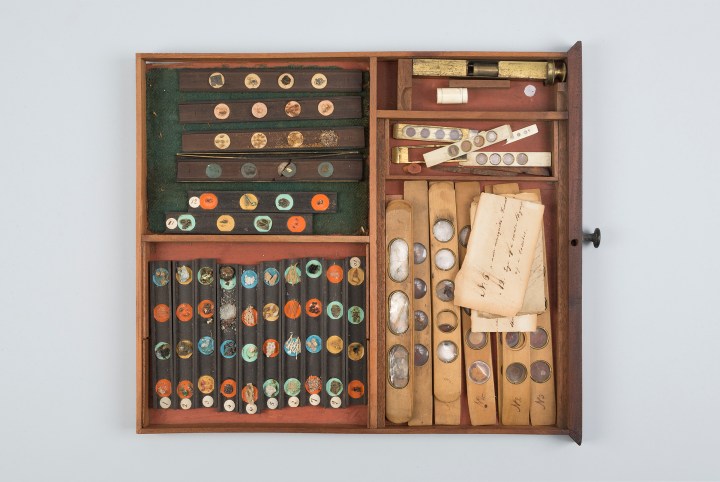
William and Samuel Jones, Jones’s Most Improved and Solar Compound Microscope, ca. 1798; drawer removed from box, displaying slides, mounted specimens, and accessories; brass, glass, and mahogany, with slides of paper and organic materials (Collection of Historical Scientific Instruments, Harvard University, 1184).
◊ ◊ ◊ ◊ ◊
Press release from Harvard Art Museums:
The Philosophy Chamber: Art and Science in Harvard’s Teaching Cabinet, 1766–1820
Harvard Art Museums, Cambridge, 19 May — 31 January 2017
The Hunterian, University of Glasgow, 23 March — 24 June 2018
Curated by Ethan Lasser
This spring, the Harvard Art Museums will present The Philosophy Chamber: Art and Science in Harvard’s Teaching Cabinet, 1766–1820, a special exhibition that brings together many long-forgotten icons of American culture. It will present new findings on this unique space—equal parts laboratory, picture gallery, and lecture hall—that stood at the center of artistic and intellectual life at Harvard and in New England for more than 50 years.
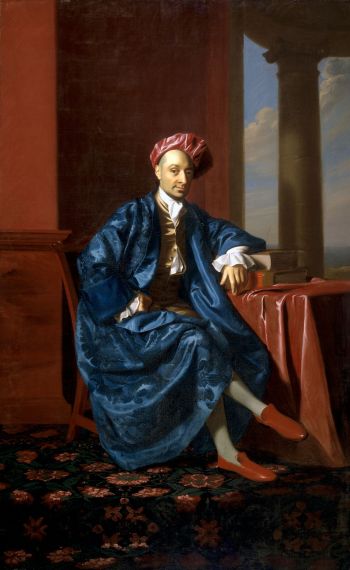
John Singleton Copley, Nicholas Boylston, 1773,oil on canvas (Harvard University Portrait Collection, H20, Harvard Art Museums).
Celebrated at the time as one of the grandest spaces in America, the original Philosophy Chamber and its adjacent rooms housed an extraordinary collection of paintings, portraits, and prints; mineral, plant, and animal specimens; scientific instruments; indigenous American artifacts; and relics from the ancient world—all of which was used regularly for lectures, discussions, and demonstrations. Highlights include: full-length portraits by John Singleton Copley, Native Hawaiian feather work, carving by indigenous artists of the Northwest Coast, Stephen Sewall’s 1768 mural-sized copy of the Native American inscription on the famous Dighton Rock in southeastern Massachusetts, and the elaborately ornamented grand orrery (a model of the solar system) created by Joseph Pope between 1776 and 1787. Many of the objects in the exhibition have not been shown publicly since the collection was dispersed almost 200 years ago.
The reassembled Philosophy Chamber invites visitors to examine the role that images and objects play in building, organizing, and transmitting knowledge; and as a historical study, it deepens our understanding not only of Harvard’s past, but also the history of early American art and culture.
The exhibition presents more than 70 objects from the earliest days of Harvard’s collecting, shown together with a small group of objects with 18th-century American provenances that closely match the description of original pieces in the collection that have been lost or destroyed, or that survive but are too fragile for display. In addition, the show includes period representations of other teaching cabinets to contextualize the material on display. The exhibition’s accompanying catalogue expands on the research into the chamber’s collection, history, and uses, presenting information on the approximately 200 objects that have been tracked thus far—just one-fifth of the original collection once housed in Harvard Hall.
The exhibition and catalogue provide a 360-degree view of early American history through the examination of the artwork displayed in the Philosophy Chamber, the instruments and specimens handled by the students and faculty who met there, and the cultural artifacts dispatched to the college by foreign envoys and the nation’s first merchant explorers. The project considers what the convergence of these objects in a New World college can tell us about the transfer of knowledge, burgeoning trade, the role of collections, and New England’s emerging self-identity in the mid-18th to early 19th century.
“Rooted in deep research and fresh curatorial insight, this exhibition invites audiences—both American and international—to explore a cultural landmark of the 18th-century Atlantic World,” said Martha Tedeschi, the Elizabeth and John Moors Cabot Director of the Harvard Art Museums. “Our efforts to unearth this largely forgotten landmark of early American art and culture led us to map collections, library archives, herbaria, and other museums across campus, in addition to public and private institutions throughout the Northeast and abroad. Thanks to this exceptional cross-institutional collaboration, we can present an immersive interdisciplinary experience that brings an important period of history to life for all visitors.”
“Weaving together art and science, this exhibition considers one of the most vibrant spaces in early America and presents a veritable cross-section of the period’s art and material culture,” said Ethan W. Lasser, curator of the exhibition, and the Theodore E. Stebbins Jr. Curator of American Art and head of the Division of European and American Art at the Harvard Art Museums. “The Philosophy Chamber opens a window into a forgotten piece of American history; the story of this room intersects with some of the most admirable—and the most challenging—aspects of Harvard’s past.”
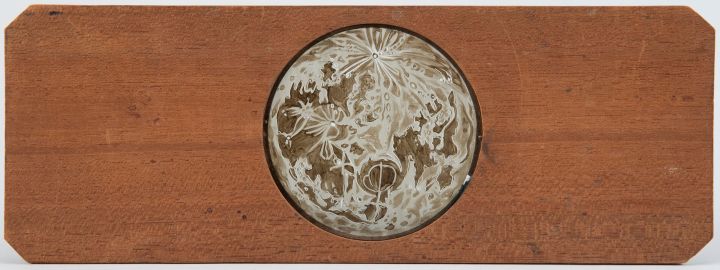
Unknown maker, possibly William and Samuel Jones, Lantern Slide of Painted Moon, late 18th century; painted glass and wood (Collection of Historical Scientific Instruments, Harvard University, 1998-1-1272).
◊ ◊ ◊ ◊ ◊
History of the Philosophy Chamber
Between 1766 and 1820, Harvard College assembled an extraordinary collection of specially commissioned scientific instruments and benefactor portraits, as well as donations from supporters around the globe. These objects were displayed in a set of three rooms adjacent to the college library in Harvard Hall, a large brick building that still stands at the center of campus today. The largest of these spaces, the Philosophy Chamber, was an ornately decorated room named for the discipline of natural philosophy, a field of study that wove together the sciences that sought to explain the natural world.
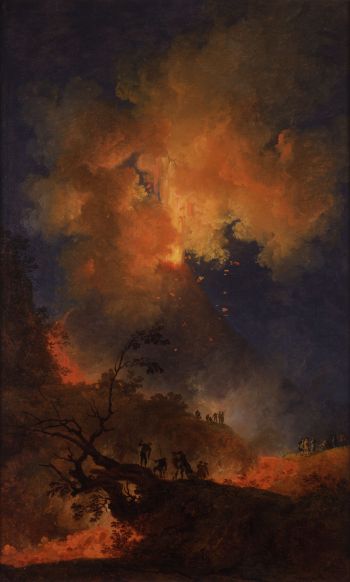
Pierre-Jacques Volaire, Vesuvius Erupting at Night, 1767, oil on canvas (Compton Verney Art Gallery and Park, Warwickshire).
The collection and the chamber, which came into existence when Harvard Hall was rebuilt after the Great Fire of 1764, played a vital role in teaching and research at Harvard, while also serving as the center of artistic and intellectual life in the greater New England region for over 50 years. Artists, scientists, students, and advocates of American Independence—including George Washington—came to the Philosophy Chamber to discover, discuss, and disseminate new knowledge. Students attended lectures and demonstrations there, and visitors from around the globe flocked to the space to see works by some of the Atlantic World’s greatest artists and artisans, including John Singleton Copley and John Trumbull.
The only repository of its kind in New England when it was established, the Philosophy Chamber was deeply connected to the network and ideology of other teaching cabinets established in Europe, the United States, and South America, such as the Ashmolean Museum at Oxford University, the Académie des Sciences in Paris, the American Philosophical Society in Philadelphia, and the University of Córdoba in Argentina. These teaching cabinets were offspring of the 17th-century Wunderkammer, or privately held cabinets of curiosities, and ultimately foreshadowed the beginnings of the modern museum.
While the chamber’s collection survived the Revolutionary War thanks to a temporary relocation (along with all of Harvard College) to Concord, Massachusetts, in 1775, an expansion of the college library in 1820 ultimately led to the dispersal of the collection to various university departments and local museums.
Research
The exhibition has its origins in curator Ethan Lasser’s early days at the Harvard Art Museums. While researching the Fogg Museum’s holdings of early American art, Lasser repeatedly came across references to the Philosophy Chamber. Intrigued, he initiated a campaign to locate the artifacts with a team of researchers at the museums. Lasser then expanded on the research by co-teaching a graduate seminar with Harvard professor Jennifer Roberts in Fall 2014. They enlisted their students to research the history of the chamber, the objects that were accessioned, and the people who visited. To date, the growing team of researchers—including curators, professors, conservators, scientists, and students from across the university—has tracked approximately 200 objects, or roughly one-fifth of the collection once housed in Harvard Hall. The whereabouts of the remaining four-fifths of the collection are unknown. Over the past 200 years, many objects have no doubt been lost, stolen, or destroyed, while some may be stored undetected in various campus and regional collections.
The Installation / Works on View
The Philosophy Chamber features more than 100 works displayed within four thematic sections.
The first section addresses how the collection was used in teaching and research, and includes tools and specimens that were regularly deployed for teaching in the 18th century. Included is the large-scale orrery, a dazzling astronomical model created by Joseph Pope. Labored over by Pope for 12 years, it was only the third orrery made in America, and was among the most celebrated objects to enter the chamber. Also included: one of two portable electrical machines for conducting demonstrations related to electricity (Benjamin Franklin advised on its purchase) and a group of six recently discovered drawings of skulls by Harvard professor and naturalist William Dandridge Peck, dated to around 1810. A projector installed in this gallery will show large-scale digitized images of solar microscope specimens and magic lantern slides.
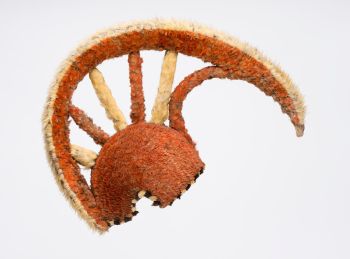
Unknown artist, Native Hawaiian, Mahiole (Crested Feathered Helmet), 18th century; ‘I’iwi (Vestiaria coccinea) and ‘ō’ō (Moho nobilis) feathers; and olonā (Touchardia latifolia) and ‘ie’ie (Freycinetia arborea) fibers (Peabody Museum of Archaeology and Ethnology, Harvard University, Gift of the Heirs of David Kimball, 99-12-70/53559).
A second gallery explores how the non-commissioned objects in the chamber’s collection arrived at Harvard and reflects on the collecting practices of wealthy alumni, entrepreneurial merchants, and scholars who sent objects from abroad. At the time, there was no curator of the collection, and very few objects were specifically solicited, resulting in a rather haphazard and idiosyncratic collection. This gallery features gifts sent to Harvard by five different donors or donor groups. In the late 18th century, as American ships began circumnavigating the globe, new courses were charted, and trade routes were established. An early 19th-century French map in this gallery shows the routes around North and South America that Captain James Cook and other explorers used. Shipmates on these missions brought back the exceptional examples of Native Hawaiian feather work on a colorful cape and a crested helmet seen in this space, as well as examples of carving by indigenous artists of the Northwest Coast. A touchscreen monitor in this gallery presents an animated map with points of origin of some of the objects in the collection, as well as demonstrations of two objects from Harvard’s Collection of Historical Scientific Instruments.
A third section addresses the entangled histories of the objects gathered in the chamber and the origin story of the United States after the Revolutionary War. Works here show how artists and scholars were actively writing American history. Included are engravings after paintings by John Trumbull, who gave a portrait of Cardinal Guido Bentivoglio to the college, which also hangs in this space. The gallery includes another celebrated object in the chamber’s history: Stephen Sewall’s mural-sized copy of the Native Americans’ inscriptions on the landmark known as Dighton Rock, an 11-foot boulder formerly located in the Taunton River, and now housed in a museum. Sewall was a professor at Harvard and his 1768 drawing is the only life-size representation of the monument known to exist. The rock was puzzled over by scholars from Harvard and around the world, and a variety of theories about the origin of the inscriptions were posited. Today, scholars attribute the inscriptions on the rock to the Algonquian-speaking peoples of the Eastern Woodlands, and more specifically to the Wampanoag who lived in the rock’s vicinity. By contrast, in the period when Sewall made his drawing, European interpreters actively disavowed the possibility of Native American authorship.
The final room is a loose reconstruction of the Philosophy Chamber itself, an experiential space complete with a re-created version of the red wallpaper that John Hancock had donated to the original room. Three early full-length portraits of Harvard benefactors by John Singleton Copley are included, as is a series of six mezzotints after Copley paintings that were given to Harvard by the artist’s heirs. Harvard was Copley’s first major patron, and plans to turn the Philosophy Chamber into a space dedicated to the artist’s life were never realized; the gift of mezzotints has never been shown until now. A bust of William Pitt the Elder, Earl of Chatham, given by Benjamin Franklin in 1769, was the first gift of sculpture the college received after the Great Fire consumed Harvard Hall in 1764. This gallery will be complemented by a digital tool, accessible on the museums’ website, that allows visitors to access recordings of present-day Harvard students reading from period sources, offering a sense of the kinds of conversations and debates that took place in the original chamber. The tool will also include deeper information about the objects displayed in the gallery.
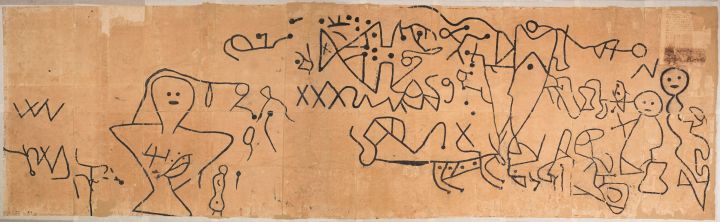
Stephen Sewall, Copy of Inscription on Dighton Rock, 1768, black ink on paper (Peabody Museum of Archaeology and Ethnology, Harvard University, 967-28-10/45474, digital file 99270006).
◊ ◊ ◊ ◊ ◊
Conservation
The research and rediscovery of objects once belonging to the Philosophy Chamber collection has led to exciting research by conservators and conservation scientists in the museums’ Straus Center for Conservation and Technical Studies. Several members of the Straus Center staff contributed essays to the exhibition catalogue on the following topics:
• Conservators were able to examine two of the full-length portraits by John Singleton Copley. Use of X-radiography and infrared digital photography helped them determine earlier iterations of a portrait of Thomas Hancock, painted between 1764 and 1766, showing Copley had reworked the painting twice to arrive at the formal, dignified pose seen in the final portrait. By contrast, a painting of college benefactor Thomas Hollis III was shown to have very few changes.
• Joseph Wilton’s bust of William Pitt the Elder, Earl of Chatham—given to Harvard by Benjamin Franklin—underwent scientific, technical, and art historical research, allowing staff to assess how the ceramic sculpture was made and to document its alteration over the centuries at Harvard. Guided by this research, the conservation treatment included removal of later overpaint layers and cleaning to uncover the original white painted surface.
• A close examination of Stephen Sewall’s drawing of the inscription on Dighton Rock sheds light on his chosen materials and processes. Conservators believe Sewall directly traced the markings rather than using a rubbing or chalking method.
Publication
Ethan Lasser, ed., The Philosophy Chamber: Art and Science in Harvard’s Teaching Cabinet, 1766–1820 (Cambridge: Harvard University Press, 2017), 312 pages, ISBN 978 0300 225921, $55.
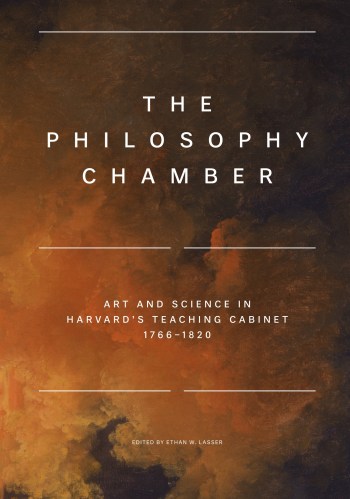 A catalogue, edited by Ethan Lasser, with essays by a mix of curators, professors, conservators, conservation scientists, and doctoral candidates, will be published in conjunction with the exhibition. The publication will advance new understandings of early American art history, and will serve as a rich resource for any reader interested in the art and culture of the Atlantic World. The catalogue is published by the Harvard Art Museums and distributed by Yale University Press. Contributors include Aleksandr Bierig, Anne Driesse, Katherine Eremin, Andrew Gelfand, Claire Grech, Teri Hensick, Jane Kamensky, Ethan W. Lasser, Georgina Rayner, Jennifer L. Roberts, Whitney Barlow Robles, María Dolores Sánchez-Jáuregui, Anthony Sigel, Kate Smith, Lucie Steinberg, and Oliver Wunsch.
Online Resources
Once the exhibition opens, supplementary digital content will be accessible via the exhibition page on the museums’ website. The digital tool complementing the room within the exhibition that loosely reconstructs the Philosophy Chamber will include “Voices of the Philosophy Chamber,” a group of audio recordings by present-day Harvard students reading from period sources. The recordings will give a sense of the conversation and debate that once filled the Philosophy Chamber. The tool will also provide additional information about the works on view.
The website will also include a series of audio recordings of gallery talks planned for the run of the exhibition. The robust series of talks by the students, staff, faculty, and scholars involved with the Philosophy Chamber research will explore the range of objects and themes in the exhibition as well as the history of the chamber. New recordings will be added on a regular basis.
Programming
A wide range of events, including lectures, a symposium, gallery talks, Materials Lab Workshops on Wampum jewelry making, and special member events, will be offered throughout the duration of the exhibition. Harvard professor Jane Kamensky will give a free public lecture, The Hungry Eye: Art and Ambition in Copley’s Boston, on Tuesday, May 23, at 3pm. Kamensky is the author of the recent biography A Revolution in Color: The World of John Singleton Copley, and also contributed to the Philosophy Chamber catalogue. During the fall semester, programming includes major lectures by artist Simon Starling and James Delbourgo (Rutgers University); The Room Where It Happens: On the Agency of Interior Spaces, a two-day public symposium featuring a keynote lecture by Louis Nelson (University of Virginia) and a full day of panel discussions; and a special late-night event for Harvard students. Detailed information about programs is forthcoming here.
Credits
The Philosophy Chamber: Art and Science in Harvard’s Teaching Cabinet, 1766–1820 is organized by the Harvard Art Museums. Curated by Ethan W. Lasser, the Theodore E. Stebbins Jr. Curator of American Art and Head of the Division of European and American Art at the Harvard Art Museums. The exhibition is supported in part by major grants from the Terra Foundation for American Art and the Henry Luce Foundation. The exhibition and catalogue also received support from the following endowed funds: the Bolton Fund for American Art, Gift of the Payne Fund; the Henry Luce Foundation Fund for the American Art Department; the William Amory Fund; and the Andrew W. Mellon Publication Funds, including the Henry P. McIlhenny Fund.
Lenders at Harvard University include: the Collection of Historical Scientific Instruments; the Harvard Map Collection, Pusey Library; the Harvard University Archives; Houghton Library; the Mineralogical and Geological Museum; the Museum of Comparative Zoology; the Peabody Museum of Archaeology & Ethnology; and the Warren Anatomical Museum, Countway Library of Medicine.
Other lenders from private, academic, and public collections in the United States and the United Kingdom include: the American Academy of Arts and Sciences, Cambridge, MA; the Richard Balzer Collection, Brookline, MA; Compton Verney Art Gallery and Park, Warwickshire, U.K.; The Library Company of Philadelphia; the Massachusetts Historical Society, Boston; Metropolitan Museum of Art, New York; Museum of Fine Arts, Boston; Peabody Essex Museum, Salem, MA; and a private collection in Boston.
Exhibition | Hidden From View: The 5th Duke of Portland’s Art Collection
Press release (via Art Daily) from The Harley Gallery:
Hidden From View: The 5th Duke of Portland’s Art Collection
The Harley Gallery, Welbeck, Nottinghamshire, 31 March — 30 September 2017
Curated by Vanessa Remington
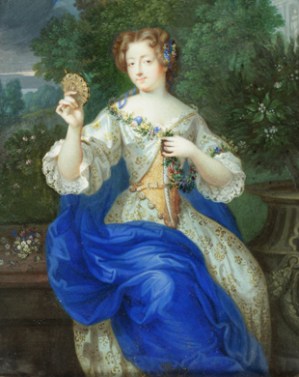
Marie Angélique de Scorailles, Duchess of Fontanges, Continental School, 18th Century.
Best known for the extensive tunnels he built underneath the family home at Welbeck Abbey on the Welbeck Estate, the eccentric and reclusive 5th Duke of Portland (1800–1879) is revealed in a new light through his “extraordinary collection” of miniature paintings says Senior Curator of Paintings at the Royal Collection, Vanessa Remington. Having catalogued the miniatures in the Royal Collection, Remington was invited to curate a new exhibition of more than 25 paintings opening at The Harley Gallery on the Welbeck Estate in Nottinghamshire on 31 March and running until 30 September 2017.
She describes the Portland Collection’s miniatures as “probably second only to the Royal Collection,” and the new exhibition focuses on the 5th Duke to show a man very different from his public persona. Despite his reputation as a recluse with little social life who avoided the outside world, Remington’s research shows a Duke who was nevertheless fascinated by youth, beauty, celebrities, and high society.
“Unfortunately, we have no diary or memoirs from the 5th Duke, and so he’s been very much defined by the miles of tunnels he built under the family home. By examining his collection of miniatures though we see a man fascinated by women, despite being a recluse who had no personal relationships with them other than his sister.
“There is a very clear focus on beautiful and famous young women so it’s a sad irony of his life that he felt unable to engage and enter that world despite the access his wealth and social status gave him,” says Remington.
Miniatures were very popular across Europe in the 18th and 19th centuries and were usually intimate and informal portraits painted by specialist artists for rich patrons who often gave them as love tokens. The 5th Duke was an avid collector, and among more than 80 miniatures he collected personally are key pieces including:
• Emperor Napoleon Bonaparte and Empress Josephine of France
• The beautiful but doomed mistress of Louis XIV, the Duchess of Fontanges
• Two young girls dressed as angels
• Louis XV, King of France and his consort, Marie Leszczynska, Queen of France
• The famous soprano, Adelaide Kemble, with whom the Duke was once in love, and her sister, the actress Frances ‘Fanny’ Kemble. Also on show will be a series of pastel paintings of the opera singer, which he commissioned.
Painted on vellum and ivory, the miniatures of the Portland Collection are displayed very infrequently and for short periods because of the risk of light damage. Many of the miniatures are painted with watercolour paint which is light sensitive. A specialist viewing area uses sophisticated PIR technology to manage light levels in order to protect the works for generations to come.
The Portland Collection at Welbeck houses treasures assembled over 400 years by the Dukes of Portland and their families. It opened to the public on Sunday 20th March 2016 and includes masterpieces such as Michelangelo’s Madonna del Silenzio, on show for the first time in 50 years; Van Dyck’s paintings of a young Charles II in armour and Thomas Wentworth, 1st Earl of Strafford, not publicly exhibited since 1960; as well as the pearl earring worn by Charles I at his execution in 1649. The Portland Collection was named RIBA East Midlands’ building of the year, as well as winning the East Midlands Sustainability Award, Heritage award and a prestigious national RIBA award. The Gallery most recently won a silver award in the American Architecture Prize, and is currently in the running for a ‘Building’ award and a Civic Trust award.
Exhibition | America Collects Eighteenth-Century French Painting
From the NGA:
America Collects Eighteenth-Century French Painting
National Gallery of Art, Washington, D.C., 21 May — 20 August 2017

When Joseph Bonaparte, elder brother of Napoleon, arrived in the United States in 1815, he brought with him his exquisite collection of eighteenth-century French paintings. Put on public view, the works caused a sensation, and a new American taste for French art was born. Over the decades, appreciation of French eighteenth-century art has fluctuated between preference for the alluring decorative canvases of rococo artists such as François Boucher and Jean Honoré Fragonard to admiration for the sober neoclassicism championed by Jacques Louis David and his pupils. This exhibition brings together sixty-eight paintings that represent some of the best and most unusual examples of French art of that era held by American museums and tells their stories on a national stage: Who were the collectors, curators, museum directors and dealers responsible for bringing eighteenth-century French painting to America? Where are the paintings now?
The exhibition highlights smaller museum collections, less well-known paintings, and diverse locations across the United States, from Pittsburgh and Indianapolis to Birmingham and Phoenix. It considers eighteenth-century America’s very real fascination with France—a staunch ally in the American Revolution, an intellectual model for Benjamin Franklin, Thomas Jefferson, and other Americans abroad—and how the cultural ideal of eighteenth-century France has continued to endure in the American imagination to this day.
Image: Joseph Ducreux, Le Discret, ca. 1791, oil on aluminum, transferred from canvas (Lawrence: Spencer Museum of Art, University of Kansas).
◊ ◊ ◊ ◊ ◊
Note (added 28 May 2017) — A checklist for the exhibition is available here. Online, there’s also a useful chronology (condensed from the catalogue), establishing larger contexts and tracing the history of selected works in the exhibition.
Note (added 30 May 2017) — The catalogue is published by Lund Humphries:
Yuriko Jackall, Philippe Bordes, Jack Hinton, Melissa Hyde, Joseph Rishel, and Pierre Rosenberg, with Joseph Baillio, Susan Earle, Christophe Leribault, Robert Schindler, and D. Dodge Thompson, America Collects Eighteenth-Century French Painting (London: Lund Humphries, 2017), 304 pages, ISBN: 978 18482 22342, £50 / $70.
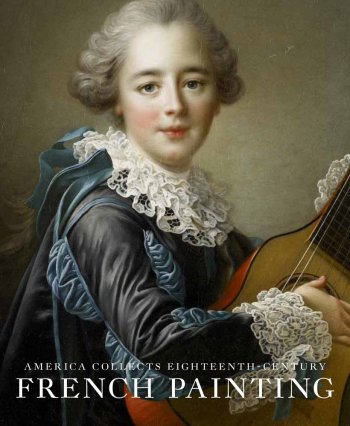 C O N T E N T S
Director’s Foreword
Acknowledgments
Lenders to the Exhibition
Essays
• Pierre Rosenberg, Only in America
• Yuriko Jackall, American Visions of Eighteenth-Century France
• Joseph Bailliom, Wildenstein in America
• Jack Hinton, Fiske Kimball and French Period Rooms in America
• Christophe Leribault, The Tuck Donation to the Petit Palais: A Mirror of American Taste
• Melissa Hyde, Femmes-Artistes and America from the Early Republic to the Gilded Age
• Robert Schindler, Eugenia Woodward Hitt Collects
• Philippe Bordes, Buying against the Grain: American Collections and French Neoclassical Paintings
• Susan Earle, Joseph Ducreux, John Maxon, and the Spencer Museum of Art
• D. Dodge Thompson, When the Eighteenth Century Was New: Joseph Bonaparte in America
• Joseph Rishel, Notes on the American Reception of Eighteenth-Century French Painting
Plates
Yuriko Jackall
• Collector’s Century: From the King’s Mistress to the Shores of San Francisco
• Sensual Century: Pursuit of Love
• Opulent Century: Douceur de Vivre
• Playful Century: Games and Pastimes
• Fanciful Century: Masquerade and the Pleasures of the Imagination
• Inspired Century: Artists and Artistic Practice
• Virtuous Century: Institutional Taste
• Enlightened Century: Science, Nature, and the Passage of Time
Checklist of the Exhibition
Chronology
Bibliography
Index
Exhibition | Francisco de Goya: Los Caprichos
Press release from the Riga Bourse:
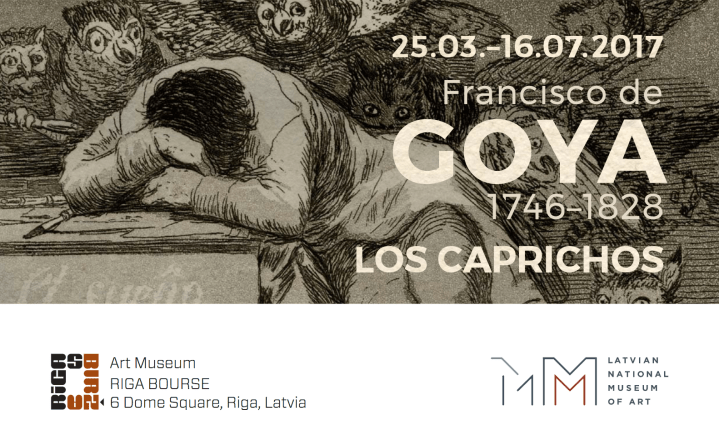
Francisco de Goya: Los Caprichos / Fransisko Goija: Kaprīzes
Art Museum Riga Bourse, 25 March — 16 July 2017
Curated by Daiga Upeniece
The exhibition introduces us to one of the world’s most famous art masterpieces by the brilliant Spanish artist Francisco José de Goya y Lucientes (1746–1828) Los Caprichos series of graphics. The album, containing 80 pages of graphics compiled and published by the artist himself in 1799, gained popularity in Spain and elsewhere soon after its publication and captured the quintessence of Goya’s style, reflecting a new, freer, and much more expressive approach to reality’s portrayal. Los Caprichos reverberated in 19th-century art and ended the dominance of Neo-Classicist academic style graphics.
There are many unsolved riddles hidden within the series. It has been assumed that the artist was influenced by various works of philosophy and art. However, Goya himself—disregarding references to some well-known poets, for example, Gaspar Melchor de Jovellanos, or parallels with the plays of Goya’s friend Leandro Fernández de Moratín—has categorically denied any kind of influence.
Goya was already focusing on the everyday life of his time and, in particular, on the position of women in society in the voluminous selection of drawings in his Madrid album (1796–97). La Celestina, a traditional image in Spanish literature who takes on particularly symbolic importance in Goya’s art, appears there for the first time. Her image reminds us of the temporality of youth and beauty and the inescapable approach of decrepitude. Like La Celestina, the often-utilized image of the prostitute and a focus on the theme of magic personify the dark aspects of society.
The blending of fantasy and reality forms the uniqueness of Goya’s vision. The dream motif was a traditional element that was used by Spanish artists and writers and those of other European countries, to tell of fantastic, philosophically tangible or surreal creatures. Initially, Goya’s series was also called Sueños—that is, dreams, instead of whims.
Some of Goya’s compositions are like theatrical scenes—others, like a parade of eccentric images. The mood in most of the works has similar qualities to Dante’s Inferno—every imaginable mischief rages within them: hypocrisy, lies, cruelty and the collapse of morality. The subjects tell of the church, the nation, the court, laws, physicians, art and science, the streets of Madrid, rural life, the poetry and philosophy of the time, about the needy, the rich, the sick, the young and the old, combining all of these images in a unified mirror of society. Goya’s self-portrait, found on the first page, explains his attitude to what is portrayed in Los Caprichos. The artist, in a way, identifies with the new, modern Enlightenment period; and looked at from these positions, his gaze slides obliquely to the graphics which he himself has created.
Goya used a complex and innovative graphic technique. At its foundations was traditional etching, which Goya combined with a comparatively new invention—aquatint. In this way, clean lines, engraved with acid were supplemented with pale, sort of washed-out tones, which were created with fine dots, obtained, by processing the graphic plate with crushed resin. Of equal importance were the very delicate lines that were engraved with a blade, directly onto the surface of the plates. In graphic art, etching with drypoint on a black background or creating delicate lines and subtle shading around the eyes and hands of the images created the equivalent of airy brushstrokes in painting.
There are 78 works from the second impression in the collection at the Art Museum Riga Bourse. The works’ annotative texts consist of Goya’s comments, explanations about Goya’s works by art historians, as well as informative materials about people and events in Spain in the late 18th century. The exhibition is curated by Daiga Upeniece, Head of the Art Museum RIGA BOURSE / Latvian National Museum of Art.
Monographs used in the notes: Sarah Simmons, Goya (London: Phaidon Press, 1998), pp. 139–84; Xavier de Salas, “Light on the Origin of Los Caprichos,” The Burlington Magazine 121 (1979): 711–16; В. Прокофьев. Капричос Гойи. 2 т., Искусство, Москва, 1969.
Exhibition | British Art: Ancient Landscapes
Opening next month at The Salisbury Museum:
British Art: Ancient Landscapes
The Salisbury Museum, 8 April — 3 September 2017
Curated by Sam Smiles
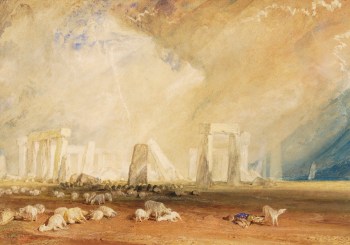
J.M.W. Turner, Stonehenge, ca. 1827–28, watercolour (The Salisbury Museum).
The British landscape has been a continual inspiration to artists across the centuries and particularly the landscapes shaped and marked by our distant ancestors. The megaliths, stone circles, and chalk-cut hill figures that survive from Neolithic and Bronze Age times have stimulated many artists to make a response. In this major new exhibition curated by Professor Sam Smiles, these unique artistic responses have been brought together to create a new discussion. Featuring the work of some of the greatest names in British art from the last 250 years—including John Constable, J.M.W. Turner, Eric Ravilious, John Piper, Barbara Hepworth, Henry Moore, Paul Nash, Richard Long, and Derek Jarman—the exhibition explores how this work records and reflects on some of Britain’s most treasured ancient landscapes.
The catalogue is published by Paul Holberton:
Sam Smiles, British Art: Ancient Landscapes (London: Paul Holberton Publishing, 2017), 120 pages, ISBN: 978 19113 00144, £25.
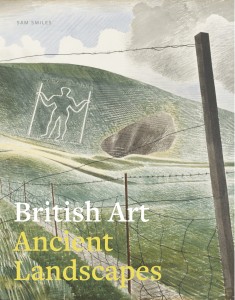 Published to accompany an exhibition at The Salisbury Museum and Art Gallery, this volume explores the most significant works of art engaged with prehistoric moments across Britain from the 18th century to the 21st. While some of the works in the earlier period may be familiar to readers—especially Turner and Constable’s famous watercolours of Stonehenge—the varied responses to British Antiquity since 1900 are much less well known and have never been grouped together.
The author aims to show the significance of antiquity for 20th-century artists, demonstrating how they responded to the observable features of prehistoric Britain and exploited their potential for imaginative re-interpretation. The classic phase of modernist interest in these sites and monuments was the 1930s, but a number of artists working after WWII developed this legacy or were stimulated to explore that landscape in new ways. Indeed, it continues to stimulate responses and the book concludes with an examination of works made within the last few years.
An introductory essay looks at the changing artistic approach to British prehistoric remains over the last 250 years, emphasizing the artistic significance of this body of work and examining the very different contexts that brought it into being. The cultural intersections between the prehistoric landscape, its representation by fine artists and the emergence of its most famous sites as familiar locations in public consciousness will also be examined. For example, engraved topographical illustrations from the 18th and 19th centuries and Shell advertising posters from the 20th century will be considered.
Artists represented include: J.M.W. Turner, John Constable, Thomas Hearne, William Blake, Samuel Prout, William Geller, Richard Tongue, Thomas Guest, John William Inchbold, George Shepherd, William Andrews Nesfield, Copley Fielding, Yoshijiro (Mokuchu) Urushibara, Alan Sorrell, Edward McKnight Kauffer, Frank Dobson, Paul Nash, Eric Ravilious, John Piper, Henry Moore, Barbara Hepworth, Ithell Colquhoun, Gertrude Hermes, Norman Stevens, Norman Ackroyd, Bill Brandt, Derek Jarman, Richard Long, Joe Tilson, David Inshaw and Jeremy Deller.
Sam Smiles is the author of The Image of Antiquity: Ancient Britain and the Romantic Imagination (1994), Flight and the Artistic Imagination (2012), and West Country to World’s End: The South West in the Tudor Age (2013).
Exhibition | Pugin, Prisons, and the Plight of the Poor
Now on view at The Huntington:
A. W. N. Pugin, Prisons, and the Plight of the Poor: British Prints,
Drawings, and Illustrated Books from The Huntington’s Collections
The Huntington Art Gallery, San Marino, CA, 11 March — 26 June 2017
Curated by Courtney Long
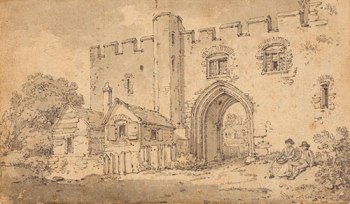
William Alexander, Prison at St. Albans, undated, late 18th–early 19th century, graphite and ink wash on board (San Marino: The Huntington).
This exhibition examines the history of British prisons and how artists and architects documented the social, political, and legal tensions surrounding prison reform and Poor Law debates in Parliament during the 19th century. Drawn from the rich holdings of British material in The Huntington’s library and art collections, the works in A.W. N. Pugin, Prisons, and the Plight of the Poor depict a range of prison styles and highlight the role that these spaces served in containing and punishing criminals, debtors, drunks, gamblers, and paupers. Through a variety of visual materials, the exhibition examines the belief that the style and treatment of architecture has a direct correlation to the manner and behavior of society, an idea which had been promoted by prominent 19th-century architect and designer Augustus Welby Northmore Pugin. Fifteen thought-provoking drawings, watercolors, prints, and rare books by artists such as Thomas Rowlandson, George Romney, Henry Rushbury, and Edward Dalziel present images of the fortress-like prisons, criminal acts, and zealous reformers that sparked imaginations from the mid-18th to the early 20th centuries.
Courtney Skipton Long is guest curator for A.W.N. Pugin, Prisons, and the Plight of the Poor. She received her Ph.D. in the history of art and architecture from the University of Pittsburgh in 2016 and is currently the Zvi Grunberg Postdoctoral Fellow at the Bruce Museum in Greenwich, Connecticut.
Also, see the posting at Verso, the blog for The Huntington Library, Art Collections, and Botanical Gardens.
Exhibition | Printed Fashions: Textiles for Clothing and the Home
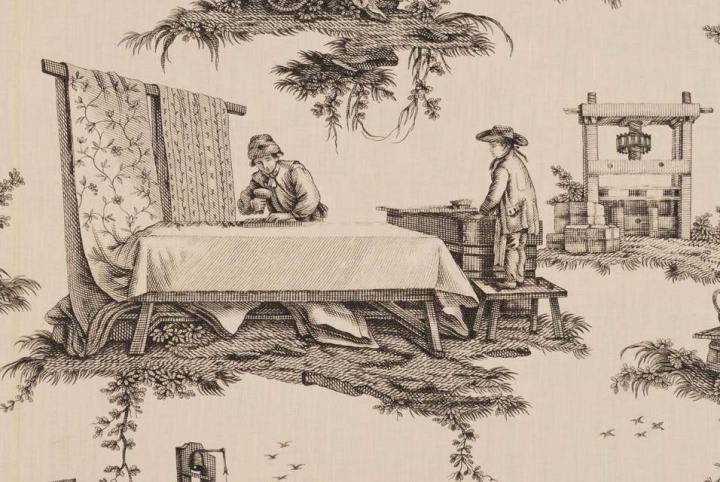
Scene of textile printing, adapted from a French copperplate-printed textile of the 1780s
(The Art Museums of Colonial Williamsburg)
◊ ◊ ◊ ◊ ◊
Press release (6 February 2017) from Colonial Williamsburg:
Printed Fashions: Textiles for Clothing and the Home, 1700–1820
DeWitt Wallace Decorative Arts Museum, Colonial Williamsburg, 25 March 2017 — March 2019
Curated by Linda Baumgarten
In the eighteenth and early nineteenth centuries, early printed textiles with their luminous colors and attractive designs were widely sought for fashionable clothing and home furnishings. Eighty examples of these stunning printed cottons and linens, many of which have never been exhibited before, will go on view in Printed Fashions: Textiles for Clothing and Home at the DeWitt Wallace Decorative Arts Museum, one of the Art Museums of Colonial Williamsburg, opening March 25, 2017. The exhibition will illustrate the design, history, and techniques of printed textiles during this formative era; these objects played their own important role in history, not just for their obvious aesthetic qualities, but also for their economic importance as trade goods and as examples of technological advances. Printed Fashions will remain on view through March 2019.
“Textiles are among the most fragile objects that survive from the past. They also afford us particularly detailed views into the lives of our forbearers,” said Ronald L. Hurst, Colonial Williamsburg’s Carlisle H. Humelsine chief curator and vice president for collections, conservation, and museums. “Thanks to decades of effort and scholarship on the part of our textile curator Linda Baumgarten and her predecessors, the Foundation is home to a remarkably large and complete collection of printed textiles. This exhibition provides an opportunity to employ many of those beautiful objects to tell these very human stories.”
“The history of printed textiles may sound modern to today’s consumers,” says Linda Baumgarten, Colonial Williamsburg’s senior curator of textiles and costumes who organized the exhibition. “Traders shipping goods from the other side of the world in ships, domestic workers trying their best to respond to foreign competition, people making the effort to dress in up-to-date styles despite their limited means and the importance of chemistry and mechanical expertise in the production of consumer goods: All of these concepts could easily represent textile production today as well as it did centuries ago.”
Although fashionable Indian chintzes had inspired European printers to begin developing competing technologies as early as the seventeenth century, it was during the eighteenth century that most of the technical advances were realized. Rather than using the Indian method of painstakingly hand-painting chemical fixatives known as mordants and then dyeing the textiles, Europeans developed laborsaving techniques to expedite the process. Blocks, copperplates, and rollers allowed printers to apply pattern at a faster rate, often with delicate and intricate linear effects rivaling prints on paper. Experiments with chemicals yielded pencil blue and china blue techniques to solve the difficult challenges of pattering textiles with indigo blue.
Printed Fashions will include a variety of objects dating between 1700 and 1820 from India, England, France, and colonial America. Among them will be men’s and women’s garments, women’s accessories, a doll dressed in original clothing from the 1770s, quilts and an Indian ‘palampore’ bedcover in brilliant colors, a trunk linked with rare, early printed cotton, case covers for chairs, curtains and valances for tall-post beds, plus study documents that show printing techniques, advances in printing chemistry, and trends in design. Among the exhibition’s highlights is a stunning bed quilt, never previously exhibited, incorporated into which is a printed panel from India as the center focus. This panel, or ‘palampore’, was too small for the finished quilt, so the unknown quilt maker enlarged the bedcover with fine silk borders and then quilted the whole with closely spaced running stitches. The flowering tree at the center of the palampore is patterned with a large tree bursting with floral blooms, growing from the hilly ground. Later known as a ‘tree of life’, this design influenced English and American appliquéd quilts for a century after the first palampores entered the West.
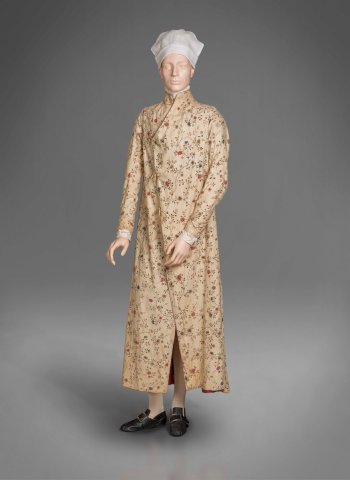 Another featured object in Printed Fashions is a gentleman’s banyan made of stylish and expensive cotton from India. The delicate floral design was mordant-painted-and-resist-dyed, creating a colorful yet comfortable garment suitable for relaxing at home. By donning his imported chintz banyan, the man at leisure signaled his wealth and fashion sense. A textile swatch or sample book from 1783 is yet another must-see object in the exhibition; it unrolls to reveal more than seven feet of swatches with 430 samples in all. The colorful printed cottons were available for sale in a single year by a Manchester, England printing establishment. In less than a century, British manufacturers went from rudimentary early attempts at copying Indian imports to becoming a major printing industry.
This exhibition was made possible through the generosity of Mary and Clinton Gilliland and the Turner-Gilliland Family Fund of the Silicon Valley Community Foundation; the DeWitt Wallace Fund for Colonial Williamsburg; and Mr. and Mrs. Jay E. Frick. Ellan and Charles Spring funded the purchase of mannequins.
To celebrate the opening of Printed Fashions, the Colonial Williamsburg Foundation will host a symposium of internationally known scholars, March 26–28, 2017. Guest speakers will include Rosemary Crill, honorary research associate, Victoria and Albert Museum; Linda Eaton, John L. & Marjorie P. McGraw director of collections & senior curator of textiles, Winterthur Museum; Susan Greene, author and independent researcher whose lecture is generously sponsored by Windham Fabrics, Inc.; Philip Sykas, research associate, Manchester School of Art, United Kingdom; and Barbara Brackman, independent scholar and researcher. In addition, twenty scholars from the United States and England will present juried papers on all aspects of textile printing and usage. The program will take place in the Hennage Auditorium at the Art Museums of Colonial Williamsburg. More information is available here.
An exhibition in formation for more than a decade, Printed Fashions: Textiles for Clothing and Home is certain to fascinate and delight decorative arts aficionados, fashion historians, and design enthusiasts who will appreciate the many patterns that could easily have modern interpretations.










leave a comment