Exhibition | The Lure of Italy: Artists’ Views
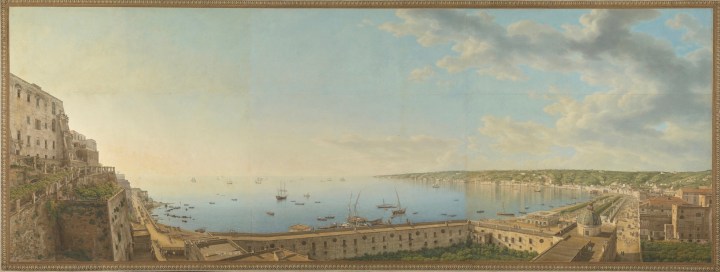
Giovanni Battista Lusieri, A View of the Bay of Naples, Looking Southwest from the Pizzofalcone towards Capo di Posilippo, 1791; watercolor, gouache, graphite, and pen and ink on six sheets of paper; unframed: 102 × 272 cm (Los Angeles: The J. Paul Getty Museum, 85.GC.281).
◊ ◊ ◊ ◊ ◊
Press release (20 April 2017) for the exhibition now on view at The Getty:
The Lure of Italy: Artists’ Views
The Getty Center, Los Angeles, 9 May — 30 July 2017
Curated by Julian Brooks with Annie Correll
For centuries, Italy has fascinated travelers and artists alike. From the crumbling ruins of ancient Rome to the crystal-clear light of Venice, artists have found inspiration not only in the cities but also in the countryside and in Italy’s rich history and culture. The Lure of Italy: Artists’ Views explores the numerous ways Italy’s topography, history, and culture have motivated artists to create works of extraordinary beauty and resonance. The exhibition, selected from the Getty Museum’s permanent collection of drawings and watercolors, includes several important recent acquisitions, including works by Francesco Guardi and Richard Parkes Bonington.
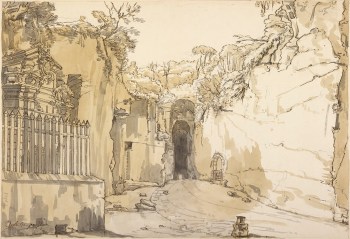
Claude-Joseph Vernet, The Entrance to the Grotto at Posillipo, ca. 1750; pen and brown ink with brown and gray wash over black chalk, 34 × 49 cm (Los Angeles: The J. Paul Getty Museum, 97.GG.53).
“For many, Italy represented—and still represents today—a stunningly lush treasure of scenic wonder, with picturesque ancient sculptures, historic buildings, and dramatic landscapes,” says Timothy Potts, director of the J. Paul Getty Museum. “This exhibition bears witness to the long-standing love affair that artists have had with the country of Italy.”
Italy—a collection of city-states until unification in the 1800s—has captured the imagination of artists for centuries, yet interest in the country peaked in the 1700s, when the region became a prime destination for wealthy travelers embarking on the Grand Tour from England, France, the Netherlands, Germany, and beyond. Artists journeying with them or working for them used pencil, ink, and watercolor to capture celebrated views and preserve vivid memories, creating works that encapsulate the essence and spirit of Italy.
Italian natives such as Guardi, Canaletto, and Giovanni Battista Lusieri responded to the tourist demand for souvenirs by crafting their own masterpieces. Guardi’s A Regatta on the Grand Canal (about 1778), a recent acquisition for the Getty, conveys with freshness and spontaneity the lively atmosphere of the annual gondola race (regatta) in Venice. The finish line is at left and spectators crowd the balconies of the nearby Palazzo Balbi, while the water bustles with decorated gondolas.
Further south, the Bay of Naples was another favorite destination of Grand Tourists. Lusieri’s huge, nearly nine-foot wide panorama, A View of the Bay of Naples (about 1791) is meticulously executed in tiny detail with watercolor. It was painted over a period of two years from the residence of Sir William Hamilton, the British envoy to the court of Naples, who commissioned it for his London home. The view looks towards the Capo di Posillipo and the so-called grotto there, a feat of ancient-Roman engineering.
Other highlights include sketches of enchanting sites with plunging perspectives through the rich Italian countryside, capriccio scenes caught between fantasy and reality, studies of ancient ruins, Roman landmarks and lauded works of art, and views of the most picturesque and awe-inspiring sights that Italy has to offer.
During his only visit to Venice, two years prior to his death at age 25 from tuberculosis, Richard Parkes Bonington made numerous pencil sketches and a handful of oil and watercolor studies of the city. The jewel-like Riva degli Schiavoni, from near San Biagio, Venice (1826) emphasizes his renowned ability to capture the effects of calm water and dramatic cloud formations in watercolor. This match of subject and media helped to make the magical atmosphere of the city the real subject of his work. “The extraordinary character of Italian cityscapes and landscapes pushed artists to the limits of their potential,” says Julian Brooks, senior curator of drawings at the J. Paul Getty Museum. “To render them effectively, the choices of media and technique became crucial.”
The Lure of Italy: Artists’ Views is curated by Brooks, with the assistance of Annie Correll, graduate intern in the Department of Drawings. The exhibition is presented in conjunction with Eyewitness Views: Making History in Eighteenth-Century Europe (9 May — 30 July 2017) on view in the Special Exhibitions Pavilion at the J. Paul Getty Museum.
The exhibition checklist is available as a PDF file here»
S E L E L E C T E D P R O G R A M M I N G
Peter Björn Kerber, Venice vs. Rome: A Capital Contest
Saturday, May 13, 3:00pm
Pitting gilded gondolas against sumptuous coaches, Venice and Rome sought to surpass each other in staging the eighteenth century’s most spectacular festivals and celebrations. Peter Bjorn Kerber, curator of the exhibition Eyewitness Views: Making History in Eighteenth-Century Europe, explores the pictures Canaletto, Panini, and other leading painters produced to record these dazzling occasions.
Julian Brooks, The Bumpy Road to Beautiful Italy
Sunday, June 4, 3:00pm
With one eye on the practicalities and perils of travel in Italy in past centuries, Julian Brooks, senior curator of drawings at the Getty, discusses some of the works of art made by visitors to the country, and how they responded to—and fueled—the lure of Italy.
From The Getty Shop:
Julian Brooks, The Lure of Italy: Artists’ Views (Los Angeles: Getty Publications, 2017), 96 pages, ISBN: 978 160606 5198, $20.
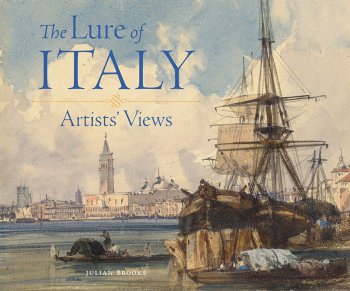 For centuries Italy has fascinated travelers and artists. From the crumbling ruins of ancient Rome to the crystal-clear light of Venice, artists have found inspiration not only in the cities but also in the countryside and in the deep history and culture. From as early as the 1500s, artists visiting from France, England, the Netherlands, and Germany drew sketches to preserve vivid memories, often creating work of extraordinary atmosphere and beauty in the process. A growing number of tourists in the subsequent centuries fueled a further demand for souvenir views, spurring local artists to craft their own masterpieces.
This lovely book is a narrated assemblage of some of these beautiful views, which transport the reader effortlessly to Italy, rekindling memories, setting intentions, or provoking curiosity. The text provides new insights into the topographical renditions of Italian scenes over the centuries, while compelling illustrations of works from the Getty collection by artists such as Richard Parkes Bonington, J. M. W. Turner, Claude Lorrain, Giovanni Battista Lusieri, Canaletto, and many more capture the essence and spirit of Italy.
Julian Brooks is senior curator and head of the Department of Drawings at the J. Paul Getty Museum, where he has organized and co-organized numerous exhibitions. Among his many publications are Andrea del Sarto: The Renaissance Workshop in Action (Getty Publications, 2015) and Master Drawings Close-Up (Getty Publications, 2010).
Exhibition | Showstoppers: Silver Centrepieces

Thomas Pitts, Epergne, London, 1759
(Leeds Museums and Galleries)
◊ ◊ ◊ ◊ ◊
Opening this weekend at Temple Newsam:
Showstoppers: Silver Centrepieces
Temple Newsam House, Leeds, West Yorkshire, 13 May — 16 October 2017
Curated by Rachel Conroy
Silver is a seductive, glamorous material and the centrepiece is one of its most wondrous uses. Showstoppers takes two iconic eighteenth-century centrepieces from Temple Newsam’s renowned historic silver collection and presents them alongside contemporary masterpieces by artists Junko Mori and Miriam Hanid. The exhibition showcases the continuation and reinvention of traditional silversmithing techniques and celebrates women in silver, as makers and owners.
S A T U R D A Y , 1 0 J U N E 2 0 1 7
Silversmithing Demonstration
An exciting opportunity to see artist silversmith Miriam Hanid demonstrating chasing and engraving in the Great Hall. 11.00–12.00 and 12.30–1.30. Free with general admission.
Surtouts, Epergnes and Grands Platts Menages: Silver and Ceramic Centrepieces
Join James Lomax for a survey of the wondrous array of silver and ceramic centrepieces produced in England during the eighteenth century. 2.00–3.00. Free with general admission, but booking required.
Exhibition Tour
Join exhibition curator, Rachel Conroy, for a tour of the exhibition. 3.00–3.45. Free with general admission, but booking required.
O T H E R E V E N T S
Artist Talk: Miriam Hanid
9 June, 2.00–3.00
Miriam will explain how she started her silversmithing journey and how her capabilities have now developed into creating large commissions for a range of collectors and private clients. Followed by a tour of the exhibition. £7 (including admission), booking required.
Silver and Yachts: The Glamorous Possessions of Women at Temple Newsam
5 July, 2.00–3.00
Curator Rachel Conroy will tell the stories behind some of the most luxurious objects in the collection that were owned by or connected to women. Free with general admission, but booking required.
Shining Silver Commissions from the Sheffield Assay Office Collection: The Work of Junko Mori
16 September, 2.00–3.00
Emma Paragreen (Sheffield Assay Office) will give a brief introduction to the history and work of the Sheffield Assay Office and then focus on two examples of work commissioned by Sheffield Assay Office from Junko Mori. Free with general admission, but booking required.
An Eye for Design: Rosalinde Gilbert, Fashion Designer and Collector
14 October, 2.00–3.00
In this talk, Hanne Faurby (V&A) will introduce Rosalinde Gilbert, a fashion designer working in wartime London. Charlotte Johnson (V&A) will then discuss the Gilbert Collection, formed by Rosalinde and her husband Arthur, examining how Rosalinde’s background in design may have informed their collecting practices. Free with general admission, but booking required.
Exhibition | We the People: American Folk Portraits
Press release (27 March 2017) from Colonial Williamsburg:
We the People: American Folk Portraits
Abby Aldrich Rockefeller Folk Art Museum, Colonial Williamsburg, from 6 May 2017
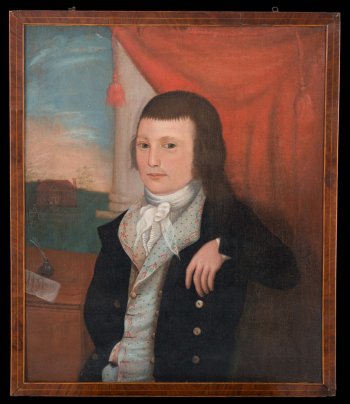
Jacob Frymire, Portrait of Daniel Clarke, ca. 1791, oil on canvas (Colonial Williamsburg: 2016.100.2, gift of Julie Lindberg).
Before there were photographs, people in the late 18th century to the middle 19th century who wanted images of themselves and their family members commissioned portraits from a broad range of artists, many of whom had little or no academic training. Today, we characterize these types of paintings that fall outside of academic tradition as folk portraiture. These often naïve depictions of individuals, children, families and couples are beloved for their charming characterizations. The world-class assemblage of these portrayals in the Abby Aldrich Rockefeller Folk Art Museum (AARFAM), one of the Art Museums of Colonial Williamsburg, is among the most popular with visitors. The museum celebrates its diamond anniversary in 2017 with We the People: American Folk Portraits, a long-term exhibition of more than 30 portraits which will open on May 6, 2017. The show will highlight new accessions on view for the first time as well as constant favorites.
“Colonial Williamsburg is blessed with one of the nation’s finest and most geographically diverse collections of American folk portraits. With their deeply human qualities, they are in many ways the heart of the Foundation’s folk art collection. It is highly fitting that they be featured in this special anniversary year,” said Ronald Hurst, the institution’s Carlisle H. Humelsine chief curator and vice president for collections, conservation, and museums.
Several portraits recently acquired by the AARFAM will be shown in We the People. Among them is an oil-on-canvas, Portrait of Daniel Clarke by Jacob Frymire, an itinerant painter who made this portrait in Franklin County, Pennsylvania, probably in 1791. While the young gentleman depicted has long been identified as Daniel Clarke, his name could refer to several men of the same name and appropriate age who lived in the region where Frymire worked. The well-dressed man, the red drapery behind him and the substantial brick building in the background suggest that either the subject was wealthy or the setting may have been aspirational. Portrait of the Jennison Family by Jefferson Gauntt (1805–1864) is another recently acquired painting to be shown. Gauntt depicts the close connections between the siblings in this strikingly unified composition. Each of the eight children born to the prosperous merchant William Jennison (1795–1866) is portrayed here physically connected or overlapping: a baby in arms, arms around shoulders, hand in hand. The group portrait descended in the family of the young male sitter to the far right of the canvas.
The itinerant artist John James Trumbull Arnold (1812–1865) painted another of the highlighted works to be displayed for the first time in We the People. Portrait of Mary Mattingly, an 1850 painting made in Mt. Savage, Maryland is one of three that the artist painted of this family’s members. Mary Mattingly is of the young daughter of Ellen and Sylvester Mattingly. She never married but lived independently and sold ice cream from her shop in Cumberland, Maryland. On the reverse of this portrait, like many of Arnold’s paintings, is the artist’s fancifully written signature and date; he used the same ornate script on his pen-and-ink self-portrait (also in the Colonial Williamsburg collection). Arnold described himself as a “professor of penmanship,” an occupation which may have predisposed him to a heavy reliance on linear definition of hands and facial features in his portraits.
“The beauty of this exhibition is that it provides us with the platform to exhibit long-term favorite portraits from the collection alongside new acquisitions,” said Laura Pass Barry, Juli Grainger curator of paintings, drawings and sculpture. “We have been fortunate over the past few years to acquire some wonderful examples of the form and we are thankful to the individuals who have helped to make this happen.”
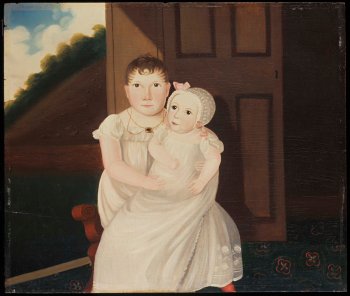
Two Children, America, ca. 1810, oil on pine panel (Colonial Williamsburg: 1954.100.2, from the collection of Abby Aldrich Rockefeller, gift of the Museum of Modern Art).
Included in We Are One are several favorites in the collection; one such example is Portrait of Mrs. Seth Wilkinson by The Wilkinson Limner, probably painted between 1827 and 1830 in New York State. Twenty portraits are attributed to the artist who painted Mrs. Seth Wilkinson, and because her likeness was among the first studied and possibly remains the best known, her name was adapted to identify her portrait painter. In this case, ‘limner’ means ‘painter’. Evidence about The Wilkinson Limner suggests that he began his career as a portraitist while incarcerated at the state prison in Charlestown, Massachusetts. About 1827, he began creating more opulent settings for his sitters, perhaps as a reflection of his newly regained freedom. It is also only fitting that an exhibition celebrating the 60th anniversary of the AARFAM includes a portrait that comes from the Mrs. Rockefeller’s collection. Such is the case with Two Children, an unusual American portrait painted ca. 1810. It is remarkable in several aspects including the placement of the two subjects within the painting’s overall design, which focuses on the children even as the darkened room, open door and temporarily-placed bench or chair in the background creates an air of mystery around them. The children seem to bridge two worlds; their setting seems to imply that they yearn to go outside but cannot.
We the People will not only offer a visual feast but will also debunk common misconceptions about American folk portraits, including whether or not the sitters are actually smiling and are wearing the same or stock clothing or costumes in their depictions. The topics of why subjects often appear with one hand in their coat pocket as well as whether or not the heads were added to pre-painted bodies will also be set straight. Research about many of the sitters and their portrait painters will also be shared throughout the exhibition to offer visitors a sense of who these people were.
Exhibition | Eyewitness Views: Making History
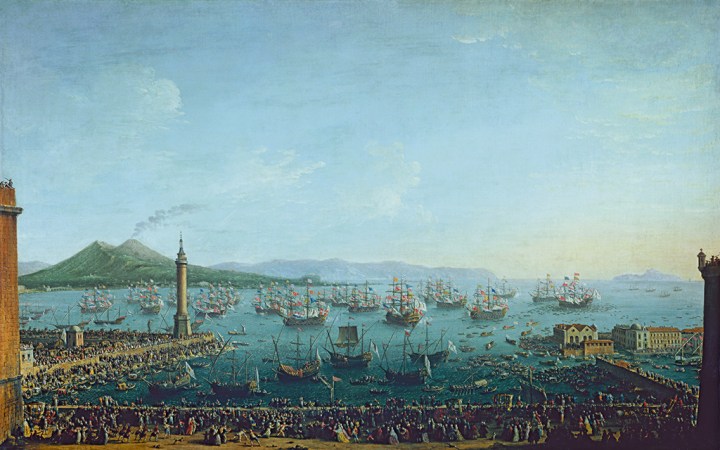
Antonio Joli, Departure of Charles III from Naples to Become King of Spain, 1759, oil on canvas
(Madrid: Museo Nacional del Prado)
◊ ◊ ◊ ◊ ◊
Opening tomorrow at The Getty:
Eyewitness Views: Making History in Eighteenth-Century Europe
The Getty Center, Los Angeles, 9 May — 30 July 2017
Minneapolis Institute of Art, 10 September — 31 December 2017
The Cleveland Museum of Art, 25 February — 20 May 2018
Curated by Peter Björn Kerber
From Paris to Venice to Rome, Europe’s most iconic cities have played host to magnificent ceremonies and dramatic events—and artists have been there to record them. During the eighteenth century, princes, popes, and ambassadors commissioned master painters such as Canaletto and Panini to record memorable moments, from the Venetian carnival to eruptions of Vesuvius, inspiring what became the golden age of view paintings.
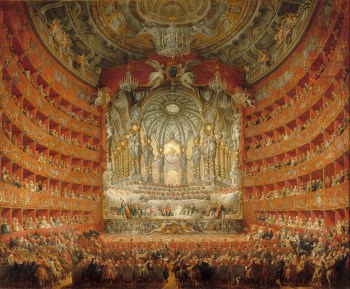
Giovanni Paolo Panini, The Musical Performance in the Teatro Argentina in Honor of the Marriage of the Dauphin, 1747, oil on canvas (Paris: Musée du Louvre)
This is the first exhibition to focus on view paintings as depictions of contemporary events. These reportorial works visually record occasions ranging from royal celebrations to state visits, religious ceremonies, sporting contests, and natural disasters. Their dates correspond to the golden age of European view painting from the beginning of the eighteenth century to the eve of the French Revolution. Through immersive compositions and a wealth of acutely observed detail, artists skillfully created the illusion that the viewer is present on the scene as history is made.
Memory & Manipulation
Members of the highest echelons of European society, from kings and popes to doges and ambassadors, commissioned view painters to commemorate the spectacular events staged at their command or for their benefit. In many cases, these noble patrons are themselves portrayed in the resulting canvases. While artists cultivated the impression that they were faithful chroniclers capturing an event on canvas just as they had witnessed it, they were in fact not above manipulating or ‘improving’ upon reality in order to meet the expectations of their status-conscious clientele.
Civic & Religious Ritual
In Europe’s major cities, the populace gathered throughout the year to commemorate local historic events, celebrate religious feast days, or participate in public rituals. Whether sacred or secular in character, these occasions were always imbued with civic pride. They were also among the few times when the different social classes interacted with each other and shared a common experience. Religious processions typically involved a revered object—such as the Blessed Sacrament, a relic, or a statue—that was carried through the streets with pomp and fanfare. A city’s deliverance from devastating epidemics of bubonic plague was commemorated with recurring festivals of thanksgiving and supplication, since the threat of a resurgence remained very real in the eighteenth century.
Festival & Spectacle
In eighteenth-century Europe, Venice was the undisputed capital of pageantry and entertainment. Undaunted by its political and economic decline, the Serene Republic and its aristocracy invested vast sums in maintaining its traditional ceremonies and dazzling its visitors—for example, by commissioning a new version of the Bucintoro, the lavishly gilded state barge used only on Ascension Day. Financial considerations were also brushed aside to provide extravagant entertainments for kings or princes staying in the city. The grandest of these special events was a ceremonial regatta. In Rome, a comparable level of opulence was seen in the French embassy’s celebrations of royal births and marriages.
Disaster & Destruction
Images of tragic events satisfied a desire for paintings that stimulated the imagination. Whether they showed devastation caused by warfare, fire, natural disaster, or political turmoil, these works offered viewers the thrill of witnessing a catastrophe. They stand apart from most other reportorial paintings in that they downplay the presence of rulers and nobility in favor of depicting the lower classes. Such figures were rarely intended to be recognizable likenesses of actual people. Instead, they serve as proxies through which viewers are able to funnel their own reactions to unfolding calamity.
From The Getty Store:
Peter Björn Kerber, Eyewitness Views: Making History in Eighteenth-Century Europe (Los Angeles: Getty Publications, 2017), 252 pages, ISBN: 978-160606 5259, $45.
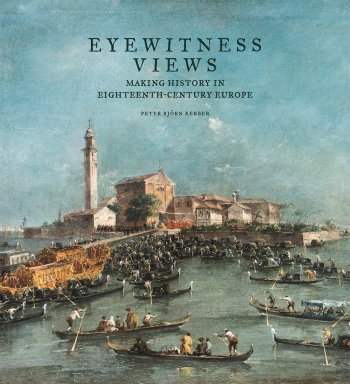 Canaletto, Bernardo Bellotto, Luca Carlevarijs, Giovanni Paolo Panini, Francesco Guardi, Hubert Robert—these renowned view painters are perhaps most famous for their expansive canvases depicting the ruins of Rome or the canals of Venice. Many of their most splendid paintings, however, feature important contemporary events. These occasions motivated some of the greatest artists of the era to produce their most exceptional work. Little explored by scholars, these paintings stand out by virtue of their extraordinary artistic quality, vibrant atmosphere, and historical interest. They are imbued with a sense of occasion, even drama, and were often commissioned by or for rulers, princes, and ambassadors as records of significant events in which they participated.
Lavishly illustrated and meticulously researched, this volume provides the first-ever comprehensive study—in any language—of this type of view painting. In examining these paintings alongside the historical events depicted in them, Peter Bjorn Kerber carefully reconstructs the meaning and context these paintings possessed for the artists who produced them and the patrons who commissioned them, as well as for their contemporary viewers.
Peter Björn Kerber is assistant curator of paintings at the J. Paul Getty Museum.
Exhibition | Cross-Pollination

Dish from Chelsea Porcelain Factory, ca.1760; glazed porcelain with enamel; approximately 10 × 8 inches (Saint Louis Art Museum, Gift of Melanie Redler from the collection of Dr. and Mrs. Irving Redler, 188:2015).
◊ ◊ ◊ ◊ ◊
Opening next month at the Saint Louis Art Museum (along with Reigning Men: Fashion in Menswear, 1715–2015, which was previously on view in Los Angeles and Sydney) . . .
Cross-Pollination: Flowers in 18th-Century European Porcelain and Textiles
Saint Louis Art Museum, 26 May — 26 November 2017
Curated by Genevieve Cortinovis
Intoxicated by scientific discovery, the fervor for natural science, particularly botany, reached new heights in 18th-century Europe. Botanical gardens and nurseries flourished, as did expertly illustrated albums describing flora and fauna of the Old and New World in tantalizing detail. Naturalism triumphed across the decorative arts, but especially in textiles and porcelain, where the media’s vibrant colors and painterly effects allowed for particularly artful and accurate botanical imagery.
The exhibition will feature a number of artworks never before exhibited at the Museum. Outstanding recent acquisitions include a rare silk damask by the English textile designer Anna Maria Garthwaite and an exceptional porcelain tureen and stand from a little-known Meissen dinner service. Two mid-18th-century dresses made of exquisite floral silk will be presented alongside recent gifts of Chelsea porcelain delicately painted with sprays of lilies, roses, and violets.
Cross-Pollination also examines potential sources for floral imagery by presenting rare illustrated books and plant specimens on loan from the Missouri Botanical Garden. The result is an interdisciplinary look at the dialogue between fashionable goods, nature, and natural science in the 18th century.
Cross-Pollination is curated by Genevieve Cortinovis, assistant curator of decorative arts and design at the Saint Louis Art Museum.
Exhibition | The Luther Effect
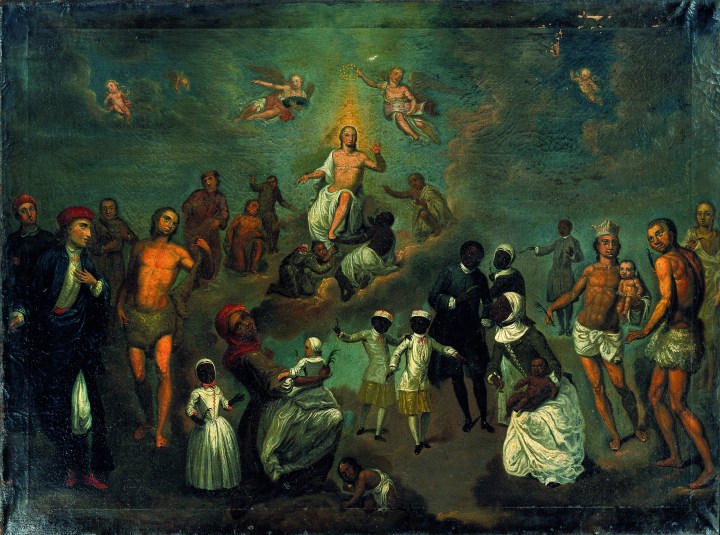
Johann Valentin Haidt, First Fruits (Erstlingsbild),1748
(Herrnhut: Unitätsarchiv der Evangelischen Brüder-Unität, GS 463)
◊ ◊ ◊ ◊ ◊
From the exhibition website:
The Luther Effect: Protestantism—500 Years in the World
Der Luthereffekt 500 Jahre Protestantismus in der Welt
Deutsches Historisches Museum at Martin-Gropius-Bau, Berlin, 12 April — 5 November 2017
The German Historical Museum (DHM) welcomes Martin-Gropius-Bau visitors on a trip through five centuries and across four continents. Marking the Reformation’s 500th anniversary, The Luther Effect shows the diversity and history, as well as the conflict potentials of Protestantism in the world. What impact has Protestantism had on other denominations and religions? How did Protestantism change through these encounters? And not least, how have people of different cultures adopted, shaped, and lived Protestant doctrine? Starting with Reformations in the 16th century, the exhibition highlights a global history of effect and counter-effect as seen in the examples of Sweden, the United States, South Korea, and Tanzania.
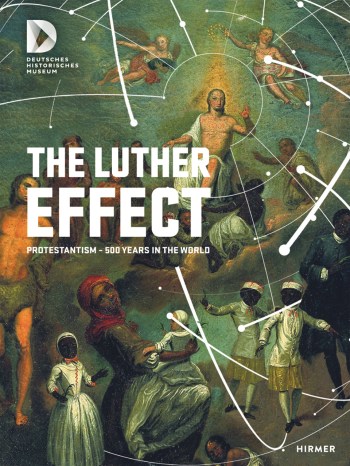 An impressive display of around 500 original exhibits in an exhibition space measuring some 3,000 square meters (32,000 square feet), the exhibition includes exceptional artworks and compelling, meaningful everyday objects from the era. Many of these extraordinary exhibits are being shown in Germany for the first time, to mark the occasion of the 500th anniversary of the Reformation. Modern media is used to give background information, enriching the exhibition.
Reformations, 1450–1600
The Reformation was a European event. Since the 16th century, various paths of reform had been leading to a renewal of the Church and life in general. Martin Luther’s Reformation was one of these. However, from a global perspective, other paths such as the Reformed Church or the Anglican Church in England were more influential. The Catholic Church also underwent a process of reform.
Undisputed beliefs and centuries-old practices were called into question. Soon proponents and opponents of reform were fighting not only against each another but also among themselves. The more radical movements like the Anabaptists were persecuted and marginalised not only by Catholics, but by Lutherans and the Reformed as well. The competition forced Luther, the Reformed, Anabaptists, Anglicans, and Catholics to clarify their own positions and to set themselves apart from others. The different reform paths developed into denominations that continue to evolve dynamically to this day.
One Land, One Religion: Sweden as a Lutheran Great Power, 1500–1750
King Gustav Vasa of Sweden, influenced by the Lutheran Reformation, broke with the Pope in Rome in 1527. This contributed to the spread of various reformist ideas in the Swedish Empire. But it was the Synod and the Parliament of Uppsala in 1593 that first established the Lutheran Church as the binding confession of Sweden, resulting in a Lutheran State Church and a confessionally unified state in Sweden.
The Swedish State Church brought the evolution of a new religious culture. The community that emerged saw itself as the protective power of Lutheranism. Swedish rulers and their armies fought on Europe’s battlefields for Sweden’s great power status and Luther’s doctrines. At home in Sweden, the State Church became increasingly restrictive. Church discipline, and the conversion of the Sámi who lived in the north of the country, were intended to consolidate the Lutheran faith and foster a common identity.
The United States of America: The Promised Land?, 1600–1900
Protestantism was brought to the British colonies of North America, later the United States, through the immigration of various groups, churches, and confessions, which accounts for the diversity of American Protestantism. A state church does not exist in the United States; instead, there is a vast landscape of independent churches. Protestantism in the USA developed its unique profile under the influence of charismatic revivalist preachers beginning in the 18th century. This gave rise to new confessions and numerous social reform movements. The so-called Black Churches of African Americans also emerged in the course of this development. Protestantism contributed significantly to the creation of the American nation and the formation of its self-understanding. It shaped the notion of America as the Promised Land, and of Americans as the Chosen People. These concepts gave rise to ideas that continue to influence American society to the present day.
Korea: Boom Land of Protestantism, 1850–2000
In the Republic of Korea (South Korea), numerous religions lead a relatively peaceful coexistence. Almost 30 percent of South Koreans consider themselves Christian, and slightly fewer than two-thirds of them are Protestant. This makes South Korea the only East Asian country where a significant proportion of the population is Protestant.
Protestant missionaries could not settle permanently in Korea until the mid-1880s. At this time, the first Protestant communities, founded by Korean laypeople, already existed. Using the Korean alphabetic script Han’gul to translate the Bible proved to be an important instrument for the missions. After the division of the land and the Korean War 1950–53, most Christians fled the Democratic People’s Republic of Korea (North Korea) to the South. Since the 1960s, South Korea has developed rapidly into an industrialised state. At the same time, the religious landscape has changed drastically: in 1950, three percent of South Koreans were Protestant, and by 1995 the number had already risen to around 20 percent. The relation to North Korea, including the possible reunification of the country, is a key issue in South Korea, and for the Protestant churches as well. On such questions the churches take very diverse positions.
Tanzania: Mission and Self-Reliance Today
The country of Tanzania has been shaped by migration and by the more than 130 ethnic groups who coexist there in a largely peaceful atmosphere. Among the many forms of Tanzanian Protestantism, the Evangelical Lutheran Church in Tanzania (ELCT) plays a major role. With more than 6 million members in 24 dioceses, the ELCT is now the largest Lutheran Church in Africa and the second largest in the world. It traces its origins back to German, Scandinavian, and American missionary societies that were active in the region which had become the colony known as German East Africa (then encompassing today’s Tanzania, Burundi, Rwanda, and part of Mozambique). In addition, the Moravian Brethren, the Anglican Church, and charismatic movements were instrumental in the spread of Protestant faith communities.
A variety of Protestant churches rapidly developed, driven forward by devout Tanzanians. From the outset, the missions aimed to establish financially independent churches and parishes. Today, their influence extends beyond Tanzania’s borders. Missionaries from Tanzania work throughout the continent. With a heedful view of the European churches, they see themselves as preserving the original Lutheran ideals.
Transformation and Schism: Installation by Hans Peter Kuhn
Exclusively for the exhibition, the Berlin artist Hans Peter Kuhn transforms the atrium of the Martin-Gropius-Bau into a gigantic artwork out of aluminum tubing, light, and sound. The installation Transition approaches the worldwide effects of the Reformation from an artistic perspective and makes the processes of the transformation of the relationship of Man to God and the schism of the Church doctrines triggered by the Reformation palpable and perceptible.
◊ ◊ ◊ ◊ ◊
Published by Hirmer, the catalogue is distributed in North America and Japan by The University of Chicago Press:
The Luther Effect: Protestantism—500 Years in the World (Munich: Hirmer Verlag, 2017), 400 pages, ISBN: 978 37774 27225, $54.
To mark the occasion of the five-hundredth anniversary of the Protestant Reformation in 2017, The Luther Effect offers a vivid and rich journey across five centuries and four continents, detailing the visual history of the growth of Protestantism around the world. The book examines how Protestantism has affected—and been affected by—encounters with diverse denominations, cultures, and lifestyles throughout the centuries. It explores how Protestantism has adapted and transformed and how different people around the world have adopted, modified, and followed its doctrine. Including two hundred and fifty stunning color plates and looking specifically at the art and cultural objects created in response to and in celebration of the religious movement, The Luther Effect presents the first comprehensive global history of Protestantism’s influence, reverberations, and reception.
Now Open: American Revolution Museum at Yorktown
From the Jamestown-Yorktown Foundation:
 2017 is a pivotal year at Jamestown Settlement and the American Revolution Museum at Yorktown, two premier living-history museums in two corners of America’s Historic Triangle that offer year-round experiences, compelling special exhibitions, events, and programs that immerse visitors into the story of America’s beginnings.
The Grand Opening Celebration of the American Revolution Museum at Yorktown March 23–April 4 culminates the museum’s 10-year transformation from the Yorktown Victory Center. The American Revolution Museum at Yorktown presents a renewed national perspective on the meaning and impact of the Revolution through introductory film, timeline, expansive gallery exhibits with nearly 500 artifacts, interactive displays and experiential theaters, and new settings for hands-on interpretive experiences in expanded re-creations of a Continental Army encampment and Revolution-era farm. The celebration launches the new museum with daily highlights of one of America’s 13 original states in the order that they ratified the Constitution, with a dedication ceremony on April 1. Patriotic festivities include gallery tours, living-history programs, artillery firings, flag-raising ceremonies, military musical performances, military re-enactments, lectures, and children’s activities.
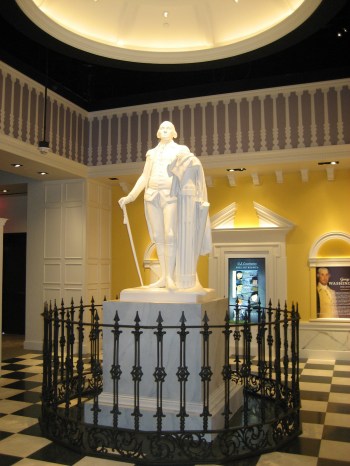 Located next to Yorktown National Battlefield, the Yorktown Victory Center opened in 1976 as one of three Virginia visitor centers for the Bicentennial of the American Revolution. Structural and exhibit improvements were implemented in the 1990s, broadening the museum’s focus to encompass the entire Revolution. The American Revolution Museum at Yorktown is the realization of a master plan adopted in 2007. The plan called for replacing the 1976 facility, with the new building positioned on the 22-acre site to allow for continued operation throughout construction, and repositioning and reconstructing the encampment and farm. A new 80,000-square-foot building opened in March 2015, with a theater for showings of Revolution-theme films, an illustrated timeline spanning the second half of the 18th century, and a gift shop and cafe. An important element of the new building is an education center, with five classrooms and a separate entrance, to serve student groups and the general public with dynamic, interactive learning experiences.
The museum’s inaugural special exhibition—AfterWARd: The Revolutionary Veterans Who Built America—debuts June 10 and follows the post-war stories of veterans of the Siege of Yorktown and how they went on after the war to shape the America we know today. A series of plays, performances and public lectures June through November feature Revolutionary War veterans James Lafayette, Alexander Hamilton, the Marquis de Lafayette and Henry Knox as well as issues facing modern-day veterans.
At Jamestown Settlement, a museum of 17th-century Virginia history and culture, visitors this spring can experience new interactive gallery exhibits exploring the Powhatan Indian, English and west central African cultures that converged in the 1600s. As part of a phased gallery enhancement, touch-screen panels allow visitors to compare and contrast each culture’s language, religion, government, economy and family structure. Jamestown Settlement’s expansive gallery exhibits debuted in 2006 in time for America’s 400th Anniversary commemoration in 2007, and are now being refreshed a decade later with new technology.
Four hundred years after the 1617 death of Pocahontas in England, her image and legend live on. Using depictions of Pocahontas from across the centuries, Jamestown Settlement presents Pocahontas Imagined, a special exhibition opening July 15 that illuminates the reasons behind her enduring legacy as well as her impression on popular culture and art. The six-month exhibition features Pocahontas memorabilia, advertisements, and interactive experiences.
Outdoors, visitors can examine artistic patterns, lines, and colors in objects found in Jamestown Settlement’s re-created Powhatan Indian village, ships and fort. Public lectures in partnership with the Virginia Museum of Fine Arts take place September 5, September 13, and October 3.
Jamestown Settlement is located on Route 31 at the Colonial Parkway next to Historic Jamestowne, administered by the National Park Service and Jamestown Rediscovery (on behalf of Preservation Virginia). The American Revolution Museum at Yorktown is located on Route 1020 in Yorktown near Yorktown Battlefield, administered by the National Park Service.
Exhibition | Inventing Utamaro: A Japanese Masterpiece Rediscovered
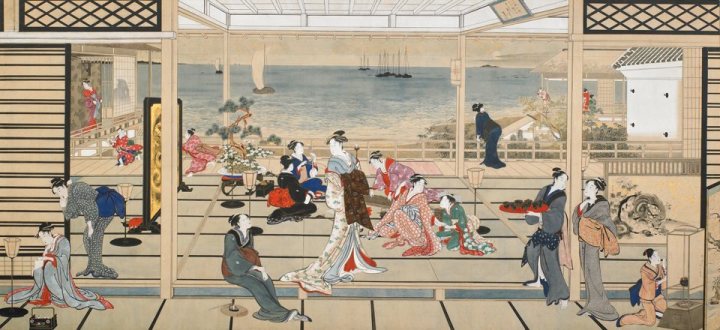
Kitagawa Utamaro, Moon at Shinagawa (or Moonlight Revelry at Dozō Sagami), detail, ca. 1788; painting mounted on panel; color on paper
(Washington, D.C., Freer Gallery of Art, F1903.54)
◊ ◊ ◊ ◊ ◊
Press release (10 March 2017) for the exhibition:
Inventing Utamaro: A Japanese Masterpiece Rediscovered
Wadsworth Atheneum Museum of Art, Hartford, 7 January — 26 March 2017
Arthur M. Sackler Gallery, Washington, D.C., 8 April — 9 July 2017
Okada Museum of Art, Hakone, 28 July — 29 October 2017
Curated by Julie Nelson Davis and James Ulak
Inventing Utamaro: A Japanese Masterpiece Rediscovered reunites for the first time in nearly 140 years three works by the legendary Japanese ukiyo-e (‘pictures of the floating world’) master, Kitagawa Utamaro (1753–1806). The exhibition is open at the Smithsonian’s Arthur M. Sackler Gallery April 8–July 9.
Last seen together in 1879, the three paintings left Japan and traveled to Paris where they were separated and marketed by Siegfried Bing in the 1880s. Charles Lang Freer, founder of the Smithsonian’s Freer Gallery of Art, acquired Moon at Shinagawa in 1903, and today it is part of the Freer’s permanent collection. Cherry Blossoms at Yoshiwara, passed through several hands before entering the collection at the Wadsworth Atheneum Museum of Art in Hartford, Connecticut, in the late 1950s. Snow at Fukagawa, held by the Okada Museum of Art in Hakone, Japan, was rediscovered in 2014 after missing for nearly 70 years. In 2014, the Okada Museum of Art announced the discovery and acquisition of Snow at Fukagawa. Whereabouts of that painting had been unknown since the late 1940s.
Separately conceived exhibitions inspired by the monumental triptych will occur at each of these museums, although all will be different in scope and content. Due to conditions of Freer’s will and bequest, the Sackler will be the only venue to show all three pieces. A facsimile of the Freer’s Moon at Shinagawa will be displayed at the other two locations.
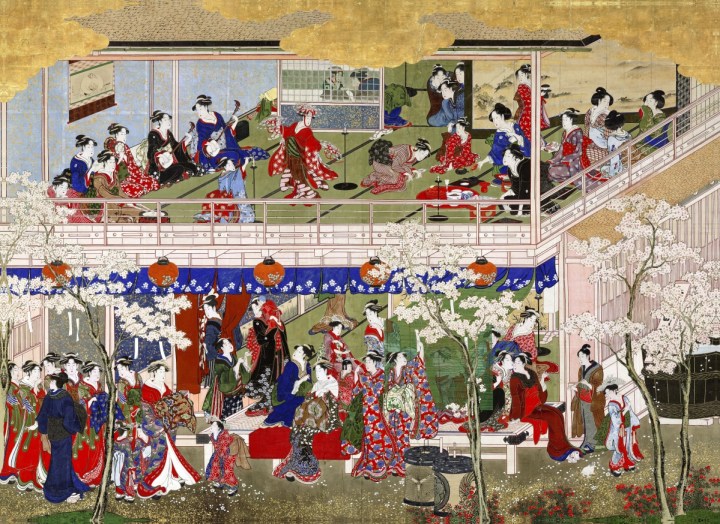
Kitagawa Utamaro, Cherry Blossoms at Yoshiwara, ca. 1793; ink, gouache, gold and gold leaf on bamboo paper
(Hartford: Wadsworth Atheneum Museum of Art)
◊ ◊ ◊ ◊ ◊
The Sackler exhibition explores the carefully constructed persona of Utamaro and the many questions surrounding his work and subject matter. The trio, painted in ukiyo-e style, idealize Edo’s (modern day Tokyo) ‘floating world’—pleasure centers of leisure, consisting of numerous brothels, which served as diversions from the pressures of everyday life. Unusual in scale and meticulously detailed, the three paintings portray the romanticized lives and appearances of workers of these quarters. Little is known about Utamaro’s life, but to this day he is considered one of the greatest artists of the ukiyo-e genre.
Utamaro began his study of painting in the studio of Toriyama Sekien, who introduced him to the publisher Tsutaya Jūzaburō, forever transforming his career. Together, they promoted the pleasure quarter, setting the tone for Utamaro’s success and brand as a connoisseur of female beauty that was carried throughout his career.
By the 1890s, Japan and the West had become uncomfortable and overwhelmed with the changes, including societal changes, caused by modern industrialization and internationalism. In Paris, in particular, the craze for things Japanese and ‘Oriental’ found a uniquely receptive market for paintings and prints of Japan’s ‘courtesans’ and pleasure quarters.
The exhibition frames these reunited paintings in the context of two moments of ‘branding and marketing’: first, the clever selling of Utamaro’s persona in his own time as a connoisseur of women, someone perfectly suited to create accurate and emotionally resonant images of the ‘beauties’, and second, the adroit response of Japanese and Western art dealers to the special moment of receptivity to the Japanese ‘beauty’ in fin-de-siècle Paris. This created a uniquely receptive market and audience in the West, with Paris at its center, which craved a return to civilized behaviors and romanticized moments of pleasure.
At this time, a glamorized image of ‘old Edo’ began to emerge as Japan struggled to hold onto its traditional identity and values in the face of this rapid change. Japanese art became an embodiment of the desire for simpler times and Utamaro’s work captured a sense of this world before it had permanently passed into memory. The exhibition examines how these two moments in time—Paris during the end of the nineteenth century and the 1780s, when Utamaro created his paintings—are simultaneously separated and connected through the need for fantasy and escape. Utamaro, as a carefully constructed persona and brand, was deliberately marketed both as an artist and as a personality to advance the introduction of Japanese art to collectors in Europe and the United States.
Equally as carefully managed by international Japanese art dealers were depictions of the ‘floating world’, promoting a fantastical depiction that illustrated an unsullied and harmonious world—one in stark contrast to the fast-paced and often gritty world that replaced it. Dealers, striking upon the West’s desire for the exoticism of the ‘Orient’, made deliberate and self-conscious efforts in the late 19th century to refine the concept of what Japanese art could mean for Western consumers and expanded the market by introducing ukiyo-e, alongside binjutsu or fine art, to collectors. Through the carefully concerted efforts of art dealers, Utamaro became a predominant tour de force in the visual arts exported by Japan.
Utamaro’s work was well known both in Japan and Europe and the exhibition places him in the larger context of Japonisme, the influence of Japanese art on Western art. Since the mid-1850s, Japan strategically sought exposure in world markets and eventually the demand for Japanese Edo-period works skyrocketed. Art dealers exported thousands of Japanese works to Europe and Northern America. The exhibition showcases Edo-period prints, books and paintings, mostly by Utamaro revealing his artistic persona and influence on the time as well as his skill at depicting female beauty. Other period works will also be on view with the common theme being beautiful women.
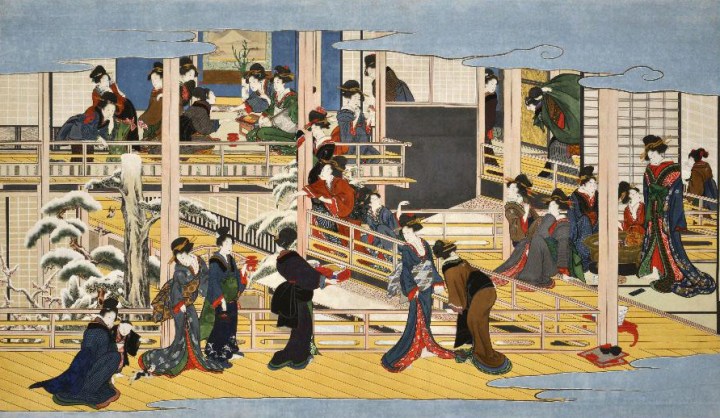
Kitagawa Utamaro, Snow at Fukagawa, ca. 1780s
(Hakone: Okada Museum of Art)
◊ ◊ ◊ ◊ ◊
“The rediscovery of Snow at Fukagawa has presented the unique opportunity to reunite these paintings,” said James Ulak, Sackler senior curator of Japanese art. “Seeing Utamaro as a successfully fabricated persona in his own time and at the moment that Charles Freer assembled his collection certainly frames our assessment in a new and deeply informative light.”
The exhibition includes significant loans from The British Museum, the John C. Weber Collection, and several anonymous private lenders. Important books, prints, and paintings from the Sackler’s permanent collection will also be on display. Programming information is available here.
Mitsubishi Corp. is the lead sponsor for Inventing Utamaro: A Japanese Masterpiece Rediscovered. Additional support is provided by the Anne van Biema Endowment Fund.
Exhibition | Treasures of the Hispanic Society of America
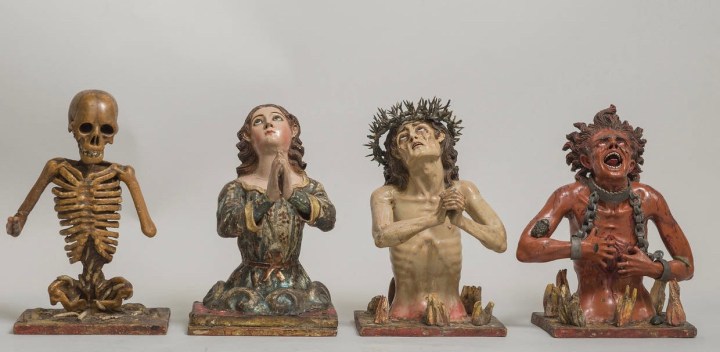
Manuel Chili, known as Caspicara, Four Fates of the Soul: Death, Soul in Heaven, Soul in Purgatory, and Soul in Hell, ca. 1775 (New York: The Hispanic Society of America).
◊ ◊ ◊ ◊ ◊
Press release (31 March 2017) for the exhibition:
Treasures of the Hispanic Society of America: Visions of the Hispanic World
Museo Nacional del Prado, Madrid, 4 April — 10 September 2017
Curated by Mitchell Codding
Through September 10, the Museo del Prado will present the treasures of the museum and library of the Hispanic Society, an institution located in Upper Manhattan in New York, founded in 1904 by Archer Milton Huntington (1870–1955), one of America’s greatest philanthropists. Huntington created an institution that reflected an appreciation of Spanish culture and the study of the literature and art of Spain, Portugal, and Latin America. Treasures of the Hispanic Society of America: Visions of the Hispanic World brings together more than two hundred works of art including paintings, drawings, and sculpture, archaeological artifacts, liturgical vestments, furniture, and books and manuscripts from the library, creating a fascinating chronological and thematic experience of the highlights of the Hispanic Society’s vast collections.
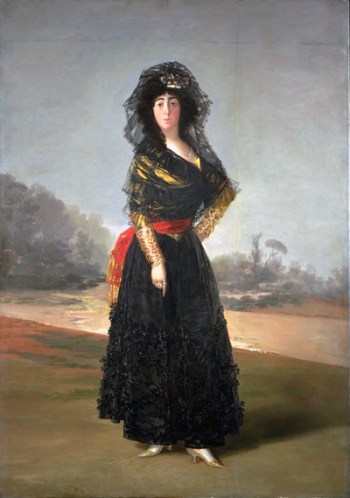
Francisco de Goya y Lucientes, The Duchess of Alba, 1796–97, oil on canvas, 210 × 149 cm (New York: The Hispanic Society of America).
With this exhibition—which occupies all of the temporary exhibition galleries in the new extension—the Museo del Prado offers its visitors the privilege of enjoying one museum within another, as it did in 2012 with the exhibition The Hermitage in the Prado. In this case, the renovation of the Hispanic Society’s galleries has allowed the treasures of their collections of Spanish and Latin American art, along with rare books and manuscripts, to travel to Spain. Many of the works of art that will be shown have not previously been exhibited or were unknown, including the reliquary busts of Santa Marta and Santa María Magdalena by Juan de Juni and the Fates of Man by Manuel Chili, known as Caspicara. Others have recently been identified, such as the Map of Tequaltiche, which was thought to be lost. Besides the individual value of each work of art, this exceptional grouping gives context to the magnitude of the rich history of Hispanic culture in the Iberian Peninsula, America, and Philippines. Spanning more than 3,000 years, the collection shows a quality of art works that no museum outside of Spain can compete with, demonstrating the passion of a unique collector who put his resources and knowledge towards creating a Spanish museum in America.
The extraordinary selection of paintings includes master works such as Portrait of a Little Girl, Camillo Astalli and Gaspar de Guzmán, Conde-Duque de Olivares by Velázquez, Pieta by El Greco, The Prodigal Son by Murillo, Santa Emerenciana by Zurbarán, and the emblematic Duchess of Alba by Goya, especially conserved for this occasion at the Museo del Prado with the collaboration of Fundación Iberdrola. Also represented are paintings by Post-Impressionists and modern artists, such as Zuloaga, Sorolla, and Santiago Rusiñol. The selection of sculpture includes, among others: the Efigie of Mencía Enríquez de Toledo from the Workshop of Gil de Siloé, the terracotta The Mystical Marriage of Saint Catherine by Luisa Roldán, and Fates of Man, a group of polychromed wood sculptures by Manuel Chili, known as Caspicara.
The exhibition also includes a selection of important archaeological artifacts, among them Celtiberian jewelry, Bell-Beaker vessels, and a Visigothic belt buckle. Completing the survey is a significant selection of decorative arts, with Renaissance and Baroque metalwork, ceramics from Manises, Talavera and Alcora, and an exquisite Pyxis made of ivory with gold plated hinges. Alongside these objects are textiles including a Fragment of the tunic of Prince Felipe de Castilla and a Nazrid silk textile.
An innovative mounting technique will allow the important holdings of the library of the Hispanic Society to be appreciated in all their splendor; works include A grant (Privilegio) issued by Alfonso VII, king of Castile and León, Biblia sacra iuxta versionem vulgata. Bible in Latin; unique letters such as Holograph instructions for his son Philip, the Letter to Phillip II of Spain from Elizabeth I, Queen of England, and the Holograph letter, signed “Diego de Silva Velazquez” to Damián Gotiens; and various maps including Portolan Atlas by Battista Agnese and the Mapamundi by Juan Vespucci.
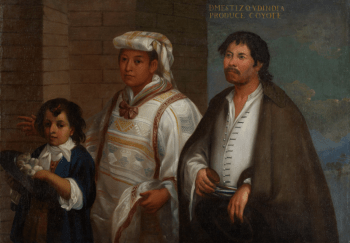
Juan Rodríguez Juárez, De Mestizo y de India produce Coyote, ca. 1716–20; Mexico, oil on canvas, 104 × 146 cm (New York: The Hispanic Society of America).
The first part of the exhibition (Galleries A and B) is organized chronologically and thematically by period in Spain and Latin America and comprises archaeological artifacts from sites on the Iberian Peninsula, Roman sculpture, magnificent ceramics, glass, furniture, textiles, silverworks, and Islamic and Medieval treasures as well as those from the Golden Age. Of particular relevance are Spanish paintings, in dialogue with the collections of the Prado, and colonial art closely related to the peninsula’s artistic legacy. Also included is a section dedicated to the library at the Hispanic Society, one of the most important in the world.
Gallery C offers a broad selection of the best Spanish painting from the 19th century through the early 20th century, including an exceptional collection of portraits of the leading Spanish scholars of that period, who worked closely with Huntington. After the First World War, Archer Huntington halted acquisitions, but maintained a close relationship with Spanish art and culture through his friendship with various painters, principally Joaquín Sorolla, who was commissioned to paint the famous series of large scale canvases depicting the regions of Spain for the Hispanic Society.
Accompanying the exhibition is a documentary projected in Gallery D, directed by Francesco Jodice, that transports the visitor to New York in the beginning of the twentieth century and narrates the history of the Hispanic Society and the passion of its founder, the philanthropist Archer Milton Huntington. The film contextualizes the origins of the early collecting practices of Huntington; the construction and inauguration of the headquarters of the Hispanic Society; Huntington’s collections and the fantastic holdings of the library; his relationship with Spain through Alfonso XII and the great Spanish intellectuals of the era; his friendship with Sorolla in New York; and the philanthropy of this great patron who wanted to remain anonymous during his entire life. The story is told by the director, Mitchell Codding, Chairman of the Board of Trustees, Philippe de Montebello, and the curators. The film, which runs for approximately 20 minutes, was filmed in New York and at the Prado Museum and is in English with Spanish subtitles.
Visions of the Hispanic World is the latest chapter in the decade-long collaboration between the Museo del Prado and the BBVA Foundation, involving the annual organization of a major exhibition event. This partnership has made possible such celebrated exhibitions as Passion for Renoir, The Hermitage in the Prado, El Greco and Modern Painting, and Bosch: The 5th Centenary Exhibition. Thanks to the Prado’s select network of relations with public and private lenders, these shows are the opportunity for an international public to view works that might otherwise never be seen under one roof. The exhibitions presented by the Prado and BBVA Foundation have met with an extraordinary response. In particular, those devoted to the Hermitage and Bosch successively broke the record of visits to the Madrid museum’s temporary exhibits, with over 580,000 spectators each.
Archer Milton Huntington, only son of one of the wealthiest families in The United States, from a young age possessed a profound interest in the Hispanic world. His education and numerous trips to Europe inspired an interest in collecting, always with the idea of creating a museum. In less than forty years, Huntington created a library and museum designed to elevate the study of Hispanic art through unparalleled collections in both scope and quality. At the same time, he published various facsimiles of important rare books and manuscripts. Huntington, in an effort to not deprive Spain of its artistic treasures, acquired most of his collection outside of the country. One can confirm, as did Jonathan Brown, that Huntington saw the Hispanic Society as an encyclopedic depository of Spanish art and literature. Huntington was one of the first Hispanists in the United States in the first half of the 20th century. For this reason he was awarded by numerous American universities. He was an active member of various Spanish museums and was invested as member of the Spanish Royal Academies. This exhibition pays homage to Huntington’s lifelong work for The Hispanic Society Museum & Library in the diffusion and study of Spanish culture in the United States of America.
Tesoros de la Hispanic Society of America (Madrid: Museo Nacional del Prado, 2017), 448 pages, ISBN: 978 84848 04079, 35€.
Exhibition | Thomas Jefferson: The Private Man
Thomas Jefferson was born 274 years ago today (13 April). From the New-York Historical Society:
Thomas Jefferson: The Private Man
From the Collections of the Massachusetts Historical Society
Massachusetts Historical Society, Boston, 29 January — 26 May 2016
New-York Historical Society, 7 April — 16 July 2017
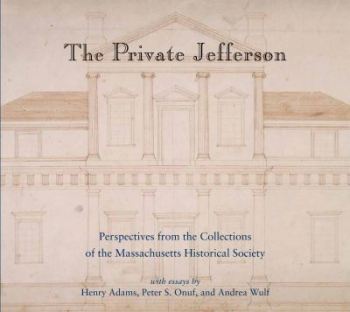 Thomas Jefferson’s role as a private citizen is as defining as his personae as founder, president, and political standard-bearer. A gifted writer and political philosopher, Jefferson was also an accomplished gardener, farmer, and architect. Thomas Jefferson: The Private Man provides a glimpse of his life outside the public sphere through the iconic documents he created. Among the 36 documents and artifacts on display from the collection of the Massachusetts Historical Society are Jefferson’s garden book, his last letter to John Adams, manuscript leafs from his Notes on the State of Virginia, early drawings of Monticello, and a copy of the Declaration of Independence in Jefferson’s hand.
Distributed by The University of Virginia Press:
Ondine LeBlanc, ed., with essays by Peter S. Onuf, Andrea Wulf, and Henry Adams, The Private Jefferson: Perspectives from the Collections of the Massachusetts Historical Society (Boston: Massachusetts Historical Society, 2016), 224 pages, ISBN: 978 19365 20084 (hardcover), $60.00 / ISBN: 978 19365 20091 (paperback), $35.










leave a comment