Exhibition | Cristóbal de Villalpando: Mexican Painter of the Baroque
Press release from The Met:
Cristóbal de Villalpando: Mexican Painter of the Baroque
Palacio de Cultura Banamex – Palacio de Iturbide, Mexico City, 9 March — 4 June 2017
The Metropolitan Museum of Art, New York, 25 July — 15 October 2017
Curated by Ronda Kasl, Jonathan Brown, and Clara Bargellini
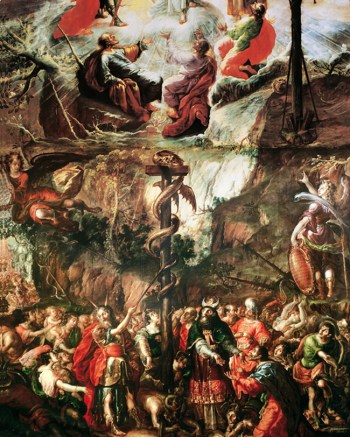
Cristóbal de Villalpando, Moses and the Brazen Serpent and the Transfiguration of Jesus (detail), 1683; oil on Canvas. Col. Propiedad de la Nación Mexicana, Secretaría de Cultura, Dirección General de Sitios y Monumentos del Patrimonio Cultural Acervo de la Catedral de Nuestra Señora de la Inmaculada Concepción, Puebla, Mexico.
Cristóbal de Villalpando (ca. 1649–1714) emerged in the 1680s not only as the leading painter in viceregal Mexico, but also as one of the most innovative and accomplished artists in the entire Spanish world. Opening July 25 at The Metropolitan Museum of Art, the exhibition Cristóbal de Villalpando: Mexican Painter of the Baroque features his earliest masterpiece, a monumental painting depicting the biblical accounts of Moses and the brazen serpent and the Transfiguration of Jesus that was painted in 1683 for a chapel in Puebla Cathedral. Newly conserved, this 28-foot-tall canvas has never been exhibited outside its place of origin. Ten additional works, most of which have never been shown in the United States, will also be exhibited. Highlights include Villalpando’s recently discovered Adoration of the Magi, on loan from Fordham University, and The Holy Name of Mary, from the Museum of the Basilica of Guadalupe.
Born in Mexico City around mid-century, Cristobal de Villalpando may have begun his career in the workshop of Baltasar de Echave Rioja (1632–1682). Villalpando’s rise to prominence coincided with the death of Echave Rioja in 1682, just one year before Villalpando painted his ambitious Moses and the Brazen Serpent and the Transfiguration of Jesus. Villalpando was celebrated in his lifetime, rewarded with prestigious commissions, and honored as an officer of the Mexico City painters’ guild.
The exhibition begins with Villalpando’s masterful Moses and the Brazen Serpent and the Transfiguration of Jesus, which was painted to decorate a chapel in Puebla Cathedral that was dedicated to a miracle-working image of Christ at the Column. In wealth and importance, Puebla Cathedral was second only to the Metropolitan Cathedral in Mexico City.
This painting—the first in a series of important ecclesiastical commissions—marks a breakthrough in Villalpando’s work, in terms of its grand scale and its audacious conception and execution. He signed it Villalpando inventor, an inscription that distinguishes the artist’s intellectual achievement from his manual skill and asserts his professional status as the learned practitioner of a noble art. In a bold and erudite arrangement, Villalpando juxtaposed the Old Testament story of Moses and the brazen serpent with the New Testament account of the Transfiguration—an unprecedented pairing of subjects. The two biblical events are staged within a single, continuous sacred landscape that encompasses the wilderness of Exodus and the holy mounts of Calvary and Tabor. Life-size figures of every age and gender, clothed and nude and in an astounding variety of poses and attitudes, populate the composition. The painting’s lower half features the story of Moses making and using the image of the brazen serpent according to God’s instructions to heal Israelites bitten by poisonous serpents. This episode provides a scriptural precedent for the making and use of images in worship, while also affirming the importance of art and artists. The upper half of the composition represents the transfiguration of Jesus’s corporeal body into light, a scene that demanded nothing less than the materialization of light in paint, which Villalpando attained through shimmering color and fluid brushwork.
Ten additional paintings by Villalpando will demonstrate his intense striving as an inventor; his great originality and skill; his ability to convey complex subject matter; and his capacity to envision the divine.
Catalogues in English and Spanish published by Fomento Cultural Banamex will accompany the exhibition. Essays address the major themes of the exhibition. The catalogues will be available for purchase in The Met book shop. A series of exhibition tours will complement the exhibition.
The exhibition was curated by Ronda Kasl, Curator of Latin American Art in The American Wing at The Met; Jonathan Brown, Carol and Milton Petrie Professor of Fine Arts, Institute of Fine Arts, New York University; and Clara Bargellini, Professor, Instituto de Investigaciones Estéticas, Universidad Nacional Autónoma de México. The work of Dr. Brown and Dr. Bargellini was commissioned by Fomento Cultural Banamex. At The Met, the exhibition is designed by Michael Langley, Exhibition Design Manager; graphics are by Mortimer Lebigre, Graphic Designer; and lighting is by Clint Ross Coller and Richard Lichte, Lighting Design Managers, all of the Museum’s Design Department.
Exhibition | Bonnie Prince Charlie and the Jacobites
Press release (24 February 2017) for the exhibition:
Bonnie Prince Charlie and the Jacobites
National Museum of Scotland, Edinburgh, 23 June — 12 November 2017
Curated by David Forsyth
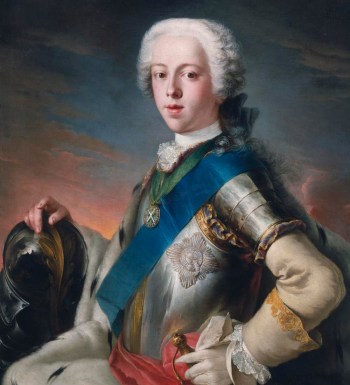
Louis Gabriel Blanchet, Portrait of Prince Charles Edward Stuart, 1739 (Royal Collection Trust).
This summer National Museums Scotland will present the largest exhibition about the Jacobites to be held in over 70 years. As well as drawing on National Museums Scotland’s own collections, the exhibition will feature spectacular loans from the United Kingdom and Europe. More than 300 paintings, costumes, documents, weapons, books, and many unique objects owned by the exiled Jacobite kings will help tell the wider story of Bonnie Prince Charlie and the Jacobites.
David Forsyth, the exhibition’s lead curator, said, “The story of Bonnie Prince Charlie and the Jacobites has had an enduring and generally romantic fascination for subsequent generations, from Sir Walter Scott to the current Outlander TV programme, along with many other representations in literature, TV, and film. This exhibition will enable us to use the best material there is—real objects and contemporary accounts and depictions—to present the truth of a story more layered, complex, and dramatic than even these fictional imaginings.”
The Jacobites (from Jacobus, the Latin for James) were supporters of a movement to reinstate the Roman Catholic Stuart king, James VII & II and his heirs to the throne after his exile to France in 1688. Bonnie Prince Charlie and the Jacobites presents a detailed and dynamic, multi-faceted re-examination of this familiar yet much-contested story, showing how the Jacobite challenge for the three kingdoms was a complex civil war, which even pitched Scot against Scot. Support for the cause was drawn from Scotland, England, Ireland, and Continental Europe; it was part of the broader dynastic and political rivalries of Europe’s great powers.
Bonnie Prince Charlie
Bonnie Prince Charlie has a place in popular consciousness as the romantic personification and figurehead of the movement. This is at least in part due to the Victorian fascination with the period, illustrated by the portrait which opens the exhibition of the Prince arriving at a ball at the Palace of Holyroodhouse. The work, by John Pettie, was painted over a century after Charles’s death and actually depicts a scene from Sir Walter Scott’s novel Waverley.
In fact, Charles Edward Louis John Casimir Sylvester Maria Stuart (1720–1788) was born and died in Rome, spending less than fourteen months in Scotland during his lifetime. The exhibition will explore the full story of the Jacobites, which spans two centuries and encompasses Britain, Ireland, and Continental Europe.
The Stuart Dynasty: Divided by Faith
At the heart of the story lies one family—The Royal House of Stuart—one of Europe’s most enduring dynasties, a dynasty with a claim to unite three kingdoms: Scotland, England, and Ireland.
James VII & II had taken the throne in 1685 after the death of his brother, Charles II. By 1688 political and religious pressures drove a wedge through the family. James’ Catholic faith, shown in spectacular altar pieces bought in 1686 for his chapel at Holyrood, caused widespread concern and, when he announced the birth of a male heir which heralded the prospect of a Catholic succession, he was deposed in the Glorious Revolution, replaced by his daughter Mary and her husband, William of Orange, while her baby half-brother was smuggled out the country for his own safety.
These events led to James VII & II, Bonnie Prince Charlie’s grandfather, spending the rest of his days in exile in France, while the house of Hanover succeeded to the throne in 1714. The Hanoverian line is shown through the basin and ewer of the Winter Queen, Elizabeth of Bohemia, daughter of James VI & I, whose grandson George became King after the death of Queen Anne in 1714.
Courtly Exile in Europe
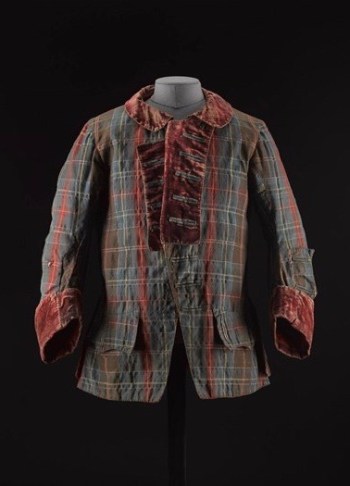
Short tartan frock coat with velvet collar and cuffs and lined in wool twill and linen, associated with Prince Charles Edward Stuart (National Museums Scotland).
The baby smuggled to safety was Charles’s father, James Francis Stuart (1688–1766); to supporters loyal to the exiled Stuarts, he became James VIII & III and was formally recognised as such by Louis XIV of France. The exhibition will bring to the forefront the lives of the Jacobites in exile at the courts they established in Saint Germain, France, and later in Rome, where they were joined by many of their followers. A display of remarkable and symbolic objects including the targe (shield), broadsword, and travelling canteen, commissioned by supporters at home, will be shown in the context of the exiled Stuart court in Rome. These objects, all later recovered from the baggage train at Culloden, were produced to promote the Jacobites’ dynastic claims, affirming their royal status and showing their connections with their distant supporters while in exile. Secret signs and insignias marked out those loyal to the ‘kings over the water’, ranging from a subtle white rose to a seditious full tartan suit, made for leading English Jacobite Sir John Hyde Cotton.
James Francis Stuart married a Polish Princess, Clementina Sobieski. His marriage certificate will be shown, as will the baptismal certificate of their first
son, Charles Edward Stuart.
Five Jacobite Challenges for the Throne
Meanwhile, in Scotland, this tumultuous period was characterized by five Jacobite challenges to the throne, in 1689–90, 1708, 1715, culminating in Bonnie Prince Charlie’s campaign of 1745–46. Weapons, plans, paintings, and commemorative objects show the earlier campaigns. Charles’s time in Scotland, while short, forms one of largest sections of the exhibition, including spectacular costume including items associated with Charles himself and dresses of the time thought to have been worn at the Court he briefly held at the Palace of Holyroodhouse in Edinburgh. Alongside this, the ‘lost’ Ramsay portrait of Charles in the guise of a European prince, recently acquired by the National Galleries of Scotland, will be shown.
Bonnie Prince Charlie and the Last Jacobite Challenge
After further advances followed by a long retreat, the campaign came to an abrupt and bloody end in little more than an hour at Culloden. The plan of the battle, a portrait of the Duke of Cumberland and numerous weapons and effects of those who fell will form a reflective backdrop as a Gaelic lament plays in the background.
Retribution across the Highlands was swift and brutal. Charles spent five months evading government forces eventually sailing for France, leaving the Jacobite cause in tatters. Portraits of Anne MacKintosh and Flora MacDonald introduce two of the key figures in Charles’ eventful escape.
Kings over the Water
The denouement to the story and to the exhibition is the remaining years in exile of James, Charles, and his brother Henry who, after Culloden, joined the priesthood of the Catholic Church while Charles, his ambitions thereby thwarted once and for all, dwindled towards a dissolute end. A pair of portraits of Henry and Charles in their later years serves to illustrate their contrasting fates. Henry, Charles, and their father James are all buried in the Vatican, the latter being the only monarch interred there.
A closing selection of Jacobite memorial treasures is presented, including the ‘Spottiswoode’ Amen glass, c.1775. On loan from William Grant and Sons, owners of Drambuie, this is one of the finest ‘Amen’ glasses in existence, so called due to its engraving with the Jacobite anthem of James VIII and dedicatory inscriptions to his sons, Prince Charles and Prince Henry.
The exhibition is supported by Baillie Gifford Investment Managers and will be accompanied by a programme of public events and by two publications.
The National Museum of Scotland is part of a new trail of 26 attractions across Scotland whose history is intertwined with the Jacobite story. Learn more here.
David Forsyth, ed., Bonnie Prince Charlie and the Jacobites (Edinburgh: National Museums Scotland, 2017), 256 pages, ISBN: 978 191068 2081, £25.
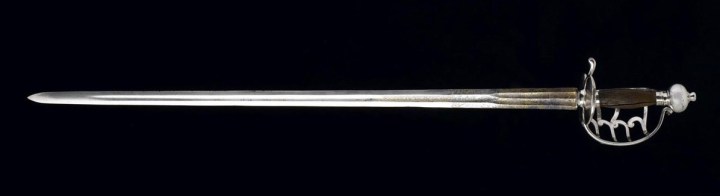
Broadsword with a silver hilt made by Edinburgh goldsmith Harry Bethune, ca. 1715 (National Museums Scotland, H.LA 124). The inscription shows support for James ‘VIII’, the son of the deposed King James VII and father of Bonnie Prince Charlie.
◊ ◊ ◊ ◊ ◊
S T U D Y D A Y — 2 8 O C T O B E R 2 0 1 7
Chaired by historian Fiona Watson, our expert panel will examine the wider Jacobite story: Bonnie Prince Charlie’s court at the Palace of Holyroodhouse, the Stuart courts in exile in France and Italy, and how our conservators prepared costume pieces for display.
10:00 Registration
10:30 Fiona Watson, Welcome and Introduction
Watson is an author, broadcaster, and historian. She is best known for her 2001 BBC series In Search of Scotland. She is former Senior Lecturer in Scottish History and founding Director of the Centre for Environmental History at the University of Stirling.
10:45 David Forsyth, Bonnie Prince Charlie and the Rise and Fall of the Jacobites
Drawing on exceptional material from Scottish collections as well as treasures from across the UK and France, this talk will reveal who the Jacobites were and explores the cause that drove their campaigns. Forsyth is Principal Curator of Medieval–Early Modern Collections in the Department of Scottish History and Archaeology at National Museums Scotland and the curator of Bonnie Prince Charlie and the Jacobites.
11:15 Deborah Clarke, Bonnie Prince Charlie at the Palace of Holyroodhouse
In 1745, the Jacobites seized the city of Edinburgh and Bonnie Prince Charlie set up court at the Palace of Holyroodhouse. This talk uncovers the famous court of the ’45 Rising and discusses the ceremonies and events that took place during the Prince’s residence at the Stuart palace. Clarke is Senior Curator, Royal Collection Trust, at the Palace of Holyroodhouse.
11:45 Danielle Connolly and Miriam McLeod, Conserving the Jacobites
The National Museum of Scotland’s Jacobite textile collections are of international importance. They are often unique objects, covering a range of materials and techniques. This talk will highlight the painstaking textile conservation work undertaken on large costume pieces—such as the silk dress said to have been worn by Margaret Oliphant of Gask at the Great Ball of Holyrood after the Battle of Prestonpans—and the small but highly symbolic white cockade. Connolly is Assistant Textile Conservator at National Museums Scotland; McLeod is Textile Conservator at National Museums Scotland.
12:15 Lunch Break and Opportunity to View Exhibition
National Museums Scotland Research Librarians will be on hand to showcase related material in South Hall. The scope of the library collection reflects the strengths and variety of the Museums’ collections and Library staff can offer advice and support in locating items and using the collections. The Research Library is our main reading room on level 3 of the National Museum of Scotland.
13:30 Edward Corp, The Stuart Court in France and Italy
An analysis of the Jacobite Court in exile—re-assessing its importance and highlighting the significance of Stuart relations with the European monarchy and the Papacy. This talk will also explore how the court came to an end—and how it has since been misrepresented. Corp was Professor of British History at the University of Toulouse until 2011 and since then has been Emeritus Professor. Edward curated The King over the Water, a major exhibition on the exiled Stuart Court at the Scottish National Portrait Gallery in 2001 and wrote the associated publication The King over the Water: Portraits of the Stuarts in Exile after 1689 (National Galleries of Scotland, 2001). He has also written a three volume history of the Stuart Court in exile: A Court in Exile: The Stuarts in France, 1689–1718; The Jacobites at Urbino: An Exiled Court in Transition; and The Stuarts in Italy, 1719–1766: A Royal Court in Permanent Exile.
14:15 Panel Discussion and Audience Q&A, Chaired by Fiona Watson
Additional programming details are available here»
Exhibition | The Demolition of the Château de Meudon: Hubert Robert
Now on view at the Château de Sceaux, Hauts-de-Seine:
La Démolition du Château de Meudon par Hubert Robert
Château de Sceaux, 21 April — 9 July 2017
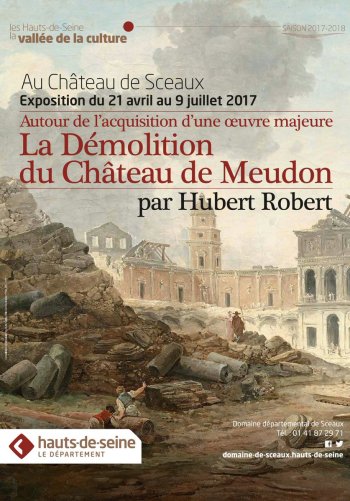 Le château de Meudon fut l’un de ces grands domaines prestigieux de l’ouest parisien, propriété de plusieurs personnages illustres, comme la duchesse d’Étampes, le cardinal de Lorraine, Abel Servien ou le marquis de Louvois, et le plus fameux : Louis de France (1661–1711), dit le Grand Dauphin, fils de Louis XIV, qui porta le domaine de Meudon à son apogée.
Constitué d’un Château-Vieux—ayant connu, depuis la Renaissance, une suite ininterrompue de transformations—et d’un Château-Neuf, voulu par le Grand Dauphin, l’ensemble était environné de jardins en terrasses générant des points de vue exceptionnels sur la campagne, la Seine et Paris. Résidence de nombreux hôtes de marque, au cours du XVIIIe siècle, le domaine fut saisi par la Nation, en 1793, et devint un lieu d’expérimentations scientifiques. C’est au cours de l’une d’elle que l’aile gauche du Château-Vieux fut incendiée, en 1795. Laissé en l’état durant une dizaine d’années, le bâtiment fut finalement démoli à partir de 1803.
Le peintre Hubert Robert, qui avait été chargé sous Louis XVI de divers aménagements dans les jardins de Meudon, fut une fois de plus sensible à l’image de ces terribles vestiges de l’Ancien Régime. Dans un élan préromantique, il a immortalisé sur la toile le moment pathétique de la disparition de l’un de ses plus beaux symboles. Le tableau final est aujourd’hui conservé au Getty Museum de Los Angeles, mais le musée du Domaine départemental de Sceaux a pu se porter acquéreur, en vente publique, de l’esquisse aboutie de cette œuvre. Hubert Robert s’y montre à la fois d’une grande virtuosité dans l’écriture et d’une parfaite délicatesse dans le coloris. Un chef-d’œuvre qui vient enrichir les collections du musée et qui est ici révélé au public dans le cadre d’une exposition-dossier.
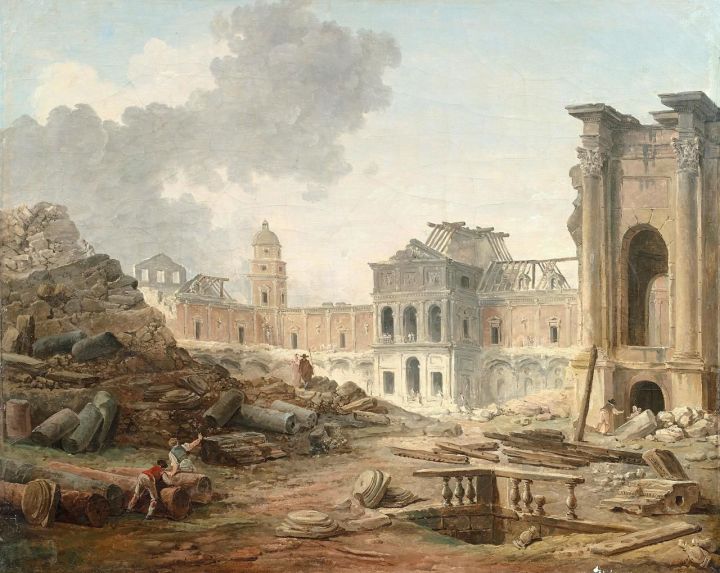
Hubert Robert, The Demolition of the Château de Meudon, 1803
(CD92/MDDS – Cab. Turquin)
◊ ◊ ◊ ◊ ◊
As reported by Art Media Agency (AMA), 15 October 2016:
Estimated at between €40,000 and €60,000, a work by Hubert Robert has been pre-empted at €111,600 by France’s Musées Nationaux, in favour of the department of Hauts-de-Seine. The painting was identified by its owner following a visit to the Louvre, during the Hubert Robert (1733–1808): Un peintre visionnaire exhibition last spring. The work was assessed by Bertrand Couton. It is a small version of a painting conserved at the J. Paul Getty Museum in Los Angeles, which featured in the Paris exhibition. It represents a demolition scene at the Château de Meudon, one of the symbols of the monarchy’s Ancien Régime.
Reconstitution 3D du château de Meudon vers 1715 (published 22 October 2014). Restitution réalisée par la société PHIDIAS 3D pour l’Association pour la Restauration du Château de Meudon.
◊ ◊ ◊ ◊ ◊
A YouTube clip from The Getty, with commentary by Jon Seydl, is available here»
Exhibition | Romantic Shakespeare
Now on view in Saint-Omer:
Shakespeare Romantique: Füssli, Delacroix, Chassériau
Musée de l’hôtel Sandelin, Saint-Omer, 24 May — 30 August 2017
Curated by Dominique de Font-Réaulx, Marie-Lys Marguerite, and Roman Saffré
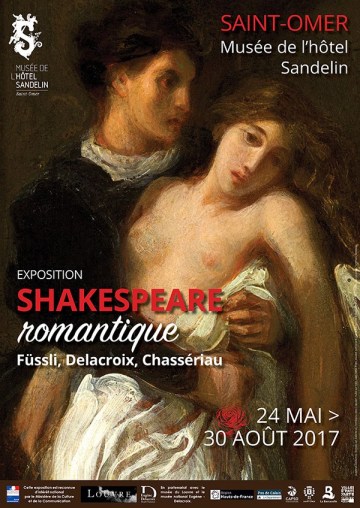 In May 2017, the musée de l’hôtel Sandelin presents a new exhibition organized as part of a prestigious partnership with the musée du Louvre and the musée national Eugène-Delacroix. The exhibition will present some 70 exceptional works. These painters, printmakers, and sculptors built a collective imagination around the parts of an author who was particularly inspirational for them throughout the 19th century, the great English playwright Shakespeare. Fuseli, Delacroix, Chassériau, Moreau, Préault, and Doré were able to recreate in their creations the feelings, the strangeness, and the morality of Shakespearean tragedies. Their works still influence the staging of Shakespeare’s plays.
In 1824, Stendhal wrote: “All the great writers were romantics of their time.” In fact, the 19th century was marked by a renewed interest in the great literary frescoes past Dante, Ariosto, Shakespeare, Racine become essential sources of inspiration for the romantic authors, but also for painters, who then have a special relationship to the art of staging.
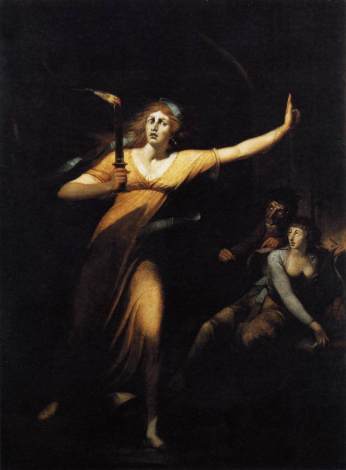
Henry Fuseli, Lady Macbeth, 1784, 221 × 160 cm (Paris: Louvre).
The early 19th century saw the birth of a true rediscovery of Shakespeare in France. The feelings of strangeness and morality in each of Shakespearean tragedies influence painters, printmakers and sculptors to create some art of emotion and narrative. The exhibition aims to show the the creation of a collective imagination that gave rise to the plays of Shakespeare. These designs still influence the staging of the texts of the English playwright. Works presented in the exhibition come mainly from the collections of the Louvre, the Musée national Eugène-Delacroix, the d’Orsay Museum, and the Victoria and Albert Museum in London.
Curators
Dominique de Font-Réaulx, General Curator of Heritage and Director of Eugene Delacroix Museum
Marie-Lys Margaret, Heritage curator and director of the Museum of Fine Arts of Arras
Romain Saffré, Heritage curator and director of museums Saint-Omer
Exhibition | Casanova: The Seduction of Europe
From the Kimbell Art Museum and Distributed Art Publishers (DAP) . . .
Casanova: The Seduction of Europe / Casanova’s Europe: Art, Pleasure, and Power
Kimbell Art Museum, Fort Worth, 27 August — 31 December 2017
The Legion of Honor, San Francisco, 10 February — 28 May 2018
Museum of Fine Arts, Boston, 1 July — 8 October 2018

Jean-Marc Nattier, Portrait of Manon Balletti, 1757, oil on canvas, 54 × 47.5 cm (London: National Gallery). Balletti was the fiancée (1757–60) of Giacomo Casanova and then wife (1760–74) of the architect Jacques-François Blondel.
Casanova: The Seduction of Europe explores the 18th century across Europe through the eyes of one of its most colorful characters, Giacomo Casanova (1725–1798). Renowned in modern times for his amorous pursuits, Casanova lived not only in Italy, but in France and England, and his travels took him to the Ottoman Empire and to meet Catherine the Great in Saint Petersburg. Bringing together paintings, sculpture, works on paper, furnishings, porcelains, silver, and period costume, Casanova will bring this world to life. Following its display in Fort Worth, the exhibition will be on view at the Fine Arts Museum of San Francisco and the Museum of Fine Arts, Boston.
Frederick Ilchman, Thomas Michie, C.D. Dickerson III, and Esther Bell, with texts by Meredith Chilton, Jeffrey Collins, Nina Dubin, Courtney Leigh Harris, James Johnson, Pamela Parmal, Malina Stefanovska, Susan Wager, and Michael Yonan, Casanova: The Seduction of Europe (Boston: MFA Publications, 2017), 344 pages, ISBN: 978 087846 8423, $45.
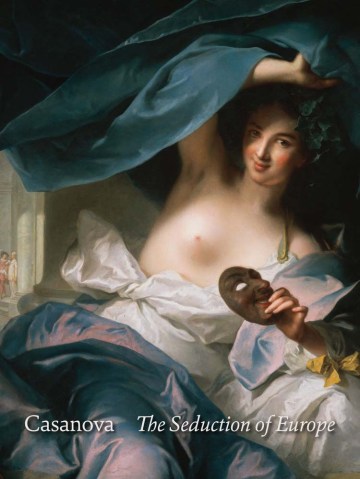 In 18th-century Europe, while the old order reveled in the luxurious excesses of the Rococo style and the Enlightenment sowed the seeds of revolution, the shapeshifting libertine Giacomo Casanova seduced his way across the continent. Although notorious for the scores of amorous conquests he recorded in his remarkably frank memoirs, Casanova was just as practiced at charming his way into the most elite social circles, through an inimitable mix of literary ambition, improvisational genius and outright fraud. In his travels across Europe and through every level of society from the theatrical demimonde to royal courts, he was also seduced by the visual splendors he encountered.
This volume accompanies the first major art exhibition outside Europe to lavishly recreate Casanova’s visual world, from his birthplace of Venice, city of masquerades, to the cultural capitals of Paris and London and the outposts of Eastern Europe. Summoning up the people he met and the cityscapes, highways, salons, theaters, masked balls, boudoirs, gambling halls and dining rooms he frequented, it provides a survey of important works of 18th-century European art by masters such as Canaletto, Fragonard, Boucher, Houdon, and Hogarth, along with exquisite decorative arts objects. Twelve essays by prominent scholars illuminate multiple facets of Casanova’s world as reflected in the arts of his time, providing a fascinating grand tour of Europe conducted by a quintessential figure of the 18th century as well as a splendid visual display of the spirit of the age.
◊ ◊ ◊ ◊ ◊
Note (added 20 August 2018) — This article might be of interest for anyone thinking about the exhibition and its reception within our own political/cultural context: Cynthia Durcanin, “Casanova as Case Study: How Should Art Museums Present Problematic Aspects of the Past?,” ArtNews (13 August 2018). As noted in the essay: “The MFA also changed the show’s title from the Legion of Honor’s, removing the word ‘seduction’ so that it became ‘Casanova’s Europe: Art, Pleasure and Power in the 18th Century’.” According to Katie Getchell, the chief brand officer and deputy director of the MFA Boston, “It’s an important nuance. The show is not about Casanova—it’s about Europe in Casanova’s time.”
2017 AAMC Awards Announced
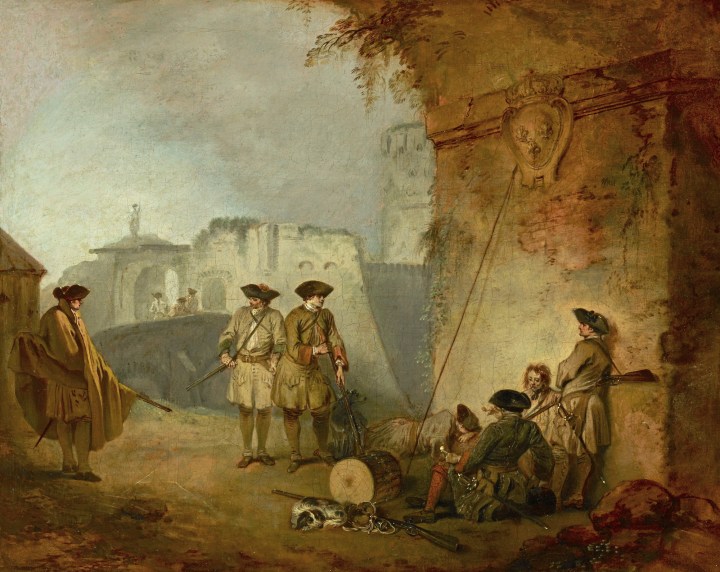
Jean-Antoine Watteau, The Portal of Valenciennes, ca. 1710–11, oil on canvas, 32.5 × 40.5 cm (New York: The Frick Collection, purchased with funds from the bequest of Arthemise Redpath, 91.1.173 / photo: Michael Bodycomb).
◊ ◊ ◊ ◊ ◊
Congratulations to Aaron Wile! His essay “Watteau and the Inner Life of War”—from the catalogue Watteau’s Soldiers: Scenes of Military Life in Eighteenth-Century France , published in conjunction with the exhibition that Wile also curated for The Frick Collection—was awarded the 2017 Prize for ‘Best Article, Essay, or Extended Catalogue Entry’ from the Association of Art Museum Curators (AAMC).
A full list of awards is available here»
Symposium | Reportage and Representation
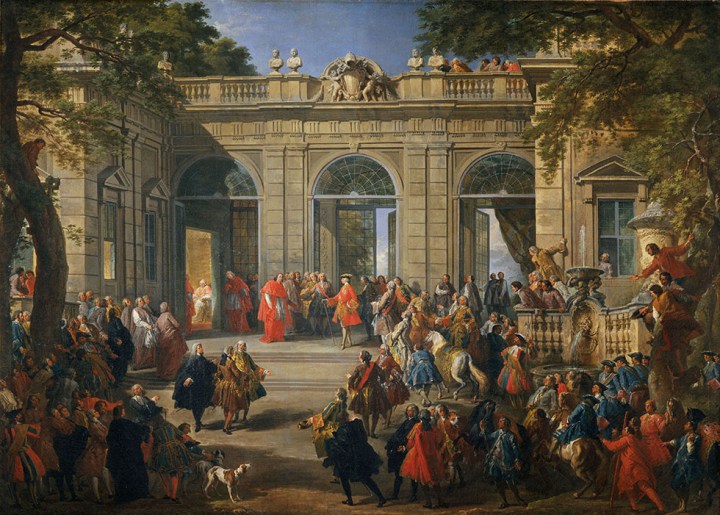
Giovanni Paolo Panini, King Charles III Visiting Pope Benedict XIV at the Coffee House of the Palazzo del Quirinale, 1746, 124 × 174 cm
(Naples: Museo Nazionale di Capodimonte)
◊ ◊ ◊ ◊ ◊
I’m dreadfully sorry to be late with this announcement (the event is just now wrapping up at The Getty), but I imagine the schedule is still useful for those of us not there to appreciate what a good day it must have been. –CH
Reportage and Representation: View Painting as Historical Witness
The Getty Center, Los Angeles, 28 May 2017
On the occasion of the exhibition Eyewitness Views: Making History in Eighteenth-Century Europe (on view at the Getty Center May 9–July 30, 2017), this scholarly symposium investigates the artistic framework and historical context of eighteenth-century view paintings recording contemporary events.
P R O G R A M
9:00 Registration and coffee
9:30 Welcome from Richard Rand (J. Paul Getty Museum)
9:45 Session 1: Princes, Popes, and Ambassadors
Moderator: Davide Gasparotto (J. Paul Getty Museum)
• Alberto Craievich (Ca’ Rezzonico, Venice), Regattas in Venice, 1680–1791
• Christopher Johns (Vanderbilt University, Nashville), Papal Diplomacy and Public Spectacle from Clement XII to Pius VI
• Stéphane Loire (Musée du Louvre, Paris), Giovanni Paolo Panini as a Witness of Public Life in Rome for the French Ambassadors
• Susan Tipton (Ludwig-Maximilians-Universität, Munich), Ambassadors on Stage in Eighteenth-Century Europe: Paintings of Diplomatic Ceremonies and Their Original Settings
12:30 Lunch
2:00 Session 2: Constructing Reality
Moderator: Louis Marchesano (Getty Research Institute)
• Edgar Peters Bowron (formerly The Museum of Fine Arts, Houston), Bernardo Bellotto’s Historical Views of Dresden, Vienna, and Warsaw
• David Marshall (University of Melbourne), Staging Rome: Giovanni Paolo Panini as Vedutista and Designer
3:00 Coffee break
3:30 Session 3: Patronage and the Market
Moderator: Jeffrey Collins (Bard Graduate Center, New York City)
• Francis Russell (Christie’s, London), Venetian Vedutisti and English Buyers: Some Connections and Footnotes
• Charles Beddington (London), Meeting Demand in Canaletto’s Venice
• Respondent: Jeffrey Collins (Bard Graduate Center, New York City)
R E L A T E D L E C T U R E
From Public Spectacle to Public Sphere: New Anthropologies of the Enlightenment
The Getty Center, Los Angeles, 27 May 2017
Larry Wolff, professor of history at New York University, considers how the baroque public spectacle—so essential to the rituals of the court and the church—began to give way in the eighteenth century to more informal and participatory forms of sociability and discussion, as reflected in eighteenth-century paintings of public occasion. Saturday, May 27, 5:00pm.
Exhibition | Lives Bound Together: Slavery at Mount Vernon
◊ ◊ ◊ ◊ ◊
Now on view at Mount Vernon:
Lives Bound Together: Slavery at George Washington’s Mount Vernon
The Donald W. Reynolds Museum, Mount Vernon, 1 October 2016 –30 September 2017
Mount Vernon was George Washington’s home. It was also home to hundreds of enslaved people who lived and worked under Washington’s control: in 1799, there were 317 men, women, and children enslaved at Mount Vernon’s five farms, which covered 8,000 acres. They made up more than 90% of the population of the estate.
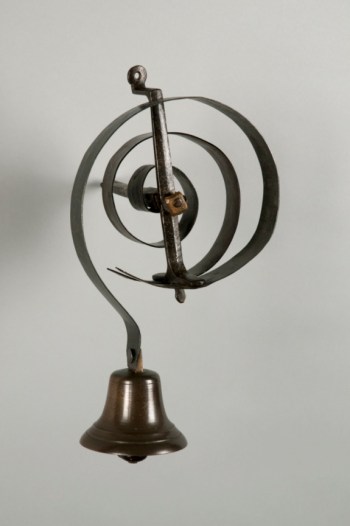
House Bell, ca. 1784–88; Copper alloy, iron (Mount Vernon).
Through household furnishings, art works, archaeological discoveries, documents, and interactive displays, the exhibition, which spans 4,400 square feet throughout all seven galleries of the Donald W. Reynolds Museum, demonstrates how closely intertwined the lives of the Washingtons were with those of the enslaved. Nineteen enslaved individuals are featured throughout the exhibit, represented with life-size silhouettes and interactive touchscreens providing biographical details.
More than 350 items are on view—seeds and animal bones, ceramic fragments, and metal buttons unearthed from archaeological excavations around the estate, as well as fine tablewares and furniture from the Washington household, providing insights into the enslaved community’s daily lives and work. Guests gain a better understanding of Washington’s changing views towards slavery, culminating in his landmark decision to include in his will a provision freeing the slaves that he owned. Visitors will have an opportunity to view original manuscript pages from George Washington’s will, written in July 1799, showing his decision to free the slaves he owned. The exhibition profiles 19 individuals enslaved at Mount Vernon, using George Washington’s extensive records to piece together what is known of their lives in interactive displays.
Susan P. Schoelwer, ed., with an introduction by Annette Gordon-Reed, Lives Bound Together: Slavery at George Washington’s Mount Vernon (2016), 172 pages, ISBN: 978 970931 9170, $20.
Lives Bound Together provides fresh research on this important topic, with brief biographies of 19 enslaved individuals, 10 essays, and 130 illustrations, including paintings, prints, and household furnishings from the Mansion, artifacts excavated by archaeologists from the slave quarters, documents, maps, and conjectural silhouettes that suggest the presence of the enslaved.
Exhibition | The Treasury Collection: Works by Maria Sibylla Merian
Now on view at the Cromhouthuis (with thanks to Hélène Bremer for noting it and the related symposium). . .
The Treasury Collection: Works by Maria Sibylla Merian
Cromhouthuis, Amsterdam, 31 March — 18 June 2017
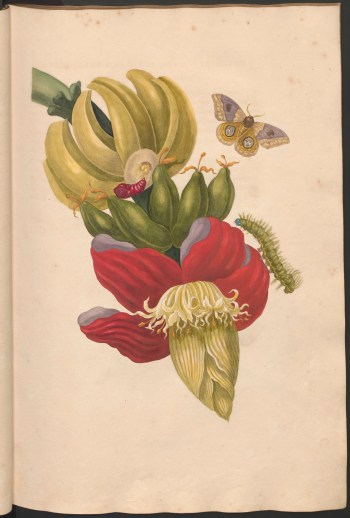 This year is the 300th anniversary of the death of naturalist and artist Maria Sibylla Merian (1647–1717). On view at the Cromhouthuis, The Treasury Collection: Works by Maria Sibylla Merian features her colourful paintings and illustrations of caterpillars, butterflies, and other insects. This valuable and fragile collection is part of the Artis Library Collection from the University of Amsterdam.
Maria Sibylla Merian was born in Frankfurt in 1647 and moved to Amsterdam in 1691. Merian was an independent woman with modern ideas that she carried over into her research as a naturalist. For example, she felt it was important to see the creatures she was researching in their natural environment. This conviction lay at the basis of her journey to Surinam where she worked on her most well-known book, Metamorphosis Insectorum Surinamensium. The focus of this richly illustrated work, just as in her book Raupen wunderbare Verwandlung, is the metamorphosis of caterpillar to butterfly. The exhibition illustrates beautifully how Merian worked on the interface between art and science.
The exhibition was designed by Florian Seyd and Ueli Signer from The Wunderkammer. They took their inspiration from the antique books and original prints in the collection of the Artis Library (UvA) and combined this with specimens and objects from nature. British writer Redmond O’Hanlon made a special audio guide for the exhibition, available for free at the entrance.
To commemorate the 300th anniversary of the death of Merian, the Maria Sibylla Merian Society is holding an international symposium on her work, 7–9 June. The exhibition—a collaboration between Artis Library, the University of Amsterdam, and the Amsterdam Museum—is part of the symposium programme.
Exhibition | Peter the Great: A Tsar in France, 1717
Press release for the exhibition at Versailles, with thanks to Elizabeth Jane Timms for noting it:
Peter the Great: A Tsar in France, 1717
Grand Trianon, Château de Versailles, 30 May — 24 September 2017
Cuarated by Gwenola Firmin, Thierry Sarmant, and George Vilinbakhov
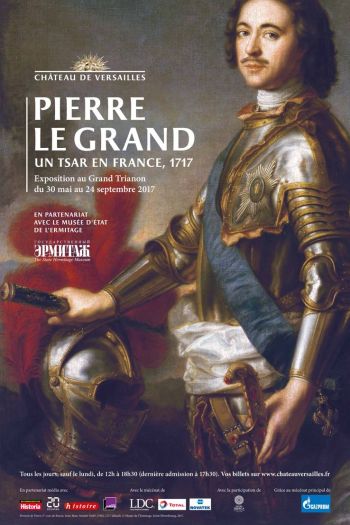 The exhibition Peter the Great: A Tsar in France, 1717 will be on display in the Grand Trianon from 30 May to 24 September 2017. It is dedicated to Tsar Peter the Great’s trip in and around Paris in May and June 1717 and will commemorate the 300th anniversary of this diplomatic visit. The fruit of exceptional collaboration between the Palace of Versailles and the Hermitage Museum, the exhibition will present over 150 works including paintings, sculptures, decorative artworks, and tapestries, as well as plans, medallions, scientific instruments, books and manuscripts, two thirds of which belong to the collections of the prestigious museum in Saint Petersburg.
A member of the house of Romanov and son of Tsar Alexis Mikhailovich (1645–1676) and Nataliya Naryshkina (1651–1694), Peter I (1672–1725) embarked on a second journey to the West twenty years after the Grand Embassy, which took him to Europe for the first time in 1697–98. He arrived in France on 21 April 1717 and remained until 21 June. He stayed at Versailles twice and was accommodated in the Grand Trianon, from 24 to 26 May and from 3 to 11 June. The exhibition will lead visitors step by step through the trip, which, although official, nonetheless allowed a certain amount of freedom since Peter I, being little accustomed to French etiquette and with his imposing figure and unpredictability, departed from protocol on multiple occasions. His encounter with Louis XV particularly shocked onlookers when, flouting the ceremonial custom of the court, he spontaneously took the young king, aged 7, in his arms. A number of memorialists, including Saint-Simon, the Marquis de Dangeau and Jean Buvat, left precious testimonies allowing us to retrace the journey.
Although there were political and economic aims to the stay—a project for an alliance with France against Sweden and the signature of a trade agreement—the reforming Tsar and founder of modern Russia most particularly wanted to see the finest of France in order to adapt certain models for his own empire. During the two months that Peter the Great spent in Regency Paris, his visits and discussions with French people provided him with food for thought and had an influence on the works he started in 1703 in Saint Petersburg and the surrounding area.
Pierre le Grand: Un Tsar en France, 1717 (Paris: 2017), 240 pages, ISBN: 978 23590 62014, 38€.
Curators
• Gwenola Firmin Curator in charge of paintings from the 18th century at the Palace of Versailles
• Thierry Sarmant Chief curator, head of the Archives historic Center, historic department of the Defence
• George Vilinbakhov Vice-director of the State Hermitage Museum in Saint Petersburg










leave a comment