Exhibition | Fragonard: The Fantasy Figures

Jean Honoré Fragonard, Sketches of Portraits, ca. 1769, drawing, 23 × 35 cm
(Private Collection, Paris)
◊ ◊ ◊ ◊ ◊
From the press release (11 July 2017) for the exhibition:
Fragonard: The Fantasy Figures
National Gallery of Art, Washington, D.C., 8 October — 3 December 2017
Curated by Yuriko Jackall
Combining art, fashion, science, and conservation, the revelatory exhibition Fragonard: The Fantasy Figures brings together—for the first time—a newly discovered drawing by Jean Honoré Fragonard (1732–1806) and some 14 of his paintings that have been identified with it including the Gallery’s own Young Girl Reading (c. 1769). Fragonard is considered among the most characteristic and important French painters of his era, and this series casts light on the development of his career, the identity of his sitters and patrons, and the significance of his innovative imagery. Fragonard: The Fantasy Figures and the fully illustrated catalog that accompanies it not only present new art-historical and scientific research into this series but also examine the 18th-century Parisian world in which these paintings were created. The exhibition may be seen only at the National Gallery of Art, Washington, in the West Building, from October 8 through December 3, 2017.

Jean Honoré Fragonard, Young Girl Reading, ca. 1769, oil on canvas, framed: 104.9 × 89.5 cm (National Gallery of Art, Washington, D.C., Gift of Mrs. Mellon Bruce in memory of her father, Andrew W. Mellon).
Covered with 18 thumbnail-sized sketches and apparently annotated in the rococo artist’s own hand, the drawing now known as Sketches of Portraits emerged at a Paris auction in 2012 and upended several long-held assumptions about the fantasy figures—a series of rapidly executed, brightly colored paintings of lavishly costumed individuals.
“The first exhibition to unite the fantasy figures with the recently discovered drawing focuses on this aspect of Fragonard’s production in a powerful and intimate way,” said Earl A. Powell III, director, National Gallery of Art, Washington. “We are grateful to the public and private collections, both here and abroad, that have generously lent to this exhibition, as well as to Lionel and Ariane Sauvage whose gift supported the catalog’s publication.”
Fragonard: The Fantasy Figures explores the many interpretations of this series in the context of the artist’s career. Fragonard strove to create a specific portrait type that showcased the painterly skill for which he was renowned. The fantasy figures also enabled him to experiment and to refine his ideas of artistic reference and emulation. Created within the competitive atmosphere of the Parisian art world, these works were influenced by a range of events, artworks, and visitors to his studio.
The fantasy figures depict men and women posed at leisure or employed in various pursuits, such as acting, reading, writing, playing instruments, or singing. Wearing extravagant attire, these figures are dressed in what was known in 18th-century France as à l’espagnole (Spanish style)—plumed hats, slashed sleeves, ribbons, rosettes, ruffs, capes, and accents of red and black. Shaped by artistic imagination, these paintings pushed the boundaries of accepted figure painting at the time.

Jean Honoré Fragonard, The Writer, ca. 1769, oil on canvas, framed: 115 x 91 cm (Paris: Musée du Louvre, Département des Peintures).
Exhibited for the first time is the newly discovered Sketches of Portraits (c. 1769), a thin sheet of paper with three rows of 18 small sketches—all but one are annotated with a name, 14 have been identified with one of Fragonard’s painted fantasy figures, and four remain unknown. The emergence of Sketches of Portraits prompted a two-year investigation of Young Girl Reading, conducted as a collaborative effort by the Gallery’s Yuriko Jackall, assistant curator of French paintings, John K. Delaney, senior imaging scientist, and Michael Swicklik, senior conservator of paintings. Published in the April 2015 issue of The Burlington Magazine, the findings established Young Girl Reading as a part of the fantasy figure series and shed light upon Fragonard’s approach to the ensemble as a whole.
Other works in the exhibition include the rarely lent, privately held portraits of the Harcourt brothers François-Henri, duc d’Harcourt (c. 1770) and Anne-François d’Harcourt, duc de Beuvron (c. 1770)—which are on view together for the first time since the 1987 exhibition Fragonard at The Metropolitan Museum of Art and the Musée du Louvre—as well as The Vestal (c. 1769–71), The Actor (c. 1769), and The Singer (c. 1769). Also on view is the Louvre’s M. de La Bretèche (c. 1769), which depicts the wealthy brother of one of Fragonard’s most devoted patrons, Jean-Claude Richard, abbé de Saint-Non.
The exhibition is curated by Yuriko Jackall, assistant curator, department of French paintings, National Gallery of Art.
Yuriko Jackall ed., with essays by Carole Blumenfeld, Kimberly Chrisman-Campbell, Jean-Pierre Cuzin, John Delaney, Elodie Kong, Satish Padiyar, and Michael Swicklik, Fragonard: The Fantasy Figures (London: Lund Humphries, 2017), 160 pages, ISBN: 978 184822 2489, £40 / $50.
 The fully illustrated catalog includes an overview and technical examination by Yuriko Jackall with John K. Delaney and Michael Swicklik, all at the National Gallery of Art, and essays by Carole Blumenfeld, research associate at the Palais Fesch-Musée des Beaux-Arts d’Ajaccio; Kimberly Chrisman-Campbell, fashion historian; Jean-Pierre Cuzin, former director of the department of paintings at the Musée du Louvre, Paris; Elodie Kong, an art historian specializing in the collecting habits of financiers in 18th-century Paris; and Satish Padiyar, senior lecturer in 19th-century European art at The Courtauld Institute of Art, London.
P R O G R A M M I N G
Lecture and Book Signing
An Introduction to the Exhibition—Fragonard: The Fantasy Figures
October 8, 2:00pm
East Building Auditorium
Yuriko Jackall, assistant curator, department of French paintings, National Gallery of Art
Lecture
Fashion à la Figaro: Spanish Style on the French Stage
November 26, 2:00pm
Kimberly Chrisman-Campbell, fashion historian
Concert
New York Opera Society
November 26, 3:30pm
West Building, East Garden Court
New York Opera Society performs The Three Lives of Rosina Almaviva
Exhibition | Alexandre-Évariste Fragonard
Now on view in Grasse:
Alexandre-Évariste Fragonard: Une Collection Grassoise
Villa-Musée Jean-Honoré Fragonard, Grasse, 1 July — 1 October 2017
Curated by Rébecca Duffeix with Côme Fabre
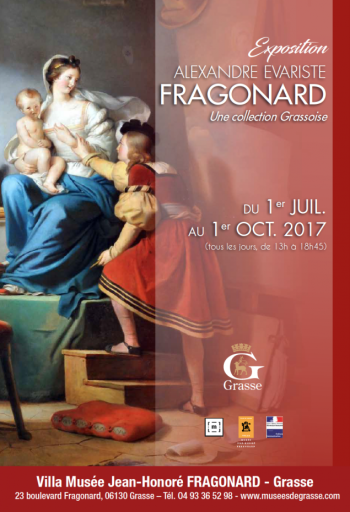 Né à Grasse le 26 octobre 1780 et mort le 11 novembre 1850 à Paris, Alexandre-Evariste Fragonard est le fils de Jean-Honoré. Considéré comme un enfant prodige, il expose au Salon à Paris dès 13 ans et est placé par son père dans l’atelier de David. Ses deux influences, néoclassique avec David et celle de la peinture amande et hollandaise qui lui vient de son père, vont être présentes dans ses œuvres tout au long de sa longue et proli que carrière de peintre, de sculpteur et de décorateur. Artiste of ciel très actif, il accepte de nombreuses commandes pour la manufacture de Sèvres et participe à plusieurs réalisations pour l’État sous l’Empire et la Restauration. Rattaché au courant Troubadour, son style demeure tout de même très enlevé et tumultueux. Il va également travailler dans le domaine de la gravure et participer notamment à l’édition des Voyages pittoresques et romantiques dans l’ancienne France du baron Taylor.
Injustement oublié aujourd’hui, Alexandre-Évariste Fragonard et son œuvre méritent largement d’être remis en lumière. Cette exposition estivale, du 1er juillet au 1er octobre 2017, a l’ambition de faire découvrir plus largement sa carrière à travers ses dessins et ses tableaux conservés dans notre collection grassoise.
Depuis la création des musées de Grasse dans les années 20 et l’ouverture de la Villa-musée Jean- Honoré Fragonard en 1977, les collections n’ont cessé de s’enrichir de dessins et de peintures de cet artiste pour constituer aujourd’hui une des collections publiques les plus importantes en France qui lui soit consacrée. Nous aurons ainsi le plaisir de présenter plusieurs dessins inédits, notamment des feuilles préparatoires à ses plafonds peints du Louvre, toujours en place, commande prestigieuse sous la Restauration pour le musée Charles X.
Le commissariat de l’exposition est assuré par Rebecca Duffeix, Docteur en Histoire de l’art et spécialiste de l’artiste, et nous avons eu l’honneur de béné cier également de la contribution de Côme Fabre, conservateur des peintures au Musée du Louvre.
The press release is available here»
The catalogue is available from ArtBooks.com:
Rebecca Duffeix and Olivier Quiquempois, Alexandre-Évariste Fragonard: Une Collection Grassoise (Milan: Silvana, 2017) 48 pages, ISBN: 978-8836636303, $23.
Exhibition | Caroline, Sister of Napoleon, Queen of the Arts
Now on view at the Palais Fesch (as noted at Napoleon.org). . .
Caroline, Sister of Napoleon, Queen of the Arts
Palais Fesch, Musée des Beaux-Arts, Ajaccio, Corsica, 30 June — 2 October 2017
Curated by Jehanne Lazaj and Maria Teresa Caracciolo with Laëtitia Giannechini
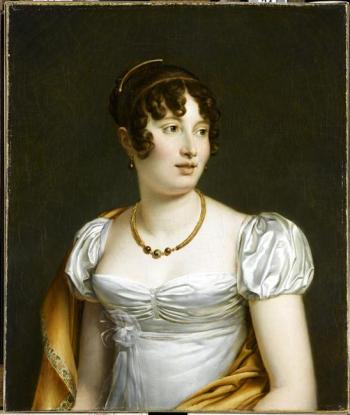
François Gérard, Portrait of Caroline Murat, Queen of Naples (Ajaccio: Palais Fesch, Musée des Beaux-Arts / Gérard Blot).
Caroline Bonaparte (1782–1839) was a woman of a complex and difficult temperament, yet she won over hearts by her beauty, culture, and spirit, along with a deep political intelligence that reflected her ambition. Napoleon affirmed in this respect: “Of all my family, she is the one that resembles me the most.” And while her political strategy has been much criticized, her keen intelligence, her great literary culture, her relationship with the artistic sphere, and her talents as a patron and collector have long been hidden.
If this exhibition intends to honour the younger sister of Napoleon, who has often been considered the ‘capricious’ one, its primary aim is to offer the widest possible panorama of the taste of an era and to give back to Caroline Murat the place which she deserves, that of a sovereign from both a political and artistic point of view. As a princess and later a dazzling queen, despite her almost tragic destiny, she embodied the giddy era in which she lived and which allowed her to encourage artistic creation as well as to enjoy the luxury, refinement, and strategies that power allowed her.
The exhibition is divided into five thematic sections presenting works and objects from the collections of the Palais Fesch and the Mobilier National, as well as loans from private collectors and large institutions including the Musée du Louvre, the Palace of Versailles, and the Museum of Capodimonte of Naples.
The press release is available here»
The catalogue is available from ArtBooks.com:
Maria Teresa Caracciolo and Jehanne Lazaj, Caroline, Soeur de Napoléon, Reine des Arts (Milan: Silvana, 2017), 300 pages, ISBN: 978 88366 36426, $45.
Exhibition | Epic Tales from Ancient India
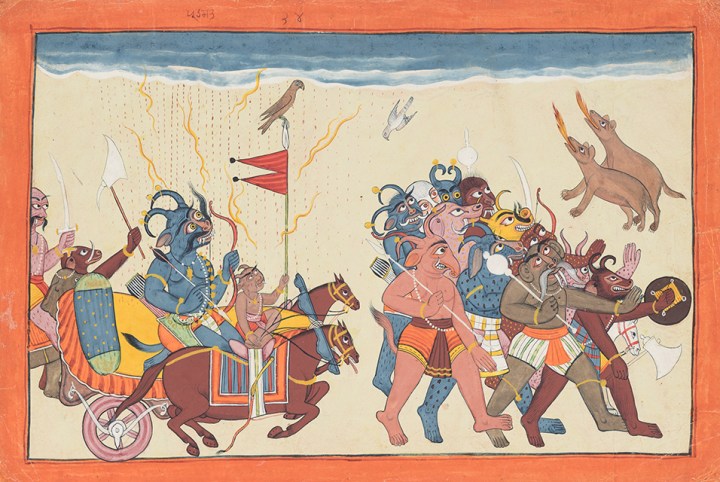
The Demon Dhumraksha Leads His Army, North India, Kulu or Bahu, ca. 1700–10; opaque watercolor on paper (The San Diego Museum of Art, Edwin Binney 3rd Collection, 1990.1107).
◊ ◊ ◊ ◊ ◊
Press release from the Blanton:
Epic Tales from Ancient India: Paintings from The San Diego Museum of Art
Princeton University Art Museum, 19 November 2016 — 5 February 2017
Blanton Museum of Art, The University of Texas at Austin, 9 July — 1 October 2017
The San Diego Museum of Art, 3 March — 12 June 2018
One of the most comprehensive collections of South Asian paintings outside of India will be on display at the Blanton Museum of Art at the University of Texas at Austin from July 9 to October 1, 2017. These dynamic images were originally associated with important literary and religious texts and will be organized according to thematic narratives. Museum visitors will be introduced to the epic stories that continue to hold great cultural value in India and beyond.

Rama and Sita Enthroned, ca. 1800; opaque watercolor and gold on paper, 24.7 × 18.5 cm (The San Diego Museum of Art, Edwin Binney 3rd Collection).
“The Blanton is honored to partner with The San Diego Museum of Art to bring this remarkable collection to Austin,” said Blanton director Simone Wicha. “The epic stories have much to say about courage, loyalty, love and friendship, and the paintings themselves impress with the delicacy of their technique, the boldness of their design, and the humanity of the stories they convey. This exhibition is sure to delight audiences of all ages.”
Epic Tales from Ancient India: Paintings from The San Diego Museum of Art represents the highest achievement of court paintings from several regions of the Indian subcontinent from the 16th to the 19th centuries and have been selected from the renowned Edwin Binney 3rd Collection of The San Diego Museum of Art. This exhibition depicts stories that have been integral to South Asian culture for hundreds of years and provides a compelling introduction to classic Indian and Persian texts, including Bhagavata Purana, a Sanskrit text about the Hindu god Vishnu and his different incarnations; Ramayana, the adventures of Prince Rama of Ayodhya; Ragamala, a text that explores various modes in Indian classical music; and works of Persian literature, including Shahnameh, an epic poem about the legendary kings of Iran. The colorful manuscripts depict dutiful heroes, loyal friends, and strong-willed women, and each character serves as an instructive model in. Dangerous beasts, cunning adversaries, and assorted demons must be confronted and subdued. Battle scenes teeming with combatants give way to quieter moments, such as lovers meeting for a secret tryst. Many of the stories have religious significance and show the intervention of various divinities in maintaining cosmic order.
Complementing the paintings will be examples of Chola-period processional bronze images, Vishnu and Hanuman, on loan from the Kimbell Art Museum and the Cleveland Museum of Art, respectively. These works hint at Hindu ritual practices and highlight the religious significance of the narratives.
Ray Williams, who leads the Blanton’s education efforts and serves as the managing curator for this exhibition, has a deep appreciation for India’s cultural expressions through story and image. “The struggle for cosmic order in the face of dark forces and fulfilling one’s duty with courage and integrity, are ongoing human concerns. The paintings invite us to plunge into Rama’s world, for example, and readily join in the quest to rescue Sita from the ten-headed, mustachioed, demon king and his frightful army,” said Williams.
A series of public programs will complement the exhibition, featuring gallery talks, musical demonstrations, classical Indian dance, and storytelling performances.
◊ ◊ ◊ ◊ ◊
The catalogue is distributed by Yale UP:
Marika Sardar, with contributions by Neeraja Poddar, Qamar Adamjee, and Alka Patel, Epic Tales from Ancient India: Paintings from The San Diego Museum of Art (New Haven: Yale University Press, 2017), 164 pages, ISBN: 978 03002 23729, $45.
 Exploring the topic of narrativity in Indian art, this beautiful and deeply researched book considers illustrations to the Bhagavata Purana, the Ramayana, the Ragamala, and a range of texts in the Persian language, notably the Shahnama. Featuring stunning reproductions of paintings made between the sixteenth and nineteenth centuries from the Edwin Binney 3rd Collection at The San Diego Museum of Art, the publication includes thorough and fascinating explanations of the narrative of each text, including how that narrative is visually conveyed. Essays examine why these particular stories are so enduring, why patrons may have chosen to have a copy of a particular text made for their own collections, and how artists responded to the challenge of creating new versions of venerable classics.
Marika Sardar is Associate Curator of Southern Asian and Islamic art at The San Diego Museum of Art. Neeraja Poddar is the Mellon Fellow at the Philadelphia Museum of Art. Qamar Adamjee is Associate Curator of South Asian and Islamic art at the Asian Art Museum, San Francisco. Alka Patel is Associate Professor of South Asian and Islamic Art at the University of California at Irvine.
Small Token from Carriera’s ‘Winter’ Recently Discovered
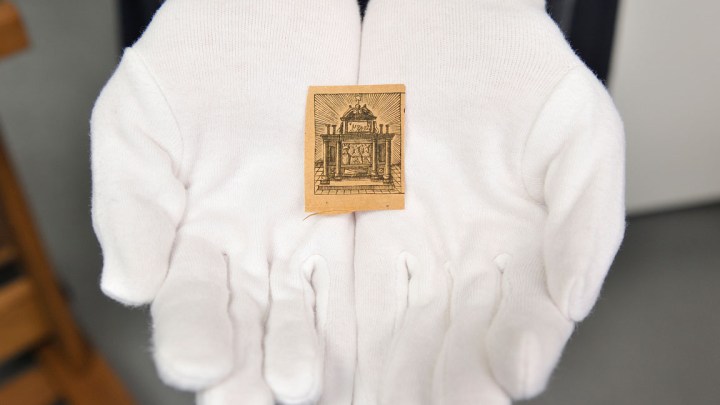
The Three Magi, print, 4.2 cm × 3.3 cm; this small print was sealed inside the frame of Rosalba Carriera’s Personification of Winter (ca. 1726), between the pastel’s wooden support and canvas liner (The Royal Collection Trust).
◊ ◊ ◊ ◊ ◊
From the press release (9 May 2017) describing an extraordinary item discovered as a result of research for the Royal Collection Trust’s exhibition Canaletto and the Art of Venice, now on view at The Queen’s Gallery:
An 18th-century good-luck token has been found hidden inside Rosalba Carriera’s pastel A Personification of Winter by Royal Collection Trust’s conservators. One of the artist’s finest works, Winter was produced around 1726 for Joseph Smith, a British merchant, art collector, and dealer who lived in Venice and acted as agent to many artists, including Carriera and, most famously, Canaletto. Sealed inside the frame between the pastel’s wooden support and canvas liner, the token came to light during conservation of Winter for display in Royal Collection Trust’s exhibition Canaletto & the Art of Venice, which opened at The Queen’s Gallery, Buckingham Palace on 19 May.
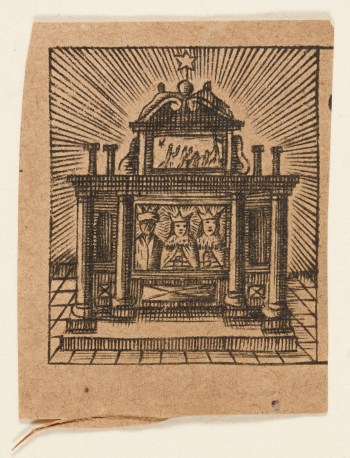 Just 4.2 cm × 3.3 cm in size, the token is in the form of a print of the three Magi and was clearly placed there by Carriera to protect the fragile pastel on its journey to its new owner. In the 18th century these tiny prints, known as santini (‘little saints’), were kept in prayer books or clothing as affordable and portable devotional objects. Rosalba Carriera, a very devout woman, is known to have been particularly fond of images of the three Magi, whose association with arduous journeys made them appropriate guardians for her works. Similar tokens have been found attached to other pastels by the artist.
In a letter to a friend in Florence on 3 December 1729, the Venetian nobleman Pier Caterino Zeno described Carriera’s devotion to the Magi: “Once she gave me a certain portrait to send to my brother in Vienna, and she gave me a little card of the three aforementioned adoring Magi; and said that to these she entrusted the safe outward journey of the portrait; adding that whenever such little images had accompanied her pictures, they had always arrived safely.”
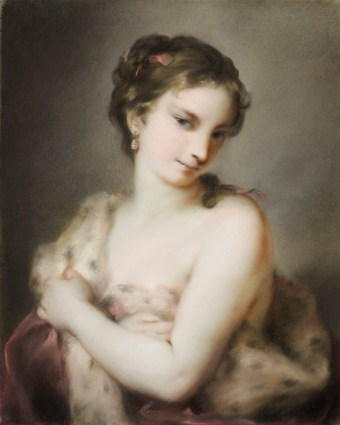
Rosalba Giovanna Carriera, A Personification of Winter, ca. 1726, pastel on paper (London: Royal Collection Trust, 400647).
Rosalba Carriera was one of the most celebrated women artists of her day. Her pastels were highly admired by 18th-century European collectors, and prominent foreign visitors to Venice and Grand Tourists were eager to sit for portraits by her. The soft, velvety texture of pastel was particularly suited to Carriera’s sensual personifications such as Winter, portrayed as a young woman with a fur wrap slipping from her shoulders.
In 1762 the young monarch George III purchased virtually the entire collection of Joseph Smith, including Winter, which was among Smith’s most prized possessions. Thanks to this single acquisition, the Royal Collection contains one of the finest groups of 18th-century Venetian art in the world, including the largest collection of works by Canaletto. Winter hung in George III’s bedchamber at Buckingham House (later Buckingham Palace) alongside Carriera’s pastel of Summer.
Clara de la Peña McTigue, Royal Collection Trust’s Head of Paper Conservation, said, “The conservation of pastels is a very delicate operation, as the pigment surface of these works is so fragile. When we carefully removed the frame, we became very excited when we noticed a small piece of paper in the narrow space between the pastel’s support and the canvas, and suspected it might be one of Carriera’s tokens.”
Rosie Razzall, Royal Collection Trust’s Curator of Prints and Drawings and the exhibition’s co-curator, said, “It was only during conservation treatment that the print came to light. It’s incredible to think that it was put there by Carriera herself nearly 300 years ago to protect the work from ill fortune and has remained undiscovered until now.”
Display | Hyacinthus by Tiepolo
Now on view at the Museo Thyssen-Bornemisza:
Hyacinthus by Tiepolo
Museo Thyssen-Bornemisza, Madrid, 23 June — 17 December 2017
In conjunction with the celebration of the Museum’s 25th anniversary and to coincide with World Pride 2017 in Madrid, the Museo Thyssen-Bornemisza is now presenting the results of the restoration and technical study of one of the most important and fascinating works in its collection and probably its greatest gay icon: The Death of Hyacinthus by Giovanni Battista Tiepolo.
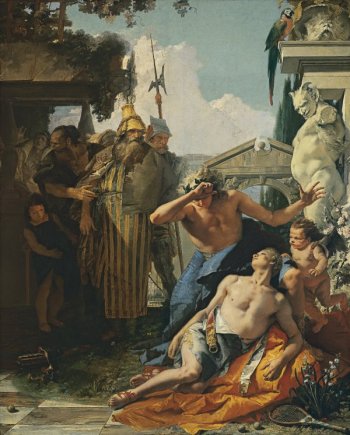
Giambattista Tiepolo, The Death of Hyacinthus, ca. 1752–53 (Madrid: Museo Thyssen-Bornemisza).
Following its restoration in the Museum’s studios, the painting has now returned to its habitual location in Room 17, accompanied by a special display organised by the departments of Restoration and Old Master painting. This installation includes X-radiographs and infra-red reflectographs that show the most interesting aspects of the work undertaken, explain the methodology applied, and reveal the outstanding quality of the painting. These images are accompanied by two preparatory drawings loaned by the Staatsgalerie in Stuttgart and a video of the entire restoration process, which also explains the most important discoveries made during this restoration and study project and features interesting details from the painting.
Given the widespread interest in restoration projects of this type, with this new display the Museum is aiming to introduce visitors to the working methods used by restorers, which are essential for determining the appropriate treatments to be applied in each case and which also provide art historians with important information. Knowledge of the techniques and materials employed by artists is fundamental for deciding on the procedures to be adopted when halting the deterioration of a work of art. Furthermore, focusing on the most detailed aspects of the creation of a work also allows us to enter into the artist’s mind to some extent and that of his or her period and to understand the creative act and its context on the basis of more solid arguments.
The Death of Hyacinthus (ca.1752–53) was commissioned by Baron Wilhelm Friedrich Schaumburg-Lippe, who lived in a town near Würzburg (Germany) where Tiepolo was employed with his sons Giovanni Domenico and Lorenzo from 1750 onwards on the decoration of the residence of the new Prince-Bishop, Carl Philipp von Greiffenclau. The painting seems to have an elegiac nature as a homage to the Baron’s lover, a young Spanish musician with whom he had lived in Venice and who had died in 1751.
The painting is inspired by an episode from Ovid’s Metamorphoses (Book X, 162–219): Apollo and his lover, the young and beautiful Hyacinthus, Prince of Sparta, were competing at throwing the discus when the latter was mortally wounded when struck on the head by the discus. In the classical account Hyacinthus was killed by his own clumsiness as he threw the discus during the competition, but another version recounts that as it was thrown by Apollo, it was blown off course by Zephyrus, god of the west wind, who had been spurned by Hyacinthus in favour of Apollo. Unable to return him to life, Apollo immortalised the youth by making the hyacinth flower sprout from his blood on the ground.
Tiepolo depicts the scene on the basis of the Italian translation of Ovid’s text by Giovanni Andrea dell’Anguillara (Venice, 1561), in which the discus throwing is replaced by a tennis match, a fashionable sport among the nobility of the time. In the foreground we see the racquet and some balls cast on the ground and in the background a net that indicates the tennis court. Hyacinthus lies dying in front of the despairing Apollo, who feels responsible for the accident and whose gestures indicate the fateful outcome. Apollo had neglected his duties as a god to devote his time to his lover and Tiepolo reminds us of this by including two of his attributes: the lyre and the quiver with arrows, abandoned on the ground on the left while he shows Apollo himself as a youthful athlete with blonde hair and a laurel wreath. Behind them Hyacinthus’s father King Amyclas and his retinue watch the scene with sombre expressions. Numerous iconographical details emphasize the painting’s symbolic language, from the figure of the macaw, a symbol of courtship, to the mocking expression of the statue of Pan, protector of male sexuality, with Apollo’s hand covering his genitals and his thumb imitating the shape of an erection.
The composition of the central group was tried out in numerous preparatory sketches by both the artist and his son and assistant Giovanni Domenico. These studies play with the different positions adopted by the two principal figures, bringing them closer together or changing the poses. Other studies feature specific details that were subsequently carefully reproduced in the final version, like the figure of Hyacinthus and the depiction of the small putto in the drawings from the Staatsgalerie in Stuttgart on display in the exhibition.
The restoration of The Death of Hyacinthus has essentially focused on the complex elimination of the superimposed layers of oxidised and yellowed varnishes which had accumulated over time. Cleaning the painting has recovered its visual unity and the richness of the original palette with its vibrant, subtly nuanced colours. The architectural features and figures are now also easier to read and the original pictorial depth can once again be properly appreciated. Taking micro-samples of the pigments has provided new information on them and allowed for the materials used by the artist and their state of conservation to be analysed, while gigapixel images and macrophotographs have revealed the tiniest alterations and details of the painting. Ultraviolet and infra-red images have similarly provided valuable information on the creation of the work and the artist’s methods.
An X-radiograph of a painting shows the modifications introduced by the artist during the process of its creation. In The Death of Hyacinthus it can be seen that Tiepolo changed the position of the king, turning him to face the principal scene directly, which resulted in a modification of the folds of his clothing and the position of his arm. Behind this figure Tiepolo added a soldier and also changed the size and shape of both figures’ headwear. In the lower part of the composition it is evident that the straps of the quiver were originally longer. Unlike the other figures, the putto is not visible in the X-radiograph as it was painted with a type of pigment that can be easily penetrated by X-rays.
Tiepolo worked more confidently on the right part of the painting, locating the principal figures in a more emphatic manner and with hardly any changes. There are small modifications to the position of Hyacinthus’s arm and Apollo’s thumb, the position of which has been interpreted as an erotic reference. His knee, on which Cupid is leaning, was slightly moved, with the result that the latter’s left hand is suspended in the air. Tiepolo also changed the background motifs as the X-radiograph reveals what might be the sketch of a mountain as well as different architectural structures which he ultimately covered over with clouds or vegetation in order to create a greater sense of space.
This image reveals the preparatory drawing or study concealed by the paint layers and thus the changes introduced into the composition by the artist, some of them also visible on the Xradiograph. In this case it can be seen that the figure of Amyclas originally had a cloth headdress which was then replaced with a hat, while his right hand also reveals some corrections or changes with regard to the final position. The god Apollo appears in the preparatory drawing with some ornamental accessories such as an earring and a belt decorated with a pearl, which were subsequently covered over with brushstrokes of pigment. In addition, his left thumb was not originally superimposed over the figure of Pan as we see in the final painting and some lines of under-drawing are visible that locate Apollo’s knee in a more elevated position and in contact with Cupid’s left hand. Finally, Tiepolo made a slight change to the position of the drapery over Hyacinthus’s leg.
Exhibition | Homage to the Grand Duke
◊ ◊ ◊ ◊ ◊
Now on view at the Pitti Palace, with a catalogue published by Sillabe and available from ArtBooks.com:
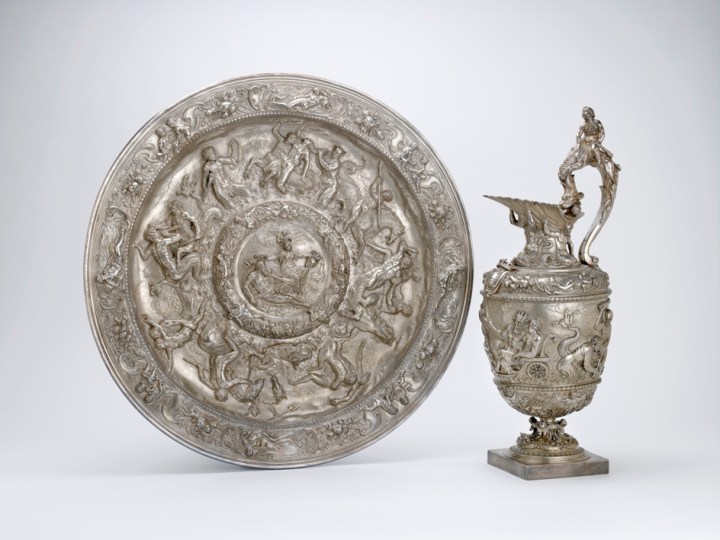
Homage to the Grand Duke: Memories of Silver Plates for the Feast of St. John
Omaggio al Granduca: Memorie dei piatti d’argento per la festa di San Giovanni
Palazzo Pitti, Florence, 24 June — 24 September 2017
The precious items in the Tesoro dei Granduchi include a number of 18th-century moulds of the now lost ‘St. John’s plates’, a nostalgic echo of masterpieces of the Roman silversmith’s art in the age of the Baroque. The fifty-eight magnificent silver ewers were intended as a gift for Grand Duke Cosimo III (1642–1723) and, after him, for Gian Gastone (1671–1737), his successor on the throne of Tuscany. One ewer was presented every year on 24 June, the feast of St. John, from 1680 until the Medici dynasty became extinct in 1737.
 The silver ewers—weighing some fifteen pounds (or five kg) and worth 300 Roman scudi each—were meticulously embossed and chased with scenes celebrating the most illustrious members of the House of Medici from Lorenzo the Magnificent down to the reigning Grand Dukes. It was probably the fact that the ewers depicted the unusual subject of her family’s history that prompted the Electress Palatine Anna Maria Luisa (1667–1743) to do everything in her power to safeguard them from the threat of destruction at the hands of the House of Lorraine, who succeeded the Medici on the throne of Tuscany and whose military expenditure meant that they were regularly strapped for cash.
The ewers were jealously guarded in the Wardrobe in Palazzo Vecchio, leaving the premises only from 1789 to 1791 for display in the ‘Medal Room’ in the Galleria degli Uffizi. Sent back to the Wardrobe as their popularity declined, they set off down the path to oblivion. It is only thanks to casts commissioned by the Marchese Carlo Ginori and made in his Manufactory in Doccia between 1746 and 1748 that we can appreciate at least a pale reflection of their splendour today.
Rita Balleri and Maria Sframeli, eds., Omaggio al Granduca: Memorie dei piatti d’argento per la festa di San Giovanni (Livorno: Sillabe, 2017), 328 pages, ISBN: 978 8883 479595, 35€ / $60.
Exhibition | Sampled Lives

Press release for the exhibition now on view at The Fitzwilliam:
Sampled Lives: Samplers from the Fitzwilliam Museum
The Fitzwilliam Museum, Cambridge, 6 May 2017 — 8 April 2018
Coloured silks and metal threads, white-work, and needle lace… Over 120 beautifully embroidered samplers—some hundreds of years old—have gone on display in Cambridge in the exhibition Sampled Lives: Samplers from the Fitzwilliam Museum. Each one meticulously stitched by a girl or young woman, the samplers and accompanying book give a glimpse of past lives: from mid-17th-century English Quakers to early 20th-century school pupils. The skill employed in making them is remarkable—works by girls as young as nine years old are shown.
Very rarely seen due to their fragility and sensitivity to the light, several samplers have been newly conserved and cleaned for the show. This will be the first time so many fine examples from The Fitzwilliam’s outstanding collection of samplers have gone on display together.
The sampler was an essential part of a young woman’s education. It showed much more than just her ability with a needle and thread—it was a stitched CV, representing her competence to run a future home, or for seeking employment where such needle skills would be to her advantage. Samplers were also a work of creativity and pride, some containing hidden messages in the symbols and images used, referring to the girls’ political or religious beliefs. Many are stitched with names and ages. In some cases it is the only surviving document to record the existence of an ordinary young woman.
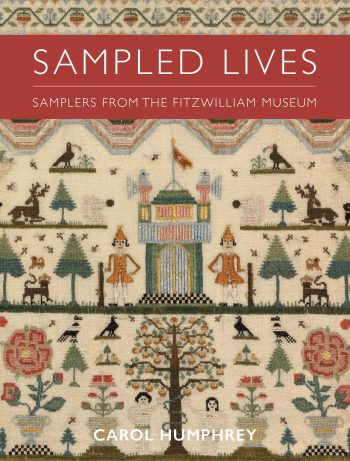 As the centuries progressed the sampler also became part of exercises towards literacy. Stitched prayers and odes to charity and faith adorned the fabric alongside alphabets and numerals. The displays highlight the importance of samplers as documentary evidence of past lives, revealing their education, employment, religion, family, societal status, and needlework skills. A fully- illustrated catalogue by Carol Humphrey, Honorary Keeper of Textiles, includes new high resolution photography to reveal the intricacy of the coloured silk stitches. It explores some of the personal stories that archival and genealogic research has revealed, as well as showing the evolution of different embroidery styles. It is hoped that the exhibition and book of Sampled Lives will stimulate further research, revealing more about the hidden histories of their makers.
Carol Humphrey commented: “The samplers are a stunning example of the needlework of the past and a masterclass for anyone interested in the changing fashions and styles of embroidery over the centuries. Much has changed in the study of samplers during the last thirty years or so. Now samplers can be seen as a valid means of studying the circumstances and material culture of their makers. When researched in depth, they can reveal not only personal details about an individual girl but also provide a key to family histories. We hope that visitors will enjoy discovering more about the techniques and past lives revealed in the exhibition and the book, and that further discoveries will come to light in the future.”
Carol Humphrey, Sampled Lives: Samplers from the Fitzwilliam Museum (Cambridge: The Fitzwilliam Museum, 2017), 242 pages, ISBN: 978 1910731 079, £20.
Exhibition | Honey from Many Flowers
Now on view at The Fitzwilliam:
Honey from Many Flowers: Carl Wilhelm Kolbe and Salomon Gessner’s Idylls
The Fitzwilliam Museum, Cambridge, 4 March — 10 September 2017
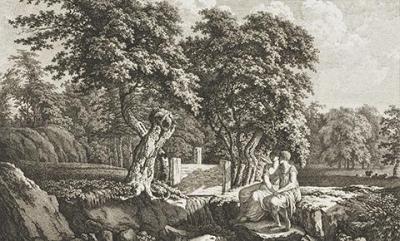
Carl Wilhelm Kolbe, after Salomon Gessner, Damon (Demophon) en Phillis (Phyllis), 1811 (Cambridge: The Fitzwilliam Museum).
Salomon Gessner (1730–88) was a Swiss artist and writer whose idyllic poetry and prose made him a household name in his lifetime. After his death, his family invited the German printmaker Carl Wilhelm Kolbe (1759–1835) to produce prints after a set of Gessner’s landscape drawings, which capture the Romantic period’s preoccupation with the pastoral idyll and delight in the natural world. This exhibition showcases a recently acquired complete set of Kolbe’s twenty-five etchings, issued in five parts from 1805 to 1811, together with a selection of works by eminent masters from whom Gessner drew inspiration, including Anthonie Waterloo, Allart van Everdingen, and Claude Lorrain.
Display | Desire, Love, Identity: Exploring LGBTQ Histories
Now on view at The British Museum:
Desire, Love, Identity: Exploring LGBTQ Histories
The British Museum, London, 11 May — 15 October 2017
Ashmolean Museum, Oxford, 25 September — 2 December 2018
 This display provides glimpses into LGBTQ (Lesbian Gay Bisexual Transgender Queer) experience across time and around the world through the British Museum’s collection. The objects offer insights into to what the novelist E. M. Forster described as “a great unrecorded history.” Ranging chronologically from ancient history to the present day the objects often prompt questions, challenging the contemporary viewer to question the assumptions that they bring to objects from other cultures and the more distant past. The display draws on material from across the breadth of the Museum’s collection including coins, medals, and prints. As well as highlighting famous figures such as the poetess Sappho, and the emperor Hadrian and his lover Antinous, the display looks beyond Europe’s classical past to explore less familiar themes and stories.
This exhibition coincides with the 50th anniversary of the passing of the Sexual Offences Act in July 1967. This legislation partially decriminalised homosexuality in England and Wales and marks an important milestone in the campaign for equality.
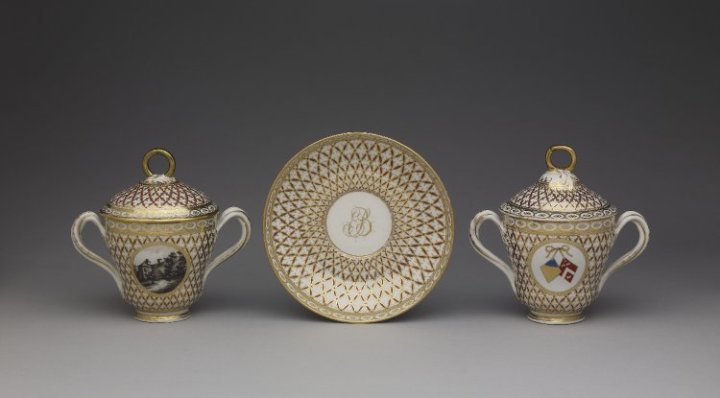
The Ladies of Llangollen Chocolate Cups and Saucers, porcelain from Bristol China Manufactory, 1779–81, and Derby Porcelain Factory (replacements), 1790 (London: The British Museum, 1887,0307,VIII.34).
◊ ◊ ◊ ◊ ◊
The exhibition includes Chocolate Cups and Saucers that belonged to the Ladies of Llangollen:
Sarah Ponsonby (1755–1831) and Eleanor Butler (1739–1829), known popularly as the Ladies of Llangollen, ran away in 1780 to set up home together, leaving their old aristocratic lives in Ireland behind them. They lived happily for 50 years in North Wales, challenging the conventions of their era and acquiring a celebrity-like status. These chocolate-cups are decorated with a view of their house on one side and their coats of arms on the other. The centre of each saucer is decorated with their entwined monograms. During the 1700s the concept of romantic friendships between women became common. Friends often wrote to one another using passionate language that to modern readers would imply a sexual relationship, but largely reflected social convention.
◊ ◊ ◊ ◊ ◊
Note (added 4 September 2018) — The posting was updated to include the Ashmolean as a venue, where the exhibition is entitled No Offence: Exploring LGBTQ+ Histories.










leave a comment