Exhibition | The Tweeddales: Power, Politics and Portraits

Attributed to Sir John Baptiste de Medina, The Family of John Hay, 1st Marquess Tweeddale, Lord High Chancellor of Scotland, ca. 1695, oil on canvas, 141 × 184 cm (Scottish National Portrait Gallery, purchased with the aid of the Art Fund and the Heritage Lottery Fund 1999).
◊ ◊ ◊ ◊ ◊
Now on view at the Scottish National Portrait Gallery:
The Tweeddales: Power, Politics and Portraits
Scottish National Portrait Gallery, Edinburgh, 23 April 2016 — 28 May 2017
Wealthy, influential, and politically savvy the Tweeddale family was at the heart of Scottish society in the second half of the seventeenth century. At the head of the family was John Hay (1626–1697), 2nd Earl and later 1st Marquess of Tweeddale. His marriage to Lady Jean Scott (1629–1688), second daughter of the Borders landowner Walter Scott, 1st Earl of Buccleuch, brought him wealth, opportunity, and a large family—the couple had several children. Members of the Tweeddale dynasty married into some of the noblest families in Scotland and England.
While several members of the Tweeddale family are acknowledged for their contribution to politics, the military, and for their strategic marriage matches, their role as patrons of the arts and architecture is often overlooked. The family were enthusiastic art collectors who commissioned portraits and landscapes by established and little-known artists, particularly those of Dutch, Flemish, and German origin including Sir Anthony van Dyck, Sir Peter Lely, Gerard Soest, and Sir John Baptiste de Medina. Paintings by each these artists feature in the exhibition. The highlight of the exhibition is the fascinating group portrait of the Marquess and his family, attributed to the Flemish artist Sir John Baptiste de Medina, which was painted around 1695.
Exhibition | The Land without Music
From the Lewis Walpole Library:
The Land without Music: Satirizing Song in Eighteenth-Century England
The Lewis Walpole Library, Farmington, CT, 1 March — 29 September 2017
Curated by Amy Dunagin
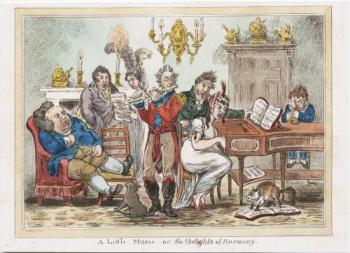
Copy after James Gillray, A Little Music, or, The Delights of Harmony, etching and stipple with hand coloring; published 1818 by John Miller and W. Blackwood (Lewis Walpole Library, 810.00.00.72).
Music pervaded public and private spaces in eighteenth- and nineteenth-century England; yet, in 1904, German critic Oscar Adolf Hermann Schmitz, heightening long-standing aspersions, dismissed England as a “land without music.” This unflattering epithet pointed to England’s meager contributions to the western musical canon during the eighteenth and nineteenth centuries—no English Gluck, Mozart, or Verdi; no English operatic or symphonic tradition that could rival those that flourished on the continent. The English, critics like Schmitz suggested, were importers rather than producers—tasteless consumers and dilettantes rather than discerning, proficient practitioners. This view did not originate with continental nationalists; in the eighteenth century the English often presented themselves as uniquely unmusical in print and in visual satire. At once self-effacing and boastful, this representation asserted a national character too sensible, too chaste, too sober to permit the excesses of musical genius. Bringing together satirical prints and documents pertaining to English music makers and listeners, this exhibition explores English attitudes toward music as lascivious, feminine, foreign, frivolous, and distinctly un-English.
Curated by Amy Dunagin, Postdoctoral Associate, European Studies Council, Yale University, and Managing Editor, Eighteenth-Century Studies
The exhibition brochure, which includes a full checklist, is available as a PDF file here»
Exhibition | Jane Austen by the Sea
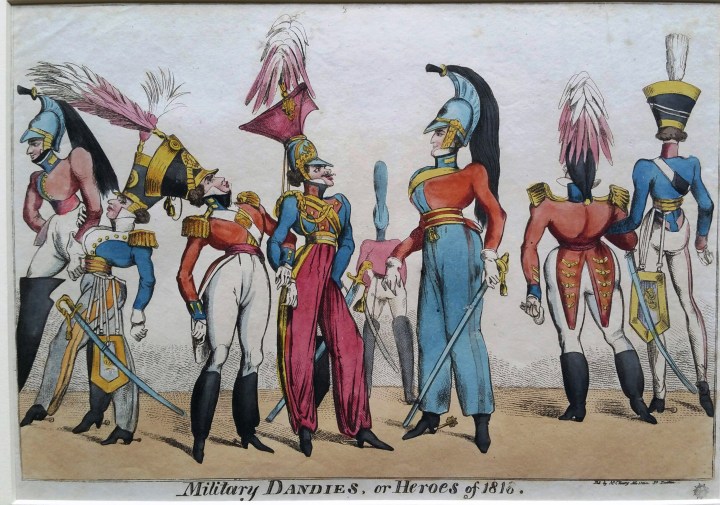 William Heath, Military Dandies or Heroes of 1818, published by M. Cleary.
◊ ◊ ◊ ◊ ◊
Opening this summer in Brighton:
Jane Austen by the Sea
Royal Pavilion, Brighton, 17 June 2017 — 8 January 2018
Curated by Alexandra Loske
A new display at the Royal Pavilion will explore Jane Austen’s relationship with coastal towns and life in Brighton during her time, to mark the bicentenary of her death. The display will reassess Austen’s relationship with the town in the light of a long-term misunderstanding, arising from a hand-written letter of 8 January 1799. Curator Dr Alexandra Loske said, “For many years, Austen has been quoted as having written: ‘I assure you that I dread the idea of going to Brighton as much as you can do..’, but her sentence actually referred to Bookham, a village in Surrey, rather than Brighton. We now know that Austen may not have felt as negatively about the town as has been thought.”
Jane Austen by the Sea will look at the seaside context of Austen’s plots and paint a picture of the leading resort of Brighton in the early 1800s, when it was a fashionable ‘watering place’ featured in novels like Pride and Prejudice. George IV, who created the Royal Pavilion and spent long periods living there when he was Prince Regent, was a high-profile fan of Austen’s—and although she seemed not to approve of his lifestyle she was encouraged to dedicate Emma to him in 1815.
Highlights include
• The King’s personal, specially-bound copy of Emma—on display at the Royal Pavilion for the first time (generously lent by Her Majesty The Queen from the Royal Collection)
• A mourning brooch containing a lock of Jane Austen’s hair
• The manuscript of Jane Austen’s unfinished novel, Sanditon, set in a seaside town in Sussex
• Examples of Regency costume and accessories, including a wedding dress that has never been on show before and a dress in the style of the ‘Brighton Walking Dress’ featured in a London fashion magazine in 1817
• Letters from Jane Austen to the Prince Regent’s librarian, James Stanier Clarke
• One of Jane Austen’s music books
• Prints, paintings, and caricatures of the resorts and fashions popular with seaside visitors
• Rare images of Brighton as it looked in Jane Austen’s lifetime
Jane Austen by the Sea will form part of our Regency Season in 2017, which will also include the exhibition Constable and Brighton and the display Visions of the Royal Pavilion Estate (both at Brighton Museum & Art Gallery).
Exhibition | Visions of the Royal Pavilion Estate
Press release for the exhibition:
Visions of the Royal Pavilion Estate
Brighton Museum & Art Gallery, 14 March — 3 September 2017
Curated by Alexandra Loske

Colin Jones, Digital model of the Royal Pavilion Estate as it is believed to have looked in 1832, with lost servants’ dormitory in the foreground.
A new display at Brighton Museum & Art Gallery will showcase rarely-seen views of the Royal Pavilion Estate dating back to the 1760s, as well as cutting-edge digital reconstructions of how it might have looked. According to curator Dr Alexandra Loske,“This display will survey the Royal Pavilion and its estate as it was and might have been, featuring rarely-seen views alongside discarded designs and recent digital re-creations. It will give visitors an opportunity to see unfamiliar, unusual and lost images, sourced almost exclusively from the city’s own archives and collections.”
Illustrations from the earliest printed books about the estate will sit beside unrealised designs, early municipal maps, and 20th-century plans and images. Highlights include
• Images of the Estate before the Royal Pavilion was built, and early designs commissioned by the Prince Regent by Henry Holland (1786, Marine Pavilion).
• Unrealised designs by Humphry Repton (published 1808), who George, as Prince of Wales, appointed to apply his romantic style to the Marine Pavilion and its grounds. When his beautiful, hand-produced ‘Red Book’ of designs failed to win him a commission, he had the book published for commercial sale, with fewer than 250 copies thought to have been printed. Delicate ‘overlays’ pasted onto the images provided before-and-after perspectives, with Repton’s ambitious proposals including a glass corridor around the entire East Lawn, an aviary, a pheasantry, a water feature and a clearer view of the sea.
• Lost designs and aquatints giving a lively impression of the Royal Pavilion Estate in the 18th and 19th century, sourced from the city’s collection and early popular guide books.
• Depictions of fashionable Georgian society in and around the Estate, in rare watercolours, prints and drawings from the city’s collection.
• 1830s drawings by Joseph Henry Good, who was commissioned by William IV to survey the Royal Pavilion Estate and drew up around 200 architectural plans. Detailed plans of now-lost servants’ quarters and the area around the South Gate will give a new perspective on everyday life for staff on the estate.
• Detailed digital 3D images of lost areas and structures of the Royal Pavilion Estate by RPM volunteer Colin Jones, largely based on the Good plans (will also be available online).
• Photography of the Estate’s use in the 20th century, including images from World War II and never-before-seen inter-war designs for the Royal Pavilion Garden.
• Real and imagined views of the Estate in popular culture, including illustrations and cover designs for books like Malcolm Saville’s children’s adventure story The Long Passage (1954) and Georgette Heyer’s popular novel Regency Buck (1935).
Alexandra Loske has sourced almost all the display’s inclusions from the city of Brighton & Hove’s own archives and collections. She said, “We’re keen to really make use of the city’s incredible collections and keep making new items available for the public to see.”
The display will accompany RPM’s project to digitise Humphry Repton’s Designs for the Pavilion at Brighton (1808) and John Nash’s The Royal Pavilion at Brighton (1826) and to publish the books online. It also comes as RPM works with Brighton Dome & Brighton Festival and Brighton & Hove City Council to realise a future vision for the Royal Pavilion Estate, starting with a major refurbishment of Brighton Dome’s Corn Exchange and Studio Theatre. Visions of the Royal Pavilion Estate will form part of Royal Pavilion & Museums’ Regency Summer season in 2017, which will also include Jane Austen by the Sea at the Royal Pavilion and Constable and Brighton at Brighton Museum.
Exhibition | The Woodner Collections: Master Drawings
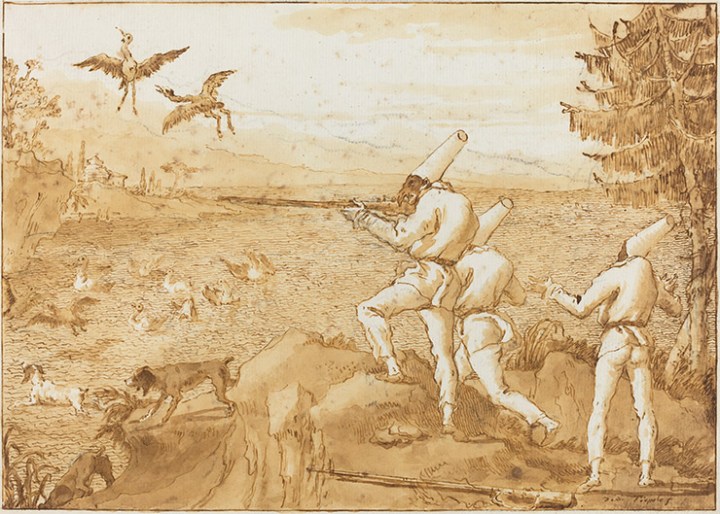
Giovanni Domenico Tiepolo, Punchinellos Hunting Waterfowl, ca. 1800, pen and ink with wash over charcoal (Washington, D.C.: National Gallery of Art, Gift of Dian Woodner, 2006).
◊ ◊ ◊ ◊ ◊
From the press release (10 January 2017) for the exhibition:
The Woodner Collections: Master Drawings from Seven Centuries
National Gallery of Art, Washington, D.C., 12 March — 16 July 2017
Curated by Margaret Morgan Grasselli
Ian Woodner (1903–1990) assembled an extraordinary collection of over 1,000 old master and modern drawings, making him one of the 20th century’s most important collectors. More than 150 works from his collection now reside at the National Gallery of Art in Washington. While Ian Woodner gave some works himself in the 1980s, the majority have been donated by his daughters, Dian and Andrea. His daughters have also made other gifts and have pledged works from their personal collections. The Woodner Collections: Master Drawings from Seven Centuries brings together for the first time the best of Ian Woodner’s collection with some of the works given and promised by Dian and Andrea Woodner. More than 100 major works of art will be on view in the West Building of the National Gallery of Art from March 12 through July 16, 2017.
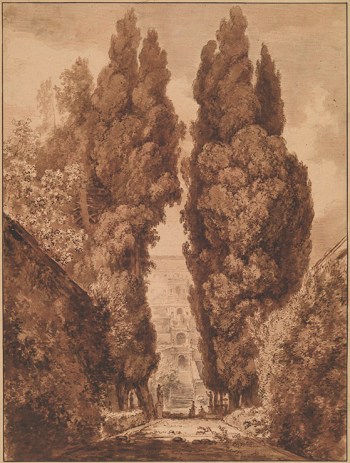
Jean-Honoré Fragonard, Avenue of Cypresses at Villa d’Este, 1760/65, pen and ink with wash over chalk counterproof (Washington, D.C.: National Gallery of Art, Gift of Dian Woodner, 2013).
The Woodner Collections includes some 100 drawings dating from the 14th to the 20th century executed by outstanding draftsmen such as Leonardo da Vinci, Albrecht Dürer, Raphael, Jean-Auguste-Dominique Ingres, Edgar Degas, and Pablo Picasso, among many others. Two highlights in the exhibition are Ian Woodner’s greatest acquisitions, known as his ‘crown jewels’: Giorgio Vasari’s Libro de’ Disegni (sheets probably 1480–1504 and after 1524) and A Satyr (1544/45) by Benvenuto Cellini. Vasari’s Libro de’ Disegni consists of ten drawings by the Renaissance masters Botticelli, Filippino Lippi, and Raffaellino del Garbo arranged harmoniously on both sides of the sheet. It is widely regarded as one of the most beautiful and impressive of the few pages surviving intact. Cellini’s monumental nude is a finished study of a bronze sculpture designed to stand at the entrance to the French royal palace at Fontainebleau.
“Included in the exhibition are many impressive works by well-known artists, all acquired by the Woodner family with an intrepid spirit and exquisite taste. A visit to the exhibition will offer a remarkable journey through many facets of European draftsmanship, revealing the broadly diverse ways the artists responded to their individual worlds and expressed their unique creativity,” said Margaret Morgan Grasselli, curator and head of the department of old master drawings, National Gallery of Art.
The earliest works in the exhibition are two rare sheets from the 14th century: a page from a model book by an unknown Austrian artist, and the other, attributed to the Paduan painter Altichiero da Zevio, shows a band of knights in armor storming a medieval castle. Nearly half of the exhibition is devoted to works from the 15th and 16th centuries, including drawings by Raphael, Leonardo, and Albrecht Dürer. The most important figure in German Renaissance art, Dürer is represented by an outstanding group of five drawings: four figurative works and one vividly colored book illumination, A Pastoral Landscape with Shepherds Playing a Viola and Panpipes (1496/97). Leonardo’s petite Grotesque Head of an Old Woman (1489/90) is both touching and comical. The study of Eight Apostles (ca. 1514), a fragment of a preparatory drawing for a tapestry cartoon, shows the classical rhythms and expressive qualities that are typical of the ‘divine’ Raphael. By contrast, a rare study by Pieter Bruegel the Elder humorously depicts a musician tipping precariously on a three-legged stool. It combines the artist’s lively pen strokes with a keen eye for pose and expression and captures both the boisterous spirit and the clumsy charm of the peasants that populate so many of Bruegel’s compositions.

Henry Fuseli, Satan Defying the Powers of Heaven, late 1790s, graphite, black chalk, and gray wash (Washington, D.C.: National Gallery of Art, purchased as the Gift of Andrea Woodner 2015.10.1.b).
Among the small group of works by the 17th-century artists, Rembrandt’s evocative View of Houtewael near the Sint Anthoniespoort (ca. 1650) demonstrates his remarkable ability to express space, light, and atmosphere with an economy of means. The 18th century is particularly rich in examples by many French and Venetian artists, including François Boucher, Giovanni Battista Tiepolo, Giovanni Battista Piranesi, and Jean-Honoré Fragonard. A more emotional tone is struck in a drawing of Satan Defying the Powers of Heaven by the Swiss-Anglo artist Henry Fuseli and in two enigmatic compositions by the great Spaniard, Francisco de Goya.
The 19th-century drawings include three elegant works by Jean-Auguste-Dominique Ingres and the eerie, powerful image Cactus Man (1881) by French symbolist Odilon Redon, one of Woodner’s favorite artists. Several works from the 20th century close the exhibition: three masterly drawings by the young Pablo Picasso, Two Fashionable Women (1900), a blue-period Head of a Woman (c. 1903), and a cubist Standing Nude (summer 1910); an imposing study of a female nude by Georges Braque (1927); and three drawings by Louise Bourgeois, including M is for Mother (1998), a drawing of a large, red letter M that conveys both maternal comfort and maternal control.
Exhibition | Canaletto and the Art of Venice
Press release (14 December 2016) from the Royal Collection Trust:
Canaletto and the Art of Venice
The Queen’s Gallery, Buckingham Palace, London, 19 May — 12 November 2017
The Queen’s Gallery, Palace of Holyroodhouse, Edinburgh, 11 May — 21 October 2018
National Gallery of Ireland, Dublin, 5 December 2018 — 24 March 2019
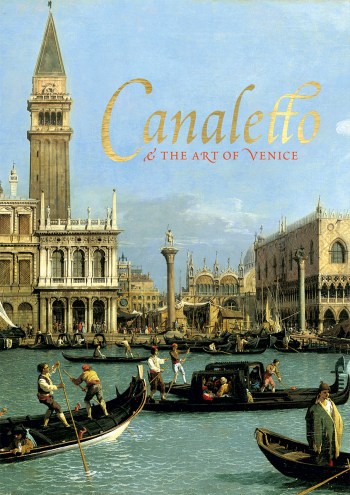 In 1762 the young monarch George III purchased virtually the entire collection of Joseph Smith, the greatest patron of art in Venice at the time. Thanks to this single acquisition, the Royal Collection contains one of the finest groups of 18th-century Venetian art in the world, including the largest collection of works by Giovanni Antonio Canal, better known as Canaletto.
Through over 200 paintings, drawings, and prints from the Royal Collection’s exceptional holdings, Canaletto and the Art of Venice presents the work of Venice’s most famous view-painter alongside that of his contemporaries, including Sebastiano and Marco Ricci, Rosalba Carriera, Francesco Zuccarelli, Giovanni Battista Piazzetta, and Pietro Longhi and explores how they captured the essence and allure of Venice for their 18th-century audience, as they still do today.
Joseph Smith (c.1674−1770) was an English merchant and later British Consul in Venice, a post dealing with Britain’s maritime, commercial, and trading interests. He had moved to Italy in around 1700 and over several decades built up an outstanding art collection, acting as both patron and dealer to many contemporary Venetian artists. Smith was Canaletto’s principal agent, selling his paintings to the wealthy Grand Tourists who were drawn to Venice’s cultural attractions. His palazzo on the Grand Canal became a meeting place for collectors, patrons, scholars, and tourists, where visitors could admire his vast collection and commission their own versions of Canaletto’s views to take home.
One of the most important of Smith’s commissions from Canaletto was the series of 12 paintings of the Grand Canal, which together create a near complete journey down the waterway. Canaletto’s sharp-eyed precision makes these views seem powerfully real; yet he rearranged and altered elements of each composition to create ideal impressions of the city. Two larger paintings are of festivals, including the ‘Sposalizio del Mar’, or ‘Wedding of the Sea’, which took place on Ascension Day and attracted crowds of British visitors. The Grand Canal was a subject frequently captured by Canaletto, including in a series of six drawings, among them Venice: The central stretch of the Grand Canal, c.1734. Intended as works of art in their own right, rather than as preparatory studies for paintings, the drawings are carefully constructed and rich in tone and detail.
Alongside the grand public entertainments, Venice boasted a thriving opera and theatre scene, especially during carnival season. The need to create stage sets within a very short period of time provided plentiful employment for Venetian artists. Both Marco Ricci and Canaletto worked for the theatre, where they learned how to manipulate perspective to heighten drama. The exhibition includes several of Ricci’s designs for the Venetian stage, such as A room with a balcony supported by Atlantes, c.1726. Marco Ricci also produced caricatures of opera singers, such as the drawing of the internationally famed castrato Farinelli, which were circulated among Joseph Smith and his fellow Venetian collectors and opera aficionados.
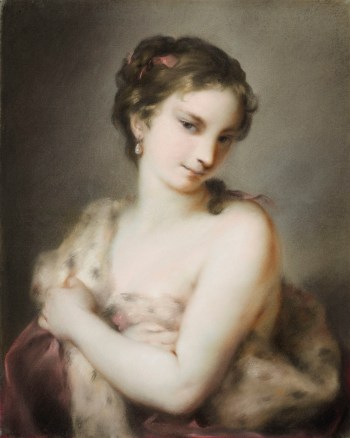
Rosalba Giovanna Carriera, A Personification of Winter, ca. 1726, pastel on paper (London: Royal Collection Trust, 400647).
On display together for the first time are personifications of the Four Seasons by Rosalba Carriera, whose pastels were highly prized by European collectors. They were intended to be hung in private domestic spaces, such as dressing rooms, bedrooms, or small antechambers. Carriera was one of the first artists to develop a commercial relationship with Joseph Smith, and her sensual pastel of Winter, c.1726, an allegorical female figure wrapped in furs, was one of the most admired works in Smith’s collection.
Canaletto, Marco Ricci, and Francesco Zuccarelli all contributed to the development of the genre known as the capriccio—scenes combining real and imaginary architecture, often set in an invented landscape, to create poetically evocative works. Ruins of ancient Rome in both Ricci’s Caprice View with Roman Ruins, c.1729, and Zuccarelli’s pastoral Landscape with Classical Ruins, Cattle and Figures, c.1741–42, convey a sense of the irrevocable loss of a great age.
There was a major revival in printmaking in Venice in the 18th century, with many publishers recruiting established artists, such as Giovanni Battista Piazzetta and Antonio Visentini, to provide designs for their publications. Joseph Smith was an enthusiastic print collector and one of the major supporters of contemporary printmaking in Venice. Smith financed and directed the Pasquali press, which contributed to the circulation of Enlightenment ideas, such as those of Isaac Newton, and imported banned foreign texts into Venice, including the work of Voltaire. Visentini was the chief draughtsman for the press, providing many hundreds of pen and ink drawings of initials and tailpieces, several of which will be on display in the exhibition.
The catalogue is distributed by The University of Chicago Press:
Lucy Whitaker and Rosie Razzall, Canaletto and the Art of Venice (London: Royal Collection Trust, 2017), 320 pages, ISBN: 978 190974 1409, $60.
Note (added 22 November 2018) — The posting was updated to include dates for Edinburgh and Dublin.
Exhibition | La Serenissima: Celebrating Venice
From the press release for the exhibition:
Sérénissime! Venise en fête, de Tiepolo à Guardi
La Serenissima: Celebrating Venice, from Tiepelo to Guardi
Musée Cognacq-Jay, Paris, 25 February — 25 June 2017
Curated by Rose-Marie Herda-Mousseaux and Benjamin Couilleaux
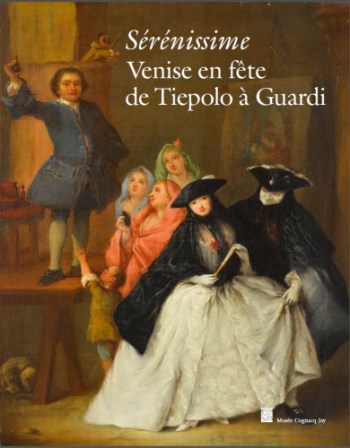 In the eighteenth century, the political and economic stability of the Serenissima Repubblica di Venezia gave rise to the last golden age of Venice, which would end with the Napoleonic conquest of 1797. This last chapter of a millenary history was marked by an unprecedented deployment of public and private events. Festivities, celebrations, regattas, and other spectacles set the tempo of city life and attracted the curious from all over Europe. Much more than simple amusements, these festivities were part of a political and religious pageant designed to promote Venice. Immortalized by some of the great names in painting—Tiepolo, Guardi, Longhi—they created a lasting impression and made known the charms of the City of the Doges throughout Europe. Over forty paintings, engravings, and drawings from prestigious French and European collections are presented to the public, bringing to life once again, for the duration of the exhibition, the opulence of the Most Serene Republic of Venice in the Age of Enlightenment.
The exhibition layout focuses on four themes related to Venetian celebrations:
Festivities Large and Small
Dance and music were highly esteemed by Venetian society, among both the aristocracy and the people.
From City to Stage
In the eighteenth century, the commedia dell’arte achieved unprecedented popularity, in particular with playwright Carlo Goldoni. Opera also benefited from majestic settings, the most famous of which is still La Fenice.
Power as Spectacle
Both secular and sacred institutions in the Most Serene Republic encouraged the crowds to attend major festivities that crystallized the image of Venice as a powerful and sumptuous city. Receptions for foreign princes, notably French, also provided an opportunity to organize extraordinary celebrations on Piazza San Marco or the Grand Canal.
At the Carnival
What would Venice be without its carnival? Dating from the Middle Ages, this colorful masked festival brought together an eighteenth-century cosmopolitan crowd that loved the open-air fairground attractions as much as it did the more discreet amusements of the Ridotto, the ancestor of the casino.
Rose-Marie Herda-Mousseaux and Benjamin Couilleaux, Sérénissime: Venise en fête, de Tiepolo à Guardi (Paris: Editions Paris Musées, 2017), 176 pages, ISBN: 978 27596 03428, 30€.
Exhibition | Gilded Interiors: French Masterpieces of Gilt Bronze

Jean-Baptiste Lepaute, Mantel clock, detail, 1781
(London: The Wallace Collection)
◊ ◊ ◊ ◊ ◊
From the press release for the exhibition:
Gilded Interiors: French Masterpieces of Gilt Bronze
The Wallace Collection, London, 4 May — 30 July 2017
Curated by Helen Jacobsen
Often designed by leading architects and modeled by important sculptors, gilt bronze was used to create beautiful yet functional objects such as clocks, candelabras, and firedogs and to decorate and embellish highly refined furniture and porcelain. This exhibition showcases luxurious artworks commissioned and owned by the wealthiest patrons and collectors, including leading figures of pre-revolutionary France like Marie-Antoinette, the duc d’Aumont, and the comte d’Artois as well international patrons such as the Prince of Wales (later George IV). Artists such as Pierre Gouthière, François Rémond, and Claude Pition, who ran the finest chasing and gilding workshops, created beautiful works, equal in expense and craftsmanship to some of the greatest paintings and sculpture of the period.
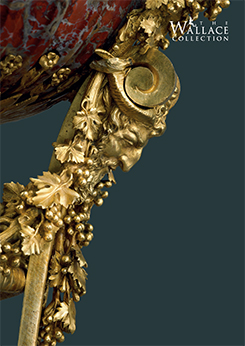 Largely drawn from The Wallace Collection, home to one of the world’s most important collections of French eighteenth-century gilt bronze, these exceptional objects include the exquisite perfume burner by Gouthière once owned by Marie-Antoinette and a pair of candlesticks made for the French Queen to celebrate the birth of her son. The Wallace Collection works will be shown alongside loans from other world-class collections including drawings from the Bibliothèque Municipale in Besançon.
The exhibition will feature drawings by Pierre-Adrien Pâris, one of the foremost architects and interior designers of the period. His highly-detailed works, never before seen in the UK, illustrate how buildings from ancient Rome were used as a fertile source of design for gilt-bronze masterpieces and reveal how the antique world provided artists with contemporary ideas for architecture and decorative art. Architects and designers who travelled to Rome took inspiration from the classical ruins with which they were surrounded and their drawings of architecture and Antique monuments provided the basis for some of the greatest gilt-bronze works ever created.
Gilded Interiors: French Masterpieces of Gilt Bronze will be an opportunity for visitors to engage more fully with these magnificent works, which will be given centre stage in the special exhibition galleries. Well-lit and with the works fully visible ‘in the round’, the exhibition will enable the viewer to experience these works of art in a different way, allowing the exquisite beauty and technical accomplishments of these pieces to be properly admired and enjoyed.
◊ ◊ ◊ ◊ ◊
From I. B. Tauris:
Helen Jacobsen, Gilded Interiors: Parisian Luxury and the Influence of Rome, 1770–1790 (London: Philip Wilson, 2017), 112 pages, ISBN: 978 178130 0589, £20 / $30.
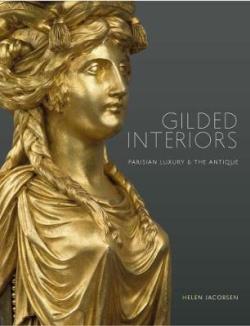 The Wallace Collection has an internationally-renowned collection of French eighteenth-century art but perhaps lesser known today is their stunning collection of gilt-bronze objects. These bronzes d’ameublement—from clocks and mounted Sevres porcelain to wall lights and candelabra—epitomise the levels of luxury achieved in Parisian interiors. Highly expensive and expertly wrought, they illustrate the heights of skilled craftsmanship achieved by French bronze workers in the eighteenth century as well as showcasing the wealth and connoisseurship of their owners. Lavishly illustrated with new photography, this publication will be a book of ‘highlights’ to include the very best of what the Wallace Collection has to offer in this field.
Helen Jacobsen is senior curator and curator of French eighteenth-century decorative arts at the Wallace Collection.
Exhibition | Poussin to David: French Drawings at the Albertina

Jacques-Louis David, The Combat of Diomedes, 1776
(Vienna: Albertina)
◊ ◊ ◊ ◊ ◊
Now on view at the Albertina:
Poussin to David: French Drawings at the Albertina
Poussin bis David: Französische Zeichnungen der Albertina
Albertina, Vienna, 25 January — 25 April 2017
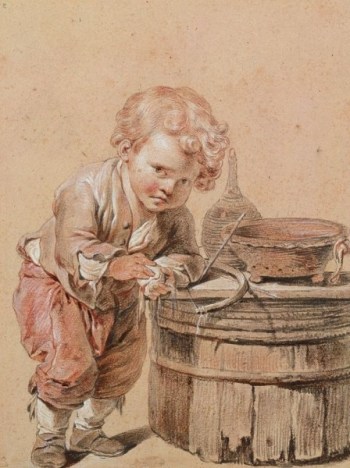
Jean-Baptiste Greuze, Boy with a Broken Egg, ca. 1756 (Vienna: Albertina).
Whether poetic love stories or mythological epics, whether atmospheric portrait studies or picturesque ruins—today, the masterpieces of French Baroque art are more enthralling than ever. 70 major works selected from the Albertina’s rich holdings of drawings sweep visitors into the dreamy and multi-layered cosmos of French art from the Baroque and Rococo periods: the works on display include Nicolas Poussin’s breath-taking free landscape studies as well as Claude Lorrain’s light-drenched depictions of nature, and playful masterpieces by François Boucher and Jean-Honoré Fragonard likewise assume their rightful places here, as do the lovely scenes of Jean-Baptiste Greuze. The crowning conclusion of this showing, which reflects two centuries of French art, is provided by the imposing creations of Jacques Louis David.
Christine Ekelhart, ed., From Poussin to David: French Drawings at the Albertina (Munich: Hirmer, 2017), 176 pages, ISBN: 978 37774 28369, $45.
Exhibition | Drawing Gold and Silver: Odiot
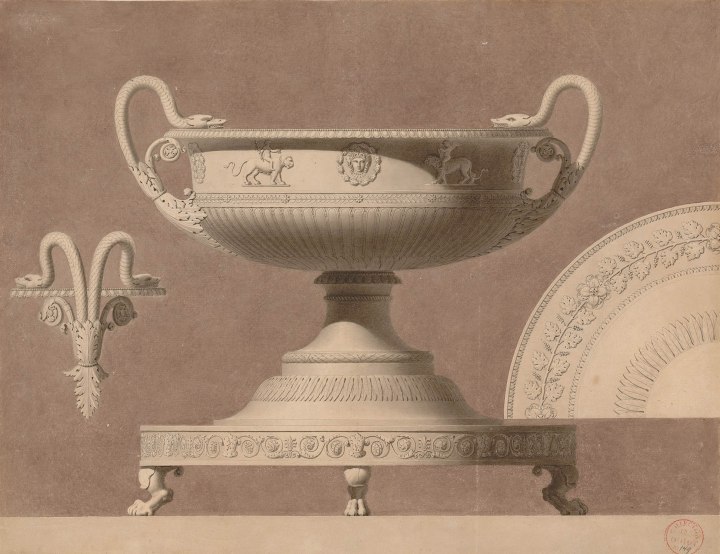
‘Snake handles’ dish, attributed to Charles-Jean-Alexandre Moreau, creator of the model; drawing attributed to Auguste Garneray, draughtsman in Jean-Baptiste-Claude Odiot’s workshop, ca. 1810; graphite, pen and grey ink, grey and sepia wash on paper (Paris: Les Arts Décoratifs).
◊ ◊ ◊ ◊ ◊
Now on view at the Musée des Arts Décoratifs:
Drawing Gold and Silver: Jean-Baptiste-Claude Odiot
Dessiner l’or et l’argent: Odiot (1763–1850), orfèvre
Musée des Arts Décoratifs, Paris, 8 March — 7 May 2017
Jean-Baptiste-Claude Odiot (1763–1850) became one of the most successful and prolific gold and silversmiths during the Empire and Restoration periods. He received several important royal commissions from the courts of Europe, including a sumptuous table service, a dressing table for empress Marie-Louise, and a cradle for the King of Rome.
The Musée des Arts Décoratifs has an exceptional collection of 33 silverware pieces and—acquired in 2009—176 original drawings from Odiot’s workshop, classified as important works of heritage by the Ministry of Culture’s Consultative Commission on National Treasures. On display for the first time, this exhibition reunites Odiot’s design drawings with the executed pieces, demonstrating his creative process, as well as his formal development and experimentation. Dating from the first quarter of the 19th century, these drawings are superbly executed in graphite and pen and enhanced with ink wash, watercolor, and gouache.
The drawings illustrate the various stages of a piece’s creation, from the initial sketches to the final detailed drawings presented to clients. On sheets of paper often measuring more than one meter high, tableware, dressing tables, and desks pieces are represented to scale, displaying the splendor and refinement of the art of living in the early 19th century. The drawings also propose different versions of the same model, offering alternatives for applied ornaments, handles, etc. Each drawing reveals an ornamental repertoire that became Odiot’s hallmark that he repeatedly employed in varying combinations from the beginning of the Empire period to the end of the Restoration. Only ten of the drawings are signed by colleagues of Odiot, including draughtsmen Auguste Garneray (1785–1824) and Adrien-Louis-Marie Cavelier (1785–1867), and the silversmith Jacques-Henry Fauconnier (1779–1839). The drawings also feature the names of prestigious clients such as Count Demidov, Countess Branicka, and members of the Imperial Family, including Madame Mère (Napoleon’s mother), Empress Marie-Louise, and Jerome I of Westphalia. These 176 drawings complement the Museum’s collection of 31 bronze models, a sugar bowl, and ‘Venus’s breast and butterfly’ bowl in vermeil, all by Odiot.

Jean-Baptiste-Claude Odiot, ‘Venus breast and butterfly’ bowl, ca. 1810–20; silver-gilt, hammered, cast, chased and engraved (Paris: Les Arts Décoratifs, Paris / photo: Jean Tholance).
The forms of the bronze models are as varied as the drawings: tea urns, soup tureens, dishes, wine coolers, oil cruets, saltcellars… Their handles, legs, and applied decoration incorporate an ornamental vocabulary derived from Antiquity. In addition to the central theme of the procession of Bacchus, Odiot’s pieces and drawings incorporates other iconographical figures such as of Hebe, Ceres, Leda, Venus, Adonis, Flora, and allegories of Victory. Snakes, swans, and mermaids lend their sinuous forms to handles, while monopod winged sphinxes and lion’s paws were better suited as legs. The foliated friezes framing the piece’s main body are decorated with panthers, reeds, vine branches, ears of wheat, and dolphins.
In 1835, Odiot donated 31 models to the Chambre des Pairs (Upper House of the French Parliament) for posterity and to serve as models for his successors. The models were initially displayed in the Musée du Luxembourg, which was, in the 19th century, devoted to painting and sculpture by living artists. In 1852, the models were transferred to the storerooms of the Louvre where they were gradually forgotten.
Simultaneously, initiatives were taking place to create the Musée des Arts Décoratifs during the second half of the 19th century. The museum of the ‘beautiful in the useful’ opened in 1882 with the goal of encouraging links between art and industry by providing models and references for workers and artisans. As there was a clear connection between Odiot’s motives and those of the new museum, Odiot’s models were put on permanent loan to the Musée des Arts Décoratifs in 1892. In 1907–08, the Musée des Arts Décoratifs commissioned Christofle to gold and silver-plate these models in order to give them the appearance of silver. In 2016, the models were officially added to the inventory of the Musée des Arts Décoratifs.
 These models were executed with great finesse. Their components, assembled by a system of nuts and bolts, were chased to heighten the relief decoration and provide contrast between matte and reflective surfaces. As a result of recent scientific analysis by the Centre de Recherche et de Restauration des Musées de France, the pieces, previously described in Odiot’s terminology as bronze, are, in fact, made of brass. The rare opportunity to showcase the Museum’s collection of Odiot silver alongside the drawings creates a unique dialogue in the history of decorative arts.
The Silversmith Jean-Baptiste-Claude Odiot’s Designs for Silver and Gold exhibition explores this dialogue between a piece’s initial conception on the drawing board and the finished work in Jean- Baptiste-Claude Odiot’s workshop. A selection of approximately 100 drawings, exhibited for the first time, will be displayed alongside 33 pieces of silver, revealing this great silversmith’s creative process. The exhibition will be accompanied by a catalogue of the collection and interactive digital media.
Audrey Gay-Mazuel and Julie Ruffet-Troussard, Odiot: Un atelier d’orfèvrerie sous l’Empire et la Restauration (Paris: Les Arts Décoratifs, 2017), 240 pages, ISBN : 978 2916914 688, 45€.










leave a comment