Exhibition | 18th-Century Masterpieces in the Churches of Paris
From the press release for the exhibition:
Enlightenment Baroque: 18th-Century Masterpieces in the Churches of Paris
Le Baroque des Lumières: Chefs-d’œuvre des églises parisiennes au XVIIIe siècle
Petit Palais, Paris, 21 March — 9 July 2017
Curated by Christophe Leribault and Marie Monfort
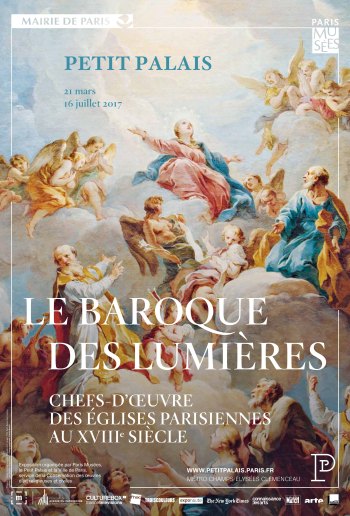 For the first time the Petit Palais is offering the public a spectacular ensemble of 18th-century religious paintings created for the churches of Paris. Through some 200 works the museum will reveal the significance and diversity of artistic output in Paris from the Regency to the French Revolution: from such heirs to the age of Louis XIV as Largillière and Restout to the exponents of rocaille, from Lemoine to Carle Van Loo, and the best of Neo-Classicism, from Vien to David. Produced in partnership with COARC (Conservation of Religious and Secular works of Art for the City of Paris), this exhibition is an extension of the one at the Musée Carnavalet (Paris) in 2012, which focused on 17th-century painting in Paris churches and the rediscovery of an enormous, little-known heritage.
The emphasis of 18th-century French painting was more on the sophistication of the fête galante and the portrait than the elaborateness of great religious art. Outside the Salon season, however, it was in the churches of Paris that art lovers could view contemporary painting, and so the city’s artists gave of their best there. Indeed, parishes and congregations bent on renovating the capital’s places of worship were among the main sponsors of history painting, and it is this forgotten segment of 18th-century art that Enlightenment Baroque aims to reassess. In a spectacular decor evocative of the inside of a church and its related spaces—the chapels and the sacristy, for example—the exhibition itinerary highlights numerous masterpieces, often very large, that have benefited from unprecedentedly thorough renovation. In addition to the pictures still to be seen in churches today, the exhibition brings together works which since the Revolution have been scattered. The masterpieces come from institutions (the Louvre, the Château de Versailles, and the art museums of Lyon, Rennes, Marseille, Brest, and elsewhere), churches and cathedrals nearby (Saint Denis and Villeneuve-Saint-Georges, for example), or further away (Mâcon, Lyon).
Divided into eight sections, the exhibition delights the eye with the finesse and varying styles of altarpieces, the colourful grace of François Lemoine, Jean-François de Troy and Noël Hallé, and the unadorned Neo-Classicism of Drouais and, of course, David, whose large portrait of Christ closes the exhibition. There are also references to ornamental ensembles, some of which, like Charles Natoire’s decor for the Chapelle des Enfants Trouvés have been lost or destroyed. Other sections are devoted to images of the new saints of the Counter-Reformation, smaller works intended for private devotion, commissioning procedures and the restorations that took place at the time in ancient buildings like the Invalides.
Along the way viewers will find two educational spaces, one given over to restoration campaigns and the other to religious imagery. Visitors will also be able to take part in guided tours of various religious edifices in Paris. This groundbreaking panorama of religious painting in 18th-century Paris is nothing short of a revelation: the pictures brought together for the occasion have been endowed with an unsuspected vividness of colour harking back to what we find so agreeable in the art of the Age of Enlightenment.
Christine Gouzi and Christophe Leribault, eds, Le Baroque des Lumières: Chefs-d’œuvre des églises parisiennes au XVIIIe siècle (Paris: Paris musées, 2017), 368 pages, ISBN : 978 27596 03442, 50€.
Curators
Christophe Leribault, Director, Petit Palais
Marie Monfort, Head of Conservation of Religious and Secular works of Art for the City of Paris
Associate Curators
Maryline Assante di Panzillo (Petit Palais), Lionel Britten (Musée d’Orsay), Jessica Degain, Nicolas Engel et Emmanuelle Federspiel (COARC), Christine Gouzi (Université de Paris- Sorbonne), et Guillaume Kazerouni (Musée des Beaux-Arts de Rennes)
Exhibition | From Watteau to David: The Horvitz Collection
From the press release for the exhibition:
From Watteau to David: The Horvitz Collection
Petit Palais, Paris, 21 March — 9 July 2017
Curated by Alvin Clark, Isabelle Mayer-Michalon, and Christophe Leribault
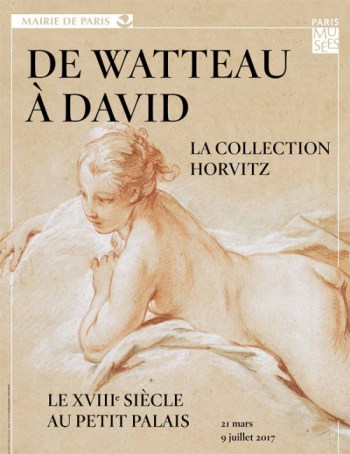 The Petit Palais is delighted to present an anthology of some 200 18th-century French paintings, sculptures, and drawings from the Horvitz Collection in Boston. The work of thirty years, this is the largest private collection of 18th-century French drawings outside of France and is home to such artists of the first rank as Watteau, Boucher, Fragonard, Greuze, and David. It also offers an overview of all the major artists of the period, ranging from Oudry to De Troy, from Natoire to Bouchardon, and from Hubert Robert to Vincent—and all of them at their best.
The exhibition offers the visitor an exhaustive panorama of French painting and drawing from the Regency to the Revolution, together with a small but impeccable selection of of sculptures, including pieces by Lemoyne, Pajou, and Houdon. It comprises fifteen chronologically organised thematic and monographic sections, whose elegant scenography provides an overview of a century rich in artistic innovation.
The exhibition opens with portraits by Rigaud, Largillière, and Jean-François de Troy, before addressing the mythological and religious painting of the early 18th century via works by François Lemoyne and Charles de la Fosse. The viewer then moves on to the fête galante, with drawings by Watteau and Lancret, and to landscape and animal painting, with Oudry and Desportes. The exhibition also takes in architecture and the triumph of ornamentation as typified by the whimsicality of Oppenord and Lajoüe. An entire section given over to François Boucher is followed by a group of academic nudes and head studies by Coypel, Lépicié, Vien, and others. Next comes mid-century history painting, represented by Natoire and Carle Van Loo, and the tour continues with drawings by sculptors like Bouchardon and Pajou. A second monographic section is dedicated to Fragonard, after which visitors are treated to views of ruins and landscapes by Hubert Robert and Joseph Vernet, and, in a more sentimental vein, works by Greuze, Prud’hon, and Boilly. The exhibition closes with an assertion of neo-Classicism by Jacques-Louis David, Perrin, and Vincent.
The Horvitz Collection—with its meticulous documentation and works in perfect condition—has become a touchstone for the period. Its presentation in Paris is a major event whose prestige and intimist character make it a perfect complement to Enlightenment Baroque: 18th-century Masterpieces in the Churches of Paris, an exhibition devoted to the big, forgotten religious paintings of the period.
Curators
Alvin L. Clark, Jr., The Horvitz Collection and The J.E Horvitz Consultative Curator Department of Drawings, Division of European and American Art, Harvard Art Museum, in association with Isabelle Mayer-Michalon, Doctor of Philosophy in Art History. Christophe Leribault, Director, Petit Palais.
Alvin Clark, ed, Tradition & Transitions: Eighteenth-Century French Art from The Horvitz Collection (Boston: The Horvitz Collection, 2017), 701 pages, ISBN: 9780991262519, $115.
Note (added 21 January 2018) — The original posting did not include information on the catalogue.
Exhibition | The Art of Power: Treasures from the Bute Collection
Opening at the end of the month at both The Hunterian and Mount Stuart:
The Art of Power: Treasures from the Bute Collection at Mount Stuart
Hunterian Museum and Art Gallery, Glasgow, 31 March 2017 — 14 January 2018
Mount Stuart, Isle of Bute, 31 March 2017 — 14 January 2018
Curated by Caitlin Blackwell and Peter Black

Sir Joshua Reynolds, Portrait of John Stuart, 3rd Earl of Bute, 1773 (The Bute Collection at Mount Stuart).
This new exhibition offers a unique opportunity to see major paintings from the Bute Collection at Mount Stuart on the Isle of Bute. Merging art, biography and cultural history, Art of Power uncovers the fascinating Enlightenment figure, John Stuart, Third Earl of Bute, and his collection of rarely-seen masterpieces.
The exhibition is split across two venues—The Hunterian and Mount Stuart—offering visitors the chance to experience two world-class collections. Art of Power: Treasures from Mount Stuart marks the tercentenary of Mount Stuart, an architectural jewel on the Isle of Bute which houses the Bute Collection, one of the foremost private collections of artworks and artefacts in the UK.
The exhibition reveals a selection of rarely-seen masterpieces collected by the fascinating Enlightenment figure, John Stuart, Third Earl of Bute (1713–1792), the first Scottish-born Prime Minister and ‘favourite’ of George III. After retiring from politics, Bute amassed a great art collection, which was particularly renowned for its Dutch and Flemish paintings. This major exhibition brings a selection of European and British masterpieces from the Bute Collection to the Hunterian Art Gallery, many of which have not been on public display in over a century.
Highlights include works by Dutch Golden Age masters like Jan Steen and Jacob van Ruisdael, Grand Manner portraits by Sir Anthony Van Dyck, Joshua Reynolds and Allan Ramsay, and Italianate landscapes and history subjects by Claude Lorrain and Veronese. A portion of these works will be displayed at the Hunterian, along with works on paper, including botanical illustrations and satirical engravings from the collection. The remainder of the paintings will be displayed at Mount Stuart, where they will be accompanied by historical artefacts, such as costume, letters, and rare books.
◊ ◊ ◊ ◊ ◊
Caitlin Blackwell, Peter Black, and Oliver Cox, Art of Power: Masterpieces from the Bute Collection at Mount Stuart (New York: Prestel, 2017), 144 pages, ISBN: 978 37913 56631, $50.
John Stuart, 3rd Earl of Bute, was one of history’s most enthusiastic art collectors. As tutor to Prince George, Bute became indispensable to the royal household. Soon after his accession to the throne, the King made Bute Prime Minister―a career that was cut short after the Peace of Paris in 1763.
Forced out of London by an angry mob, Bute retired to an estate at Luton, where he spent the rest of his years in private study and amassing a collection of 500 paintings, including major works by Venetian painters such as Tintoretto, Bordone, and Veronese. Bute had a special interest in Dutch and Flemish pictures, building the greatest collection of its kind in Britain. This book features over thirty masterpieces, mainly genre paintings and landscapes, and including jewel-like landscapes by Brueghel and Savery. The collection is housed at the Bute family’s Scottish seat, Mount Stuart, on the Isle of Bute. Essays by leading scholars delve into the history of Bute’s collection, focusing on his relationship with King George III, and his wide ranging passions, which resulted in rooms filled floor to ceiling with works of art.
Caitlin Blackwell is the inaugural Bute Fellow at Mount Stuart, which is located on the Isle of Bute off the coast of Scotland. Peter Black is curator at the Hunterian and has published widely on Dutch and Flemish art. Oliver Cox is Heritage Engagement Fellow at the University of Oxford.
◊ ◊ ◊ ◊ ◊
From CODART, with text from Peter Black, Curator of Dutch and Flemish Paintings and Prints, Hunterian Museum and Art Gallery (12 December 2016). . .
The Bute Collection is housed at Mount Stuart (1880–1912), the Gothic Revival Palace by Robert Rowand Anderson on the Isle of Bute. It contains, besides a truly great collection of 18th-century portraits, important Dutch and Flemish works that were collected in the 1760s and 1770s by John Stuart, Third Earl of Bute (1713–1792). Bute was tutor to King George III when he was Prince of Wales, advising him, among other things, on acquisitions for the royal collection. Soon after the coronation in 1760, Bute was given power by his former pupil, becoming Prime Minister in 1762. His main business was to negotiate the Peace of Paris, ending the Seven Years’ War. Within one year, however, Bute resigned and was forced to leave London to escape the London mob. He bought a country house at Luton, which he had remodeled by Adam, and landscaped by Capability Brown. There he settled down to become the most important British collector of Dutch paintings, assembling for the purpose a library and collection of prints and drawings (dispersed 1794–1809). At the time of his death, there were 500 works in the house. Bute had more than a penchant for Venetian art and the grand rooms on the ground floor were hung with works by Tintoretto, Veronese and Bordone, as well as some of the finest examples of the work of Francesco Zuccarelli. Masterpieces by Dutch artists in the library included a magnificent Windy Autumn Day landscape by Berchem (Mount Stuart), and Cuyp’s River Landscape with Horseman and Peasants (now in the National Gallery, London). That painting is said to have started the craze for Cuyp among British collectors when Bute acquired it in the early 1760s. The smaller Dutch paintings were accommodated on the upper floor, clustered in dense thematic hangs in the bedrooms and dressing rooms.
The exhibition of 26 pictures in Glasgow University provides a window onto the riches of Mount Stuart, which can be visited in a day-trip by train and ferry from Glasgow. They are generally smaller works, including jewel-like landscapes by Savery, De Momper/Brueghel, Jan van der Heyden, Cuyp, Berchem, and Ruisdael, as well as genre scenes by Steen, Teniers, Verelst, Metsu and Bega. Visitors to Mount Stuart will see the extraordinary collection of family portraits by Batoni, Ramsay and Reynolds as well as works by Hobbema, Steen, Willem van Herp and Pieter van Slingelandt.

Mount Stuart, Isle of Bute (Wikimedia Commons, July 2006).
Exhibition | Aert Schouman and the Imagination of Nature

From CODART regarding the exhibition now on view at the Dordrechts Museum:
A Royal Paradise: Aert Schouman and the Imagination of Nature
Een Koninklijk Paradijs: Aert Schouman en de verbeelding van de natuur
Dordrechts Museum, 19 February — 17 September 2017
The Dordrechts Museum dedicates an exhibition to the Dordrecht painter Aert Schouman (1710–1792). On view will be a wall decoration of the Il Pastor Fido series. The paintings, only rediscovered in 2016, are an example of Schouman’s early work. The recently restored wall paintings of the Huis ten Bosch Palace will also be display. Due to the renovation work taking place at the palace, the series depicting the menagerie of Willem V may be exhibited in Dordrecht exclusively.
Het mooiste werk van dierenschilder Aert Schouman (1710–1792) komt samen in een feestelijke tentoonstelling voor kunst- en natuurliefhebbers. Absoluut hoogtepunt vormt de complete kamerbeschildering van Willem V uit Huis ten Bosch met daarop zijn bijzondere dierenverzameling. Deze ‘kamer in het rond’ is onlangs gerestaureerd en straks in het Dordrechts Museum nog één keer te bewonderen, voordat ze weer binnen de muren van het toekomstige woonpaleis van koning Willem-Alexander en koningin Máxima verdwijnt.
Met stukken uit musea en particuliere collecties in binnen- en buitenland laat de tentoonstelling het paradijs van Schouman zien vol inheemse en exotische dieren. Vooral zijn werken met schitterende vogels spreken tot de verbeelding. Schouman tekende bovendien de buitenplaatsen en tuinen die zijn rijke opdrachtgevers als aardse paradijzen lieten aanleggen.
Emile Havers, ed., Een Koninklijk Paradijs: Aert Schouman en de verbeelding van de natuur (Zwolle, W Books, 2017), 360 pages, ISBN: 978 94625 81852, 30€.
Exhibition | The First Jewish Americans
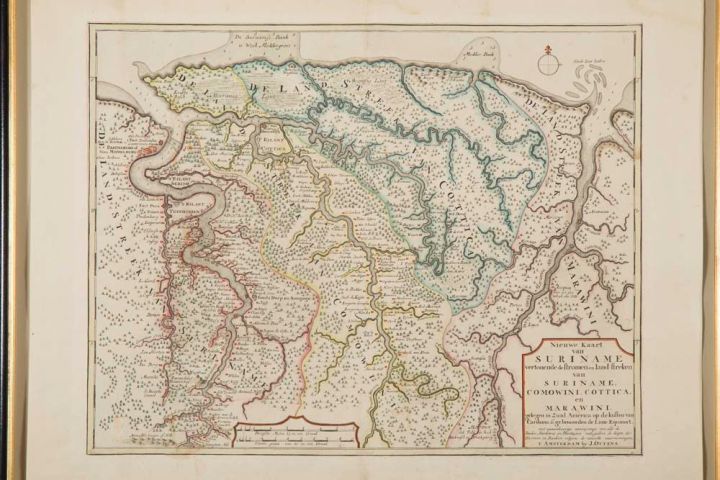
Suriname map, 1718. Nieuwe Kaart van Suriname vertonende de stromen en land-streken van Suriname, Comowini, Cottica, en Marawini; Amsterdam, 1718 (Collection of Leonard L. Milberg).
◊ ◊ ◊ ◊ ◊
Closing on Sunday at the New-York Historical Society (the exhibition was shown at Princeton in 2016 under the title By Dawn’s Early Light: Jewish Contributions to American Culture from the Nation’s Founding to the Civil War); from the press release:
The First Jewish Americans: Freedom and Culture in the New World
Princeton University Art Museum, 13 February — 12 June 2016
New-York Historical Society, 28 October 2016 — 12 March 2017
How did Jewish settlers come to inhabit—and change—the New World? Jews in colonial America and the young United States, while only a tiny fraction of the population, significantly negotiated the freedoms offered by the new nation and contributed to the flowering of American culture. The First Jewish Americans: Freedom and Culture in the New World follows the trajectory of a people forced from their ancestral lands in Europe, as well as their homes in South America and the Caribbean, to their controversial arrival in New Amsterdam in 1654 to the unprecedented political freedoms they gained in early 19th-century New York, Philadelphia, and Charleston. In this ground-breaking exhibition, rare portraits, drawings, maps, documents, and ritual objects illuminate how 18th- and 19th-century artists, writers, activists, and more adopted American ideals while struggling to remain distinct and socially cohesive amidst the birth of a new Jewish American tradition.

Gerardus Duyckinck I, Portrait of Jacob Franks (1688–1769), oil on canvas (Bentonville, Arkansas: Crystal Bridges Museum of American Art).
The exhibition explores the origins of the Jewish diaspora and paths to the New World, Jewish life in American port cities, and the birth of American Judaism in the 18th and early 19th centuries, as well as profile prominent Jewish Americans who made an impact on early American life.
European Jews fleeing persecution and seeking ports of refuge were propelled westward to the distant shores of New World colonies, which offered hope for a new beginning until the infamous Holy Inquisition followed them across the ocean. The exhibition powerfully illustrates this experience through the 1595 autobiography of Luis de Carvajal, a ‘converso’ Jew in Mexico and the nephew of a prominent governor, who was tried by the Inquisition and denounced more than 120 other secretly practicing Jews before he was burned at the stake in 1596. The recently rediscovered documents, which had gone missing from the National Archives of Mexico more than 75 years ago, will be on view at New-York Historical by special arrangement with the Mexican government before returning to Mexico.
The Jewish community in the New World dispersed throughout the colonies in the Caribbean, creating a network built on trade, family, and religious connections. Examples of these island communities and influences featured in the exhibition include a 1718 map of the Jewish settlement in Suriname, 18th-century texts of religious services for the circumcision of slaves, and Jamaican legal documents from 1823 that argued for Jewish voting rights.
During the colonial period, Jews clustered in the cosmopolitan and commercially minded port cities of New York, Philadelphia, and Charleston, and within each city, an elaborate communal infrastructure grew that supported all aspects of Jewish life. Shearith Israel, the first Jewish congregation in colonial North America, built its home in Lower Manhattan in 1730. The congregation has loaned significant objects to the exhibition, such as a Torah scroll that was burned by British soldiers during the Revolutionary War and a rare set of Torah bells (or rimonim) designed by Myer Myers—one of colonial America’s preeminent silversmiths and an active congregation member. Also on view are six oil paintings circa 1735 of the prominent Levy-Franks family of New York, also members of the congregation. On loan from the Crystal Bridges Museum of American Art, they emulate paintings of the British aristocracy.
The Philadelphia Jewish community grew during and after the Revolutionary War, with the city serving as a refuge for patriots fleeing British-occupied New York. Some Philadelphia Jews opposed Britain’s harsh restrictions on American trade by signing the Resolution of Non-Importation made by the Citizens of Philadelphia in 1765—one of the first official protests against British mercantile policy, which is on view in the exhibit. Also featured are portrait paintings of Philadelphia merchant Barnard Gratz, a signer of the resolution who supplied American militias; and of his niece Rebecca Gratz, who in 1819 established the Female Hebrew Benevolent Society, the first Jewish lay charity in the country.
In the first decades of the 19th century, Charleston was home to more Jews than any other place in North America and became a site of cultural and religious ferment. Congregation K.K. Beth Elohim—whose elegant synagogue is depicted in an 1838 oil painting on view—was the birthplace of the Reform movement in 1824, when a group of 47 members petitioned to make worship more accessible by introducing innovations that included prayers in English. The leadership refused, so the petitioners seceded and established the Reformed Society of Israelites for Promoting True Principles of Judaism According to Its Purity and Spirit. The exhibition features the group’s 1825 prayer book and speeches promoting their initially radical position, which soon became main stream. Also on view are earlier examples of revolutions in American Judaism, such as an English translation of a Hebrew prayer book from 1766, Samuel Johnson’s English and Hebrew Grammar book from 1771, and a lunar calendar of Jewish festivals and Sabbath observance from 1806.
The exhibition also features profiles of prominent Jewish Americans of the 18th and early 19th centuries, whose writing, activism, and artistic achievements provide a window into an era of cultural vitality and change in the new Republic. Among the highlighted figures are renown artist Camille Pissarro (1830–1903), a Caribbean Jew born in St. Thomas whose 1856 landscape paintings on view capture waterfront scenes of his island home; and Louis Moreau Gottschalk (1829–1860), a New Orleans-born piano prodigy and composer who became the first classically trained American pianist to achieve international fame. Science and medicine were remarkably open to Jewish men during the 19th century. On display are books written by Jewish Americans that made major contributions to American science and medicine as those fields were developing during this period. The exhibition concludes with views of newly flourishing cities, including Cincinnati, Los Angeles, and San Francisco that became home to American Jews as they ventured westward.
The exhibit is based primarily upon loans from the Princeton University Jewish American Collection, gift of Mr. Leonard L. Milberg, Class of 1953, and Mr. Leonard L. Milberg’s personal collection.
Adam Mendelsohn, By Dawn’s Early: Light Jewish Contributions to American Culture from the Nation’s Founding to the Civil War (Princeton: Princeton University Library, 2016), 352 pages, ISBN: 978 08781 10593.
Terrific installation photographs are available at Arts Summary.
Exhibition | Saving Washington
From the press release from the New-York Historical Society:
Saving Washington
New-York Historical Society, 8 March — 30 July 2017
Curated by Valerie Paley
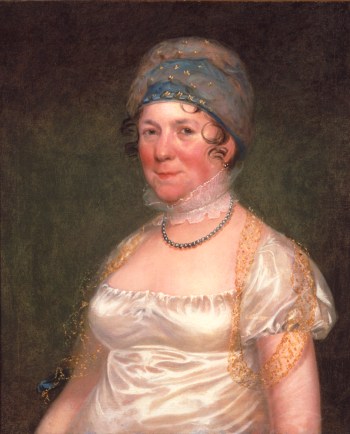
Bass Otis, Portrait of Dolley Madison, ca. 1817, oil on canvas (New-York Historical Society).
Opening on International Women’s Day, March 8, and remaining on view through July 30, 2017, in the Joyce B. Cowin Women’s History Gallery, Saving Washington will explore the tenuousness of American democracy from the aftermath of the Revolutionary War through the War of 1812 and beyond, addressing women’s roles as citizens of a new republic by focusing on the political and social significance of First Lady Dolley Madison and other women of the era. Curated by Valerie Paley, New-York Historical vice president, chief historian, and director of the Center for Women’s History, the exhibition will illustrate the mission of the Center for Women’s History: to reveal the often-overlooked stories of women who shaped American history.
Saving Washington recasts the traditional Founding Fathers narrative to focus on the less-examined contributions of women whose behind-the-scenes and largely unrecognized efforts helped develop the young nation and realize the Constitution ‘on the ground’. Among those who expertly navigated the political world of the early republic, Dolley Madison (1768–1849) was more than an example of what a woman could be in America; she was the embodiment of American strength, virtue, and honor. As the wife of the fourth U.S. president, she is sometimes remembered merely as the hostess who saved the White House portrait of George Washington from British vandalism during the War of 1812. But in fact, she was one of the most influential women in America during the nation’s formative years and a powerful force during a time when women were excluded from affairs of state.
Saving Washington will feature more than 150 objects—including artwork, books, documents, clothing, jewelry, and housewares—within immersive, interactive installations evoking Dolley Madison’s famous ‘Wednesday night squeezes’, her popular social gatherings that drew a wide range of people to ‘squeeze’ into the president’s mansion and encouraged informal diplomacy.
Saving Washington will inaugurate the Joyce B. Cowin Women’s History Gallery within the Center for Women’s History on New-York Historical’s renovated fourth floor. Other programming highlights for Women’s History Month will include a conference on the history of reproductive rights; an evening with tennis icon and social justice pioneer Billie Jean King, who will unveil select items from her personal archives, recently donated to New-York Historical; a reading series with Girls Write Now featuring young women sharing their creative works; and a panel discussion about “Women and the White House,” moderated by 60 Minutes correspondent Lesley Stahl.
Lead support for Saving Washington has been provided by Joyce B. Cowin and the Robert David Lion Gardiner Foundation, with additional support provided by Susan Klein. Educational programming was made possible by Deutsche Bank.
Exhibition | Winckelmann: Modern Antiquity

Henry Fuseli (Johann Heinrich Füssli), Woman before the Laocoön, ca. 1801–05, ink on paper
(Kunsthaus Zürich).
◊ ◊ ◊ ◊ ◊
Opening next month in Weimar:
Winckelmann: Modern Antiquity / Moderne Antike
Neues Museum Weimar, 7 April — 2 July 2017
Johann Joachim Winckelmann (1717–1768) is widely regarded as the founder of modern archaeology and aesthetics. With his view of ancient art as possessing “noble simplicity and solemn greatness,” he was a pioneer of European aesthetics during the Classical period. In commemoration of Winckelmann’s 300th anniversary, the Klassik Stiftung Weimar and the German Studies Department of the Martin Luther University Halle-Wittenberg present the first comprehensive exhibition on this influential researcher, writer, and critic who strongly shaped our modern view of antiquity.
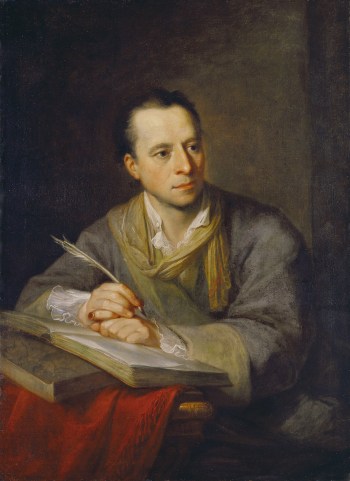
Angelika Kauffmann, Portrait of Johann Joachim Winckelmann, 1764 (Kunsthaus Zürich).
Winckelmann grew up in poverty. His path in life led him to Halle, Jena, and Dresden, and finally to Italy where he gained international fame in papal Rome. Winckelmann was many things: a passionate visionary, a learned enthusiast, and an intellectual adventurer who put everything on the line to achieve his life’s dream. His violent death, which stunned Goethe and his contemporaries like a “clap of thunder,” played no small role in making him a revered and eminent figure throughout Europe within a few short years.
Like a kaleidoscope, the exhibition demonstrates the fascinating power of Winckelmann’s extraordinary life and his revolutionary works in which antiquity and modernity commune. Exquisite items from German and international collections illustrate the impact of his aesthetic, anthropological, and political ideas from the end of the eighteenth century to the present day. It will be the first time that three portrait paintings of Winckelmann from collections in Weimar, Zurich, and New York are presented together in one exhibition.
The exhibition is part of a joint research project, conducted by the Klassik Stiftung Weimar and the German Studies Department of the Martin Luther University Halle-Wittenberg. The project director at the Klassik Stiftung Weimar is Dr. Bettina Werche. Funded by the Cultural Foundation of German States, the Ernst von Siemens Kunststiftung, and Alexander von Humboldt Foundation.
The catalogue is published by Hirmer:
W. Holler, E. Décultot, M. Dönike, C. Keller, T. Valk, and B. Werche, eds., Winckelmann: Moderne Antike (Munich: Hirmer Verlag, 2017), 352 pages, ISBN: 978 37774 27560, 45€.
 Johann Joachim Winckelmann (1717–1768) gilt als Begründer der Archäologie und Kunstgeschichte. Mit seiner Formel von der »edlen Einfalt und stillen Größe« antiker Kunst war er ein Wegbereiter der klassizistischen Ästhetik in Europa. Winckelmanns revolutionäres Werk, in dem Antike und Moderne einander begegnen, wird anlässlich seines 300. Geburtstages neu beleuchtet.
Winckelmann wuchs in ärmlichen Verhältnissen auf. Sein Weg führte ihn über Halle, Jena und Dresden nach Italien, wo er im päpstlichen Rom zu einer internationalen Berühmtheit wurde. Winckelmann war vieles: ein schwärmerischer Visionär, ein gelehrter Enthusiast und ein geistiger Abenteurer, der für seinen Lebenstraum alles auf eine Karte setzte. Nicht zuletzt sein gewaltsamer Tod, der auf Goethe und andere Zeitgenossen wie ein »Donnerschlag« wirkte, ließ ihn binnen weniger Jahre zu einem in ganz Europa verehrten Klassiker aufsteigen. Als einflussreicher Forscher, Schriftsteller und Kritiker hat Winckelmann unseren Blick auf die Antike wesentlich geprägt, wie das reich bebilderte Grundlagenwerk anschaulich vor Augen führt.
Note (added 16 March 2017) — The original posting omitted information about the catalogue.
◊ ◊ ◊ ◊ ◊
Note (added 8 March 2017) — Klaus-Werner Haupt draws readers’ attention to his 2014 book on Winckelmman:
Klaus-Werner Haupt, Johann Winckelmann: Begründer der klassischen Archäologie und modernen Kunstwissenschaft (Weimar: Weimarer Verlagsgesellschaft, 2014), 296 pages, ISBN: 978 386539 7188, 28€.
 Johann Joachim Winckelmann, Sohn eines Schuhmachermeisters, rastloser Autodidakt und der Begründer der klassischen Archäologie und modernen Kunstwissenschaften, gilt als Beispiel, wie ein einfacher Bürger mit Glück und Verstand alle mit seiner niederen Herkunft verbundenen Schranken zu überwinden wusste. Seine literarischen Kunstbeschreibungen sowie sein Hauptwerk—die Geschichte der Kunst des Altertums (1764)—revolutionierten die Kunstrezeption und beeinflussten neben Ästhetik und Kunstkritik die Literatur in ganz Europa. Der Autor Klaus-Werner Haupt schafft es, Winkelmanns kämpferische Vitalität und die poetische Bildhaftigkeit seiner Sprache vor biografischem Hintergrund und seinen wissenschaftlichen Leistungen lehrreich und unterhaltend für ein breites Publikum darzustellen.
Exhibition | Goethe and France
Now on view at the Bodmer Foundation, just outside of Geneva:
Goethe et la France
Fondation Martin Bodmer, Cologny, 12 November 2016 — 23 April 2017
Curated by Jacques Berchtold

Heinrich Christoph Kolbe, Portrait of Goethe (detail), oil on canvas, ca. 1826 (Cologny: Fondation Martin Bodmer).
Martin Bodmer (1899–1971) placed Johann Wolfgang von Goethe (1749–1832) high in his personal hall of fame and at the center of his collection, one of the most important in the world. In many ways he owed the very concept of Weltliteratur to this towering figure. Goethe was familiar with French culture from very early on. Like many of his contemporaries of feudal and aristocratic Europe, he too felt the shock of the French Revolution, and his participation in the failed campaign against the Revolutionary forces (the Battle of Valmy in 1792) was a trauma that marked him for the rest of his days.
From his affinities for Rousseau, Goethe changed directions, and the work he did in Weimar, the new capital of the Aufklärung, established a uniquely German classicism. In the process, the ideologues of classicism at court drew on antiquity but also fostered a competitive relationship with their predecessors at Versailles. Goethe—who managed the library, theater, and opera—introduced Germans to the masterworks of French geniuses in literature, theater, music, and painting. Odd writers of the French canon were rehabilitated (Rabelais), and innovative authors of the period were discovered (Diderot).
The social, ethical, and political thinking that resulted from the shock of the French Revolution was crystallized in Goethe’s play The Natural Daughter (Die natürliche Tochter). Under the protectorate of the Confederation of the Rhine, Goethe met Napoleon—a great reader of Werther—in October 1808, and contemplated creating a portrait of him as Julius Caesar in homage to this genius of visionary and decisive action. And Faust, which Goethe pursued from 1808 on, had a special resonance in France. Taking off from the many Goethean gems in the Bodmer Collection, the exhibition shows the extent to which a complex and ambivalent ‘French question’ deeply influenced Goethe’s output for some sixty years.
Exhibition | Volcanoes

Sir William Hamilton’s volcano archive includes paintings he commissioned (Oxford: Bodleian).
◊ ◊ ◊ ◊ ◊
From the press release (16 January 2017) for the exhibition:
Volcanoes
Weston Library, Bodleian, Oxford, 10 February 2017 — 21 May 2017
Curated by David Pyle
A new exhibition at the Bodleian Libraries uses a spectacular selection of eye witness accounts, scientific observations, and artwork to chart how our understanding of volcanoes has evolved over the past two millennia. The exhibition examines some of the world’s most spectacular volcanoes including the 79 AD eruption of Vesuvius—one of the most catastrophic eruptions in European history—and the 19th-century eruptions of Krakatoa and Santorini, two of the first volcanic eruptions to be intensely studied by modern scientists.
Today, satellites monitor volcanic activity and anyone with internet access can watch volcanic eruptions live in real time. In the past, volcanic eruptions were described in letters, manuscript accounts, and early printed books and illustrated through sketches, woodcuts, and engravings. Many of these fascinating accounts are preserved in the Bodleian’s historic collections and will be on display in Volcanoes at the Weston Library.
The human encounters with volcanoes that are traced in the exhibition range from Pliny the Younger’s account of the dramatic eruption of Vesuvius in 79 CE to early Renaissance explorers who reported strange sightings of mountains that spewed fire and stones. Also explored is how scientific understanding of volcanoes and the Earth’s interior have developed over time, from classical mythology and early concepts of subterranean fires to the emergence of modern volcano science, or volcanology, in the 19th century. The exhibition brings together science and society, art, and history and will delight visitors of all ages.
 The exhibition is curated by David M. Pyle, Professor of Earth Sciences at the University of Oxford, whose research uses historical sources to improve our knowledge of past volcanic activity and to shed light on what might happen in the future at young or active volcanoes. It will feature treasures from the Bodleian Libraries, some of which have never been on public display before. In addition, the exhibition will feature items on loan from the Natural History Museum in London and from the University of Oxford’s Museum of Natural History, the Museum of the History of Science, and Magdalen College. Highlights of Volcanoes include:
• Fragments of ‘burnt’ papyrus scrolls from the ancient Roman town of Herculaneum, which were buried during the 79 AD eruption of Vesuvius
• The earliest known manuscript illustration of a volcano, found in the margin of a 14th-century account of the voyage of St Brendan, an Irish monk who travelled across the north Atlantic in the 6th century
• A stunning illustration of the Earth’s subterranean fires from Athanasius Kircher’s Mundus Subterraneus, an influential 17th-century work which proposed that volcanoes were created where the Earth’s internal fires escaped at the surface
• Spectacular 18th-century studies of Vesuvius by Scottish diplomat and early volcanologist William Hamilton who wrote one of the first descriptive monographs of an active volcano
• 18th- and 19th-century weather diaries and paintings that capture the distant effects and freak weather conditions caused by major volcanic eruptions in Iceland and Indonesia
• ‘Infographics’ from 19th-century natural historians Alexander von Humboldt and Charles Daubeny whose work has contributed greatly to our current understanding of volcanoes
• Lava and rock samples, maps, lecture notes, and scientific equipment from 19th-century volcanologists and explorers
The exhibition curator David Pyle said: “Humans have lived with volcanoes for millions of years yet scientists are still grappling with questions about how they work. This exhibition features historical representations and ideas about volcanoes that are captivating and dramatic but most importantly these works provide scientists today with valuable insights into how these enigmatic phenomena behave. Looking back at history can help us learn valuable lessons about how best to reduce the effects of future volcanic disasters.”
Richard Ovenden, Bodley’s Librarian said: “Volcanoes are one of the most extraordinary marvels of the natural world and have fascinated us for millennia. This exhibition draws on both the rich collections held at the Bodleian and cutting edge scientific research to demonstrate the power and fascination of volcanoes through time.”
David Pyle, Volcanoes (Oxford Bodleian Libraries, 2017), 224 pages, ISBN: ISBN: 978 18512 44591, £20.
Exhibition | A Life of Seduction: Venice in the 1700s
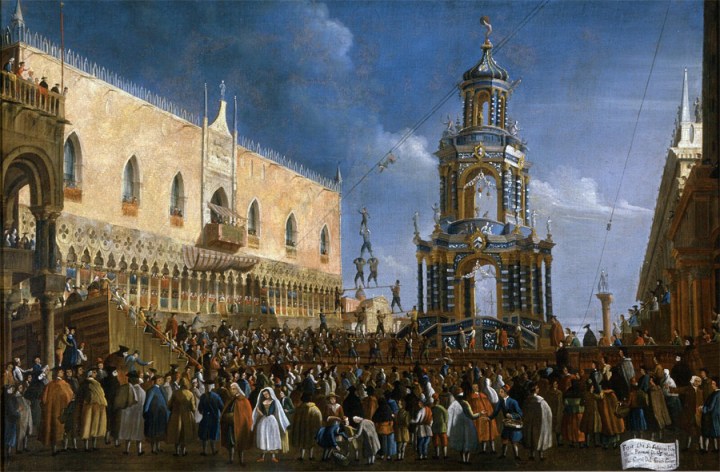
Gabriel Bella, Fat Thursday Festivity in Piazzetta, 18th century
(Venice: Querini Stampalia Foundation)
◊ ◊ ◊ ◊ ◊
Press release (11 January 2017) from NOMA:
A Life of Seduction: Venice in the 1700s
New Orleans Museum of Art, 16 February — 21 May 2017
Curated by Giandomenico Romanelli
The grandeur of Venice comes to America’s most historic city in A Life of Seduction: Venice in the 1700s, an exhibition at the New Orleans Museum of Art. NOMA is the sole venue in the United States presenting this exhibition of objects providing a glimpse into the pageantry, ceremony, and extravagance of Venetian life in the eighteenth century.

Glass sugar bowl, Venice, 18th century, glass and chalcedony (Murano: Museo del Vetro).
“It is with great pleasure that NOMA brings this remarkable exhibition to our public. Venice is presented through an elegant, multi-disciplinary installation featuring an exceptional selection of objects, costumes, and paintings that illuminate an extraordinary time in the history of Venice,” says Susan Taylor, Montine McDaniel Freeman Director at the NOMA.
A Life of Seduction illuminates Venetian life and pageantry during the century of Casanova, Canaletto, and Tiepolo. Visitors will see objects depicting the opulence of the time, when the city was a cultural mecca. Eighteenth-century carnival masks, costumes and robes, shoes, handbags, and regal glass objects are displayed among exquisite paintings by Canaletto and Guardi. “A significant strength of this exhibition is its historical and cultural point of view and the distinctive range of objects that tell the story,” says NOMA Curator Vanessa Schmid.
Fittingly, A Life of Seduction arrives in New Orleans at a time when parallels between the two cities are apparent, just before Carnival and the spring festival season. Guest-curated by the former director of the Civic Museums of Venice, Giandomenico Romanelli, the exhibition presents four themes: A City that Lives on Water, the Celebration of Power, Aristocratic Life in Town and Country, and the City as Theater. The festivals and celebration unique to Venetian culture are depicted in detailed paintings of a city transformed at carnival. Gondola models illustrate the exquisite craftsmanship and elegance of canal life and travel. Palace and country living are brought to life by resplendent costumes, silk waistcoats, gloves, and handbags, as well as furnishings and delicate, rare Venetian glass objects, for which the city is still so well known. Theater and opera—vital elements in Venetian life and imagination—are represented through paintings, decorative arts, and a full-scale puppet theater lent by the Casa Goldoni of Venice especially for this exhibition.
The exhibition is originated by NOMA, organized by the Contemporanea Progetti, and guest-curated by Giandomenico Romanelli.










leave a comment