Exhibition | Glorious Years: French Calendars

François Gérard Jollain, Almanac (detail), ‘The August Portraits of the First Born Sons of Our Kings That Have Had the Title of Dauphin’ (Louis XV, the Queen, and the Dauphin surrounded by courtiers and other nations with a family tree of French kings), 1734; etching and engraving, 84 × 51 cm (Waddesdon Manor, National Trust, 2669.3.17; photo: Mike Fear).
◊ ◊ ◊ ◊ ◊
Opening next month at Waddesdon:
Glorious Years: French Calendars from Louis XIV to the Revolution
Waddesdon Manor, Buckinghamshire, 22 March — 29 October 2017
Curated by Rachel Jacobs
Glorious Years is a celebration of the power of the printed image before photography—an exhibition of rare calendars, published in Paris in the 17th and 18th centuries, from their golden period under Louis XIV, through to the Revolution, when time itself was re-invented, with new ways of illustrating and naming the days and years.
Despite their popularity, these calendars (originally named ‘almanacs’) have not survived in great numbers. They were replaced annually and were easily damaged due to their large sizes. The depicted major events, from royal weddings, and births to victorious battles and peace treaties and were designed to inform and delight the public, while glorifying the king and his image. These rare prints can be enjoyed as works of art and as important historic documents, revealing much about the social, political, and artistic world of the Old Regime.

Philibert Louis Debucourt, Almanac: Republican Calendar, 1794; etching and engraving; 51 × 41 cm (Waddesdon Manor, National Trust, 2669.3.42; photo: Mike Fear).
A number of bound pocketbook almanacs are also included in the exhibition. These small volumes were extremely popular towards the end of the 18th century. They vary hugely in content, but all contain a calendar within. Some are official directories, listing members of the royal households, schedules for the post and carriage travel; others are for amusement, containing songs, poems, illustrations and even erasable paper for recording gambling gains and losses. These small pocketbooks are not dissimilar to our modern-day smart phones, perfectly suited to distract, amuse, and inform.
In a time before photography, the printed image was the most effective communicator. Images were everywhere and consumed by all. The exhibition will explore the context in which these almanacs were made and consider how these everyday prints and books were used to educate, delight, impress, and express the official print programme of the court and the later revolutionary government.
Baron Ferdinand de Rothschild (1839–1898) was as fascinated by social history and printed ephemera—such as trade cards and lottery tickets—as he was by the finest English and French art of the 18th century. His collection of over 70 almanacs is unique in the UK, and it is the first time some 30 of these prints will be on public display. All the prints in the exhibition have been conservation cleaned, remounted, and digitised and will be available to browse and research on the website alongside our other collections of printed ephemera, including trade cards, board games, and prints from the French Revolution.
Exhibition | The Universal Museum: From Napoleon’s Dream to Canova

Now on view at the Scuderie del Quirinale:
The Universal Museum: From Napoleon’s Dream to Canova
Il Museo Universale: Dal sogno di Napoleone a Canova
Scuderie del Quirinale, Rome, 16 December 2016 — 12 March 2017
Curated by Valter Curzi, Carolina Brook, and Claudio Parisi Presicce
A major exhibition recounting the recovery of Italy’s masterpieces from France—from Raffaello to Titian, from the Carracci to Guido Reni, Tintoretto, and Canova.
It was in 1816 that the Papal States’ masterpieces of art and archaeology returned to Rome after the Napoleonic confiscations. This event was preceded and accompanied by other administrations of the peninsula recovering many of more than 500 paintings that had been confiscated throughout the Italian territories in the course of French military campaigns from 1796 to 1814 and packed off to Paris where they were selected for display in the embryonic Musée du Louvre.
As the works of art that had been taken to France began to return home, the whole of Italy was confronted with the problem of what to do with the thousands of paintings and sculptures that had been removed from churches and convents after the religious orders had been suppressed in the early 19th century. The fate of the Musée du Louvre as a universal museum, the loss of several masterpieces of art remained in France, and most of all the sheer mass of paintings now in state ownership and stored in improvised warehouses, fuelled a lively debate on the public value of art heritage and fostered the foundation of museums that still number among the country’s leading cultural institutions today, including the Pinacoteca di Brera in Milan, the Gallerie dell’Accademia in Venice, and the Pinacoteca in Bologna.
It was in these and other museums in Italy and abroad, which looked with interest to the Louvre’s experience, that a revisitation of art history began and eventually led to significant progress being made in the fields both of scholarship and of the public display of cultural heritage. Thus the aim of this exhibition is to retrace the salient phases in these historical events but also—indeed above all—to offer a critical interpretation capable of stimulating today’s audiences to appreciate the value that our national cultural heritage acquired in those years, when it was seen for the first time as a key tool for educating citizens and at the same time as playing a linchpin role in a common European identity. This interpretation remains absolutely relevant and topical, which is why the exhibition sets out also to trigger an occasion to reflect on the cultural heritage as a primary terrain for the definition of a common European language.
Valter Curzi, Carolina Brook, and Claudio Parisi Presicce, Il Museo Universale: Dal sogno di Napoleone a Canova (Milan: Skira, 2017), 312 pages, ISBN: 978 88572 34939, £40.
Exhibition | Good Hope: South Africa and the Netherlands from 1600

Installation view of the exhibition Good Hope: South Africa and The Netherlands from 1600 at the Rijksmuseum in Amsterdam, 14 February 2017; photo by Olivier Middendorp.
◊ ◊ ◊ ◊ ◊
Now on view at the Rijksmuseum:
Good Hope: South Africa and the Netherlands from 1600
Rijksmuseum, Amsterdam, 17 February — 21 May 2017
Curated by Martine Gosselink
The arrival of the Dutch changed South Africa forever. The population’s composition and the introduction of slavery by the VOC (the Dutch East India Company) resulted from ties with the Netherlands. But this also applies to the language, Afrikaans, the legal system, the protestant church, the introduction of Islam, the typical façades, and Dutch names on the map. The relationship with South Africa also changed the Netherlands. The Boer Wars around 1900, countless ‘Transvaal districts’ in Dutch cities, and the violent anti-apartheid struggle of the 1980s symbolise a continuously tempestuous relationship. In this exhibition, around 300 paintings, drawings, documents, photos, items of furniture, souvenirs, tools, and archaeological discoveries give a vivid impression of the culture shared and the influence reciprocated by the two countries.
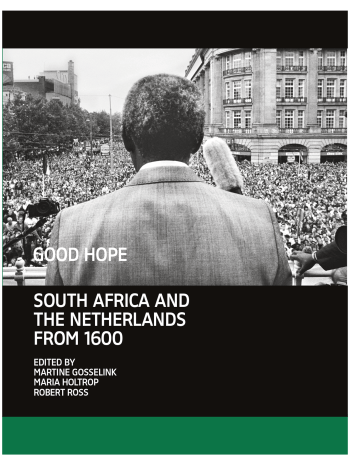 Robert Jacob Gordon’s landscape panoramas, several metres long, occupy a prominent place in the exhibition. This Dutch traveller illustrated 18th-century South Africa, giving the country an identity. The imposing portraits of children born after 1994—when apartheid was abolished—by the South African photographer Pieter Hugo illustrate South Africa’s future. Along with the exhibition, the NTR (Dutch public-service broadcaster) will be broadcasting a seven-part TV series presented by Hans Goedkoop. The exhibition is produced under the directions of Martine Gosselink, Head of the History Department at the Rijksmuseum.
“The Good Hope exhibition illustrates a significant aspect of Dutch colonial history in all its nuances—a tale that is both painful and striking, but more especially disturbing and recognisable.”
–Adriaan van Dis, Dutch writer, Africa specialist, and the exhibition’s narrator
Symposium—Good Hope for a New Generation: Reflections on Diversity and Change in South Africa and the Netherlands, 5 April 2017
The aim of this symposium is for the Dutch and South Africans to learn from each other in building an open and diverse nation where talents can develop. For this symposium, two South African speakers are invited to reflect on the past and especially on the future of the new generation.
Martine Gosselink, Maria Holtrop, and Robert Ross, eds., Good Hope: South Africa and the Netherlands from 1600 (Amsterdam: Rijksmuseum, 2017), 376 pages, ISBN: 978 94600 43130, €35.
A richly illustrated book accompanies the exhibition, containing 56 contributions from 26 authors from the fields of literature, language, art history, archaeology, politics, and journalism.
Exhibition | Splendour! Art in Living Craftsmanship
Now on at The Georgian Group:
Splendour! Art in Living Craftsmanship
The Georgian Group, Fitzroy Square, 2-25 February 2017
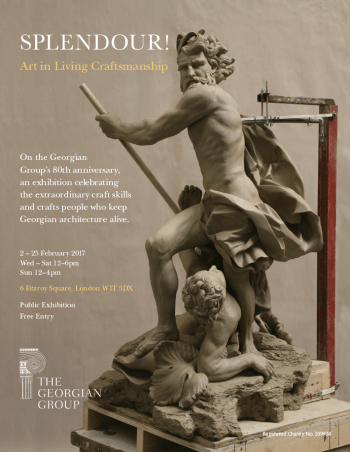 In February 2017 the Georgian Group opens its Fitzroy Square townhouse for an exhibition celebrating 80 years of conservation work by the charity. Splendour! promises to transport the visitor into a world of craftsmanship, beauty, and design. Gathering together an eclectic selection of traditional ‘Georgian’ arts and crafts practiced in the 21st century, objects range from silk wallpaper and chandeliers to carved stone sculpture and ceiling designs. Work by the most promising recent graduates features alongside the most experienced practitioners in the UK; this is an exhibition that displays talent from across the spectrum of British craftsmanship. History, architecture, art, and design come together with exciting relevance to craft today.
Details of our Tuesday talk series, Saturday demonstrations by leading practitioners, and our interactive Sunday workshops are available at The Georgian Group website.
Exhibition | In the Name of the Lily: French Printmaking
Press release for the exhibition now on view in Bremen:
In the Name of the Lily: French Printmaking in the Age of Louis XIV
Im Zeichen der Lilie: Französische Druckgraphik zur Zeit Ludwigs XIV
Kunsthalle Bremen, 1 February — 28 May 2017

Pierre Drevet after Hyacinthe Rigaud, Portrait of Louis XIV, 1714/15, 39 × 52 cm (Kunsthalle Bremen).
This exhibition presents outstanding French prints from 1650 to 1715, an era in which the magnificence of Absolutism reached its climax. During the reign of Louis XIV, a principal task of the fine arts was to spread the glory and splendour of the Sun King as a statesman, general, and patron far beyond the borders of his own country. Prints were especially suited to this purpose. They were easy to transport; they could be produced in great numbers; they were sold individually or sumptuously bound together; and they could unequivocally serve political aspirations. Engravings after paintings in the King’s collections, views of his palaces, and images of his military victories advanced them to highly respected prestige objects.
In 1660, Louis XIV freed engravers from the restrictions of the guild system and elevated them to the rank of free artists. In 1663 they were allowed to enter the Royal Academy, which provided standardized training and thereby ensured an extraordinarily high level of technical skills. The precision and inventiveness of engravers such as Gérard Edelinck, Robert Nanteuil, Pierre Drevet, and Jean Audran—who used subtle graduated tonality, sophisticated lighting, and elaborately worked surfaces—contributed significantly to the formation of a French style that set the standard for later printmaking.
The engraver Anton Würth (b. 1957), who has explored the aesthetic quality of 17th-century French engravings in depth, has been invited to make a guest contribution.
Only a few minutes’ walk away from Bremen’s central market square, the Kunsthalle Bremen’s building has stood in the Wall gardens for over 150 years. The gallery’s private owner is to this day is the Kunstverein in Bremen (the Bremen Art Association), founded by the citizens of Bremen in 1823, making it one of the oldest art associations in Germany. With more than 9,000 members, it counts today one of the strongest memberships in the Federal Republic of Germany. As the city’s most distinguished art and cultural institution, its impact extends far beyond the region. Generous endowments, private donations, bequests by friends of the arts and allocations from the City of Bremen municipality form the basis for the gallery’s successful pursuit of its historic activity. Over the centuries, a rich and diverse collection has been assembled, containing outstanding paintings and sculptures as well as precious holdings of graphic art.
◊ ◊ ◊ ◊ ◊
Christien Melzer and Anton Würth, Im Zeichen der Lilie: Französische Druckgraphik zur Zeit Ludwigs XIV (Bremen: Kunstverein Bremen, 2017), 96 pages, ISBN: 978-3935127332.
 Der französische Kupferstich erlebte zwischen 1650 und 1715 eine besondere Blüte. Ausstellung und Katalog Im Zeichen der Lilie. Französische Druckgraphik zur Zeit Ludwigs XIV. stellen vom 1. Februar bis 28. Mai 2017 erstmals in der Kunsthalle Bremen eine Auswahl von rund 70 Kupferstichen und Radierungen von 25 Künstlern des Barock vor. Die Zeitspanne umfasst in etwa die Regierungszeit des französischen Sonnenkönigs, Ludwig XIV., der alle Künste der Staatsräson unterordnete. In der Druckgraphik erkannte er ein Massenmedium par excellence, um seinen Ruhm über die Grenzen Frankreichs hinaus zu verbreiten und seine Macht zu festigen. Zahlreiche, teils monumentale Kupferstiche in ausgezeichneter Qualität und hervorragender Erhaltung spiegeln die Machtentfaltung des französischen Monarchen. Auf höchstem technischem Niveau zeigen sie die Besitztümer des Königs, seien es Gemälde, Tapisserien, Fresken oder Gebäude. Dramatische Schlachtenbilder illustrieren die militärischen Erfolge des Königs, brillante Porträts hn unterordnete. In der Druckgraphik erkannte er ein Massenmedium par excellence, um seinen Ruhm über die Grenzen Frankreichs hinaus zu verbreiten und seine Macht zu festigen. Zahlreiche, teils monumentale Kupferstiche in ausgezeichneter Qualität und hervorragender Erhaltung spiegeln die Machtentfaltung des französischen Monarchen. Auf höchstem technischem Niveau zeigen sie die Besitztümer des Königs, seien es Gemälde, Tapisserien, Fresken oder Gebäude. Dramatische Schlachtenbilder illustrieren die militärischen Erfolge des Königs, brillante Porträts halten die Subjekte seines Staatswesens für die Ewigkeit fest, prachtvolle Allegorien führen seine Tugenden vor Augen. Die präzisen und zugleich höchst sinnlichen Stiche von Gérard Edelinck, Robert Nanteuil, Pierre Drevet oder Jean Audran zeichnen sich durch subtil abgestufte Tonalitäten, eine raffinierte Lichtregie und differenziert ausgearbeitete Oberflächen aus und etablierten einen genuin französischen Stil, der geschmacksbildend für ganz Europa werden sollte.
Exhibition | Clouds in a Bag
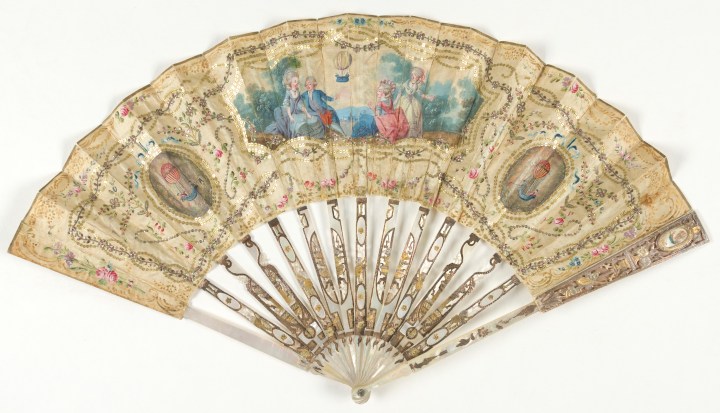
Late eighteenth-century fan showing three images of the first hydrogen balloon, flown by J. A. C. Charles and M. N. Robert in 1783. The sticks are carved Mother of Pearl (Evelyn Way Kendall Collection, National Air and Space Museum, Smithsonian Institution, WEB14851-2015).
◊ ◊ ◊ ◊ ◊
Press release (24 January 2017) from the National Air and Space Museum:
Clouds in a Bag: The Evelyn Way Kendall Ballooning and Early Aviation Collection
The Udvar-Hazy Center, Smithsonian National Air and Space Museum, Chantilly, Virginia, 28 January 2017 — 2018
Curated by Tom Crouch
The Smithsonian’s National Air and Space Museum opened the exhibition Clouds in a Bag: The Evelyn Way Kendall Ballooning and Early Aviation Collection on January 28 at the Steven F. Udvar-Hazy Center, in Chantilly, Virgnia. This is the first time these early aviation artifacts are on public display since the Smithsonian acquired the collection in 2014.
When the first balloon rose over the rooftops of Paris in the late 18th century, enormous crowds gathered to watch. This phenomenon spurred a new age of aeronauts dreaming of what else could fly. The excitement of this achievement was captured much like it would be today—in artwork and on memorabilia. Objects such as decorative fans, china, snuff boxes, and prints will be on display. Clouds in a Bag explores the fascination of the first balloon flights through these pieces.
“The invention of the balloon struck the men and women of the late 18th century like a thunderbolt,” said Tom Crouch, senior curator of aeronautics at the National Air and Space Museum. “After centuries of dreaming, we were airborne at last! Visitors to the exhibition will be able to share some of the excitement experienced by those who watched the first aerial travelers rise into the sky.”
The exhibition includes 51 prints, paintings and drawings, and 35 examples of 18th- and 19th-century memorabilia. This is a small portion of the collection of over 1,000 pieces in the Evelyn Way Kendall Ballooning and Early Aviation Collection, donated to the museum by the Norfolk Charitable Trust in 2014. The Norfolk Charitable Trust also supported the processing, conservation, and exhibition of the collection. Clouds in a Bag will be open through 2018.
The National Air and Space Museum building on the National Mall in Washington, D.C., is located at Sixth Street and Independence Avenue S.W. The museum’s Steven F. Udvar-Hazy Center is located in Chantilly, Virgnia, near Washington Dulles International Airport. Attendance at both buildings combined was 9 million in 2016, making it the most-visited museum in America.
Display | Batoni, the Rezzonico Family, and Occasional Portraiture
This new acquisition is now on view at the Palazzo Barberini:
The Painter and the Great Lord: Batoni, the Rezzonico Family, and Occasional Portraiture
Il pittore e il gran signore: Batoni, i Rezzonico e il ritratto d’occasione
Palazzo Barberini, Rome, 11 January — 23 April 2017

Pompeo Batoni, Portrait of Abbondio Rezzonico, Palazzo Barberini, 1766.
Prince Abbondio Rezzonico returns to Rome. In 2016 the Italian state acquired from the heirs of the Rezzonico family the striking portrait of the Senator of Rome, painted by Pompeo Batoni in 1766 on the occasion of his triumphal entry to Palazzo Senatorio on the Capitol. Abbondio Rezzonico (1742–1810), a member of a noble Venetian family and nephew of Pope Clement XIII, was appointed in 1765 to the rank of Senator—one of the most important magistracies in the city’s government. The portrait, commissioned from Pompeo Batoni (1708–1787), was celebrates this solemn occasion. The canvas will be displayed with a small group of other works illustrating the social context of the painting as well as the artist’s output. Visitors will be able to compare two portraits of Pope Clement XIII Rezzonico, one by Batoni and the other splendidly painted by his talented rival, Anton Raphael Mengs. The latter work is on loan from the Pinacoteca Nazionale of Bologna. Together with these two portraits there will be other works from the National Gallery’s collection of eighteenth-century paintings, not always on display. They include the elegant portraits of Count Soderini and Sir Henry Peirse by Batoni and the exceptional portrait of the Governor Robert Clive by Anton von Maron.
Display | Gifts for a Jacobite Prince: A Highlight Tour

Backsword made by Charles Frederick Kandler of London, 1740–41, presented to Bonnie Prince Charlie by James, 3rd Duke of Perth
(National Museums Scotland)
◊ ◊ ◊ ◊ ◊
On view in Perth (Scotland), from National Museums Scotland, with thanks to Elizabeth Jane Timms for noting it:
Gifts for a Jacobite Prince: A Highlight Tour
Perth Museum art Art Gallery, 25 October 2016 — 25 February 2017
Inverness Museum and Art Gallery, 7 March – 21 May 2017
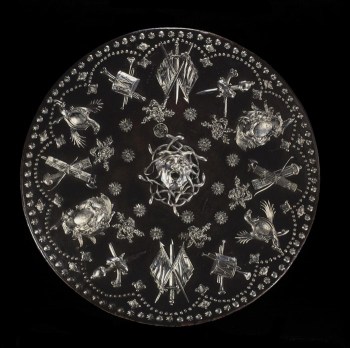
Dress targe presented to Prince Charles Edward Stuart by James, 3rd Duke of Perth (National Museums Scotland).
Touring in advance of the opening of the exhibition Bonnie Prince Charlie and the Jacobites at the National Museum of Scotland [23 June — 12 November 2017], the sword and the targe, or Highland shield, were probably gifted to Prince Charles Edward Stuart, better known as Bonnie Prince Charlie, by James, 3rd Duke of Perth, a committed supporter of the Jacobite cause. The son of James VIII and III, the exiled claimant to the thrones of Scotland, England and Ireland, Charles arrived in Scotland in the summer of 1745 intent on raising an army to regain the crown for this father. Others rallied by his side, culminating in the Battle of Culloden where the Jacobites suffered a crushing defeat.
Not weapons of war, but instead symbols of power and status, the sword and targe were discovered after the battle. The targe was recovered by a Jacobite clan chief, while tradition states that the sword was found by government troops and presented to their Commander, the Duke of Cumberland. This is just one of the fascinating stories to feature in the major exhibition Bonnie Prince Charlie and the Jacobites, opening at the National Museum of Scotland on 23 June 2017.
Display | Two Busts by Rysbrack
From the DIA press release (19 January 2017). . .
Two Busts of John Barnard by John Michael Rysbrack
Detroit Institute of Arts, January 2017 — Summer 2018
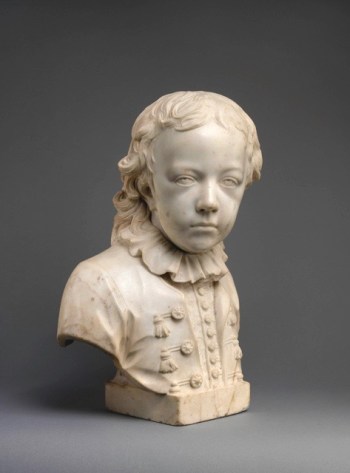
John Michael Rysbrack, Portrait of John Barnard, 1744, marble (New York: The Metropolitan Museum of Art, 1976.330).
The Detroit Institute of Arts welcomes two new ‘guests of honor’: a terracotta model and a marble bust of a young boy, John Barnard, by John Michael Rysbrack. The model is on loan from a private collector and the bust is on loan from The Metropolitan Museum of Art, New York. Shown together for the first time, these immaculately preserved portraits provide a rare glimpse of Rysbrack’s creative process. The sculptures, both of which the artist signed and dated, showcase both Rysbrack’s mastery of modeling terracotta and his exceptional skill as a marble carver. They will be on view through summer 2018.
Born and trained in Antwerp, Rysbrack moved to London in 1720 and quickly became one of the leading sculptors working in 18th-century England. Along with his fellow expatriate sculptor Louis François Roubiliac, whose arresting bust of the architect Isaac Ware stands as a major highlight of the DIA’s British portrait collection, Rysbrack was instrumental in elevating the popularity of the sculpted portrait bust above that of more conventional painted portraits in England.
While Rysbrack was highly sought after for his psychologically dynamic portraits, only a handful of his surviving works represent children. On the back of the marble bust, Rysbrack inscribed the name of his young sitter, John Barnard, the son of a British clergyman. The boy is fashionably outfitted in a Hussar’s costume, the uniform of a Hungarian cavalryman. Deriving from England’s sympathy for Hungary and Vienna during the War of the Austrian Succession (1740–48), the fad for the Hussar’s uniform appeared often throughout the 1740s in portraits of children and adults alike.
The livelier expression on the boy’s face in the hand-modeled terracotta contrasts with his graver yet youthful appearance in the marble, suggesting that the portrait was intended as a posthumous tribute to a child who died at a young age. Viewing the Metropolitan Museum’s marble bust alongside its corresponding terracotta model presents a unique opportunity to appreciate Rysbrack’s ability to transform keen observation of youthful vitality into an enduring memorial portrait. The two works are on display in the third floor British portrait gallery.
Display | The First Inauguration
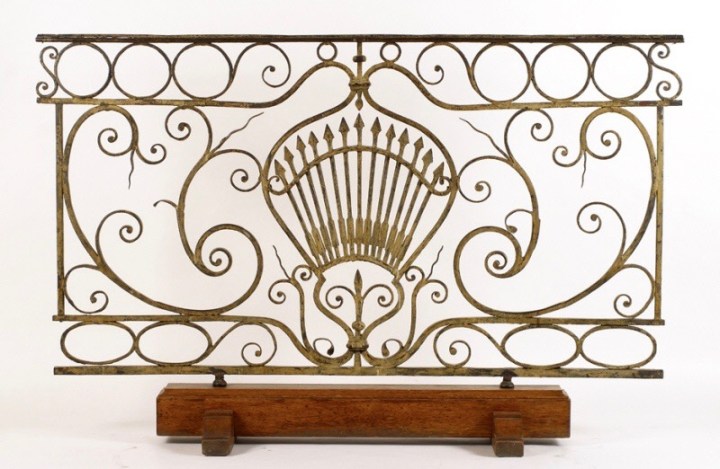
Balustrade Section from Federal Hall, New York, 1788–89, painted wrought iron, 95 × 178 × 4 cm (New York Historical Society, 1884.3). More information is available here»
◊ ◊ ◊ ◊ ◊
This installation is part of The Presidency Project at the New-York Historical Society:
The First Inauguration: George Washington’s 1789 Ceremony at Federal Hall
New-York Historical Society, 9 January — 26 February 2017
On April 30, 1789, George Washington was sworn in as president of the United States on the balcony of Federal Hall in lower Manhattan, uttering for the first time the words that every succeeding president would recite: “I do solemnly swear that I will faithfully execute the Office of President of the United States, and will to the best of my ability, preserve, protect, and defend the Constitution of the United States.” To mark the 2017 inauguration and as part of the The Presidency Project, the New-York Historical Society presents artifacts and documents linked to the nation’s first presidential inauguration. At its center, the installation showcases an original section of the wrought-iron railing from Federal Hall, a municipal building that was transformed by French architect Pierre-Charles L’Enfant into a suitable headquarters for the national government. L’Enfant adorned the facade with classical and patriotic motifs, including the railing’s thirteen arrows—one for each state in the republic.
This special installation also features an armchair used by George Washington in the Senate chamber of Federal Hall just after his swearing in. The storied armchair, designed in the latest neoclassical fashion, was later used for the inaugurations of Ulysses S. Grant and James A. Garfield. A printed broadside of Washington’s inaugural address is also on view.










leave a comment