Exhibition | Italian Landscape of the Romantic Era

Ferdinand Oehme, Villa d’Este in Tivoli, detail, 1833
(Dresden: Albertinum, Galerie Neue Meister)
◊ ◊ ◊ ◊ ◊
From the Staatliche Kunstsammlungen Dresden:
Italian Landscape of the Romantic Era: Painting and Literature
Italienische Landschaft der Romantik: Malerei und Literatur
Neues Schloss, Bad Muskau, 11 May — 21 August 2016
The whole sky was covered with a whitish haze of cloud, through which the sun, without its form being distinguishable, gleamed over the sea, which displayed the most beautiful sky blue hue that one ever could see. –Johann Wolfgang von Goethe, 1787
Tivoli and the Roman Campagna, Capri and the Bay of Naples, majestic silhouettes of lofty mountains, glittering expanses of sea, dignified ancient architecture and Mediterranean flora: il bel paese (‘the beautiful country’) as seen by writers and artists, is at the focus of this special exhibition.
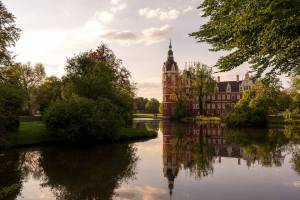
Neues Schloss in Bad Muskau (Photo by David Pinzer)
In the late 18th and early 19th centuries travelers to Italy increasingly focused on the perception of nature. Their encounters with southern climes promised a substantial impetus for artistic development and regeneration. Hence, the Italian landscape became a new ideal for landscape gardens which spread more or less simultaneously from England over the whole continent of Europe. One of the most important protagonists of this movement in Germany was Prince Hermann von Pückler-Muskau (1785–1871), whose park and castle in Bad Muskau are an ideal venue for the exhibition. His landscape park, which was begun in 1815, is now one of the most beautiful in Europe and has been a UNESCO World Heritage site since 2004. Indeed, the park itself was originally conceived as a kind of museum: “A park must be like an art gallery: every few steps you should see a new picture” (Pückler-Muskau).
The special exhibition in the New Castle (Neues Schloss) features more than 20 masterpieces—landscapes full of light by painters such as Jakob Philipp Hackert, Ludwig Richter, Ernst Ferdinand Oehme, Carl Rottmann, and Carl Blechen. All these paintings reflect the poetry of nature, the rich colours, and forms found in the south. Most of them are usually housed in the Dresden Albertinum and are among the highlights of the Galerie Neue Meister; thanks to the restoration of several paintings from the store room, their original radiance has been revitalized.
Selected writings by contemporary authors who also traveled around Italy—Johann Wolfgang von Goethe, Johann Gottfried Seume, Madame de Staël, and Wilhelm Waiblinger—enable the Italian landscape to be experienced in a combination of genres. The most important starting point for such painted and written projections of this land of longing, Goethe’s Italian Journey was first published in installments in 1816, and so the year 2016 marks the 200th anniversary of its publication. It initiated a period of German fascination for the “land where the lemon trees bloom” (Goethe), a fascination which—with few exceptions and several interruptions—extended into broad social circles and whose effect is still felt today.
Exhibition | Elegance and Intrigue: French Society in Prints and Drawings

Charles Thévenin, The Storming of the Bastille, 14 July 1789, etching, 1790, sheet: 41.6 × 58.5 cm
(The Cleveland Museum of Art, 2015.21)
◊ ◊ ◊ ◊ ◊
From the The Cleveland Museum of Art:
Elegance and Intrigue: French Society in 18th-Century Prints and Drawings
The Cleveland Museum of Art, 16 July — 6 November, 2016
Curated by James Wehn
Sumptuous designs, classical tales, political zeal, and erotic rendezvous pervade this selection of more than ninety prints, drawings, and decorative objects from the final decades of the ancien régime through the French Revolution and the early years of Napoleon’s empire.
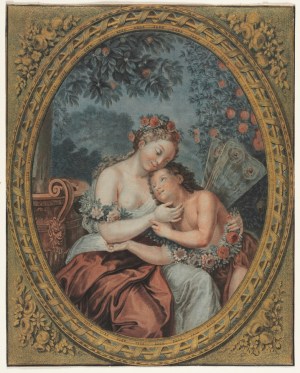
Jean François Janinet, after Antoine Coypel, Zephyre and Flore, ca. 1776, color wash-manner etching and engraving with applied gold leaf; 33.3 × 26.5 cm (The Cleveland Museum of Art, 1987.91)
In celebration of the CMA’s centennial year, Elegance and Intrigue: French Society in 18th-Century Prints and Drawings showcases works from the museum’s collection, including a rare impression of Jean-Antoine Watteau’s etching The Clothes Are Italian, several prints and drawings by court favorite François Boucher, and Jean-Honoré Fragonard’s ravishing drawing Invocation to Love.
At the heart of the exhibition is a selection of color etchings and engravings meticulously crafted to imitate chalk and gouache drawings, a trend in elite home décor at the time. Charles Thévenin’s expressive etching The Storming of the Bastille captures a sense of revolutionary spirit, while Juste-Aurèle Meissonnier’s Tureen, a quintessential masterpiece of silverwork fashioned for the English duke of Kingston, is displayed alongside Gabriel Huquier’s etching featuring two views of the tureen set in a lavish rococo interior.
James Wehn’s extended description of the exhibition is available here.
Exhibition | A Civic Utopia: France 1760–1840
The display is part of Somerset House’s larger celebration Utopia 2016: A Year of Imagination and Possibility, marking the 500th anniversary of the publication of Thomas More’s inspirational text, Utopia—with a varied and vibrant programme of special events, exhibitions, new commissions, and activities across the entire site, spanning the realms of art, literature, society, fashion, design, architecture, theatre, and film.
A Civic Utopia: France 1760–1840
The Courtauld Institute of Art, London, 8 October 2016 — 8 January 2017
Curated by Nicholas Olsberg
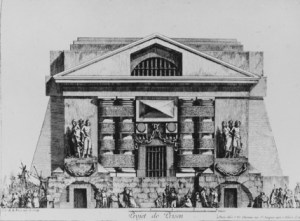
Jean Charles Delafosse, Project for a Prison (exterior view, rear), 18th century (London: Courtauld Institute of Art)
A Civic Utopia: France 1760–1840 examines the place of architecture in establishing the notion of public life. Bringing together a number of drawings of public buildings and spaces from the late Ancien Régime through to the early years of King Louis-Philippe in France, the display explores the idea of a ‘scientific’ city, in which rational and symbolic expressions of civic life established a pattern for the improvement of society. If Utopia is defined as the imagining of a comprehensive ideal system or pattern of civil organisation, then we can see this French vision as utopian, in which public places and buildings function to encourage the moral character of society.
Exhibition | Versailles and the American Revolution
Now on view at Versailles:
Versailles and the American Revolution / Versailles et l’Indépendance Américaine
Château de Versailles, 5 July — 17 October 2016
Curated by Valérie Bajou
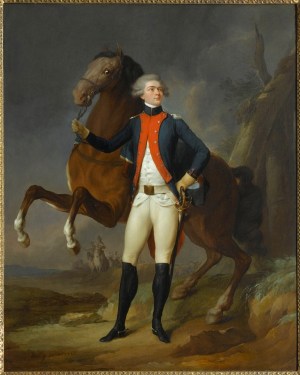
Louis-Léopold Boilly, Portrait de La Fayette, 1788 (RMN-Grand Palais / Château de Versailles)
From 5 July to 2 October 2016, on the occasion of the 240th anniversary of the Declaration of Independence, the Palace of Versailles dedicates an exhibition highlighting the war during which the fate of three countries met: the United States, the United Kingdom, and France.
As the first country to recognise the United State of America as a new nation, it was France’s duty to commemorate the event, especially at Versailles where this decision was taken, where the War of Independence was supported, and where the peace treaty with England was signed in 1783. The exhibition aims to remind viewers of facts that are often forgotten but which bear testimony to the circumstances, scale, and consequences of France’s involvement in the war.
The exhibition recounts the events and highlights the context of French and English rivalry after the Seven Years’ War as well as internal divisions in the French side, the American side between ‘patriots’ and ‘loyalists’, and the English side due to some opposition to the way the settlers were treated. It recounts the decision-making process at Versailles, the personalities of key figures—notably Benjamin Franklin—and the exact locations in the palace where discussions were held. Finally, it explains the international spread of the fighting—from India across the Mediterranean Sea, to the shores of America—and the human losses due to the violence and scale of the battles, the largest of both the 18th and 19th centuries.
The War of Independence has been interpreted by artists from all three countries; so iconic works seen for the first time outside the USA will illustrate the exhibition’s discourse. The generosity of the loans granted must also be stressed, a key example being the Diamond Eagle of George Washington from the Society of the Cincinnati.
The exhibition is the result of scientific collaboration with researchers from American museums and universities, the Congress, and the Society of the Cincinnati, as well as French, Spanish, and English historians. It aims to present different points of view in order to avoid presenting a perspective of the events which is too narrow.
The exhibition will be held in an unusual location, the Battles Gallery, near The Battle of Yorktown, which represents the deciding battle of 1781. Commissioned in 1835 by Louis-Philippe, a year after the death of Lafayette, this commemorative painting indicates that the memory of the war and the sacrifices made had not been forgotten but were kept alive on the other side of the Atlantic like a debt of blood, also explaining the fervour in the famous expression of 1917: “Lafayette, here we are!”
Valerie Bajou : Curator in chief at the national museum of the Palaces of Versailles and Trianon
Scenographer : Loretta Gaïtis
A symposium opened the exhibition on July 5; the programme is available as a PDF file here.
◊ ◊ ◊ ◊ ◊
The catalogue is available from ACC Distribution:
Valérie Bajou, ed., Versailles and the American Revolution (Montreuil: Gourcuff Gradenigo, 2016), 208 pages, ISBN: 978-2353402465, £35 / $40.
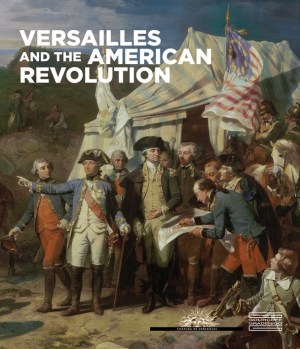 Published to accompany an exhibition at the Palace of Versailles, this catalogue is a collective work bringing together contributions from French, American, and British specialists in this field, which together shed light on the importance of the relationship between France and America in the closing years of the Ancien Régime. During the reign of Louis XVI, the Palace of Versailles—the seat of power and government in France—played a crucial role in the history of America, in its struggle for independence, and in the recognition of the United States by the great European powers. In tracing this remarkable story, the catalogue demonstrates the constant interest displayed in the fledgling United States by the French monarchy.
Richly illustrated throughout, it documents the events of the War of Independence, before exploring the consequences of the entry of France into the war, the siege of Yorktown, and the peace treaty signed at Versailles in 1783. Finally, it analyses the origins and development of the mythology of the ‘American Revolution’ in both France and the United States, a source of enduring inspiration for artists and history painters.
Display | Drawn to Sicily: Early British Exploration
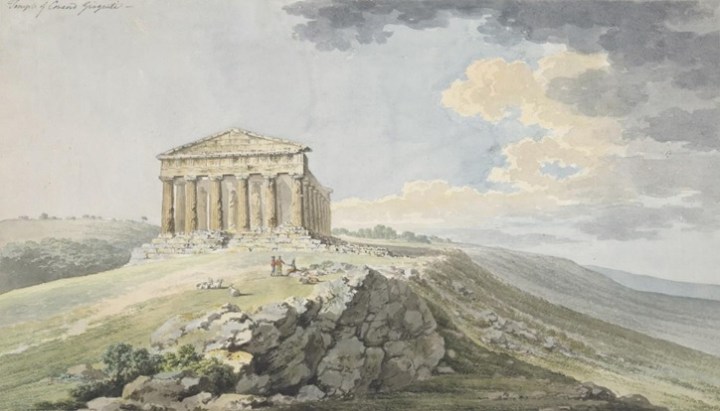
Charles Gore, View of the Temple of Concord at Agrigento, 1777, watercolour over graphite, with some pen and ink
(London: The British Museum)
◊ ◊ ◊ ◊ ◊
Closing this week at The British Museum:
Drawn to Sicily: Early British Exploration of the Classical World
The British Museum, London, Late April — 14 July 2016
In the 18th century, Sicily was a Grand Tour destination only for the intrepid few, an optional extension to the more conventional tour that focused on Rome, Florence, Venice, and Naples. Travel on the rural, rugged island was challenging and many parts were inaccessible. Furthermore, the countryside could be dangerous, as groups of bandits preyed on travelers. Yet those with a specific interest in ancient art and architecture went to admire and study first-hand the remains of the majestic Greek temples.
The presence of European diplomats at the court of the Kingdom of the Two Sicilies in Naples made access to, and travel in, Sicily somewhat easier. Diplomats could provide travel passes—such as one which was issued to Charles Townley (1737–1805) and displayed in this show—as well as letters of introduction to the cultured élite in the main cities: Palermo, Catania, and Syracuse. A travel pass could ensure lodging when presented, as English visitors were well-respected. This display illustrates four expeditions undertaken by some of Britain’s best-known Grand Tourists and renowned architects.
Exhibition | The Ince Blundell Collection of Classical Sculpture

Pantheon interior Blundell Hall
◊ ◊ ◊ ◊ ◊
Now on view at The Atkinson:
Pantheon: Roman Art Treasures from the Ince Blundell Collection
The Atkinson, Southport, 11 June 2016 — 12 March 2017
At the end of the eighteenth century local landowner Henry Blundell (1724–1810) of Ince Blundell Hall amassed a spectacular collection of antique sculpture to rival that of the British Museum. Housed in a scaled-down replica of the Pantheon at Rome, the collection included highly characterful Roman portraits, classical subjects, and elaborate funerary sculpture. The collection has remained virtually intact and this exhibition brings together many of its highlights. The story of Henry Blundell’s creation of the collection and the magnificent setting in which he housed it is a fascinating one and brings to life a powerful and driven personality who played a major role in the art market of the time.
◊ ◊ ◊ ◊ ◊
And due out in October from Liverpool University Press:
Elizabeth Bartman, The Ince Blundell Collection of Classical Sculpture (Liverpool: Liverpool University Press, 2016), 272 pages, ISBN: 978-1781383100, £75 / $125.
This book investigates the important antiquities collection formed by Henry Blundell (1724–1810) of Ince Blundell Hall outside Liverpool in the late eighteenth century. Consisting of more than 500 ancient marbles—the UK’s largest collection of Roman sculptures after that of the British Museum—the collection was assembled primarily in Italy during Blundell’s various ‘Grand Tour’ visits. As ancient statues were the preeminent souvenirs of the Grand Tour, Blundell had strong competition from other collectors, both British nobility and European aristocrats, monarchs, and the Pope. His statues represent a typical cross-section of sculptures that would have decorated ancient Roman houses, villas, public spaces, and even tombs, although their precise origins are largely unknown. Most are likely to have come from Rome and at least one was found at Hadrian’s Villa at Tivoli.
Although most of the works are likely to have been broken when found, in keeping with the taste of the period they were almost all restored. Because of their extensive reworking, the statues are today not simply archaeological specimens but rather, artistic palimpsests that are as much a product of the eighteenth century as of antiquity. Through them we can learn what antiquarians and collectors of the eighteenth century—a key period in the development of scientific archaeology as a discipline—thought about antiquity. Steeped in the work of such writers as Alexander Pope, an educated Englishman like Blundell sought a visual expression of a lost past. Restoration played a major role in creating that visual expression, and the book pays close attention to the aims and methods by which the Ince restorations advanced an eighteenth-century vision of the ‘classical’. The image of antiquity formed at this time has continued to exert a profound effect on how we see these pieces today. The book will be the first to examine the ideal sculpture of Ince Blundell Hall in nearly a century. In so doing it aims to rehabilitate the reputations of a collector and collection that have largely been been ignored by both art-lovers and scholars in post-war Britain.
Elizabeth Bartman was President of the Archaeological Institute of America between 2011 and 2014 and is a Fellow of the Society of Antiquaries, London, as well as a Fellow of the American Academy in Rome. Elizabeth is also a Paul Mellon Visiting Senior Fellow at the Center for the Advanced Study of the Visual Arts, National Gallery of Art, Washington, DC and a Corresponding Member for the Deutsches Archäologisches Institut.
Display | Jacques-Louis David’s ‘Napoleon’
Now on view at AIC:
Jacques-Louis David’s Napoleon
Art Institute of Chicago, 28 May — 9 October 2016

Jacques-Louis David, The Emperor Napoleon in His Study at the Tuileries, 1812 (Washington, D.C.: National Gallery of Art)
The dominant French painter of the late 18th and early 19th century, Jacques-Louis David responded with brilliant artistry to the extraordinary events unfolding during the French Revolution and its aftermath. With his painting The Emperor Napoleon in His Study at the Tuileries, David created the quintessential image of the legendary leader as a figure of deliberation and action. At the time, Napoleon’s empire was at its height—he had not yet led his army on the disastrous invasion of Russia—and David himself had referred to Napoleon as “the man of the century.” For his painting of this exalted figure, David drew on the tradition of the state portrait, a full-length standing representation that had served as the public image of a ruler since the Renaissance, but he brought new life to the conventional type by placing Napoleon in the foreground and framing him with details that tell a story. David described that story in this way: “Having passed the night composing his Napoleonic code, [the emperor] only realizes that it is dawn from the guttering candles that are about to go out. The clock has just struck four in the morning. With that, he rises from his desk to strap on his sword and review his troops.”
The loan of this great painting from the National Gallery of Art, Washington, D.C., provides occasion to highlight related paintings, works on paper, and sculpture in the Art Institute’s own collection. Featured objects include a rarely exhibited sketchbook of studies for another renowned Napoleonic painting by David, The Distribution of the Eagle Standards, which records the ceremonial oath-taking of the generals and officers of the imperial army following Napoleon’s coronation in 1804. This original sketchbook is displayed near an interactive digital reconstruction that allows visitors to turn the book’s pages.
In addition to the NGA loan, the display includes Marie Denise Villers’s 1801 portrait of Charlotte du Val d’Ognes, on loan from The Met (though I’ve been unable to find any mention of it online). The digitized sketchbook is remarkable, but I’m not sure why it’s not also available through the AIC website. –CH
◊ ◊ ◊ ◊ ◊
Lecture | Napoleon, and the Legacy of the Storming of the Bastille
Fullerton Hall, Art Institute of Chicago, 14 July 2016, 2:00pm
In honor of Bastille Day, this lecture interweaves a discussion of Jacques-Louis David’s Napoleon with the history of the Bastille as event, monument, and symbol. Registration required—register today!
Exhibition | The White Dress
Press release (25 May) from the NGC:
Masterpiece in Focus: The White Dress
National Gallery of Canada, Ottawa, 27 May — 25 September 2016
Curated by Erika Dolphin
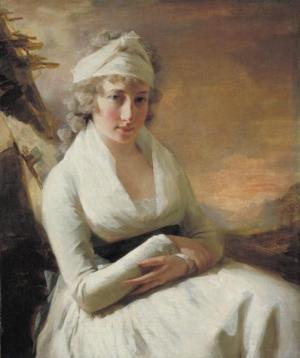
Henry Raeburn, Jacobina Copland, ca. 1794–98, oil on canvas, 76.2 × 63.5 cm. (Ottawa: National Gallery of Canada)
The National Gallery of Canada presents, as part of its Masterpiece in Focus program, The White Dress, an exhibition that highlights the evolution of the chemise dress and the drastic transformation in fashion around the turn of the nineteenth century. Complementing the Gallery’s major summer retrospective of Elisabeth Louise Vigée Le Brun (1755–1842), the portraitist to Marie Antoinette, The White Dress offers a rich exploration of the trends and artistic movements of the time. At the heart of this Masterpiece in Focus presentation are two portraits by Vigée Le Brun’s contemporaries: Scottish artist Henry Raeburn and French artist Anne-Louis Girodet. These magnificent works from the national collection—Jacobina Copland (ca. 1794–98), by Raeburn, and Madame Erneste Bioche de Misery (1807), by Girodet—can be seen alongside insightful drawings and illustrations, as well as stunning period dresses on loan from the Royal Ontario Museum and a private collector.
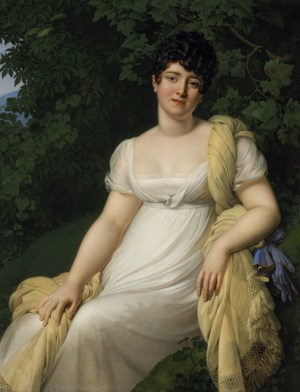
Anne-Louis Girodet, Madame Erneste Bioche de Misery, 1807, oil on canvas, 115.7 × 91.5 cm (Ottawa: National Gallery of Canada)
With the aid of a simple white dress, the exhibition unveils the world that portraitist Elisabeth Louise Vigée Le Brun and her sitters navigated at the turn of the eighteenth century. Although it may seem demure to contemporary eyes, Vigée Le Brun’s portrait of Marie Antoinette in a Chemise Dress caused a scandal when it was exhibited at the Paris salon in 1783. Royal etiquette required elaborate formal dress. The notorious portrait depicting France’s queen in a simple muslin garment was seen as immodest and had to be removed from view. But more than a breach of decorum, nearly a decade before the French Revolution of 1789, the painting can also be seen as announcing the end of formality, luxury and all that was synonymous with the monarchy.
At the time, court gowns, made of ornately embellished heavy brocades, required structural undergarments—panniers, hooped petticoats, and whalebone stays (an early form of the corset)—for support. It was a style designed to inspire respect for the French monarchy. Marie Antoinette’s preference for the chemise dress was deemed not only a breach of decorum, but an act of treason: court dress was largely a product of the French textile industry—especially the silk looms of Lyon, while the white muslin was a foreign import from India and Britain.
The Gallery’s website presents a time-lapse video of Dr. Anne Bissonnette, dress historian at the University of Alberta, preparing one of the eighteenth-century muslin dresses for the exhibition in the Gallery’s conservation lab.
Additional information and images are available from Sheila Singha’s article “A Scandal in Muslin: Marie Antoinette’s Little White Dress,” for NGC Magazine (24 May 2016).
Display | Regarding Trees
On view now at The Courtauld Gallery:
Regarding Trees
The Courtauld Gallery, London, 18 June — 25 September 2016
Curated by Rachel Sloan
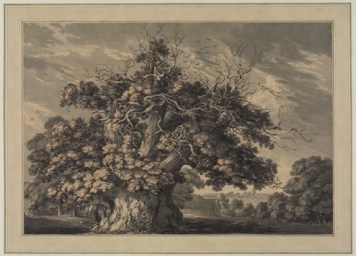
Thomas Hearne, The Chestnut Tree at Little Wymondley, Hertfordshire, 1789, watercolour (London: The Courtauld Gallery)
“It is no exaggerated praise to call a tree the grandest, and most beautiful of all the productions of the earth.” With these words, the artist and theorist William Gilpin (1724–1804) opened his influential treatise Remarks on Forest Scenery and other Woodland Views (1791).
For as long as artists have created landscapes, the tree has been an essential element of them. But, intriguingly, almost from the beginning, individual trees have been the subject of close study in their own right. In many cases they serve as a means for artists to develop their powers of observation and manual dexterity as well as a tool for constructing larger landscapes. Whether studied directly from nature or conjured from the artist’s imagination, whether loaded with poetic or political symbolism or addressed in a down-to-earth, factual manner, artists through the ages have treated trees with the same reverence and psychological insight as a portraitist would accord a sitter.
This display of drawings, drawn from The Courtauld Gallery’s collection, explores artists’ enduring fascination with the tree. Ranging from the early sixteenth to the mid nineteenth centuries and including works by Fra Bartolommeo, Jan van Goyen, Claude Lorrain and John Constable, among others, it takes the framework of Gilpin’s treatise as its starting point, moving from portraits of individual trees to depictions of trees within landscapes and concluding with a selection of forest scenes. Together, they offer an insight into some of the many roles trees have played over the centuries.
Exhibition | Chinamania: Walter McConnell
Contemporary art, engaging an iconic nineteenth-century interior, engaging perennially popular early eighteenth-century ceramics—opening next week at the Sackler:
Chinamania: Walter McConnell
Arthur M. Sackler Gallery, Washington, D.C., 9 July 2016 — 4 June 2017
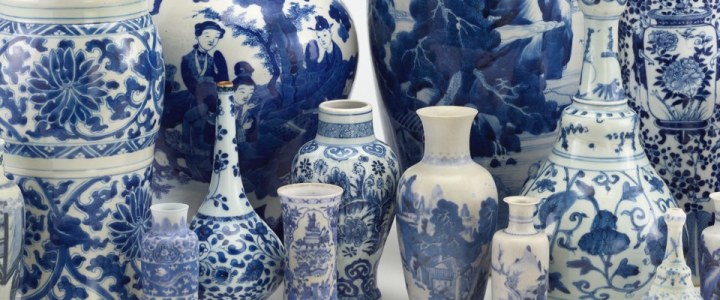
A mania for Chinese blue-and-white porcelain swept through London in the 1870s as a new generation of artists and collectors ‘rediscovered’ imported wares from Asia. Foremost among them was American expatriate artist James McNeill Whistler. For him, porcelain was a source of serious aesthetic inspiration. For British shoppers, however, Chinese ceramics signified status and good taste. Cultural commentators of the time both embraced and poked fun at the porcelain craze. Illustrator George du Maurier parodied the fad in a series of cartoons for Punch magazine that documented what he mockingly called “Chinamania.”
More than a hundred fifty years later, American artist Walter McConnell explores Chinamania in our own time. In this exhibition, he juxtaposes two monumental porcelain sculptures, which he terms stupas, with export wares from China’s Kangxi period (1662–1722). Those blue-and-white ceramics are similar to those that once filled the shelves of Whistler’s Peacock Room in London. These historical porcelains also inspired McConnell to create a new work based on 3D-printed replicas. His interest in replication and in the serialized mass production of ceramic forms began after he visited China more than a decade ago. The large kilns and busy factories at Jingdezhen prompted McConnell to look at China as an enduring resource for ceramic production.
Chinamania complements the exhibition Peacock Room REMIX: Darren Waterston’s Filthy Lucre, a contemporary installation that reimagines the Peacock Room as a resplendent ruin. Inspired by museum founder Charles Lang Freer’s collection of Asian ceramics, Waterston painted scores of vessels and arranged them on the buckling shelves of Filthy Lucre. These oozing, misshapen ceramics convey a sense of unsustainable luxury and excess. They also echo McConnell’s interest in the interplay of creativity, the mass production of aesthetic objects, and the powerful forces of materialism and conspicuous consumption.
◊ ◊ ◊ ◊ ◊
Summer Open House: Chinamania After-Hours Preview
Arthur M. Sackler Gallery, Washington, D.C., 8 July 2016
Free and open to the public
Join us for a special after-hours celebration of the opening of Chinamania, the third and final installation in the Peacock Room REMIX series. Explore the craze for Chinese porcelain that took the West by storm in the nineteenth century and discover the interplay between creativity and mass production. Chinese blue-and-white ceramics from the Freer|Sackler collection join monumental installations by contemporary sculptor Walter McConnell and 3D objects printed especially for this exhibition.
The open house will feature tours led by McConnell and curator Lee Glazer, music, photo booths, and hands-on activities such as customizable screen-printed tote bags and create-your-own stop motion animation, featuring decorative motifs inspired by Chinese blue-and-white porcelain.
Across the street from the Sackler, food will be available through the USDA Farmer’s Market at Night, which hosts over 20 of our city’s most popular local food trucks from 4:00 to 7:00pm. So come get a first look at Chinamania and enjoy a picnic on the National Mall.
Friday, July 8, 5:30pm, Arthur M. Sackler Gallery, 1050 Independence Ave. SW, Washington, D.C.










 Enfilade
leave a comment