Exhibition | Ecclesiastical Textiles from the Age of Maria Theresa
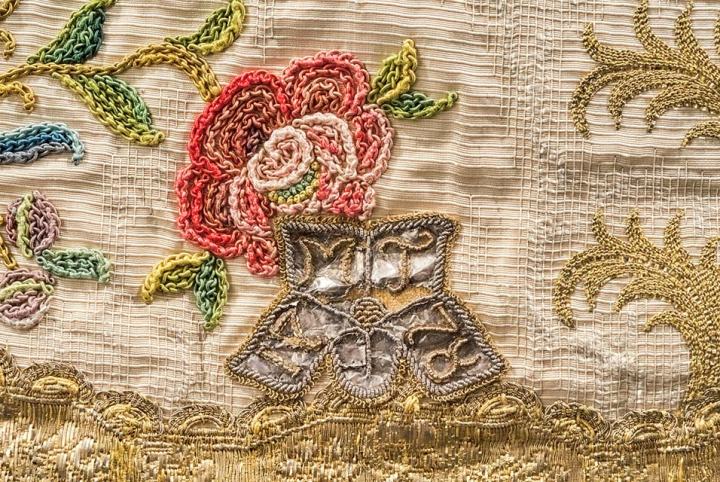
Blue Vestments: chasuble (detail), donated by Maria Theresia (1717–1780), produced in Vienna, 1778; h. 106 cm, w. 73 cm
(KHM-Museumsverband)
◊ ◊ ◊ ◊ ◊
Press release for the exhibition now on view at the Kaiserliche Schatzkammer Wien:
Praise of God: Ecclesiastical Textiles from the Age of Maria Theresia
Gottes Lob: Kirchliche Textilien aus der Zeit Maria Theresias
Imperial Treasury, Vienna, 4 May 2016 — 12 February 2017
The Ecclesiastical Treasury house’s important holdings of 18th-century liturgical vestments cannot be on permanent display for conservation reasons. The majority of these precious textiles were donated by Emperor Charles VI (1685–1740), his wife Elisabeth Christine (1691–1750) and their daughter Maria Theresia (1717–1780). At the time it was customary to use costly French or Italian fabrics, lavishly embellished with embroidery, for such vestments. Imperial robes were also occasionally reworked into such robes.
 The exhibition offers insights into the wealth and exceptional quality of the Imperial Treasury’s holdings of precious vestments, which reflect the Pietas Austriaca, the deep piety of the House of Habsburg. The museum has also included a selection of contemporary ecclesiastical garments produced after designs by the artists Christof Cremer and Stephan Hann. They document the high standard liturgical vestments are still expected to meet today as they continue to form a seminal part of the celebration of Mass. In connection with the exhibition, the museum has also decided to confront three modern copes produced after designs by Christof Cremer with historical vestments in a display installed in the so-called Paramentengang (vestment corridor) in the Ecclesiastical Treasury. This is the first time that contemporary art is displayed in the Treasury since it was newly installed and reopened in the 1980s.
The extensive holdings of the Ecclesiastical Treasury in Vienna are largely unknown to the general public; they comprise mainly vestments and liturgical textiles that were used to celebrate Mass or during religious festivities. Totalling around 1,700 artefacts, the collection includes both sets of vestments and individual textiles. Many of these precious garments were donated by members of the House of Habsburg who for centuries ruled the Holy Roman Empire. The pomp and circumstance associated with this high office is reflected in the costliness of these sumptuous textiles, the finest of which date from the Baroque, the apogee of Habsburg piety. Unlike medieval ecclesiastical textiles, baroque vestments generally feature not figurative but purely ornamental decorations. Precious secular silks adorned with a variety of designs frequently function as the base material, which is then elaborately embellished with appliqués, lace or gold-, silver- and silk embroidery to produce opulent textile works of art.
The leading benefactress in the 18th century was Maria Theresa (1717–1780). She donated precious textiles for use in the imperial palace chapel and the chapels of the different imperial summer residences at Schönbrunn, Laxenburg and Hetzendorf, as well as in St. Augustine’s church in Vienna. The latter evolved into a major stage for Habsburg piety. Here newly-appointed bishops were invested. All these places were lavishly appointed with sumptuous ecclesiastical textiles.
Contemporary sources clearly document the seminal role played by high-quality vestments during the Baroque. Many of these artefacts have been preserved in the Ecclesiastical Treasury because of their preciousness and the prominent benefactors who donated them. A selection is on show in this exhibition.
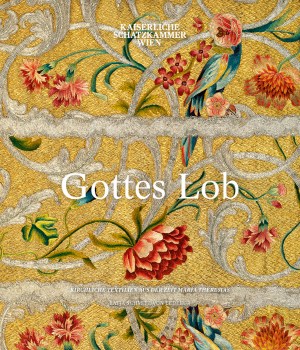
Katja Schmitz-von Ledebur, Gottes Lob: Kirchliche Textilien aus der Zeit Maria Theresias (Vienna, 2016), 96 pages, ISBN: 978-3990201145, €15.
Exhibition | Drawing or Design? Fine Art Versus Applied Art
Upcoming exhibition at the Wallraf-Richartz Museum:
Drawing or Design? Fine Art Versus Applied Art
Zwischen Disegno und Design? Von der Zeichnung zum Entwurf
Wallraf-Richartz Museum, Cologne, 2 September — 20 November 2016
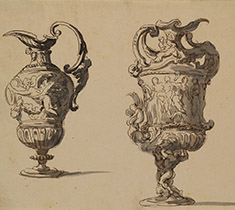 The Wallraf-Richartz Museum has recently been able to identify a set of more than twenty vase drawings in its collection as the work of Louis-Claude Vassé (1716–1772). As a Sculpteur du Roi (sculptor to the king), the artist enjoyed a considerable reputation in his lifetime, but today his name is familiar only to experts. The new attributions have prompted the Museum to devote an exhibition to the specific aesthetic properties of designs for works of decorative art. Such works are still categorised as distinct from fine art drawings, yet designs for applied art produced by French, German and Italian artists in the seventeenth and eighteenth centuries show that the distinction is spurious both in aesthetic terms and as regards artistic quality. The exhibition in the Print Room outlines the rationale behind the separation of the two kinds of drawing and seeks to encourage debate on the subject.
Exhibition | Fiji: Art and Life in the Pacific

Double-hulled Fijian Canoe (drua), Suva Harbour, August 2015.
Photo: Steven Hooper.
◊ ◊ ◊ ◊ ◊
Press release for the exhibition:
Fiji: Art and Life in the Pacific
Sainsbury Centre, University of East Anglia, Norwich, 15 October 2016 – 12 February 2017
Curated by Steven Hooper with Katrina Igglesden and Karen Jacobs
Revealing stunning sculptures, textiles, ceramics, and ivory and shell regalia, Fiji: Art and Life in the Pacific opens in October 2016 at the Sainsbury Centre, Norwich. The largest and most comprehensive exhibition about Fiji ever assembled, it will take the visitor on a journey through the art and cultural history of Fiji since the late 18th century. A highlight of the exhibition will be a beautiful, newly commissioned, eight metre-long double-hulled sailing canoe that has been built in Fiji and shipped to Norwich for display. Made entirely of wood and coir cord, with no metal components, the canoe results from a project to encourage canoe-building skills and is a small version of the great 30-metre- long vessels of the 19th century, the biggest canoes ever built.
Over 270 works of art, including European paintings and historic photographs, are being loaned by exhibition partner the Museum of Archaeology & Anthropology at Cambridge, and by the Fiji Museum, the British Museum, the Pitt Rivers Museum (Oxford) and museums in Aberdeen, Birmingham, Exeter, London, Maidstone, as well as Dresden and Leipzig in Germany.
This exhibition results from a three-year Arts & Humanities Research Council-funded project which examined the extensive but little-known Fijian collections in the UK and overseas and uncovered some significant treasures. Research project leader and exhibition curator Professor Steven Hooper says, “An important aspect of this exhibition is that the many examples of exceptional Fijian creativity on display are not presented as ethnographic specimens or illustrations of Fijian culture, but as works of art in their own right, as worthy of attention as any art tradition in the world, including Modernism. Remarkable creative imagination is applied to the making of ancestral god images, ritual dishes and regalia, and to the decoration of enormous barkcloths.”
Paintings, drawings and photographs of the 19th and 20th century provide context for the artworks. These include exquisite watercolours by the intrepid Victorian travel writer and artist Constance Gordon Cumming and by naval artist James Glen Wilson, who was in Fiji in the 1850s.
Fiji has always been a dynamic place of cultural interactions and exchanges. Since 1000 BC voyaging canoes have transported people and objects around the region, including to Tonga, Samoa and other neighbouring Pacific islands. In the 19th century new voyagers arrived—Europeans—with their new technologies, metal, guns, and Christian religion. Sophisticated strategists, Fijian chiefs twice asked to join the British Empire, and a colonial government was established in 1874. Fiji became independent in 1970. Fiji managed the British colonial administration quite effectively, establishing a particularly close relationship with the British royal family, notably with Her Majesty the Queen.
Fiji has also succeeded in maintaining and adapting many of its proud cultural traditions, and today woodcarvers and textile artists continue to produce sailing canoes, kava bowls (for the preparation of the important ritual drink), and impressive decorated barkcloths—some over 60m long, for weddings and mortuary rituals. In the vibrant Pacific fashion scene designers are using barkcloth and other local materials to make gowns and wedding dresses, showing their creations in London and Los Angeles.
The Sainsbury Centre’s large 900m suite of galleries will be used to present Fiji’s rich cultural past and its important relationship with Britain. Despite a population below one million, Fiji is known globally as a major rugby nation (they are currently World Champions at Rugby 7s) and as an alluring destination for travellers, for whom Fijian hospitality is legendary. The Sainsbury Collection, housed at the Sainsbury Centre, Norwich is world renowned for its works of art from the Pacific, the Americas, Africa, and Asia, as well as for its antiquities and modern works by Picasso, Moore, Giacometti, and Bacon. A selection of contemporary Fijian works such as painted barkcloths and small wood carvings will be stocked for sale in the Museum shop during the exhibition. A fully illustrated book by Steven Hooper will serve as a catalogue of the exhibition and an art history of Fiji.
The exhibition is curated by Professor Steven Hooper, with Katrina Igglesden and Karen Jacobs, all at the Sainsbury Research Unit at the University of East Anglia. Steven Hooper became passionate about Pacific art when growing up in his grandfather’s private museum, the Totems Museum in Arundel, Sussex. It was full of objects brought back from the Pacific as a result of Britain’s naval, missionary, and colonial past. He initially spent over two years (1977–79) doing anthropological research on Kabara, a remote island in eastern Fiji, where canoes, bowls, and barkcloths were still made and which had retained a rich traditional culture. In August 2015 he was in Fiji sailing on, and filming, the canoe that has been specially made for the exhibition. Katrina Talei Igglesden is a PhD student studying Fijian barkcloth and design/fashion. Her mother is Fijian. Karen Jacobs is Lecturer in the Arts of the Pacific specialising in clothing, missionary collections, and the arts of the Kamoro region of West Papua. In 2014 Jacobs and Igglesden co-curated the exhibition Art and the Body at the Fiji Museum.
This exhibition is one of the main outcomes of a research project Fijian Art: political power, sacred value, social transformation and collecting since the 18th century, funded by the UK s Arts and (umanities Research Council A(RC from 2011 to 2014. It was a collaborative endeavour of the Sainsbury Research Unit (SRU) at the University of East Anglia, Norwich, and the Museum of Archaeology and Anthropology (MAA) at the University of Cambridge. Led by Professor Steven Hooper (SRU) and Dr Anita Herle (MAA), project members undertook extensive research on Fijian collections in the UK and overseas, with the aim of bringing these substantial but hitherto little-known collections into the academic and public domains. Artefacts, archives, and pictorial material, including photographs, are being brought together to allow fresh perspectives on the art and history of Fiji.
The islands now called Fiji were first settled about 1000 BC by voyagers from the west, probably from Vanuatu. During the subsequent 3000 years further migrations occurred and the population had expanded to over 120,000 by the late 18th century, when Fiji was briefly visited by Captain Cook and Captain Bligh. After the mutiny on the Bounty in 1789, Bligh was chased by Fijian canoes and was fortunate to escape. The 19th century saw the arrival of European traders, missionaries and planters, and after the first request in 1859 to join the British Empire was turned down, Fiji eventually became a British colony in 1874, with Sir Arthur Gordon as first Governor. He and others based at Government House, including Baron Anatole von Hügel and the redoubtable lady traveller Constance Gordon Cumming, were avid collectors and turned it into a kind of museum. Much of this material was eventually sent back to Britain, hence the substantial collections at Cambridge, the British Museum, and elsewhere. There is also a major high-quality collection in Fiji Museum in the capital, Suva. Although pre-Christian images, ritual objects, and weapons ceased to be made after conversion to Christianity and the cessation of warfare during the 19th century, other traditions, such as canoe building and barkcloth making, have continued as part of a rich traditional cultural life.
Exhibition | Revisiting Rome: Prints of the Eighteenth Century

Giuseppe Vasi, Prospetto dell’ Alma Città di Roma visto dal Monte Gianicolo, ca. 1765, etching
(Staatliche Kunstsammlungen Dresden)
◊ ◊ ◊ ◊ ◊
Upcoming exhibition from the Staatliche Kunstsammlungen Dresden:
Revisiting Rome: Prints of the Eighteenth Century
Begegnungen mit Rom: Druckgraphik des 18. Jahrhunderts
Dresden Royal Palace, 19 October 2016 — 15 January 2017
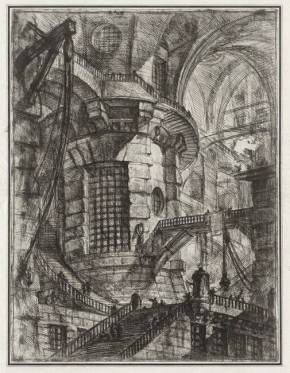
Giovanni Battista Piranesi, Carceri episode: The round tower, ca. 1749–50, etching.
In the eighteenth century Rome was a popular travel destination. Its remains of antiquity, the Renaissance, and Baroque monuments transformed the city into a laboratory of urban and aesthetic innovation. As a location with a rich publishing tradition, Rome also had the necessary infrastructure at its disposal to effectively spread the fame of local landmarks through printed images: illustrators, engravers, and etchers met here with publishers, printers, and distributors of different nationalities.
Thanks to the international circulation of the images, most visitors to Rome had already taken a visual journey through the city. Veduta, maps or panoramas, such as those from Giuseppe Vasi, provided the viewer with an overview of the monuments. Like today’s tourist guides they offered directions on how one might explore the city.
For artists, Rome was also an inexhaustible source of inspiration for architectural fantasies, which, alongside the realistic panoramas, enjoyed a growing popularity. With these inventions, Veneto-born architect Giovanni Battista Piranesi caused something of a stir. At the time, his masterly etchings were significant in establishing Rome alongside Venice as a center of Italian printmaking.

Pier Leone Ghezzi, Signor Domenico Annibali, che parla all’Eminentissimo di San Cesareo, ca. 1749
During his lifetime, almost the entire etched œuvre of the artist made its way to the Dresden Kupferstich-Kabinett. The purchase of Piranesi’s works is only one example of the extensive and selective acquisitions of Roman printmaking that were made at the time. Piranesi’s lifespan covers roughly the same time frame as the exhibited works, which concentrate on panoramas of the ancient and modern Rome as well as unreal spaces. To this day, most of these sheets are bound in so-called collector’s albums—large format volumes that were preferred in the eighteenth and nineteenth centuries for the storage and presentation of print collections.
Additionally, with caricatures by Pier Leone Ghezzi the exhibition offers insights into who populated the streets of the Eternal City in the eighteenth century. Numerous Ghezzi drawings were etched by order of the Saxon Royal Court. Today these sheets are presented as a particularly charming witness of the intensive relationship between Rome and Dresden at that time.
A catalog of the same name published by Sandstein-Verlag Dresden will accompany the exhibition.
Exhibition | Canova and the Dance
Opening in October at the Bode-Museum:
Canova and the Dance / Canova und der Tanz
Bode-Museum, Berlin, 21 October 2016 — 22 January 2017

Antonio Canova, Dancer with Cymbals (Tänzerin), marble, 1809/1812 (Berlin: Bode-Museum; photo by Andreas Praefcke, Wikimedia Commons, 2007)
Dancer with Cymbals by Antonio Canova (1757–1822) numbers among the most significant and popular of the Bode-Museum’s works of art. The most important sculptor of Italian Neoclassicism was to explore the theme of dance three times in life-size sculptures. On the occasion of the special exhibition, Canova and the Dance, the Berlin dancer is to be joined by her counterparts: Dancer with Hands on Hips, created for Napoleon’s first wife Josephine and held at the Hermitage Museum in Saint Petersburg, and Dancer with Finger on Chin, the model of which is kept at the Museo Canova in Passagno (the sculptor’s place of birth). Additionally, Hebe—a work from the Alte Nationalgalerie acquired for the Berlin collections in 1825—will for the first time be displayed alongside the Dancers. Artistically, Hebe is considered a precursor to Canova’s Dancers, and is the second major work by the Italian sculptor held by the Staatliche Museen zu Berlin. The exhibition gives centre stage to these fascinating marble sculptures, along with a work known as the Berlin Dancer from the Antikensammlung (Collection of Classical Antiquities). Sculptures like this were to serve as a source of inspiration for Canova during the composition of the Dancer in the Bode-Museum’s collection. A key aspect of the exhibition is the way in which Canova, a master of materiality, applied himself to exploring one of his favourite themes—dance—through design sketches, then paintings and models, and finally in the completed marble artwork.
Canova and the Dance is a project undertaken in partnership with two museums in Veneto: the Museo Canova in Passagno and the Museo Civico in Bassano del Grappa—which in 2011 began work on reconstructing the plaster model of the Berlin Dancer (made in Passagno and damaged during World War I), featuring it as part of an exhibition entitled Canova e la danza. The model will now appear in a more advanced state of completion at the Bode-Museum. Paintings both in oil and tempera, created by Canova for his private home, drawings, illustrations, and sculptures—many of which have never previously been exhibited in Germany—will form a display around Canova’s unique suite of Dancers, tracing a visual account of the sensuousness and movement at play in the great Italian sculptor’s work.
Exhibition | Shakespeare in Soane’s Architectural Imagination
Press release for the exhibition on view now at Sir John Soane’s Museum:
‘The Cloud-Capped Towers’: Shakespeare in Soane’s Architectural Imagination
Sir John Soane’s Museum, London, 21 April – 8 October 2016
Curated by Alison Shell
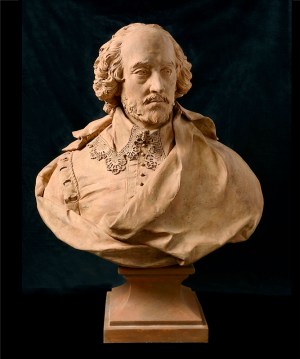
Louis-François Roubiliac, Bust of William Shakespeare (modern replica), 1742 (London: The Garrick Club).
A new exhibition coinciding with the 400th anniversary of the death of William Shakespeare will open at Sir John Soane’s Museum on 21st April. ‘The Cloud-Capped Towers’: Shakespeare in Soane’s Architectural Imagination focuses on Soane’s extensive Shakespeare collections, including his ownership of the first four Folios of Shakespeare’s collected works, the way Soane and his family participated in the eighteenth-century Shakespearean revival, and the influence of the Bard on Soane’s architecture. Guest-curated by Dr Alison Shell of UCL, the exhibition will largely consist of Soane’s own collection, supplemented by important loans from The Garrick Club. Whilst Soane’s fascination with Shakespeare is evident throughout his house-museum, this is the first time the elements have been drawn together to provide a cohesive study of the way Shakespeare influenced Soane. It is also a rare opportunity to see Shakespeare’s first our Folios displayed together in one exhibition.

Robert Adam, Adam’s interior of the Drury Lane Theatre from Works in Architecture of Robert and James Adam, 1779.
The first room of the exhibition introduces the 400th anniversary of Shakespeare’s death, setting it in the context of the 200th anniversary celebrations in 1816, and discusses the intersection between literature and architecture with a particular focus on David Garrick, the celebrated actor-manager of the Drury Lane Theatre who was so instrumental in the popularisation of Shakespeare in Georgian London.
The Garrick Club has loaned two paintings: David Garrick between the Muses of Tragedy and Comedy, after Sir Joshua Reynolds, and John Philip Kemble as Hamlet, from the studio of Sir Thomas Lawrence. These are instantly recognisable portraits of two of the greatest actors of the eighteenth century, famed for their interpretations of Shakespeare. The Adam brothers’ designs for Drury Lane Theatre will also be on display, as well as a rare coloured edition of The Works in Architecture of Robert and James Adam.
The second room in the gallery goes on to consider Shakespeare in Soane’s architectural imagination. In 1788–89 ‘The Shakespeare Gallery’, only the second purpose-built art gallery in England, was built in Pall Mall to designs by George Dance the Younger, Soane’s first architectural teacher and mentor. These in turn influenced Soane’s later designs for the Dulwich Picture Gallery—itself the first public art gallery in Britain.
The exhibition closes with a selection of Soane’s large-scale Royal Academy lecture drawings, allowing access to these appealing and striking images which can usually be viewed only by appointment.
◊ ◊ ◊ ◊ ◊
Catalogue available through Sir John Soane’s Museum:
Frances Sands, Alison Shell, Stephanie Coane, and Emmeline Leary, ‘The Cloud-Capped Towers’: Shakespeare in Soane’s Architectural Imagination (London: Sir John Soane’s Museum, 2016), 48 pages, ISBN: 978-0993204128, £10.
 This book of essays, ‘The cloud-capped towers:’ Shakespeare in Soane’s Architectural Imagination, is published to coincide with an exhibition with the same title to be shown at Sir John Soane’s Museum in 2016 as part of the nationwide commemoration of the 400th anniversary of the death of the great English playwright William Shakespeare.
Sir John Soane (1753–1837) was a highly literary architect, who appears to have valued Shakespeare for the architectural pictures he conjured up, and also as a moral teacher. He had a deep knowledge of Shakespeare’s work, quoting (and misquoting) it often, notably in his Royal Academy lectures. His fascination with Shakespeare is evident both in his library and in the Shakespearian references throughout his house-museum, the most obvious being the Shakespeare Recess, a shrine to the Bard on the staircase.
The four essays in this volume look at the influence of Shakespeare on Soane’s architecture, against the wider background of the eighteenth-century Shakespearean revival; at Soane as a ‘bardolator’ and bibliophile; and at contemporary performance and theatre-going, with a particular focus on the plays seen by Soane and his wife Eliza. The essays are illustrated by a number of illustrations in full colour, the majority drawn from Soane’s own collection.
Frances Sands is Curator of Drawings and Books at Sir John Soane’s Museum. Alison Shell is a professor in the Department of English, University College London. Emmeline Leary is an independent scholar. Stephanie Coane is Senior Librarian is Senior Librarian, College Library, Eton College and Honorary Librarian to Sir John Soane’s Museum.
Display | Handel’s Performers

Johannes Verelst, Portrait of Anna Maria Strada (detail), ca. 1732, oil on canvas
(London: The Foundling Museum)
◊ ◊ ◊ ◊ ◊
Press release for the display now on view now at The Foundling Museum:
Handel’s Performers
The Foundling Museum, London, 13 November 2015 — 30 October 2016
George Frideric Handel worked with many singers, often composing or adapting music for a particular performer. This new display of portraits and documents in the Handel Gallery brings together celebrities of the day, along with some lesser-known singers who brought Handel’s music to the public in the eighteenth century.
In particular, the display focuses on two celebrities, Anastasia Robinson and Senesino, who were among the highest paid singers at the time, showcasing music, documents and images relating to them. ‘Mrs Robinson’, as she was known, was secretly married to the Earl of Peterborough, but they did not acknowledge the marriage until shortly before the Earl’s death, and she was publicly assumed to be his mistress. She sang in over twenty Handel operas, and Handel composed or adapted music especially for her voice. Francesco Bernardi adopted the stage name ‘Senesino’ from Siena, his birthplace, and was recruited by Handel from Dresden to join his opera company. Senesino became the leading castrato singer in London in the 1720s, creating the title role in Handel’s opera Giulio Cesare in 1724 and singing major roles in seventeen operas by Handel, despite a sometimes stormy relationship with the composer.
Another of the portraits on show is of Anna Maria Strada, one of Handel’s leading sopranos. The oil painting by Johann Verelst, shows the singer holding an aria headed ‘Sung by Signora Strada’, which she had made famous. This sheet music is part of the Gerald Coke Handel Collection. Contemporary accounts write of Strada being unattractive in appearance and she was known to be nicknamed ‘The Pig’. However, in this portrait, the artist has done his best to make the singer attractive.
The display also includes a portrait by Thomas Frye of Richard Leveridge, a singer and composer who made famous the song The roast beef of old England. Leveridge is holding the music to ‘Ghosts of every occupation’, which he sang for many years in the popular pantomime The Necromancer. In between engagements Richard Leveridge ran a coffee shop in Tavistock Street near Covent Garden.
Another singer included is Gustavus Waltz, in a portrait by by Johann Maurice Hauck. Waltz, like Handel, was a German who became a British citizen, and was reported to have been Handel’s cook as well as a bass singer. He created roles in several Handel operas and sang in the benefit performance of Handel’s Messiah at the Foundling Hospital in 1754. Next to Waltz is displayed a print of John Hebden, who played in the orchestra for the Foundling Hospital’s benefit performances of Messiah in 1754 and 1758.
Other singers represented who were in London during Handel’s life time are the Italian castrati Carlo Broschi (‘Farinelli’) and Giovanni Carestini, and the English singer Kitty Clive, who sang in the first London performance of Messiah in 1743. Farinelli sang with the Opera of the Nobility, a company set up to rival Handel’s opera company in the 1730s, while Carestini sang for Handel in his operas and oratorios.
Exhibition | Noble Prospects: Capability Brown and Yorkshire
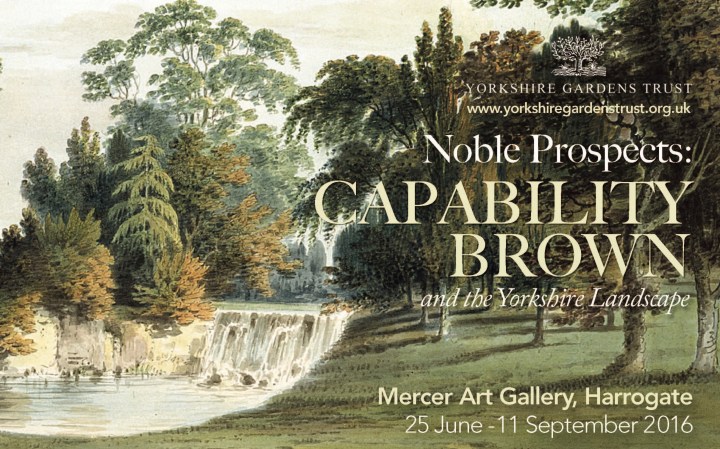
Now on view at The Mercer Art Gallery, with more information from the Capability Brown Festival:
Noble Prospects: Capability Brown and the Yorkshire Landscape
The Mercer Art Gallery, Harrogate, North Yorkshire, 25 June — 11 September 2016
The great landscape gardener Lancelot ‘Capability’ Brown (1716–1783) changed the face of eighteenth-century English parkland, creating a magical world of woods, water and swathes of green that lives on until this day in Yorkshire. This Mercer Art Gallery exhibition is the first ever dedicated to the Yorkshire landscapes of this legendary designer to mark the 300th anniversary of his birth, devised in partnership with the Yorkshire Gardens Trust.
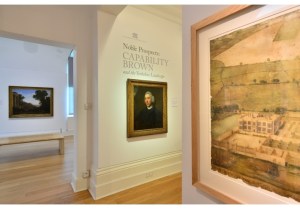
Installation view of the exhibition “Noble Prospects: Capability Brown and the Yorkshire Landscape,” The Mercer Art Gallery, Harrogate, North Yorkshire, 2016. Photo by Simon Miles.
Capability Brown is the creator of some of Yorkshire’s most admired landscapes, which include Burton Constable, Harewood, Roche Abbey, Scampston, Sledmere and Temple Newsam. This unique exhibition brings together an intriguing collection of artworks, which reveal more about the designer and his designs. Drawn largely from Yorkshire collections the show features portraits of Capability Brown and his Yorkshire clients, original plans, drawings and documents by Brown, paintings of his creations as well as works of art that inspired his landscapes.
Capability Brown was the leading landscape designer of the second-half of the eighteenth century and there are thought to be 20 sites in Yorkshire associated with him. He rejected the very formal geometric French style of gardening and concentrated on echoing the natural undulations of the English landscape in his plans. The landscape garden is recognised as one of Britain’s greatest artistic achievements and the designs of Brown and his contemporaries have influenced gardens across the world.
Noble Prospects: Capability Brown and the Yorkshire Landscape is supported by The Landscape Agency, Saffery Champness, Savills, Coutts, Harrogate Borough Council, The Capability Brown Festival 2016, Art Fund, Natural England, The Calmcott Trust, The Friends of the Mercer Art Gallery, Leeds Philosophical and Literary Society, Historic Houses Associations Yorkshire Friends, Mr and Mrs J. Samuel and private donors. The Yorkshire Gardens Trust, an educational charity founded in 1996, works to help conserve, protect and promote Yorkshire’s rich heritage of parks, gardens and designed landscapes.
◊ ◊ ◊ ◊ ◊
From the Yorkshire Gardens Trust:
Karen Lynch, Noble Prospects: Capability Brown and the Yorkshire Landscape (Yorkshire Gardens Trust, 2016), 72 pages, £12.
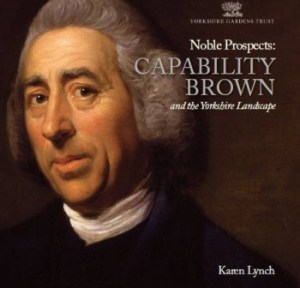 The development of a new natural style of laying out parks in the eighteenth century is acknowledged to be one of the greatest artistic achievements in British history. One man’s name is indelibly linked with the profession of landscape gardening: Lancelot Brown. Achieving great renown in his own lifetime he became universally known by his affectionate nickname ‘Capability’, and whilst fashions in design have come and gone, his fame remains great three hundred years after his birth. This new publication celebrates Capability Brown’s work in Yorkshire and is the culmination of two years of research to identify just what Brown did in this vast county. It features contemporary views by artists such as J.M.W. Turner and Paul Sandby as well as works by amateur artists who admired the landscapes they visited. Also illustrated are designs by Brown and portraits of the man and his Yorkshire clients. Stunning newly commissioned photography by artist Simon Warner shows the parks as they look today.
Exhibition | French Portrait Drawings
Opening in September at The British Museum (from the press release). . .
French Portrait Drawings: From Clouet to Courbet
The British Museum, London, 8 September 2016 – 29 January 2017
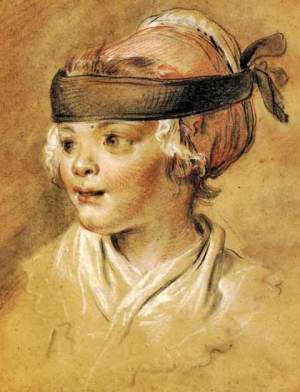
Jean Michel Moreau le Jeune, Portrait of the Artist’s Daughter Fanny at the Age of Two, ca. 1772; black and red chalk heightened with white on buff paper (London: The British Museum).
This exhibition will showcase The British Museum’s remarkable holdings of French portrait drawings, chosen to illustrate the development of this medium from the Renaissance until the 19th century. Throughout its history, the drawn portrait has been a more informal medium, created for circulation among friends and relations of the sitter, rather than the wider public intended for the official painted portrait. Artists turned to chalk or watercolour to depict members of their own families and throughout the display there is experimentation and innovation: drawings were cheaper to produce than an oil painting or sculpture and allowed the artist greater freedom for creativity.
Portraits on paper will be displayed alongside examples in other more formal media, including medals, enamels and an onyx cameo. The exhibition will open with drawings by Francois Clouet, which offer an intimate picture of the French Renaissance court, and close with Toulouse Lautrec’s vivid portraits of the Parisian demi-monde, offering visitors the chance to see some of the Museum’s well-known portraits along with some which have never been exhibited before.
◊ ◊ ◊ ◊ ◊
Note (added 8 January 2017) — The extended description from The British Museum:
See over 65 portraits by French artists spanning four centuries, from the early drawings of Jean Clouet (1480–1541) and his son François (c. 1510–1572) to the exquisite drawings of the Realist Gustave Courbet (1819–1877). The British Museum has a remarkable collection of French portrait drawings, including examples by the most celebrated artists—from Clouet, Watteau, and Ingres, to Fantin-Latour, Courbet, and Toulouse-Lautrec. Many have not been widely displayed, so this exhibition is a chance to see beautiful, rarely seen works. The exhibition illustrates the development of portrait drawing from the Valois and Bourbon kings to the upheavals of the Revolution, Napoleon’s Empire, and beyond.
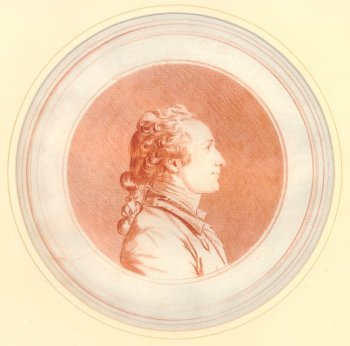
Louis Rolland Trinquesse, A Young Man in Profile to the Right, ca.1770, red chalk over a red-chalk counterproof (London: The British Museum, 1928,1110.30).
Drawing was a more informal medium than official painted portraits. Drawn portraits were intended for circulation among friends or family of the sitter, rather than a wider public. Many of the portraits also demonstrate a range of experimentation and innovation. Drawings were cheaper to produce than oil paintings, sculptures, or medals and allowed the artist greater creative freedom, often for preparatory studies.
This exhibition begins in the 16th century with Clouet’s portrait series commissioned by Henri II’s queen, Catherine de’ Medici. Psychologically penetrating as well as artistically beautiful, these previously unexhibited portraits give a strikingly intimate glimpse of figures at the Renaissance French court. Later on, artists turned to the medium of chalk or watercolour to represent members of their own families, such as Jean-Michel Moreau le Jeune’s portrait of his infant daughter or Albert Lebourg’s striking portrait of his wife and mother-in-law from around 1879.
The 18th-century works include famous sitters such as Marie-Antoinette and Leopold Mozart performing with his children Wolfgang and Marie-Anne. The exhibition also includes examples of original and creative ways of approaching portraiture, such as Pierre Dumonstier’s playful ‘portrait’ of the artist Artemisia Gentileschi’s hand, drawn in 1625, or Henri Fantin-Latour’s self-portrait studies from 1876, which show the artist seen from behind—a portrait without a face. The section focusing on 19th-century artists features Ingres’s splendid portrait of Sir John Hay and his sister Mary, made in 1816, Toulouse-Lautrec’s dynamic portrait of Marcelle Lender, drawn in 1894, and the confident self-portrait by Gustave Courbet.
The drawings, selected from the Museum’s unparalleled collection, are complemented by portraits in other media, including prints, medals, enamels, and an onyx cameo. Together they illustrate the development of French portrait drawing from the Renaissance until the 19th century.
The illustrated handlist, with entries for each image, is available from the museum.
Exhibition | Benjamin Franklin: Portraits by Duplessis
Press release (11 August 2016) from The Met:
Benjamin Franklin: Portraits by Duplessis
The Metroplitan Museum of Art, New York, 22 August — 28 November 2016
Curated by Katharine Baetjer

Joseph Siffred Duplessis, Portrait of Benjamin Franklin (The ‘Fur Collar’ Portrait), 1778, oil on canvas; oval, 72.4 × 58.4 cm (New York: The Metropolitan Museum of Art, 32.100.132).
Several works depicting the brilliant writer, inventor, politician, patriot, and statesman Benjamin Franklin (1706–1790), who has been the subject of hundreds of portraits, will go on view at The Metropolitan Museum of Art in a focused exhibition opening on August 22. The most famous of these was painted by Joseph Siffred Duplessis (1725–1802), Louis XVI’s official portraitist, after Franklin arrived in Paris in 1776 to seek French support for the American war of independence. Portraying Franklin in a red coat with a fur collar, and with an astonishingly elaborate frame decorated with his attributes, the oval painting was greatly admired and Duplessis exhibited it at the 1779 Paris Salon.
The painting, which has been in The Met collection for 85 years, will be a focal point of the installation Benjamin Franklin: Portraits by Duplessis, along with the preliminary pastel portrait of Franklin, probably a life study by Duplessis. The pastel, which is rarely exhibited and will be on loan from the New York Public Library, shows Franklin in the same pose as the painting but wearing a gray, collarless jacket and waistcoat. The image will be familiar to many: it is the same likeness that is replicated on the current one-hundred-dollar bill. The installation will also explore the processes of image transfer and replication in the 18th century.
Franklin arrived in Paris on December 21, 1776, as a commissioner of the American Continental Congress, and lived in nearby Passy until he returned to America in 1785. He promoted the treaty of alliance between the fledgling nation and the government of Louis XVI that was signed on February 6, 1778. The American Revolutionary War was an enormously popular cause in France, where the elderly statesman’s simplicity of dress and manner were admired. The ‘Fur Collar Portrait’, or ‘VIR Portrait’, by Duplessis was commissioned by the entrepreneur Jacques Donatien Le Ray de Chaumont. The oval canvas, exhibited in the frame in which it is still displayed, became the object of extravagant praise. Versions from the artist’s workshop and by other hands were in demand and the portrait was replicated dozens of times. A fine replica by or after Duplessis, also belonging to The Met, is so close in design that the contours must have been transferred from the 1778 picture.
Franklin understood the importance of circulating his image and gave sittings to some half-dozen French artists, but he did not enjoy doing so. He did not wish to sit for the same painter twice, sending away in later years those who applied to him for an original and suggesting that they instead commission a copy. An X-radiograph of the ‘Fur Collar Portrait’ reveals that Franklin’s coat was originally much simpler, with small buttons and a narrow collar. In this connection, the exhibition will draw attention to the Duplessis pastel portrait of Franklin that was given to the New York Public Library in 1896. For more than a century, the pastel has been conscientiously protected from damage due to overexposure to light and thus has rarely been exhibited. The pastel had been assigned to the early 1780s, but technical examination reveals that it dates to 1777 or early 1778 and is preliminary to the ‘Fur Collar Portrait’—its design precisely matches the composition revealed in the painting’s X-radiograph. Pastel is a portable medium, and Duplessis probably took his pastel crayons to Passy to set down the direct likeness of Franklin.
Benjamin Franklin: Portraits by Duplessis is organized by Katharine Baetjer, Curator in Department of European Paintings at The Met.










leave a comment