Exhibition | Chinese Opera Costumes of the 18th and 19th Centuries
Press release (17 May 2016) from The Met:
From the Imperial Theater: Chinese Opera Costumes of the 18th and 19th Centuries
The Metropolitan Museum of Art, New York
first rotation: 15 June 2016 — 8 January 2017 / second rotation: 14 January — 9 October 2017
Curated by Pengliang Lu and Denise Patry Leidy
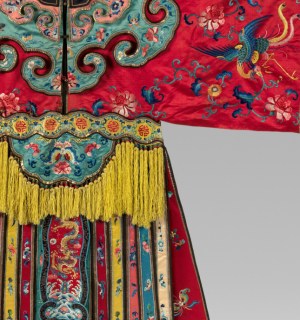
Theatrical robe with phoenix and floral patterns (detail), Qing dynasty (1644–1911), 19th century; silk thread embroidery on silk satin; 50 × 96 inches (New York: The Metropolitan Museum of Art).
Drawn entirely from The Met collection, From the Imperial Theater: Chinese Opera Costumes of the 18th and 19th Centuries will examine these luxury textiles from artistic and technical points of view. The exhibition will be organized in two rotations. The first will focus on costumes used in dramas based on historical events, and the second will feature costumes from plays derived from legends and myths. The presentation will showcase eight robes, each of which was created for a specific role—court lady, official, general, monk, nun, and immortal. A set of album leaves faithfully depicting theatrical characters wearing such robes will also be displayed.
The 18th and 19th centuries witnessed a flowering of Chinese drama. Under the patronage of the Qing court (1644–1911), performances—including the ‘Peking Opera’—filled the Forbidden City in Beijing. A form of traditional Chinese theater, Peking Opera was developed fully by the mid-19th century, and because of the form’s minimal stage settings and the importance of exaggerated gestures and movements, costume played an unusually significant role. The exhibition will include superb examples with interior markings indicating their use in court productions.
The exhibition is curated by Pengliang Lu, Henry A. Kissinger Curatorial Fellow, and Denise Patry Leidy, Brooke Russell Astor Curator of Chinese Art, both in the Museum’s Department of Asian Art.
Exhibition | The Lacquerwork of Gérard Dagly
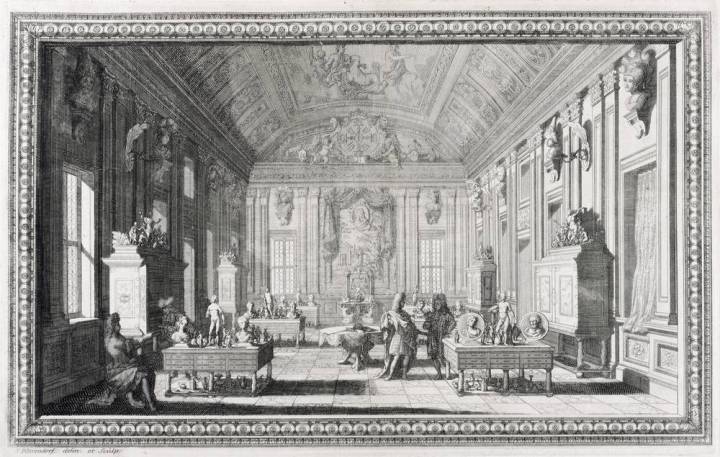
Idealized View of the Coin and Antiques Cabinet, Berliner Schloss, ca. 1695, Samuel Blesendorf, Thesaurus Brandenburgicus selectus, volume 1 (Berlin 1696).
◊ ◊ ◊ ◊ ◊
From the Staatliche Museen zu Berlin (with thanks to Tobias Locker for noting it). . .
In Praise of Good Rule: The Lacquerwork of Gérard Dagly in the Berlin Palace
Lob der Guten Herrschaft: Die Lackkunst des Gérard Dagly im Berliner Schloss
Kunstgewerbemuseum (Museum of Decorative Arts), Köpenick Palace, Berlin, 8 July — 9 October 2016
Gérard Dagly (c. 1660–1715) was a master of Baroque lacquerwork. His most important work is the coin cabinet from the cabinet of antiquities of the Prussian royal art collection, now preserved in the Berlin Kunstgewerbemuseum. The dramatic composition in gold on black lacquer on the cabinet’s decorative panels is unusual for Europe, and provides early evidence of a serious artistic interaction with East Asian models. In this piece Dagly unites East Asian and European visual traditions in a homage to Frederick III, Elector of Brandenburg.

Gérard Dagly, Medal Cabinet for the Cabinet of Antiquities of the Brandenburg-Preußischen Kunstkammer, 1690–95 (Berlin: Kunstgewerbemuseum; photo by Tomasz Samek).
As ‘Director of Ornaments’, Gerard Dagly was responsible for all the furnishings of the cabinet of antiquities in the Berlin Palace. These included an ensemble of four coin and medal cabinets and six tables, as well as the interior decorations of the room, including paintings and gilded sculptures. A monumental catalogue, the Thesaurus Brandenburgicus selectus compiled by Lorenz Berger, accompanied the presentation of the collection. All these elements served Baroque prestige, forming an accolade praising the Elector Frederick III, later King Frederick I as a preserver of antiquity, and using this connection to the past to legitimize his claim to power.
This exhibition presents the coin cabinet in its context, for which the Kopenick Palace, built for Frederick III, forms the ideal location. Historic images of the cabinet of antiquities accompany a rich display of the works of art they depict. These include ancient gold and silver coins, sculptures, and gems, an Egyptian death mask, Etruscan beaked jugs, as well as the Thesaurus Brandenburgicus, Chinese and Japanese porcelain and lacquerwork, and other examples of Dagly’s work, such as the lost Chinese cabinet from the Berlin Palace.
Lenders to the exhibition include: the Brandenburgisches Landesamt für Denkmalpflege und Archäologisches Landeszentrum, the Humboldt-Universität zu Berlin, the Museum für Lackkunst Münster, the Stiftung Preußische Schlösser und Gärten Berlin-Brandenburg, the Staatsbibliothek zu Berlin Preußischer Kulturbesitz, as well as other collections within the Staatliche Museen zu Berlin, specifically: the Ägyptisches Museum, Antikensammlung, Kunstbibliothek, Münzkabinett, the Museum für Asiatische Kunst, and Skulpturensammlung.
Exhibition | Giambattista and Domenico Tiepolo: Master Drawings

Domenico Tiepolo, A Centaur Playing with Punchinellos, ca. 1770 (Bloominton Indiana: The Anthony Moravec Collection of Old Master Drawings, Eskenazi Museum of Art)
◊ ◊ ◊ ◊ ◊
From the Eskenazi Museum of Art at Indiana University:
Giambattista and Domenico Tiepolo: Master Drawings from the Anthony J. Moravec Collection
Eskenazi Museum of Art, Indiana University, Bloomington, 1 October 2016 — 5 February 2017
Crocker Art Museum, Sacramento, California, 29 October 2017 — 4 February 2018
Curated by Adeheld Gealt
This fall, the Eskenazi Museum of Art at Indiana University will showcase a series of Italian master drawings, in an exhibition that highlights a major gift of art in the museum’s 75-year history. Giambattista and Domenico Tiepolo: Master Drawings from the Anthony J. Moravec Collection will present a collection of works on paper by the Venetian masters Giambattista and Domenico Tiepolo—a father and son who are widely considered two of the most notable Italian draftsmen of their era—along with works by contemporaries Ubaldo Gandolfi and Giuseppe Bernardino Bison, as well as their predecessor Jacopo Palma il Giovane. Giambattista and Domenico Tiepolo marks the first time that the Eskenazi Museum has comprehensively exhibited the collection of Anthony J. Moravec, an Indiana philanthropist and civic leader who spent five years building the collection in concert with Dr. Adelheid Gealt, the museum’s director emeritus, before donating his holdings to the Eskenazi Museum in 2010.

Domenico Tiepolo, Jesus in the Garden of Gethsemane: The Second Prayer, ca. 1785, pen and brown ink wash over black chalk on paper (The Anthony Moravec Collection of Old Master Drawings, Eskenazi Museum of Art, 2010.118).
On view from October 1, 2016 through February 5, 2017, the exhibition and its accompanying catalogue will provide new scholarship and curatorial insight on Giambattista and Domenico Tiepolo, two of the most important artists in the Old Masters canon. The exhibition will center on a set of 12 New Testament drawings by Domenico Tiepolo, part of a now-scattered cycle of 320 drawings that is regarded as the most exhaustive and sustained visual exploration of the subject by any artist in history. Domenico’s large pen, brush, and ink drawings were dispersed after his death in 1804, and entered many public and private collections where they were prized as outstanding drawings. However, the actual series to which these individual drawings belonged was not known until two scholars— Adelheid Gealt and George Knox, professor emeritus of the University of British Columbia, Vancouver—spent 10 years piecing the series back together and publishing it as a newly discovered New Testament cycle in 2006. Following Moravec’s 2010 gift, which was the largest private collection of New Testament drawings to enter a public collection in recent history, the Eskenazi Museum has become the world’s third-largest repository of works from Tiepolo’s New Testament series, after the Museé du Louvre and the Morgan Library and Museum.
In addition to works from Domenico’s New Testament series, the Moravec collection also includes important works on paper by his father, Giambattista Tiepolo, who is widely regarded as one of the greatest draftsmen of the 18th century. Works by Ubaldo Gandolfi and Giuseppe Bernardino Bison round out the collection, along with a drawing by Jacopo Palma il Giovane—a previously unidentified study for his painting St. John the Baptist Preaching, which was acquired by the museum in 1964. In total, 24 works on paper will be displayed in Giambattista and Domenico Tiepolo, which will be a major highlight of the Eskenazi Museum’s 75th-anniversary season.
◊ ◊ ◊ ◊ ◊
The catalogue will be available in October from Indiana University Press:
Adeheld Gealt, with George Knox, Giambattista and Domenico Tiepolo (Bloomington: Indiana University Press, 2016), 136 pages, ISBN: 978-0253022905, $50.
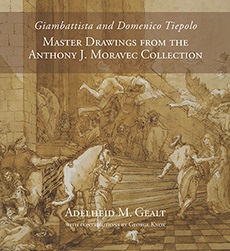 Giambattista and Domenico Tiepolo documents an important collection of master drawings donated by an individual to the Sidney and Lois Eskenazi Museum of Art at Indiana University, including five drawings by the celebrated Venetian genius Giambattista Tiepolo and sixteen drawings by his most famous son, Domenico Tiepolo. Twelve of the sixteen form part of Domenico’s most important drawing series—his exhaustive visual exploration of the New Testament. Also included are two drawings discovered after the 2006 publication of Domenico Tiepolo: A New Testament and seen here for the first time. Gealt and Knox are world-renowned experts on the Tiepolos and this book will serve as a useful reference to understanding their work as draftsmen. This beautiful illustrated volume will appeal to art lovers, biblical scholars, and those who value the unique work of the Tiepolos.
Adeheld M. Gealt is Director Emerita of the Eskenazi Museum of Art. Her research has concentrated on reconstructing the lost serial narratives of the Venetian draftsman Domenico Tiepolo (1727–1804). She is editor (with George Knox) of Domenico Tiepolo: Master Draftsman (1997) and Domenico Tiepolo: A New Testament (2006).
◊ ◊ ◊ ◊ ◊
C O N T E N T S
Foreword, David Brenneman
Preface and Acknowledgments
Structure of the Catalogue
An Interview with the Collector, Anthony J. Moravec and Adelheid M. Gealt
A Brief History of Venetian Drawing
Giambattista Tiepolo, a Brief Biography
Development as a Draftsman
Flight into Egypt
Holy Family
Caricatures
Domenico Tiepolo, a Brief Biography
St. Anthony of Padua
Satyrs and Centaurs
Punchinello
New Testament
Palma Giovane
Ubaldo Gandolfi
Giuseppe Bernardino Bison
Notes
Bibliography
Index
◊ ◊ ◊ ◊ ◊
Note (added 29 October 2017) — The posting was updated to include the Crocker Art Museum as a venue.
Exhibition | An Amateur’s Passion: Lord Fitzwilliam’s Print Collection
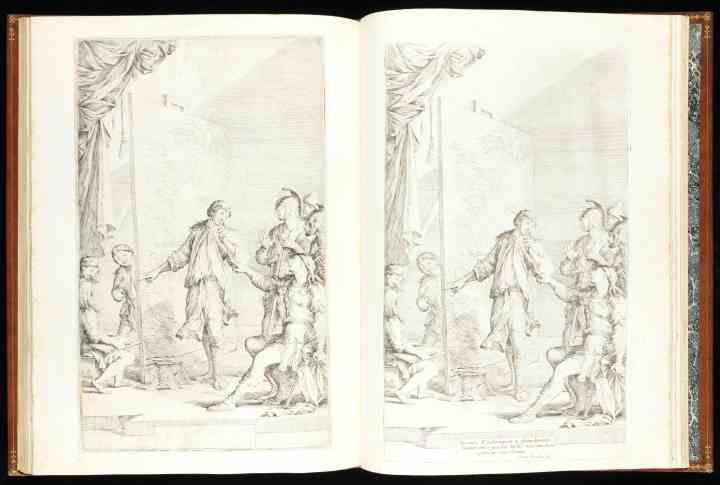
Now on view at The Fitzwilliam:
An Amateur’s Passion: Lord Fitzwilliam’s Print Collection
The Fitzwilliam Museum, Cambridge, 9 August 2016 — 29 January 2017
Curated by Elenor Ling
To mark the bicentenary of the founding of The Fitzwilliam Museum and celebrate its collection, this exhibition looks at one of the passions of its founder, Richard 7th Viscount Fitzwilliam of Merrion (1745–1816). Lord Fitzwilliam embodies both our present idea of the amateur print collector, as a non-professional enthusiast, and in the way the word amateur was understood in his day—a ‘lover of the arts’. The 198 albums that were housed in his library at the time of his death and transferred to the University of Cambridge under the terms of his bequest are testament to his love of prints. Despite his other all-consuming passions—the plight of the French monarchy in exile and the activities for the Concerts of Ancient Music—he managed to find time to boast of his collection to the exiled French court and to the Earl of Sandwich. The fact that some 40,000 prints are contained within the 198 albums gives a sense of the time and effort he expended on his collection. This small exhibition, comprising thirty-one prints and seven albums, gives a sense of the content and scope of Fitzwilliam’s print collection.
The first significant fact about Fitzwilliam’s albums is that they are arranged according to printmaker—that is to the person who made the print, rather than the artist who designed it or the work in another medium it represents. The names on the spines of the albums, therefore, usually correspond to the work of the person, or a family of engravers, regardless of whether a print was designed by the printmaker or someone else. The display begins with a small selection of Fitzwilliam’s Rembrandt prints, known at the time of his death as one of the strengths of his collection and evidently one of his earliest preoccupations. Following Rembrandt is a mixture of old masters, including Ishrael van Meckenem (c.1445–1503) and Albrecht Dürer (1471–1528), as well as work by contemporary artists, such as Jean-Jacques de Boissieu (1736–1810) and Johann Christian Reinhart (1761–1847).
Fitzwilliam’s albums fall into two main categories: those he acquired complete from other sources and those containing mounted, individual prints arranged entirely by Fitzwilliam himself. The latter is the focus of this exhibition, although the first category is represented. In terms of construction, evidence suggests that Fitzwilliam assembled the work of each printmaker in turn. In general Fitzwilliam tried to acquire prints in good condition and of good quality, and paid great attention to the decorative effect of the finished sheets. Neatness, symmetry and elegance are characteristic qualities across all his albums. Large prints were usually folded, rather than cut and pasted on separate sheets (in contrast to some albums acquired from other collections).
The examples of prints from his monographic albums serve to highlight the anomalies in his collection: the outsized albums that housed his mezzotints (the chief strength of his collection of British prints) and two albums arranged by subject, ‘Imitations of Drawings’, which comprises a mixture of sixteenth and seventeenth-century Italian woodcuts and eighteenth-century prints produced as facsimiles of drawings. Most bizarrely of all is the strange large album called simply ‘Jesuites’, a testament to another of his admirations: St Ignatius of Loyola and the Jesuit Order.
The exhibition presents what little can be gleaned about Fitzwilliam’s method of acquisition, including the single-surviving draft letter, written by Fitzwilliam just after the turn of the nineteenth century to someone who was to buy prints for him in Paris, and the names of print sellers and publishers written by Fitzwilliam as notes in a small number of the albums. The lack of documentation concerning the acquisition of prints highlights how importance it is that the majority of his albums has survived intact to this day.
Exhibition | Fashion Forward, 3 Siècles de Mode
The exhibition closes this week at the Arts Décoratifs. Writing for Worn Through (10 August 2016), Hayley-Jane Dujardin-Edwards provides a review.
Fashion Forward, 3 Siècles de Mode, 1715–2016
Musée des Arts Décoratifs, Paris, 7 April — 14 August 2016

Dress and Petticoat (robe à la française), ca. 1740, silk damask satin ground silk brocaded and filé (Collections UFAC, Les Arts Décoratifs, Paris / photo by Jean Tholance)
The Musée des Arts Décoratifs is celebrating the thirtieth anniversary of its fashion collection from April 7 to August 14, 2016. In doing so we are responding to our public’s strongly expressed desire to at last be shown an all-embracing panorama of fashion history over several centuries. It will also be an unique opportunity to showcase the jewels and highlight the particularities of a national fashion and textiles collection curated in full dialogue with the other departments of a museum dedicated to all the decorative arts. Fashion Forward, 3 Centuries of Fashion, 1715–2016 brings together 300 items of men’s, women’s and children’s fashion from the 18th century to today, selected from the museum’s collections to provide a novel chronological overview.
The Arts Décoratifs fashion collection now comprises more than 150,000 works, ranging from ancient textiles to haute couture creations and emblematic silhouettes of ready-to-wear fashion, but also including accessories, major collections of drawings and photographs, and the archives of iconic creators such as Elsa Schiaparelli, Madeleine Vionnet and Cristobal Balenciaga. Now France’s foremost national collection, it is the result of the amalgamation of two admirable collections, that of the Musée des Arts Décoratifs since its creation in 1864, and that of the Union Française des Arts du Costume (UFAC), founded in 1948 and currently presided by Pierre Bergé, of which the Musée des Arts Decoratifs is the proud custodian.
To mark the 30th anniversary of the opening of the Musée des Arts de la Mode—founded in 1986 on the initiative of Pierre Bergé and the French textile industry with the support of Jack Lang, then culture minister—the Musée des Arts Décoratifs is paying tribute to this collective adventure and great ‘fashion moment’. Fashion Forward, Three Centuries of Fashion casts a new spotlight on one of the richest collections in the world, freed from its display cases in the Fashion galleries to be shown for the first time in the museum’s Nave.
The three hundred pieces, selected from a collection constantly enriched by donations and acquisitions, take us on a journey through time, highlighting the key moments in fashion history from the very late 17th century to the most contemporary creation. Freeing itself from the dictates of the conservation of works and the stringent conditions of their display, the exhibition is conceived as an ideal museum of fashion, featuring the finest examples of three centuries of creation habitually illustrated in reference books. It also provides a fascinating new insight into fashion’s evolution via its designers, clients and periods, because now more than ever at Les Arts Décoratifs, fashion is treated as an artistic field that has wide-ranging echoes in the museum’s other collections. Fashion is a history of evolving techniques, materials and designs but also a history of changing times and attitudes, a reflection of the art of living. Fashion is even more fascinating when it is not self-generating but dialogues with the arts of its time, as did great figures of Couture such as Charles-Frederick Worth, Jacques Doucet, Paul Poiret, Jeanne Lanvin, Madeleine Vionnet, Gabrielle Chanel, Christian Dior and Yves Saint Laurent.
In a completely novel manner, the exhibition recreates each of these ‘fashion moments’ in its human, artistic and social context, not didactically but via ellipses illustrating fashion’s constant elective affinities with the decorative arts. Eighteenth-century wood paneling, scenic wallpapers by Zuber, Paul Iribe’s drawings for the ‘Robes de Paul Poiret’, and the straw marquetry doors created by Jean-Michel Frank for the writer François Mauriac, provide perfect settings for fashion’s stylistic expressions and the metamorphoses of the body and style from the 18th century. The exhibition culminates in the effervescence and singular eclecticism of the global contemporary fashion scene, in which the names of the most original creators are now associated with the most ancient fashion houses.
Because the entire history of fashion is also a history of the body and style, the exhibition’s artistic direction was entrusted to the British dancer and choreographer Christopher Wheeldon, formerly one of the stars of the New York City Ballet and winner of a Tony award for his stage adaptation of An American in Paris in 2014, based on the film by Vicente Minelli. In collaboration with the scenographer Jérôme Kaplan and assisted by Isabelle Vartan, Christopher Wheeldon has succeeded in giving the collection a sensual, poetic dimension, breathing new life into these illustrious creations by transforming every stage of the exhibition into a world in itself. Each of these moments is enhanced by a unique collaboration with the dancers of the Opéra de Paris, in which a choreography gracefully casts new light on a silhouette, posture or attitude characteristic of this social and artistic evolution of the body.
Exhibition | Highest Heaven: Spanish and Portuguese Colonial Art
Now on view at the San Antonio Museum of Art:
Highest Heaven: Spanish and Portuguese Colonial Art
of the Roberta and Richard Huber Collection
San Antonio Museum of Art, 11 June 2016 — 14 September 2016
Crocker Art Museum, Sacramento, 23 October 2016 — 22 January 2017
Worcester Art Museum, 12 March — 9 July 2017
Chrysler Museum of Art, Norfolk, Virginia, 2 March — 3 Jun 2018
Curated by William Keyse Rudolph and Marion J. Oettinger

Our Lady of Candlemas with Donors, Bolivian, Potosí, 1799, oil on canvas (Roberta and Richard Huber Collection; photograph by Graydon Wood, Philadelphia Museum of Art)
Highest Heaven explores the paintings, sculpture, furniture, ivories, and silverworks of the Altiplano, or high plains, of South America in the 18th century. Through the work of both well-regarded masters and lesser-known artists, Highest Heaven highlights the role of art in the establishment of new city centers in the Spanish Empire and the propagation of the Christian faith among indigenous peoples. Drawn exclusively from the distinguished collection of Roberta and Richard Huber, the exhibition highlights the distinct visual language created by the cultural and creative exchanges that occurred between Spain and Portugal and their South American colonies. The exhibition will remain on view through September 4, 2016, before traveling to the Crocker Art Museum in Sacramento, California in October, and to the Worcester Art Museum in Worcester, Massachusetts the following March.
The exhibition features more than 100 works, including religious paintings, carved and gilded wooden sculptures, intimate ivories, and silverwork, originally housed in ecclesiastical and private collections throughout the former colonial possessions of Spain and Portugal. The majority of these works were created for functional purposes, as articles of faith or symbols of civic order, and were displayed in a manner that enhanced religious understanding, brought social order, and spurred conversion among colonial populations. Highest Heaven examines these uses, focusing in particular on the translation of Christian imagery to the colonies and the ways in which these works and objects worked to establish an ordered society and were integrated into religious life. The exhibition includes approximately 20 recent acquisitions by the Hubers, many of which have never before been seen in a museum exhibition.
“A central component of our mission is to examine and communicate the historic and cultural contexts of artworks, along with the objects themselves. Highest Heaven is an exciting opportunity to not only investigate the aesthetic beauty of this art, but also the significant role that it played in the cultural, religious, and social lives of these peoples,” said Katherine Luber, The Kelso Director of San Antonio Museum of Art. “We are grateful to Roberta and Richard for their collecting vision and the chance to share this incredible collection with our audiences. San Antonio is a city rich in history and diversity, and we look forward to engaging our community with this work, which we think will have a particular meaning here.”

Pax Depicting the Ecce Homo, Peruvian, 18th century, silver (Roberta and Richard Huber Collection; photograph by Graydon Wood, Philadelphia Museum of Art)
The exhibition is co-curated by William Keyse Rudolph, Mellon Chief Curator and Marie and Hugh Halff Curator of American Art, and Marion J. Oettinger Jr, Curator of Latin American Art. Unlike many previous exhibitions of Colonial Art, which have arranged objects by media, Highest Heaven will be organized according to iconography. After an introductory section that explores a group of objects made for secular life, the exhibition considers the art works religiously, from the angels and archangels that foretold the coming of Jesus Christ, through imagery dealing with the life of Christ and spread of the gospel, to the importance of the Virgin Mary and the saints. Each section of the exhibition contains a mixture of works of art in all media, from paintings to sculpture to silverwork and ivories.
The Altiplano stretches from northern Argentina to the flatlands of Peru, and much of the exhibition focuses on works produced by workshops in the major cities of Cuzco and Lima in modern day Peru and Potosi in modern day Bolivia, where both European and native artists practiced. Paintings and sculpture served primarily to disseminate Christian images and faith to the New World, while works in ivory and silver underscored the wealth and prosperity of the growing Empire. Paintings also frequently depicted major colonial cities to both capture their urban fabric and educate those back home on the appearance and existence of the colonies.
With the extensive growth of trade across the Empire, works of art took on a range of styles that represented European traditions and local idioms. In some instances, European aesthetics and subjects were replicated directly. In others, European saints, idols, and figures took on the appearance of native populations, enhancing their relevance and influence. Yet, in other work, Christian symbols were incorporated into scenes of local rural and urban life. Together, these distinct yet interrelated approaches, created a new visual culture that represented the expansiveness of the Empire, and spoke to the integration of a diversity of peoples into a single faith.
“In contrast to other areas of Spanish colonial scholarship, such as New Spain (present-day Southwestern United States, Mexico, and Central America), much less is known about the artists, workshop practices, and even the names of South American artists,” said Luber. “Collectors are often the first to blaze the trail of discovery, and then the scholarship follows. A show like Highest Heaven opens up avenues of investigation. We are producing a catalogue that we hope will spur additional scholarship in the field. That’s part of what is so exciting about this exhibition.”
New York-based collectors Roberta and Richard Huber developed the collection of colonial South American art over the last 40 years. The Hubers continue to discover new artists and works, building on their holdings for personal enjoyment and public education and making their collection a living and evolving one. They first discovered the art and antiquities of the Spanish Empire when Richard Huber was relocated for work to Buenos Aires, Argentina in 1962. His and Roberta’s love for the period grew as they traveled and lived in other areas of South America. Today, they are committed to enhancing understanding of the diversity, depth, and intricacy of art produced by artists across the Altiplano during Spanish rule.
Erin Kathleen Murphy and William Keyse Rudolph with contributions by Thomas B. F. Cummins, Katherine Moore McAllen, and Katherine Crawford Luber, Highest Heaven: Spanish and Portuguese Colonial Art from the Roberta and Richard Huber Collection (San Antonio: San Antonio Museum of Art, 2016), 192 pages, ISBN: 978-1883502225, $40.
Exhibition | Power and Piety: Spanish Colonial Art
Traveling exhibition through Art Services International:
Power & Piety: Spanish Colonial Art
Society of the Four Arts, Palm Beach, 18 March — April 17 2016
Loyola University Museum of Art, Chicago, 20 August — 13 November 2016
Appleton Museum of Art, College of Central Florida, Ocala, 3 December — 26 February 2017
Dixon Gallery and Gardens, Memphis, 1 July — 24 September 2017
Figge Art Museum, Davenport, 14 October — 7 January 2018
Middlebury College Museum of Art, Middlebury, 26 January — 22 April 2018
Allentown Art Museum (Pennsylvania), 25 August — 9 December 2018

Juan Pedro Lopez, Our Lady Guidance, ca. 1762, oil on wood (Patricia Phelps de Cisneros Collection)
From the late 17th century until the 1820s, vast profits from cattle ranching and the cultivation and trading of tropical crops turned Spanish American elites from cities in the Caribbean basin into some of the wealthiest people in the New World. The production and trading of religious art during this period was centered on high-end pieces for churches, the local nobility, and wealthy individuals; their fine craftsmanship rivaled that of luxury goods imported from Europe. More affordable—and less refined—artworks were produced in large numbers for the homes of people of lesser means.
Painters, sculptors, gilders, silversmiths, and cabinetmakers created pieces of the finest craftsmanship to compete with luxury goods imported from Europe. They benefited from a vast supply of assorted raw materials from the Americas that included not only precious metals such as gold and silver, but also rare wood varieties with colors and grains of unmatched richness, and unique local pigments. Through 57 paintings, sculpture, silver pieces, furniture, and other decorative devotional objects, this exhibition showcases a wide range of artistic production and the finesse of local masters. It offers an exceptional opportunity to learn more about the daily life and religious practices of colonial Latin America and sheds light on the nature of commercial exchange in the region.
The works are drawn from the Patricia Phelps de Cisneros Collection—a component of the Fundación Cisneros which was founded to enhance the appreciation of art from Latin America—and is co-organized by the Museum of Biblical Art, New York, and Art Services International, Alexandria, Virginia.
◊ ◊ ◊ ◊ ◊
Note (added 25 August 2018) — The original posting did not include the Allentown Art Museum.
Exhibition | Miniature World in White Gold: Meissen Porcelain
On view now at the Wadsworth Atheneum:
Miniature World in White Gold: Meissen Porcelain by Johann Joachim Kaendler
Wadsworth Atheneum Museum of Art, Hartford, 16 January 2016 — 16 January 2017
Curated by Vanessa Sigalas

Model by Johann Joachim Kaendler,Writing Cavalier, ca. 1740, hard-paste porcelain.
Johann Joachim Kändler was one of the most visionary artists in the history of porcelain, creating more than 2,000 models over the course of his career and consistently testing the limits of porcelain as an artistic medium. Kändler was one of the first artists to use porcelain as a sculpting material rather than as a surface for painted decoration. His designs and figures—more detailed and realistic than any earlier creations—were essential for the development of porcelain as an independent art form in Europe.
Miniature World in White Gold showcases a broad selection of the finely detailed and innovative porcelain sculptures Kändler designed over his 44 years at the Meissen Porcelain Factory in Germany, featuring examples of his animals, crinoline figures, exotic representations, and court and peasant figures.

Model by Johann Joachim Kaendler, Persian Woman with Elephant, ca. 1763–74, hard-paste porcelain.
The formula for hard-paste porcelain, which originated in China centuries earlier, was not discovered in Europe until the early 18th century—only decades before Kändler became a modeler at Meissen. The material was as valuable as gold during his lifetime (1706–1775), when dinner services and figurines were commissioned by aristocrats to ornament extravagant banquet and dining tables. While they initially served as table decoration and conversation pieces, porcelain figures soon became collectibles themselves and were displayed in cabinets as independent artworks.
Exhibition | Gardens, Art, and Commerce in Chinese Woodblock Prints
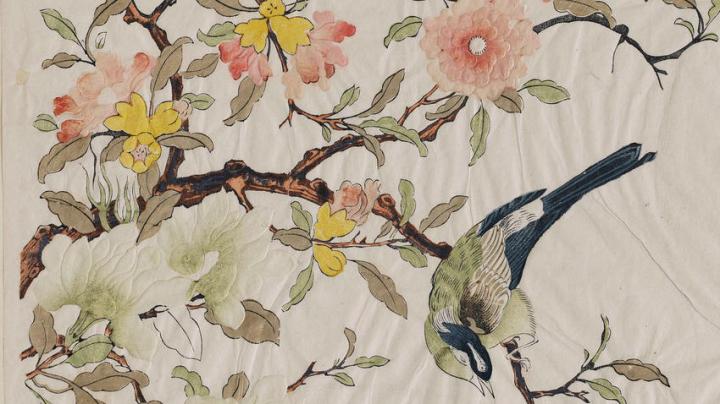
Ding Liangxian, Pomegranate and Magnolia with Bird, (detail), Qing Dynasty, 1700–50; woodblock print with embossing, ink, and colors on paper (multiblock technique with hand-coloring), 11 7/8 × 14 3/4 inches (Boston: Museum of Fine Arts)
◊ ◊ ◊ ◊ ◊
Press release (28 June 2016) from The Huntington:
Gardens, Art, and Commerce in Chinese Woodblock Prints
The Huntington, San Marino, CA, 17 September 2016 — 9 January 2017
Curated by June Li and Suzanne Wright
The Huntington Library, Art Collections, and Botanical Gardens will present a major international loan exhibition exploring the art, craft, and cultural significance of Chinese woodblock prints made during their golden age, with works made from the late 16th century through the 19th century. Gardens, Art, and Commerce in Chinese Woodblock Prints brings together 48 of the finest examples gathered from the National Library of China, Beijing; the Nanjing Library; the Shanghai Museum; and 14 institutional and private collections in the United States. The exhibition presents monumental visual accounts of sprawling, architecturally elaborate ‘scholar’s gardens’, alongside delicate prints with painterly textures and subtle colors depicting plants, birds, and other garden elements so finely wrought they might be mistaken for watercolors. A highlight of the exhibition is The Huntington’s rare edition of the Ten Bamboo Studio Manual of Calligraphy and Painting (ca. 1633–1703), acquired in 2014, and on public view for the first time in this exhibition.
Research informing the exhibition and an accompanying catalog reveals much about the history and significance of Chinese pictorial printing during the period, including its influence on better-known Japanese woodblock artists and collectors. Coveted for their artistic merit and technical virtuosity, Chinese illustrated books and pictorial works were collected by the literati and wealthy merchant classes in both China and Japan. The Ten Bamboo Studio Manual, for example, contains the inscriptions of five renowned Japanese artists, successive owners who treasured the artistically ambitious and visually creative volumes as an important resource.
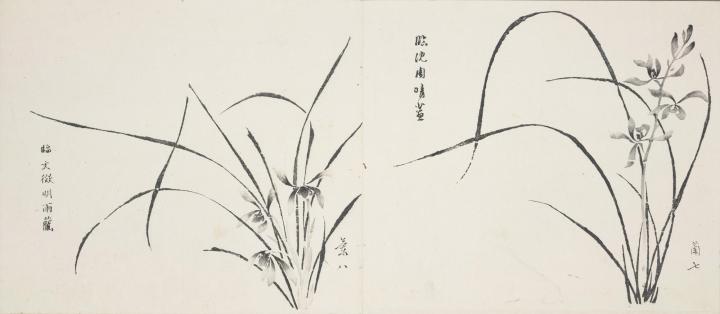
Lotus Leaf, Lotus Root, and Two Jitou Capsules, with calligraphy by Sun Yuwang, Fruit 10, from Ten Bamboo Studio Manual of Calligraphy and Painting, compiled and edited by Hu Zhengyan; woodblock-printed book, ink and colors on paper, each page 9 7/8 × 11 1/4 inches (San Marino: Huntington Library, Art Collections and Botanical Gardens)
◊ ◊ ◊ ◊ ◊
The founding curator of The Huntington’s Chinese Garden, June Li, is co-curator of the exhibition and co-author of the catalog, along with Chinese woodblock print specialist Suzanne Wright, associate professor of art history at the University of Tennessee.
Gardens, Art, and Commerce in Chinese Woodblock Prints unites several interests at The Huntington. It is the home of one of the most extensive collections of early printed books in the nation, various collections of prints by European and American artists, and one of the largest Chinese scholar’s gardens outside of China.
“This exhibition is utterly evocative of The Huntington’s transdisciplinary nature,” said Laura Skandera Trombley, Huntington president. “Woodblock prints were formative communication and aesthetic tools that served a number of purposes over time, from disseminating Buddhist teachings to depicting ideals of beauty. This perfect fusion of art and language, an integration of emotion and intellectual pursuit, is evidenced in The Huntington’s art and library collections, and is embodied in our stunning Suzhou-style Chinese Garden. We are enormously grateful for June Li’s commitment and guiding vision for this extraordinary exhibition.”
During the late Ming (1368–1644) and early Qing (1644–1912) dynasties, an increase in wealth, stemming in part from the salt, rice, and silk industries, led to higher levels of literacy and education. Consumer demand for printed words and images increased as merchants and scholars looked for ways to display their taste in drama, poetry, literature, and art. For these elites, gardens were central to a cultured life, appearing frequently in woodblock prints as subject or setting. By the 1590s, several enterprising publishers were successfully meeting the strong demand for woodblock prints. They hired renowned designers, carvers, and printers to produce sophisticated and exquisite works, raising the standards of printmaking. During the last decades of the Ming dynasty, several centers of printing around the lower Yangzi River delta grew in reputation, ushering in a golden age of Chinese pictorial printing.
“In the realm of Chinese art, pictorial woodblock prints are not as familiar as paintings, calligraphy, or ceramics,” said Li. “The subject of woodblock prints usually brings to mind Buddhist icons, Daoist deities, or folk images, rather than refined and artistic works. But, over the past few years, scholars researching the historical and artistic aspects of these prints have re-introduced a trove of beautiful works that are highly accomplished.”
Building on this story, Gardens, Art, and Commerce in Chinese Woodblock Prints is organized into thematic sections with explanatory panels in both English and Chinese. In the first gallery visitors will find an impressive nine-and-an-half-foot long hand scroll that was commissioned by the Song emperor Taizong (r. 976–97). An unusual Buddhist work that depicts landscape rather than images of deities, it is the earliest and only religious work in the exhibition, showing the lofty achievements of woodblock printers by the 10th century, with enormous clarity of line and painstaking attention to the details of mountains, streams, trees, and tiny figures. The accomplishments of such early printing established the technical foundation from which later Ming and Qing artists grew. Illustrations of the Garden Scenery of the Hall of Encircling Jade, an extraordinary set of 45 prints produced around 1602 to 1605, will be displayed in facsimile (the only evidence that remains of the original). Taken as a whole, the prints illustrate the enormous garden estate of a successful merchant, scholar, and book publisher of the early 17th century. The detailed prints show what seems to be acres of a fashionable garden, with a large, elegant hall framing scholars seated in conversation; a courtyard where figures re-enact a famous poetry game around a table; an enclosure for carefully sculpted penjing (bonsai trees); and more than a hundred names inscribed on buildings, ponds, and rocks. The print has an elevated viewpoint and changing perspectives that allow glimpses into interior spaces, revealing a cultivated life of books and men in scholars’ robes deep in discussion.
The exhibition next focuses exclusively on prints about gardens, both historical and fictional. Historical gardens include famous sites recorded by emperors, such as Suzhou’s Lion Grove, a popular tourist destination to this day. Another imperial work, a scroll more than 25 feet long (six feet of which will be displayed), shows urban gardens and the bustle of daily life in 18th-century Beijing.
The effects of exchanges between European missionaries and the Chinese also are explored in the exhibition. One publisher incorporated biblical illustrations into his ink catalog, produced around 1616. The Qianlong emperor in 1783–86 commissioned a set of large copperplate engravings in a European style that showed details of the European pavilions in his private retreat.
Another section of the exhibition explores the styles of print artists from the late 16th through the 18th centuries in publishing centers such as Hangzhou, Huizhou, Wuxi, and Suzhou. On view are several examples by different publishers illustrating a single popular story, The Story of the Western Chamber, making clear their varying visual and artistic interpretations. In some cases, prints were made to resemble known paintings. Sometimes famous painters, such as Chen Hongshou (1598–1652), designed works expressly for printing. The exhibition includes a rare early edition of Chen’s version of The Story of the Western Chamber, as well as a set of cards he designed for a drinking game.
The exhibition also looks at accomplishments in multi-color and embossed printing, such as beautifully printed guides offering suggestions for cultivating taste. These manuals prescribed appropriate pastimes for a cultivated life, instructed on calligraphy, and advised on chess strategy and drinking games for men, and embroidery patterns for women. They also illustrated musical and dramatic works such as the popular Peony Pavilion. Many of these leisure activities took place in the garden, and prints showing scholar’s rocks, which had become precious items for the discerning collector, will be represented by finely printed editions of well-known works including a rare edition of The Stone Compendium of Plain Garden. Two examples of actual scholar’s rocks from The Huntington’s collection will be on view to complement the book.
Additionally, four iPads in the galleries will allow for a deeper investigation of Illustrations of the Garden Scenery of the Hall of Encircling Jade (a work showing the large garden estate of the successful merchant and publisher Wang Tingna) and allow visitors to see all the leaves of The Huntington’s Ten Bamboo Studio Manual of Calligraphy and Painting, a work that due to its delicate nature can only be viewed a few leaves at a time in the galleries.
Visitors of all ages can view Chinese woodblock printing techniques in a gallery featuring a replica of a printing table, along with carving tools, colored inks, paper, brushes, and burnishers. To better understand the multi-color printing process, a set of woodblocks and step-by-step prints replicating a page of the Ten Bamboo Studio Manual will be on view, a display commissioned from the Shanghai publisher Duo Yun Xuan especially for the exhibition.
T. June Li and Suzanne E. Wright, Gardens, Art, and Commerce in Chinese Woodblock Prints (San Marino: The Huntington Library, Art Collections, and Botanical Gardens, 2016), 176 pages, ISBN 978-0873282673, $50.
June Li details the origins and provenance of The Huntington’s Ten Bamboo Studio Manual of Calligraphy and Painting, a landmark of multi-block color printing, with particular emphasis on its appeal to 18th- and 19th-century Japanese collectors. Suzanne Wright traces the development of three distinct regional styles of woodblock-printed illustrations during the late Ming dynasty, with striking examples of each style drawn from the exhibition. The 176-page volume, published by The Huntington, features more than 150 illustrations, including full-color plates of each work in the exhibition.
◊ ◊ ◊ ◊ ◊
Exhibition Symposium | Word and Image: Chinese Woodblock Prints
The Huntington, San Marino, CA, 12 November 2016
The late Ming period witnessed an unprecedented production of woodblock images printed for many different purposes, including illustrations for drama and games, decorations for stationery paper or ink making, as well as pictorial works for the market. This symposium will explore the relationship and interaction between image and text in woodblock prints during the late Ming and early Qing periods. Register online here.
• Kai-Wing Chow (University of Illinois at Urbana-Champaign), “Nature, Print, and Art: Commerce and Garden Culture in Late Imperial China”
• He Yuming (University of California, Davis), “Illustrating Encyclopedic Knowledge in the Ming”
• Richard Strassberg (University of California, Los Angeles), “The Kangxi Emperor’s Thirty-Six Views: The Making of an Imperial Publication”
• Meng-ching Ma (National Tsing Hua University, Taiwan), “‘Poetic Pictures’ in Late-Ming Illustrated Dramatic Publications”
• Suzanne Wright (University of Tennessee, Knoxville), “The Swallow Messenger: Text and Image”
• Hu Jun (Northwestern University), “A Panoply of Metaphor: Painting and Intermediality in the Late Ming”
Exhibition | Rooms Hidden by the Water: Photographs from Venice

◊ ◊ ◊ ◊ ◊
From Kansallis Museo Finland:
Rooms Hidden by the Water: Photographs from Venice by Jaakko Heikkilä
National Museum of Finland, Helsinki, 29 April — 28 August 2016
The exhibition features approximately 50 photographs by Jaakko Heikkilä, taken between 2005 and 2015 in the palaces of Venetian nobility along with Venetian furniture from the late 1800s from the National Museum’s collections.
Jaakko Heikkilä (b. 1956) is an observer, renowned for photographing people and groups of people around the world. Heikkila photographs people in their own environment: at home, working, at museums, or as flickering shadows on walls. Heikkilä started photographing the Venetian nobility through a friend who opened the doors of the first palace for him. The photographs offer a unique opportunity to peek inside the palaces of the decreasing Venetian nobility and meet the residents and their life stories.
The Venetian nobility live a somewhat isolated life that is bound and protected by their history. The nobility consists of merchants from La Serenissima, the golden age of the Republic of Venice, which existed from the 500s to 1797. They represent Old Europe, the lost world, which is disappearing under the waves just like Venice is due to climate change.
Jaakko Heikkilä, Barone Alberto Franchetti, Alex Snellman, and Minerva Keltanen, Rooms Hidden by the Water: Photographs from Venice by Jaakko Heikkilä (Helsinki: Maahenki, 2016), 131 pages, ISBN: 978-9516162723, €43.










leave a comment