Exhibition | Sylvester Schedrin and the Posillipo School
On view at Saint Michael’s Castle:
Sylvester Schedrin and School of Posillipo: To the 225th Anniversary of the Artist
Mikhailovsky Castle, Saint Petersburg, 11 August — 1 November 2016

Sylvester Schedrin, New Rome, Castle St.Angelo, c. 1823, oil on canvas, 47 x 60, the State Russian Museum.
Silvester Schedrin (1791–1830) is a prominent master of Russian landscape of romanticism epoch. He was one of the first masters who started making landscapes directly from nature, reflecting the vision of the air and light and the idea of the unity of man and nature. His works were highly praised by the contemporaries and heirs, becoming the classics of the Russian school of landscape painting.
From 1818 until his death, Schedrin lived in Italy and sent the works he made there to the motherland. While working in Rome and Naples and their environs Schedrin communicated with local artists and influenced the southern-Italian landscape school— the so-called Posillipo school—that united various artists from Italy, Germany and Holland (Antonis Pitloo, Giacinto Gigante, and others).
The exhibition will comprise around 100 pieces of art by Schedrin and painters of the Posillipo school from the Russian Museum and other museum collections. The exhibition will present the oeuvre of this brilliant representative of Russian landscape school together with paintings of his European contemporaries.
Exhibition | Feeding the 400
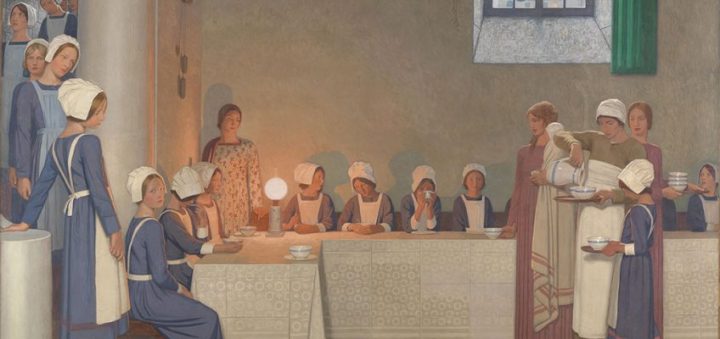
Frederick Cayley Robinson, Orphan Girls Entering the Refectory of a Hospital, 1915, oil on canvas (London: Wellcome Library). According to Art UK (the operating name of the Public Catalogue Foundation), the picture is one “in a set of four allegorical paintings on the theme of the ‘Acts of mercy’ commissioned from F. Cayley Robinson for the Middlesex Hospital in 1912. The hospital was demolished in 2008 and the paintings were acquired from the health authority in 2009.”
◊ ◊ ◊ ◊ ◊
From The Foundling Museum:
Feeding the 400
The Foundling Museum, London, 23 September 2016 — 8 January 2017
Curated by Jane Levi
Based on new research, guest curator Jane Levi presents the multi-faceted impact that food and eating regimes had on children at the Hospital from 1740 to 1950. This fascinating story is explored through art, archival material, photographs and the voices of former pupils, whose memories of food are captured in the Museum’s extensive sound archive.
Feeding the 400 explodes myths and misconceptions around eating at the Hospital, demonstrating how the institution’s food choices were far more than just questions of economy, nutrition and health. Working with historians, scientists and cultural practitioners, the exhibition brings alive the connections between what, when, where and why the foundlings ate what they ate; the beliefs and science that underpinned these decisions; and their physiological and psychological effects. Alongside archival material, paintings and objects including tableware from the Foundling Museum collection, a newly commissioned sound work evokes the experience of communal eating, conjuring sounds common to the Hospital’s dining rooms. Feeding the 400 is supported by a Wellcome Trust People Award.
Display | So That They May Be Usefull to Themselves
Opening in November at The Foundling Museum:
So That They May Be Usefull to Themselves
The Foundling Museum, London, 15 November 2016 — 7 May 2017
This display in the Introductory Gallery explores the Foundling Hospital’s work with disabled children. The Foundling Hospital was ground-breaking in its approach to access, as shown by the education and care it gave to disabled children in its custody. In some cases this led to lifelong support, even into old age. Curated by the Museum’s volunteers, this in-focus display explores their treatment of disability at the Foundling Hospital in the eighteenth and nineteenth centuries, alongside stories of former pupils.
Exhibition | In Pursuit of Pleasure: The Polite and Impolite

Now on view at Fairfax House:
In Pursuit of Pleasure: The Polite and Impolite World of Georgian Entertainment
Fairfax House, York, 29 July — 31 December 2016
From exotica to erotica, In Pursuit of Pleasure opens a window onto the outrageous and sometimes shocking behaviour of ‘polite society’—conducted in the name of entertainment.
Fairfax House’s major summer exhibition will look at the social scene in English towns and cities including London, delving into the tempting array of decadent activities and pleasurable pursuits catering for all tastes and predilections, sometimes challenging the notions of what ‘polite’ entertainment encompassed in the eighteenth century. In Pursuit of Pleasure also specifically uncovers the richness of Georgian York’s offerings as the social capital of the North and the place to see and be seen. With Burlington’s exquisite new Assembly Rooms, the excitement of the races, as well as the city’s renowned Theatre Royal, the city enjoyed a social and cultural renaissance. The explosion of luxury retail experiences combined to make York the destination of choice for those in pursuit of refined amusement. As well as exploring its lively winter season with rounds of dinners, balls, assemblies and parties, the exhibition delves into the city’s debauched diversions, including ‘polite’ society’s taste for notorious trials, visiting prisons and public hangings, the wanton pleasures available in the city’s brothels, as well as raucous activities such as cockfighting, bear baiting and street boxing. In exploring the full gamut of York’s lively social and cultural life In Pursuit of Pleasure reveals a fascinating world of the city’s exuberant, and often times murky, past.
The Fairfax House website includes images of objects in the exhibition, including a remarkable ivory dildo (more information on that here).
◊ ◊ ◊ ◊ ◊
2016 Georgian Studies Symposium
Polite and Impolite Pleasures: Entertaining the Georgian City
York Hilton Hotel and Fairfax House, York, 21 October 2016
Early registration ends 30 September 2016
The Georgian era saw a huge increase in the range and variety of entertainments available to an expanding and urbanising population. In the towns and cities of Georgian Britain, urban life offered a dazzling and constantly changing kaleidoscope of pleasures that could be enjoyed for a price. The lowest and the highest forms of entertainment were catered for along with everything in between, from the cultivated recreations of the nobility through the gentility of middle-class leisure to the earthier enjoyments of the ‘common folk’.
New cultures of entertainment reflected changing patterns of work, mobility and social relations, and reflected developments in class, gender and the dynamics of personal and collective identity. The urban environment itself was affected by these changing cultures of entertainment. From London to provincial centres, industrial cities to market towns, new promenades, parks, streets and squares were developed, new theatres, assembly rooms and concert halls were built and embellished. And paralleling this brightly-lit and orderly world of polite pleasure was another, darker urban realm of more dubious diversions: prostitution and prize fights, the gambling stew and the drinking den.
From theatrical performances and musical recitals, assemblies and dances, to race meetings, boxing matches, cock fights and hangings, the fourth Fairfax House Symposium in Georgian Studies explores the theme of Georgian entertainment and the ‘polite and impolite pleasures’ of the long eighteenth century (c.1680–1830).
Keynote Speakers
• Ivan Day (British and European culinary historian, scholar, broadcaster and writer)
‘Crocants, Collops, and Codsounds: Fashions in Dining and Food in Georgian Provincial Towns and Cities’
• Murray Pittock (Bradley Professor of English Literature, University of Glasgow)
‘Music, Theatre, Innovation, and Resistance: Edinburgh in the First Age of Enlightenment’
Exhibition | Real Time and Time of Reality: Clocks at the Pitti Palace
Opening this week at the Pitti Palace:
Real Time and Time of Reality: Clocks from the Pitti Palace
Tempo reale e tempo della realtà: Gli orologi di Palazzo Pitti dal XVII al XIX secolo
Palazzo Pitti, Florence, 13 September 2016 — 8 January 2017
Curated by Simonella Condemi and Enrico Colle

Amphora-shaped clock, made in Paris, 1810–20, gilt bronze (Florence: Museo Stibbert)
The exhibition will comprise a significant selection of roughly eighty clocks out of the almost two hundred pieces in the Palazzo Pitti’s collection, testifying to the passage of time for those whose daily lives were played out in the Florentine palace in the 18th and 19th centuries.
The selection of these singular objets d’art will allow visitors to admire the astonishing technical and artistic quality of these timepieces in the various different forms and formats in which they were produced, revealing their duality comprising, on the one hand, an often sophisticated and complex mechanism, and on the other, a case which started out life as a cover for the mechanism but which gradually turned into a work of art in its own right.
Additional information (in Italian) and images are available here»
Exhibition | The Four Continents: Florentine Tapestries

Florentine tapestry after cartoons by Giovanni Camillo Sagrestani, The Continent of America, from a series of The Four Continents, ca. 1730s.
◊ ◊ ◊ ◊ ◊
Opening this month at the Pitti Palace:
The Four Continents: Florentine Tapestries after Drawings by Giovanni Camillo Sagrestani
I Quattro Continenti: Arazzi fiorentini su cartone di Giovanni Camillo Sagrestani
Palazzo Pitti, Florence, 27 September 2016 — 8 January 2017
Curated by Caterina Chiarelli and Daniele Rapino
On display will be four beautiful tapestries woven from cartoons by the painter Giovanni Camillo Sagrestani (1660–1731). It is one of the finest series realized by the Grand Ducal tapestry workshop, signed by the most skillful weavers of that time, among whom Vittorio Demignot (d. 1742), whose apprenticeship took place in Flanders. The Four Continents are represented with extravagant features and creative innovations that reflect the contemporary conception of cultural and historical identities of world lands. Comparable to the finest coeval French examples, their magnificent and elegant composition was largely appreciated: in particular, on the 20th of January 1739, they were used as decorative setup for the triumphal entry into Florence of the new Hapsburg-Lorraine Grand Duke, Francis II, and his wife Maria Teresa, future empress of Austria.
Exhibition | Character Mongers
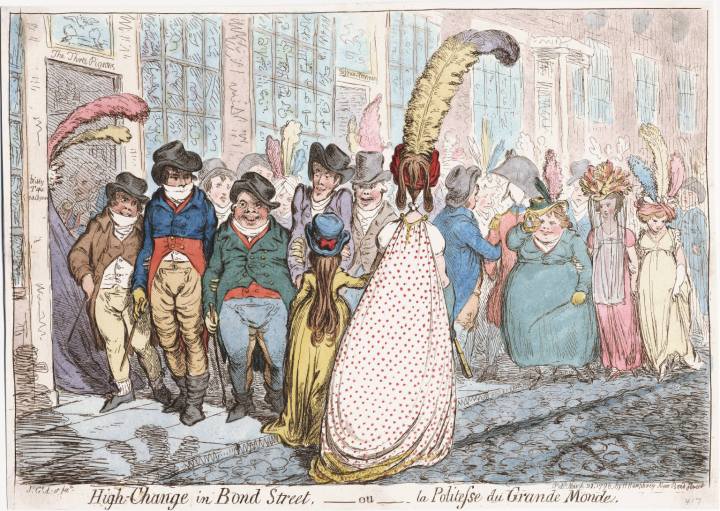
James Gillray, High Change in Bond Street, ou, La Politesse du Grande Monde, published March 27th 1796 by H. Humphrey, etching with hand coloring (The Lewis Walpole Library, 796.03.27.01+).
◊ ◊ ◊ ◊ ◊
From The Lewis Walpole Library:
Character Mongers, or, Trading in People on Paper in the Long 18th Century
The Lewis Walpole Library, Farmington, CT, 10 October 2016 — 27 January 2017
Curated by Rachel Brownstein and Leigh-Michil George
In the course of the long eighteenth century—the Age of Caricature, and of The Rise of the Novel—the British reading public perfected the pastime of savoring characters. In a flourishing print culture, buying and selling likenesses of people and types became a business—and arguably an art. Real and imaginary characters—actual and fictional people—were put on paper by writers and graphic artists, and performed onstage and off. The exigencies of narrative, performance, and indeed of community conspired to inform views of other people—friend and foe, fat and thin—as tellingly, characters. “For what do we live,” Jane Austen’s Mr. Bennet would ask rhetorically in 1813, “but to make sport for our neighbours and laugh at them in our turn?”
This exhibit will feature images by William Hogarth, James Gillray, Thomas Rowlandson, Thomas Patch, Edward Francis Burney, Francis Grose, and G.M. Woodward, excerpts from novels by Jane Austen, Frances Burney, Henry Fielding, and Laurence Sterne, and examples of graphic collections published by Matthew and Mary Darly and Thomas Tegg that marketed caricature as entertainment.
◊ ◊ ◊ ◊ ◊
Public Talk | Eating People
Rachel Brownstein (Professor Emerita, Brooklyn College and The Graduate Center, CUNY)
The Lewis Walpole Library, Farmington, CT, Wednesday, 16 November 2016, 7:00pm
Offered in collaboration with the Farmington Libraries. Advance registration required.
◊ ◊ ◊ ◊ ◊
Graduate Student Seminar | Character and Caricature
Rachel Brownstein (Professor Emerita, Brooklyn College and The Graduate Center, CUNY)
The Lewis Walpole Library, Farmington, CT, Friday, 18 November 2016
Caricature relies on a double take: you recognize both the person represented and the artist’s critical, comic view, register both the familiar and the strange. Basic to what E.H. Gombrich called “the cartoonist’s arsenal” is the contrast between extremes, differences in scale (fat and thin, short and tall) that define a character in relation to another (the thing it is not). Pairings proliferate, sometimes by accident, always by design.
History has a hand in the process. The fathers of Charles James Fox and William Pitt were also political rivals, and Fox in fact was plump and Pitt skinny. But as Simon Schama imagines it, the artist James Gillray, commissioned in 1789 to produce a formal portrait of Pitt, could not but see him with a caricaturist’s eye, as “angular where Fox was sensual, repressed where Fox was spontaneously witty, … the upper lip stiff as a board, where both of Fox’s were fat, shiny cushions.” Schama speculates, “How could he resist? He didn’t. The ‘formal portrait’ looked like a caricature, or at the very least a ‘character.’” Is the one a version of the other?
Coming with different questions from different disciplines, we will consider caricatures by Gillray and others, bringing fresh perspectives to the questions they raise about the relation of caricature to character and to being ‘a character,’ as well as to the trick of contrast, to historical context, and to point of view.
The program is open by application. Preference will be given to graduate students. For further details contact Cynthia Roman, cynthia.roman@yale.edu. Yale Shuttle to and from New Haven. Accommodation at the Library’s Timothy Root House may be available at no charge upon inquiry.
◊ ◊ ◊ ◊ ◊
Talk with Edward Koren
Edward Koren (Cartoonist, The New Yorker Magazine)
Sterling Memorial Library Lecture Hall, New Haven, 13 December 2016, 5:30pm
“In my cartoon drawings, I like getting things right… What captures my attention is all the human theater around me. I can never quite believe my luck in stumbling upon riveting minidramas taking place within earshot (and eyeshot), a comedy of manners that seem inexhaustible. And to be always undercover makes my practice of deep noticing more delicious. I can take in all the details as long as I appear inattentive—false moustache and dark glasses in place. All kinds of wonderful moments of comedy happen right under my nose…”
On Cartooning, by Edward Koren
Edward Koren’s iconic images record the comedy of manners in society and politics that have captured his attention for decades. In this talk, he will reflect on his career as a New Yorker artist, and on the many and diverse influences that have contributed to the development of his thinking and drawing.
◊ ◊ ◊ ◊ ◊
The Art of Observational Satire: A Conversation
Rachel Brownstein and Edward Koren, moderated by Cynthia Roman
Beinecke Rare Book and Manuscript Library, New Haven, Friday, 14 December 2016, 2:00pm
Edward Koren, a long-time cartoonist, and Rachel Brownstein, a literary scholar, will reflect on the enduring tradition of social satire. Space is limited. Please register in advance.
Note (added 17 October 2016) — The original posting incorrectly listed the 13 December talk as scheduled for mid-afternoon. My apologies for any confusion –CH.
Exhibition | Fragonard: Un Provençal aux Pays-Bas
Now on view at the Villa-Musée Fragonard:
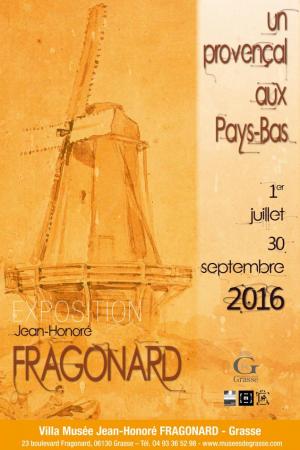
Fragonard: Un Provençal aux Pays-Bas
Villa-Musée Jean-Honoré Fragonard, Grasse, 1 July — 30 September 2016
 Grasse et Fragonard, l’association semble évidente et pourtant la réalité est plus complexe. Certes Jean-Honoré Fragonard naît à Grasse en 1732 dans une famille modeste d’ouvriers gantiers, cet artisanat grassois qui, depuis le XVIIe siècle, accompagne et est aussi pour partie à l’origine du développement de l’activité liée au parfum dans la ville. Mais dès ses six ans, en 1738, toute la famille quitte la ville pour s’installer à Paris. Par la suite nous n’avons ni témoignages ni documents écrits qui pourraient faire supposer un retour ou un séjour du peintre dans sa ville natale. Cela jusqu’en février 1790, où Alexandre Maubert, son cousin, consigne, avec précision dans son livre de compte, un loyer mensuel que Fragonard lui verse pour loger avec sa femme et sa belle-soeur, Marguerite Gérard, dans sa bastide à un jet de pierre de l’entrée de Grasse. L’année suivante les Fragonard retournent à Paris, leur présence est confirmée dans la capitale en août 1793 par un document bancaire. Rien n’établit ensuite que le peintre revienne à Grasse. Il meurt le 22 août 1806 après une promenade sur le Champs de Mars à Paris. Six ans puis une grosse année : certes deux périodes cruciales dans la vie du peintre, mais c’est au final assez peu.
Ajoutons à cela la théorie, paradoxalement uniquement défendue localement, avec aplomb, depuis les années 1980, que les travaux de décoration de la cage d’escalier de la Villa Maubert n’étaient pas de la main de Jean-Honoré mais de son fils, le musée Fragonard rebaptisé Musée d’Art et d’Histoire de Provence en 1977, de trop rares expositions consacrées au peintre, une en 1957, une autre en 2006, voilà que progressivement semble s’éloigner la présence du peintre à Grasse. Pourtant la Villa Maubert, transformée en Villa Musée Fragonard par la ville, conserve un trésor. En ses murs ce sont les derniers feux créateurs du peintre en cette fin du XVIIIe siècle que l’on peut encore admirer aujourd’hui. Ce patrimoine, dont l’histoire est complexe et mal documentée, est unique et original, il justifie pleinement de mettre en lumière Jean- Honoré Fragonard dans la capitale des parfums.
Avec cette première exposition d’été, Un Provencal aux Pays-Bas, c’est ce que les musées de Grasse veulent réaffirmer en s’efforçant d’initier un nouveau cycle de travaux et de recherches consacré à cet enfant du pays grassois.
◊ ◊ ◊ ◊ ◊
The catalogue is available from Artbooks.com:
Marie-Anne Dupuy-Vachey, Fragonard: Un Provençal aux Pays-Bas (Milan: Silvana, 2016), 32 pages, ISBN: 978-8836633388, $23.
 Né à Grasse en 1732, à quelques lieues de la frontière italienne, Fragonard ne pouvait qu’être séduit par les paysages méditerranéens comme ses deux séjours dans la péninsule en témoignent. Mais le peintre a aussi exploré des territoires plus septentrionaux. A l’instar des amateurs de son temps, Fragonard fut très attiré par la peinture flamande et hollandaise du XVIIème siècle. Tout au long de sa carrière il entretint un dialogue fructueux avec les maîtres du passé, étudiant et copiant les toiles de Rembrandt et de Rubens, les paysages de Ruysdael. Il en vint même à absorber leur style et leur technique au point de les pasticher tout en restant lui-même. Cette pratique fut stimulée par des voyages, dont un documenté en 1773, qui le mena de Paris à Amsterdam en passant par Bruxelles, Malines, Anvers et La Haye. Les collections de la ville de Grasse, complétées par des prêts de collections publiques et privées, offrent l’occasion de se pencher sur cet aspect moins connu de l’auteur du Verrou et des Hasards heureux de l’escarpolette.
Exhibition | Fragonard: Drawing Triumphant

Jean Honoré Fragonard, Rinaldo in the Enchanted Forest, ca. 1763; brown wash over very light black chalk underdrawing; 33.5 × 45.7 cm
(New York: The Metropolitan Museum of Art, 2009.236).
◊ ◊ ◊ ◊ ◊
Press release (2 August 2016) from The Met:
Fragonard: Drawing Triumphant—Works from New York Collections
The Metroplitan Museum of Art, New York, 6 October 2016 — 8 January 2017
Curated by Perrin Stein
Jean Honoré Fragonard (French, 1732–1806)—one of the most forward-looking and inventive artists of the 18th century—was equally skilled in painting, drawing, and etching. Yet, unlike many old masters for whom drawing was a preparatory tool, Fragonard explored the potential of chalk, ink, and wash to create sheets that were works of art in their own right. As displays of virtuosity and an imaginative spirit, his drawings were highly prized from his own day to the present, and New York has long been a center for collecting these works.
The exhibition Fragonard: Drawing Triumphant—Works from New York Collections, opening October 6 at The Metropolitan Museum of Art, will celebrate the artist’s achievements as a master draftsman. A similar brio and inventiveness mark the artist’s etchings, and examples of these will also be featured. Among the 100 works on paper on view, nearly half are from private collections, some of which will be shown publicly for the first time. The exhibition will thus provide a rare opportunity to see well-loved masterpieces alongside new discoveries and works that have long been out of the public eye.
Fragonard’s career took place in the later 18th century when the role of drawing was undergoing a critical transformation. No longer regarded solely as a step in the genesis of another work, drawings were appreciated by a growing audience as original works by the artist’s hand, precious manifestations of creative inspiration. As the century progressed, sheets by living artists appeared at public auctions with growing frequency, suggesting either that they were made for the market as independent works of art or that the value assigned to such works provided an incentive for artists to part with them.
The freedom and speed afforded by chalk or wash on paper were particularly suited to Fragonard’s improvisational talents and allowed his creative genius to shine. Among the subjects for which he is best known are joyful images of daily life, portraits, and landscapes, as well as episodes from the Bible and from diverse works of literature, ranging from the fantastic to the licentious. The frolicking children, young lovers, and sunlit gardens that sprang from his imagination are not weighed down by specificity or detail, but rather speak to the universality of such themes.
By uniting works in The Met collection with loans from other New York City museums and private collections, the exhibition will represent Fragonard’s entire range and achievement as a draftsman at the highest level. The selection will embrace the full spectrum of his career as well as all the genres in which he worked. In technique, they range from the most spontaneous sketches to highly worked studio pieces, intended to be framed and displayed.
The exhibition will follow the chronology of the artist’s life, from his early training in Paris in the studio of François Boucher, to his training at the French Academy in Rome, to his return to the French capital, and ultimately to his break with the official arts establishment. By spurning royal patronage in order to work for private clients, Fragonard gained the freedom to choose his own subjects and formats, thus contributing to our modern view of the artist as innovative and independent. Groupings within this chronological framework will illuminate Fragonard’s practice of revisiting themes and compositions he had already explored to create new works in a different medium or technique. Cross-fertilization and play between media were central to his working method.
A highlight will be the display of all five of the works on paper—three drawings, an etching, and a gouache—related to his famous composition The Little Park (Le petit parc). The constellation of works on this subject will be reunited for the first time since the artist’s lifetime, providing important insight into his working methods. Also on view will be many pairs of works whose compositions echo one another, experimental variations on themes, often in different media.

Jean Honoré Fragonard, A Gathering at Wood’s Edge, ca. 1770–73; red chalk, 37.5 × 49.2 cm
(New York: The Metropolitan Museum of Art, 1995.101).
◊ ◊ ◊ ◊ ◊
Four major sheets acquired by The Met in recent years will also be featured. A Gathering at Woods’ Edge depicts a lush scene of well-dressed visitors finding respite at the shady entrance of a sunlit grove of trees, rendered in a vibrant yet precise manner in red chalk, also called sanguine. Later and equally masterful are two large-scale studies of fishermen drawn at the edge of the sea in Naples, where Fragonard visited in 1774. Acquired in 2009, Rinaldo in the Enchanted Forest is fueled more by imagination than by observation, as Fragonard used layers of fluidly applied gold-brown wash to produce, seemingly effortlessly, the dramatic tenor of a brave warrior battling magical creatures.
The exhibition is organized by Perrin Stein, Curator in the Department of Drawings and Prints. Exhibition design is by Brian Oliver Butterfield, Senior Exhibition Designer; graphics are by Chelsea Amato, Graphic Designer; lighting is by Amy Nelson, Lighting Designer, all of the Museum’s Design Department.
Fragonard: Drawings Triumphant—Works from New York Collections is one of a series of exhibitions and programs organized to celebrate the centennial of the Department of Prints and Drawings at The Met, one of the most comprehensive and distinguished collections of works of art on paper in the world. The centennial began in January 2016.
◊ ◊ ◊ ◊ ◊
Distributed by Yale UP:
Perrin Stein, with contributions by Marie-Anne Dupuy-Vachey, Eunice Williams, and Kelsey Brosnan, Fragonard: Drawing Triumphant (New York: The Metropolitan Museum of Art, 2016), 320 pages, ISBN: 978-1588396013, $65.
One of the most forward-looking artists in 18th-century France, Jean-Honoré Fragonard (1732–1806) is considered the preeminent draftsman of his time. This fresh assessment of the artist focuses on the role of drawing in his creative process and showcases Fragonard’s mastery and experimentation with drawing in a range of media, from vivid red chalk to luminous brown wash, as well as etching, watercolor, and gouache. Unlike many old master painters, Fragonard explored the potential of drawings as works of art in their own right, ones that permitted him to work with great freedom and allowed his genius to shine. The drawings featured here come from public and private collections in New York, balancing a mix of well-loved masterpieces, new discoveries, and works that have long been out of the public eye.
Perrin Stein is a curator, Department of Drawings and Prints, The Metropolitan Museum of Art. Marie-Anne Dupuy-Vachey is an independent art historian based in Paris. Eunice Williams is an independent scholar. Kelsey Brosnan is research assistant, Department of Drawings and Prints, The Metropolitan Museum of Art.
Exhibition | Rembrandt’s Shadow: England and the Black Art
Upcoming exhibition at the Staatsgalerie Stuttgart:
Rembrandt’s Shadow: England and the Black Art
Rembrandts Schatten: England und die Schwarze Kunst
Staatsgalerie Stuttgart, 18 September 2016 — 8 January 2017

Richard Earlom, after Joseph Wright of Derby, An Iron Forge, detail, 1771, mezzotint (Staatsgalerie Stuttgart).
The œuvre of Rembrandt (1606–1669) was of key importance for the development of English art in the eighteenth century. The expressive orchestration of light in his paintings and particularly the radical chiaroscuro of his etchings were compared to the mezzotint, a method that emerged later and advanced to become the quintessential English printing technique (the ‘English Manner’). Also referred to as the ‘black art’ on account of its strong light-dark contrasts, the mezzotint has always possessed a mysterious and magical quality. Particularly Rembrandt’s portraits had a great influence on England’s most prominent artists, for example Sir Joshua Reynolds. Rembrandt’s self-portraits, for their part, came to serve as models of artistic self-staging par excellence, and were often quoted. Rembrandt’s Shadow will thus embrace a compositional as well as a temporal component: the masterful chiaroscuro of his art and its aftereffect in eighteenth-century England.










leave a comment