Exhibition | Louis Style: French Frames, 1610–1792
◊ ◊ ◊ ◊ ◊
Press release for the exhibition now on view at The Getty:
Louis Style: French Frames, 1610–1792
The Getty Center, Los Angeles, 15 September 2015 — 3 January 2016
Curated by Davide Gasparotto, Anne Woollett, and Gene Karraker
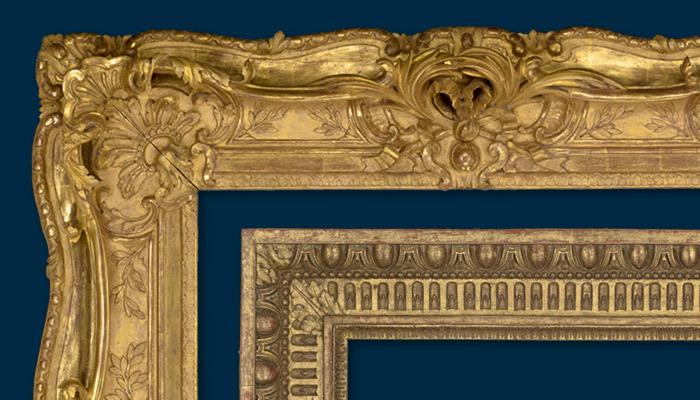
Louis Style: French Frames, 1610–1792 celebrates the dramatic stylistic transformation and technical skill of French frame making in the 17th and 18th centuries. Drawn from the J. Paul Getty Museum’s collection of antique frames, this exhibition presents an array of French design in wall furniture under four kings—from the simple moldings and Italian-inspired ornaments in the time of Louis XIII (1610–1643), to the opulent carved and gilded masterpieces in the age of Louis XIV (1643–1715), to the sculptural forms and rich finishes of the transitional period of the Régence (1715–1723) and Louis XV (1723–1774), and concluding with the restrained treatments preferred during the reign of Louis XVI (1774–1792).
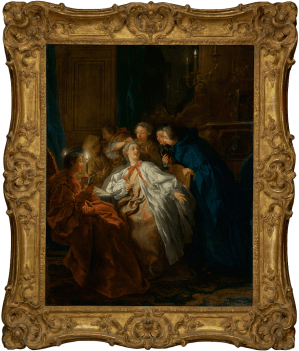
Jean-François de Troy, Before the Ball, 1735, oil on canvas, in a Louis XV frame, carved and gilded oak (The J. Paul Getty Museum)
Louis Style: French Frames, 1610–1792 will be the first exhibition devoted to frames at the Getty Museum. Featuring more than forty frames and framed paintings, Louis Style offers visitors the rare opportunity to consider in depth the types and function of this art form. The installation provides a rich compendium of French design and craftsmanship, along with practical tools, such as the vocabulary of ornament needed to identify the period of a frame, as well as insight into the construction and gilding techniques specific to frames made in France. By addressing the important relationship between a painting and its frame (which sometimes date from different periods and regions), visitors to the exhibition will also gain an awareness of the significance and use of frames in museums.
During the early 1600s through the 1700s—a golden age for frame-making in Paris—the functional surrounds for paintings became expressions of artistry, innovation, taste, and wealth. The primary stylistic trendsetters were the kings of France, whose desire for increasingly opulent forms of display spurred the creative efforts of brilliant designers and craftsmen to magnificent expressions of their personal styles. French frames of this period are distinguished by the use of oak and gold leaf as materials, and techniques of water gilding, elaborate carved ornamentation and varied finishes.
Over the course of several decades, the Museum has assembled a substantial group of period frames to enhance and appropriately display its paintings collection, resulting in a rich and varied assemblage of moldings. Enduring visitor interest in frames and framing led to the publication of D. Gene Karraker’s Looking at European Frames: A Guide to Terms, Styles and Techniques (J. Paul Getty Museum, 2009), illustrated exclusively by works in the collection. The celebration of the 300th anniversary of the death of Louis XIV this year, marked by two major loan exhibitions at the Getty Center, provides the opportunity to present one of the largest and most beautiful areas of the frame collection.
Louis Style: French Frames, 1610–1792 was organized by Senior Curator of Paintings and Department Head, Davide Gasparotto, Curator of Paintings, Anne Woollett, and Associate Conservator of Frames, Gene Karraker.
Exhibition | La Fibre des héros, l’Histoire racontée par la Toile de Jouy
Now on view at the Musée Lambinet:
La Fibre des héros, l’Histoire racontée par la Toile de Jouy
Musée Lambinet, Versailles, 19 September — 20 December 2015
 Dans le cadre des commémorations nationales du bicentenaire de la disparition de Christophe-Philippe Oberkampf (1738–1815), fondateur de la manufacture de Jouy, le musée Lambinet présente l’exposition La fibre des héros. Celle-ci propose de retrouver, grâce à la toile imprimée, le reflet des idéaux et des événements qui ont intéressé la société à la fin du XVIIIe siècle et dans la première moitié du XIXe siècle. Les toiles à personnages, fidèles aux canons néo-classiques en vogue à leur époque, représentent souvent des héros antiques. D’autres toiles mettent en scène des épisodes et héros du monde littéraire, militaire ou scientifique contemporain. Reflets de l’actualité, elles montrent aussi le vol des premiers aérostats ou encore des combats navals marquants. Ces décors ultra-narratifs ont été principalement produits par la manufacture de Jouy-en-Josas, mais aussi les manufactures de Rouen, de Nantes ou de Mulhouse. Empruntées majoritairement au musée de la toile de Jouy, à Jouy-en-Josas, les toiles exposées forment un complément de l’exposition Christophe-Philippe Oberkampf, 1738–1815: Les toiles de Jouy, une aventure humaine, industrielle et artistique, qui se tient à Jouy du 15 septembre au 27 décembre 2015.
Exhibition | Oberkampf: Les Toiles de Jouy
Now on view at the Musée de la Toile de Jouy:
Christophe Phillipe Oberkampf. Les toiles de Jouy: Une aventure humaine, industrielle et artistique
Musée de la Toile de Jouy, Jouy-en-Josas, 15 September — 27 December 2015
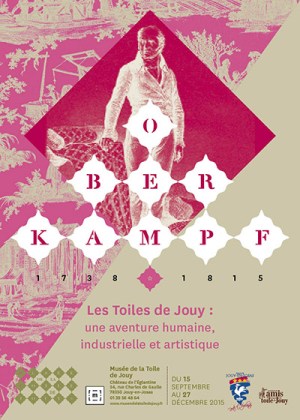 Pour tout savoir sur l’histoire de Christophe-Philippe Oberkampf et la façon dont il a fait de la Toile de Jouy un produit mondialement connu, le musée propose un parcours chronologique qui relate l’ascension de ce fils d’un teinturier allemand, né en 1738 et devenu un des pionniers de la révolution industrielle. Arrivé à Paris comme simple ouvrier, peu instruit (il le déplorera toute sa vie) mais visionnaire, Oberkampf fit de la manufacture qu’il fonda à Jouy-en-Josas la deuxième entreprise de France à la fin de l’Ancien Régime. Toujours à l’avant-garde des progrès techniques, il sut par ailleurs s’entourer de peintres talentueux, comme Horace Vernet ou Jean-Baptiste Huet, pour imaginer les motifs de ses toiles. L’exposition raconte cette histoire, ou comment les Toiles de Jouy ont supplanté les ‘palampores’, ces toiles indiennes importées des lointains comptoirs et comment elles ont conquis toutes les couches de la société, participant à une démocratisation de la mode et de la décoration, grâce à l’industrialisation des procédés inventée par Oberkampf.
Exhibition | Simeon De Witt: Mapping the Revolution
From the exhibition press release (23 September 2015). . .
Simeon De Witt: Mapping the Revolution
Zimmerli Art Museum, Rutgers, New Brunswick, New Jersey, 1 September 2015 — 31 July 2016
Curated by Jenevieve DeLosSantos with Donna Gustafson

Ezra Ames, Portrait of Simeon De Witt, 1804 (Zimmerli Art Museum at Rutgers, photo by Jack Abraham)
When General George Washington led troops into colonial New Jersey during the early months of the Revolutionary War, he did not have access to an app—or even adequate drawings on paper—to guide him across the region. But in 1776, Simeon De Witt (1756–1834), the sole graduate that year from Rutgers (then known as Queen’s College), joined the Continental Army to fight the British. As a signature project of Rutgers 250, the year-long celebration of the university’s founding in 1766, the Zimmerli Art Museum presents Simeon De Witt: Mapping the Revolution, on view through July 31, 2016. The exhibition honors De Witt’s crucial role during the Revolutionary War and, throughout the rest of his life, documenting the geography of New York State (he was a native of Ulster County). It also explores the practice of 18th-century cartography through his original maps and tools.
“As we get ready to celebrate the 250th anniversary of Rutgers in 2016, this exhibition reminds us of the important role that New Jersey and its citizens played in the colonies’ efforts to win their independence and form a new democracy,” observed Jenevieve DeLosSantos, who organized the exhibition while working as a graduate curatorial assistant at the Zimmerli and recently received her PhD in Art History from Rutgers. By 1780, De Witt was named surveyor general and sketched maps of New Jersey’s uncharted land, working directly under George Washington. His topographic renderings were a valuable resource to the Commander-in-Chief as he navigated the terrain and evaded British forces.
After the successful conclusion of the war, De Witt built a career with accomplishments that aided new Americans who were instrumental in the early stages of westward expansion. In 1784, De Witt was appointed Surveyor General of the State of New York, a post he held for 50 years. In 1802, he drafted the first large-scale map of the state to be printed. It was the most detailed to date—depicting newly established cities, towns, and county lines—and distributed to salons and offices as an accurate reference of the Empire State’s geography. An 1804 version of this map is on view, on loan from Special Collections and University Archives at Rutgers University Libraries. The map is accompanied by several of De Witt’s original drafting tools, on loan from the Albany Institute of History and Art, and a field compass commonly used during the era, also from Special Collections. These historical objects provide insight into the resources available to De Witt at the time.
The Zimmerli’s 1804 three-quarter length portrait of De Witt in a stately interior captures him in the prime of his life. He thoughtfully gazes beyond the frame of the image, surrounded by the tools of his profession: a telescope, a globe. De Witt’s hand rests on a table, with the top portion of the aforementioned map of New York State visible. That it was painted by the prominent portrait artist Ezra Ames (1768–1836), who lived in Albany, New York, indicates De Witt’s status as an accomplished and respected member of society. More than 700 portraits have been attributed to Ames; among them, Founding Father Alexander Hamilton and the first governor of New York, George Clinton.
The selection includes other items that indicate the popularity of Revolution-era subjects in fine art and popular culture during the nation’s early decades. The Zimmerli’s recently cleaned and conserved portrait of George Washington was painted by Jane Stuart around 1840. The daughter of the renowned portraitist Gilbert Stuart, she opened her own studio after his death in 1828 and sold her work; especially popular were replicas of her father’s portrait of the country’s first president. Also on view are prints that depict important battles in New Jersey during America’s War for Independence, including a map by English engraver William Faden that depicts the positions of Washington’s troops in New Jersey and Pennsylvania at the beginning of the war.
Simeon De Witt: Mapping the Revolution is organized by Jenevieve DeLosSantos, PhD Art History, Rutgers University and Graduate Curatorial Assistant, 2013–2015, with the assistance of Donna Gustafson, Curator of American Art and Mellon Director for Academic Programs. The exhibition is a signature project of Rutgers 250, a yearlong celebration beginning November 10, 2015, to mark the university’s 250th anniversary. Complete information and a list of related events can be found at 250.rutgers.edu.
The Jane Voorhees Zimmerli Art Museum houses more than 60,000 works of art, ranging from ancient to contemporary art. The permanent collection features particularly rich holdings in 19th-century French art; Russian art from icons to the avant-garde; Soviet nonconformist art from the Dodge Collection; and American art with notable holdings of prints. In addition, small groups of antiquities, old master paintings, as well as art inspired by Japan and original illustrations for children’s books, provide representative examples of the museum’s research and teaching message at Rutgers. One of the largest and most distinguished university-based art museums in the nation, the Zimmerli is located on the New Brunswick campus of Rutgers, The State University of New Jersey. Established in 1766, Rutgers is America’s eighth oldest institution of higher learning and a premier public research university.
Exhibition | The Italian Travels of Louis-François Cassas
Opening in November at the Musée des Beaux-Arts:
Voyages en Italie de Louis-François Cassas (1756–1827)
Musée des Beaux-Arts, Tours, 21 November 2015 — 22 February 2016
 Louis-François Cassas compte parmi les grands artistes voyageurs du XVIIIe siècle. L’exposition dévoile ici les dessins de l’artiste réalisés lors de son Grand Tour en Italie. Cette manifestation s’inscrit dans le thème transversal et séduisant du voyage et de l’Italie dans toute sa diversité archéologique, urbaine, insulaire… à la fin du Siècle des Lumières. La découverte récente de nombreux dessins inédits en Angleterre est venue confirmer l’opportunité de cette exposition : cinquante dessins prêtés par le National Trust et provenant de la collection du marquis de Bristol à Ickworth (Suffolk) seront montrés pour la première fois en France.
L’exposition s’articulera autour des deux grands voyages en Italie de L.-F. Cassas et de ses différents mécènes tous grands amateurs et collectionneurs, à l’origine de l’évolution de la carrière de l’artiste. Parmi les 116 œuvres exposées figurent des prêts de musées français et étrangers prestigieux : Paris : Bibliothèque Mazarine, Bibliothèque Nationale, Ecole Nationale Supérieure des Beaux-Arts, Fondation Custodia / New-York : Metropolitan Museum of Art / Londres : Victoria and Albert Museum, The National Trust : Ickworth (Suffolk), The Bristol Collection / Cologne : Wallraf-Richartz Museum / Vienne : Albertina Museum, et de collections privées.
Le premier voyage en Italie, 1778–83
Le Grand Tour pour le plaisir de dessiner
Grâce au mécénat du duc de Chabot, Cassas découvre l’Italie et peut obtenir une chambre d’externe à l’Académie de France à Rome. Seront évoquées les grandes étapes de cette pérégrination : Lyon, Genève, les Alpes, Bologne, Parme, Rome, Naples, Paestum… Invité à Venise au printemps 1782, puis à Trieste par le Baron Pittoni, Cassas travaille alors pour l’Empereur Joseph II jusqu’aux frontières de l’Empire ottoman. À l’automne 1782, Cassas part en Sicile travailler pour l’abbé de Saint-Non. Ses vues de Messine, de Catane, du Val di Noto… seront particulièrement remarquées.
Le second voyage en Italie, 1787–92
Les années romaines d’un artiste indépendant
Le nouveau mécène de Cassas, le comte de Choiseul- Gouffier (1752–1817), ambassadeur de France à Constantinople, permit à l’artiste de découvrir les provinces de l’Empire ottoman de 1784 à 1786. Désormais c’est dans son atelier à Rome, Piazza di Spagna, que Cassas accroche ses aquarelles de Palmyre, du Caire, de la Corne d’Or, de Chypre… qui suscitent l’admiration, notamment celle de Goethe, et des amateurs qui font le Grand Tour. Trois maquettes de monuments romains, provenant de la collection de Cassas, restaurées pour l’exposition : le Temple de la Fortune Virile, le Temple de Tivoli et l’Arc de Constantin, seront exceptionnellement présentées.
The catalogue will be available from Artbooks.com:
Sophie Join-Lambert, Louis-François Cassas (1756–1827): Ses Voyages en Italie et Ses Mécènes (Milan: Silvana Editoriale, 2015), 280 pages, ISBN: 978-8836631636, $65.
Exhibition | Bawdy Bodies: Satires of Unruly Women

◊ ◊ ◊ ◊ ◊
Opening next week at The Lewis Walpole Library:
Bawdy Bodies: Satires of Unruly Women
The Lewis Walpole Library, Farmington, CT, 24 September 2015 — 26 February 2016
Curated by Hope Saska and Cynthia Roman with contributions by Jill Campbell
Characterized by comically grotesque figures performing lewd and vulgar actions, bawdy humor provided a poignant vehicle to target a variety of political and social issues in eighteenth-century Britain. Bawdy Bodies: Satires of Unruly Women explores the deployment of this humorous but derisive strategy toward the regulation of female behavior. The exhibition will present satirical images of women from a range of subject categories including the royal family, aging members of fashionable society, disparaged mothers, political activists, gamblers, medical wonders, artists, performers, and intellectuals.
The exhibition is co-curated by Hope Saska, Curator of Collections and Exhibitions at the Art Museum of the University of Colorado, Boulder, and Cynthia Roman, Curator of Prints, Drawings, and Paintings at the Lewis Walpole Library, with contributions by Yale Professor of English Jill Campbell. It will be on view at the Lewis Walpole Library, 154 Main Street, Farmington, Connecticut, on Wednesdays from 2:00 to 4:30 pm and by appointment.
◊ ◊ ◊ ◊ ◊
P U B L I C L E C T U R E
Amelia Rauser | Rock, Paper, Scissors: Dimensionality and
Neoclassical Aesthetics in the Art and Fashion of the 1790s
28 October 2015, 5:30 pm, Sterling Memorial Library Lecture Hall
In the 1790s, women dressed in imitation of antique statuary. Yet most devotees of the style had never seen the originals they emulated; rather, they were inspired by print representations of them, and this process of translation—from three-dimensional sculptures into two-dimensional paper representations and then back into fabric gowns swathed around moving bodies—created several interesting effects, including a pronounced emphasis on contour. This lecture will discuss the way 1790s fashionable dress was mediated by print, and connect this phenomenon to the contemporary vogue for John Flaxman’s outline drawings and other aspects of neoclassical taste.
Amelia Rauser is the author of Caricature Unmasked: Irony, Authenticity, and Individualism in Eighteenth-Century English Prints (2008). Her new project, “Living Statues: Neoclassical Culture and Fashionable Dress in the 1790s—London, Paris, Naples,” is a study of the radical style of undress in the 1790s and its connection to contemporary aesthetic, political, and scientific thought. Dr. Rauser is Professor of Art History at Franklin & Marshall College.
G R A D U A T E S T U D E N T W O R K S H O P S
Limited enrollment by application
Jill Campbell (Yale University) | ‘We are an injured body’: Collectivity and the Female Body
2 October 2015, Lewis Walpole Library
Amelia Rauser (Frankin & Marshall College) | Expressive Bodies in Eighteenth-Century Satirical Prints
30 October 2015, Lewis Walpole Library
Details for all of these events can be found here»
Exhibition | Aristocratic Life in the Eighteenth Century
From the Musée National de la Renaissance:
Être et paraître, la vie aristocratique au XVIIIe siècle:
Trésors cachés du Musée national de la Renaissance
Château de La Roche Guyon, 11 April — 29 November 2015
Curated by Muriel Barbier
 Sortis exceptionnellement des réserves du musée national de la Renaissance, des objets d’art du XVIIIe siècle retracent en dix tableaux les thèmes majeurs de la vie aristocratique à l’époque des Lumières. Au travers de quatre-vingt-cinq oeuvres, le quotidien de l’aristocratie du XVIIIe siècle revit dans les grands salons du château de La Roche Guyon ornés de leurs lambris d’époque et dépourvus de mobilier.
Une journée ordinaire dans une demeure seigneuriale au siècle des Lumières. L’exposition, articulée en dix vitrines, suit le déroulement d’une journée de la haute société des Lumières, en abordant les thèmes suivants : toilette et soins, parure et élégance, arts de la table, lecture et écriture, jeux et divertissements, priser et fumer, ouvrages de dames, prières et dévotions, armes d’apparât et chasse. Cette présentation, entend faire comprendre la fonction de ces objets, la préciosité de leur décor et leur utilisation. Elle propose une autre approche des arts décoratifs non fondée sur l’évolution des stymes et des techniques mais sur l’histoire des civilisations et des moeurs.
Muriel Barbier, Être et paraître: La vie aristocratique au XVIIIe siècle (Artlys, 2015), 142 pages, ISBN: 978-2854956108, 18€.
Bénédicte Bonnet Saint-Georges reviewed the exhibition for La Tribune de l’Art (21 August 2015).
Exhibition | Le Roi est Mort!
As reported by the AFP:
 To mark the 300th anniversary of the Sun King’s death on Tuesday, the Palace of Versailles turned to modern-day town crier Twitter to relay his slow and agonising demise from gangrene. “Breaking News. Louis XIV passed away,” the palace said from its account @CVersailles at 0615 GMT (8:15am) on Tuesday, after livetweeting the king’s illness as if it were taking place today.
The hashtag #leroiestmort (“the king is dead” in English) was rolled out to mark the anniversary of his death at 76 years old on September 1, 1715. With 72 years on the throne, king Louis XIV was the longest-reigning monarch in European history, overseeing a period of glory in France in which he built the glittering palace west of Paris. . . .
The tweets will continue up to his funeral (the schedule is available here), all as a perfect build-up to the exhibition at Versailles, which opens next month:
The King Is Dead!
Châteaux de Versailles, 27 October 2015 — 21 February 2016
Curated by Béatrix Saule, Hélène Delalex, and Gérard Sabatier
Scenography by Pier Luigi Pizzi
The death of the king, both as a man and an institution, was a key moment in the construction of the public perception of the monarchy, combining religion (the death of a Christian) and politics (the death and resurrection of the king, who never dies). From his final death throes to the burial it resembled a performance, a great Baroque show of huge significance to courtly society, which was affected more than ever by it.
 The exhibition—the first on the subject—will look back on the details of the death, autopsy and funeral of Louis XIV, which strangely are little known, and to situate them in the funeral context of European sovereigns from the Renaissance period to the Enlightenment. It also discusses the survival—often paradoxical—of this ritual from the French Revolution to the contemporary era.
The exhibition will bring together works of art and historical documents of major importance from the largest French and foreign collections, including ceremonial portraits, funeral statues and effigies, gravestones, the manuscript for the account of the autopsy of the king, coins from the Saint-Denis Treasury, gold medals, emblems and ornaments, and furniture of funeral liturgy. Some of the pieces on display have never been exhibited in public.
Exhibiting these masterpieces has required grand scenography effects. Scenographer Pier Luigi Pizzi was asked by Béatrix Saule, the exhibition’s Head Curator, to design the layout for this great Baroque show. Across the nine sections, visitors will discover a veritable funeral opera conducted by the artist.
The subject of the exhibition will not fail to surprise, and is scientifically rigorous. It is based on an international research program on royal ceremonies in European Courts, undertaken over the course of three years at the Palace of Versailles Research Centre under the leadership of Professors Gérard Sabatier and Mark Hengerer and with the participation of a team representing a range of disciplines, from coroners to liturgists, from medieval to contemporary historians.
Curated by Béatrix Saule, Director and Head Curator of the Musée National des Châteaux de Versailles et de Trianon, assisted by Hélène Delalex Conservation Officer at the Musée National des Châteaux de Versailles et de Trianon, and Gérard Sabatier, Emeritus Professor. Scenography by Pier Luigi Pizzi.
Additional information is available at the exhibition website.
Exhibition | De Versailles à La Motte Tilly: L’abbé Terray
Press release for the exhibition now on view at the Château de La Motte Tilly:
De Versailles à La Motte Tilly: L’abbé Terray, Ministre de Louis XV
Château de La Motte Tilly, 29 May — 20 September 2015
Curated by Gwenola Firmin and Vincent Bastien
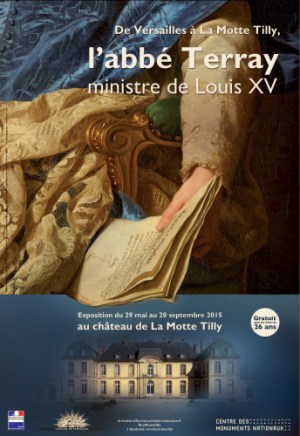 Après Sacres Royaux, de Louis XIII à Charles X au palais du Tau à Reims et Le salon de George Sand à Nohant, en 2014, la troisième exposition du partenariat entre le Centre des monuments nationaux et le château de Versailles se tiendra au château de La Motte Tilly (Aube) du 29 mai au 20 septembre 2015. Cette nouvelle exposition conjointe est consacrée à l’abbé Joseph Marie Terray (1715–1778), ministre des finances de Louis XV, à l’occasion du tricentenaire de sa naissance.
L’abbé Terray et La Motte Tilly
Joseph Marie Terray bénéficie, à ses début, de l’héritage financier de son oncle, premier médecin de la princesse Palatine, belle-sœur de Louis XIV. Nommé abbé de Notre-Dame de Molesme, au diocèse de Langres, en octobre 1764, il devient, le 23 décembre 1769, contrôleur général des Finances de Louis XV. Après le renvoi du duc de Choiseul en 1770, il est l’un des hommes forts du ministère dit du Triumvirat. Incarnation de l’ascension sociale du XVIIIe siècle, talentueux réformateur, grand homme de l’histoire économique et politique du règne de Louis XV, l’abbé Terray, malgré l’appui constant de Madame de Pompadour puis de Madame Du Barry, est très impopulaire. Il mène en effet une politique financière, certes efficace et progressiste, mais aussi brutale et autoritaire. Le ministre occupe finalement la prestigieuse charge de directeur des Bâtiments du Roi en août 1773. Mais, un an plus tard, il démissionne avec l’avènement de Louis XVI et se retire à La Motte Tilly, tout en rêvant secrètement d’être rappelé au gouvernement.
Son domaine de La Motte Tilly, parfait exemple de l’architecture du XVIIIe siècle, est sa résidence de 1748 à son décès en 1778. La demeure et son parc, comprenant aujourd’hui près de 1080 hectares, témoignent d’un certain art de vivre au Siècle des Lumières. L’actuel château, élevé à partir de 1755, est l’œuvre de l’architecte parisien François-Nicolas Lancret (1717–1789), le neveu du célèbre peintre de scènes galantes, Nicolas Lancret. L’implication de l’abbé Terray dans les différents chantiers de sa demeure de plaisance s’amplifie à mesure que sa carrière politique prend de l’importance.
L’exposition
Présentée dans les anciens appartements du ministre, l’exposition De Versailles à La Motte Tilly. L’abbé Terray, ministre de Louis XV retrace l’ascension et la vie du maître des lieux, personnage historique parmi les plus influents de la fin du règne de Louis XV mais aussi parmi les plus controversés du XVIIIe siècle. Réunis pour la première fois, des documents d’archives, des objets d’art précieux, des dessins et des tableaux contribuent également à mettre en lumière le domaine de La Motte Tilly, chef-d’œuvre architectural trop longtemps ignoré. L’exposition est enfin l’occasion unique de présenter un somptueux portrait conservé dans les collections versaillaises : l’effigie officielle du ministre tout puissant peinte par Alexandre Roslin à la demande de Terray en 1773. Ce dernier y est figuré au sommet de sa gloire.
L’exposition est rendue possible grâce au prêt d’œuvres des collections du musée national de Versailles et de Trianon, ainsi qu’aux concours généreux du musée du Louvre, de l’abbaye de Chaalis, de la Bibliothèque nationale de France, de la Bibliothèque municipale de Versailles, des Archives nationales, des Archives départementales de l’Aube et de plusieurs collections particulières.
Ce parcours historique est conçu par Gwenola Firmin, conservateur, en charge des peintures du XVIIIe siècle au château de Versailles, assistée de Vincent Bastien, docteur en Histoire de l’art, chargé de mission.
Le partenariat entre le CMN et le château de Versailles
Le partenariat établie en 2013 entre le CMN et le château de Versailles instaure un dialogue entre des collections trop souvent méconnues et des hauts lieux du patrimoine national. Des expositions temporaires conjointes permettent aux deux institutions d’unir leurs ressources afin de donner au plus grand nombre la possibilité de découvrir ou de redécouvrir quelques pages de l’Histoire de France. En 2014, les expositions Sacres royaux, de Louis XIII à Charles X au palais du Tau à Reims et Le salon de George Sand au domaine de Nohant ont attiré au total près de 76 000 visiteurs.
Gwenola Firmin and Vincent Bastien, De Versailles à la Motte Tilly: L’abbé Terray, Ministre de Louis XV (éditions du Patrimoine / Centre des Monuments Nationaux, 2015), 48 pages, ISBN: 978-2757704714, 12€.
The full dossier de presse is available as a PDF file here»
Galleries Reopen at the Bayerisches Nationalmuseum

◊ ◊ ◊ ◊ ◊
From the Bavarian National Museum:
Barock und Rokoko
Bayerisches Nationalmuseum, Munich, open from 9 July 2015
Seit dem 9. Juli 2015 ist der zum Englischen Garten gelegene Westflügel des Bayerischen Nationalmuseums nach mehrjähriger Sanierung wieder für den Besucher zugänglich. Auf rund 1500 m² werden mehr als 600 einzigartige kunst- und kulturhistorische Glanzstücke des 17. und 18. Jahrhunderts in neuem Licht präsentiert. Skulpturen, Möbel, Gemälde, Uhren, Porzellan, Goldschmiedewerke, Prunkwaffen und Tapisserien künden von Vorlieben, Alltag und Entwicklungen jener Epoche.
 Im Hauptgeschoss des Museums wird damit der kunst- und kulturhistorische Rundgang fortgesetzt, der sich in erster Linie an bayerischen Kurfürsten Maximilian I., Ferdinand Maria, Max Emanuel und Karl Albrecht und ihren Kunstvorlieben orientiert. Erstmals präsentiert sind große Teile der Kunstsammlung des Kurfürsten Johann Wilhelm von der Pfalz, dessen Kunstschätze aus Düsseldorf und Mannheim um 1800 nach München kamen. Bei den nun neu ausgestellten Werken handelt es sich um einen Großteil der Objekte, die das Haus Wittelsbach dem Museum kurz nach dessen Gründung 1855 übergeben hat.
Ein eigener Saal widmet sich Facetten des barocken Gartens und dem von der Natur inspirierten Kunsthandwerk. Ein weiterer Raum, das sogenannte Landshuter Zimmer aus dem Stadtpalais der Freiherren von Stromer in Landshut, veranschaulicht die Wohnwelt des Adels im 18. Jahrhundert. Einen weiteren Schwerpunkt der Sammlung bilden schließlich die Skulpturen des Barock und Rokoko, allen voran die Werke von Johann Baptist Straub und Ignaz Günther.
In der Vermittlung beschreitet das Museum neue Wege. Medienstationen mit Touchscreens ermöglichen den Besuchern spannende Blicke hinter verschlossene Schranktüren oder auf tickende Uhrwerke.
Additional images are available here»

◊ ◊ ◊ ◊ ◊
The catalogue, published by Sieveking Verlag, is available from Artbooks.com:
Renate Eikelmannn, Barock und Rokoko: Meisterwerke des 17. und 18. Jahrhunderts (München: Sieveking Verlag, 2015), 248 pages, ISBN: 978-3944874364, 25€ / $45.
The collections of Baroque and Rococo art at the Bayerisches Nationalmuseum are among the most important in Europe. Many of the works created by the international artists and craftsmen represented at the museum are outstanding achievements. Sculptures, furniture, paintings, clocks, porcelain objects, goldsmith work, sumptuously decorated weapons, and tapestries bear witness to the tastes and trends of the era. The succession of rulers who had a profound impact on Bavaria between the Thirty Years’ War and the French Revolution provides the chronological focus for this catalogue of selected works: Bavarian electors Maximilian I, Ferdinand Maria, Max Emanuel, and Karl Albrecht, as well as Elector Palatine Johann Wilhelm, whose art collection arrived in Munich by way of family succession. The publication also includes a look at the domestic environments of the nobility and the eighteenth-century passion for gardens. Baroque and Rococo sculptures constitute a cornerstone of the museum’s collections, especially works by Munich sculptors Johann Baptist Straub and Ignaz Günther. Their masterpieces, produced for churches and monasteries as well as for aristocratic patrons, are now considered quintessential examples of southern German Rococo.










 Enfilade
leave a comment