Exhibition | The Image of the European City
From the Correr:
The Image of the European City from the Renaissance to the Enlightenment
Museo Correr, Venice, 8 February — 18 May 2014
Curated by Cesare De Seta
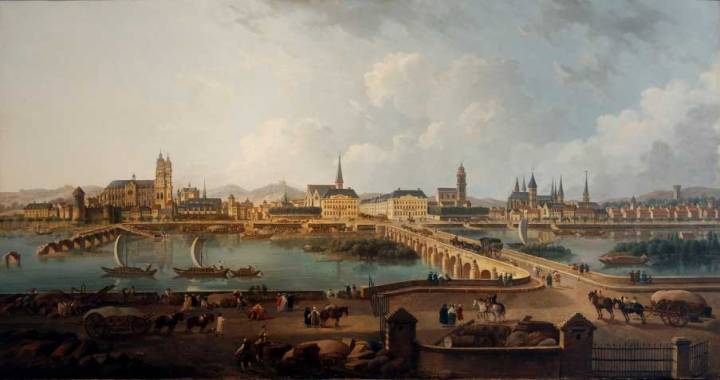
Pierre-Antoine Demachy, Panoramic View of Tours,
1787 (Musée des Beaux-Arts, Tours)
◊ ◊ ◊ ◊ ◊
The fascinating context of the European city from the Renaissance to the Enlightenment is evoked in this exhibition through an extraordinary iconographic repertory comprising over a hundred paintings, prints and drawings from prestigious public and private, Italian and foreign collections.
Ever since the Middle Ages, towns have been a favoured subject in European painting and a means for a state to promoate itself and show off its virtues. The exhibition brings together those global images of an especially high quality that for centuries were the only or most persuasive means for showing off the beauty and wealth of Europe’s leading cities. The exhibition starts with Italy, the first to introduce the imago urbis thanks to the invention of perspective in the early years of the 15th century, providing a fascinating manifesto of the ambitions of popes, princes and sovereigns. Following a chronological and geographic itinerary, the visitor can then travel virtually through cities transformed by time, which for the most part no longer exist in the same way.
For more information, see the press release, available here»
Exhibition | Georgians: 18th-Century Dress for Polite Society
From Bath’s Fashion Museum:
Georgians: 18th-Century Dress for Polite Society
Fashion Museum, Assembly Rooms, Bath, 25 January 2014 — 1 January 2015
 …it being absolutely necessary that propriety of dress should be observed at so polite an assembly as that at Bath. Captain William Wade, Master of Ceremonies, New Assembly Rooms Bath 1771.
The Fashion Museum’s special exhibition for 2014, Georgians, celebrates the museum’s situation in the Georgian Assembly Rooms in Bath. The new exhibition will present a selection of the finest fashions worn by those attending Assemblies, and other glittering occasions of 18th-century life.
An Assembly was defined at the time as “a stated and general meeting of the polite persons of both sexes for the sake of conversation, gallantry, news and play.” As Bath grew in popularity in the 18th century, there was a need for a grand Assembly Room in the fashionable upper town, and in 1771 the New Rooms, designed by John Wood the Younger and financed by public subscription, opened to the public. Today, the New Rooms are known as the Assembly Rooms and are the location of the world-famous Fashion Museum.
Georgians will include over 30 original 18th-century outfits and ensembles from the museum’s world-class collection, including gowns made of colourful and richly patterned woven silks, as well as embroidered coats and waistcoats worn by Georgian gentlemen of fashion. A highlight of the exhibition will be a trio of wide-skirted Court dresses dating from the 1750s and 1760s (held out by cane supports known as panniers, from the French word for baskets), the early years of the reign of King George III. The grand finale of Georgians will include 18th-century-inspired fashions by five top fashion designers: Anna Sui, Meadham Kirchhoff, Vivienne Westwood, Stephen Jones, and AlexanderMcQueen. All are influenced by the 18th-century aesthetic, and all (in different ways) show how the elegance and grace of Georgian dress continues to inspire fashion today.
Exhibition | Fame and Friendship
From the YCBA press release:
Fame and Friendship: Pope, Roubiliac, and
the Portrait Bust in Eighteenth-Century Britain
Yale Center for British Art, New Haven, 20 February — 19 May 2014
Waddesdon Manor, Buckinghamshire, 18 June — 26 October 2014
Curated by Malcolm Baker

Louis François Roubiliac, Portrait Bust of Alexander Pope, 1741, marble (Yale Center for British Art)
Opening in February 2014, the Yale Center for British Art, in collaboration with Waddesdon Manor, will present an exhibition on the eighteenth-century literary figure and poet Alexander Pope (1688–1744), whose sculpted portraits exemplified his fame at a time when the portrait bust was enjoying new popularity. Fame and Friendship: Pope, Roubiliac, and the Portrait Bust in Eighteenth-Century Britain will bring together paintings, sculptures, and materials that convey Pope’s celebrity status, high-lighted by a series of eight busts by Louis François Roubiliac (1702–1762), the leading sculptor of the period, to explore questions of authorship, replication, and dissemination.
Frequently used in antiquity to represent and celebrate writers, the portrait bust became the most familiar way of lauding famous writers in the eighteenth century, as the concept of authorship was being newly conceived. The signed and documented versions of Roubiliac’s busts of Pope, which span the years from 1738 to 1760, are among the most fascinating and iconic images of the poet. These early versions of Roubiliac’s bust are likely to have been made for Pope’s close friends, serving to articulate those friendships that were so important to him. Further, the comparisons of these related versions, together with copies from the period in marble, plaster, and ceramic, will provide a unique and unprecedented opportunity to understand the role of replication and repetition in eighteenth-century sculptural practice.
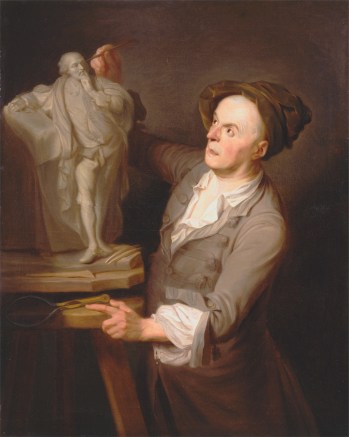
Adrien Carpentiers, Louis-Francois Roubiliac Modelling His Monument to Shakespeare, between 1760 and 1761 (Yale Center for British Art)
Complementing the sculptures of Pope will be busts of other sitters with whom Pope’s image was associated, reflecting the poet’s place in a developing literary canon, as well as a selection of painted portraits of the poet by artists such as Jonathan Richardson the Elder, Jean-Baptiste van Loo, and Sir Godfrey Kneller. Alongside these works will be a range of Pope’s printed texts. With their subtle changes in typography and their carefully planned illustrations and ornamental features, these early editions were produced under the watchful eye of Pope himself and were the outcome of the poet’s direct engagement with the materiality of the book and print.
Also presented will be lesser-known material about the Yale literary critic W. K. Wimsatt, who in the 1960s not only helped to make Yale a major center for the study of eighteenth-century literature (and Pope in particular), but spent twenty-five years researching the poet’s portraits, an achievement celebrated in this exhibition. As Wimsatt recognized, the relationship between Pope’s private persona and public fame was complex and ambiguous. Pope proved adept at managing the two while gradually establishing himself as an independent author, no longer dependent upon the support of noble patrons. Throughout his career, he astutely managed the presentation of his own image and reputation through both his published works and his portraits, especially those by Roubiliac.
Among the busts by Roubiliac will be a terracotta model (ca. 1738) from the collection of the Barber Institute of Fine Arts in Birmingham, England, and four marble pieces that he carved between 1738 and 1741. These busts have been assembled from a number of locations: the Center’s own collection; Temple Newsam House, Leeds Museums and Galleries; and the Shipley Art Gallery, Gateshead (formerly in the possession of the eighteenth-century actor David Garrick). Another, from a private collection, was made for Pope’s close friend, the brilliant young lawyer, William Murray, later first Earl of Mansfield, with whom the poet shared an enthusiasm for both the classics and the visual arts, particularly sculpture. Also on view will be an earlier marble bust of Alexander Pope made in 1730 by the Anglo-Flemish sculptor John Michael Rysbrack (1694–1770), from the collection of the National Portrait Gallery, London.
When this exhibition travels to Waddesdon Manor, the core group of busts of Pope by Roubiliac and some of the contextual material from the Yale Center for British Art will remain the same, but there will be an additional selection of painted portraits, a different range of printed texts lent by the British Library, and material that will illustrate the reception of Pope and his works in France in keeping with Waddesdon’s superb French collections.
Fame and Friendship: Pope, Roubiliac, and the Portrait Bust in Eighteenth-Century Britain is co-organized by the Center and Waddesdon Manor (The Rothschild Collection), where it will travel in June 2014. It is curated by Malcolm Baker, Distinguished Professor of the History of Art at the University of California, Riverside, and Honorary Senior Research Fellow at the Victoria and Albert Museum, London. The organizing curator at the Yale Center for British Art is Martina Droth, Associate Director of Research and Education, and Curator of Sculpture; and at Waddesdon Manor, Dr. Juliet Carey, Senior Curator of Paintings, Sculpture and Works on Paper.
P U B L I C A T I O N S & S C I E N T I F I C S T U D Y
 During the course of the exhibition, Yale University Press will be publishing The Marble Index: Roubiliac and Sculptural Portraiture in Eighteenth-Century Britain, Malcolm Baker’s study of the bust and the statue as genres [scheduled for release in August 2014]. Following the exhibition, a second book will appear as a volume in the series Studies in British Art, published by the Yale Center for British Art and the Paul Mellon Centre in collaboration with Yale University Press. The latter will include essays based on papers presented at the conferences at Yale and Waddesdon organized by the Center, the Paul Mellon Centre in London, and the Rothschild Foundation. It will also incorporate the results of a related research program of detailed digital scanning using the world-class facilities under development at the Yale Digital Collections Center at Yale’s West Campus. By analyzing the busts both visually and technically, this study aims to discover similarities and differences in surfaces, dimensions, construction, and materials, thus shedding new light on the studio practices of eighteenth-century sculptors. These findings will be the focus of a workshop to which leading figures in the field of eighteenth-century sculpture will be invited.
◊ ◊ ◊ ◊ ◊
Note (added 31 May 2014) — A more tightly focused catalogue will also be published by Paul Holberton:
Malcolm Baker, Fame and Friendship: Pope, Roubiliac and the Portrait Bust (London: Paul Holberton Publishing, 2014), 128 pages, ISBN: 978-0954731052, £15 / $25.
◊ ◊ ◊ ◊ ◊
Note (added 13 June 2014) — Waddesdon will host a study day (with a visit to Stowe) on July 10 and a conference on July 12.
Exhibition | The Artist’s View: Landscape Drawings
From the original Crocker Art Museum press release (23 April 2012) . . .
The Artist’s View: Landscape Drawings from the Crocker Art Museum
Crocker Art Museum, Sacramento, 22 September 2012 — 2 January 2013
Snite Museum of Art, Notre Dame, 12 January — 16 March 2014
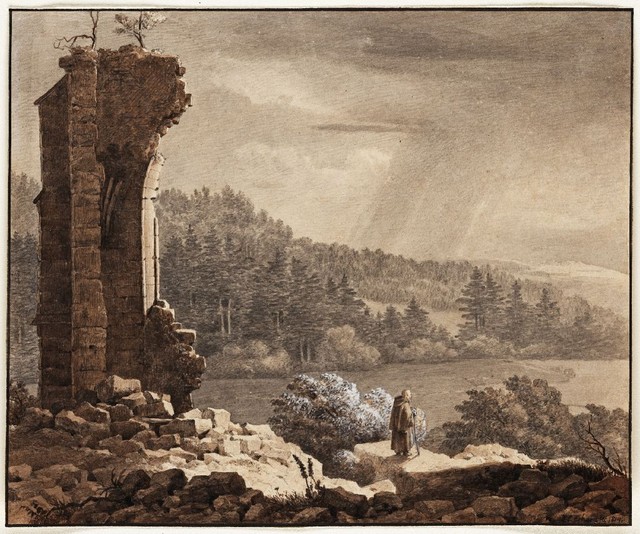
Johann Christoph Erhard, A Monk Visiting Ruins, 1814, graphite and wash on wove paper (Crocker Art Museum)
Featuring works by artists as diverse as Herman van Swanevelt and Camille Corot, this exhibition celebrates the beauty of landscape drawings from the major European schools. Spanning four centuries, The Artist’s View: Landscape Drawings from the Crocker Art Museum consists of 45 of the most important works in the collection, dating from the 16th through the 19th centuries.
This exhibition traces the historical context of landscapes from 17th-century Dutch and Flemish works, including a fine sheet by Anthonie van Waterloo and a newly-attributed Adriaen Frans Boudewijns, through 17th-century Italian and 18th-century German and French drawings. Works from 18th- and 19th-century Germany, which represent one of the heights of landscape drawing and are one of the collection’s major strengths, will also be featured.
Among the highlights of the The Artist’s View are two of the best surviving drawings by Willem van Bemmel, representing his Dutch and Italian periods. The first shows the artist himself at work recording a farmstead at the edge of a Northern forest, while the second, a view of the Colosseum, shows the transformation that Italian monuments and light worked on his style. This dialogue between Italy and the North is a major theme of the exhibition—French and German as well as Dutch and Flemish artists went to Italy to study the land, as illustrated by Hubert Robert’s Temple of Diana at Baia, near Naples, a new acquisition.
This exhibition also depicts how these artists often returned to themes explored by others. Corot’s scene of woodcutters at the edge of the forest shows the same humble labor as in Bemmel’s farmstead of three hundred years before. Such continuity among variety—of artists, their views, and the views they depicted—is part of the appeal of landscape drawing through the centuries.
Exhibition | The Art of the Louvre’s Tuileries Garden
Press release (20 September 2013) from the High Museum:
The Art of the Louvre’s Tuileries Garden
High Museum of Art, Atlanta, 3 November 2013 — 19 January 2014
Toledo Museum of Art, 13 February — 11 May 2014
Portland Art Museum, 14 June — 28 September 2014

Antoine Coysevox, Faun, 1709
The Art of the Louvre’s Tuileries Garden features more than 100 works, some of which have never traveled outside of Paris. These include large-scale sculptures from the garden that were created in the 17th, 18th, 19th, and 20th centuries by sculptors including François-Joseph Bosio, Antoine Coysevox, and Aristide Maillol along with paintings, photographs, and drawings that depict the Tuileries. Thirty-five works in the exhibition are from the collections of the Louvre.
The exhibition also explores how the 63-acre garden influenced and inspired French and American Impressionists such as Édouard Manet, Camille Pissarro, and Childe Hassam and photographers such as Eugène Atget, Henri Cartier-Bresson, and André Kertész. As part of the exhibition’s presentation in Atlanta, the High has turned the museum’s piazza into a landscaped park, inspired by the Tuileries Garden.
The ‘Paris on Peachtree’ experience begins as visitors arrive on the High’s piazza to find a dozen holly trees in planter boxes similar to those in the Tuileries Garden, installed to create a path to the exhibition entrance. Two sculptures by Maillol have been placed among the trees. The immersive experience continues in the galleries, where six sculptures that have never before left France and for centuries resided in the Tuileries Garden will greet visitors on the first level of the exhibition. The High is also devoting an entire gallery in the exhibition to a video titled “A Day in the Tuileries Garden,” featuring footage from the Garden projected on three walls.
Key works featured in the exhibition include:
• Antoine Coysevox, Faun, 1709
• François Joseph Bosio, Hercules Battling Achelous as Serpent, 1824
• Édouard Manet, Children in the Tuileries Garden, ca. 1861–62
• Childe Hassam, Tuileries Gardens, ca. 1897
• Camille Pissarro, The Tuileries Gardens in the Snow, 1900
• Aristide Maillol, Mediterranean or Latin Thought/Contemplation, 1923–27
• Henri Cartier-Bresson, The Terrace and Tree-lined Path, 1975
The exhibition examines how the Tuileries, which extends from the Musée du Louvre to the Place de la Concorde, evolved from its beginnings as an outdoor museum for French royalty to its role as one of the first public gardens in Europe, after which it served as both subject and inspiration for artists working in Paris.
Presented on the occasion of the 400th birthday of André Le Nôtre (1613–1700), The Art of the Louvre’s Tuileries Garden also celebrates the man commissioned by Louis XIV in 1664 to expand and transform the Tuileries into a formal French garden. One of the first public gardens in Europe, the Tuileries Garden was originally created in 1564 by Catherine de Medici as the garden for the Tuileries Palace, a palace that was originally part of the Louvre but which was destroyed following the Franco-Prussian War. Each monarch who lived in the palace left his or her own indelible mark on the Tuileries. Under the reign of Louis XV, the garden became known for its monumental outdoor sculpture collection. In 1667, just three years after Le Nôtre was hired, the Tuileries Garden became Paris’ first public park. The garden is still open to the public today.
The Art of the Louvre’s Tuileries Garden is co-organized by the High Museum of Art, the Toledo Museum of Art, and the Portland Art Museum, with the exceptional collaboration of the Musée du Louvre.
◊ ◊ ◊ ◊ ◊
From Yale UP:
Laura Corey, Paula Deitz, Guillaume Fonkenell, Bruce Guenther, Sarah Kennel, and Richard H. Putney, The Art of the Louvre’s Tuileries Garden (New Haven: Yale University Press, 2013), 176 pages, ISBN: 978-0300197372, $50.
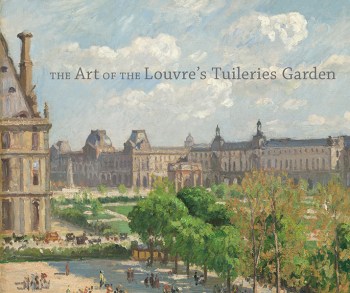 The Tuileries Garden is a masterpiece of garden design and one of the world’s most iconic public art spaces. Designed for Louis XIV by landscape architect André Le Nôtre, it served the now-destroyed Tuileries Palace. It was opened to the public in 1667, becoming one of the first public gardens in Europe. The garden has always been a place for Parisians to convene, celebrate, and promenade, and art has played an important role throughout its history. Monumental sculptures give the garden the air of an outdoor museum, and the garden’s beautiful backdrop has inspired artists from Edouard Manet to André Kertész.
The Art of the Louvre’s Tuileries Garden brings together 100 works of art, including paintings and sculptures, as well as documentary photographs, prints, and models illuminating the garden’s rich history. Beautifully illustrated essays by leading scholars of art and garden studies highlight the significance of the Tuileries Garden to works of art from the past 300 years and reaffirm its importance to the history of landscape architecture.
Laura D. Corey is consulting curator at the High Museum of Art. Paula Deitz is editor of The Hudson Review. Guillaume Fonkenell is curator of sculpture and museum historian at the Musée du Louvre. Bruce Guenther is chief curator and Robert and Mercedes Eichholz Curator of Modern and Contemporary Art at the Portland Art Museum. Sarah Kennel is curator of photographs at the National Gallery of Art, Washington, D.C. Richard H. Putney is an art historian and head of the Art Museum Practices program at the University of Toledo and Consulting Curator of Medieval Art at the Toledo Museum of Art.
Exhibition | Dessins de François-André Vincent
From Paris Musées:
Le Trait en liberté: Dessins de François-André Vincent, 1746–1816
Musée Cognacq-Jay, Paris, 29 March — 29 June 2014
Curated by Benjamin Couilleaux
L’exposition présente l’étendue du talent de François-André Vincent, tout au long de sa carrière de dessinateur, à travers la variété de ses sujets et techniques.
Artiste aussi talentueux que protéiforme, et néanmoins méconnu, François-André Vincent (1746–1816) a marqué le paysage artistique français entre la fin du XVIIIe siècle et le début du XIXe. À partir d’une cinquantaine de feuilles issues de grandes collections publiques et privées de Paris, l’exposition présente l’étendue du talent de Vincent dessinateur, tout au long de sa carrière, à travers la variété de ses sujets et techniques. Débutant dans un style très esquissé, proche de Fragonard, Vincent s’est progressivement rallié à la majesté héroïque du néoclassicisme. Il s’est intéressé aussi bien au paysage qu’à la scène de genre, à la peinture d’histoire comme au genre animalier. Portraitiste génial, Vincent a produit toute une série de caricatures, comiques et fascinantes, mais aussi des portraits psychologiques d’une immense sensibilité. L’exposition permet ainsi de montrer des dessins rarement, voire jamais vus par le public, avec des regroupements inédits.
En parallèle, l’artiste fait l’objet d’un catalogue raisonné par Jean-Pierre Cuzin, ainsi que d’une grande rétrospective, d’abord présentée au musée des Beaux-Arts de Tours (du 18 octobre 2013 au 19 janvier 2014) puis au musée Fabre à Montpellier (du 8 février au 11 mai 2014). L’exposition du musée Cognacq-Jay s’intègre également dans l’actualité parisienne en s’associant à la Semaine du dessin 2014.
Exhibition | Nepal Natural History Drawings, 1802–03
As recently posted on the ever-informative C18-L, from the new listserv, HEMPS, History of Early and Modern Plant Sciences (1450–1850) . . .
Nepal Natural History Drawings: Francis Buchanan-Hamilton, 1802–03
Embassy of Nepal, 12A Kensington Palace Gardens, London, 7–24 January 2014
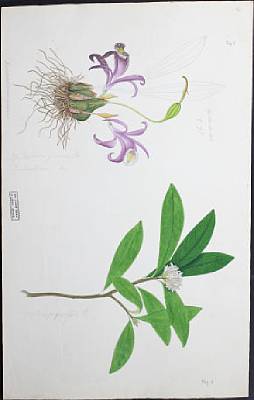 The first natural history collections from Nepal were made by Dr Francis Buchanan (later known as Buchanan-Hamilton) in 1802–03, whilst surgeon-naturalist on the British Mission led by Captain Knox. During his year in the Kathmandu Valley he documented more than a thousand plant species, many of which are now rarely seen. This Scottish ‘father of Nepalese botany’ laid the foundation of botanical knowledge for this Himalayan country, and over 500 new species have been described using his collections.
Buchanan-Hamilton took with him to Nepal a Bengali artist from Calcutta who prepared exquisite coloured watercolour drawings of over a hundred species—27 of which have been selected for this exhibition. On his return to England in 1806, Buchanan-Hamilton gave these drawings, and his other scientific records, to his friend from University days, James Edward Smith, and they have lain virtually unknown in the archives of the Linnean Society of London (which Smith founded) ever since. This exhibition is the first public viewing outside Nepal of Buchanan-Hamilton’s drawings, made by a talented but sadly un-named
Indian artist. Current research is uncovering the scientific and cultural value of these early collections.
Buchanan-Hamilton placed great importance on local names people were using for plants and instructed his Indian pandit, Babu Ramajai Bhattacharji, to record these spoken names and translate them into English. Buchanan-Hamilton frequently used these common names for the new scientific names that he coined and wrote on the drawings—some of these are still in use today. Buchanan-Hamilton is now recognised as the pioneer of biodiversity research in Nepal, but he could not have done this by himself and he needed to collaborate with Nepalese and Indian people. As he was one of the first foreigners to spend any length of time in Nepal, he had an unsurpassed understanding of the people, their cultures and traditions, which later helped underpin the developing relationship between Britain and Nepal. Two centuries on, botanical research continues with British and Nepalese scientists working together on the Flora of Nepal—www.floraofnepal.org. This facsimile exhibition has been produced by the Linnean Society of London and Royal Botanic Garden Edinburgh, with the support of the Embassy of Nepal and the UK Foreign and Commonwealth Office.
Admission free: open to the public 7th to 24th January 2014, Monday to Friday, 10am–1pm, 2–4pm, Embassy of Nepal, 12A Kensington Palace Gardens, London, W8 4QU.
Sponsored by Nature & Herbs UK Ltd. Drawings online here»
Contact: Dr Mark Watson, Royal Botanic Garden Edinburgh, m.watson@rbge.org.uk
Exhibition | Medicine and the Eighteenth Century
As noted by Hélène Bremer, from the Château de Seneffe:
Le XVIIIe et la Médecine
Château de Seneffe, Hainaut, Belgium, 5 October 2013 — 21 April 2014
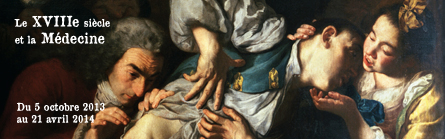 L’exposition « Le XVIIIe et la Médecine » sort des sentiers battus par son contenu et son approche scientifique. Elle présente le thème de la médecine non pas uniquement du point de vue purement médical mais bien dans le contexte de la vie de l’époque. En tant que témoins privilégiés- et avec l’apport des instruments scientifiques, d’objets mis en relation avec les thématiques abordées, d’extraits littéraires,…-nous racontons l’existence d’une société en pleine évolution sociologique.
Découvrir ce que signifie la médecine au XVIIIe siècle c’est lever le voile sur différentes pratiques peu conventionnelles, c’est aborder le corps et l’esprit sous différents angles, c’est observer les avancées en la matière qui vont bousculer les tabous et révolutionner les façons de penser et de voir d’une façon plus rationnelle. C’est comme un kaléidoscope de découvertes inattendues et surprenantes. Le XVIIIe avait à cœur de replacer l’homme, en tant qu’être humain, au centre de la société. Les individus sont alors en quête de bien être, comme aujourd’hui. Et depuis, tout continue.
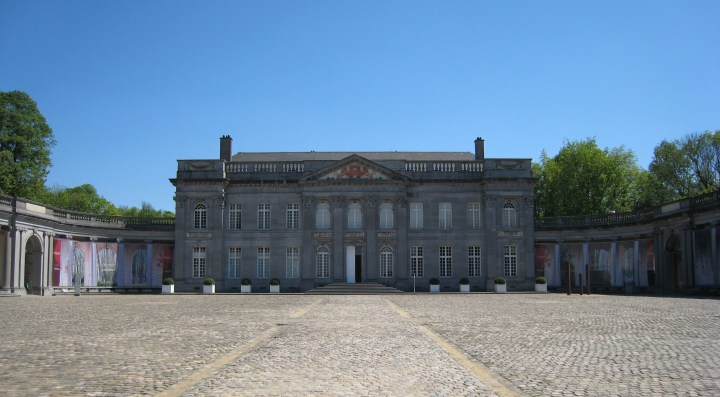
Château de Seneffe
(Photo: Wikimedia Commons, May 2007)
◊ ◊ ◊ ◊ ◊
According to Wikipedia:
In 1758 the ‘Seigneurie de Seneffe’ was bought by Joseph Depestre, a Walloon merchant who earned a fortune by selling goods to the Imperial Austrian troops stationed in the Austrian Netherlands. Depestre’s new status as a wealthy and influential individual was also confirmed by the acquisition of noble titles such as ‘Seigneur de Seneffe’ (Lord of Seneffe) and ‘Count of Turnhout’. The new castle designed by Laurent-Benoît Dewez had to match with Depestre’s new noble status. It was erected between 1763 and 1768 in a novel neoclassical style. When Joseph Depestre died in 1774 the decoration of the château and the embellishment of the park were continued by his widow and his eldest son Joseph II Depestre. . .
Exhibition | Unflinching Vision: Goya’s Rare Prints
From the exhibition press release (August 2013):
Unflinching Vision: Goya’s Rare Prints
Norton Simon Museum, Pasadena, 6 December 2013 — 3 March 2014
Curated by Leah Lehmbeck
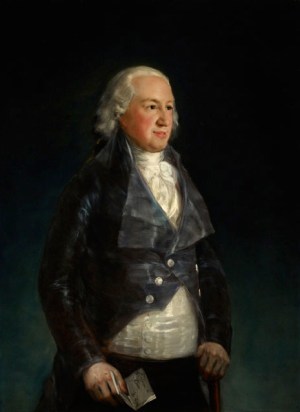
Francisco de Goya y Lucientes, Don Pedro, Duque de Osuna, ca.1790s. Oil on canvas, 54 x 43 x 4 inches (137.8 x 109.2 x 10.2 cm). The Frick Collection; photo: Michael Bodycomb.
In celebration of the rare loan of The Frick Collection’s Don Pedro, Duque de Osuna by Spanish master Francisco de Goya y Lucientes (1746–1828), the Norton Simon Museum presents the exhibition Unflinching Vision: Goya’s Rare Prints. While the majority of the artist’s prints were published posthumously, this exhibition presents a selection of works that Goya himself worked on during his lifetime. More than 30 working proofs, trial proofs and published prints made under his supervision are on view, as well as a small selection of posthumous examples from his later numbered editions. With exceptional examples from his series Los Caprichos, The Disasters of War, La Tauromaquia, and Los Proverbios, these artworks demonstrate Goya’s mastery of printmaking and, most significantly, his care in meaningfully capturing the spirit of his time.
From royal portraiture to scenes in a bullring, Goya infused his keen vision of the observed world with his own creative impulses. This delicate dance is visible throughout the artist’s incredible output of prints. Goya began to experiment with printmaking well after he had established himself as a successful painter to the royal court in Madrid. He started, tentatively, etching a few religious subjects, yet rather quickly he began his first ambitious series of etchings: 11 copies after masterpieces by the father of Spanish painting, Diego Velázquez. Goya’s skill as a draftsman is pronounced in these prints, as is his facility with working on a copper plate, for it is in this series that he first experiments with aquatint, a technique that allows the artist to create subtle tonal areas in the image rather than just scratched lines. “Un Infante de España,” on view in this exhibition, not only presents the formality of Velázquez’s composition but also exhibits Goya’s growing skill with intaglio techniques. Though aquatint is used here primarily in the background, Goya came to master its use, harnessing its subtlety to create depth and even to draw entire compositions.
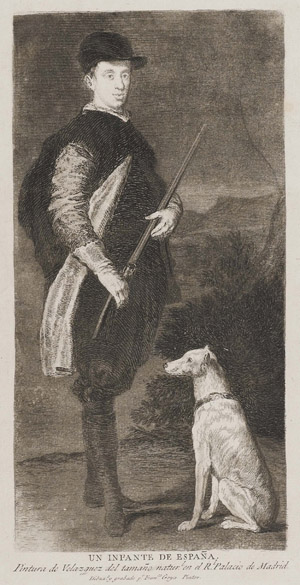
Francisco de Goya y Lucientes, Copies After Velázquez: Un Infante de España, Infante Don Fernando, ca. 1778–79, etching with burnished aquatint and drypoint
(Norton Simon Art Foundation)
By the mid-1790s, Goya began to work on Los Caprichos, the first of four major print series that came to define his career as a printmaker. Images of people, witches and imagined creatures identifying specific social and cultural problems, with titles carefully narrating the scenes, make up this series. An early working proof of plate 6, “Nobody Knows Himself,” presents Goya’s concerns with deception and artifice, and it shows the print before numbering and with the title handwritten in ink. In plate 20, “There They Go Plucked (i.e. Fleeced),” prostitutes sweep out their customers, cowering and pathetic, as the women prepare for the next group of clients who hover above. The drama of the scene is enhanced by the contrast between completely uninked areas and the various gradations of aquatint that define recessional space, but as the edition was printed, this contrast was lost as the aquatint faded nearly completely. Exhibiting the working proof alongside the first, second and eighth editions of the same plate highlights this degradation.
While Los Caprichos describes a time before the turn of the century, when the French monarchy fell and Napoleon rose to power, Goya’s next series tells of the grueling six-year war between France and Spain that began in 1808. In addition to its cruel, disorganized and prolonged combat (the term ‘guerilla’ warfare was coined from this war), it caused a disastrous famine. Many of its battles and events, including torture and starvation, are depicted brutally in the 82 plates of Goya’s print series The Disasters of War. “One Can’t Look,” plate 26, is a triumph of Goya’s compositional acumen. Men and women cower, plead and surrender in desperation within a web of dramatic shadows, and only the tips of the executioners’ bayonets reveal the reason for their suffering.
Perhaps due to the sensitivity of the subject, Goya decided not to publish an edition of The Disasters during his lifetime. Turning instead to a public project that was more benign, Goya prepared a series of bullfighting scenes, equally brilliantly executed and known ultimately as La Tauromaquia. This group of 33 prints traces the history of bullfighting in the country and can be read as being both respectful and critical of the pastime. In plate 20, the theatrical physical feats accomplished by a torero are on display. Yet, in the following plate, Goya reminds us of the deadly nature of the sport. His interest in the popular subject matter and its connection to his national identity were further illuminated when Goya was living in exile in Bordeaux, France. There, in 1825, he used lithography for the first time. The technique is very similar to drawing, and Goya was immediately able to create lively compositions with greater ease than aquatint, in a series of four prints with the same theme, known as The Bulls of Bordeaux.
Whereas the two intaglio series—La Tauromaquia and The Disasters—depict real-life events, Goya continued to create wildly imaginative scenes that comment on contemporary behavior as in Los Caprichos. In the group of 18 prints gathered together and sold as Los Proverbios upon their first publication in 1864, Goya magnificently illustrates a number of human follies. Two-headed women, animals, giants and monsters are all situated in a world with no setting, no real context. The scenes are executed with brilliant technical facility: etched lines creating dynamic scenarios set off against the rich darkness of a field of aquatint, as in “A Way of Flying,” a fantastical illustration of the idea that “Where there’s a will, there’s a way.”
Unflinching Vision: Goya’s Rare Prints is organized by Curator Leah Lehmbeck. It is presented in conjunction with The Frick Collection’s loan of Goya’s Don Pedro, Duque de Osuna, and in anticipation of the scholarly catalogue Goya in the Norton Simon Museum, to be published in 2014.
Exhibition | From Veronese to Casanova: Italian Paintings from Brittany
From the Musée des Beaux-Arts de Rennes:
De Véronèse à Casanova: Parcours italien dans les collections de Bretagne
Musée des Beaux-Arts de Quimper, 19 April — 30 September 2013
Musée des Beaux-Arts de Rennes, 14 December 2013 — 2 March 2014
Curated by Mylène Allano
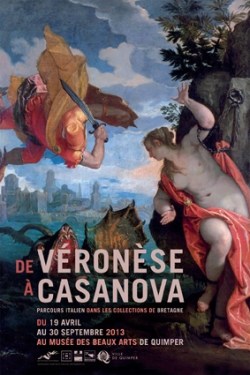 Les musées des beaux-arts de Rennes et de Quimper présentent successivement une grande exposition des peintures italiennes conservées dans la région. La manifestation a pour vocation de mettre en valeur et de faire connaître le patrimoine de la Bretagne historique, en exposant les fleurons des collections italiennes des musées de Brest, Dinan, Morlaix, Nantes, Quimper, Rennes, Vannes et ainsi que les plus belles œuvres des églises bretonnes ; soit 85 peintures de tout premier ordre offrant un panorama représentatif de la peinture italienne des XVIe au XVIIIe siècles.
Didier Rykner provides an exhibition review at La Tribune de l’Art (13 May 2013). . .
. . . L’exposition s’est basée sur une thèse de Mylène Allano—commissaire scientifique de cette exposition—qui cataloguait toutes les peintures italiennes conservées en Bretagne. Le parcours aurait pu être chronologique, par école ou par thèmes. C’est cette dernière présentation qui a été choisie. . .
◊ ◊ ◊ ◊ ◊
The catalogue is available from Artbooks.com:
Mylène Allano, ed., De Véronèse à Casanova: Parcours italien dans les collections de Bretagne (Lyon: Lieux Dits, 2013), 199 pages, ISBN: 978-2362190742, $47.50.
 Italian paintings held in Brittany are well known and appreciated by art specialists, and are characterised by their quality and by the variety of places represented (Venice, Rome, Naples…). This exhibition enables access to a remarkable set of works collected by museums, which have never previously received such attention. There are no less than eighty works which, for the first time, are the subject of an original display underlying the extraordinary vitality of artistic creation in Italy from the 16th century until the end of the 18th century.










leave a comment