Exhibition | Winter Antiques Show in New York to Highlight the PEM
Press release (13 August 2013) from the Winter Antiques Show:
Fresh Take, Making Connections at the Peabody Essex Museum
60th Winter Antiques Show, Park Avenue Armory, New York, 24 January — 2 February 2014

Pair of carp tureens, 1760–80, Porcelain, Jingdezhen, China, with gilded bronze mounts, possibly from Spain (Peabody Essex Museum)
The Winter Antiques Show’s 2014 loan exhibition will celebrate the Peabody Essex Museum (PEM) in Salem, Massachusetts. Fresh Take, Making Connections at the Peabody Essex Museum is comprised of more than 50 paintings, sculptures, textiles, and decorative objects. One of America’s oldest and fastest growing museums, PEM was founded in 1799 and its collection showcases an unrivaled spectrum of American art as well as outstanding Asian, Asian export, Native American, African, Oceanic, maritime, and photography collections. The exhibition will be on view during the run of the Winter Antiques Show, from January 24 to February 2, 2014.
PEM celebrates its 215th year in 2014, and has recently embarked on a $650 million capital campaign and expansion that will place the museum among the top 10 art museums in the country in terms of gallery space and total endowment. The museum’s campus boasts 22 historic buildings celebrating Salem’s rich architectural and garden heritage and Yin Yu Tang, a 200-year old Chinese house that is the only example of its kind in the United States. PEM offers a vibrant schedule of changing exhibitions, a lively contemporary art program, performances, and an interactive education center.

Painted Side Chair, ca. 1795, Salem, MA, wood, paint, reproduction
upholstery (Peabody Essex Museum)
Fresh Take, Making Connections at the Peabody Essex Museum is a microcosm of the PEM experience. Works of art from diverse cultures and time periods are grouped together, uniting and contrasting objects of creative expression in unexpected ways. Highlights of the exhibition range from a spectacular inlaid ivory chair from India (18th century) to a mahogany dressing chest by Thomas Seymour (c. 1810); from an English brass mariner’s astrolabe used to determine time and latitude by the stars (late 1500s) to a stick chart used by Micronesian sailors navigating the Pacific Ocean (early 20th century); from a view of Salem Common by George Ropes (1808) to a Joseph Cornell collage inspired by Magritte’s surrealist landscape (c.1964); from a bronze Japanese reliquary from the Koki-ji Temple, Kawachi-gun, Osaka Prefecture (1679) to a Chinese bridal headdress made of Kingfisher feathers, silk, pearls, and semi-precious stones (c. 1800s).
One of the many highlights is a striking portrait of Nathaniel Hawthorne by Charles Osgood (1809– 1890). The 1840 portrait was painted when Hawthorne worked in the Boston Custom House, ten years before The Scarlet Letter was published. It is the best-known likeness of the young author.
The founding organization of today’s Peabody Essex Museum was the East India Marine Society. A centerpiece of the exhibit is the 1803 sign painted by Michele Felice Cornè (1752–1845) for the original Society’s exhibition hall. The sign depicts Salem Harbor and a ship, probably the Mount Vernon, on which the artist emigrated from Naples to America in 1800. Banner and letters were added in 1825 by sign painter Samuel Bartol for the new East India Marine Hall, where it was placed over the door.
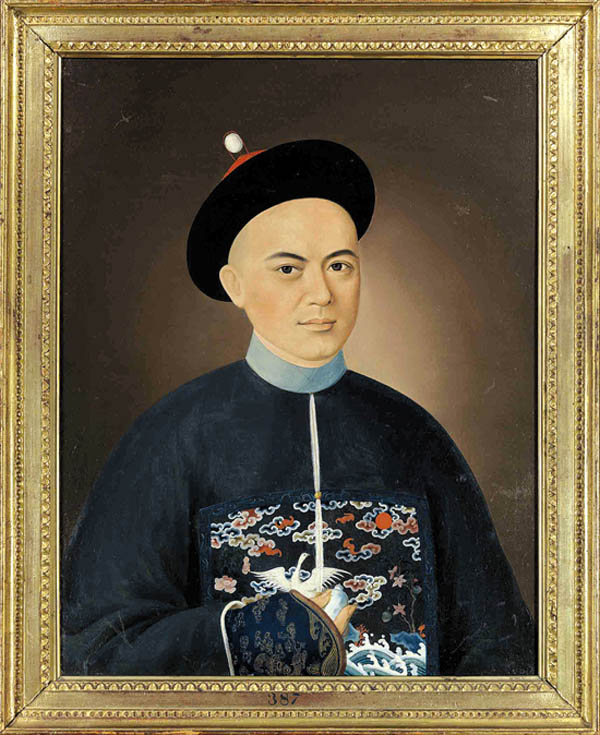
Spoilum, Portrait of Eshing, ca. 1805, Guangzhou (Canton).
Oil on canvas (Peabody Essex Museum)
A Spoilum portrait of a prominent Cantonese silk merchant is also included in the exhibition (1805). Spoilum (active 1785–1810) was one of the first Chinese artists to work in a Western style, and though he never traveled outside of China, his paintings often resemble early American portraiture. The artist is best known for his portraits of English and American merchants, so this portrait of Eshing (a Chinese merchant) is particularly rare. Eshing frequently did business with Salem merchants, and this portrait was acquired as a gift from one of these merchants to the East India Marine Society in 1809.
Demonstrating the wide travels of Salem’s wealthy merchants is a Brazilian headdress collected by Michael W. Shepherd on a trip up the Amazon River in 1847. The mid 19th-century headdress is made primarily of red and blue macaw feathers, an important expression of wealth for many indigenous people of South America. This type of headdress would have been worn by caciques (Native chiefs).
Jeff Daly, formerly senior design advisor to the director at the Metropolitan Museum of Art, will design the Winter Antiques Show’s loan exhibition and plans to create a modern kuntskammer to hold the many treasures from PEM, much like they were displayed in the original East India Marine Society exhibition hall.
The exhibition is sponsored by Chubb Personal Insurance for the 18th consecutive year.
About the Winter Antiques Show
The Winter Antiques Show celebrates its 60th year Diamond Jubilee as America’s most prestigious antiques show, featuring 73 renowned experts in American, English, European, and Asian fine and decorative arts in a fully vetted show. The show was established in 1955 by East Side House Settlement, a social services institution located in the South Bronx. All net proceeds from the show benefit East Side House Settlement. The Winter Antiques Show will run from January 24 to February 2, 2014, at the Park Avenue Armory, 67th Street and Park Avenue, New York City. The Winter Antiques Show hours are 12–8pm daily except Sundays and Thursday, 12–6 pm. Daily admission to the show is $25, which includes the show’s award-winning catalogue. To purchase tickets for the Opening Night Party on January 23, 2014, or Young Collectors Night on January 30, 2014, call (718) 292-7392 or visit the show’s website.
About East Side House Settlement
East Side House Settlement was founded in 1891 to help immigrants and lower income families on the East Side of Manhattan. In 1962, it moved to the South Bronx where it serves 8,000 residents annually within one of America’s poorest congressional districts, the Mott Haven section of the South Bronx. Among the initiatives that focus on educational attainment as the gateway out of poverty is the innovative and highly acclaimed Mott Haven Village Preparatory School.
Exhibition | Fragonard: Poetry and Passion
From the Staatliche Kunsthalle Karlsruhe:
Fragonard: Poetry and Passion / Poesie und Leidenschaft
Staatliche Kunsthalle Karlsruhe, 30 November 2013 — 23 February 2014
You could say that the drawings are the diary of his imagination.
–Edmond and Jules de Goncourt, 1865
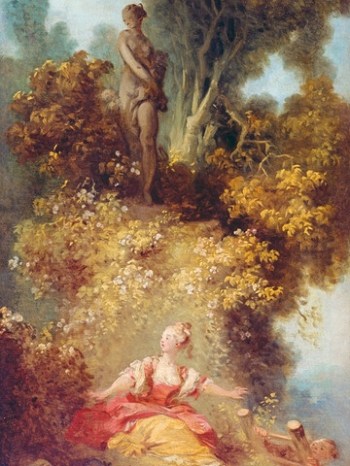
Jean-Honoré Fragonard, La Surprise, ca. 1771
(Musée des Beaux-Arts, Angers)
The work of Jean-Honoré Fragonard (1732–1806) is the embodiment of elegance and expressiveness. The French artist was one of the outstanding masters of the 18th century; and yet his name is relatively unfamiliar to many in Germany today. Born in Grasse, Fragonard spent most of his life in Paris, where he was a pupil of François Boucher. Despite initial successes in the Paris Salon exhibition, he embarked on a path outside the Academy and found his main audience among wealthy private collectors.
First monographic exhibition in Germany of Fragonard’s work
The Karlsruhe exhibition principally features a selection of Fragonard’s drawings, enriched by several oil studies and paintings. With some 80 works in all, the display gives an insight into the dazzling versatility of an oeuvre that includes scenes of cheerful social gatherings, landscapes, narrative scenes, and intimate depictions of great sensuality. The exhibition captures and reflects the artist’s delight in experimentation, his vitality of imagination, and boldness in formal composition. In the same breath, Fragonard demonstrates both how firmly rooted he was in the artistic tradition of the 17th century and his skill in being able to vary and reinterpret the repertoire of forms and subjects of that tradition. Through his handling of chalk and brush, he created compositions of sparkling imagination and great passion.
The exhibition has been made possible thanks to the generous support of international lenders, including the Louvre in Paris, the Albertina in Vienna, the British Museum in London, and the Fundação Calouste Gulbenkian in Lisbon, as well as several private collectors.
◊ ◊ ◊ ◊ ◊
From Artbooks.com:
Juliane Betz, ed., Fragonard: Poesie und Leidenschaft (Munich, Deutscher Kunstverlag, 2013), 272 pages, ISBN: 978-3422072145, $68.50.
 The current exhibition at Staatliche Kunsthalle Karlsruhe focuses on drawings by Jean-Honoré Fragonard, one of the finest French artists of the 18th century. They are juxtaposed against selected paintings that reveal links between his graphic and painterly works. Fragonard developed a unique pictorial idiom, which made use of both painterly and graphic elements and elevated unworked sections of bare paper into a core compositional element.
Exhibition | Houghton Hall: Portrait of an English Country House
As Courtney Barnes noted back in November at Style Court, America’s fascination with England’s country houses will continue into the new year (and 2015). While Houghton Revisited, which brought dozens of paintings back to the house from Russia for display this summer and fall, was awarded Apollo Magazine’s 2013 Exhibition of the Year, pictures and objects still in the Houghton Hall collection will travel to Houston, San Francisco, and Nashville. From the MFAH press release (22 November 2013). . .
Houghton Hall: Portrait of an English Country House
Museum of Fine Arts, Houston, 22 June — 22 September 2013
Legion of Honor, San Francisco, 18 October 2014 — 18 January 2015
Frist Center for the Visual Arts, Nashville, 13 February — 10 May 2015
Curated by Gary Tinterow and Christine Gervais with David Cholmondeley

William Hogarth, The Cholmondeley Family, 1732
(Marquess of Cholmondeley, Houghton Hall)
◊ ◊ ◊ ◊ ◊
Family portraits by Hogarth and Sargent, exquisite examples of Sèvres porcelain, and unique pieces of William Kent furniture from this aristocratic English family chronicle three centuries of art, history, and politics.
Museum of Fine Arts, Houston, Director Gary Tinterow today announced an unprecedented exhibition: Houghton Hall: Portrait of an English Country House, which will be on view at the Museum from June 22 to September 22, 2014. The exhibition marks the first time the renowned collection of the Marquesses of Cholmondeley, housed at Houghton Hall, the family estate in Norfolk, will travel outside of England.

Houghton Hall (Photo: Nick McCann)
The house and much of its collection were built in the early 1700s by Sir Robert Walpole—England’s first prime minister and the ancestor of the current marquess. Renowned as one of the finest Palladian houses and one of the most extensive art collections in Britain, Houghton became notorious when Sir Robert’s collection of Old Master paintings was sold by his grandson to Catherine the Great, in 1779. But the house and all of its furnishings, considered to comprise William Kent’s Georgian masterpiece, remained intact; Walpole’s descendants added considerably to the collection of paintings. From great family portraits by William Hogarth, Joshua Reynolds, and John Singer Sargent, to exquisite examples of Sèvres porcelain, rare pieces of R. J. & S. Garrard silver, and unique furniture by William Kent, the exhibition vividly evokes the fascinating story of art, history, and politics through the collections of this aristocratic English family over three centuries.
Organized by Tinterow; Christine Gervais, associate curator; and Lord Cholmondeley, the exhibition will tour nationally after the Houston presentation, beginning with the Legion of Honor of the Fine Arts Museums of San Francisco (October 18, 2014–January 18, 2015) and the Frist Center for the Visual Arts in Nashville (February 13–May 10, 2015).
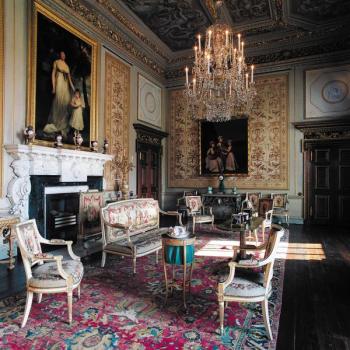
The White Drawing Room at Houghton Hall, with paintings by John Hoppner and George James (Photo: Nick McCann)
“Houghton Hall and its superb collections epitomize the historic legacy of art, architecture, and patronage among the great families and country houses of England,” commented Tinterow. “I am delighted to partner with David Cholmondeley to bring this extraordinary heritage to American audiences. Given our fascination with Downton Abbey and its similar story of a great English house and its family, I know this exhibition will be highly anticipated.”
“I was enormously gratified by the response to Houghton Revisited, the exhibition in which we reunited the paintings sold to Catherine the Great with their home at Houghton Hall,” commented David Cholmondeley on the success of that recent project. “I look forward to working with Gary Tinterow and his colleagues at the Museum of Fine Arts, Houston, to share Houghton Hall and our family’s history with visitors in Houston, San Francisco, and Nashville.”
About Portrait of an English Country House
Houghton Hall: Portrait of an English Country House will assemble more than 100 objects in settings that combine paintings, porcelain, sculpture, costume, metalwork, and furniture to evoke the stunning rooms at Houghton Hall. Bought or commissioned by eight generations of descendants of Sir Robert Walpole, together these objects comprise a fascinating chronicle. (more…)
Apollo Magazine’s 2013 Exhibition of the Year: Houghton Revisited
From Apollo Magazine:
Apollo Magazine’s 2013 Exhibition of the Year
Houghton Revisited at Houghton Hall, Norfolk
 There have been some great international blockbuster shows this year: Inventing Abstraction, 1910–1925 at MoMA and Life and Death in Pompeii and Herculaneum at the British Museum. At Apollo, we also like to celebrate focused exhibitions that enlighten us with the exceptional intelligence of their curation on a smaller scale: Piero della Francesca in America at the Frick Collection brought together most of the panels of the Sant’Agostino altarpiece, while the Ashmolean Museum’s Francis Bacon/Henry Moore: Flesh and Bone tuned into a conversation between two artists that few had previously heard with such clarity. At the St Louis Art Museum, and later the National Gallery in London, Barocci: Brilliance and Grace provided revelations about one artist’s restless inventiveness; while The Springtime of the Renaissance, at Palazzo Strozzi and now the Louvre, brought superb loans together in sharp and surprising ways.
But one exhibition ran away with the laurels this year. Once-in-a-lifetime is a phrase that gets bandied about too much—but this was not just a once-in-a-lifetime exhibition, but something we may have to wait another two and half centuries to see again. It reunited many of the works from Robert Walpole’s magnificent collection, including many simply audacious loans from Russia and elsewhere, recreating their original hang at Houghton Hall in Norfolk, and bringing 114,000 visitors through the doors. I am delighted to present this award to curator Thierry Morel and Lord David Cholmondeley for Houghton Revisited.
Neapolitan Crèche at The Met
From The Met:
Christmas Tree and Neapolitan Baroque Crèche
The Metropolitan Museum of Art, New York, 26 November 2013 — 6 January 2014
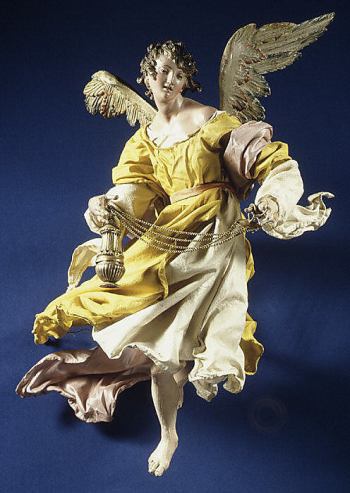
Angel, attributed to Giuseppe Sanmartino (Italian, 1720–1793), polychromed terracotta head; wooden limbs and wings; body of wire wrapped in tow; various fabrics, 14 inches (NY: The Met)
The Museum continues a longstanding holiday tradition with the presentation of its Christmas tree, a favorite of New Yorkers and visitors from around the world. A vivid eighteenth-century Neapolitan Nativity scene—embellished with a profuse array of diminutive, lifelike attendant figures and silk-robed angels hovering above—adorns the candlelit spruce. Recorded music and lighting ceremonies add to the enjoyment of the holiday display.
The annual Christmas installation is the result of the generosity, enthusiasm, and dedication of the late Loretta Hines Howard, who began collecting crèche figures in 1925 and soon after conceived the idea of combining the Roman Catholic custom of elaborate Nativity scenes with the tradition of decorated Christmas trees that had developed among the largely Protestant people of northern Europe. This unusual combination was presented to the public for the first time in 1957, when the Metropolitan Museum initially exhibited Mrs. Howard’s collection. More than two hundred eighteenth-century Neapolitan crèche figures were given to the Museum by Loretta Hines Howard starting in 1964, and they have been displayed each holiday season for nearly forty years. Linn Howard, Mrs. Howard’s daughter, worked with her mother for many years on the annual installation. Since her mother’s death in 1982, she has continued to create new settings for the Museum’s ensemble. In keeping with family tradition, Linn Howard’s daughter, artist Andrea Selby Rossi, joins her mother again this year in creating the display.

The exhibit of the crèche is made possible by gifts to The Christmas Tree Fund and the Loretta Hines Howard Fund.
The Museum’s towering tree, glowing with light, is adorned with cherubs and some fifty gracefully suspended angels. The landscape at the base presents the figures and scenery of the Neapolitan Christmas crib. This display mingles three basic elements that are traditional to eighteenth-century Naples: the Nativity, with adoring shepherds and their flocks; the procession of the three Magi, whose exotically dressed retinue echoes the merchants and travelers one may have encountered in bustling Naples at the time of the crèche’s creation; and, most distinctive, colorful peasants and townspeople engaged in their quotidian tasks. The theatrical scene is enhanced by a charming assortment of animals—sheep, goats, horses, a camel, and an elephant—and by background pieces serving as the dramatic setting for the Nativity, including the ruins of a Roman temple, several quaint houses, and a typical Italian fountain with a lion’s-mask waterspout.
The origin of the popular Christmas custom of restaging the Nativity traditionally is credited to Saint Francis of Assisi. The employment of manmade figures to reenact the hallowed events soon developed and reached its height of complexity and artistic excellence in eighteenth-century Naples. There, local families vied to outdo each other in presenting elaborate and theatrical crèche displays, often assisted by professional stage directors. The finest sculptors of the period—including Giuseppe Sammartino and his pupils Salvatore di Franco, Giuseppe Gori, and Angelo Viva—were called on to model the terracotta heads and shoulders of the extraordinary crèche figures. The Howard collection includes numerous examples of works attributed to them as well as to other prominent artists.
The Museum’s crèche figures, each a work of art, range from six to twenty inches in height. They have articulated bodies of tow and wire, heads and shoulders modeled in terracotta and polychromed to perfection. The luxurious and colorful costumes, many of which are original, were often sewn by ladies of the collecting families and enriched by jewels, embroideries, and elaborate accessories, including gilded censers, scimitars and daggers, and silver filigree baskets. The placement of the approximately fifty large angels on the Christmas tree and the composition of the crèche figures and landscape vary slightly from year to year as new figures are added.
Exhibition | Piranesi’s Antiquity: Findings and Polemics
From the Wallraf-Richartz Museum:
Piranesis Antike: Befund und Polemik / Piranesi’s Antiquity: Findings and Polemics
Wallraf-Richartz Museum, Cologne, 25 October 2013 — 26 January 2014
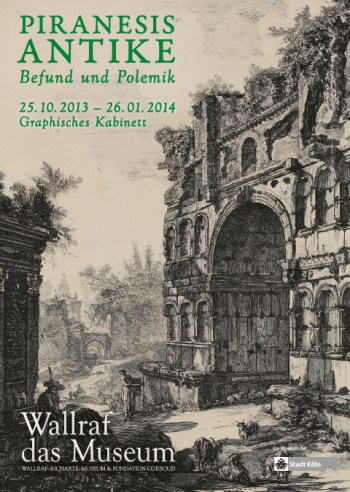 ‘Rome or Athens?’ In the eighteenth century, this simple and yet so complex question was at the heart of a vehement dispute concerning the exemplary function of classical antiquity for contemporary art. One major advocate of Rome was the artist Giovanni Battista Piranesi (1720–1778). Over a period of about 30 years, he produced more than 130 large-format etchings with views of ancient and modern Rome, as well as of buildings from the immediate surroundings. These etchings were compiled into a self-contained series under the title Vedute di Roma. Piranesi uses dramatic perspectives, strong contrasts between light and dark, and gigantic enlargements of sections of ancient buildings in order to convince his contemporaries of the importance of classical Rome.
Some 20 of these fascinating works can now (25 October 2013 to 26 January 2014) be seen in Cologne at the Wallraf-Richartz Museum’s Department of Drawings and Prints under the title Piranesi’s Antiquity: Findings and Polemics.
One of the most versatile Italian artists of the eighteenth century, Piranesi still fascinates us today with his extensive œuvre. During his lifetime he produced more than 1,000 etchings and thus left us impressive witnesses of his age. In addition to his graphic work, Piranesi also wrote numerous theoretical treatises, defending Roman civilization against the claims of Greek culture. The exhibition in Cologne shows how, in the large-format Vedute or views of Rome, the multifarious and contradictory ways in which classical antiquity was appropriated by the eighteenth century are superimposed. Meticulous archaeological investigations stand alongside market-oriented production of prints, and a polemical debate on the true legacy of antiquity (Rome versus Athens). By selling his views of Rome to foreign visitors to the city, Piranesi made a fortune and became well known throughout Europe.
This exhibition is being held to mark the 625th anniversary of the foundation of Cologne University. Together with teachers and students of art history and classical archaeology, the works were selected and researched from among the holdings of the university archives. The archive has 46 views of Rome by Piranesi, an unusual wealth of material for a university collection. It is the result of a donation by the university’s first Professor of Greek Philology, Dr Joseph Kroll.
Information on the exhibition symposium is available here»
Exhibition | Wallpaper from the Deutschen Tapetenmuseums

Orangerie, Kassel
(Wikimedia Commons, November 2005)
◊ ◊ ◊ ◊ ◊
While this exhibition of wallpapers in Kassel addresses primarily the nineteenth century, there are eighteenth-century examples, and it’s useful to draw attention to the collection of the German Wallpaper Museum (Deutschen Tapetenmuseums), which includes some 23,000 objects. With plans for a new home in the works, the current exhibition is mounted in Kassel’s Orangerie, which itself dates to the opening decade of the eighteenth century. From the exhibition description:
Aufgerollt. Tapeten: Vom Entwurf an die Wand
Westpavillon der Orangerie, Kassel, 13 September 2013 — 12 January 2014
 Jeder kennt sie, fast jeder hat sie: Tapeten. Seit dem 18. Jahrhundert begeistern die in allen nur denkbaren Farben und Motiven gedruckten Wanddekore. Ob geometrisch oder malerisch, farbenfroh oder dezent, ob im 18. oder im 21. Jahrhundert entstanden: Bevor die Tapete ihre Wirkung als Wandschmuck entfalten kann, sind zahlreiche Arbeitsschritte notwendig, die von der Inspirations- und Entwurfsphase, über die Produktion bis hin zur Vermarktung reichen. Die Sonderausstellung des Deutschen Tapetenmuseums zeigt Objekte aus dem reichen Schatz der Sammlung, die dieses faszinierende Thema insbesondere für das 19. und frühe 20. Jahrhundert beleuchten. Gezeigt wird eine Vielfalt an Vorlagewerken, Tapetenentwürfen und Handdruckmodeln ebenso wie das fertige Produkt Tapete. Musterbücher und Werbebilder mit gesamten Wandabwicklungen lassen die Möglichkeiten der Vermarktung von Tapeten lebendig werden.
Das Schaufenster bietet einen Einblick in die fantastische Sammlung des Deutschen Tapetenmuseums, die mit fast 23.000 Objekten nahezu lückenlos die Geschichte der Tapete dokumentiert. Von 1976 bis 2008 im Hessischen Landesmuseum ausgestellt, wurde die Sammlung 2010 in ein fachgerechtes Depot verlagert. Ein Museumsneubau ebenso wie eine neue Dauerausstellung sind in Planung.
Exhibition | The Remondini & Eighteenth-Century Print Culture
This is the last week for a small exhibition I worked on with one of my exceptional students, Paula Manni (having graduated with her B.A. in May, she’s currently an intern at the Detroit Institute of Arts). Pedagogically, the project was immensely gratifying and provided more evidence for me of just how much one can do with online projects at basically no (economic) costs whatsoever. While we developed the online component primarily for a popular audience (iPads were available in the gallery), I was thrilled to receive—just one week after the exhibition opened—an email from a UK museum that owns several prints from the same Prodigal Son series and to learn that their images have been manipulated and combined with other prints in really interesting ways, further highlighting the interactive character of these sorts of perspective views. The bibliography for the exhibition provides a useful starting point for anyone working on zograscopes and vue d’optique prints generally. Paula and I shall continue to update the site occasionally , so I would welcome suggestions for sources we should add. As is typically the case with any project involving Google, there are terrific, telling measures of assessment: search for ‘Remondini’ and ‘Prodigal’, and among the top results will be the Prodigal Son among the Harlots. -CH
◊ ◊ ◊ ◊ ◊
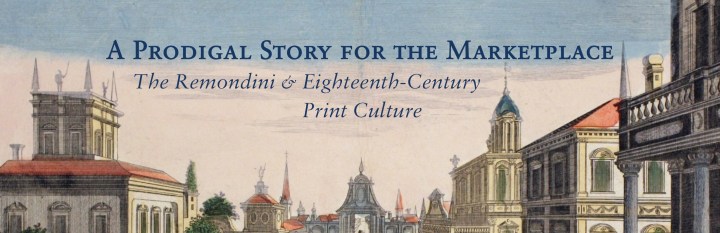
A Prodigal Story for the Marketplace: The Remondini and Eighteenth-Century Print Culture
The Center Art Gallery, Grand Rapids, Michigan, 1 November — 17 December 2013
Curated by Craig Ashley Hanson and Paula Manni with Joel Zwart
◊ ◊ ◊ ◊ ◊
Founded in the mid-seventeenth century, the Remondini publishing firm produced prints and books on a massive scale for nearly two hundred years, marketing their paper commodities not only across Europe but also in the American colonies and parts of Asia. Based in Bassano, Italy (45 miles northwest of Venice), the firm targeted a large, popular audience. By offering a wide array of printed materials, ranging from religious pictures and texts, to genre scenes, to sweeping landscape views (often copying the works of others without permission), the firm appealed to the interests—and budgets—of an emerging middle class audience.
Highlighting Calvin College’s own Prodigal Son series of six etchings produced by the Remondini firm in the 1780s—copies after a series first published by Georg Balthasar Probst around 1770—this exhibition situates the prints within the visual culture of the period. While there is a tendency to address eighteenth-century prints as ‘art’ simply because of their age, exploration of the original publishing context allows us to see these pictures as both belonging within and contributing to an expanding popular culture that conflated entertainment, religion, and the marketplace. Most of the items included in the exhibition were never intended to be framed (much less hung on a gallery wall) but were instead expected to be handled and seen through perspective-enhancing viewing devices—variously described as diagonal mirrors, optical pillar machines, or (most commonly today) zograscopes.
Exhibition | Vincoli d’Amore: Spose in Casa Gonzaga
From the Palazzo Ducale in Mantova:
Vincoli d’Amore: Spose in casa Gonzaga tra XV e XVIII secolo
Museo di Palazzo Ducale, Mantua, 18 October 2013 — 6 January 2014
Curated by Paola Venturelli and Daniela Ferrari
 Si inaugura venerdì 18 ottobre alle ore 16.30 nell’Atrio degli Arcieri la mostra Vincoli d’Amore. Spose in casa Gonzaga tra XV e XVIII secolo, a cura di Paola Venturelli e Daniela Ferrari e promossa dall’Archivio di Stato di Mantova in collaborazione con la Soprintendenza BSAE di Mantova. Insieme alle curatrici intervengono Giovanna Paolozzi Strozzi, Soprintendente e Direttore del Museo di Palazzo Ducale, Francesca Zaltieri, Assessore alla Cultura della Provincia di Mantova e Renata Casarin Presidente del Soroptimist International Club di Mantova.
Spose di casa Gonzaga o spose giunte in casa Gonzaga lungo un arco di tempo che coincide con gli anni del dominio di questa grande dinastia, dagli inizi del XV secolo all’aprirsi del XVIII. Solo di alcune conosciamo le fattezze. Di poche gli interessi, i pensieri e le attitudini, rimanendo la maggior parte quasi priva di spessore storico e relegata nello sfondo della Grande Storia. Pedine, le cui mosse, abilmente studiate, porteranno tuttavia a costruire la Grande Storia dei Gonzaga. I loro matrimoni, voluti per allacciare vincoli di parentela con i principali casati, italiani o d’Oltralpe, erano infatti il frutto di oculate strategie dinastiche. Vincoli, qualche volta “d’amore”, anche spirituale – sull’imitazione del matrimonio mistico di Santa Caterina -, che cambiarono il panorama esistenziale delle nostre protagoniste.
La mostra è allestita negli ambienti in cui alcune delle protagoniste di questa esposizione hanno mosso i primi passi della loro vita coniugale. Presenti le duchesse Eleonora d’Asburgo ed Eleonora de’ Medici, ritratte nella supersite porzione della pala della Santissima Trinità, eseguita da Pieter Paul Rubens (ca. 1605), che domina la Sala degli Arcieri.
The Burlington Magazine, December 2013
The (long) eighteenth century in The Burlington:
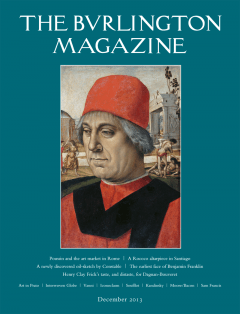
The Burlington Magazine 155 (December 2013)
E D I T O R I A L
• Richard Shone, “Home is Where the Art Is,” p. 807.
 Houses once occupied by distinguished residents are a special strand of the heritage industry that increasingly dominates a nation in thrall to all aspects of the past. We are constantly being exhorted to save and preserve this or that—a factory, a view, a manor house, a pier, a site of outstanding natural beauty, the historic habitat of wildlife, or, indeed, of the famous dead. Some of the shrines we visit are more larded with authenticity than others. Inevitably, the further back in time the illustrious lives were lived, the fewer objects there are likely to be which were familiar to the inhabitants. Was this her chair; was this really his easel? The aspic of preservation continually wobbles between the authentic and the fake. We do not always know—are not always told—whether something is ‘of the same period’ or ‘similar to’ or a ‘replica of’ what may or may not have been originally there, under the eye, the hand, the bottom or the feet of the presiding genius. Much depends on the piety of heirs and descendants, the
changing ownership of the house and the fluctuating stakes of fame. . . .
The latest appeal for an artist’s house has much to recommend it and should attract supporters beyond British shores. It concerns the restoration and preservation of J.M.W. Turner’s rural retreat at Twickenham, west London. This is an exceptional project and not simply a matter of tidying up and putting a blue plaque on the front. Turner designed this house himself, and plans for it abound in sketchbooks of c.1810–12, after he had purchased two plots of land near the Thames. The intention is to remove later additions (not serious) and reveal its compact interior, obviously influenced by his friend John Soane’s house in Lincoln’s Inn Fields. For Turner, Sandycombe Lodge was for rest and recreation such as fishing (when he could ‘angle out the day’) and hosting friends on excursions for picnics, rather than for long residence and staying guests. Turner sold the house in 1826 and the adjoining meadow in 1848 (to the Windsor, Staines and South Western Railway). Under the auspices of the Turner’s House Trust, the appeal for £2 million is well underway, with support already assured from the Heritage Lottery Fund, among many other organisations and private donors, although further funding is still needed.2 It is expected that the public will be able to visit in 2016.
2. For an entertaining and informative account of the house, see C. Parry-Wingfield, with Foreword by A. Wilton: J.M.W. Turner. The Artist and his House at Twickenham, London 2012. Donations can be sent to the Trust at 11 Montpelier Row, Twickenham, tw1 2nq, or at www.turnerintwickenham.org.uk.
The full editorial is available here»
A R T I C L E S
• Gauvin Alexander Bailey and Fernando Guzmán, “The Rococo Altarpiece of St Ignatius: Chile’s Grandest Colonial Retable Rediscovered,” pp. 815–20.
An examination of the Rococo altarpiece of St Ignatius in Santiago, Chile, and of the European influences on this great retablo.
• David Pullins, “Dating and Attributing the Earliest Portrait of Benjamin Franklin,” pp. 821–22.
A re-evaluation of a painting now found to be the earliest known portrait of Benjamin Franklin, added to an earlier figure of a man by Robert Feke (c.1746–48).
R E V I E W S
• Elizabeth Goldring, Review of Laura Houliston, ed., The Suffolk Collection: A Catalogue of Paintings (English Heritage, 2012), p. 835.
• Michael Rosenthal, Review of Leo Costello, J.M.W. Turner and the Subject of History (Ashgate, 2012), p. 836.
• Basile Baudez, Review of the exhibition Soufflot: Un architecte dans la lumière, pp. 850–51.
• Xavier F. Salomon, Review of the exhibition Il Gran Principe Ferdinando de’ Medici (1663–1713) collezionista e mecenate, pp. 851–53.
• Angela Delaforce, Review of the exhibition Da Patriarcal à Capela Real de São João Baptista, pp. 855–56.
• Jamie Mulherron, Review of the exhibition Interwoven Globe: The Worldwide Textile Trade, 1500–1800, pp. 856–58.










leave a comment