Exhibition | American Adversaries: West and Copley
Press release (19 June 2013) from the MFAH:
American Adversaries: West and Copley in a Transatlantic World
Museum of Fine Art, Houston, 6 October 2013 — 5 January 2014
 This October, the Museum of Fine Arts, Houston, presents American Adversaries: West and Copley in a Transatlantic World, an extensive exhibition charting the rise and spectacular success of contemporary history painting in the 18th century through the lives and experiences of two colonial American innovators: Benjamin West (1738–1820) and John Singleton Copley (1738–1815). West and Copley—initially friends and eventually bitter rivals—gained phenomenal fame from their theatrical paintings that romanticized current events and captured the imaginations of the art-viewing public. American Adversaries is on view from October 6, 2013, to January 20, 2014.
American Adversaries: West and Copley in a Transatlantic World traces the ambitious, competitive and highly successful lives of West and Copley through oil paintings, works on paper, sculptures and artifacts. At the core of the exhibition are two paintings that catapulted West and Copley into international fame: West’s The Death of General Wolfe (1770; 1779 version) and Copley’s Watson and the Shark (1778). The paintings have not been presented together in more than 60 years and never before in this context.
“This is a remarkable opportunity for Museum visitors to see in the same exhibition these two iconic paintings in the history of art, The Death of General Wolfe and Watson and the Shark,” said MFAH director Gary Tinterow. “Painted nearly 250 years ago and considered strikingly modern in their day, the issues addressed with such dramatic flair have the power to still resonate with viewers today.”
“Long before Jackson Pollock drew international acclaim for his innovative Abstract Expressionist paintings in the mid-twentieth century, West and Copley held center stage in the international art world of the 18th century centered in London,” said Emily Ballew Neff, MFAH curator of American painting and sculpture. “The exhibition addresses how it is that these two colonial artists on the margins of empire come to have such phenomenal success.”
Both born in the same year (1738) in the American Colonies of Pennsylvania and Massachusetts, Benjamin West and John Singleton Copley crossed the Atlantic in pursuit of international fame and fortune. London, the cultural and political capital of the empire, attracted and swayed both artists to stay to develop their careers as history painters and neither returned home to America.
West and Copley established a new genre of painting known as contemporary history painting with The Death of General Wolfe and Watson and the Shark. These dramatic large-scale canvases featured compositional elements derived from antique and Old Master sources, yet instead of portraying biblical, mythological or literary heroes, they depicted real people from contemporary life. This exhibition examines these paintings and the period in which they were painted to animate a past that is unfamiliar to many today. It restores the dynamism and modernity of this particular artistic moment as it happened, rather than through the lens of what we later have come to know. These works point to a world informed by the powerful agency of the Iroquois (Haudenosaunee) Confederacy in the Great Lakes region; the scientific and imperial exploration of the seas; the rising role of the media and its relationship to history painting; and the stagecraft involved in managing the perception of a successful artistic career in 18th-century London. In the exhibition, the two key paintings are joined by works of art from all over the Atlantic World, which give them greater context and meaning.
A fully illustrated catalogue, published by the Museum of Fine Arts, Houston, distributed by Yale University Press and designed by Studio Blue, accompanies the exhibition and features essays by international scholars. The catalogue for this exhibition receives generous funding from Furthermore: a program of the J. M. Kaplan Fund.
American Adversaries: West and Copley in a Transatlantic World is organized by the Museum of Fine Arts, Houston. An indemnity has been granted by the Federal Council on the Arts and the Humanities. The exhibition is made possible through support from the Terra Foundation for American Art.
◊ ◊ ◊ ◊ ◊
38th Annual Ruth K. Shartle Symposium
American Adversaries: West and Copley in a Transatlantic World
Museum of Fine Art, Houston, 5 October 2013
This one-day symposium includes talks by prominent scholars addressing themes developed in the exhibition. Following the symposium, guests are invited to a reception and a viewing of the exhibition. More information is forthcoming. Visit www.mfah.org/calendar for updates.
◊ ◊ ◊ ◊ ◊
From Yale UP:
Emily Ballew Neff with Kaylin H. Weber, American Adversaries: West and Copley in a Transatlantic World (New Haven: Yale University Press, 2013), 272 pages, ISBN: 978-0300196467, $75.
American artists and innovators Benjamin West (1738–1820) and John Singleton Copley (1738–1815) changed the way history was recorded in the 18th century and became America’s first transatlantic art superstars. Initially friends but eventually bitter rivals, the artists painted contemporary events as they happened, illustrating the transformation of imperial power through diplomacy between British Americans and the Iroquois, and through transatlantic trade, exploration, and the natural history of the West Indies.
Focusing on two iconic works, West’s The Death of General Wolfe (1770) and Copley’s Watson and the Shark (1778), American Adversaries charts the rise of contemporary history painting, and offers a compelling examination of American history and New World exploration. Featuring more than two hundred color reproductions of paintings, works on paper, and objects that informed the artists, this handsome volume also includes essays that shed new light on, among other subjects, West and Copley within the context of the Royal Academy and the use of Western and Native American objects in cultural diplomacy.
Emily Ballew Neff is curator of American painting and sculpture, and Kaylin H. Weber is assistant curator of American painting and sculpture, both at the Museum of Fine Arts, Houston.
Display | Ben Okri on Ayuba Suleiman Diallo
From the NPG:
Ben Okri on Ayuba Suleiman Diallo: A Dialogue Across Time
National Portrait Gallery, London, 20 September 2013 — 16 March 2014

William Hoare, Portrait of Ayuba Suleiman Diallo (Job ben Solomon), 1733 (NPG L245, Lent by Qatar Museums Authority/Orientalist Museum, Doha, 2010)
Ayuba Suleiman Diallo was an educated man from a family of Muslim clerics in West Africa. In 1731 he was taken into slavery and sent to work on a plantation in America. By his own enterprise, and assisted by a series of spectacular strokes of fortune, Diallo arrived in London in 1733. Recognised as a deeply pious and educated man, in England Diallo mixed with high and intellectual society, was introduced at Court and was bought out of slavery by public subscription. Through the publication of his Memoirs in 1734, Diallo had an important and lasting impact on Britain’s understanding of West African culture, black identity and Islam. In the early years of the nineteenth-century, advocates of the abolition of slavery would cite Diallo as a key figure in asserting the moral rights and humanity of black people.
Booker-prize winning Ben Okri is one of Britain’s finest writers. Fascinated with the enigmatic story of Diallo, and his relevance today, Okri embarked on a series of conversations to explore the painting and its impact with audiences at the National Portrait Gallery and its regional partners in Liverpool, South Shields and Leicester. Okri’s new poem, which is part of the display, is inspired by this journey of discovery into the moving and sometimes uncomfortable story of Ayuba Suleiman Diallo and a portrait which raises many questions.
The tour and display has been made possible by the generosity of Thomson Reuters, the Qatar Museums Authority and individual Gallery supporters. The display and its interpretation is complemented by a series of talks and events funded by the American Friends of the National Portrait Gallery, including a conversation between Ben Okri and Gus Casely-Hayford.
New Book | Turner and the Sea
The exhibition opens at the National Maritime Museum in November; proposals for the related conference are due by September 6.
Christine Riding and Richard Johns, Turner and the Sea (London: Thames & Hudson, 2013), 288 pages, ISBN: 978-0500239056, $60.
 This is the first publication to focus on J. M. W. Turner’s lifelong fascination with the sea, from his Royal Academy debut in 1796, Fishermen at Sea, to his iconic maritime subjects of the 1830s and 1840s such as Staffa, Fingal’s Cave. It places Turner and his work firmly in the broader field of maritime painting that flourished in nineteenth-century Britain, France, Germany, Holland, and America.
The majority of the works illustrated here—paintings, watercolors, sketches, sketchbooks, and engravings—are by Turner, but there are also comparative works by some forty other artists including Winslow Homer, James McNeill Whistler, John Constable, Benjamin West, and Gustave Courbet. The book is organized thematically and chronologically, and the subjects range from “Contested Waters,” which examines what was at stake for marine painting during the Napoleonic Wars, to “New Wave,” an exploration of Turner’s international and often surprising legacy for the art of the sea.
Christine Riding is senior curator of paintings and head of the arts department at the National Maritime Museum. Richard Johns is curator of prints and drawings at the National Maritime Museum.
Exhibition | Splendore a Venezia: Art and Music
Press release (6 June 2013) from the MMFA:
Splendore a Venezia: Art and Music from the Renaisance to Baroque in the Serenissima
Montreal Museum of Fine Arts, 12 October 2013 — 19 January 2014
Portland Art Museum, 15 February — 11 May 2014
Curated by Hilliard T. Goldfarb
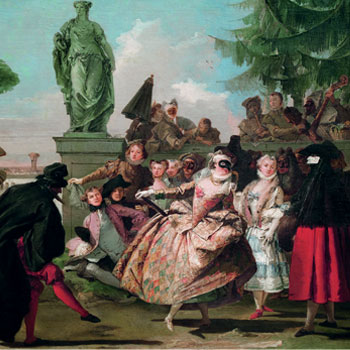
Giovanni Domenico Tiepolo, Minuet (detail), 1756 (Barcelona: Museu Nacional d’Art de Catalunya)
This fall the Montreal Museum of Fine Arts will present an innovative interdisciplinary exhibition, exploring for the first time the important interrelationships between the visual arts and music in the Venetian Republic, from the early sixteenth century to the fall of the Serenissima at the close of the eighteenth century, a period during which these art forms served the political ambitions of the state and civic institutions and became increasingly central to the economy of the Republic.
Thanks to outstanding loans from prestigious museums and collectors, visitors to the exhibition Splendore a Venezia: Art and Music from the Renaissance to Baroque in the Serenissima will discover the splendours of Venice through the musical scene: salons, the elaborate carnevale, the theatre, street performances and the festive, costumed commedia dell’arte.
Featuring approximately 120 paintings, prints and drawings, as well as historical instruments, musical manuscripts and texts, Splendore a Venezia paints a portrait of extraordinary artistic and musical creativity. This exhibition organized by the Museum brings together masterworks by many of the most renowned names associated with the city on the lagoon: visual artists directly associated with the musical life of the city include Titian, Tintoretto, Bassano, Giovanni Battista and Domenico Tiepolo, and Francesco Guardi, many of whom were also amateur musicians, as well as Bernardo Strozzi, Pietro Longhi and Canaletto, whose paintings record the role of music in Venetian life. The exhibition also includes manuscripts and publications by Venetian composers like the Gabrieli, Monteverdi, Albinoni, Lotti and Vivaldi.
Nathalie Bondil, Director and Chief Curator of the MMFA, said, “In keeping with the original exhibition programming we began with Warhol Live, Imagine, Miles Davis and Lyonel Feininger, music takes its place front and centre with this new MMFA production. As D’Annunzio said: “In Venice, in the same way that one cannot feel except in music, one cannot think if not in images.” That’s how it is at the MMFA, too: it is impossible to see without listening or to listen without seeing.” In a presentation that resembles the Museum’s previous multidisciplinary exhibitions, Splendore a Venezia will give visitors an opportunity to enjoy musical accompaniment related to each theme in the galleries, thus enhancing the exploration of each of these works.
Exhibition curator Hilliard T. Goldfarb, Associate Chief Curator and Curator of Old Masters at the MMFA and a specialist of the Italian Renaissance, developed the concept of this original exhibition produced by the MMFA, by gaining inspiration from an idea put forward by the Musée de la musique in Paris. This exhibition will be circulated by the MMFA to the Portland Art Museum in Oregon from March 7 to June 8, 2014. The exhibition’s musical accompaniment is being overseen by musicologist François Filiatrault.
The works, on loan from prominent international collections like the Metropolitan Museum of Art, the Morgan Library & Museum, the New York Public Library, the Wadsworth Atheneum, the Cleveland Museum of Art, the National Gallery of Art (Washington), the Palatine Gallery, Uffizi, Capitoline, Cini Foundation, Accademia, Museo Correr, Kunsthistorisches Museum, Thyssen-Bornemisza, the Dulwich Picture Gallery, the National Gallery (London) and the National Gallery of Canada (Ottawa), and the Cité de la musique in Paris, among others. Extensive associated programming includes a series of concerts with period instruments in the MMFA’s Bourgie Hall, as well as related activities throughout the city.
The visual arts and musical scenes during the extraordinarily creative period from Titian to Guardi and Willaert to Vivaldi were profoundly interconnected. The world’s first public opera house (1639) opened in Venice, which boasted no fewer than nine commercial opera houses in the seventeenth and eighteenth centuries. Modern music typography was invented in Venice, and it was there that the most important musical presses in Europe were located. Public musical concerts were crucial to the economic strength of Venice’s scuole (rich, powerful brotherhoods) and ospedali (establishments for the poor and orphans). Each year, a variety of processions were held in celebration of special occasions. These were recorded in the visual arts and celebrated in music, in turn serving its government, which sponsored the arts. Music and the visual arts also became central to state propaganda and the Republic’s state receptions and international profile.
The exhibition is organized along three broad conceptual themes reflecting specific, parallel and interrelated characteristics of art and music during this critical period of Venetian history: 1) Art and Music in the Public Sphere 2) Art and Music in the Private Realm 3) Art, Music and Mythology [more information about each theme is available in the press release]
To accompany the exhibition, the MMFA’s Publishing Department is co-publishing a full-colour exhibition catalogue, in English and French editions, with Hazan, Paris [Art and Music in Venice: From the Renaissance to Baroque]. The catalogue features essays by leading international experts in Venetian art, culture and music, under the general editorship of Dr. Hilliard T. Goldfarb. He is joined by a distinguished team of international cultural and musicological experts, including Tiziana Bottecchia, Dawson Carr, Francesca del Torre, Joël Dugot, Iain Fenlon, Caroline Giron, Jonathan Glixon, Sergio Guarino, Eugene Johnson, Piero Lucchi and Ellen Rosand. This publication will serve as a reference work that will make an ongoing contribution to the body of knowledge on music and the visual arts in the private and public realms of the Venetian Republic. It will be distributed internationally by Hazan (French edition) and Yale University Press (English edition). (more…)
Exhibition | Interwoven Globe: The Worldwide Textile Trade, 1500–1800
As noted at Style Court, Interwoven Globe opens this month at The Met; from the press release:
Interwoven Globe: The Worldwide Textile Trade, 1500–1800
The Metropolitan Museum of Art, New York, 16 September 2013 — 5 January 2014
Curated by Amelia Peck
 Interwoven Globe: The Worldwide Textile Trade is the first major exhibition to explore the international transmittal of design from the 16th to the early 19th century through the medium of textiles. It highlights an important design story that has never before been told from a truly global perspective. Beginning in the 16th century, the golden age of European maritime navigation in search of spice routes to the east brought about the flowering of an abundant textile trade, causing a breathtaking variety of textiles in a multiplicity of designs and techniques to travel across the globe. Textiles, which often acted as currency for spices and other goods, made their way from India and Asia to Europe, between India and Asia and Southeast Asia, from Europe to the east, and eventually to the west to North and South America. Trade textiles blended the designs, skills, and tastes of the cultures that produced them, resulting in objects both intrinsically beautiful and historically fascinating.
The exhibition is made possible by The Andrew W. Mellon Foundation, the Diane W. and James E. Burke Fund, The Coby Foundation, Ltd., The Favrot Fund, the Gail and Parker Gilbert Fund, and the Quinque Foundation.
While previous studies have focused on this story from the viewpoint of trade, Interwoven Globe is the first exhibition to explore it as a history of design—and to approach it from a perspective that emphasizes the beauty and sophistication of these often overlooked objects. It will explore the interrelationship of textiles, commerce, and taste from the Age of Discovery to the 19th century. From India and its renowned, ancient mastery of painted and dyed cotton to the sumptuous silks of China and Japan, Turkey and Iran, the paths of influence are traced westward to Europe and the Americas. Shaped by an emerging worldwide visual culture, the resulting fashion for the “exotic” in textiles, as well as in other goods and art forms, gave rise to what can be recognized as the first truly global style.
Interwoven Globe will feature 134 works, about two-thirds of which are drawn from the Metropolitan Museum’s own rich, encyclopedic collection. These objects will be augmented by important domestic and international loans in order to make worldwide visual connections. Works from the Metropolitan will come from the following departments: American Decorative Arts, Asian Art, Islamic Art, European Sculpture and Decorative Arts, The Costume Institute, European Paintings, Drawings and Prints, and Arts of Africa, Oceania, and the Americas. They will include numerous flat textiles (lengths of fabric, curtains, wall hangings, bedcovers,) tapestries, costumes, church vestments, pieces of seating furniture, and paintings and drawings. (more…)
Exhibition | Eighteenth-Century Pastels
Now on view at The Met:
Eighteenth-Century Pastels
The Metropolitan Museum of Art, New York, 2 August — 29 December 2013
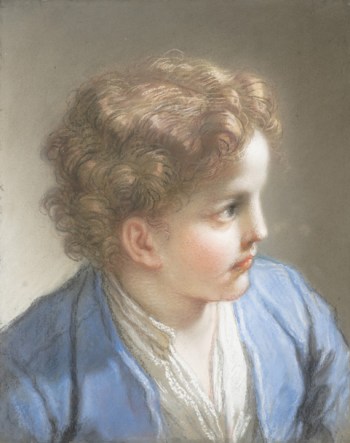
Benedetto Luti, Study of a Boy in a Blue Jacket, 1717. Pastel and chalk on blue laid paper, laid down on paste paper (New York: The Metropolitan Museum of Art)
With the 1929 bequest of Mrs. H. O. Havemeyer, the Metropolitan Museum acquired its first pastels—about twenty nineteenth-century works by Mary Cassatt, Edgar Degas, and Édouard Manet. For forty years, they were shown with our European and American paintings. It was not until 1956 that we were bequeathed a pastel by Jean Pillement (1728–1808). Between 1961 and 1975 we acquired a small group of works by John Russell (1745–1806), and there the matter stood until 2002, when the Metropolitan bought a pastel by the Venetian artist Rosalba Carriera (1673–1757). Since then we have purchased nearly a dozen others by Italian, French, British, German, and Danish artists. Most are portraits, exhibited here with two vivid seascapes by Pillement from a private collection. Pastels are made from powdery substances that are fragile and subject to fading. In accordance with modern museum practice, they are exhibited in very low light or rotated to ensure their long-term preservation. This display is therefore a temporary extension of the new installation in the adjoining galleries for European Old Master paintings.
Described by the great Salon critic and encyclopedist Dennis Diderot as no more than dust, pastel owes it distinctive velvety quality to its powdery surface, which reflects diffuse scattered light. Consisting of finely ground pigment and a white mineral extender moistened with a minute quantity of binder (such as oatmeal whey, mineral spirits, and gum tragacanth) rolled into sticks of color, pastels are made in a progression of tints and shades. Pastelists kept hundreds of such crayons on hand. The popularity of pastel—especially for portraiture—swept across Europe and Britain in the eighteenth century. Unlike today, such compositions were regarded as paintings. They were executed in vibrant colors on paper mounted on a wood strainer, elaborately framed with costly glass and on an intimate scale that suited the refined living spaces of the aristocracy and the haute bourgeoisie. These works have retained their original brilliance because the pastel medium does not contain resins and the surfaces of works in pastel were never varnished and rarely fixed, thereby precluding the darkening or yellowing that so often alters the hues of paintings in oil.
Exhibition | William Kent: Designing Georgian Britain
From the Bard Graduate Center:
William Kent: Designing Georgian Britain
Bard Graduate Center, New York City, 20 September 2013 — 9 February 2014
Victoria & Albert Museum, London, 22 March — 13 July 2014
Curated by Susan Weber and Julius Bryant
 William Kent: Designing Georgian Britain, on view at the Bard Graduate Center: Decorative Arts, Design History, Material Culture from September 20, 2013 to February 9, 2014, is the first major exhibition to examine the life and career of one of the most influential designers in eighteenth-century Britain. Visitors will discover Kent’s genius, through nearly 200 examples of his elaborate drawings for architecture, gardens, and sculpture, along with furniture, silver, paintings, illustrated books, and through new documentary films. As most of his best-known surviving works are in Britain’s great country houses, the exhibition is rich in loans from private as well as public collections. Organized by the Bard Graduate Center in collaboration with the Victoria & Albert Museum in London, the exhibition is curated by Susan Weber (BGC) and Julius Bryant (V&A). It will travel to the V&A where it will be on view from March 22 to July 13, 2014.
Background
William Kent: Designing Georgian Britain explores Kent’s work over three decades (1719–48)—a period when Britain was defining itself as a new nation and overtaking France as a leading world power. Like Robert Adam a generation later, Kent is identified not only with his own prolific and diverse output but also with an entire period style. At a time when most patrons and collectors looked to Italy for their art and design, Kent’s versatility and artistic inventiveness set the style of his age and asserted the status of the modern British artist. From a time when no refined education was complete without the Grand Tour to Italy, the word ‘Kentian’ has come to denote rich, Italianate palatial interiors furnished with gilded sculptural tables, mirrors, and Old Master paintings, elaborately presented on walls lined with the richest silk damasks and velvets, and beneath painted ceilings. Kent devised a style that catered to the Grand Tour alumni, recreating the splendors of Roman palazzi. A jovial house guest of his patrons, ‘Kentino’ (as he was affectionately known) and his creations reminded them of the best days of their lives, before they returned, inherited, and dutifully managed their old family estates.
Many of the ideas we take for granted today about visual education, good design, and national style were established by Kent’s generation. At the start of the eighteenth century, the United Kingdom of Great Britain was established through the Act of Union between England and Scotland (1707). Great expectations of new public buildings followed, especially for a new parliament and royal palace to replace those destroyed by the Whitehall Palace fire of 1698. From the accession of George I in 1714 through the death of Queen Victoria in 1901, the Royal House of Hanover reigned over Britain. With Kent’s help, this German family reinvented themselves. The new nation needed a new sense of style, both to define itself through design (in contrast to the Stuarts and the French) and to improve society at large. Responding to a challenge articulated in the Earl of Shaftesbury’s Letter Concerning the Art, or Science of Design (1712), Lord Burlington is the best- known today of several patrons who took on this responsibility. Kent lived in his London townhouse, Burlington House (today the home of the Royal Academy) for most of his life and was also, in effect, artist-in-residence at Burlington’s new Italianate villa at Chiswick. Essentially, Kent saw that good design is about visual experience, not only dependent on the erudite eye of the connoisseur or the knowledge of architecture’s ancient rules, but also reliant on the emotional response as one moved through and around houses, offices, streets, and gardens.
◊ ◊ ◊ ◊ ◊
The Exhibition
William Kent: Designing Georgian Britain is divided into ten sections that introduce specific aspects of Kent’s work, including signature private and royal commissions, and important periods in his career. William Kent’s life and the historical age in which he worked is the subject of the first section. A highlight is William Aikman’s portrait of Kent that hung over the mantelpiece at Wanstead House, and is now in the National Portrait Gallery, London. The second section focuses on Kent’s formative years on the Grand Tour in Italy where he was sent to hone his painting skills by copying the Old Masters, and to act as a purchasing agent for British collectors. Italian Baroque art, interiors, and furnishings made a lasting impression on Kent. Featured are seldom seen paintings and drawings, including Kent’s copies after Agostino Carracci, Domenichino, and Carlo Maratti, and drawings of Italianate interiors by fellow Grand Tourist John Talman, that document this inspiring period in Kent’s life. While in Italy, Kent met Lord Burlington who became his mentor and collaborator for the next several decades. Together they became early exponents of the designs of the late Renaissance architect, Andrea Palladio, which they eventually incorporated into their own Anglo-Palladian style that came to define the Georgian era.
Kent is best known for the interiors he designed for several grand country estates in Britain, and for his approach in taking responsibility for the design of the entire interior from the painting and furniture to the sculpture and decoration. Visitors to the exhibition will have the opportunity to explore a few of Kent’s best-known early interiors, such as Chiswick House, Wanstead House, and Houghton Hall, Kent’s most important early commission for the grand estate of Sir Robert Walpole, and one of the key buildings in the history of Palladian architecture in England. In addition to drawings and plans of these interiors, the exhibition features rare examples of Kent’s furniture designed specifically for these commissions.
In time, Kent began to receive important royal commissions, particularly from King George II and his son, Frederick, Prince of Wales. A section of the exhibition is devoted to designs for the new monarchy. In 1722, Kent was given a major commission to design the Cupola Room at Kensington Palace, where he was in charge of painting the ceiling and designing the furniture and chimneypieces. One of Kent’s best known and somewhat unusual works was a state barge designed for Frederick. Although the barge is too large to travel, the exhibition will feature Kent’s beautifully rendered designs, along with a detailed model. Other notable royal commissions explored include those for Queen Caroline’s Library and Hermitage in Richmond Garden. Also on view will be several extraordinary pieces of silver, made after designs by Kent. Among these are a chandelier commissioned by George II for the Leineschloss, Hanover, made by Balthasar Behrens, on loan from the Museum of Fine Arts, Boston, and a large centerpiece (or epergne) for Frederick made by silversmith George Wickes.
Another section looks specifically at the work Kent produced in London, both in private residences as well as in public buildings. Among the most prestigious of these commissions was the design of Devonshire House, the residence of the Duke of Devonshire. Although the palatial home was demolished in the 1920s, objects from and related to it survive, and the exhibition will feature drawings and a door designed by Kent. Of his public works, the exhibition examines 10 Downing Street, the Houses of Parliament, the Horse Guards at Whitehall, and the Royal Mews. Also explored are Kent’s contributions to sculpture. Among the works shown are drawings for tomb monuments for Isaac Newton, William Shakespeare, and James Stanhope in Westminister Abbey, and Michael Rysbrack’s terracotta model of Newton.
One section is devoted to Holkham Hall, designed with the assistance of Lord Burlington for Thomas Coke, 1st Earl of Leicester, who was among Kent’s most important patrons. Now considered to be one of the finest examples of the Palladian revival style of architecture in Britain, Holkham Hall is shown through a number of important works that the BGC is fortunate to borrow, including a gilded and elaborately carved settee, drawings of the interior, and Francesco Trevisani’s portrait of Thomas Coke, who built Holkham.
Although known today almost exclusively for his Palladian style, Kent worked in other idioms depending on the wishes of the patron. The exhibition looks at his Gothic works, including projects at Hampton Court and Esher Place, and his illustrations for books, most notably an edition of Edmund Spenser’s The Faerie Queene.
The final section examines Kent’s contributions to the history of landscape and garden design. Through drawings, furniture, and video, visitors will discover how Kent revolutionized garden design and helped usher in a style of natural gardening that came to characterize the English landscape garden. Two of Kent’s most important gardens, at Rousham and Stowe, remain today close to Kent’s original designs. A BGC produced video will offer a virtual journey through these gardens so that visitors will gain a better understanding of his landscape designs.
The Book
William Kent: Designing Georgian Britain, edited by Susan Weber, and published with Yale University Press, presents twenty-one essays by leading scholars of eighteenth-century British art and design, including Julius Bryant (co-curator), Geoffrey Beard, John Harris, John Dixon Hunt, Frank Salmon, and David Watkin. The book is richly illustrated with over 600 color images, including the pieces featured in the exhibition. A chronology of Kent’s projects, an exhibition checklist, and an extensive bibliography round out this scholarly publication.
Support
William Kent: Designing Georgian Britain has been generously supported by The Rothschild Foundation, Edward Lee Cave, Dr. H. Woody Brock, Christie’s, Philip Hewat-Jaboor, John A. Werwaiss, Patricia and Martin Levy, The Paul Mellon Centre for Studies in British Art, Friends of the BADA Trust, Ronald Phillips, Ltd., and two donors who wish to remain anonymous.
Exhibition | François-André Vincent
From Le musée des Beaux-Arts de Tours:
François-André Vincent
Musée des Beaux-arts, Tours, 18 October 2013 — 19 January 2014
Musée Fabre de Montpellier Agglomération, 8 February — 11 May 2014

François André Vincent, Portrait Presumed to be Madame Jeanne-Justine Boyer-Fonfrede and Her Son, Henri (Paris: Louvre)
Le musée des Beaux-Arts de Tours et le musée Fabre de Montpellier s’associent pour concevoir et organiser d’octobre 2013 à mai 2014 la première exposition consacrée au peintre François-André Vincent (1746–1816), à l’occasion de la publication du catalogue raisonné de l’œuvre de l’artiste publié chez Arthéna par Jean-Pierre Cuzin, ancien conservateur général du département des peintures du musée du Louvre.
Le commissariat de l’exposition est constitué, aux côtés de Jean-Pierre Cuzin qui a sélectionné peintures et dessins, de Sophie Join-Lambert et Michel Hilaire, directeurs des deux musées, et de deux conservateurs, Olivier Zeder, conservateur en chef à Montpellier et Véronique Moreau, conservateur en chef au musée des Beaux-Arts de Tours.
Les publications récentes ont montré l’importance d’un artiste, aussi bien pour la peinture que pour le dessin, dont les œuvres, entre deux mondes stylistiques, ont pu être confondues avec celles de Fragonard comme avec celles de David. Il tient une place essentielle dans la peinture française comme promoteur des sujets pris à l’Antiquité comme de ceux pris à l’Histoire de France et peut apparaître, à beaucoup d’égards, comme un “préromantique”. Son rôle dans le domaine du portrait et particulièrement dans celui du portrait-charge apparaît capital.
L’exposition devrait apporter la révélation d’un grand artiste jusqu’ici méconnu et dont les œuvres enrichissent des collections publiques et privées des plus prestigieuses, tant en Europe qu’à l’étranger. Un tel projet ne peut se concevoir sans faire appel aux musées et collectionneurs français et étrangers. Parmi les collections publiques, plusieurs appartiennent au réseau FRAME (French Regional American Museums Exchange, France et Etats-Unis).
◊ ◊ ◊ ◊ ◊
From Art Media Agency:
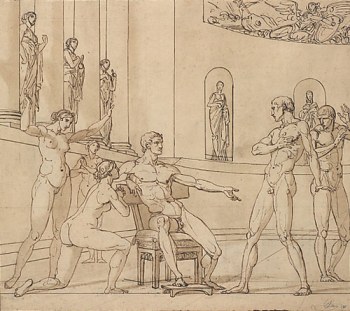
François André Vincent, The Clemency of Augustus (Corneille, Cinna, V, 3) (recto); Knight Restraining a Female Figure (verso), 1788
(New York: Metropolitan Museum of Art)
An exhibition of works by François-André Vincent (1745–1816) is to take place between 19 October 2013 and 19 January 2014 at the Musée des Beaux-Arts in Tours. The exhibitions is to coincide with the publication by Arthéna of a catalogue raisonné devoted to the artist François-André Vincent produced by Jean-Pierre Cuzin, former curator of painting at the Louvre.
Stylistically, Vincent’s works have been compared to those by Fragonard and David, and are sometimes described as pre-Romantic. Inspired by antiquity, the artist’s pieces often return to explore moments in France’s history. The exhibition features over 100 works, gathered from collections in both France and further afield. It is organised with the support of the French state, in collaboration with the Ministry of Culture and Communication, the French Heritage Management association, and the French Museums Service.
Following its close at Tours, the exhibition is to travel to the Musée Fabre in Montpellier, where is is to be on display between 8 February to 11 May 2014. A selection of drawings by Vincent will then be display at the Cognacq-Jay museum from 26 March to 30 June 2014.
Exhibition | Exuberance of Meaning: Catherine the Great’s Patronage
Press release (1 July 2013) from the Georgia Museum of Art:
Exuberance of Meaning: The Art Patronage of Catherine the Great
Georgia Museum of Art, The University of Georgia at Athens, 21 September 2013 — 5 January 2014
Hillwood Museum and Gardens, Washington, D.C., 1 February — 7 June 2014
Curated by Asen Kirin
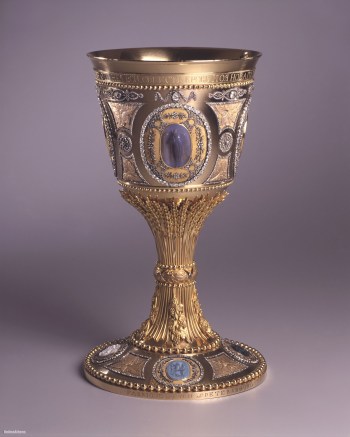
Chalice, Iver Windfeldt Buch (1749-1811), St. Petersburg, 1791, gold, diamonds, chalcedony, bloodstone, nephrite, carnelian, cast glass, height: 33 cm, diameter: 18 cm (Hillwood Museum and Gardens)
The Georgia Museum of Art at the University of Georgia presents Exuberance of Meaning: The Art Patronage of Catherine the Great September 21, 2013 to January 5, 2014. This exhibition features works of decorative art the Russian empress Catherine the Great commissioned for her own use or as gifts for courtiers, including a large chalice created by noted goldsmith Iver Winfeldt Buch.
The Buch chalice, which belongs to Hillwood Museum and Gardens in Washington, D.C., serves as the centerpiece of the exhibition. Adorned with precious gems and eight carved cameos, it demonstrates how Catherine combined Byzantine and classical influences to forge a new direction for Russian culture. Other objects establish the background for the empress’s choices or represent major currents in 17th- and 18th-century Russian art. Dr. Asen Kirin, associate professor of art and associate director of UGA’s Lamar Dodd School of Art, is curator of this exhibition, which borrows objects from the Metropolitan Museum of Art, the Chipstone Foundation, the Walters Museum and private collections, as well as Hillwood.
Marjorie Merriweather Post, the sole heir to the multimillion-dollar Post Cereal Company, purchased the works that formed Hillwood’s Russian collection. Many of the works she purchased while in Russia in the 1930s are on display in this exhibition. Kirin invites audiences “to contemplate the art collections of two extraordinary women, who lived at different times and could not have come from more dissimilar environments. One is Europe’s Old Regime of absolute hereditary monarchies, the other—the modern, industrialized America of free enterprise.”
The exhibition presents a comparison of dazzling and masterful objects that exemplify both medieval Byzantine culture, of which Russia was the successor and guardian, and the Western, neoclassical style that was the hallmark of the Enlightenment. It focuses on the manner in which Catherine applied her knowledge of ancient and medieval glyptic art and incorporated her collection of carved gems in the commission of new works of art, a deliberate continuation of the centuries-old tradition of placing pagan, Greek, and Roman carved stones onto sacred Christian liturgical and devotional objects.
During her reign, the empress worked to reconcile her contemporary scientific and historical frame of mind with the devotional ways of the Orthodox Church, which had long been sanctified by tradition. The title Exuberance of Meaning refers to the crucial characteristic that distinguishes her endeavors in the arts: she conceived her projects in a manner that allowed for multiple complementary interpretations covering a wide spectrum of meanings.
Kirin is particularly interested in the comparison of the two collectors, Catherine and Post, as both women were powerful, accomplished and elevated their respective domains despite a tradition of male dominance. Kirin suggests that audiences contemplate “how the arts enabled them to present themselves to society and to control the perception of their images.”
Kirin has worked with the museum before, perhaps most notably on the exhibition Sacred Art, Secular Context, which examined Byzantine works of art from the collection of Dumbarton Oaks, Washington, D.C.
The museum will publish a catalogue to accompany the exhibition, featuring full-page, full-color illustrations of the objects it includes and scholarly essays on Catherine’s art patronage, the Buch chalice and the empress’ proto-feminist use of vessels to make a statement about gender and power.
Events associated with the exhibition include films, a family day, and a two-day symposium scheduled for November 1–2 featuring noted scholars of Russian art. The museum’s Collectors Group, an upper-level membership group within the Friends of the Georgia Museum of Art, will host an opening for the exhibition September 21 in conjunction with the UGA Performing Arts Center’s presentation of a concert of music the empress favored.
Exhibition | Leipzig 1813, The Battle of the Nations
Leipzig marks the 200th anniversary of the Battle of the Nations (19 October 1813) with a 1:1 scale panorama by Yadegar Asisi, depicting the city in the aftermath of the battle — Europe’s largest prior to World War I, with 90,000 dead and injured. From a press release:
Leipzig 1813, The Battle of the Nations: A Panorama by Yadegar Asisi
Leipzig Panometer, 3 August — December 2013

◊ ◊ ◊ ◊ ◊
Having opened on August 3, Yadegar Asisi’s monumental 360° panorama Leipzig 1813: Amidst the Confusion of the Battle of the Nations is now on display at the Panometer Leipzig. The world’s largest panorama, 3500 m² in size and on a scale of 1:1, shows us the city of Leipzig immediately following the Battle of the Nations, which took place on October 19, 1813. The visitor views the scene from the vantage point of the roof of the church of St. Thomas at the western border of the city, with an excellent view both of the city centre and of the surrounding areas, where the most violent battles took place.
It came as something of a surprise to Yadegar Asisi that he was to spend so much time – since 2009 – working so intensively on this theme. “Having grown up in Leipzig, the Battle of the Nations was present in the form of the monument but not in as far as the actual events were concerned“, says the artist. “For a long time it didn’t really mean anything to me, until I asked myself the question of what Leipzig was like in 1813 and what the battle meant to the city. I came to the conclusion that I would present this European event from the perspective of Leipzig and its citizens. Under no circumstances did I wish to create a battle panorama. In fact, it has turned out to be more of an anti-war panorama.”
Asisi presents Leipzig as it would have looked in 1813, complete with its architecture still relatively intact. The city is struggling to come to terms with the repercussions of the battle: 90,000 dead and injured, countless numbers of refugees from the burned-out villages in the surrounding areas. The crowds in the alleyways and squares are in turmoil as the victorious troops move in and the French take flight, leaving behind them hundreds of thousands of people in a state of despair.
The successful ten-year collaboration between Asisi and the composer Erik Babak, well known for his work in international film and television productions, again bears fruit in Leipzig 1813; the accompanying music features a chorus of 40 voices and passages from the poem “Abroad” by Heinrich Heine. The panoramic experience is rounded off with sound effects reflecting the era and the confusion of the scene.
The complex figuration in the architectural design was the greatest challenge facing Asisi during his work on Leipzig 1813. Troops numbering around 600,000 soldiers, with over 90,000 dead and injured, all had to find their places in and around Leipzig, which had only 35,000 inhabitants at the time. For this purpose alone, it was necessary to stage four lavish photo shootings with several hundred extras in costume, saddle horses, teams of horses and traps. Scenes featuring soldiers, citizens of Leipzig, marketeers, refugees, the wounded and the dead, were re-enacted and coordinated as though a film were being made. To this end, Asisi’s expert advisor Helmut Börner smoothed the way for a cooperation with the “Verband Jahrfeier Völkerschlacht b. Leipzig 1813 e.V.”.
An encounter with the novelist Sabine Ebert led to a piece of special media interaction. Details from the panorama Leipzig 1813 can be discovered in Sabine Ebert’s most recent work 1813 – Kriegsfeuer (1813 – Warfire), just as scenes from the book can be found in Yadegar Asisi’s panorama. For example, the author is depicted in the panorama wearing the same clothes as one of her protagonists on the cover of the book.
The accompanying exhibition introduces the free city of Leipzig on the evening before the battle on an emotional and intuitive level. It leads visitors around the outside circumference of the panorama, presenting Leipzig as a town famous for its trade, learning, publishing and music, before the greatest battle there had ever been breaks out outside its gates. A “making-of” film will be shown in the auditorium, explaining how the complex circular picture was created and documenting the milestones of its production, which covered a period of almost five years.
An extensive mediation programme, including various guided tours, lectures and special events, is scheduled in connection with the panorama. This programme is designed to bring visitors into closer contact with life as it was at the time of the battle, 200 years ago.
Additional information is available here»
◊ ◊ ◊ ◊ ◊
For those of you interested in panoramas generally, see the website of the International Panorama Council. The organization’s conference takes place in November:
2013 International Panorama Conference
Switzerland, 22–24 November 2013
The conference days will include visits to Bourbaki Panorama Lucerne, Alpineum Museum with its Alpine Dioramas and to Glacier Garden Museum with its optical spectacles. On November 25 a post-conference program rounds up the panoramic experience in the beautiful city of Lucerne and includes a trip to Einsiedeln to visit the Crucifixion of Christ Panorama.










leave a comment