Eighteenth-Century Easter Bunny at Winterthur
From ArtDaily:
Eighteenth-Century Drawing of an Easter Rabbit
Winterthur Museum, 21 April — 8 May 2011

Attributed to Johann Conrad Gilbert, "Easter Rabbit," second half of the eighteenth century (Winterthur Museum)
Winterthur Museum recently acquired one of the earliest known American depictions of the Easter Bunny, which was sold at Pook & Pook auction house in Downingtown, Pennsylvania. Together with the Christmas tree, the custom of the Easter rabbit and colored eggs was brought to America by immigrants from southwestern Germany in the 1700s, and has become a favorite American tradition. This delightful image is attributed to schoolmaster Johann Conrad Gilbert (1734–1812), who emigrated from Germany in 1757 and ultimately settled in Berks County, Pennsylvania. He likely made the drawing as a gift for one of his students. A similar drawing, also attributed to Gilbert, is in the collection of
Colonial Williamsburg.
These drawings are examples of a Pennsylvania German tradition of decorated manuscripts known as fraktur, which include birth and baptismal certificates, family records, writing samples, and bookplates. Lisa Minardi, a fraktur expert and assistant curator of the museum’s current exhibition, Paint, Pattern & People: Furniture of Southeastern Pennsylvania, 1725–1850, notes, “The Easter rabbit drawing is one of the rarest of all fraktur, with only two examples known, and is a major addition to Winterthur ’s collection.” “This important acquisition allows Winterthur to document the Germanic beginnings of a beloved American tradition,” adds J. Thomas Savage, Winterthur ’s director of museum affairs.
The full article at ArtDaily is available here»
Furniture Exhibition at Winterthur: ‘Paint, Pattern, and People’
Press release from Winterthur:
Paint, Pattern & People: Furniture of Southeastern Pennsylvania, 1725-1850
Winterthur, 2 April 2011 — 8 January 2012
Curated by Wendy Cooper and Lisa Minardi

ISBN: 9780912724690, $55
This landmark exhibition explores the colorful furniture of southeastern Pennsylvania along with the people who made, owned, inherited, and collected it. Featuring nearly 200 objects—including furniture, fraktur, needlework, and paintings—the show focuses on the culture and creativity of the area’s English- and German-speaking inhabitants. Paint, Pattern & People sheds new light on southeastern Pennsylvania’s highly distinctive local expressions of furniture and presents important objects for which the maker or family history is known. This well-documented furniture provides a new context to understand the objects as fully as possible and place them within specific locations. Although the exhibition is about furniture, it is not about dovetails and glue blocks but rather the people of the region who are the threads from which the story is woven. Thus the furniture in Paint, Pattern & People is the vehicle that transports us into the lives of our ancestors and leads to a greater understanding of our rich cultural heritage.
Due to William Penn’s policy of religious tolerance that attracted people of various faiths and ethnic backgrounds, Pennsylvania was the most culturally diverse of the thirteen colonies. Through the study of objects produced by this great mixed multitude, the extraordinary vibrance and variety of the region’s furniture comes into focus. Ethnicity, religious affiliation, personal taste, socioeconomic status, and the skill of the craftsman all influenced local forms, ornamentation, and construction. (more…)
Exhibition: ‘Picturing the Senses in European Art’
From the MFAH:
Picturing the Senses in European Art
The Museum of Fine Arts Houston, 10 April — 17 July 2011

Sebastiano Ceccarini, "Portrait of the Young Princes Marescotti of Parrano," 1745
Picturing the Senses in European Art, organized by the Sarah Campbell Blaffer Foundation, explores artists’ interest in evoking the five senses through both allegorical and realistic associations. The exhibition of 16th-, 17th- and 18th-century paintings and works on paper is drawn largely from the permanent collections of the Blaffer Foundation and the MFAH, and offers an opportunity to see some significant works that are not often on display while viewing others in a fresh context.
The theme of Picturing the Senses is simple and accessible, yet rooted in classical philosophy and art-historical tradition. “Picturing the Senses includes and reaches beyond the traditional scenes and cycles of the senses,” says Leslie Scattone, assistant curator of the Blaffer Foundation, “and covers a variety of subjects that evoke one or more of the senses. While all of the works are mediated through the sense of sight, many appeal to multiple senses, and the discovery of these can be an intriguing process.”
The five senses as a theme in art first emerged in the medieval period, when they were often associated with vice. During the 16th century, the senses began being treated as independent subjects, usually as allegories. A shift to more naturalistic depictions took place in the 17th century, paralleling intellectual developments of the time. (more…)
Exhibition: London’s Lost Museums at the Hunterian
Press release from the Hunterian:
London’s Lost Museums: Nature and Medicine on Show
Hunterian Museum at the Royal College of Surgeons, London, 1 March — 2 July 2011
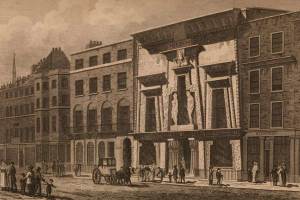
William Bullock's Egyptian Hall
London’s Lost Museums: Nature and Medicine on Show celebrates early natural history and anatomical collections once displayed in the capital, now ‘lost’ due to neglect, dispersal or destruction. With manuscripts, illustrations and specimens, the exhibition brings to life the contents, purpose and fate of seven historic collections and paints a portrait of curators and museum practices of the last 350 years. The exhibition also provides an opportunity to see fascinating objects such as a rare illustrated catalogue, Museum Regales’ Societis from 1681, a mummified foot believed to be from the Royal Society’s Repository, and hear about the devastating bomb damage inflicted upon the Hunterian Museum during
the Second World War.
As noted by Sarah Pearson, Curator at the Hunterian Museum, “Displays of natural history and anatomy have been popular in London since the 17th century and were curated for various reasons, some enhanced social and professional credentials while others were created to inspire wonder or to educate. Whatever their purpose, precious remains of collections forgotten, dispersed or damaged have found their way into today’s museums, including the Hunterian Museum, and so centuries on are still helping to explain the world of nature and medicine.”
The seven ‘lost’ natural history and anatomy museums featured in the exhibition are:
1. The Royal Society’s Repository – 17th to 18th century
2. Sir Hans Sloane’s Museum – 17th to 18th century
3. Sir Ashton Lever’s Holophusikon and the Museum Leverianum – 18th to 19th century
4. William Bullock’s Egyptian Hall – early 19th century
5. Joshua Brookes’ museum of anatomy and natural history – 18th to 19th century
6. John Heaviside’s anatomy museum – 18th to 19th century
7. The original College Museum at the Royal College of Surgeons – 19th to 20th century
◊ ◊ ◊ ◊ ◊
London’s Lost Museums Study Day
Hunterian Museum at the Royal College of Surgeons, London, 21 May 2011
For those inspired by the exhibition London’s Lost Museums, this study day offers the opportunity to learn more about museums that did not survive the test of time. Engage with the material and manuscript remnants of forgotten collections and tour the exhibition with its curators. Featuring speakers from across the heritage sector:
* Sam Alberti (Royal College of Surgeons) on lost medical museums
* Alan Bates (University College London) on lost anatomy shows
* Caroline Cornish (Royal Holloway) on Kew’s lost museums
* Stuart Eagles on the lost art museum at Ancoats
* Tim Knox (Sir John Soane’s Museum) on a lost architectural museum
* Frances Larson (Durham University) on Wellcome’s lost collection
* Chris Plumb (University of Manchester) on lost animal displays
£45/£35 concessions (MGHG members; College members, fellows and affiliates, full-time students). Includes refreshments and lunch. Bookings: 020 7869 6560. More information is available here»
Exhibition: Goya’s ‘Disasters of War’ in Barcelona
As noted at ArtDaily:
Goya: The Disasters of War / Los Desastres de la Guerra
Museu Diocesà de Barcelona, 24 March — 29 May 2011
Ibercaja, together with the Diocesan Museum of Barcelona, has organised this exhibition of the first complete series of The Disasters of the War: 80 engravings of the Aragonese painter Francisco Goya Lucientes (Fuendetodos, Zaragoza, 1746 – Bordeaux, 1828). These were painted during the Spanish Independence War, between 1810 and 1814, and are a graphical chronicle of those tragic events. However, Goya far-reaches the events and his existential and vital adventure, and he uses his art to make a declaration against all wars: he denounces the atrocities of the French army against the Spanish people, as well as the violence of the soldiers and the uncontrollable masses. The result of these paintings is the evidence of a surprisingly modernity for the times, a real crude disillusioned reflexion about mankind, finding itself in a limit situation that creates cruelty, death and misery and shows the failure of reason, strongly defended by the erudites. . . .
The full ArtDaily posting is available here»
Germanic Drawings at the Getty
From the Getty:
Spirit of an Age: Drawings from the Germanic World, 1770–1900
Getty Center, Los Angeles, 29 March — 19 June 2011
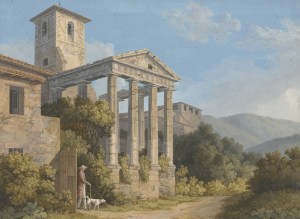
Jakob Philipp Hackert, "The Temple of Hercules in Cori near Velletri," 1783 (Los Angeles: The J. Paul Getty Museum)
Introducing recent acquisitions that represent a new area of the J. Paul Getty Museum’s collection, this exhibition features German and Austrian drawings made between 1770 and 1900. During that period, the Germanic world underwent profound changes—intellectual, social, economic, and political. Events such as the publications of Johann Wolfgang von Goethe, the Industrial Revolution, the formal unification of Germany into a nation state, and the invention of psychoanalysis shaped modern life and its representations in art.
In the early 1800s, the philosopher Georg Wilhelm Hegel professed that art was a fundamental mode of consciousness whereby humans could reach a profound understanding both of themselves and the world. Art, therefore, reflected the spirit of the age (“Zeitgeist” in German) in which it was created; this influential notion held sway over the 19th century. In fact, drawing—along with music—proved to be an essential expression of the period. It achieved an extremely high rank among the pictorial arts, sustained by the rise of art academies, which particularly emphasized draftsmanship as part of artistic training and practice. . . .
More information is available here»
Exhibition: ‘The Art of Courtly Lucknow’
I’m afraid this exhibition slipped past me when it was at LACMA. It opens today, however, at the Musée Guimet in Paris. Thanks to Hélène Bremer for pointing it out. The following description comes from the LACMA press release:
India’s Fabled City: The Art of Courtly Lucknow / Une cour royale en Inde: Lucknow
The Los Angeles County Museum of Art, 12 December 2010 — 27 February 2011
Musée National des Arts asiatiques-Guimet, Paris, 6 April — 11 July 2011
Curated by Stephen Markel and Tushara Bindu Gude
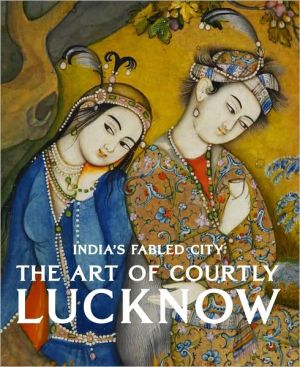
Exhibition catalogue, 272 pages, ISBN: 9783791350752
The Los Angeles County Museum of Art presents India’s Fabled City: The Art of Courtly Lucknow—the first major international exhibition devoted to the cosmopolitan culture of the northern Indian court of Lucknow, and the refined artistic production of the city’s multiethnic residents and artists. On view from December 12, 2010 through February 27, 2011, the exhibition will include almost 200 artworks: European oil paintings, watercolors, and prints; Indian opaque watercolor paintings generally made for albums, vintage photography, textiles, and garments, and a range of decorative art objects including metalwork, glassware, weaponry, and jewelry. Organized by Stephen Markel, LACMA curator of South & Southeast Asian art and department head, and Tushara Bindu Gude, associate curator, The Art of Courtly Lucknow will not only present the unique artistic traditions of Lucknow, but will also provide a framework for understanding the history of this extraordinary region and the nature of India’s colonial history and memory. . . .

After Johann Zoffany, "Colonel Polier Watching a Nautch," gouache on paper, ca. 1786-88 (Zurich: Museum Rietberg)
Lucknow was the capital of Awadh (a province in the Mughal Empire located in the present-day Indian state of Uttar Pradesh), and has become identified with the broader region and culture. From the mid-eighteenth century until the establishment of formal British rule in India in 1858, Lucknow overshadowed Delhi—the capital of the Mughal dynasty—to become the cultural center of northern India. Indian artists, poets, and courtiers flocked to Awadh seeking security and patronage, as Delhi suffered an extended period of unrest beginning in 1739. European artists, travelers and political agents were also soon lured to the region, seduced by tales of the wealth, opulence, and the generosity of Lucknow’s rulers (nawabs) and by the beauty of the city itself. The dynamic interaction between Indians and Europeans, the interplay
between their respective tastes and traditions, and the hybrid
lives led by many of Lucknow’s residents are explored in the
exhibition and accompanying publication. (more…)
‘Street Cries’ at the Museum of London
From the Museum of London:
Street Cries
Museum of London, 25 March — 31 July 2011
Curated by Francis Marshall
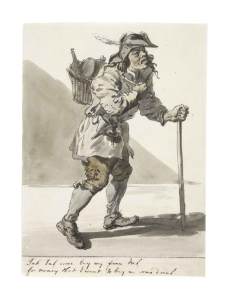
Paul Sandby, "Ink Seller," watercolour, ca. 1759 © Museum of London
Street Cries uses the Museum of London’s extensive art collection to consider how the urban poor were depicted from the 17th to the 19th century. Some of the earliest visual records of the urban poor were prints showing street traders. These first appeared in 15th-century Europe and continued to be made well into the 19th century. The market for this type of imagery was a flourishing one, particularly in London.
Many of these images presented an idealised vision of the poor. However, some artists, attempted greater realism. In 1760, for instance, Paul Sandby sought to redress the sanitizing tendency with his etchings Twelve London Cries Drawn from the Life. However, he anticipated a much larger set running to around forty images. He made watercolour drawings for these, of which the museum has an important group, but they were never published, probably because Sandby’s work was too realistic. Sixty years later, the French artist Théodore Géricault produced a print series depicting London’s poor. These powerful prints where a commercial flop largely because the imagery was too hard hitting to appeal to collectors at
the time.
Images of street vendors, and the urban poor generally, pose interesting questions about how society was organised, the motives of those making, selling and buying the prints, and the status and identity of the people depicted. Amongst other things, they can be seen as precursors of Mayhew’s efforts to produce a taxonomy of the London poor. The exhibition explores these issues as well as showcasing some of the Museum’s most important 18th- and 19th-century prints and drawings. Amongst the artists included are Paul Sandby, Gustave Doré, Théodore Géricault, and Thomas Rowlandson.
April 27, 3:00 — Curator Francis Marshall speaks on the exhibition at the Museum of London.
◊ ◊ ◊ ◊ ◊
Writing for The Independent (21 March 2011), Matilda Battersby reviews the show:
Put them all together and they resemble the cast of Oliver Twist: street urchins, prostitutes, beggars and street vendors all carefully drawn, painted or printed in the 17th and 18th centuries. They are some of the earliest depiction of London’s poor and are due to go on show at the Museum of London this week.
It is an interesting body of work for two reasons. Firstly, it encapsulates the diverse roles, functions and perceptions of Britain’s ‘underclass’ during those two centuries as well as giving insight into what was eaten, sold and readily available. Secondly, it shows an increased, although for the most part snobbish, awareness of what was then the ‘undeserving poor’ and an anthropological, if not exactly philanthropic, interest in them. . . .
The full review — plus a video with Francis Marshall discussing three images from the exhibition — is available here»
Stockholm Show Surveys Sexuality
Press release from the museum:
Lust & Last / Lust & Vice
Nationalmuseum, Stockholm, 24 March — 14 August 2011

Louis Lagrenée, "Amor and Psyche," (Stockholm: Nationalmuseum)
On 24 March 2011, Nationalmuseum opens the doors to Lust & Vice, a major exhibition filling three rooms and five display cases. Over 200 works from the 16th century to the present day, mostly little-known treasures from the museum’s own collection, will illustrate how views of sexuality, virtue and morality have changed over the centuries. The exhibition includes works coloured by the religious teachings of the 16th and 17th century, which held that sexual relationships could only take place inside marriage. However, there was a big difference between the behaviour the church prescribed for ordinary people and the liberties taken by the elite. The exhibition continues by examining the upper-class view of marriage in the 18th century: a social institution that left the parties to seek true passion elsewhere. In other words, an
attitude diametrically opposed to that of the church. The 18th
century was a time of double standards: one for the masses
and another for the enlightened elite.

Adolf Ulrik Wertmüller, "Danaë and the Shower of Gold,"(Stockholm: Nationalmuseum)
From the 19th century onward, the city becomes a central theme. Large-scale urbanization frequently led to anonymous sexual encounters and prostitution. Secret images for private consumption coexisting with moralistic public art were another by-product of urbanization. The exhibition presents examples of how virtue and sin have been depicted in art through the ages. One of the display cases examines how girls were brought up to lead a virtuous life in order to be good marriage material. Exhibits include a real chastity belt on loan from Nordiska museet. One wall in the first room displays paintings of women’s bottoms – an erotic reference that was long considered sinful because sex, besides taking place inside marriage, required eye contact in order to be morally acceptable. Artists managed to paint erotic motifs by portraying
myths or biblical scenes, often with moralistic undertones
alluding to the consequences of a sinful lifestyle. (more…)
Drawings in Portland, Maine
Press release from the museum:
European Drawings at the Portland Museum of Art
Portland Museum of Art, Portland, Maine, 26 March — 22 May 2011

Thomas Rowlandson, "Norfolk Broads," watercolor, graphite, and ink, ca. 1795 (Portland Museum of Art)
In the spring, the Portland Museum of Art will feature an exhibition devoted to European drawings comprised of 30 works from the Museum’s permanent collection and on loan from private collectors. European Drawings at the Portland Museum of Art, on view March 26 through May 22, 2011, will highlight masterworks by the finest draughtsmen of the 18th, 19th, and 20th centuries. This will be a unique opportunity to see works of art that are rarely exhibited because of the fragile nature of paper. The exhibition is part of Where to Draw the Line: The Maine Drawing Project, a statewide collaboration of 20 arts organizations that will present exhibitions dedicated to the medium of drawing throughout 2011. (more…)










leave a comment