Exhibition | The Abyss: Nantes and the Atlantic Slave Trade, 1707–1830

L’abîme: Nantes dans la traite atlantique et l’esclavage colonial, 1707–1830 as installed at the Musée d’histoire de Nantes (Photo by David Gallard). The graphic elements on the wall and the floor are taken from an eighteenth-century document, signed by participants in the slave trade, that depicts La Marie Séraphique, a slave ship that in 1769 transported 312 captives to Cap-Français.
◊ ◊ ◊ ◊ ◊
Now on view at the Musée d’histoire in Nantes (there is also a Google Arts & Culture site, “Nantes and the Atlantic Slave Trade,” with related objects from the museum).
The Abyss: Nantes’s Role in the Slave Trade and Colonial Slavery, 1707–1830
L’abîme: Nantes dans la traite atlantique et l’esclavage colonial, 1707–1830
Musée d’histoire de Nantes, Château des ducs de Bretagne, 16 October 2021 to 19 June 2022
Curated by Krystel Gualdé

Plan, Profile, and Layout of the Ship ‘The Séraphique Marie’ of Nantes, outfitted by Mr Gruel, for Angola, under the command of Gaugy, who dealt in Loango . . ., 1770 (Musée d’histoire de Nantes).
Still today, historians are unable to agree on the number of victims resulting from the transatlantic slave trade. With so many documents missing, it is impossible to arrive at an exact figure; and yet, the difference in final totals does not vary in terms of tens or hundreds or thousands—but in millions. How can a phenomenon so tragic and fundamental divide those who study it to such a degree? It would appear that the number, as staggering as it may be, does not explain the problem sufficiently. Moreover, what would we ultimately know if we arrived at a definite number? Would we know how many men, women, and children died during the wars and raids that led to their captivity? Would we have a better idea of how an entire city and its surrounding region could justify using the colonial system and slave trade as a means to accumulate unprecedented wealth? Would we be able to imagine the close ties between the transatlantic slave trade and the early Industrial Revolution? Would we understand, if only for an instant, how horrible it must have been to no longer be autonomous, to stop being considered human and be relegated to the status of a material good, to disappear without leaving any trace or memory? The exhibition provides an opportunity to hold the collections of the Musée d’histoire up to the light, revealing the invisible but ever-present traces of the men and women who were victims of the colonial system. Beyond the economic and commercial perspective commonly offered, this exhibition reveals the complex reality of a city so deeply involved in the slave trade.
Krystel Gualdé, est directrice scientifique du Musée d’histoire de Nantes et du Mémorial de l’esclavage. Spécialiste de la traite atlantique et de l’esclavage colonial, elle engage le musée dans de nombreux partenariats et réseaux scientifiques au niveau national comme international (Conseil d’orientation de la Fondation pour la mémoire de l’esclavage ; Projet SLAFNET – Slavery in Africa: A Dialogue between Europe and Africa). Elle est par ailleurs membre du Global Curatorial Project porté par le Center for the Study of Global Slavery at the Smithsonian’s National Museum of African American History and Culture (NMAAHC) et le Center for the Study of Slavery and Justice à l’université Brown aux Etats-Unis.
Krystel Gualdé, L’abîme: Nantes dans la traite atlantique et l’esclavage colonial, 1707–1830 (Rennes: Presses Universitaires de Rennes), 320 pages, ISBN: 978-2906519794, 30€.
A preview of the book is available here»
The dossier de presse is available here»
The Decorative Arts Trust Announces Failey Grant Recipients
From the press release (1 December 2021) . . .
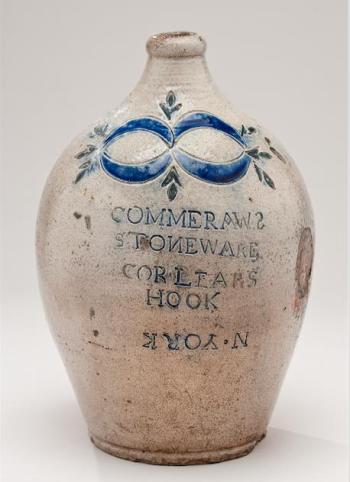
Thomas W. Commeraw, Jug, ca. 1796–1819, stoneware and cobalt oxide. Impressed on front: “COMMERAW’S/STONEWARE / CORLEARS / HOOK / N. YORK” (New-York Historical Society, 1937.820).
The Decorative Arts Trust congratulates author Caitlin Meehye Beach, Historic Rock Ford, and the New-York Historical Society on receiving Failey Grants. The Failey Grant program provides $25,000 in support for noteworthy research, exhibition, publication, and conservation projects through the Dean F. Failey Fund, named in honor of the Trust’s late Governor. Preference is given to projects that employ or are led by emerging professionals in the museum field.
Caitlin Meehye Beach, an assistant professor in the Department of Art History and affiliated faculty in the Department of African and African American Studies at Fordham University, will utilize grant funds for her forthcoming book Sculpture at the Ends of Slavery, which will be published by the University of California Press in 2022. The text will examine how a wide range of works of sculpture and decorative art—from antislavery medallions to statues of bondspeople bearing broken chains—gave visual form to narratives about abolition in the 18th and 19th centuries.
Historic Rock Ford in Lancaster, Pennsylvania, will use grant funding for further research and interpretation of the over 200 objects in their John J. Snyder, Jr. Gallery of Early Lancaster County Decorative Arts. Their goal is to uncover more about the shops, apprentices, laborers, indentured laborers, and enslaved workers who contributed to the Gallery’s collection of furniture, silver, clocks, and paintings from the mid-1700s to the early 1800s.
The New-York Historical Society receives grant funding for the groundbreaking exhibition Crafting Freedom: Uncovering the Life and Legacy of Free Black Potter Thomas Commeraw, to be presented January to June 2023 in their Pam & Scott Schafler Gallery. Crafting Freedom will be the first exhibition focused solely on Commeraw, a free Black craftsman descended from enslaved people, who was active as a master potter from the 1790s through 1819.
The Decorative Arts Trust is a non-profit membership organization that promotes and fosters the appreciation and study of the decorative arts through exchanging information through domestic and international programming; collaborating and partnering with museums and preservation organizations; and underwriting internships, research grants, and scholarships for graduate students and young professionals.
Exhibition | Antoine Watteau: Art — Market — Trade
Now on view at Schloss Charlottenburg:
Antoine Watteau: Art — Market — Trade
Schloss Charlottenburg, Berlin, 9 October 2021 — 1 January 2022
Curated by Christoph Martin Vogtherr
 2021 marks the 300th anniversary of the death of the French painter Antoine Watteau (1684—1721). The fame of the artist, who was already celebrated during his lifetime, continues to have an effect today, and his works are coveted collector’s items. After the Louvre in Paris, the Prussian Palaces and Gardens Foundation Berlin-Brandenburg owns the most important collection of paintings by this artist. Under the motto ‘Art—Market—Trade’, a special exhibition at Charlottenburg Palace pays tribute to this outstanding painter of the 18th century. The focus of the show is one of Watteau’s major works: the Shop Sign of the Art Dealer Gersaint (L’enseigne du marchand d’art Gersaint). Acquired by Frederick the Great (1712—1786) in 1746, the painting has been considered a masterpiece ever since it was painted. Originally created as a medium of business advertising and as a ‘figurehead’ of the Parisian art trade, the painting continues to stimulate contemporary questions concerning marketing, trade, but also collecting and intellectual engagement with art.
Two protagonists of Parisian art life are presented: Edme-François Gersaint (1694—1750) and Jean de Jullienne (1686—1766). Gersaint, a young up-and-coming art dealer, used his shop on the Pont Notre Dame in Paris to market the artist’s works throughout Europe through new advertising media and formats after Watteau’s death. Together with Jullienne, a collector and patron of Watteau, they realized the idea of reproducing all of the painter’s drawings and paintings in print. This edition, the Recueil Jullienne, was the prototype of a modern illustrated collection of works, which in its aftermath was to trigger a veritable fashion wave: throughout Europe, collectors, manufactory owners, and tradesmen acquired the prints created after Watteau’s works. Watteau’s imagery also inspired court painting and arts and crafts in Prussia. Motifs á la Watteau can be found not only in painting, but also on screens, wallpaper, fans, porcelain, and tapestries of the Frederician period.
As a source of inspiration, Watteau continues to have an impact right up to the modern age. Contemporary artists such as the Swiss painter Thomas Huber (b.1955) and the British fashion designer Vivienne Westwood (b.1941) are represented in the exhibition with one work each. Their artistic positions show that Watteau is still perceived today as an innovative artist and that his work stimulates creative debate. The exhibition, under the patronage of the French ambassador Anne-Marie Descôtes, paints a multifaceted picture of Watteau as an artist and style icon, whose posthumous fame was established with the shop of the art dealer Gersaint on Notre Dame in Paris.
C. Alff, S. Evers, P. Fuhring, A. Moulinier, D. Ranftl, C. Vogtherr, F. Windt, E. Wollschläger, Antoine Watteau: Kunst — Markt — Gewerbe / Art — Marché — Commerce (Munich: Hirmer Verlag, 2021), 272 pages, ISBN: 978-3777437866 (German edition) / ISBN: 978-3777437842 (French edition), 40€.
Exhibition | The Expressive Body, 1400–1750
From the press release for the exhibition:
The Expressive Body: Memory, Devotion, Desire (1400–1750)
Norton Simon Museum, Pasadena, 15 October 2021 — 7 March 2022
Organized by Maggie Bell
The Norton Simon Museum presents The Expressive Body: Memory, Devotion, Desire (1400–1750), an exhibition that examines the ways in which the human form has provoked powerful responses, from the physiological to the mystical. In the early modern period—that is, the centuries following the Middle Ages—works of art were thought to have such power that they affected the viewer physically. From erotic paintings produced for wealthy patrons to venerated statues of the wounded Christ installed in local chapels, representations of the body stimulated visceral and often self-reflexive reactions of desire, compassion, or aversion.

Francesco Trevisani, Apelles Painting Campaspe, 1720, oil on canvas, 75 × 60 cm (Pasadena: The Norton Simon Foundation).
Culled from the Norton Simon’s collections, the more than 60 artworks presented in the exhibition include paintings, drawings, prints and sculptures from throughout Europe and Latin America, some of which have rarely been exhibited. The exhibition is on view in the Norton Simon Museum’s exhibition galleries on the lower level from 15 October 2021 through 7 March 2022.
The Expressive Body is organized around two major themes: “Love and Suffering” and “Accessing the Divine.” Within these sections are art objects that were created to be experienced in multisensory ways, including sculptures meant to be caressed, prints that were handled, and even sacred images that were kissed (although not permitted today in a museum setting). Indeed, medical theory during this era suggested that even gazing at representations of beautiful lovers could have physical consequences, leading to the conception of handsome and healthy children, whereas spiritual practice could involve meditating on the portrayal of a tortured martyr in order to empathetically feel his or her torment.
The exhibition’s introductory section explores the notion of “The Body and the Senses,” providing context for the role of the body in perceiving art in the period. Included is Jusepe de Ribera’s fascinating painting The Sense of Touch from c. 1615–16. Seated at a wooden table, a blind man uses his hands to thoughtfully observe a carved head; a painting rests beside him, unexamined. By depicting the sense of touch in this way, Ribera engages with a major debate in the period over the merits of sculpture versus painting. Sculpture seems to be the victor here, since it can be perceived by both touch and sight, and is therefore the more accessible and verifiable of the arts. Ribera’s naturalistic rendering of the sculpture, however, also makes a case for the virtuosity of painting. The artist uses paint to create the effects of texture and weight, emphasizing the man’s wrinkled hands as they hold the bust. Through vision the painting appeals to the sense of touch, inviting viewers to imagine the sculpture’s smooth contours under their own fingertips.
The theme of love and suffering has long been explored by artists. In Francesco Trevisani’s Apelles Painting Campaspe from 1720, the artist blurs the line between real and represented bodies in his depiction of Apelles, the favorite painter of Alexander the Great, who painted a beautiful portrait of Campaspe, the ruler’s mistress. As the apocryphal story goes, the artist’s representation was so flattering that Alexander chose the painting over Campaspe herself. This clever interpretation, which would have amused 18th-century Roman patrons, makes an argument for the beguiling power of painting.
Also in this section is Guercino’s dramatic Suicide of Cleopatra from around 1621. This large painting depicts a moment of despair for the powerful queen, but like many images of this subject, the painting has erotic undertones. Guercino emphasizes the drama of the moment through the dynamic pose of the Cleopatra’s body, and he highlights her beauty with strong contrasts of light and dark. The soft lushness of her garments adds to the tactile nature of the painting, and contrasts with the perception of the sharp pain of the asp’s bite.

Unknown artist, Mexico, Head of Christ, 18th century, polychrome wood, 43 × 38 cm (Pasadena: Norton Simon Museum, Gift of Mrs. Henrietta S. Cecil).
Religious images likewise had palpable effects, but to devotional ends. In the “Accessing the Divine” section, visitors will encounter the Head of Christ from 18th-century Mexico, a sculpture that invites worshippers to meditate on the physicality of Christ’s pain, brutally represented by his lacerated flesh and his lips parted in agony, subtly exposing delicately carved teeth. These details become all the more arresting in their three-dimensionality, mimicking the scale and appearance of a human head, and making the representation of the suffering Christ feel inescapably real. Polychrome sculptures like this one were common, but they caused anxiety among some religious reformers who feared that the sculptures would prompt too much empathy in viewers, leading them to treat the inert representations as living idols.
A more tender representation of Christ can be found in Baciccio’s Saint Joseph and the Infant Christ from around 1670–85. The artist represents the strong familial bond between the baby Jesus and his earthly father, Joseph, which was unusual, since such scenes of parental affection typically involved the Madonna and Child. Baciccio brilliantly portrays the recognizably human gesture of a baby reaching up to the face of his parent. The act of touching is a central component of this image—we can imagine the scratchiness of Joseph’s beard in Christ’s hands, or the weight of the baby in Joseph’s arms. Though the painting depicts a human moment between father and child, the monumentality of the figures reminds the viewer of the baby’s divine nature.
When presented together, the objects in The Expressive Body: Memory, Devotion, Desire (1400–1750) reveal the historical potency of the represented body to move the mind through the flesh, and they invite us to examine our own responses to these works today. The exhibition is organized by Assistant Curator Maggie Bell and is on view in the Museum’s lower level exhibition galleries.
Exhibition | In American Waters

Unknown artist in New England, Contemplation by the Sea, 1790, oil on board 37 × 59 inches
(Salem, MA: Peabody Essex Museum, Museum purchase with funds from anonymous donor, 1994 137681)
◊ ◊ ◊ ◊ ◊
Now on view at Crystal Bridges:
In American Waters: The Sea in American Painting
Peabody Essex Museum, Salem, Massachusetts, 29 May — 3 October 2021
Crystal Bridges Museum of American Art, Bentonville, Arkansas, 6 November 2021 — 31 January 2022
Curated by Austen Bailly and Daniel Finamore
 For over 200 years, artists have been inspired to capture the beauty, violence, poetry, and transformative power of the sea in American life. Oceans play a key role in American society no matter where we live, and still today, the sea continues to inspire painters to capture its mystery and power. Be transported across time and water on the wave of a diverse range of modern and historical artists including Georgia O’Keeffe, Amy Sherald, Kay WalkingStick, Norman Rockwell, Hale Woodruff, Paul Cadmus, Thomas Hart Benton, Jacob Lawrence, Valerie Hegarty, Stuart Davis, and others.
highlights American art historical and cultural traditions associated with the sea, deepening our understanding of it as a symbol of American ambition, opportunity, and invention. While histories of American art have long privileged ways of imagining American culture that tell only a partial story and that overlook marine narratives of national and individual experience past and present, this ambitious exhibition reveals the sea as an expansive way to reflect on American culture and environment and to question what it means to be “in American waters.”
The exhibition is co-created by Austen Bailly, chief curator, Crystal Bridges Museum of American Art, and Daniel Finamore, The Russell W. Knight Curator of Maritime Art and History, Peabody Essex Museum in Salem, Massachusetts.
Daniel Finamore and Austen Barron Bailly, eds., with additional contributions by Mindy N. Besaw, Sarah N. Chasse, and George H. Schwartz, In American Waters: The Sea in American Painting (Fayetteville: University of Arkansas Press, 2021), 240 pages, ISBN: 978-1682261705, $60.
The Burlington Magazine, October 2021
The eighteenth century in October’s issue of The Burlington . . . Rado’s article is not an eighteenth-century essay, but she is a HECAA member (!), and she briefly frames the material in terms of a longer history; the theme for the October issue is ‘art in twentieth-century China’. –CH
The Burlington Magazine 163 (November 2021)
 E D I T O R I A L
• “Art History in the Anthropocene” p. 883.
A R T I C L E S
• Mei Mei Rado, “The Empress Dowager Cixi’s Japanese Screen and Late Qing Imperial Cosmopolitanism,” pp. 886–97.
R E V I E W S
• Arthur Bijl, Review of the exhibition catalogue Kjeld von Folsach, Joachim Meyer, and Peter Wandel, Fighting, Hunting, Impressing: Arms and Armour from the Islamic World, 1500–1850 (Copenhagen: David Collection / Strandberg Publishing, 2021), pp. 946–47.
• Kee Il Jr Choi, Review of John Finlay, Henri Bertin and the Representation of China in Eighteenth-Century France (Routledge, 2020), pp. 966–67.
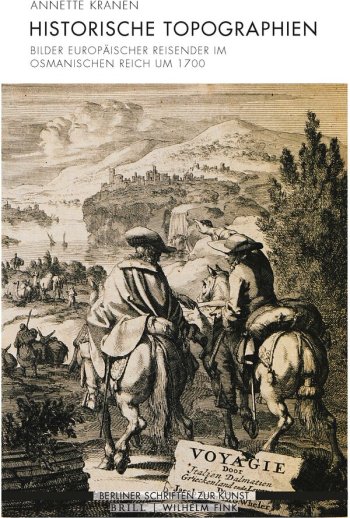
• Mirjam Hähnle, Review of Annette Kranen, Historische Topographien: Bilder europäischer Reisender im Osmanischen Reich um 1700 (Brill, 2020), pp. 971–72.
Exhibition | Hogarth and Europe

William Hogarth, The March of the Guards to Finchley, 1749–50
(London: The Foundling Museum)
◊ ◊ ◊ ◊ ◊
From the press release (1 November 2021) for the exhibition:
Hogarth and Europe
Tate Britain, London, 3 November 2021 – 20 March 2022
Curated by Alice Insley and Martin Myrone
Few artists have defined an era as much as William Hogarth (1697–1764), whose vivid, satirical depictions of 18th-century England continue to capture the imagination today. Tate Britain’s major exhibition Hogarth and Europe presents his work in a fresh light, seen for the first time alongside works by his continental contemporaries. It explores the parallels and exchanges that crossed borders and the cosmopolitan character of Hogarth’s art. Hogarth’s best-known paintings and prints—such as Marriage A-la-Mode (1743), The Gate of Calais (1748), and Gin Lane (1751)—are shown alongside works by famed European artists, including Jean-Siméon Chardin in Paris, Pietro Longhi in Venice, and Cornelis Troost in Amsterdam. Together they reveal how changes in society took art in new directions, both in Britain and abroad.
 Featuring over 60 of Hogarth’s works, brought together from private and public collections around Europe and North America, the exhibition draws decades of research to show Hogarth in all his complexity—whether as staunch patriot or sharp critic, bawdy satirist or canny businessman. It also examines the shifting status of artists in the 18th century, from workshop artisans and court painters to independent freelancers enjoying prominence alongside actors, musicians, and writers. The rapid expansion of urban centres like London, Paris, Amsterdam, and Venice also saw the city itself become a major subject in art for the first time. Tate Britain juxtaposes these metropolitan scenes from across Europe, showing the bustling London streets of Hogarth’s Southwark Fair (1733) and The March of the Guards to Finchley (1749–50) together with vibrant depictions of Étienne Jeaurat’s Paris and Longhi’s Venice.
This was an age of opportunity and innovation, but also materialism, self-delusion, exploitation, and injustice. In Europe, new heights of luxury emerged with extreme poverty, while growing cities saw overcrowding and disease. The rising demand for consumer goods at home came at the expense of the labour and lives of enslaved and colonised people overseas. Against the backdrop of this changing world, artists like Hogarth pioneered a new painting of modern life, revealing its pleasures and dynamism but also its dangers and stark inequalities. In the 1730s he began his ‘modern moral series’: frank and engaging narratives charting the rise and fall of everyday characters corrupted by immorality and vice. Hogarth and Europe includes these celebrated series, including A Rake’s Progress (1734), which were immediately popular and widely circulated through print. At Tate Britain they are shown alongside paintings by the Italian Giuseppe Crespi, including The Flea (1707–09), and the Parisian Nicolas Lancret, to show how this new artistic genre of urban storytelling developed across Europe.
The 18th century also saw greater informality and ease in portraiture, expressing the new ideas emerging around individuality and personal freedom that remain familiar today. The exhibition culminates in a room focussing on such pictures, including Miss Mary Edwards (1742)—a painting not seen in the UK for over a century—depicting the eccentric, wealthy patron who commissioned many of Hogarth’s best-known works. Additional highlights include paintings of his sisters Mary and Anne Hogarth, as well as Heads of Six of Hogarth’s Servants (c.1750–55). Through juxtapositions with European artworks, the exhibition looks afresh at these and many other works by one of Britain’s most important artists, giving visitors a chance to see Hogarth’s position on the international stage in a new light.
Hogarth and Europe is curated by Alice Insley, Curator, British Art c 1730–1850 and Martin Myrone, former Senior Curator, pre-1800 British Art, Tate Britain (now Convenor, British Art Network at the Paul Mellon Centre). The exhibition is accompanied by a fully illustrated catalogue featuring essays by eminent scholars and artists including Lubaina Himid and Sonia E. Barrett.
Martin Myrone and Alice Insley, eds., Hogarth and Europe (London: Tate, 2021), 208 pages, ISBN: 978-1849767682, £40 / $55.
The exhibition guide is available here»
Lecture | Frédéric Ogée, Pleasures of the Senses and the Imagination
From the conference series Sociabilité et libertinage au siècle des Lumières, organized at the Cognacq-Jay Museum in conjunction with this year’s summer exhibition Realm of the Senses, from Boucher to Greuze / L’ Empire des sens, de Boucher à Greuze (19 May — 18 July 2021), curated by Annick Lemoine . . .
Frédéric Ogée | Plaisirs des sens, plaisirs de l’imagination dans l’art et la littérature anglaise du 18ème siècle
Online and In-Person, Musée Cognacq-Jay, Paris, 26 November 2021, 17.00
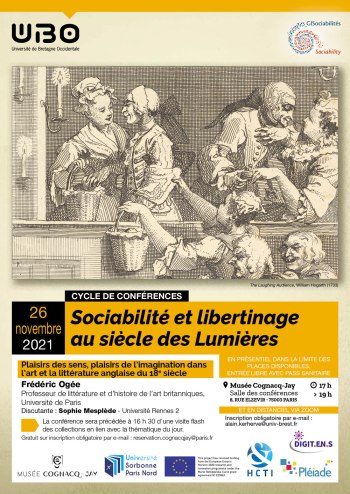 Dans le sillage de sa « Glorieuse Révolution » de 1688, l’Angleterre inaugura le siècle des Lumières en découvrant le plaisir d’un certain nombre de libertés : « régler le pouvoir des rois en leur résistant » (Voltaire), publier sans entrave, ré-évaluer l’héritage des Anciens, regarder la Nature à travers le prisme de Newton plutôt que celui des prêtres, entreprendre à crédit, célébrer la sensibilité et l’imagination. Les Anglais ont ainsi cherché de nouveaux équilibres entre la liberté de l’individu—son goût, sa subjectivité, sa perception du monde, son « progrès » —et les nécessités de la sphère collective, qu’elle soit publique ou privée. Ecrivains et artistes se sont vite employés à représenter cette nouvelle sociabilité, pour la modéliser et la polir autant que pour la promouvoir, au travers de remarquables expériences littéraires et picturales où les personnages se meuvent et s’émeuvent sous l’œil complice du spectateur-lecteur. Influencés par la philosophie empiriste ils font l’expérience du plaisir des sens pour accéder à la connaissance, d’eux-mêmes et du monde. La présente conférence permettra d’évoquer cette remarquable période de créativité qui, de Daniel Defoe et William Hogarth à Jane Austen et Thomas Lawrence, contribua au triomphe de la Grande-Bretagne sur la scène du monde.
Discutante: Sophie Mesplède (Université Rennes 2)
Frederic Ogee est professeur de littérature et d’histoire de l’art britanniques à l’Université de Paris. Ses principaux domaines de recherche sont l’esthétique, la littérature et l’art au cours du long 18ème siècle (1660–1815), sur lesquels il a souvent donné des conférences dans des universités européennes, nord-américaines et asiatiques. Commissaire de l’exposition sur le peintre anglais William Hogarth au Musée du Louvre en 2006, il est l’auteur de plusieurs ouvrages, notamment Diderot and European Culture, un recueil d’essais (Oxford: 2006, réédité 2009), J.M.W. Turner : Les paysages absolus (Hazan, 2010), et Jardins et Civilisations (Valenciennes, 2019), suite à une conférence organisée à l’Institut Européen des Jardins et Paysages de Caen. Il écrit actuellement une série de quatre monographies sur quelques grands artistes anglais (Thomas Lawrence, J.M.W. Turner, Thomas Gainsborough et William Hogarth) pour les éditions Cohen & Cohen (Paris), à paraître entre 2022 et 2025. De 2014 à 2017, il a été membre du conseil scientifique du musée Tate Britain à Londres et, depuis 2014, est membre du Conseil Scientifique de la Ville de Paris.
Conférence en présentiel dans la limite des places disponibles, entrée libre avec pass sanitaire ET en distanciel via Zoom. Participation libre sur inscription obligatoire: reservation.cognacqjay@paris.fr et alain.kerherve@univ-brest.fr. La conférence sera précédée à 16h30 d’une visite flash des collections en lien avec la thématique du jour.
Emmanuelle Brugerolles, Marine Carcanague, Marie-Anne Dupuy-Vachey, Guillaume Faroult, Yuriko Jackall, F. Joulie, É. Kerner, A. Laing, C. Le Bitouzé, A. Le Brun, A. Lemoine, N. Lesur, H. Meyer, L-A. Prat, S. de Saint-Léger, M. Szanto, L’ Empire des sens, de Boucher à Greuze (Paris Musées / Musée Cognac-Jay, 2020), 152 pages, ISBN: 978-2759605002, €30.
Exhibition | Julie Green: The Last Supper
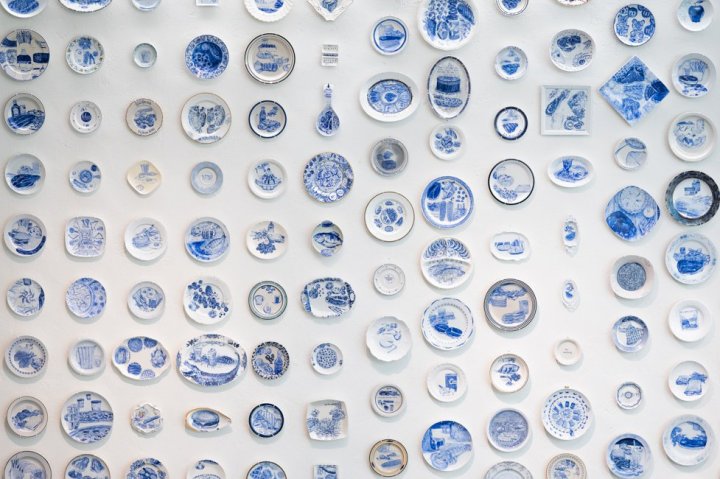
Installation view of Julie Green’s Last Supper exhibition, Bellevue Arts Museum.
◊ ◊ ◊ ◊ ◊
As noted by many news outlets—including The Art Newspaper, The Washington Post, the Smithsonian Magazine, The New York Times, and NPR (with an editorial by Scott Simon)—the artist Julie Green (1961–2021) died on October 12 at age 60, after battling ovarian cancer. An exhibition of 800 plates by Green is currently installed in Bellevue, Washington. While the ‘content’ of the project (the catalogue of inmates’ last meals) understandably receives the bulk of the attention, I imagine it’s impossible for most dixhuitièmistes not to see the long tradition of blue-and-white ware adaptation; and once a viewer goes there, the plates provide an indicting reminder of the historical origins of the inequities of the American criminal justice system, inequities in many cases derived from seventeenth- and eighteenth-century institutions. –CH
Julie Green: The Last Supper
Bellevue Arts Museum, 4 September 2020 — 23 January 2022
800 Plates Illustrating Final Meals of US Death Row Inmates
Growing up, I admired quilts and ceramics in our Iowa home, as well as the larger-than-life historical figures and 20’ American flag made with ears of colored corn in a neighbor’s yard. Appreciation for homemade and handmade led me to paint blue food. I once shared my family’s support of Nixon and capital punishment. Now I don’t.
Oklahoma has higher per capita executions than Texas. I taught there, and that is how I came to read final meal requests in the morning paper. The Last Supper illustrates the meal requests of U.S. death row inmates. Cobalt blue mineral paint is applied to second-hand ceramic plates, then kiln-fired to 1,400 degrees by technical advisors Toni Acock and Sandy Houtman.
Of the 1,521 US executions to date, 570 occurred in Texas, the only state that doesn’t allow a final meal selection. In Texas, inmates are served the standard prison meal of the day. In states that allow a choice, traditions and restrictions vary. There is no alcohol allowed anywhere. Cigarettes are officially banned but sometimes granted. Most selections are modest. This is not surprising, as many are limited to what is in the prison kitchen. Others provide meals from local venues. Pizza Hut, Wendy’s, and Long John Silver’s are frequently selected in Oklahoma, where their fifteen-dollar allowance is down from twenty in the late 1990s. California allows restaurant take-out up to fifty dollars. Historical menus from Folsom prison, shared by April Moore, point to the 733 inmates on death row today in California. State and date of execution are listed for each plate.
While looking for a permanent home for the project, unless capital punishment ends soon, I will continue until there are 1,000 plates. For me, a final meal request humanizes death row. Menus provide clues on region, race, and economic background. A family history becomes apparent when Indiana Department of Corrections adds, “He told us he never had a birthday cake so we ordered a birthday cake for him.”
Art can be a meditation. Why do we have this tradition of final meals, I wondered, after seeing a 1999 request for six tacos, six glazed donuts, and a cherry Coke. Twenty-one years later, I still wonder.
Julie Green
8 August 2020
Exhibition | The Way Sisters: Miniaturists of the Early Republic

Attributed to Mary Way, Dressed miniature portraits of a husband and wife of the Deshon family, ca. 1800, mixed media with fabrics and painted paper (Lyman Allyn Art Museum: Gift of Ursula and Gertrude Grosvenor, 1949.122 a & b).
◊ ◊ ◊ ◊ ◊
From the press release (28 October 2021) for the exhibition:
The Way Sisters: Miniaturists of the Early Republic
Lyman Allyn Art Museum, New London, Connecticut, 30 October 2021 — 23 January 2022
Curated by Tanya Pohrt with Brian Ehrlich
The Lyman Allyn Art Museum is pleased to mount a major new exhibition that presents the story and art of May Way (1769–1833) and Elizabeth (Way) Champlain (1771–1825), two sisters and artists from New London, Connecticut. The sisters were among the earliest professional women artists working in the United States. Opening 30 October 2021, The Way Sisters: Miniaturists of the Early Republic will be on view until 23 January 2022.
“This is the first museum exhibition to focus on the Way sisters, and it includes objects that have never been publicly exhibited,” said Dr. Tanya Pohrt, the exhibition’s curator. “These two women made important and lasting contributions to the art and history of Connecticut and a young nation. Their work deepens our understanding of early American art with objects and stories from the past that still resonate today.”
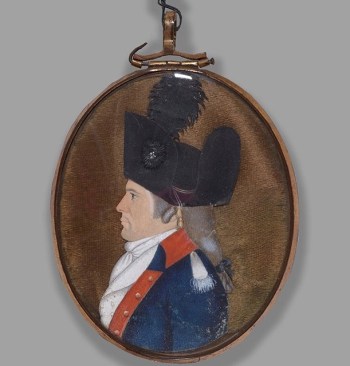
Mary Way, Portrait of Charles Holt (1772–1852), 1800, signed on verso, watercolor and fabric on paper applied to fabric (Private Collection, courtesy of Nathan Liverant & Son, LLC).
The women adapted their schoolgirl training in textiles to create collaged and painted portraits that pushed the boundaries of miniatures as an art form, while serving to expand gender roles for women. Mary Way began her career as a miniaturist around 1789 or 1790, producing painted and unique ’dressed’ portrait miniatures in profile with sewn and adhered fabric clothing that were unlike anything else made in America at the time.
Evidence suggests that Elizabeth (Way) Champlain, known as Betsey, also produced dressed and painted miniatures in roughly the same period. She remained in New London throughout her life and was active as a miniaturist until her sudden illness and death in 1825. Mary Way, who never married, moved to New York City in 1811, seeking new patrons and hoping to expand her artistic sphere. Facing stiff competition, she managed to eke out a living until she went blind in 1820 and was forced to return to New London, where her family supported her until her death in 1833.
Over the course of their careers, the Way sisters portrayed friends, relatives, and acquaintances, as well as a larger network of the mercantile elite from southeastern Connecticut. Telling a story of struggle and accomplishment, this exhibition traces what is known of the sisters’ artistic production, celebrating their stylistic and material innovations. It also examines the identities of their sitters, exploring New London’s history in the decades following the American Revolution.
On November 10, Pohrt and Brian Ehrlich, M.D., advisor to the exhibition, will give an in-person gallery talk. The lecture and reception begin at 5.30. The exhibition is made possible with support from Connecticut Humanities; the Department of Economic and Community Development, Office of the Arts; and an anonymous foundation.
The Lyman Allyn Art Museum welcomes visitors from New London, southeastern Connecticut, and all over the world. Established in 1926 by a gift from Harriet Allyn in memory of her seafaring father, the Museum opened the doors of its beautiful neo-classical building surrounded by 12 acres of green space in 1932. Today, it presents a number of changing exhibitions each year and houses a fascinating collection of over 17,000 objects from ancient times to the present: artworks from Africa, Asia, the Americas, and Europe, with particularly strong collections of American paintings, decorative arts, and Victorian toys and doll houses.
Brian Ehrlich, Catherine Kelly, D. Samuel Quigley, and Elle Shushan, The Way Sisters: Miniaturists of the Early Republic (New London: Lyman Allyn Art Museum, 2021), 100 pages, ISBN: 978-1878541086.










leave a comment