The Burlington Magazine, December 2014
The eighteenth century in The Burlington:
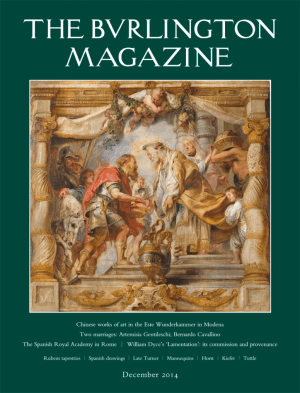
The Burlington Magazine 156 (December 2014)
 A R T I C L E S
• Pilar Dies del Corral, “The Beginnings of the Real Academia de España in Rome: Felipe de Castro and Other Eighteenth-Century Pioneers,” pp. 805–10.
R E V I E W S
• Marjorie Trusted, Review of David Bindman, Warm Flesh, Cold Marble: Canova, Thorvaldsen and their Critics (Yale University Press, 2014), pp. 824–25.
• Todd Longstaffe-Gowan, Review of Beth Fowkes Tobin, The Duchess’s Shells: Natural History Collecting in the Age of Cooke’s Voyages (The Paul Mellon Centre for Studies in British Art, 2013), pp. 827–28.
• James Ayres, Review of the exhibition Silent Partners: Artist and Mannequin from Function to Fetish (The Fitzwilliam Museum, Cambridge, 14 October 2014 — 25 January 2015; and Musée Bourdelle, Paris, 31 March — 12 July 2015), pp. 840–41.
• Xavier F. Salomon, Review of three Veronese exhibitions in the Veneto, including Veronese Inciso: Stampe da Veronese dal XVI al XIX Secolo (Museo della Stampa Remondini, Bassano del Grappa,14 September 2014 — 19 January 2015), pp. 842–43.
The Art Bulletin 96 (September 2014)
In the current issue of The Art Bulletin:
 • Claudia Mattos, “Whither Art History? Geography, Art Theory, and New Perspectives for an Inclusive Art History,” pp. 259–64.
• Aaron Wile, “Watteau, Reverie, and Selfhood,” pp. 319–37.
Watteau’s fêtes galantes break with key aspects of academic art theory in early eighteenth-century France—particularly as put forward by Roger de Piles—to elicit an experience of reverie in the spectator. Watteau’s formal innovations inaugurated a new relationship between painting and beholder that opened up a new sphere of subjective experience, linking the artist’s enterprise with the rise of modern interiority.
• Ebba Koch, Review of Santhi Kavuri-Bauer, Monumental Matters: The Power, Subjectivity, and Space of India’s Mughal Architecture (Duke UP, 2011), pp. 362–65.
New Book | Mr Kilburn’s Calicos
From WoI:
Ros Byam Shaw, “Mr Kilburn’s Calicos,” The World of Interiors (October 2014): 112–18.
A scuffed little album discovered by Gabriel Sempill among her late mother’s possessions contains exquisite watercolour patterns by the esteemed 18th-century textile designer William Kilburn. Now, a facsimile of this rare find, complete with a variety of juvenilia added by a later hand, plus modern takes on Kilburn’s repeats, is published.
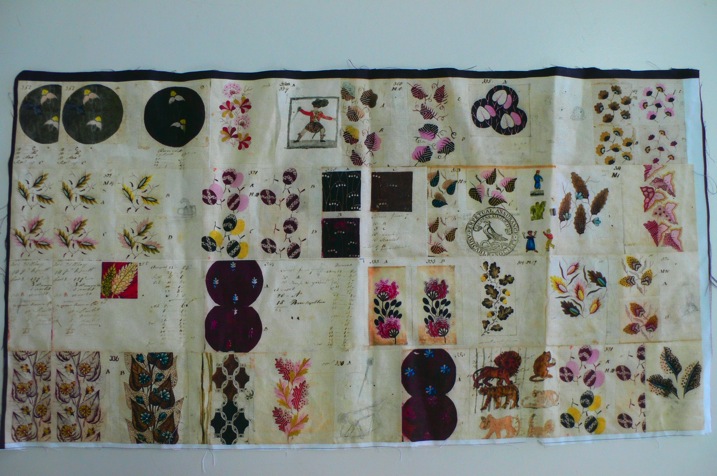
Detailed pattern units from William Kilburn’s
album, as a composite image.
◊ ◊ ◊ ◊ ◊
From Fleece Press:
Gabriel Sempill and Simon Lawrence, Mr Kilburn’s Calicos: William Kilburn’s Fabric Printing Patterns from the Year 1800 (London: Fleece Press, 2014), ISBN: 978-0992741051, £175.
Printed, bound and published at breakneck speed to coincide with The World of Interiors’ extensive feature on this book (October 2014 issue, with five pages reproduced), this is the full reproduction of a very important pocket book once owned by the great fabric designer and printer, William Kilburn (1745–1818). Hitherto known only for his highly elaborate and sumptuous chintz designs which are in the Victoria and Albert Museum, this pocket book includes 62 basic units for patterns which could be built up and repeated on a larger scale for dress material. It is a most exciting find, and Kilburn included notes of variant colourways and orders; the notebook’s subsequent use by a great grandson as a child’s scrapbook ensured its survival.
The book comprises a letterpress introduction, with the entire notebook being reproduced in the second half. There is a separate booklet of 16 patterns printed full-page, made up from Kilburn’s original units by Sholto Drumlanrig, and both the book and booklet are housed in a solander box. There are three variant bindings of quarter cloth with one of three different Kilburn patterned papers over boards.
Sweden’s Nationalmuseum Launches Free Online Journal, Volume 20
Press release (3 September 2014) from the Nationalmuseum:
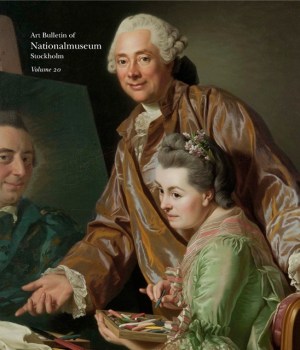 Stockholm’s Nationalmuseum has launched its first digital journal, available online to download and read free of charge. The Art Bulletin of Nationalmuseum Stockholm contains academic articles on art history relating to Nationalmuseum’s collections. The journal is moving to digital-only format and will be available through the DiVA portal (a Swedish publishing system for academic research and student theses) and the museum’s own website. The Art Bulletin of Nationalmuseum Stockholm is an annual publication containing academic articles on art history relating to Nationalmuseum’s collections. The journal has existed in print form since 1996, but is now switching to digital-only format, starting with volume 20. The journal’s established graphic design will be enhanced through the addition of digital media features such as metadata, live links to chapter headings and page references, and high-resolution images.
“For an art institution like Nationalmuseum, it’s important to offer our readers high-quality images that do full justice to the works,” said Janna Herder, editor of the Art Bulletin of Nationalmuseum Stockholm. “Readers therefore have the option of downloading the entire journal in low-resolution format or individual articles in high-resolution format.”
Nationalmuseum expects to attract a larger and wider readership now that the journal and its articles are freely available and searchable via Google and other search engines. As a member of the DiVA portal, the museum is able to distribute the publication more effectively in the academic community. “This is a further step in the digital evolution of Nationalmuseum and a key initiative in fulfilling our mandate to improve access to and awareness of our collections,” said Magdalena Gram, the museum’s head of research, library and archives and the journal’s editor-in-chief. “Another aspect of our mandate involves collaboration with other institutions such as universities and colleges. Offering an established publication like the Art Bulletin of Nationalmuseum Stockholm in digital format through the DiVA portal marks a breakthrough in terms of our ability to make specialized knowledge and information freely available.”
◊ ◊ ◊ ◊ ◊
Articles related to the eighteenth century (visit the Nationalmuseum website for the full contents) . . .
Art Bulletin of Nationalmuseum Stockholm 20 (2013).
A C Q U I S I T I O N S
Carina Fryklund, “Three 17th-Century Paintings from the Collection of Gustaf Adolf Sparre (1746–94),” pp. 11–16.
Magnus Olausson, “Roslin’s Self-Portrait with his Wife Marie Suzanne Giroust Painting a Portrait of Henrik Wilhelm Peill (1767),” pp. 17–18.
Magnus Olausson, “Wertmüller’s Portrait of Henri Bertholet-Campan with the Dog Aline (1786),” pp. 19–20.
Guilhem Scherf, “Une Statuette en Terre Cuite de Jean-Baptiste Stouf au Nationalmuseum,” pp. 27–36.
Magnus Olausson, “Madame Lefranc Painting a Portrait of her Husband Charles Lefranc (1779): A Miniature by Adélaïde Labille-Guiard,” pp. 37–8.
Anders Bengtsson, “A Unique Plate Warmer,” pp. 39–40.
Anders Bengtsson, “A Chair Fit for a Prince,” pp. 41–2.
Acquisitions 2013: Exposé, pp. 61–96.
A R T I C L E S O N T H E H I S T O R Y A N D T H E O R Y O F A R T
Martin Olin, “An Italian Architecture Library under the Polar Star: Nicodemus Tessin the Younger’s Collection of Books and Prints,” pp. 109–18.
Magnus Olausson, “Louis Gauffier’s Portrait of Gustaf Mauritz Armfelt (1793): A Political or a Conspiratorial Painting?,” pp. 119–22.
Ulf Cederlöf, “An Exceptionally Protracted Affair: The Nationalmuseum’s Acquisition of Sergel’s Collections of Drawings and Prints, 1875–76,” pp. 123–34.
S H O R T E R N O T I C E S
Görel Cavalli-Björkman and Margaretha Rossholm-Lagerlöf, “A Source-Critical Comment on Roger de Robelin’s “On the Provenance of Rembrandt’s The Conspiracy of the Batavians under Claudius Civilis,” 135–36.
Roger de Robelin, “Response to “A Source-Critical Comment etc.,” pp. 137–38.
R E P O R T
Helen Evans and Helena Kåberg, “The Nationalmuseum Lighting Lab,” pp. 139–46.
The Baroque in the Construction of a National Culture in Francoist Spain
From Taylor & Francis:
Bulletin of Spanish Studies: Hispanic Studies and Researches on Spain, Portugal and Latin America 91.5 (2014).
Special issue on ‘The Baroque in the Construction of a National Culture in Francoist Spain’, edited by Paula Barreiro López, Carey Kasten and Tobias Locker.
The baroque was both praised and attacked by critics for overwhelming the viewer through art. Yet its indisputable importance in Hispanic tradition and its characteristic intensity made the baroque an important element of culture during the regime of Francisco Franco (1939–1975). Not only did the baroque anchor official Francoist culture, its influence was also apparent in the regime’s politics, which used the baroque as an ideological legitimising tool in intellectual discourses. This interdisciplinary special issue is the first single volume to examine the influence of baroque tradition on Francoist Spain, analyzing cultural and political examples of twentieth-century reinterpretations of the baroque. For example, the concept of hispanidad, which underpinned Spain’s foreign policy and influenced international perceptions of the country, contained many baroque elements. By analysing its imprint on Spain’s culture industry both at home and abroad this special issue demonstrates the essential role the baroque played in the creation of a national and cultural identity during the dictatorship in Spain.
• Tobias Locker, “The Baroque in the Construction of a National Culture in Francoist Spain: An Introduction,” pp. 657–71.
• Till Kössler, “Education and the Baroque in Early Francoism,” pp. 673–96.
• Carey Kasten, “Staging the Golden Age in Latin America: José Tamayo’s Strategic Ascent in the Francoist Theatre Industry,” pp. 697–714.
• Paula Barreiro López, “Reinterpreting the Past: The Baroque Phantom during Francoism,” pp. 715–34.
• Noemi De Haro-García and Julián Díaz-Sánchez, “Artistic Dissidence under Francoism: The Subversion of the Cliché,” pp. 735–54.
• Johannes Großmann, ” ‘Baroque Spain’ As Metaphor. Hispanidad, Europeanism and Cold War Anti-Communism in Francoist Spain,” pp. 755–71.
• Julio Montero and María Antonia Paz, “Lo barroco en la televisión franquista: tipos y temas; actores y escenarios,” pp. 773–92.
Hand Fans, Goose Necks, and Archery Contests
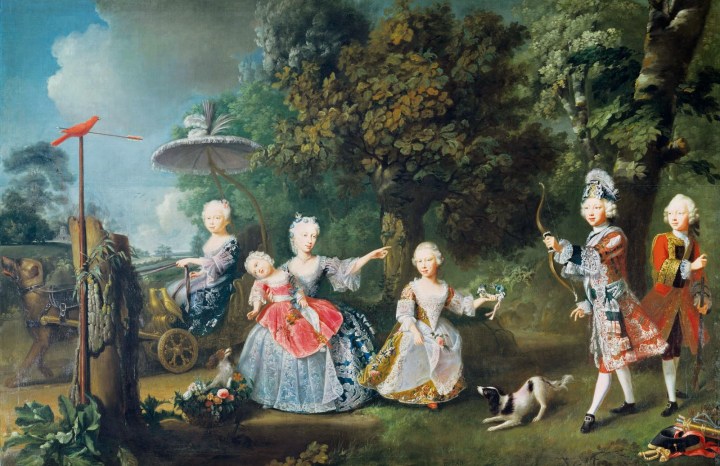
Barthélemy du Pan, The Children of Frederick, Prince of Wales, 1746
Royal Collection Trust/© Her Majesty Queen Elizabeth II 2014
◊ ◊ ◊ ◊ ◊
Pierre-Henri Biger’s website dedicated to the history of fans, Place de l’Eventail, recently published a notice related to seventeenth- and eighteenth-century target contests, commonly held in mid-August, involving a live goose (or more precisely, the goose’s neck, cou de l’oie).1 Biger quotes from Paul Sébillot’s Le Folklore de France (Paris, 1906), to make sense of a mis au rectangle (pictured at the website):
In Grez-Doiceau, in the Walloon Brabant, the second day of the fair, a live goose was hanging from a rope which brought together the upper ends of two long poles stuck in the ground. A man perched on a trestle remembered all the calamities which had hit the town during the past year, and accused the goose to be the cause. . .2
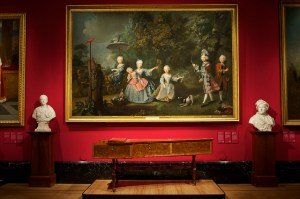
Installation view of The First Georgians, The Queen’s Gallery, Buckingham Palace, 2014.
With The First Georgians exhibition (on view at The Queen’s Gallery in London until October 12) still fresh in my memory, it’s hard to not to think of Barthélemy du Pan’s 1746 large-scale portrait of The Children of Frederick, Prince of Wales (Royal Collection), which depicts the future George III as having just struck a wooden popinjay.3 The prince wears the tartan of the Royal Company of Archers—which, as a British regimental uniform, was exempt from the 1745 ban on Scottish national dress. Bearing in mind Desmond Shawe-Taylor’s suggestion that we understand the picture as “an early example of the process by which Scottish identity became something manly and romantic, rather than threatening and rebellious,” I wonder if rustic traditions of shooting a living bird as part of a celebration with ‘atonement/scapegoat’ undertones might add another layer of relevant associations.4 I’m not sure how far I would push the point: the two contests weren’t the same thing (particularly from an animal rights perspective), and with folk festivals, it’s difficult to pin down specifics (times, places, meanings, &c.). Still, Biger’s piece, at the very least, suggests a larger context for archery contests and their pictorial representation in the eighteenth century and might encourage us to look to fans for useful points of comparison.
–Craig Ashley Hanson
1. Pierre-Henri Biger’s piece is available in both English and French. On the topic generally, see Biger’s recent article, “Introduction à l’éventail européen aux XVIIe et XVIIIe siècles,” Seventeenth-Century French Studies 36 (July 2014): 84–92. The issue, edited by Katherine Ibbett, is dedicated to the topic of fans. The table of contents is available as a PDF file here.
2. Paul Sébillot, Le Folklore de France (Paris, 1906), volume 3, pp. 247–48.
3. The Royal Collection’s online entry for Barthélemy du Pan’s The Children of Frederick, Prince of Wales is available here.
4. Desmond Shawe-Taylor makes the point in the entry for the painting from the exhibition catalogue, which he also edited, The First Georgians: Art & Monarchy, 1714–60 (London: Royal Collection Trust, 2014), p. 366.
The Art Bulletin, June 2014
The eighteenth century in the current issue of The Art Bulletin:
The Art Bulletin 96 (June 2014)
 Marcia Pointon, “Casts, Imprints, and the Deathliness of Things: Artifacts at the Edge,” pp. 170–95.
The practice of making death masks was extensive throughout Europe in the eighteenth and nineteenth centuries, yet their interest to scholars has been confined to their preparatory role in the production of portrait sculpture, the dissemination of phrenology, and as a figure for the indexicality of photographic images. The meanings generated, past and present, by casts of faces and other body parts can be investigated by addressing their materiality. As three-dimensional artifacts, positives deriving from negatives, casts have been understood as deathly in that they present an absence. In what does this deathliness consist, and how is it communicated?
Joanne Rappaport, Review of Daniela Bleichmar, Visible Empire: Botanical Expeditions and Visual Culture in the Hispanic Enlightenment (The
University of Chicago Press, 2012), pp. 241–43.
The Burlington Magazine, July 2014
The eighteenth century in The Burlington:
The Burlington Magazine 156 (July 2014)
 A R T I C L E S
• Conor Lucey, “Bas-reliefs after Angelica Kauffman,” pp. 440–44.
Plaster reliefs for interiors in Ireland based on designs of the 1770s by Angelica Kaufmann.
• Paul Hetherington and Jane Bradney, “The Architect and the Philhellene: Newly Discovered Designs by John Nash for Frederick North’s London House,” pp. 445–52.
John Nash’s designs (c.1813) for Frederick North’s unrealised house on what is now Waterloo Place, London, are published here for the first time.
R E V I E W S
• Todd Longstaffe-Gowan, Review of Elizabeth McKellar, Landscapes of London: The City, the Country, and the Suburbs, 1660–1840 (Paul Mellon Centre for Studies in British Art, 2013), pp. 467–68.
• Xavier F. Salomon, Review of Denis Tod, Giambattista Crosato: Pittore del Rococò Europeo (Scripta Edizioni, 2013), pp. 468–69.
• Philippe Malgouyres, Review of Anne-Lise Desmas, Le Ciseau et la Tiare: Les Sculpteurs dans la Rome des Papes, 1724–1758 (Collection de l’Ecole Française de Rome, 2012), p. 469.
• Richard Edgcumbe, Review of Charles Truman, The Wallace Collection: Catalogue of Gold Boxes (Wallace Collection, 2013), p. 470.
Journal of the History of Collections, July 2014
The eighteenth century in the Journal of the History of Collections (though other pieces for periods both earlier and later will likely also be of interest) . . .
Journal of the History of Collections 26 (July 2014)
A R T I C L E S
Alexander Echlin, “Dynasty, Archaeology and Conservation: The Bourbon Rediscovery of Pompeii and Herculaneum in Eighteenth-Century Naples,” pp. 145–59 (first published online 1 April 2014).
The rediscovery of the ancient sites of Pompeii and Herculaneum in the eighteenth century attracted a huge response from contemporary commentators. Many of these, as well as almost all subsequent judgements from historians, are very critical of the Bourbon excavators. Charles, King of Naples, and his team of antiquaries have been depicted as charlatans, treating ancient artefacts and the sites poorly, interested in them only in so far as they glorified their kingdom. In this article it is argued that, with an understanding of contemporary approaches to antiquity and conservation, this verdict on the Bourbons seems unduly harsh. Their archaeological methods and treatment of classical art were typical for the eighteenth century and were, in some ways, progressive. In support of this harsh judgement of Charles, Winckelmann has been portrayed as a savage critic of the excavations; in reality he was kinder to the Bourbons than historians have believed.
Julia Lenaghan, “The Cast Collection of John Sanders, Architect, at the Royal Academy, ” pp. 193–205 (first published online 4 November 2013).
John Sanders (1768–1826) was an architect and a Fellow of the Society of Antiquaries of London. He was the first student and a life-long friend of Sir John Soane. In 1817 in retirement he travelled to the Continent, where he studied and recorded with academic zeal the architectural monuments of the classical world which had so influenced his mentor and his world. In Rome he amassed a comprehensive and original collection of plaster casts of ‘architectural’ details. This collection was purchased by the Royal Academy in 1830, and much of it remains today part of the permanent collection of the Academy. This article presents the history and use of this early, non-figural, collection of plaster casts.
Paulo Oliveira Ramos, “The Royal Decree of 1721 and the Ephemeral Archaeological Collection of the Royal Academy of Portuguese History,” pp. 223–27 (first published online 22 January 2014).
In the great Lisbon earthquake of 1755, the palace of the Dukes of Braganza collapsed and its priceless treasures were lost forever. Although the content of its archaeological collection—said to constitute the first Portuguese museum of archaeology—is almost impossible to recover in detail today, the process behind its formation can be glimpsed in the documentary record. Two main aspects have emerged in the course of the present research: on the one hand, the relevance of the Royal Decree of 1721 as a crucial moment in the history of heritage preservation in Portugal and in Europe—and also as the inspiration for the archaeological collection; and, on the other hand, the antiquarian commitment of the Marquis of Abrantes.
Stephen Clarke, “Rosamond’s Bower, The Pryor’s Bank, and the Long Shadow of Strawberry Hill,” pp. 287–306 (first published online 4 March 2014).
The influence of Horace Walpole’s Strawberry Hill is traced in the little-known collections created in the 1830s and early 1840s at Rosamond’s Bower by the writer and antiquary Thomas Crofton Croker (joint author of the Gooseberry Hall satire of the Strawberry Hill sale of 1842) and by Thomas Baylis and Lechmere Whitmore at The Pryor’s Bank, both at Fulham. They were active purchasers at the sale (particularly Baylis), and Walpole’s Description of Strawberry Hill is a continuing presence behind Croker’s accounts of both collections. Both houses were social spaces, presented for antiquarian display, and in the case of The Pryor’s Bank in particular that display was played out in entertainments and Dickensian amateur theatricals. An under-explored element in this combination of collecting, antiquarianism, and jocularity is the Noviomagian Society, an antiquarian dining club of which Croker was a founder and which has connections to both houses.
R E V I E W S
• Jeremy Coote, Review of Holophusicon: The Leverian Museum – An Eighteenth-Century English Institution of Science, Curiosity, and Art,” pp. 317–18 (first published online 18 April 2014).
• Jörg Zutter, Review of Houghton Revisited: The Walpole Masterpieces from Catherine the Great’s Hermitage, pp. 319–21 (first published online 11 June 2014).
• Arthur MacGregor, Review of Natural Histories: Extraordinary Rare Book Selections from the American Museum of Natural History Library, pp. 322–23 (first published online 8 May 2014).
• Peter Mason, Review of Historias Naturales: Un Proyecto de Miguel Ángel Blanco, pp. 323–24 (first published online 16 May 2014).
• Charles Sebag-Montefiore, Review of Provenance: An Alternate History of Art, pp. 324–25 (first published online 18 April 2014).
Summer 2014 Issue of the CODART eZine
The 4th issue of the CODART eZine focuses on the eighteenth-century:
CODART eZine 4 (Summer 2014)

Jan Ekels, A Writer Sharpening His Pen, 1784
(Amsterdam: Rijksmuseum)
• Tom van der Molen, “Editor’s Note: Eighteenth-Century Art”
• Gerdien Verschoor, “Welcome: CODART Director Dies under Avalanche of Books”
• Virginie D’haene, “Bruges Artists Abroad: Neoclassicist Drawings in the Printroom of the Groeningemuseum”
• Stefaan Hautekeete, “A Cabinet of the Most Delightful Drawings: Eighteenth-Century Netherlandish Drawings from the Collection of Jean de Grez, To Be Exhibited at the Koninklijke Musea voor Schone Kunsten van België (Royal Museums of Fine Arts in Belgium) in 2016”
• René Dessing, “Historic Country Houses in the Netherlands”
• Silke Gatenbröcker, “Duke Anton Ulrich of Braunschweig-Wolfenbüttel: One of the First Collectors of Dutch Paintings outside the Netherlands”
• Jacek Tylicki, “Collecting at the Court of Poland-Lithuania and the Activities of King Stanislaus II August”
• Curator’s Interview: Paul Knolle interviewed by Andrea Rousová
• Friends: Brian Capstick interviewed by Gerdien Verschoor
• Rebecca Long, “CODART ZEVENTIEN Congress Review”
About CODART
CODART—the international council for curators of Dutch and Flemish art—aims to further the study, care, accessibility and display of art from the Low Countries in museums around the globe. It serves as a platform for exchange and cooperation between curators from different parts of the world, with different levels of experience, and from different types and sizes of institutions. Our organization stimulates international inter-museum cooperation through a variety of activities, including congresses, focus meetings, publications and our website. By these means CODART strives to solidify the cultural ties between the Netherlands and Flanders, and to make the artistic heritage of these countries accessible to the international art-loving public.










 Enfilade
leave a comment