Exhibition | Indian Skies: The Howard Hodgkin Collection

An Elephant and Keeper, India, Mughal, ca. 1650–60, opaque color and gold on paper
(New York: The Metropolitan Museum of Art, Howard Hodgkin Collection, 2022.187)
◊ ◊ ◊ ◊ ◊
Opening next month at The Met:
Indian Skies: The Howard Hodgkin Collection of Indian Court Painting
The Metropolitan Museum of Art, New York, 6 February — 9 June 2024
Over the course of sixty years, British artist Howard Hodgkin (1932–2017) formed a collection of Indian paintings and drawings that is recognized as one of the finest of its kind. A highly regarded painter and printmaker, Hodgkin collected works from the Mughal, Deccani, Rajput, and Pahari courts dating from the 16th to the 19th centuries that reflect his personal passion for Indian art. This exhibition presents over 120 of these works, many of which The Met recently acquired, alongside loans from The Howard Hodgkin Indian Collection Trust.
The works on view include stunning portraits, beautifully detailed text illustrations, studies of the natural world, and devotional subjects. The exhibition will also display a painting by Hodgkin, Small Indian Sky, which alludes to the subtle relationship between his own work, India, and his collection. This exhibition is accompanied by an issue of The Metropolitan Museum of Art Bulletin.
The Burlington Magazine, December 2023
The eighteenth century in the December issue of The Burlington, which focuses on Spain:
The Burlington Magazine 165 (December 2023)

Francisco de Goya, Self-Portrait with Dr Arrieta, 1820, oil on canvas, 115 × 77 cm (Minneapolis Institute of Art, 52.14).
a r t i c l e
• Mercedes Cerón Peña, “Goya’s Self-Portrait with Dr Arrieta,” pp. 1300–04.
In 1820 Goya painted a portrait of himself as he had appeared during his serious illness of the year before, attended by his doctor, Eugenio García Arrieta. Newly discovered biographical information about Arrieta suggests that the painting’s red and and green colour scheme may allude to the political views he shared with Goya.
r e v i e w s
• Michael Hall, Review of the new Galería de las Colecciones Reales (Royal Collections Gallery) in Madrid (opened 28 June 2023), pp. 1339–43.
• Stephen Lloyd, Review of the exhibition Return of the Gods (World Museum, Liverpool, (April 2023 — February 2024), pp. 1343–45. “Britain’s largest assemblage of Classical sculpture outside London belongs to National Museums Liverpool . . . In 1959 Liverpool City Council and its museums were gifted the entirety of the Ince Blundell collection—approximately six hundred heavily restored Roman marbles . . . collected by . . . Henry Blundell (1724–1810), a wealthy Catholic landowner, between 1776 and 1809.”
• Humphrey Wine, Review of the catalogue raisonné by Joseph Assémat-Tessandier, Louis Lagrenée, dit l’Aîné (1725–1805) (Arthena, 2022), pp. 1364–65.
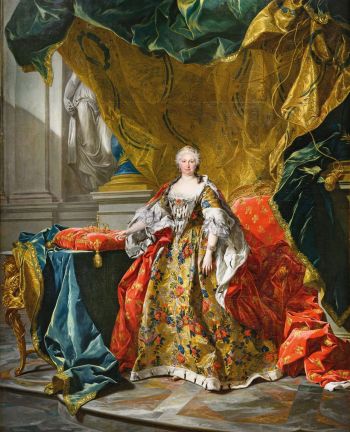
Louis-Michel van Loo, Portrait of Isabel Farnese, 1737, oil on canvas, 341 × 264 cm (Madrid: Galería de las Colecciones Reales).
• Rebeka Hodgkinson, Review of Stephanie Barczewski, How the Country House Became English (Reaktion, 2023), pp. 1370–71.
• Peter Humfrey, Review of Eveline Baseggio, Tiziana Franco, and Luca Molà, eds., La chiesa di Santa Maria dei Servi e la comunità veneziana dei Servi di Maria, secoli XIV–XIX (Viella, 2023), pp. 1374–75. “The demolition of the great fourteenth-century church of the Servi in about 1812–13 represents one of the most grievous of the many losses suffered by Venice’s artistic heritage during the Napoleonic period.”
o b i t u a r y
• Saloni Mathur, Obituary for Kavita Singh (1964–2023), pp. 1379–80.
Professor of art history and Dean of the School of Arts and Aesthetics at Jawaharlal Nehru University, Kavita Singh became internationally known for her publications on the history and politics of museums and the pre-modern art of South Asia. An authority on Indian court paintings, she was an inspiring colleague and teacher who publicly championed both her university and the study of Mughal art in the subcontinent.
Journal18 | Pendant Essays on Paint Boxes
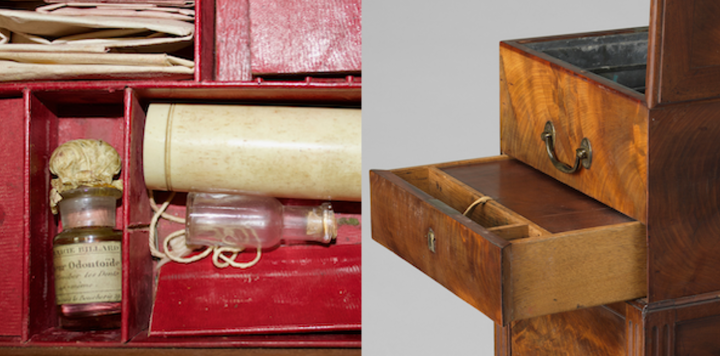
Left: Partial view of the contents of Charlotte Martner’s paint box (Private collection; author’s photograph). Right: Caspar Schneider, Paint box on stand, ca. 1789, mahogany on oak structure, 75 cm high (New York: The Metropolitan Museum of Art).
◊ ◊ ◊ ◊ ◊
Recent pieces from J18′s Notes & Queries:
Conceived as pendants, these two essays by David Pullins and Damiët Schneeweisz unpack two paint boxes that belonged to Marie Victoire Lemoine (1754–1820) and Charlotte Daniel Martner (1781–1839), bringing out how these boxes tie the material history of painting to gender, colonialism, and enslavement.
◊ ◊ ◊ ◊ ◊
David Pullins, “Contained Assertions: Marie Victoire Lemoine’s Paint Box,” Journal18 (December 2023).
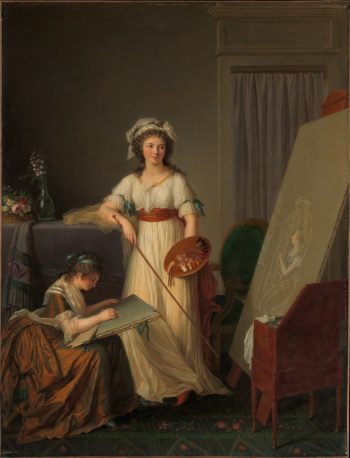
Marie Victoire Lemoine, The Interior of a Woman Painter’s Atelier, 1789, oil on canvas, 116.5 × 88.9 cm (New York: The Metropolitan Museum of Art).
Holding a loaded palette, brushes and maulstick, a standing woman represents the art of painting, while a second woman seated on a low stool embodies the foundational art of drawing (Fig. 1).[1] Their practices converge in the canvas underway on an easel, depicting a priestess presenting a young woman to a statue of Athena, goddess-protectress of the arts, in which chalk outlines have begun to be fleshed out in color. But the allegory has been dressed in contemporary terms, pointedly situating Marie Victoire Lemoine’s The Interior of a Woman Painter’s Atelier in the year it was executed, 1789, and boldly taking on the language of genre painting that was used more often to critique than to promote women artists. Michel Garnier’s A Young Woman Painter from the same year offers a counter-image (Fig. 2). A painter sets her canvases aside (literally turned to the wall, her easel reflected distantly in the mirror), while she is distracted by love (signaled by the dove, flowers, and book propped on an insubstantial table easel). In contrast to Lemoine’s somber, antique mise-en-abyme, Garnier chooses an unfinished “Greuze girl” as his gloss. . . .
The full essay is available here»
David Pullins is Associate Curator in the Department of European Paintings at The Metropolitan Museum of Art.
◊ ◊ ◊ ◊ ◊
Damiët Schneeweisz, “Laboring Likeness: Charlotte Daniel Martner’s Paint Box in Martinique (1803–1821),” Journal18 (December 2023).
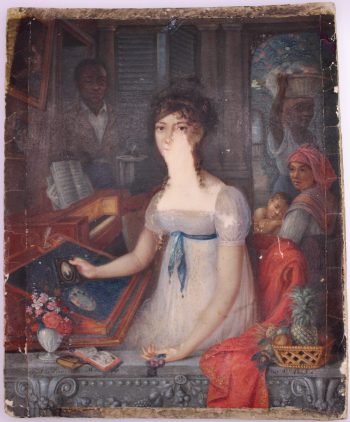
Charlotte Martner, Self-Portrait with Four People, 1805, watercolor on ivory and cardboard, 14.5 × 11.5 cm (Private collection).
In Charlotte Daniel Martner’s self-portrait miniature (1805), the classical tendencies of French eighteenth-century portraiture collide with a distinctive burgeoning Antillean visual culture of the early nineteenth century (Fig. 1).[1] The miniature is a contrast in colors: the artist’s luminous pale white skin and Empire dress, emanating from the portrait’s ivory ground like moonlight, set against the darker skin tones of the man, women, and child that surround her, each dressed in dulled shades of red, orange, blue, and beige. The precise status of the four Black individuals within this household is unclear, and they are yet to be identified, but their placement, each suspended in an act of domestic labor, suggests that perhaps they depict those then enslaved in Martner’s home. At the center of the portrait is a brisk loss, as if someone has pressed their thumb to the watercolor and swept away Martner’s features, leaving only a set of auburn eyes, the contours of a nose, dark-brown eyebrows, and loose curls pinned back with a bejeweled comb. . .
The full essay is available here»
Damiët Schneeweisz is a PhD Candidate at The Courtauld Institute of Art currently on Doctoral Placement at the Victoria & Albert Museum in London.
Journal18, Fall 2023 — Cold
The latest issue of J18:
Journal18, Issue #16 (Fall 2023) — Cold
Issue edited by Michael Yonan
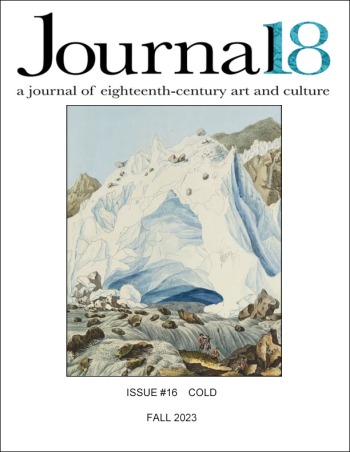 Feeling cold is increasingly a privilege in our warming world. Regions of the world known for temperate, moderate climates are becoming accustomed to erratic weather. Cooler areas of the globe are warming, and warmer areas becoming too hot to occupy. Accompanying these climatological transformations are humanity’s attempts to control temperature, led by the invention of technologies (most prominently air conditioning) which help us live comfortably, but which come with substantial human, economic, and environmental costs. By creating pleasant temperatures in which to live and work, we exacerbate the problem that makes human intervention into the climate more urgent.
The cause of these changes is the consumption of fossil fuels, which transformed human life profoundly in the pursuit of modernity. The origin of this transformation falls squarely within the long eighteenth century. The established scientific terminus post quem for measuring human effects on global temperatures is the year 1800. Moreover, the 1700s were the final century of the Little Ice Age, a climatological phenomenon characterized by lower global mean temperatures. With these conditions in mind, might temperature play a greater role in our discussion of eighteenth-century art? For this issue of Journal18, I have invited scholars to address this possibility. My goal is to encourage reflection on how eighteenth-century art might engage the scholarly literatures on historical climatology and the history of the senses. Do the conditions of eighteenth-century life, as filtered through artistic production, help us understand why the world became warmer? Can we find in the eighteenth century’s ideas about temperature the roots of our current beliefs, and perhaps locate in art ways of rethinking or undoing the assumptions that have brought us to this place?
The essays offered here address these concerns from multiple perspectives, engage varied works of art, and do so in diverse regions of the globe. Jennifer Van Horn examines an eighteenth-century plate warmer, made circa 1790, owned by George Washington and used in his residences, to reveal its place within a racially determined temperature-scape. She achieves this by analyzing not only how it mediated temperatures for its socially prominent owners, but also how it reveals the experiences of the enslaved individuals who tended it during dinners. She thereby locates the warmer’s effect on bodies, its thermoception, within the “complex entanglements of cold, race, unfreedom, and materiality” of early America to produce a “racialized thermal order.”
Sylvia Houghteling’s essay takes us to a different region of the globe, South Asia, and to a different problem, namely creating cool temperatures for inhabitants of a hot climate. Houghteling shows that South Asian societies produced sophisticated systems of cooling long before colonial occupation, but these early techniques often relied on creating the psychological effect of cold by stimulating other senses, notably smell and sight. She thereby produces a synesthetic framework for temperature modification, one in which the senses interconnect. This approach offers insight into how to produce art history that is sensually engaged, not just in an erotic dimension, but in the ability to imagine complex sensual entanglements through the past’s material remains.
Alper Metin leads us to the Ottoman Empire, where he investigates the history of a warming device appreciated across the world: the fireplace. Eighteenth-century Ottoman patrons adapted fireplace designs from Western models, and in so doing responded to substantial socioeconomic and cultural changes in Ottoman society. These included the desire for increased comfort in domestic interiors and the need to display wealth and sophistication through a fireplace’s decoration. Metin reflects on the Ottoman Turkish terminology for fireplaces, revealing both gendered and socio-ethnic dimensions to its language, and on morphological changes to fireplace design. Fireplaces emerge as more than just warming devices, but rather as creations that express changing conditions and mentalities in a society rethinking its international place.
Our shorter notices take up these themes in further directions. Kaitlin Grimes shows how the Kingdom of Denmark-Norway incorporated narwhal ivory into conceptions of royal power that both supported and materialized its colonial project in the Arctic Atlantic. Etienne Wismer demonstrates that melting glaciers in Switzerland (much in the news today) fascinated Europeans in the years around 1800, spurring scientific investigations, inspiring interior decoration, and generating new health regimens. Both Grimes and Wismer explore the relationship between what Wismer calls a “biotope” and the human beings who inhabited it. I would add that art mediates the relationship between humanity and biotope, and that temperature is a central force constituting their interconnection.
Issue Editor
Michael Yonan, University of California, Davis
a r t i c l e s
• Jennifer Van Horn — Racialized Thermoception: An Eighteenth-Century Plate Warmer
• Sylvia Houghteling — Beyond Ice: Cooling through Cloth, Scent, and Hue in Eighteenth-Century South Asia
• Alper Metin — Domesticating and Displaying Fire: The Technical and Aesthetic Evolution of Ottoman Fireplaces
s h o r t e r p i e c e s
• Kaitlin Grimes — Narwhal Ivory as the Arctic Colonial Speciality of the Kingdom of Denmark-Norway
• Etienne Wismer — Making Sense of Ice? Engaging Meltwater in the Long Eighteenth Century in Switzerland and France
All articles are available here»
Call for Articles | Spring 2025 Issue of J18: Africa, Beyond Borders
From the Call for Papers:
Journal18, Issue #19 (Spring 2025) — Africa: Beyond Borders
Issue edited by Prita Meier, Hermann von Hesse, and Finbarr Barry Flood
Proposals due by 1 April 2024; finished articles will be due by 1 September 2024
Since the dawn of decolonization in 1950s and 1960s Africa, Africanist scholars have emphasized Africa’s connections to the rest of the world before the period of European colonialism. While such views have gained widespread currency among Africanists and some Africanist-adjacent scholars and journals, Africa, apart from the continent’s Mediterranean coast, is hardly discussed beyond these circles. Even when medieval and early modern (art)history and material culture studies claim to be global, Africa often remains on the periphery of the discussion of long-distance trade, artistic innovations, and material cultural exchange.
This special issue of Journal18 invites contributions that examine the confluence of the global, interregional, and local in shaping African arts, material culture, and sartorial practices. It seeks to shift standard accounts of globalization by decentering European empire-building and the colonial archive. The long eighteenth century saw the expansion of African polities and local networks of exchange flourished. Internal trade and migration were just as important as oceanic movements. Traders, merchants, and migrants constantly moved between different societies, actively facilitating the intermingling of diverse cultural forms across great distances. Artisans, both free and enslaved, were also highly mobile during this period. Archipelagic Africa, especially its port cities and mercantile polities, played a significant role in shaping the commodity networks of the entire world.
Among the questions that this issue seeks to address are: Can the discussions of African trade objects help us historicize intra-and inter-continental trade and cultural exchanges? How did African royals, travelers, enslaved, and free individuals engage with the foreign and the faraway? What can African artifacts tell us about religious, aesthetic, and cultural transformations in Africa and its internal or transregional diasporas before the colonial period? What can historic African art collecting tell us about African identities and transcultural negotiations? How did Africa inspire global artistic imaginations during this dynamic period?
We welcome proposals for contributions on related topics, including African architectural forms and notions of space; the visualization of race in pre-colonial Africa; cultures of making and their regional and transregional connections; the reception and reimagining associated with transregional or transcultural reception; African writing and graphic systems; the material cultures of enslaved/free Africans and their experiences of migration and diaspora; and the politics of eighteenth-century heritage conservation.
To submit a proposal, send an abstract (250 words) and brief biography to the following addresses: editor@journal18.org and spm9@nyu.edu, vonhesse@illinois.edu, fbf1@nyu.edu. Articles should not exceed 6000 words (including footnotes) and will be due by 1 September 2024. For further details on submission and Journal18 house style, see Information for Authors.
Issue Editors
Prita Meier, New York University
Hermann von Hesse, University of Illinois Urbana-Champaign
Finbarr Barry Flood, New York University
Vivliofika, Volume 11 (2023)
This year’s issue of Vivliofika has just been released; in addition to the articles and book reviews noted below, the issue includes sections for obituaries and debates (both in Russian).
Vivliofika: E-Journal of Russian Eighteenth-Century Studies 11 (2023)
Vivliofika (Вивлiоѳика) is the flagship online publication of the Eighteenth Century Russian Empire Studies Association (ECRESA), an affiliate group of the Association for Slavic, Eurasian, and East European Studies (ASEEES). Volume 11 of the journal includes a special forum on “Russo-European Artistic Encounters in the Eighteenth Century,” guest edited by Margaret Samu, which highlights recent research on the Russian art world and its engagement with Western Europe in the eighteenth century. It arose from an online program in September of 2021 hosted by the Historians of Eighteenth-Century Art and Architecture (HECAA).
f o r u m : r u s s o – e u r o p e a n a r t i s t i c e n c o u n t e r s

Ivan Argunov, Portrait of Anna Nikolaevna Kalmykova, 1767, oil on canvas, 62 × 50 cm (Moscow: Kuskovo Estate Museum).
• Margaret Samu, “Introduction: Russo-European Encounters in the Eighteenth Century,” pp. 1–4.
The introduction summarizes the special forum and explains the effect that Russia’s full-scale invasion of Ukraine has had on art historical research. It argues for the importance of both trans-national and post-colonial approaches to the study of eighteenth-century Imperial Russian art.
• Margaret Samu, “Andrei Matveev: Painting Allegory from Antwerp to Russia,” pp. 5–36.
Margaret Samu explores Russia’s adoption of allegorical language in art, as well as the practice of sending art students to Europe in the Petrine era, through a close examination of Andrei Matveev’s Allegory of Painting (1725).
• Anna Korndorf, “The ‘Sketes’ of Cheerful Elizabeth: Mid-Eighteenth-Century Russian Hermitages” (in Russian), pp. 37–60.
Anna Korndorf’s article looks at hermitages as intimate, informal spaces for elite sociability. Her study helps us to rediscover the hermitages of Elizabeth Petrovna (r. 1741–62) by emphasizing their personal significance to the empress and their connections to similar structures in Europe.
• Zalina Tetermazova, “Self-Portrait Prints and Portraits of Printmakers: On the Social Status and Self-Image of Printmakers in Russia in the Second Half of the Eighteenth Century” (in Russian), pp. 61–81.
Zalina Tetermazova’s work uses self-portraits by printmakers as a lens through which to investigate their social status, as well as the role of engraving in the academic hierarchy of arts during the second half of the eighteenth century.
• Alexandra Helprin, “Ivan Argunov’s Portrait of Anna Kalmykova,” pp. 82–101.
Alexandra Helprin focuses on Ivan Argunov’s portrait of Anna Nikolaevna Kalmykova (1767) to explore the relative positions of the enserfed artist and Kalmyk child in the Sheremetev family. She analyzes the ways in which European conventions of portraiture took on new meanings under Russia’s particular conditions of serfdom and colonization.
• Emily Roy, “St. Petersburg through Venetian Eyes: An Episode in Late Eighteenth-Century Book Illustration,” pp. 102–24.
Emily Roy’s article explores Venetian perceptions of Peter I’s founding of Saint Petersburg by studying an etching published by Antonio Zatta in 1797 as part of a six-volume biography of Catherine II.
a d d i t i o n a l a r t i c l e s
• Erica Camisa Morale, “In Search of Nature and Consciousness in Andrei Bialobotskii’s Pentateugum: Classical Echoes and Modern Impulses,” pp. 125–41.
• W. Forrest Holden, “Making Sense of the Empire’s Others: Mikhail Chulkov’s Dictionary of Russian Superstitions and the European Enlightenment,” pp. 142–62.
• Rodolphe Baudin, “Translation as Politics: Translating Nikolai Karamzin’s Letters of a Russian Traveler in Nineteenth-Century France,” pp. 163–84.
r e v i e w s
• Barbara Skinner, Review of Zenon Kohut, Volodymyr Sklokin, and Frank Sysyn, with Larysa Bilous, eds., Eighteenth-Century Ukraine: New Perspectives on Social, Cultural, and Intellectual History (Montreal and Kingston: McGill-Queens University Press / Edmonton and Toronto: Canadian Institute of Ukrainian Studies Press, 2023), pp. 271–75.
• Kelsey Rubin-Detlev, Review of Vera Proskurina, The Imperial Script of Catherine the Great: Governing with the Literary Pen (Boston: Academic Studies Press, 2023), pp. 276–80.
• Rodolphe Baudin, Review of S. V. Pol’skoi and V. S. Rzheutskii, eds., Laboratoriia poniatii: Perevod i iazyki politiki v Rossii XVIII veka (Moscow: Novoe literaturnoe obozrenie, 2022), pp. 281–83.
• Sara Dickinson, Review of Nikolai Karamzin, Lettres d’un voyageur russe, introduction, translation, notes, and commentary by Rodolphe Baudin (Paris: Institut d’Études Slaves, 2022), pp. 284–86.
• Brian Davies, Review of A.G. Gus’kov, K. A. Kochegarov, S. M. Shamin, Russko-turetskaia voina 1686–1700 godov (Moscow: Russkoe slovo, 2022), pp. 287–89.
Sculpture Journal, November 2023
The latest issue of the Sculpture Journal is dedicated to the long eighteenth and nineteenth centuries:
Sculpture Journal 32.4 (November 2023)
 • Samantha Lukic-Scott and Charlotte Davis, “Valuing Sculpture: Art, Craft, and Industry, 1660–1860,” pp. 409–16.
Responding to the many useful and intriguing discussions that arose over the two days of the Valuing Sculpture: Art, Craft and Industry, 1660–1860 conference held in July 2021, this special issue explores new directions for scholarly research. This introduction considers the usefulness of the classifications of art, craft, and industry, and in doing so presents this collection’s methodology of expanding dialogues by reaching across medial, dimensional, geographical, and categorical boundaries.
• M. G. Sullivan, “Valuing Sculpture in the Long Eighteenth Century: Materials and Technology,” pp. 417–32.
In 1712 the sale catalogue of John Nost’s studio defined the value of sculpture as lying in the intrinsic value of materials, the performance of the artist, and the costs and complexity of sculptural production. This article looks at how these values of materials and making shifted over the course of the following 150 years through specific examples of materials—lead and granite—that gained and then lost value; and how production processes that streamlined sculptural production, notably James Tulloch’s marble works, were first celebrated and then seen as anathema to sculptural value. The article argues for the malleability of sculptural value systems in the long eighteenth century, and the need to understand sculptural value in materials and production in relation to economic and technological history.
• Caroline Stanford, “‘Peculiarly Fit for Statues’: The Contribution of Coade’s Fired Artificial Stone to Sculpture in the Eighteenth Century,” pp. 433–50.
This article considers the enduring ‘value’ of Coade stone as artefact. Using insights from Alois Riegl’s The Modern Cult of Monuments, it examines the contribution of fired artificial stone as a key enabler of the eighteenth-century passion for sculpture in Britain, as replicated sculptural forms entered interiors, gardens, and architecture. This durable stoneware first crossed into statuary in the 1720s. From 1769, Eleanor Coade (1733–1821) became its figurehead, successfully positioning Coade stone as superior to natural stone. Formulation and production were collaborative processes dependent upon specialist, often overlooked fabricating skills. This article considers factors that led to the success of Coade stone, as well as its composition and production. It concludes with a brief case study of the Coade stone caryatids that Sir John Soane took as a personal motif.
• Rebecca Wade, “The Young Naturalist by Henry Weekes: Intermediality, Industry, and International Exhibitions,” pp. 451–68.
The Young Naturalist by Henry Weekes (1807–77) was first presented in plaster at the Royal Academy of Arts in 1854. Beginning as an object located firmly in the domain of the fine arts through its modes of production and sites of display, the sculpture encountered industry through a series of international exhibitions in Paris, London and Manchester during the 1850s and 1860s. Not only was the work in proximity to industrial objects, processes and collectors, it was fundamentally transformed by them, resulting in a collaboration between Weekes and the Birmingham-based manufacturer Elkington & Co. This article charts the changing status of sculpture and labour in the second half of the nineteenth century, with its increasing visibility and availability to new markets through both emerging and established technologies of reproduction.
• Liberty Paterson, ” ‘Wider than the Realm of England’: The Hosack Family Heritage, Atlantic Slavery, and Casting Mary, Queen of Scots for the Nation,” pp. 469–92.
In 1871 the Scottish-born magistrate John Hosack (1809–87) was described as ‘the chivalrous and most recent defender’ of Mary, Queen of Scots. After writing a popular historical account of her life, he had presented a plaster cast bust of her Westminster effigy to London’s National Portrait Gallery, which it then used to create an electrotype sculpture with the help of Elkington & Co. This article interrogates the ‘value’ of this sculpture as a cultural heritage object by retracing its history. It places Hosack’s desire to replicate and commemorate Scottish heritage alongside his family ties to Jamaica, including the parallel life of his half-brother William and the wealth John derived from his father’s sugar profits, which relied on African enslavement. It argues the importance of understanding how such legacies enabled individuals to participate in cultural philanthropy in the Victorian period, which simultaneously distanced them from their Atlantic pasts. It also considers how, in its transformation into an electrotype, Hosack’s cast became part of a wider effort by museums and galleries to replicate national heritage using manufacturing methods indebted to the industrial economy intertwined with the British Empire. Sculpture offered a powerful medium through which to fortify national history, but its commemorative capacity can, and should, be unpicked to better understand British legacies of enslavement and colonialism.
• Justine Gain, “Valuing Ornament: Jean-Baptiste Plantar (1790–1879) between Art, Craft, and Industry,” pp. 493–511.
In the nineteenth century, as European countries reacted to industrialization, art, and burgeoning industries intertwined in a myriad of new ways. From this union, several major changes occurred in building construction, decorative arts, and sculpture. The career and oeuvre of Jean-Baptiste Plantar, French ornamentalist and sculptor des Bâtiments du Roi, illustrate the new relationships forged between traditional architectural patterns and industrial artistic production. Despite holding a central role in their establishment, Plantar has been largely unheeded both by his contemporaries and later writers. This article reasserts Plantar’s significance in the creation of a visual—essentially Parisian—landscape in the first half of the nineteenth century.
• Patricia Monteiro, “The Art of Stucco in Southern Portugal: Morphologies, Value Judgements, and the Prejudice of Conservation,” pp. 513–29.
The Portuguese artistic production of stucco is part of a long tradition of decorative techniques that form part of a shared visual and cultural legacy in southern Europe. However, little is understood of local idiosyncrasies within this legacy. By focusing on stucco artworks in the peripheral area of Alentejo, away from the cultural capitals of Europe, this article explores the emergence of an original and distinct formal and functional interplay over the course of several centuries. This article re-evaluates the morphologies of Alentejo’s stucco sculptures and assesses the degree to which such morphologies express common artistic practices and constitute a distinct art form. Finally, the article identifies the deleterious ramifications that have arisen from such considerations not being taken account of during the conservation of these works.
• David Mark Mitchell, “Fabricating Enchantment: Antoine Benoist’s Wax Courtiers in Louis XIV’s Paris,” pp. 531–44.
Antoine Benoist’s Cercle royal was an exhibition of life-size wax figures on display in Louis XIV’s Paris. In the absence of extant objects from the exhibition itself, this article focuses on the corpus of sources that attest to its reception. It concentrates on the Cercle royal’s initial recognition, beginning in the 1660s, when the exhibition centred on French royalty’s courtly entourage. Alternately celebrated as vivid miracles or derided as deceitful trivialities, Benoist’s wax figures provide an informatively problematic case for considering questions of sculptural craft and the decorum of its display in this era. In tracing the discord of wax portraiture’s reception, this article demonstrates that vexed questions of artisanal stature were embedded within aesthetic debates about illusionistic verisimilitude.
• Jennifer Dudley, Review of the exhibition If Not Now, When? Generations of Women in Sculpture in Britain, 1960–2022 (Hepworth Wakefield, 2023), pp. 545–48.
Print Quarterly, December 2023

J. J. Grandville, after Francisco de Goya, And So Was His Grandfather (‘Hasta su abuelo’), 1834, graphite, over stylus indentations, 79 × 119 mm
(Nancy: Musée des Beaux-Arts)
◊ ◊ ◊ ◊ ◊
The long eighteenth century in the latest issue of Print Quarterly:
Print Quarterly 40.4 (December 2023)
a r t i c l e s
• Thea Goldring, “Beyond Siberia: Drawings by Le Prince for the Histoire Générale des Voyages,” pp. 391–406.
This article examines two signed and dated drawings by Jean-Baptiste Le Prince (1734–1781) that were acquired by the Metropolitan Museum of Art in 2012 and identifies their origins and purpose, proving Le Prince’s hitherto unknown participation in the Histoire Générale des Voyages project. The author discusses their relationship with the commissioned illustrations to Voyage en Sibérie by Jean Chappe d’Auteroche (1728–1769), as well as Le Prince’s contribution to other illustrated books. Throughout the paper, there is a detailed analysis of his common practice to appropriate and modify visual information from earlier sources, reworking them for illustrated travel texts.

Jean-Baptiste Le Prince, Inuit Manner of Dress, 1769, pen and black ink, brush and grey wash, over black chalk, with additions in graphite, 170 × 120 mm (New York: The Metropolitan Museum of Art).
• Paula Fayos-Pérez, “La Fontaine, Goya, Grandville: A Study of Visual and Literary Sources,” pp. 406–419.
This article considers how J.J. Grandville (1803–1847) was deeply influenced by Francisco de Goya y Lucientes (1746–1828), particularly how the plates from the Caprichos inspired the former’s illustrations to Jean de la Fontaine’s Fables and other illustrated books. Incidentally, Goya had also previously derived his sources for the Caprichos and Desastres de la Guerra from earlier illustrations to La Fontaine’s 17th-century text. In doing so, the interconnection of literary and visual sources in both artists is revealed, highlighting their shared concern for public education and masked political undertones.
n o t e s a n d r e v i e w s
• Tim Clayton, Review of David Alexander, A Biographical Dictionary of British and Irish Engravers, 1714–1820 (Paul Mellon Centre for Studies in British Art and Yale University Press, 2021), pp. 442–43.
This review is just as much a praise of David Alexander’s research methods and resourcefulness as it is to the book’s groundbreaking contributions in this field. Clayton highlights the book’s revelations concerning invisible women engravers, who often worked alongside and carried on the business after their husbands had died. In keeping with Alexander’s wide area of focus, the book also includes native and foreign engravers in branches of the trade outside of fine art, leading to a far more expansive and representational dictionary than previous ones.
• Alexandra C. Axtmann, Review of Dominique Lerch, Kristina Mitalaité, Claire Rousseau and Isabelle Seruzier, eds., Les Images de Dévotion en Europe XVIe–XXIe Siècle. Une précieuse histoire (Bibliothèque Beauchesne, 2021), pp. 477–79.
This review summarises a copious book based on papers presented at a two-day conference in Paris in 2019 organized by the Dominican library of Le Saulchoir together with the Académie des Inscriptions et Belles-Lettres. The content offers a European-wide perspective on small printed devotional prints that are often considered ‘kitsch’, enabling them to be studied with a variety of approaches concerning their creation, function, and reception up to the present day.
New Book | Liotard: A Portrait of Eighteenth-Century Europe
In October, Christopher Baker was announced as the incoming editor of The Burlington Magazine (replacing Michael Hall, who has held the position since 2017). Baker’s book on Liotard has just been published in the UK by Unicorn and will be available in the US market soon.
Christopher Baker, Liotard: A Portrait of Eighteenth-Century Europe (Lewes: Unicorn Publishing Group, 2023), 176 pages, ISBN: 978-1911397595, £30 / $45.
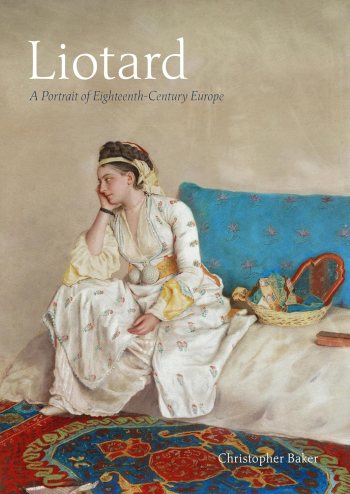 Jean Etienne Liotard (1702–1789) was one of the most accomplished, idiosyncratic, and witty artists of eighteenth-century Europe. Born in Geneva, he pursued a remarkable career, travelling across the continent and the Near East, portraying a riveting cross-section of society. Liotard worked in Paris, London, Amsterdam, Venice, Constantinople, and Vienna and excelled as a specialist in the delicate art of pastel. He became renowned for the uncanny realism of his portraits as well as the beauty of his drawings, while also experimenting with watercolour, oil painting, printmaking, and enamels. In Britain he enjoyed notoriety because of his exotic persona, and received commissions from royalty, aristocrats, grand tourists, and celebrities. Liotard: A Portrait of Eighteenth-Century Europe plots the career and practice and reputation of an extraordinary artist who deserves to be better known. This new study throws light on the wider cultural environment he navigated, illuminating connected themes, including fashion history, orientalism, and the promotion and display of portraits in the public and private spheres of Enlightenment Europe.
Christopher Baker is an art historian, curator, and author; he has been a Director at the National Galleries of Scotland and worked at Christ Church, Oxford, and the National Gallery in London. Christopher has also held Visiting Fellowships at Yale University and the British School in Rome and organised numerous highly successful exhibitions, chiefly on 18th- and 19th-century British and European art and the history of collecting.
The Burlington Magazine, November 2023
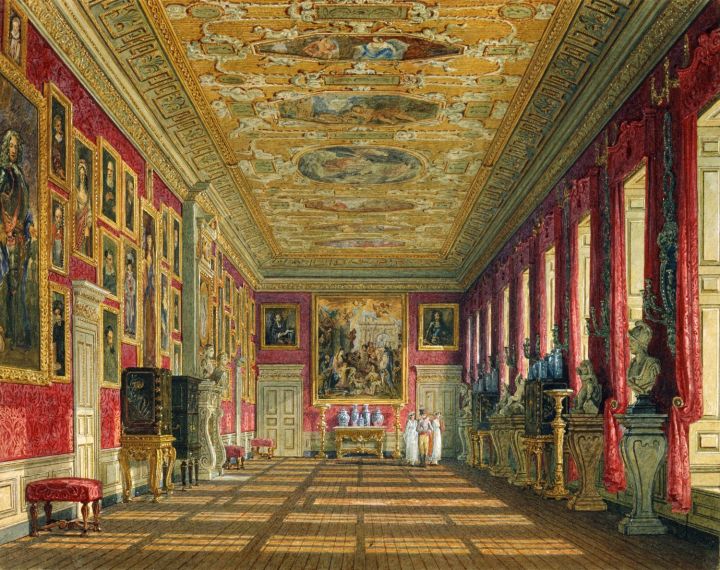
Charles Wild, Kensington Palace: The King’s Gallery, 1816, watercolour with touches of bodycolour over etched outlines, 20 × 25 cm c
(Royal Collection Trust, 922158)
◊ ◊ ◊ ◊ ◊
The eighteenth century in the November issue of The Burlington, which focuses on sculpture:
The Burlington Magazine 165 (November 2023)
e d i t o r i a l
• History of Art after Brexit, p. 1171.
It is probably fair to say that the United Kingdom’s withdrawal from the European Union in 2020 as a consequence of the referendum of 2016 was not greeted with much enthusiasm by professional art historians. The subject as it has developed over the past century is by its very nature transnational in outlook.
 a r t i c l e
• Jonathan Marsden, “George I’s Kensington Palace: The Sculptural Dimension,” pp. 1196–1205.
William Kent’s decoration of the new state rooms at Kensington Palace, London, for George I in 1722–27 has long been recognised as a pioneering exercise in neo-Palladianism. It was also an early example of the use of Classical sculpture in English interiors, a development in which Michael Rysbrack played a larger role than has formerly been recognised.
s h o r t e r n o t i c e
• Nicola Ciarlo, “Domenico Guidi in Padula: A Rediscovered Annunciation,” pp. 1206–09.
r e v i e w s
• Adriano Aymonino, “Albanimania,” pp. 1214–19.
A series of recent publications has turned the spotlight on Cardinal Alessandro Albani—described by Winckelmann as ‘the greatest patron in the world’—his villa in Rome, and collection of Classical antiquities, which have become newly accessible to scholars and the public after decades of seclusion.
• Heather Hyde Minor, Review of the exhibition catalogue, Victor Plahte Tschudi, Piranesi and the Modern Age (Nationalmuseum, Oslo / MIT Press, 2022), pp. 1239–41.
• Adam Bowett, Review of Ada De Wit, Grinling Gibbons and His Contemporaries (1650–1700): The Golden Age of Woodcarving in the Netherlands and Britain (Brepols, 2022), pp. 1247–49.
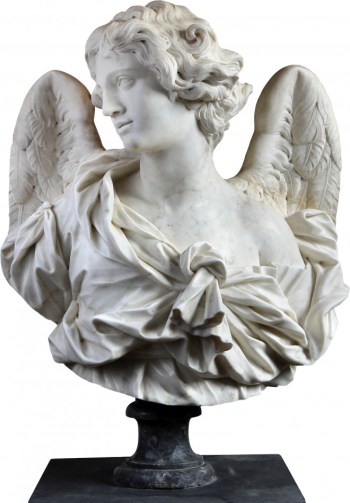
Archangel Gabriel, attributed by Nicola Ciarlo to Domenico Guidi, ca.1699–1701, marble, 94 × 81 × 39 cm, with socle (Padula: Charterhouse of S. Lorenzo).
• Marjorie Trusted, Review of Jan Zahle, Thorvaldsen: Collector of Plaster Casts from Antiquity and the Early Modern Period, 3 volumes (Thorvaldsens Museum and Aarhus University Press, 2020), pp. 1249–50.
• Natacha Coquery, Review of Iris Moon, Luxury after the Terror (Pennsylvania State University Press, 2022), pp. 1254–56.
• Joshua Mardell, Review of Jane Grenville, Pevsner’s Yorkshire, North Riding (Yale University Press, 2023), pp. 1256–57.
o b i t u a r y
• Paul Williamson, Obituary for Michael Kauffmann (1931–2023), pp. 1258–60.
Keeper of the Department of Prints & Drawings and Paintings at the Victoria and Albert Museum and subsequently Director of the Courtauld Institute of of Art, Michael Kauffmann was a scholar with a remarkable breadth of interest, as well as a widely respected and sensitive administrator and manager.
s u p p l e m e n t
• “Recent Acquisitions (2007–2023) of European Sculpture at the Victoria and Albert Museum, London,” pp. 1261–68.
Seventeen years have passed since the publication of the last supplement in this Magazine describing the recent sculpture acquisitions made by the Victoria and Albert Museum, London (V&A). The present supplement therefore highlights a selection of the most noteworthy works acquired in the intervening years.










 Enfilade
leave a comment