Online Seminar | The John Evan Bedford Library of Furniture History
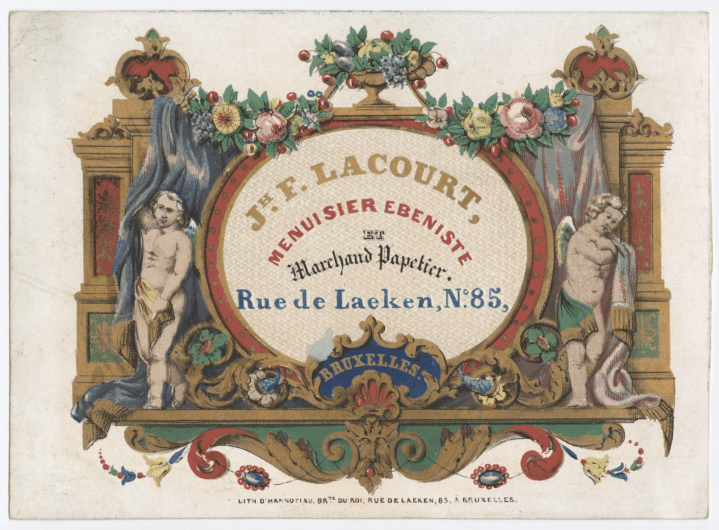
Trade Card of J. F. Lacourt (Leeds University Library, MS 2241 John Evan Bedford Library of Furniture History).
◊ ◊ ◊ ◊ ◊
From The Furniture History Society:
‘Pattern Books, Early Trade Catalogues, and Many Other Rarities’: The John Evan Bedford Library of Furniture History
The Furniture History Society Online Lecture, Wednesday, 24 March 2021, 18.00 (GMT)
Members of the Bedford project team from Special Collections at the University of Leeds will highlight some of the rare books and ephemera in the John Evan Bedford Library of Furniture History and explain more about the ambitions of the cataloguing project. Chaired by Mark Westgarth, the presentations will be followed by a discussion with the Bedford team and an opportunity to ask questions about the project.
When the art and antique dealer John Bedford died in February 2019 he gifted a remarkable collection of rare books, manuscripts, artworks, and objects to the University of Leeds. Assembled over almost half a century, the John Evan Bedford Library of Furniture History is an exceptional resource covering all aspects of the English home, from interiors and furnishings to lighting and metalwork, drapery and upholstery to architectural and garden design. Comprising over 3,000 printed items, many of them extremely rare, and in some cases unique, the collection includes furniture pattern books, designs for ornament, and inventories of country houses. The books, which also touch on household life and management, date from the seventeenth century onwards. The archive is also rich in rare ephemera including trade cards, labels, and pamphlets, many of which are unknown outside this collection. The John Victor Bedford Will Trust, with great generosity and vision, is funding a cataloguing project based in Special Collections at the University of Leeds to make the collection fully searchable and accessible.
This event is free for FHS members and £5 for non-members. If you are a non-member and would like to attend, please click here. Contact events@furniturehistorysociety.org to register interest.
Mark Westgarth is Associate Professor in Art History and Museum Studies at the University of Leeds and also Director of the Centre for the Study of the Art & Antiques Market. He has been instrumental in developing antique dealer collections at Leeds; Mark is a Council Member of the FHS.
Rhiannon Lawrence-Francis, Collections and Engagement Manager, has operational oversight of the project to catalogue the John Evan Bedford Library of Furniture History. She visited John at his Guernsey home a few weeks before he died, and planned and managed the transfer of his collection to Leeds. A medievalist by background she is responsible for the rare book collections in the University Library and has a special interest in incunabula, early modern printing, provenance, and bookbindings.
Rachel Eckersley, Rare Book Specialist, is responsible for cataloguing the pre-1851 books, researching provenance, and promoting the collection. Previously, she was a postdoctoral researcher at The Centre for the Comparative History of Print (also at Leeds), a library digitisation assistant at the Wren Library, Trinity College, Cambridge, and a research fellow in book history at Queen Mary University of London.
Rosie Dyson, Collections Officer, is currently researching trade cards and ephemera. She is undertaking work to catalogue, digitise, and repackage John’s collection of trade cards and associated ephemera and has written several articles on her findings so far. Her background is in photography and digitisation.

Illustration from Jean-Baptiste Pillement, The Ladies Amusement: Or, the Whole Art of Japanning Made Easy, second enlarged edition, ca. 1762 (Leeds University Library, MS 2241 John Evan Bedford Library of Furniture History). This is the only known complete and coloured copy.
Online | Art Museums and the Legacies of the Dutch Slave Trade
Presented by the Center for Netherlandish Art at the Museum of Fine Arts, Boston, the Harvard Art Museums, and Harvard University’s Department of History of Art and Architecture:
Art Museums and the Legacies of the Dutch Slave Trade: Curating Histories, Envisioning Futures
Online conference in four parts: 9–23 April 2021
Organized by Sarah Mallory, Kéla Jackson, and Rachel Burke, together with Joanna Sheers Seidenstein
Registration is now open for the conference Art Museums and the Legacies of the Dutch Slave Trade: Curating Histories, Envisioning Futures, presented by the Center for Netherlandish Art at the Museum of Fine Arts, Boston, the Harvard Art Museums, and Harvard University’s Department of History of Art and Architecture. This four-partprogram explores efforts by art museums to deploy their spaces and their collections—which are often enmeshed with colonialism and exploitation—to present more complete narratives of and perspectives on slavery and its legacies. This conference is organized by Sarah Mallory, Kéla Jackson, and Rachel Burke, all doctoral students in Harvard University’s Department of History of Art and Architecture, and Joanna Sheers Seidenstein, the Stanley H. Durwood Foundation Curatorial Fellow in the Division of European and American Art, at the Harvard Art Museums. We hope you will attend!
◊ ◊ ◊ ◊ ◊
Part 1 | Exhibiting Slavery and Representing Black Lives
Friday, 9 April 2021, 1–3pm EST
Curators will discuss their work on groundbreaking projects in the Netherlands and the United States, namely the Rijksmuseum’s current Slavery exhibition, the Rembrandthuis Museum’s exhibition Here: Black in Rembrandt’s Time, the Los Angeles County Museum of Art’s reinstallation of its permanent collection, and the Museums Are Not Neutral initiative. They will reflect on the broader call for museums to recognize the relationship of their collections to slavery and to present-day racial injustice. Speakers include Maria Holtrop (Curator of History, Rijksmuseum), Stephanie Archangel (Junior Curator, History Department, Rijksmuseum), Diva Zumaya (Assistant Curator, European Painting and Sculpture, Los Angeles County Museum of Art), and La Tanya S. Autry (cultural organizer, co-producer of Museums Are Not Neutral, founder of the Black Liberation Center, and independent curator).
For more information and to register, please click here»
◊ ◊ ◊ ◊ ◊
Part 2 | De-centering/Re-centering: Forging New Museological and Historical Narratives
Friday, 16 April 2021, 1–3 pm EST
This session brings together historians and art historians whose work has, on the one hand, been grounded in art museum collections and, on the other, challenged traditional museological narratives of slavery’s legacies in the Netherlands and the Americas. Speakers include Vincent Brown (Charles Warren Professor of American History, Professor of African and African American Studies, and Founding Director of the History Design Studio, Harvard University), Pepijn Brandon (Assistant Professor of Economic and Social History, Vrije Universiteit Amsterdam, and Senior Researcher, International Institute of Social History), Elmer Kolfin (Assistant Professor, University of Amsterdam), and Claudia Swan (Mark Steinberg Weil Professor of Art History & Archaeology, Washington University in St. Louis).
For more information and to register, please click here»
◊ ◊ ◊ ◊ ◊
Part 3 | History, Memory, and Legacy: Jamaica Kincaid, Rosana Paulino, and Cheryl Finley in Conversation
Friday, 23 April 2021, 11am–noon EST
Renowned writer Jamaica Kincaid and groundbreaking visual artist Rosana Paulino will discuss their explorations of the legacies of slavery in their work. They will be joined in conversation by eminent art historian Cheryl Finley.
For more information and to register, please click here»
◊ ◊ ◊ ◊ ◊
Part 4 | The Work of Objects: Interpretation within and beyond Museum Walls
Friday, 23 April 2021, 1– 2:30pm EST
This session includes brief talks, followed by a roundtable discussion, by academics and museum professionals who focus on Dutch and American art and history. Speakers will discuss specific objects—ranging from the 17th to the 21st century—that have posed interpretive and museological challenges. They will also present new possibilities for considering the relationship between slavery’s past and present-day racial injustice. Speakers include Justin Brown (Ph.D. candidate, Department of the History of Art, Yale University), Ana Lucia Araujo (Full Professor and Associate Chair, Department of History, Howard University), Makeda Best (Richard L. Menschel Curator of Photography, Harvard Art Museums), Nancy Jouwe (Chairwoman, BAK [basis voor actuele kunst] Supervisory Board, Utrecht; co-founder, Framer Framed; and co-founder, Mapping Slavery), Imara Limon (Curator, Amsterdam Museum), Adam Tessier (Barbara and Theodore Alfond Director of Interpretation, Museum of Fine Arts, Boston), and Lea van der Vinde (Curator, Royal Picture Gallery Mauritshuis).
For more information and to register, please click here»
Online Seminars | The Future of Country House Studies

Antonio Verrio, Heaven Room, ca. 1695–96
Burghley House, Lincolnshire
◊ ◊ ◊ ◊ ◊
From the research day programme:
The Future of Country House Studies
Online, University of Buckingham, Tuesday, 13 April 2021
A research day organized by the University of Buckingham Humanities Research Institute—one of a series of research seminars in the history of art.
This series of postgraduate Research Days revolve around some of the main research strengths of the department of History and History of Art of the University of Buckingham: the history of collecting and the evolution of taste; the reception of the classical tradition in the art and architecture of early modern Europe; the cultural history of the long eighteenth century; and the history of materials in art and architecture.
Each Research Day involves presentations by PhD students and members of staff, followed by a seminar given by an established scholar. Their structure is intended to facilitate dialogue and exchange between scholars at different stages of their career. Sessions are open to all, free of charge. To register, please send a simple one-line email to seminars-hri@buckingham.ac.uk.
◊ ◊ ◊ ◊ ◊
All times listed are for the UK.
2.30pm Session 1
Adrian Tinniswood, OBE — Fellow, Humanities Research Institute, University of Buckingham
The Guilt and the Gingerbread: The Country House 1945–1974
Adrian Tinniswood discusses his latest research project, Noble Ambitions, to be published by Jonathan Cape in September 2021. Adrian directs the MA in the History of the English Country House at the University of Buckingham. His most recent books include Behind the Throne: A Domestic History of the Royal Household and The Long Weekend: Life in the English Country House between the Wars.
3.30pm Session 2
Michael Bentley — PhD Student, University of Buckingham
‘Properly Bestowed’: Decorum and the Mural in the English Country House, from Verrio to Thornhill, 1672–1728
To what extent was decorum a factor in the decision-making process when commissioning wall and ceiling paintings for an English country house? If not decorum, then what? New light will be shed on Adlington Hall, Sudbury Hall, and Boughton in particular.
4.30pm Tea break
5.00pm Session 3
Martin Postle — Deputy Director, Paul Mellon Centre for Studies in British Art, Yale University
Collection and Display: Art and the Country House Digital Project
Martin Postle discusses the Mellon Centre’s latest digital project. Art & the Country House, launched in autumn 2020, is an online publication focused on the collection and display of works of art in the country house in Britain from the sixteenth century to the present day. Eight case studies (Castle Howard, Doddington Hall, Mells Manor, Mount Stuart, Petworth House, Raynham Hall, Trewithen, and West Wycombe) relate to a broad range of research topics and give a varied set of examples, in terms of geographical location, scale, patterns of ownership, chronologies, collections, and displays.
Online Talks from London Art Week, March 2021
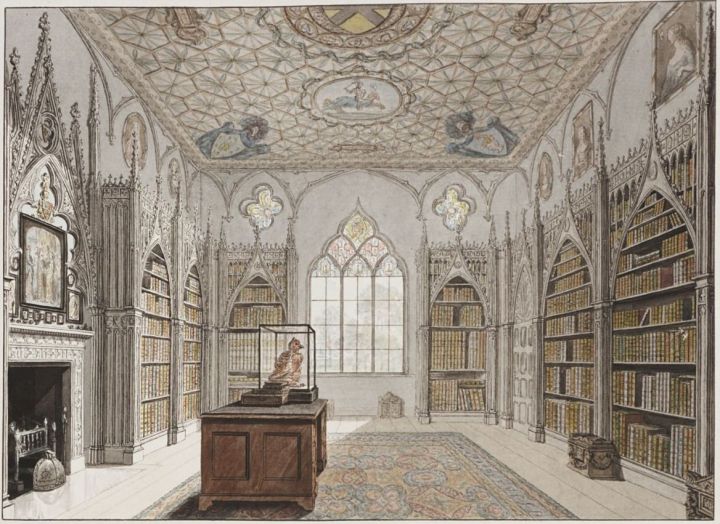
John Carter, View of the Library at Strawberry Hill, watercolour, 23.7 × 28.8 cm, from Horace Walpole, A Description of the Villa … at Strawberry-Hill (Strawberry Hill, 1784). The Lewis Walpole Library, Yale University.
◊ ◊ ◊ ◊ ◊
From the press release (via Art Daily) for this month’s Art History in Focus series:
London Art Week’s Art History in Focus
March 2021
Last October, London Art Week introduced a new series of interim online events, Art History in Focus. Another impressive line-up of insightful and lively talks is scheduled for March. All events will take place from 17.00 to 18.00 GMT.
16 March — The Female Artists, Actresses, and Playwrights of Strawberry Hill Theatricals
Introduced and moderated by Emanuela Tarizzo (Gallery Director of Tomasso Brothers Fine Art), this webinar will explore the role of female artists, actresses, and playwrights involved with theatre at Horace Walpole’s Strawberry Hill. The session will address illustrations of Walpole’s scandalous gothic play The Mysterious Mother by the artist Diana Beauclerk and the closet built to house them at Strawberry Hill. It will also touch on Walpole’s literary executor Mary Berry’s play Fashionable Friends, performed at Strawberry Hill with sets designed by her sister Agnes and with herself and the sculptor Anne Damer in the leading roles. Damer had a close relationship with the famous actress Eliza Farren, re-imagined in Emma Donoghue’s historical novel Life Mask.
Speakers include Judith Hawley (Professor of English, Royal Holloway, University of London), Cynthia Roman (Curator, Prints, Drawings, and Paintings, The Lewis Walpole Library, Yale University), and Laura Engel (Professor of English, Duquesne University).
23 March — Medieval Women: Subjects and Makers of Art
Arranged with Sam Fogg in conjunction with their online exhibition Medieval Women: Subjects and Makers of Art (25 February – 31 March 2021), the session provides a tour of the exhibition in its gallery setting, accompanied by commentary and an in-depth look at select individual works. With Jana Gajdošová of Sam Fogg, curator of the Medieval Women exhibition, and Alexandra Gajewski FSA, reviews editor at The Burlington Magazine and from 2010 to 2015, senior researcher at the CSIC in Madrid on a European Research Council funded project called Reassessing the Roles of Women as Makers of Medieval Art and Architecture.
24 March — Dürer’s Journeys
An in-depth discussion of the much-heralded National Gallery exhibition Dürer’s Journeys: Travels of a Renaissance Artist (opening soon) with Imogen Tedbury (National Gallery), Anthony Crichton-Stuart (Agnews), and Katrin Bellinger (Collector and Founder, Tavolozza Foundation). Dr. Tedbury is the Simon Sainsbury Curatorial Fellow for Paintings before 1500 at the National Gallery, where she is currently working on Dürer’s Journeys. Katrin Bellinger began collecting in 1985 in parallel to her career as a dealer in Old Master drawings; she was a partner at Colnaghi until the Gallery was sold in 2015. Fascinated by the artistic process and the mystique surrounding it, she chose to focus on one theme of the artist at work. She is a Trustee of the National Gallery and sits on the Board of the Tate.
25 March — Thomas Lawrence: Coming of Age
Amina Wright, author of a new book on Thomas Lawrence’s first twenty-five years, discusses the early works of this young prodigy with LAW dealers Lowell Libson (Lowell Libson & Jonny Yarker Ltd) and Ben Elwes (Ben Elwes Fine Art). Both galleries have recently handled early works by Lawrence that will feature in a forthcoming online exhibition at the website of the Holburne Museum in Bath entitled Thomas Lawrence: Coming of Age. Registrants to this talk can benefit from a discount on the book of the same title written by Amina Wright (Philip Wilson Publishers).
29 March — The Impact of the 20th Century on Women Artists
Florrie Evans and Jo Baring discuss the views and barriers surrounding women artists in 20th-century Britain. In 1955 a review in The Times described Elisabeth Frink’s first solo show as “Here is a sculptor of rare promise, indeed of rare quality, for Miss Frink’s handling of the problems of sculptural form is such that one has to make no allowances for her youth, or her sex.” This will be a reference point for the talk in which Jo will focus on women sculptors in particular, and Florrie will look at some of the key female artists handled by The Fine Art Society.
London Art Week, 1–16 July 2021
London Art Week will take place as a dual aspect event: online in a digital format, allowing participants from across the globe to take part, and as physical exhibitions in galleries as local guidelines allow.
A new introduction to LAW Digital Summer 2021 will be Revolution and Renewal, an online themed exhibition. London Art Week is delighted to welcome as guest curator the art historian, curator, and scholar Arturo Galansino, Director General of the Fondazione Palazzo Strozzi in Florence. Well-known among the London Art Week community, Dr. Galansino has been invited to curate this special exhibition by the LAW Board who have long admired his exceptional track record in curating and co-curating incredible shows spanning Old Masters to contemporary art: from Moroni, Giorgione and Rubens at the Royal Academy to Ai Weiwei, Bill Viola and Marina Abramović at the Palazzo Strozzi. “It will be interesting to see what thread, narrow or broad, he weaves from the submitted works to Revolution and Renewal,” comments Amelia Higgins, Director, London Art Week.
“The online exhibition will have its own section on the LAW website,” explains Luce Garrigues, Director, London Art Week Digital, “and all participants will be invited to submit a work on the theme for consideration by Dr. Galansino. As a collegial, curator-led exhibition, Arturo will select his highlights and write his own introduction on the theme. To give our dealers greater voice, we will be asking each participant to explain why they submit their chosen work.”
Online Panel | An Irish Odyssey
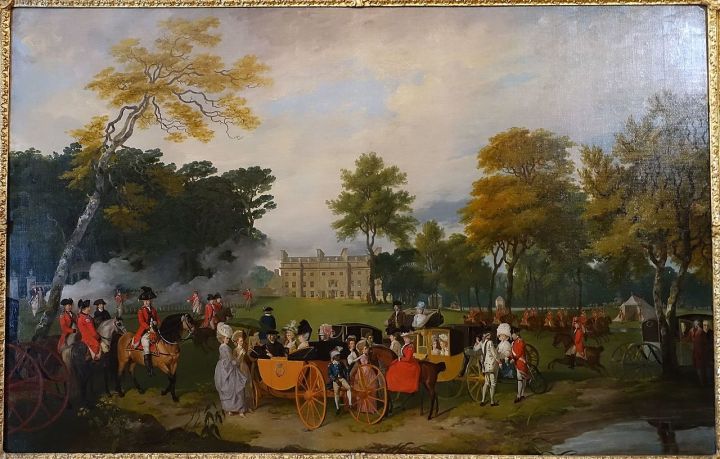
Francis Wheatley, The Earl of Aldborough Reviewing Volunteers at Belan House, County Kildare, 1782 (later changes ca.1787 and extended ca.1810), oil on canvas, 155 × 265 cm (National Trust, Waddesdon Manor, bequeathed by James de Rothschild, 1957).
◊ ◊ ◊ ◊ ◊
From The Attingham Trust’s spring lectures series:
An Irish Odyssey
The Attingham Trust for the Study of Historic Houses and Collections
Online, Tuesday, 16 March 2021, 6pm GMT
A virtual tour of Irish historic houses in film and music, followed by a live panel discussion with Terence Dooley (Centre for the Study of Historic Irish Houses and Estates), Mary Heffernan (Office of Public Works), Donough Cahill (Irish Georgian Society), and Fionnuala Ardee (Historic Houses of Ireland), hosted by Study Programme Director Elizabeth Jamieson
To register for this event, please click here. The event is free to attend, but there are options to purchase a donation ticket. All proceeds raised for The Attingham Trust will go directly to the Scholarship Fund and are gratefully received. You must be registered in order to receive the link.
NB. A day before the event the webinar link will come from The Attingham Trust, not Eventbrite. If you do not receive it or have any questions, please email Rebecca: rebecca.parker@attinghamtrust.org.
Online Seminars | O Gosto neoclássico: A Dimensão americana
I’m sorry for not posting news of these seminars much sooner. –CH
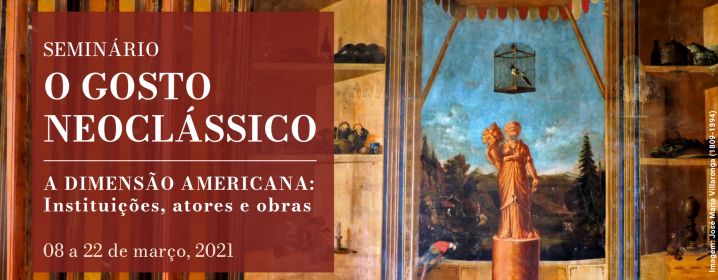
O Gosto neoclássico — A Dimensão americana: instituições, atores e obras
Online, 8–22 March 2021
O seminário O Gosto neoclássico — A Dimensão americana: instituições, atores e obras será realizado de 8 a 22 de março de 2021, às 2ª-feiras e 4ª-feiras, às 15h, em transmissão remota. É promoção do grupo de pesquisa “O gosto neoclássico”, conduzido pela Fundação Casa de Rui Barbosa e o leU/Prourb/FAU/UFRJ, com o apoio do Instituto Rui Barbosa de Altos Estudos – IRbae.
O evento dá continuidade a uma agenda sistemática de discussões públicas sobre arte, arquitetura, cidade e cultura sob o impacto da circulação das ideias neoclássicas no período compreendido entre o final do século XVIII e meados do XIX. Já foram discutidas temáticas relativas aos contextos brasileiro, português e francês. Em 2021, propõe-se uma pauta ainda inédita e que permita uma visão articulada e comparada sobre o fenômeno também nas Américas.
O Gosto neoclássico — A dimensão americana, se organiza em cinco sessões compostas por palestras e mesas redondas com especialistas brasileiros e estrangeiros. As palestras serão voltadas para aspectos da questão no México, França, Brasil, Portugal, Estados Unidos e Caribe. As mesas-redondas irão enfocar quatro eixos principais: as questões de ensino das artes nas academias: visões estéticas, padrões de gosto e formas de transmissão; mudanças e permanências nas culturas acadêmicas; as práticas projetuais e construtivas e o campo das visualidades, suas inovações e continuidades. O encerramento se dará com uma palestra concerto em torno das questões da música no período.
O evento será coordenado por Ana Pessoa (FCRB) e Margareth Pereira (leU/Prourb/UFRJ) e organizado por Ana Lúcia V. Santos (EAU/UFF), Karolyna Koppke (PROARQ-UFRJ/Ibmec RJ), Luiza Xavier (leU/Prourb/UFRJ), Ornella Savini (PIC-FCRB/CNPq). Arte e diagramação: Luiza Xavier (leU/Prourb/UFRJ). Fotografia: Ana Claudia P. Torem.
O seminário ocorrerá através da plataforma Zoom.
8 M A R C H 2 0 2 1
15.00 (BRT) Palestra
• Kelly Donahue-Wallace (CVAD-UNT, EUA), Good Taste within Reach: The Mexican Medals of Jerónimo Antonio Gil
16.00 (BRT) Mesa Redonda
• Renata Baesso (PUC-Campinas), O lugar do gosto, do gênio e da invenção nas preceptivas arquitetônicas
• Elaine Dias (UNIFESP), François-René Moreaux na Galeria e Escola de Pintura: a exposição da coleção italiana e a afirmação do artista
• Sonia Gomes Pereira (EBA-UFRJ), A Academia Imperial de Belas Artes e a longa duração da tradição clássica
1 0 M A R C H 2 0 2 1
15.00 (BRT) Palestra
• Jean Philippe Garric (Univ.Paris 1-França), Grandjean de Montigny et la polychromie architecturale à l’école de Percier
16.00 (BRT) Mesa Redonda
• Maria Luiza Zanatta (UFSM), O “tratado das ordens” de Vignola em S. Paulo: do Neoclassicismo ao Ecletismo
• Gustavo Rocha-Peixoto (PROARQ-UFRJ), Uma questão de gosto
• Karolyna Koppke (PROARQ-UFRJ/Ibmec RJ), A urbe imaginada: a Academia e o projeto para os paços Imperial e do Senado
1 5 M A R C H 2 0 2 1
15.00 (BRT) Palestra
• Margareth da Silva Pereira (PROURB-UFRJ), A ressignificação da ideia de arquitetura: A cena americana e a educação dos sentidos
16.00 (BRT) Mesa Redonda
• Ana Lucia V. dos Santos (EAU-UFF), A casa do Passeio – estudo de um edifício residencial de Grandjean de Montigny
• José Pessôa (PPGAU-UFF), A Praça Municipal de Grandjean de Montigny
• Nelson Pôrto (DAU/UFES), Os engenheiros e o neoclassicismo
1 7 M A R C H 2 0 2 1
15.00 (BRT) Palestra
• Helder Carita (FCSH-UNL), Neoclassicismo tardio em Portugal: da arquitectura às artes decorativas
16.00 (BRT) Mesa Redonda
• Paulo Knauss (UFF), O desafio da pedra: o gosto neoclássico e a escultura no Brasil
• Ana Pessoa (PPGMA/FCRB) e Ornella Savini (PIC/FCRB), Uma arcádia tropical? Vassouras, RJ, sec. XIX
• Júlio Bandeira (BN/MTur), Do Capitão Carlos Julião a Mauricio Rugendas, a camisola neoclássica no Brasil
2 2 M A R C H 2 0 2 1
15.00 (BRT) Palestras
• Dell Upton (AH-UCLA, CASVA/NGA), Politics of Neoclassicism in the United States
• Paul Niell (AH-FSU, USA), No Taste for Thatching: Value, Aesthetics, and Urban Reform in the Bohíos of Nineteenth-Century Puerto Rico
16.20 (BRT) Palestra-Concerto
• Rosana Lanzelotte (Musica Brasilis), Clássica: a nova música
Online Lecture | Wendy Wassyng Roworth on Angelica Kauffman
Dr. Roworth’s talk, originally slated for last spring in St. Louis, has been rescheduled for later this month; from the Saint Louis Art Museum:
Wendy Wassyng Roworth, Angelica Kauffman: An Enterprising Artist in 18th-Century Britain
Mary Strauss Women in the Arts Lecture, Saint Louis Art Museum
Online, 25 March 2021, noon–1 pm (CDT)
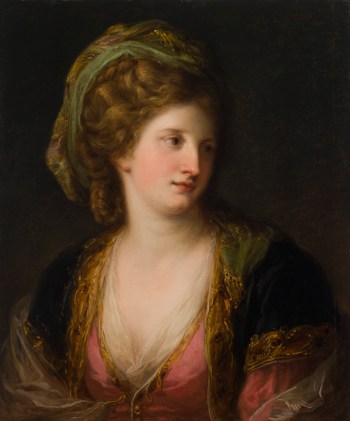
Angelica Kauffman, Woman in Turkish Dress, 1767, oil on canvas, 25 × 20 inches (Saint Louis Art Museum, Funds given by Dr. E. Robert and Carol Sue Schultz 704.2018).
Angelica Kauffman (1741–1807) was an Austrian-Swiss artist who began her career in Italy, where her clients included British tourists who encouraged the young painter to pursue her profession in England. Over the 15 years she worked in London, Kauffman achieved fame and fortune and returned to Italy as an international celebrity. This lecture celebrates a portrait recently acquired by the Museum. Wendy Wassyng Roworth will discuss Kauffman’s life and work in England as a fashionable painter and member of the Royal Academy of Arts, a rare distinction for a woman, and how the artist used her talents to her advantage.
Wendy Wassyng Roworth is Professor Emerita of Art History, University of Rhode Island.
This free, virtual program will take place on Thursday, 25 March 2021, via Zoom, and will include opportunities for participants to ask questions with the Q&A feature. Attendees’ mics and cameras will not be activated. Attendees must register to receive the Zoom link. Capacity for the live program is limited. A closed-captioned recording of the program will become available on the Museum’s YouTube channel in the weeks following. This program is supported by the Mary Strauss Women in the Arts Endowment.
Online Talk | Fortune and Folly in 1720
Wednesday evening on Zoom, from the BGC:
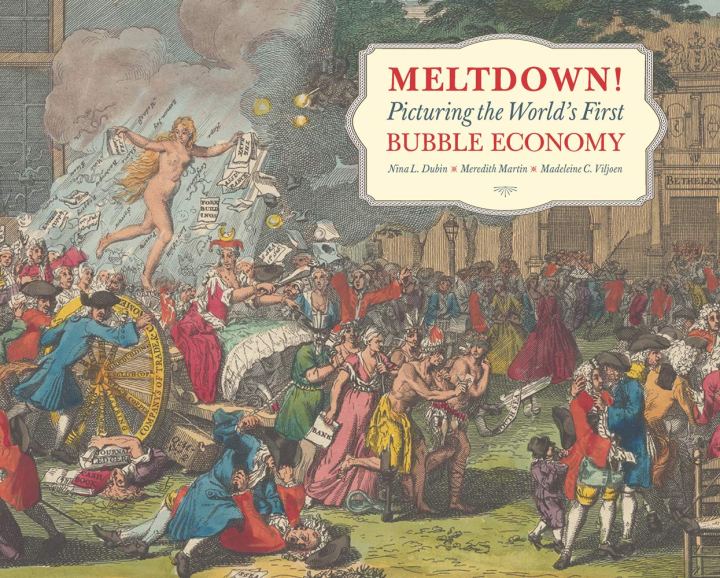
Nina Dubin, Meredith Martin, and Madeleine Viljoen | Fortune and Folly in 1720: Picturing the World’s First Bubble Economy
Françoise and Georges Selz Lectures on Eighteenth- and Nineteenth-Century French Decorative Arts and Culture
Online, Bard Graduate Center, New York, 3 March 2021, 6.00pm
This talk will explore The New York Public Library’s upcoming exhibition Fortune and Folly in 1720 (Fall 2021) and its accompanying publication Meltdown! Picturing the World’s First Bubble Economy (Harvey Miller/Brepols, 2020). Co-curated and co-authored by Dubin, Martin, and Viljoen, they tell two parallel stories: one of the spectacular rise and fall of the first bubble economy, and another of the enterprising art industry that chronicled its collapse. The Mississippi and South Sea Bubbles, spawning the invention of French banknotes as well as joint-stock companies built on fantasies of New World trade, imposed on everyday Europeans a crash course in new financial products. In turn, a bubbling print market relentlessly caricatured the meltdown of 1720, offering viewers an entertaining primer on the otherwise bewildering realities of modern economic life. Three hundred years later, our current moment offers a uniquely fitting vantage point from which to reconsider the significance of the bubbles and of the artworks that channeled the fears and desires they unleashed.
The event will be live with automatic captions. It will be held via Zoom; a link will be circulated to registrants by 3pm on the day of the event.
Nina L. Dubin is an associate professor of Art History at the University of Illinois at Chicago. Specializing in European art since 1700, she has published widely on the production of art within an economy of risk.
Meredith Martin is an associate professor of Art History at New York University and the Institute of Fine Arts. Specializing in European art of the long eighteenth century, she has published widely on gender and architectural patronage as well as maritime art, mobility, and exchange in the early modern world.
Madeleine C. Viljoen is Curator of Prints and the Spencer Collection at The New York Public Library. Responsible for the Library’s collection of prints and rare illustrated books, she has published widely on early modern printed images, with special attention to the goldsmith-engraver, the reproductive print, and ornament.
Online Lecture | Rebecca Tilles, Highlights from Hillwood

Abraham and David Roentgen, Roll-top desk, Germany (Neuwied), 1770–74; oak, cherry, and other woods, veneered with tulipwood, rosewood, maple, mother of pearl, gilt bronze (Washington, DC: Hillwood, Bequest of Marjorie Merriweather Post, 1973, 33.222).
◊ ◊ ◊ ◊ ◊
From The Furniture History Society:
Rebecca Tilles, Highlights from Hillwood: Marjorie Merriweather Post’s Taste for 18th-Century European Furniture
The Furniture History Society Online Lecture, Sunday, 21 February 2021, 19.00 (GMT)
Marjorie Merriweather Post (1887–1973) was one of the most influential female collectors, philanthropists, and businesswomen of the twentieth century. Born in Springfield, Illinois to a middle-class family, she inherited the helm of the Postum Cereal Company, eventually becoming the director of General Foods, from her father at the age of 27, making her one of the wealthiest women in America. She designed and decorated a multitude of impressive residences, notably a sprawling 54-room triplex apartment on Fifth Avenue in Manhattan (1925), the Mar-A-Lago estate in Palm Beach (1927), Adirondack Great Camp Topridge, New York (1923), and finally Hillwood, Washington, DC (1955).
This lecture will explore Post’s interest in collecting 18th-century European furniture, highlights from Hillwood’s collection (as well as a few that got away), and the dealers she bought from— spanning from the mid-1920s until the late 1960s, during which time Post acquired, renovated, and furnished Hillwood estate with the intention of bequeathing the house and collection to the public following her death. The lecture will also feature future research projects, new acquisitions, and upcoming exhibitions. This event is free for FHS members, £5 for non-members; to pay for this event online please follow this link.
Rebecca Tilles is Associate Curator of 18th-Century French & Western European Fine & Decorative Arts at Hillwood Estate, Museum & Gardens in Washington, DC. She is currently organizing an exhibition of outdoor garden sculpture by the artist Kristine Mays entitled Rich Soil (June 2021–January 2022), as well as an exhibition on the evolution of porcelain in Western Europe and Marjorie Merriweather Post’s interest in diplomatic gifts and international commissions between Western European and Russian factories (February–June 2022). Rebecca is also organizing a spotlight exhibition entitled “Marjorie Merriweather Post and the Diplomacy of Philanthropy,” in partnership with the State Department, at the National Museum of American Diplomacy in Washington, D.C. (2022). Rebecca completed her PhD in Art History from the University of Sussex where her dissertation was entitled “George and Florence Blumenthal: A Collecting Partnership in the Gilded Age, 1858–1941.” She recently published “The Artistic Patronage and Transatlantic Connections of Florence Blumenthal” in the most recent issue of 19: Interdisciplinary Studies in the Long Nineteenth Century and is currently working on a new publication on Marjorie Merriweather Post’s collection and residences with Hillwood’s curatorial team that will be published by Rizzoli in 2022.
Online Lecture | Sir Watkin’s Table

From a service of Sèvres porcelain ‘service a rubans bleu celeste’, ca. 1770, sold at Christie’s in 2018 (Sale 16185, Lot 1164).
◊ ◊ ◊ ◊ ◊
Sunday via Zoom from The French Porcelain Society:
Oliver Fairclough, Sir Watkin’s Table
FPS Living Room Lecture, 21 February 2021, 18.00 (BST)
For its next Living Room Lecture, the French Porcelain Society is honoured to welcome Oliver Fairclough, a recent FPS Chairman and the former Keeper of Art at the National Museum in Cardiff. He will discuss the fashionable taste for fine dining of eighteenth-century Welsh politician Sir Watkin Williams-Wynn. We hope you can join us! For free links, please email FPSmailing@gmail.com.
Sir Watkin Williams-Wynn (1749–1789) was one of the richest men of his day, and he set himself up in style during the 1770s. Robert Adam built him an exquisite London house in St James’s Square, and he entertained lavishly there and at his country seat, Wynnstay in Denbighshire. As well as commissioning one of the largest architect-designed silver table services of the eighteenth century, he acquired porcelain services from Sèvres, Meissen and Tournai, as well as Nankeen and English porcelains—and huge quantities of Wedgwood creamware for mass hospitality. His table services, and the settings in which they were used, are exceptionally well-documented by designs, and in account books, bills and inventories.
Sir Watkin’s silver and ceramics were sold off after World War II, together with his superlative paintings and furniture from the St James’s Square house. Examples are now in both public and private collections around the world. The largest group can be seen at the National Museum in Cardiff, where Oliver Fairclough was formerly Keeper of Art.










leave a comment