At the Newberry: Goodman on Masculinity in the Age of Revolutions
Dena Goodman, ‘Becoming a Man in the Age of Revolutions’
Newberry Library Eighteenth-Century Seminar, Chicago, 9 April 2011, 1-3pm
Professor Dena Goodman seeks to complicate the picture of nineteenth-century reactionary aristocrats and modern republicans by bringing an eighteenth-century perspective to bear on French revolutionary and post-revolutionary culture and society. Her paper will trace the life and career of a boy born less than a decade before the start of the French Revolution and asks how he became a man—and what kind of a man he became—through the successive upheavals of French history, from the Revolution and the Terror through the restoration of the monarchy and the regimes that followed. She argues that he became a “new man” of the nineteenth century only by drawing on family ties and patronage networks deeply embedded in the ancien regime of the seventeenth and eighteenth century. The paper for this seminar session will be pre-circulated. Those who plan to attend will be sent the paper via email after they have registered. Advance registration is required for all Newberry Library Center for Renaissance Studies programs. To register for this seminar, please send an e-mail to: renaissance@newberry.org or call: 312-255-3514. A reception will follow the seminar. For more information about the seminar, please visit our website.
Mimi Hellman to Speak at the Bard Graduate Center
From the Bard Graduate Center:
Mimi Hellman, Forms of Distraction: Towards a Decorative Imagination in Eighteenth-Century France
Bard Graduate Center, New York, 30 March 2011
The eighteenth-century French interior was filled with a multitude of artfully designed objects, from lustrous porcelain vases to intricately veneered furniture to paintings representing the trysts of mythological lovers. Yet sustained appreciation of these works was often difficult due to factors such as location, lighting, and codes of conduct. By exploring the tensions between visual abundance and compromised visibility, this lecture suggests that both designers and consumers imagined the interior as a space where distraction, not attention, shaped the aesthetic and social value of decorative art.
Mimi Hellman is Associate Professor in the Department of Art History at Skidmore College, Saratoga Springs, New York, where she has taught since 2004. She has also taught at Smith College in Northampton, Massachusetts, and Mount Holyoke College in South Hadley, Massachusetts. Dr. Hellman received her B.A. and M.A. from Smith College, and the Ph.D. from Princeton University. She has been the recipient of prestigious fellowships including a David E. Finley Fellowship from the Center for Advanced Study in the Visual Arts at the National Gallery of Art in Washington, D.C. (1997-2000), and a research fellowship at the American University in Paris from the Samuel H. Kress Foundation (1995-7).
Dr. Hellman is preparing a book entitled The Hôtel de Soubise: Art and Ambition in Eighteenth-Century France. She has published numerous essays, including “Enchanted Night: Decoration, Sociability, and Visuality after Dark,” in Paris: Life and Luxury (forthcoming in 2011); “The Nature of Artifice: French Porcelain Flowers and the Rhetoric of the Garnish,” in The Cultural Aesthetics of Porcelain in the Eighteenth Century (2010); “Up the River: Touring Sing Sing,” in Lives of the Hudson (2010); “The Decorated Flame: Firedogs and the Tensions of the Hearth,” in Taking Shape: Finding Sculpture in the Decorative Arts, winner of Historians of British Art book prize (2010); “The Joy of Sets: The Uses of Seriality in the French Interior,” in Furnishing the Eighteenth Century: What Furniture Can Tell Us About the European and American Past (2006); “Interior Motives: Seduction by Decoration in Eighteenth-Century France,” the introduction to the Metropolitan Museum of Art exhibition catalogue, Dangerous Liaisons: Fashion and Furniture in the Eighteenth Century (2006); and “Domesticity Undone: Three Historical Spaces,” in Undomesticated Interiors (2003).
Please RSVP and join us in the Lecture Hall at 38 West 86th Street, between Columbus Ave and Central Park West, at 5:45pm for a reception before the talk. For general information please contact academic-events@bgc.bard.edu.
Belfast Lecture on Urban Culture: Peter Borsay on Promenading
Upcoming at Queen’s University:
First Annual Belfast Lecture on Urban Culture
Peter Borsay — Promenading: Recreational Walking and Green Space in the English Town during the Long Eighteenth Century
Queen’s University Belfast, Senate Room, QUB, 8 March 2011
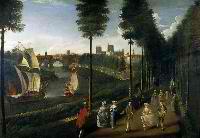 All welcome. The lecture will be followed by a wine reception to mark the launch of the lecture series. Peter Borsay is Professor of History at Aberystwyth University. He is the author of numerous publications on urban history and the history of leisure, including The English Urban Renaissance (Oxford, 1989), The Image of Georgian Bath, 1700-2000 (Oxford, 2000) and A History of Leisure (Palgrave Macmillan, 2006). He is editor of The Eighteenth-Century Town (Longman, 1992) and co-editor, with Lindsay Proudfoot, of Provincial Towns in Early Modern England and Ireland (Oxford, 2002). He is currently engaged in research on ‘green’ space in or on the edge of British towns, 1660-1900, and on spas and seaside resorts in Britain, and he is also preparing a monograph on The Discovery of England.
Study Day at The Wallace: Marquetry Furniture
From The Wallace:
Study Day, Getting to Grips: Magnificent Marquetry
The Wallace Collection, London, 9 February 2011
Join Jurgen Huber, Senior Furniture Conservator, for a detailed tour using some of the world’s finest 18th-century marquetry furniture to explain different techniques, then visit the conservation workshop to see a demonstration of cutting marquetry. Wednesday, 9 February 2011, 2:30-4:00pm, £10.
Lecture in New York: Robert Adam against Palladio
From the Parsons website:
Erika Naginksi, Contra Palladio
Parsons The New School for Design, New York, 3 February 2011
This talk broaches the question of Palladio’s critical legacy from the vantage of Robert Adam’s repudiation of the prevailing Palladianism of his time. The aim here is two-fold: first, to consider how Classical eclecticism and an interest in what Adam construed as “movement … the rise and fall, the advance and recess” of architectural form might have functioned as correctives to what in his eyes stood as the rigidity, predictability and mimicry of the Palladian system (as laid down by Lord Burlington); and second, to speculate more broadly on the tension between, on the one hand, the architect’s ambition to recodify Palladio, and on the other, to renounce the results that codification inevitably produces.
Erika Naginski is Associate Professor at the Harvard Graduate School of Design. A historian of 17th- and 18th-century art and architecture, Naginski addresses early modern aesthetic philosophy and the critical traditions of architectural history. Her publications include Sculpture and Enlightenment (Getty Research Institute, 2009), a study of commemoration in an age of secular rationalism and revolutionary politics; Polemical Objects (2004), a special issue of Res co-edited with Stephen Melville, which explores the philosophy of medium in Hegel, Heidegger and others; and Writing on Drawing (2000) for the journal Representations, with essays on the collision of semiotics and mimesis in drawing practices. She has been a fellow at the Harvard Society of Fellows, The Radcliffe Institute for Advanced Study, the Clark Art Institute, and the Deutsches Forum für Kunstgeschichte. In 2007, she was awarded a John Simon Guggenheim Memorial Foundation Fellowship for a book project on the intersections of architecture, archaeology and conceptions of history in the late 17th and 18th centuries.
Melissa Hyde on the Saint Aubins at the Bard Graduate Center
From the Bard Graduate Center:
Melissa Hyde, Needling: Embroidery and Satire in the Hands of the Saint-Aubins
Bard Graduate Center, New York, 16 February 2011
This talk will explore the themes of social satire and self-parody that are to be found in the illicit and uncensored drawings of the Livre de caricatures tant Bonnes que mauvaises, a collaborative work produced over several decades of the eighteenth century by the Saint Aubins, a family of artists (and embroiderers). A private, though monumental work comprised of nearly 400 drawings, the Livre engages with a dizzying array of highly topical and often hermetic subjects. This lecture will focus on a few images that satirize “effeminate” men, particularly society men who reputedly practiced embroidery and other forms of needlework. The talk will consider how these images relate to similar thematics in contemporary theater and to broader cultural anxieties about the undue influence of women like Mme de Pompadour – one of the Saint Aubin’s patrons and a favorite target in the Livre de caricatures. Taking into account that the patriarchs of the Saint Aubin family were themselves extremely successful royal embroiderers, this talk will also address some of the ways in which the Livre playfully and self-reflexively parodies the Saint Aubins themselves. (more…)
Lecture at the Louvre: The Sculpture of Pierre-François Berruer
From the Louvre:
Guilhem Scherf (Department of Sculpture, Louvre)
Louis XV récompense la Peinture et la Sculpture de Pierre-François Berruer
Musée du Louvre, Paris, 9 February 2011
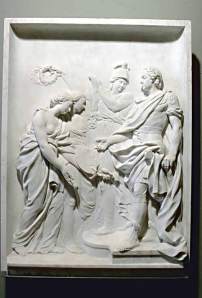
Pierre-François Berruer Paris, "Louis XV récompense la Peinture et la Sculpture." 1770 © Musée du Louvre/P. Philibert
Ce petit bas-relief en marbre fut sculpté en 1770 par Pierre-François Berruer (1733-1797), au moment de son entrée à l’Académie royale de peinture et de sculpture. Par le traitement élaboré des draperies et la gradation subtile des plans dont il fait preuve, ce morceau de réception témoigne d’une réflexion sur l’esthétique du bas-relief dans le contexte académique. Également intitulée parfois Louis XV prenant sous sa protection l’Académie royale, cette œuvre est aussi l’occasion de revenir sur le rôle du souverain et de la politique royale en faveur des arts.
UCL Seminar for Early Modern Visual Culture, Spring 2011
From UCL:
University College London, Seminar for Early Modern Visual Culture
UCL Department of History of Art, 20-21 Gordon Square, London, 6pm
Organized in collaboration with the Courtauld Institute of Art
24 January
Mary Sheriff (University of North Carolina at Chapel Hill)
Calypso’s Island and the Lure of Enchantment in the Art of the French Regency
7 February
Miles Ogborn (Queen Mary University of London)
The Freedom of Speech: Talk and Slavery in the Early Modern Caribbean
21 February
Judy Loach (Cardiff University)
Engraving and Printing, Visibility on Matter and Invisibility on Hearts and Souls
14 March
Rose Maria San Juan (University College London)
Unavailable Knowledge: Eve in the Wax Anatomical Cabinet
YCBA Lecture: Fordham on ‘British Art and the Seven Years’ War’
Lecture and Book Signing: Douglas Fordham, British Art and the Seven Years’ War
Yale Center for British Art, New Haven, 26 January 2011, 5:30pm
 Between the Jacobite Rebellion of 1745 and the American Declaration of Independence, London artists transformed themselves from loosely organized professionals into one of the most progressive schools of art in Europe. In British Art and the Seven Years’ War, Douglas Fordham argues that war and political dissent provided potent catalysts for the creation of a national school of art. Over the course of three tumultuous decades marked by foreign wars and domestic political dissent, metropolitan artists — especially the founding members of the Royal Academy, including Joshua Reynolds, Paul Sandby, Joseph Wilton, Francis Hayman, and Benjamin West — creatively and assiduously placed fine art on a solid footing within an expansive British state. Copies of British Art and the Seven Years’ War signed by the author will be available for purchase.
Lecture Series at the Louvre: Ancients and Moderns
From the Louvre:
Conférences d’histoire de l’art: Pourquoi l’antique chez les modernes?
Musée du Louvre, Paris, January-February 2011
L’antinomie entre Antiquité et Modernité est une question qui préoccupe depuis la Renaissance jusqu’aux grands débats esthétiques des XVIIe et XVIIIe siècles. Elle en implique une autre qui traverse l’histoire des arts et qui est au cœur même de la création artistique : comment réconcilier l’imitation et l’originalité ? Winckelmann, le fondateur de l’histoire de l’art et du paradigme grec, avait donné une réponse à ces questions : « La seule manière pour nous de devenir grands, et même, si cela se peut, inimitables, c’est d’imiter les Anciens » (Histoire de l’art dans l’Antiquité, 1764). Mais ce rêve d’appropriation de l’origine retrouvée est-il possible ? Par ailleurs quelles sont les conditions de la survie et des nombreux retours à l’antique à partir de la Révolution, alors même que les esprits cherchent à se libérer des autorités qui régissent la vie politique, artistique et littéraire de leur temps ? Pourtant, depuis le XVIIIe siècle, tout au long du XIXe et jusqu’au début du XXe siècle, on continue dans ces domaines à explorer l’Antiquité de manière passionnée et les styles formellement plus novateurs, tant en peinture qu’en sculpture, se tournent à nouveau vers ce modèle.
Ce cycle entend répondre à ces questions, en abordant des époques et des contextes différents: le retour à l’antique dans la France monarchique de Louis XV, la postérité du monde classique dans la Rome du XVIIIe siècle, mais aussi l’idéal du « vivre à l’antique » dans l’Europe des Lumières. Pour Ingres, comme pour Rodin, il s’agit plutôt d’une Antiquité sacrée les unissant autour d’un idéal grec qui s’impose comme fondateur, indispensable et catalyseur de modernité. Enfin, le « retour au style » des sculpteurs français au début du XXe siècle annonce les nouveaux styles modernistes.
6 January 2011, 6:30pm
Le retour à l’antique français et la crise de l’image de Louis XV
Marc Fumaroli (de l’Académie française, Collège de France)
13 January 2011, 6:30pm
Rome et l’antique : pour l’amour des Muses au XVIIIe siècle
Carolina Brook (Università degli Studi, Pise) et Valter Curzi (Università degli Studi “La Sapienza”, Rome)
20 January 2011, 6:30pm
Paraître à l’antique. Portraits et fantasmes au XVIIIe siècle
Daniela Gallo (université de Grenoble-II / Pierre-Mendès-France)
3 February 2011, 6:30pm
Ingres et Rodin ou les métamorphoses de l’antique
Pascale Picard (musée de l’Arles et de la Provence antiques, Arles)
10 February 2011, 6:30pm
Le « frein du style » à Paris au début du XXe siècle : la sculpture libérée par la rigueur ?
Édouard Papet (musée d’Orsay, Paris)










leave a comment