Scottish NPG Acquires Portrait of the Fiddler Patie Birnie
From the museum press release (1 November 2013) . . .

William Aikman, Portrait of Patie Birnie, the Fiddler of Kinghorn, ca. 1718 (Scottish National Portrait Gallery)
A rare, early portrait of a Scottish folk musician, the celebrated eighteenth-century fiddler Patie (or Peter) Birnie, has recently been acquired by the Scottish National Portrait Gallery in Edinburgh and is on public display for the first time.
This charming portrait by the Scot William Aikman (1682–1731), who portrayed many of the leading political and literary figures of his day, was probably painted in the period between 1715 and 1720. A memorable and welcome addition to the Gallery’s collection, it is a significant example of a portrait by a prominent Scottish artist in which the sitter, who is clearly identified, comes from the lower ranks of society, rather than the ruling élite. It complements other renowned portraits of musicians in the collection, such Sir Henry Raeburn’s portrayal of the fiddler Niel Gow, painted in 1787, and also provides a compelling contrast with the Gallery’s other portraits by Aikman, which are primarily of aristocratic subjects.
In the striking and unusual composition the famous musician is shown laughing, and is identified not only by the fiddle he holds, but also by a painted inscription which describes him as “The Facetious Peter Birnie / Fidler in Kinghorn.” Although the word facetious is generally used in a derogatory sense today, in the eighteenth century it meant “gay; chearful [sic]; lively; merry; witty” (Samuel Johnson’s Dictionary). Most of our information about Birnie comes from Allan Ramsay the Elder’s Elegy, published, presumably shortly after Birnie’s death, in 1721, which states that Birnie was present at the Battle of Bothwell Bridge in 1679. The Elegy was later used by the Rev. James Granger in his Biographical History (1769):
“Patie Birnie resided at Kinghorn, on the sea coast, about nine miles north of Edinburgh, where he supported himself by his consummate impudence. Not by honest labour, but by intruding upon every person who came to the public house… He then fell into the utmost familiarity… his… exploits [involved] showing a very particular comicalness in his looks and gestures; laughing and groaning at the same time. He played, sung, and broke in with some queer tale twice or thrice e’er he got through the tune; and his beard was no small addition to the diversion.”
In addition to performing in such a memorable manner, Birnie is reputed to be among the earliest composers of strathspeys (a type of dance in 4/4 time). His fame was such that a number of engravings after Aikman’s painting were made, an example of which is in the Gallery’s collection. The painting was formerly in the collection of the Earls of Rothes, at Leslie House, Fife (where it was recorded in 1839) and was acquired by the Gallery from the London dealer Philip Mould.
Speaking of the acquisition, Christopher Baker, Director of the Scottish National Portrait Gallery, said: “This is an especially attractive and endearing addition to our eighteenth-century collection: Birnie was a man renowned for his music and vivacious performances and Aikman commemorated him in a wonderfully appropriate, informal and engaging manner.”
Jon Seydl Apointed New Director of Curatorial Affairs at WAM
Press release (29 October 2013) from the Worcester Art Museum:
The Worcester Art Museum (WAM) today announced the appointment of Jon Seydl as its new Director of Curatorial Affairs. In this position, he will direct the Curatorial department, as well as the Conservation, Registration, and Collections and Exhibition Services departments; he will also be the Museum’s curator of European art. Recognized for his specialty in 17th- to 19th-century Italian art, Seydl currently serves as the Paul J. and Edith Ingalls Vignos, Jr., Curator of European Paintings and Sculpture at the Cleveland Museum of Art. He will assume his new position in January 2014.
“We are excited for Jon to lead our talented, growing team of curators,” said WAM Director Matthias Waschek. “While his Old Master focus is in keeping with one of WAM’s traditional strengths, his proven track record of working innovatively outside his field of specialization will be crucial to us as we work to better engage audiences with our own collection. Cleveland’s impressive arms and armor collection will also inform his thinking and leadership role in our integration of the Higgins Collection into WAM’s encyclopedic holdings. Jon will provide an invaluable perspective as we continue toward our goal of accessibility for all audiences.”
Most recently coming from the Cleveland Museum of Art, Seydl’s previous positions include Program Specialist at the National Endowment for the Humanities Program, followed by Research Coordinator at the Philadelphia Museum of Art. He joined the J. Paul Getty Museum in 2002 as Assistant Curator of Paintings before becoming an Associate Curator of Paintings in 2006. He came to the Cleveland Museum of Art in 2007. Since then, he has reinstalled and thematically reinterpreted Cleveland’s entire collection of European Art as part of the Museum’s renovation and expansion project. Seydl’s acquisitions for the Cleveland Museum of Art include St Peter of Alcántara by Pedro de Mena and Julius Caesar by Mino da Fiesole, an Apollo Magazine 2009 Acquisition of the Year.
During his career, Seydl has curated and co-curated many major exhibitions, including Jacques-Louis David: Empire to Exile (2005), Tiepolo Oil Sketches (2005), From Caspar David Friedrich to Gerhard Richter: German Painting from Dresden (2006), Rembrandt in America (2011–12), and The Last Days of Pompeii: Decadence, Apocalypse, Resurrection (2012–13). Seydl wrote the catalogue for Tiepolo Oil Sketches (2005), which he curated at the Getty, and has co-edited two volumes of essays: Gerhard Richter: Early Work, 1951–1972 and Antiquity Recovered: The Legacy of Pompeii and Herculaneum. In 2013 the Association of Art Museum Curators awarded him the Outstanding Catalogue Essay prize for “The Last Days of Pompeii.”
Seydl completed his BA in art history at Yale University and received his MA and PhD in art history from the University of Pennsylvania. He specialized in 17th- and 18th-century Italian Art and wrote his dissertation on images of the Sacred Heart of Jesus in the 18th century.
“I am incredibly pleased to be joining the Worcester Art Museum,” Seydl said. “With the upcoming integration of the Higgins Armory and the recent reinstallation of the Museum’s European paintings in [remastered], this is an exciting time for the Museum. Matthias’ vision for the future is thoughtful and compelling, and I look forward to working with him and the rest of the WAM team on advancing the Museum’s goal of increased accessibility and engagement through the presentation and interpretation of a very great collection.”
A New Frame for The Blue Boy
Catherine Hess, the chief curator of European art at The Huntington, offers this posting at The Huntington’s blog Verso:
Catherine Hess, “How Do You Frame a Masterpiece?” Verso (24 October 2013).

This digital rendering shows the new frame as it will appear on The Blue Boy after installation in late November 2013.
In 1921, Henry and Arabella Huntington purchased what would become the most famous work of art in their collection: The Blue Boy (1770) by Thomas Gainsborough. Its celebrity rests on many factors, not least of which is the superb quality of the painting, with its brilliant brushwork and the frank earnestness of the boy’s gaze. Its price—at roughly $725,000—was the highest ever paid for a work of art up to that time. The scandal provoked by its departure from Britain also increased its notoriety. The fact that it was exhibited at the National Gallery, London, after the art dealer Joseph Duveen sold it to the Huntingtons further expanded its fame.
So The Blue Boy is a big deal. But what’s the story behind the famous painting’s frame?
When the painting arrived in San Marino, The Blue Boy’s frame was likely the same one in which it was displayed by the previous owner, Hugh Grosvenor, 2nd Duke of Westminster. By 1938, the Huntington’s curator of art collections, Maurice Block, was ready to respond to complaints about the painting’s “bulky 19th-century frame.” According to a memo written on May 6 of that year, “We have cut down one of our old frames to put the Blue Boy into it.”
The replacement frame appears to have been an extra supplied by Duveen and probably had been in storage for some time in the Huntington Art Gallery basement. This frame is of the so-called Carlo Maratta type, widely used in England from 1750 through the turn of the 20th century. . .
The Huntington recently began exploring ways to reframe The Blue Boy. We first approached Michael Gregory, frame specialist at Arnold Wiggins & Sons in London, a workshop specializing in the adaption and reproduction of antique frames. It supplies frames to the Royal Household and London’s National Portrait Gallery. . .
The full posting is available here»
The Getty Announces Gift of Rare Botanical Books
Press release (23 October 2013) from The Getty:

From Johann Christoph Volkamer, Nürnbergische Hesperides (Nuremberg, 1708). The Getty Research Institute, 2885-927, donated by Tania Norris.
The Getty Research Institute (GRI) announced today the acquisition of The Tania Norris Collection of Rare Botanical Books, a gift from collector Tania Norris. Assembled over the last 30 years by Ms. Norris through individual acquisitions from booksellers in the US, Europe, and Australia, the collection consists of 41 rare books that provide unparalleled insight into the contributions of natural science to visual culture in Europe from the sixteenth through the nineteenth centuries.
Highlights of the collection include Crispin Van de Passe’s Hortus Floridus (1614), apparently the first illustrated book to apply the microscopy of magnifying lenses to botanical illustration; and Johann Christoph Volkamer’s Nürnbergische Hesperides (1708), documenting both the introduction of Italian citrus culture to Germany, and the revolution in urban planning which ensued from the parks designed for their cultivation and irrigation. Also found in the collection is a copy of Maria Sibylla Merian’s Derde en laatste deel der Rupsen Begin (1717), the first book to depict insect metamorphosis, reputedly hand-colored by her daughter.
“The Getty Research Institute is deeply honored to receive the donation of the Tania Norris Collection of Rare Botanical Books from one of the founding members of our GRI Council. This gift promises to open novel paths to explore the complex historical intersections between science and art,” said Marcia Reed chief curator at the Getty Research Institute. “Tania’s passionate interests and her collecting instincts have created a very generous gift which has also served to raise the profile of an important subject with strong relevance for researchers who use our special collections.”
David Brafman, curator of rare books at the GRI, said “The Norris Collection offers inestimable rewards for scholars researching global botanical trade and the ensuing stimulus of cultural exchange to the trend of collecting curiosities spawned in Renaissance and Baroque European culture. Other books in the collection document the codependent progress of technologies in the history of medicine, pharmacology, and the color and textile industries from the sixteenth to nineteenth centuries. No less important are the opportunities to study the complex artistic relationship between physiognomy and ‘naturalism’ in visual representation, as well as developments in urban planning and landscape architecture. Ms. Norris’ generous donation enhances significantly GRI’s existing collections in such subjects and promises to transform the way art historians examine the past in the future.”
In particular, the unique hand-colored copy of Maria Sibylla Merian’s Der Rupsen Begin (Birth of the Butterfly) from the Norris Collection will find a companion in the GRI vaults: Merian’s stunning Metamorphosis of the Insects of Surinam (1719), the self-published book which documented the watercolors, drawings, and scientific studies she executed and conducted while exploring the wildlife of the South American jungles. The GRI copy was featured prominently in the Getty Museum’s exhibition, Merian and Daughters, which celebrated the extraordinary pioneering contributions of the artist-naturalist, the first European woman to travel to America expressly for artistic purposes.
The Norris Collection will also prove an invaluable complement for research in landscape- and still-life painting, as well as mention the insights it will provide to conservators and conservation scientists about recipes and global trade in color-pigments and other preparations in the decorative arts.
In addition to being a founding member of the Getty Research Institute Collections Council, Ms. Norris also serves on the J. Paul Getty Museum Disegno Drawing Council and Paintings Conservation Council.
“It was one of the proudest moments of my life when the Getty Research Institute accepted my books for their library. I never collected expecting anyone else to think my books of interest, “ said Ms. Norris. “But now at the GRI, anyone can view them; some have been or will soon be in exhibitions and programs. More importantly, they will be preserved for generations to come. You don’t need much money, just passion to collect, and you just never know what treasures you may have.”
Much of the collection has been on deposit at the GRI and available to researchers; the remaining materials will be cataloged and available by the end of year
Drawings at The Morgan Library to Be Digitized
From the press release (20 September 2013) . . .

Antoine Watteau, Two Studies of the Head and Shoulders of a Little Girl, ca. 1717, Red, black, and white chalk on buff paper; drawn over black chalk sketch of legs (New York: The Morgan Library & Museum)
The Morgan Library & Museum announced today that it will begin the digitization of its collection of master drawings, considered to be one of the greatest in the world. The initiative will result in a digital library of more than 10,000 images, representing drawings spanning the fourteenth to twenty-first centuries, available free of charge on the Morgan’s website. The project will begin in October and is expected to be completed within one year, contributing significantly to the Morgan’s commitment to advancing drawings scholarship.
The images will be accessible in two formats: one for general identification and another for detailed study with enhanced resolution. Scholarly information about each drawing will be linked to a corresponding Morgan catalogue record. Importantly, the project includes approximately 2,000 images of versos (reverse sides) of drawings that contain rarely seen sketches or inscriptions by the artist. The digital library will be available on an open-access basis, and can be downloaded for non-commercial uses such as classroom presentations, dissertations, and educational websites devoted to the fine arts.
“The Morgan’s drawing collection is indisputably one of the finest in the world, however, images of only a small part of our holdings have been available in digital form,” said William M. Griswold, director of the museum. “This project will provide access to the full range of the collection and is critical to our institutional goal of promoting drawings scholarship and reaching out to an ever larger audience.”
Future plans for the project involve digitization of the department’s print collection, including its celebrated group of Rembrandt prints, as well as artists’ sketchbooks, and expanded scholarly catalogue records. For nearly a century the Morgan has played a leading role in the collecting, scholarship, and exhibition of master drawings. All the major European schools are represented in the collection, with particular strengths in the field of Italian drawings, including works by Raphael and Michelangelo, Annibale Carracci, and Giambattista and Domenico Tiepolo; French drawings, especially of the eighteenth and nineteenth centuries; British drawings, with an exceptional concentration of works by William Blake; and Dutch, Flemish, and German drawings, including numerous sheets by Dürer, Rubens, Rembrandt, and Friedrich, among many others. The collection also includes a growing number of modern and contemporary works on paper as well as drawings by American artists. The Morgan’s collection is thus unusual in that it represents, in increasing depth, continuity as well as innovation throughout the entire history of drawing.
Jennifer Tonkovich, Curator in the Department of Drawings and Prints, and Marilyn Palmeri, Imaging and Rights Manager, will lead the project team. This project is generously underwritten by the Joseph F. McCrindle Foundation and by the Samuel H. Kress Foundation.
Six New Acquisitions at the Meadows Museum
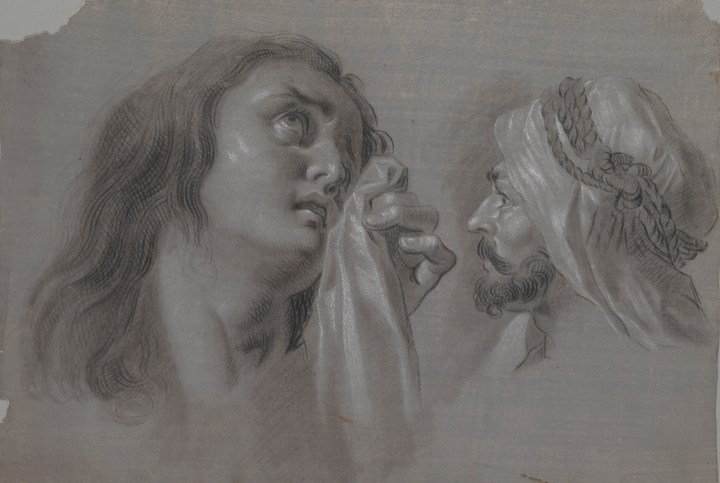
Zacarías González Velázquez, Mary Magdalene and Head of a Moor,
1793. Black chalk, wash and white chalk highlights on grey
tinted paper (Dallas: Meadows Museum, SMU)
◊ ◊ ◊ ◊ ◊
Press release (13 September 2013) from SMU’s Meadows Museum:
Southern Methodist University’s Meadows Museum announces the acquisition of six new paintings and drawings, including important works by influential Spanish artists Alonso Cano, Miguel Jacinto Meléndez, and Juan de Valdés Leal.
“We are thrilled to add six extraordinary works by artists who are so central to the history of Spanish art,” said Mark A. Roglán, the Linda P. and William A. Custard Director of the Meadows Museum and Centennial Chair, Meadows School of the Arts, SMU. “We are particularly excited to acquire such exquisite paintings by Cano and Meléndez as the first examples of works by these two prominent artists to enter the Meadows’ collection.”
The six new works are Alonso Cano’s painting Christ Child (c. 1636–38); pendant paintings by Miguel Jacinto Meléndez, Portraits of Philip V, King of Spain, and his first wife, María Luisa Gabriela of Savoy (c. 1701–03); a sanguine and black chalk drawing by Juan de Valdés Leal, Apparition of Christ to Saint Ignatius on his Way to Rome (c. 1662); a chalk drawing by Zacarías González Velázquez, Mary Magdalene and Head of a Moor (1793); and a pencil drawing by Antonio Carnicero, María Luisa of Parma, Queen of Spain (1789).
“As one of the most comprehensive museums of Spanish art in the world, the Meadows is constantly growing. These works will greatly enhance and help complete the Museum’s distinguished permanent collection,” said Linda Custard, chair of the Meadows Museum Advisory Board.
Earlier this year, the Meadows announced nine significant acquisitions, including five early 20th-century Spanish paintings from the Coleman Collection; a small oil painting by Joaquín Sorolla y Bastida (1904 or 1905); a miniature portrait attributed to Alonso Sánchez Coello (c. 1580), a terracotta sculpture by Juan Alonso Villabrille y Ron (c. 1715); and The Stewart Album, an anthology of cartes de visite, drawings and correspondence compiled by renowned American collector and expatriate William Hood Stewart during the latter half of the 19th century.
Together, these recent additions mark a milestone expansion of the Museum’s premier permanent collection of Spanish art that will be featured under the banner “Launching the Next 50 Years: Continuing the Legacy of Collecting at the Meadows Museum.” The Museum officially celebrates its 50th anniversary in April 2015.
“This has become a landmark year of acquisitions for the Meadows,” said Roglán. “Not only is it remarkable to be adding such extraordinary works by so many artists during a single year, but the breadth and variety of the acquisitions is tremendous — the new paintings, sculpture and drawings range from the 16th century to the 20th century.”
◊ ◊ ◊ ◊ ◊
Alonso Cano, Christ Child (c. 1636–38)

Alonso Cano, Christ Child (Ego dormio, et cor meum vigilat), c. 1628–29. Oil on panel (Dallas: Meadows Museum, SMU)
The exquisite oil painting Christ Child (Ego dormio, et cor meum vigilat) is the first work by the noted Sevillian artist Alonso Cano (1601–1667) to be acquired by the Meadows Museum, and the first time the painting has come to light in some 200 years. Dated to 1636–38, the work is thought to be the tabernacle door for the altarpiece of Saint Theresa of Ávila originally in the church of the former Carmelite monastery of San Alberto de Sicilia in Seville, Spain. The altarpiece was dismantled in the early 1800s, and the painting’s discovery provides new clues into the history of the altarpiece ensemble, of which only two other works are known to exist.
“This is a unique and special work by a very influential Spanish artist,” said Iraida Rodríguez-Negrón, the Meadows/Kress/Prado Curatorial Fellow who conducted extensive research on the history behind Cano’s Christ Child. “Most tabernacle doors are either lost or still located in churches, and the quality of this Cano painting is magnificent.”
Funding for the acquisition of Cano’s Christ Child was generously provided by Friends and Supporters of the Meadows Museum and the Meadows Museum Acquisition Fund.
Miguel Jacinto Meléndez, Portraits of Philip V, King of Spain, and his first wife, María Luisa Gabriela of
Savoy (c. 1701–03)

Miguel Jacinto Meléndez, Portrait of Philip V, King of Spain, c. 1701–03. Oil on copper (Dallas: Meadows Museum, SMU)
Miguel Jacinto Meléndez’s previously unknown oil paintings on copper, Portraits of Philip V, King of Spain, and his first wife, María Luisa Gabriela of Savoy, date to between 1701 and 1703, before he officially began his long career as Philip V’s court painter. The works are now recognized as the earliest known likenesses of the monarchs to be painted by the artist, and they are also the first examples of work by Meléndez (1679–1734) to enter the Meadows Collection.
Although Meléndez painted the two portraits when he was only in his early 20s, the works show the technical mastery and exquisite delicacy that made him one of the greatest Spanish portraitists of the early 18th century. The paintings were previously owned by Lord Mowbray and Stourton and his wife, Jane de Yarburgh-Bateson, and displayed at Heslington Hall in Yorkshire, England and Marcus House in Angus, Scotland.
Funding for this acquisition was generously provided by Richard and Gwen Irwin and the McDermott Foundation.
Juan de Valdés Leal, Apparition of Christ to Saint
Ignatius on his Way to Rome (c. 1662)

Miguel Jacinto Meléndez, Portrait of María Luisa Gabriela of Savoy, c. 1701–03. Oil on copper
(Dallas: Meadows Museum, SMU)
This extremely rare, unpublished drawing by Sevillian artist Juan de Valdés Leal (1622–1690) is a preparatory work for his Jesuit painting series depicting scenes from the life of St. Ignatius of Loyola. The Apparition of Christ to Saint Ignatius on his Way to Rome corresponds to the fourth in the series of at least fifteen canvases commissioned by the Jesuits of Seville for the Cloister of La Casa Profesa de la Compañía de Jesús, where the paintings were installed until the order’s expulsion in 1767.
The work is the first drawing by Juan de Valdés Leal to enter the collection of the Meadows Museum. It joins one Valdés Leal painting in the Museum, Joachim and the Angel (1655–60), as well as a print by the artist depicting the cathedral of Seville created for the canonization of Ferdinand III in 1671. There are only about 13 known drawings by Valdés Leal in the world, and until the Meadows acquired this work, only one drawing was in the United States.
Funding for this acquisition has been generously provided by Friends and Supporters of the Meadows Museum.
Zacarías González Velázquez, Mary Magdalene and
Head of a Moor (1793)

Juan Valdés Leal, Apparition of Christ to Saint Ignatius on the Road to Rome, 1660–64. Black and red chalk on paper (Dallas: Meadows Museum, SMU)
The chalk drawing Mary Magdalene and Head of a Moor by the Madrid painter Zacarías González Velázquez (1763–1834) contains two intricately executed sketches for two distinct González Velázquez paintings commissioned for the Cathedral of Jaén: Calvary and Martyrdom of St. Peter Pascual. In the drawings, González Velázquez depicts only each figure’s face, with concentration given to capturing the emotions of each character. Only minor changes can be found between the drawn figures and their painted counterpart, suggesting that this was one of the artist’s final sketches before beginning work on the canvas.
Mary Magdalene and Head of a Moor joins only one other González Velázquez work in the Museum’s collection, the painting Portrait of a Lady with a Fan (c. 1805–10). The addition of this new drawing into the Meadows collection is part of a planned expansion in holdings of original works on paper.
Funds for this acquisition were generously provided by a Challenge Grant by the Gill Family in honor of their daughter,
Anju Gill.
Antonio Carnicero, María Luisa of Parma, Queen of
Spain (1789)
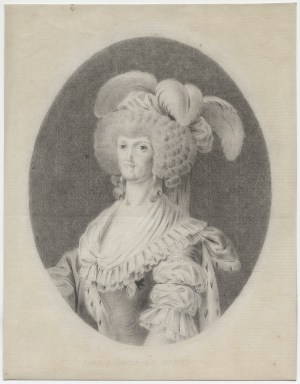
Antonio Carnicero, María Luisa de Parma, Queen of Spain, 1789. Chalk on paper (Dallas: Meadows Museum, SMU)
María Luisa of Parma, Queen of Spain is the first work to enter the Meadows Museum by Madrid painter Antonio Carnicero (1748–1814), who would become court painter to King Charles IV in 1796. This drawing stems from the period well before Carnicero’s royal appointment, which indicates the sovereigns’ awareness of Carnicero’s exceptional talent.
As a propagandistic campaign to disperse the new sovereigns’ images throughout the Spanish kingdom, portraits of Charles IV and María Luisa were commissioned from Carnicero and other painters. In Carnicero’s drawing, a bust-length portrait of María Luisa is set within an oval, and an elaborate headdress of feathers and ribbons sits on the queen’s wig of ringlets. The work is a preparatory drawing for the painted portraits of the queen, but its exquisite, polished lines resemble an engraving more than a sketch made in anticipation of a work on canvas.
Funds for this acquisition were provided by a Challenge Grant by the Gill family in honor of their daughter, Anju Gill.
High resolution images are available here»
Newly Renovated Tate Britain to Be Unveiled in November
Press release (13 August 2013) from Tate Britain . . .
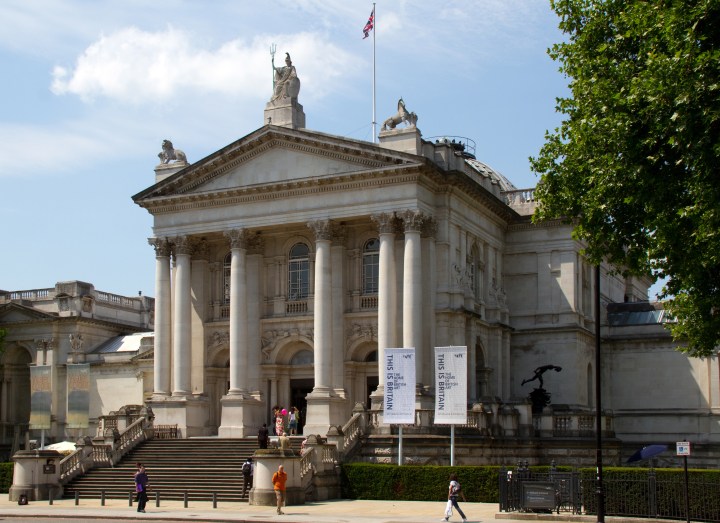
Tate Britain, London. Photo by Tony Hisgett
from Wikimedia Commons, 2011
◊ ◊ ◊ ◊ ◊
A new Tate Britain will be unveiled on 19 November 2013. The transformation of the oldest part of the Grade II* Millbank building by leading architects Caruso St John marks a significant moment for Tate Britain. The unveiling this autumn follows the opening in May 2013 of ten new galleries and the chronological presentation of the unparalleled collection of British art. The £45 million project includes:
• the reopening of the main entrance to Tate Britain on Millbank, combining new architectural features with the excavation of the most beautiful original architectural elements of the building. The changes will restore the historical logic of the building and include a striking new spiral staircase inside the entrance opening up access to new public spaces below;
• the reopening of The Whistler Restaurant, with its famous Rex Whistler mural, The Expedition in Pursuit of Rare Meats 1926-7, fully restored; and the new Djanogly Café, opposite the restaurant, which will open onto an exterior terrace. Both will serve food made with seasonal British ingredients;
• contemporary interpretations of tables and seating inspired by leading British Arts and Crafts designers active in the founding year of Tate Britain – 1897;
• new learning studios located throughout the gallery including a dedicated schools’ entrance and reception underneath the Millbank Entrance steps; and a new archive gallery, which will present temporary displays from Tate’s extensive archive of artists’ letters and ephemera. The first display by Paul Noble will be inspired by the history of the Tate Britain site as a penitentiary;
• the circular balcony of the Rotunda’s domed atrium, closed to visitors since the 1920s, which will become the elegant new café and bar for Tate Members; and a light-filled space overlooking the Thames, the original Grand Saloon, created for seminars and events; and
• site-specific work to celebrate the transformation of Tate Britain by three contemporary artists: Richard Wright will design handmade glass and leading for the eastern window in the Millbank foyer; Alan Johnston will create a ceiling drawing for the Djanogly café and Nicole Wermers will create a tea and coffee spoon for use in the café and for sale in the shop.
Director of Tate Britain, Penelope Curtis, said, “The new Tate Britain opens up the Millbank entrance to reassert and enhance the original grandeur and logic of the galleries. Adam Caruso and Peter St John have created new spaces out of old and artists have helped to articulate a new sense of the public realm.”
Thank the Getty for Open Content!
Press release (12 August 2013) from the Getty:

◊ ◊ ◊ ◊ ◊
The Getty announced that it is lifting restrictions on the use of images to which the Getty holds all the rights or are in the public domain. Getty President and CEO Jim Cuno made the announcement in a post on The Iris, the Getty’s blog.
“As of today, the Getty makes available, without charge, all available digital images to which the Getty holds all the rights or that are in the public domain to be used for any purpose,” wrote Cuno, citing the new program.
As a result, there are roughly 4,600 images from the J. Paul Getty Museum available in high resolution on the Getty’s website for use without restriction—representing 4,689 objects (some images show more than one object), including paintings, drawings, manuscripts, photographs, antiquities and sculpture and decorative arts. The Getty plans to add other images, until eventually all applicable Getty-owned or public domain images are available, without restrictions, online.
The Getty Research Institute is currently determining which images from its special collections can be made available under this program, and the Getty Conservation Institute is working to make available images from its projects worldwide.
“The Museum is delighted to make these images available as the first step in a Getty-wide move toward open content,” said J. Paul Getty Museum Director Timothy Potts. “The Getty’s collections are greatly in demand for publications, research and a variety of personal uses, and I am pleased that with this initiative they will be readily available on a global basis to anyone with Internet access.”
Previously, the Getty Museum made images available upon request, for a fee, and granted specific use permissions with terms and conditions. Now, while the Getty requests information about the intended use, it will not restrict use of available images, and no fees apply for any use of images made available for direct download on the website.
“The Getty was founded to promote ‘the diffusion of artistic and general knowledge’ of the visual arts, and this new program arises directly from that mission,” said Cuno. “In a world where, increasingly, the trend is toward freer access to more and more information and resources, it only makes sense to reduce barriers to the public to fully experience our collections. This is part of an ongoing effort to make the work of the Getty freely and universally available.”
Stockholm’s Nationalmuseum Acquires Plate Warmer by Rudolf Wittkopf
From the Nationalmuseum’s press release (as noted at the French Silver Blog , 14 August 2013) . . .
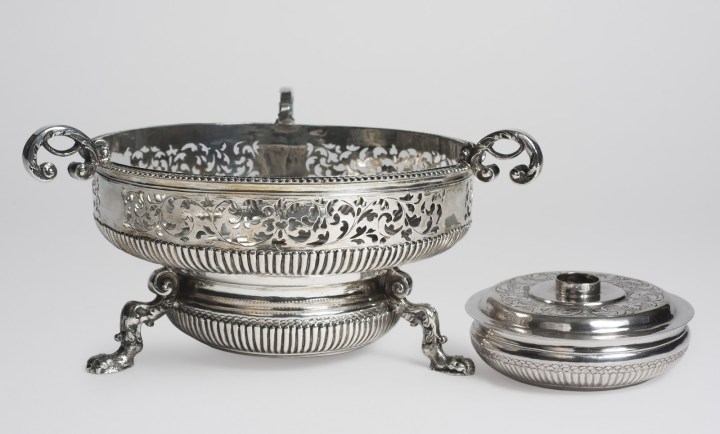
Plate Warmer by Rudolf Wittkopf, 1709. Diameter 20 cm, height 12 cm, weight 830 g. (Stockholm: Nationalmuseum, inventory number: NMK 102/2013) Photograph: Bodil Karlsson / Nationalmuseum)
◊ ◊ ◊ ◊ ◊
A plate warmer manufactured by Rudolf Wittkopf in Stockholm in 1709, believed to be a unique artifact, has been added to Nationalmuseum’s collection of early 18th-century Swedish silver. The piece, the only known surviving example in Sweden of a silver plate warmer, consists of a stand with three cast-metal feet and a removable burner with oil reservoir. The upper section is perforated to improve the airflow to the flame providing the heat, and at the top are three volute-shaped handles that hold the plate of food to be warmed.
The new, refined dining customs that appeared in Swedish upper-class circles in the early 18th century were modelled on French practices. Nationalmuseum’s extensive collection of hand drawings includes depictions from this period of two French réchaudes, or plate warmers, which were intended to serve as models for the modern silverware to be ordered by the Swedish court and aristocracy. The royal household accounts of Queen Hedvig Eleonora show that, in 1705, the fashion-conscious monarch purchased “a silver dish ring that can also be used as a heating dish” from Petter Henning, a Stockholm silversmith. However, little of the royal silverware from this period has survived, and there are no known examples in Sweden apart from the plate warmer now acquired by Nationalmuseum. This suggests that objects of this kind were a rarity even in their day and were probably manufactured only in very limited quantities.
The new acquisition is an important addition to Nationalmuseum’s collection of late baroque silver, illustrating how closely the Swedish court and aristocracy followed contemporary fashion, especially that of France.
Nationalmuseum’s acquisition of the Rudolf Wittkopf plate warmer has been made possible by a donation from the Barbro Osher Fund. Nationalmuseum has no budget of its own for new acquisitions, but relies on gifting and financial support from private funds and foundations to enhance its collections of fine art and craft.
August 23: International Slavery Remembrance Day
Next Friday at the National Maritime Museum in Greenwich:

Yinka Shonibare, Nelson’s Ship in a Bottle, 2010.
The work was displayed on the Fourth Plinth in
Trafalgar Square from 24 May 2010 to February 2012.
Photo from Wikimedia Commons, 2010
◊ ◊ ◊ ◊ ◊
The National Maritime Museum will host a day of remembrance on the anniversary of the first successful slave uprising in the western hemisphere – on 23 August in Haiti in 1791.
This year’s events will explore the Museum’s vast collections relating to the trade of enslaved people, as well as focusing on the many local connections to be found in the Greenwich World Heritage Site. Actor and broadcaster Burt Caesar will act as Master of Ceremonies for the day, which will also see art historian Dr Temi Odumosu discussing the controversial Cruickshank caricature The New Union Club; composer Dominique LeGendre giving a talk on black composers from the period of enslavement; and historian S. I. Martin revealing the hidden impact of the transatlantic slave trade during a walk around Greenwich. Unless otherwise stated, events are suitable for all ages.
Dr Temi Odumosu: The New Union Club | 12.30 | Age: 16+ | Art historian and creative educator Dr Temi Odumosu will explore the themes and attitudes of George Cruickshank’s The New Union Club, which is considered one of the most racist and complex prints of the 19th century.
Dominique LeGendre: Black Composers in the period of Enslavement | 14.00 | Critically acclaimed composer Dominique LeGendre discusses the impact and work of influential black composers during the period of enslavement, including the celebrated Ignatius Sancho.
Life of Ignatius Sancho interactive tour | Age: 10+. Maximum of 30 places on each tour | 12.00, 15.00 | Storyteller Rich Sylvester will lead interactive family learning tours around Greenwich Park, exploring Ignatius Sancho’s early life. Starting at Yinka Shonibare MBE’s eminent Nelson’s Ship in a Bottle, the tour concludes at The Ranger’s House, and with a ceremony investigating the importance of names. Young people are invited to leave their names in remembrance.
Walk to St. Alfege Church | 14.00 | Historian S. I. Martin will lead a walking tour to St. Alfege Church, Greenwich, looking into the impact that the slave trade had on Greenwich families. The walk begins at the Group Entrance of the Museum.
Youth Advisory Group textile workshop | 11.30, 14.00 | Join the Museum’s Youth Advisory Group in creating prints using adinkra symbols. Originally from the Republics of Ghana and Côte d’Ivoire, the symbols are used as both decoration and to represent objects, capturing evocative messages that carry traditional wisdom, aspects of life or the environment.
Songs of Freedom: workshop | Age: All ages and abilities welcome | 13.00, 15.30 | Singing group Ethnovox will lead a workshop exploring how songs were used as a powerful medium of resistance, and for messages of solidarity, hope and freedom.
Alternative Gallery Tour: mobile learning session | 12.30 | Take a tour of The Atlantic: Slavery, Trade, Empire gallery, using a tablet to learn about the movement of people, goods and ideas across and around the Atlantic Ocean, from the 17th century to the 19th century.
What’s in a Name? workshop | 11.00, 13.30 | Uncover the journeys that have brought people’s names to Britain, and discuss what your name means to you.
Tracing History: archive session | Age: 10+ | 11.30 | Join historian S. I. Martin in the Museum’s Compass Lounge to investigate transatlantic slavery through rare and revealing manuscripts; and unlock hidden histories of enslaved people and their struggle for freedom.
Closing ceremony | Age: 14+ | 16.15 | Broadcaster and actor Burt Caesar will lead the closing ceremony, which will take place by the River Thames at the Water Gates at the Old Royal Naval College. Participants are invited to scatter rose petals into the river as an act of silent commemoration.










leave a comment