Maritime Museum’s Appeal to Acquire Two Paintings by Stubbs
Press release (9 August 2013) from the National Maritime Museum in Greenwich . . .
Paintings completed after Cook’s first voyage to Australia are the earliest depictions of a kangaroo and a dingo in Western art.

George Stubbs, Portrait of the Kongouro (Kangaroo)
from New Holland, 1772 (private collection)
◊ ◊ ◊ ◊ ◊
The National Maritime Museum, London has announced a £1.5M appeal to acquire two oil paintings, Portrait of the Kongouro from New Holland and Portrait of a Large Dog, by the celebrated British artist George Stubbs (1724–1806).
The Museum has already secured £3.2M from the Heritage Lottery Fund (HLF) and £200,000 from the Art Fund which will go towards the acquisition of the works as well as much-needed conservation work and a public programme which will bring these remarkable works to the widest audience possible. Due to their significant place within British history and artistic culture, the paintings have been put under an export bar while the appeal is mounted to save them for the nation. Should the appeal be successful they will initially go on display in the Queen’s House, Greenwich in 2014.
The paintings (both of which are oil on panel measuring 24¼ by 28½ inches) were commissioned by the gentleman-scientist Sir Joseph Banks following his participation on Captain James Cook’s first Pacific voyage of ‘discovery’ (1768–71) aboard HMS Endeavour. Stubbs was the pre-eminent animal painter of his day and is now widely appreciated as an 18th-century European master. His paintings of the kangaroo and dingo are the most significant artistic productions directly related to Cook’s seminal voyage and the earliest painted representations of these iconic animals in Western art. They were first exhibited together in London in 1773 and have remained in the UK ever since.
Exploration is a particularly rich area of collection for the National Maritime Museum, which already holds many objects relating to Cook’s voyages, including works by William Hodges (1744–97), who was appointed by the Admiralty to record the places discovered on Cook’s second Pacific voyage (1772–75); and the highly-regarded portrait of Cook by Nathaniel Dance (1775-76), which was also commissioned by Banks and was displayed along with the paintings of the kangaroo and dingo in his house in Soho Square, London.

George Stubbs, Portrait of a Large Dog (Dingo)
from New Holland, 1772 (private collection)
◊ ◊ ◊ ◊ ◊
Lord Sterling, Chairman of Royal Museums Greenwich, said ‘We are delighted that the Heritage Lottery Fund and the Art Fund have formally backed our bid to purchase the works with very generous grants totalling two-thirds of the required funds. This is a fabulous kick-start to our campaign. Royal Museums Greenwich has a once in a lifetime opportunity to complete the acquisition of these two remarkable paintings which will enhance immeasurably the Museum’s role in engaging audiences worldwide with the story of exploration.’
Carole Souter, Chief Executive of HLF, said: “No one captures the movement and magic of animals better than George Stubbs. These two paintings form an extraordinarily important part of the James Cook voyage of ‘discovery’ story. The Heritage Lottery Fund believes they are an integral part of our seafaring nation’s multi-layered heritage, and we hope that our grant of just over £3 million, along with contributions from other funding partners, will enable them to be acquired by the National Maritime Museum. I’m particularly pleased that plans are already taking shape for the less fragile of the pair – Kongouro – to go on tour to a number of other venues with connections to Captain Cook, so it can be seen and enjoyed by as many people as possible.”
Stephen Deuchar, Director of the Art Fund, said “I cannot think of a better home for these two outstandingly important works by Stubbs than the National Maritime Museum, whose collection covers the important interrelationship between art, science and exploration. We are delighted to be supporting both the acquisition and education plans for these paintings, helping audiences to engage with a key episode in the history of exploration. I urge everyone to support the museum in the final leg of their appeal.”
The Museum’s bid to acquire the paintings is supported by the Royal Society and by Sir David Attenborough, who said “I had the privilege of working with the National Maritime Museum when it staged the exhibition of the paintings made on Cook’s Second Voyage and I greatly admired the way it cared for paintings and other artefacts. Its Cook collections, are, of course, of world importance and I have no doubt that these two Stubbs paintings should be placed among them.”
Culture Minister Ed Vaizey said: “Temporary export bars have been instrumental in ensuring many of our national treasures, like these two striking paintings by Stubbs, stay here in the UK where they can be enjoyed by all. I’m delighted that the Maritime Museum, the Heritage Lottery Fund and the Art Fund have joined forces in a campaign to save them for the nation and hope that the necessary funds can be raised to secure them for the Museum.”
 The public can donate to the appeal via mobile phone by texting STUB35 to 70070, online via JustGiving or in person at the Museum. Visitors to the Museum can also see the paintings, which are on public display in the Sammy Ofer Wing throughout the fundraising campaign.
◊ ◊ ◊ ◊ ◊
N.B. — These terrific images are taken from a Flickr set of art works subject to export bars; the set is presented by the UK’s Department for Culture, Media and Sport. Even higher resolution images are, in fact, available for download. The page offers the quickest means I’m aware of for seeing what pieces are currently subject to possible export bans. -CH
◊ ◊ ◊ ◊ ◊
Update (added 20 August 2013) — As reported at Art Daily: “The National Gallery of Australia today strongly reaffirmed its commitment to acquiring two iconic paintings by George Stubbs for Australia’s national art collection.…”
Exhibition | Picturing America
In addition to the exhibition, the Dixon has devised a truly-inspired plan to lure visitors to the museums on Fridays: food trucks in the parking lot!
Picturing America: Signature Works from the Westmoreland Museum of American Art
Dixon Gallery and Gardens, Memphis, 4 August — 6 October 2013
Vero Beach Museum of Art, Vero Beach, Florida, 15 February — 25 May 2014
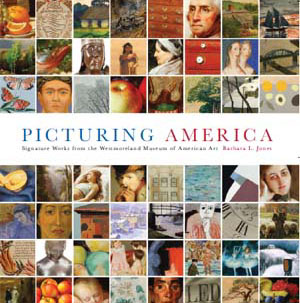 Over the past fifty years, the Westmoreland Museum of American Art, in Greensburg, Pennsylvania, has assembled a collection of works by significant American artists, concentrating on the mid-18th through the mid-20th centuries. Featuring works by John Singleton Copley, Charles Wilson Peale, and Mary Cassatt, Picturing America showcases the signature works from the museum’s collections, from preeminent American artists of the Hudson River School to modernists such as Milton Avery and Doris Lee.
Barbara Jones, Picturing America: Signature Works from the Westmoreland Museum of American Art (Greensburg, PA: Westmoreland Museum of American Art, 2010), 256 pages, ISBN: 978-0931241376, $45.
Westmoreland Museum of Art Embarks on Expansion
Press release (13 July 2013) from The Westmoreland:
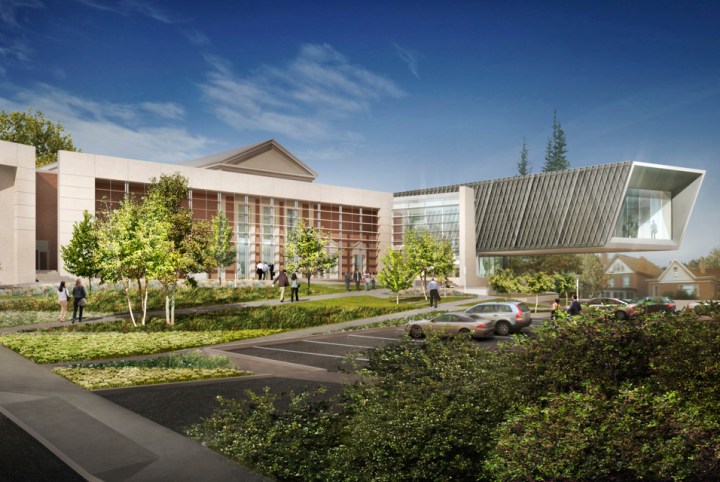 ◊ ◊ ◊ ◊ ◊
The Westmoreland Museum of American Art broke ground Friday [12 July 2013] to celebrate and begin the expansion and renovation of The Future Westmoreland. Ennead Architects of New York City and LaQuatra Bonci Associates: Landscape Architecture of Pittsburgh are working with the museum to create a new experience for visitors including a brand new wing, renovation of the existing building to have LEED silver certification, and a complete re-design of the grounds.
Pennsylvania’s First Lady Susan Corbett, Chairwoman of PA Council on the Arts, was a guest speaker at Friday’s ceremony, “The Westmoreland Museum of American Art has served as a cultural asset to downtown Greensburg and Southwestern Pennsylvania since its establishment in 1959, ” said Corbett, “The renovation and expansion of the museum will provide both visitors and residents with new ways of experiencing our American heritage.” (more…)
82nd & Fifth | Mascarade à la Grecque
The latest installment of The Met’s 82nd & Fifth:
◊ ◊ ◊ ◊ ◊
In “Fantasy” (episode #58), Femke Speelberg addresses the Mascarade à la Grecque; Suite des Vases; and [Cheminées], a series of eight etchings designed by Ennemond Alexandre Petitot, and etched and published by Benigno Bossi (1771, 1764).
Exhibition | Paintings by Hubert Robert from the Musée de Valence
Now on view at the Petit Palais:
Tableaux d’Hubert Robert du Musée de Valence
Le Petit Palais, Paris, May — October 2013
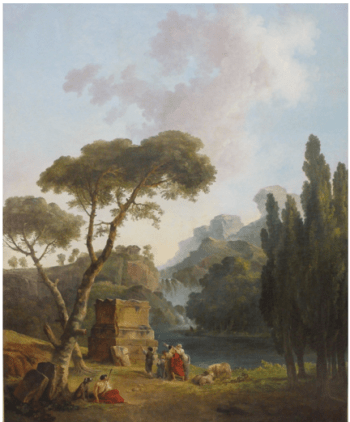
Hubert Robert, Paysage de cascade avec les bergers d’Arcadie
© Musée de Valence, photo Eric Caillet
En avant-première de la réouverture en décembre prochain du musée de Valence (Drôme), quatre des plus beaux tableaux d’Hubert Robert (1733–1808) sont présentés au Petit Palais, aux côtés des dix tableaux de l’artiste des collections permanentes.
Peintre par excellence des ruines de la Rome antique, Hubert Robert séjourna onze ans dans la ville des papes, à partir de 1754. Il en cultiva le souvenir jusqu’à la fin de sa carrière bien qu’il ait été également un chroniqueur inlassable du Paris du XVIIIe siècle. Hubert Robert a enchanté ses contemporains par sa verve, sa poésie et son inventivité – qualités qui ne pouvaient qu’enthousiasmer un critique comme Diderot. Le succès de ses paysages lui valut même la commande de plusieurs jardins qu’il peupla de « fabriques » et de grottes à la manière des tableaux qui avaient fait sa célébrité.
Connu pour sa collection incomparable de dessins d’Hubert Robert offerte par l’amateur Julien-Victor Veyrenc en 1836, le musée de Valence s’est attaché depuis plus d’une vingtaine d’années à étoffer ce fonds par l’acquisition de toiles significatives de l’artiste. L’ensemble formera un des centres de gravité du musée de Valence dont la rénovation, confiée à l’atelier d’architecture Jean-Paul Philippon, est en voie d’achèvement. Le prêt exceptionnel de quelques-uns de ses fleurons à Paris est l’occasion de les faire dialoguer avec les toiles conservées au Petit Palais. Ainsi la vue de la basilique Saint-Pierre du musée de Valence, cadrée de façon audacieuse à travers une baie, rejoint la toile vivement esquissée du Petit Palais montrant un Sculpteur sur un échafaudage dans la nef de Saint-Pierre. Le vaste Paysage de cascade avec les Bergers d’Arcadie, de Valence, est présenté dans la rotonde avec deux grandes toiles tirées des réserves du Petit Palais provenant du décor de l’hôtel Beaumarchais exécutés l’année suivante. A cette occasion, l’ensemble des salles du XVIIIe siècle du musée ont d’ailleurs été réaccrochées et des oeuvres d’autres artistes remises en valeur.
En attendant de parcourir les nouveaux espaces de l’ancien évêché de Valence, ce prêt de quelques mois est aussi une invitation à redécouvrir les galeries du XVIIIe siècle du Petit Palais – musée des Beaux-Arts de la Ville de Paris qui, rappelons-le, sont ouvertes gratuitement au public.
Le Petit Palais est heureux de soutenir la rénovation et l’extension du Musée de Valence. Pour plus d’information, téléchargez le communiqué de presse.
Judge Rules Benjamin West Altarpiece Can Go to Boston
From The Art Newspaper (11 July 2013) . . .
Anglican Court Says Benjamin West Altarpiece Can Go to Boston
City of London church to sell the masterpiece to fund repairs
By Martin Bailey
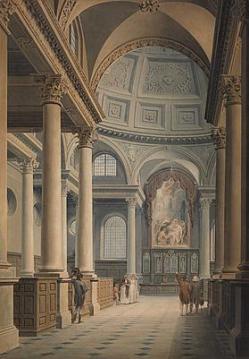
Thomas Malton (1748-1804), St Stephen Walbrook, London, watercolour over pencil, heightened with scratching out, 26 x 18 inches (646 x 447 mm)
Lowell Libson LTD (London).
West’s Devout Men Taking Away the Body of St Stephen is visible at the altar.
A Church of England court has ruled that Benjamin West’s altarpiece, Devout Men Taking Away the Body of St Stephen, 1776, which was made for one of the most important churches in the City of London can be sold for display in the US. The $2.85m painting is being bought by an anonymous foundation, which is due to lend it to the Museum of Fine Arts, Boston (The Art Newspaper, April 2013, pp6–7 and June 2013, p3). West was born in America, but worked in England.
In his judgment, delivered on 10 July, Judge Nigel Seed, chancellor of the consistory court of the Diocese of London, ruled that St Stephen Walbrook should be allowed to sell the masterpiece. The painting had been removed from the church in around 1987, in what he described as “perceived illegal actions”, and has since been kept in storage. . .
The full article is available here»
◊ ◊ ◊ ◊ ◊
As a starting place in the scholarly literature:
Jerry D. Meyer, “Benjamin West’s St Stephen Altar-Piece: A Study
in Late Eighteenth-Century Protestant Church Patronage and English
History Painting,” The Burlington Magazine 118 (September 1976): 634-41.
New Acquisition | Portrait by Adolf Ulrik Wertmüller
Press release (July 2013) from Stockholm’s Nationalmuseum:
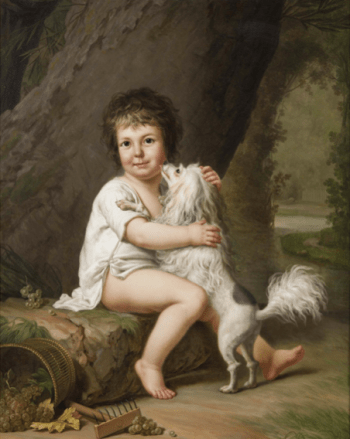
Adolf Ulrik Wertmüller, Henri Bertholet-Campan at Age Two, exhibited at the Salon of 1787 (Stockholm: Nationalmuseum, NM 7133)
Nationalmuseum’s collection of Swedish-French paintings from the 18th century now includes a portrait of the two-year-old Henri Bertholet-Campan (1784–1821), painted by Adolf Ulrik Wertmüller. The boy was the son of Marie Antoinette’s First Lady of the Bedchamber Henriette Genet-Campan. The portrait depicts him with his dog Aline in the English landscape garden at the family’s summer house in Croissy outside Paris. The painting was exhibited at the Salon of 1787, but under the rather anonymous title of A Child Playing with a Dog.
Adolf Ulrik Wertmüller (1751–1811) trained under his second cousin Alexander Roslin in Paris and studied at the French Academy in Rome. When Wertmüller returned to the French capital in spring 1781, he found it difficult to obtain work as a portraitist and instead earned his keep as a copyist at Roslin’s studio. Here he was discovered by the Swedish Ambassador Gustaf Filip Creutz, who made several important commissions. This in turn resulted in Gustav III convincing France’s Queen Marie Antoinette, during his stay in Paris in the summer of 1784, to let Wertmüller paint her portrait as a gift to the Swedish King. The portrait is currently held in the collections of Nationalmuseum.
King Gustav III had intended this to be Wertmüller’s ticket to a successful career in Paris, but jealousies abounded. When the portrait of Marie Antoinette was exhibited in August 1785, it was attacked by the critics. The Queen was also unimpressed. The artist fell into a deep depression, but recovered enough to make the necessary changes before the portrait was dispatched to Sweden the following year. It was Wertmüller’s friend Henriette Genet-Campan who came to his aid. The fact that Wertmüller even got paid was largely down to Mme Campan, since she managed the Queen’s purse and was intimately involved in the royal finances. For security reasons a mutual friend, Gabriel Lindblom, acted as a go-between in contact between the two. Lindblom had been governor to Mme Campan’s younger brother Edmond Genet and served as an interpreter at the French Ministry of Foreign Affairs in Versailles. This explains why Wertmüller was so well informed and why he came to paint almost a dozen portraits of various members of the Genet-Campan family.
As a show of gratitude to his friend Mme Campan, Wertmüller painted a portrait of her two-year-old son Henri in autumn 1786. He had already immortalised the child as a new-born baby and would continue to paint other relatives of Mme Campan. These include the portrait of her sister Adélaïde Auguié dressed as a milkmaid in the royal dairy at Petit Trianon-Le Hameau, painted in 1787. This painting has been part of the museum’s collection since 1951 as a gift from the Friends of Nationalmuseum. A study for the portrait of the French Crown Prince Louis has also since been purchased. Now this latest acquisition adds another piece to the fascinating puzzle of how Wertmüller came to paint his portrait of Queen Marie Antoinette.
Tim Knox as New Director of the Fitzwilliam Museum
Tim Knox stepped into his new role at the Fitzwilliam Museum earlier this spring. Press release (7 December 2012) from the Soane’s Museum:
 After nearly eight highly successful years as Director of Sir John Soane’s Museum, Tim Knox has been appointed to succeed Timothy Potts as Director and Marlay Curator of the Fitzwilliam Museum in Cambridge.
During his time at the Soane Museum Tim Knox masterminded the restoration of the two houses, Nos. 12 and 14 Lincoln’s Inn Fields, which flank Soane’s original Museum at No. 13. The ambitious OUTS (Opening up the Soane) project, which has involved raising over £7 million, is now fully planned and financed, and ready to move into its second phase, the first having provided a new exhibition gallery, new conservation studios and a new museum shop. At the same time many of Sir John Soane’s original arrangements have been meticulously restored, notably his Picture Room The reinstatement of Soane’s lost private apartments, including his Model Room, is planned and fully funded for 2013.
There has also been notable progress in cataloguing the Museum’s collections and making them available on the Soane’s website; in education; in outreach and access, including disabled access; and in building up support for the Museum among its many generous friends, old and new, here and in the United States.
The Trustees of Sir John Soane’s Museum are, naturally, saddened at the prospect of Tim’s departure, but will set about the task of finding a worthy replacement, confident that the Museum is in very good heart, with plans for the future fully in place and all its systems in excellent order. Simon Swynfen Jervis, Chairman of the Trustees, commented: “Working with Tim has been an exciting and rewarding experience, and we shall greatly miss him, while wishing him the very best in his new role at the Fitzwilliam Museum.”
Knox studied History of Art at the Courtauld Institute of Art. He was appointed Assistant Curator at the Royal Institute of British Architects Drawings Collection in 1989. In 1995 he moved to the National Trust as its Architectural Historian, becoming Head Curator in 2002. He was much involved with the restoration of the gardens at Stowe in Buckinghamshire, and championed the acquisition of the Workhouse in Southwell, Nottinghamshire, Tyntesfield in Somerset, and the restoration of the Darnley Mausoleum in Cobham Park, Kent.
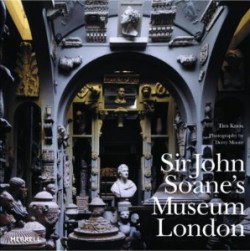 He was appointed Director of Sir John Soane’s Museum in London in 2005, and has since striven to restore Sir John Soane’s glittering architectural treasury to its appearance in 1837, just as its founder wished. In 2009 the next door house, No 14 Lincoln’s Inn Fields, was restored to provide Education facilities, a Research Library and offices for the Museum. In July 2012, the first phase of the £7 million Opening up the Soane project was unveiled, with a new Gallery for temporary exhibitions, a Shop, Conservation Studios and a lift. The next phase of the project, the restoration of Soane’s private apartments, began in April 2013, and the Opening up the Soane project will be fully complete in 2015.
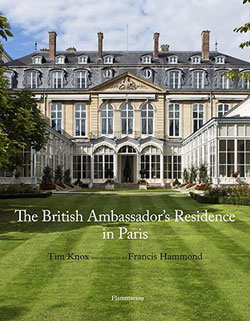 Knox is Historic Buildings Adviser to the Foreign and Commonwealth Office – advising on the presentation of historic ambassadorial residences abroad – and is Chairman of the Government’s Acceptance in Lieu Committee, He sits on the Royal Mint Advisory Committee on the Design of Coins, Medals, Seals and Decorations. He is a Trustee of the Pilgrim Trust and is Patron of the Mausolea and Monuments Trust, which he helped found and Chaired 2000-2005. He is a Fellow of the Society of Antiquaries of London and a Member of the Society of Dilettanti. His Publications include Sir John Soane’s Museum London (Merrell, 2009) and The British Ambassador’s Residence in Paris (Flammarion, 2011).
The Fitzwilliam press release is available here»
Imagining the Shantytown Dwellings at Fort Mifflin
I’m sorry I learned of this Philadelphia project only a few days ago (after the close of the festival, which looks to have been positively exhilarating). Still, it seems worth noting, a useful counterweight perhaps to all the magnificence within the period’s historiography. One of the artists, Ben Neiditz, is, incidentally, on staff at the Penn Museum. -CH
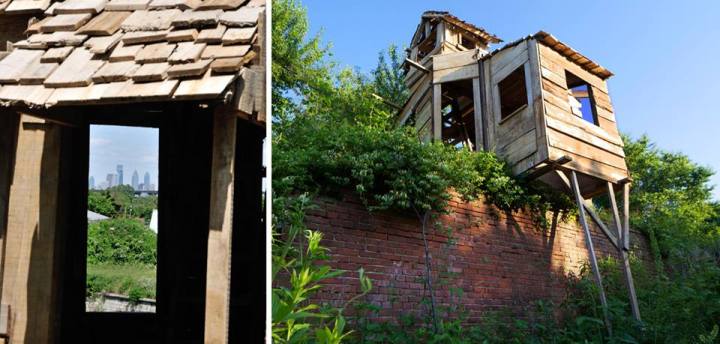
Ben Neiditz and Zach Webber, Ruins at High Battery,
Fort Mifflin, Philadelphia, 2013. Photo by Peter Woodall
◊ ◊ ◊ ◊ ◊
In connection with Philadelphia’s Hidden City Festival (23 May — 30 June 2013), Ben Neiditz and Zach Webber have constructed improvised dwellings that recall Revolutionary War-era shantytowns along the Delaware River at Fort Mifflin, a stunning remnant of the Revolutionary War. Playing with notions of permanence and impermanence, the artists’ settlement recalls the shantytowns that have dotted the Delaware River wetlands since the 18th century–while also imagining the DIY settlements of the future. . .
Read more at the festival website; additional photos can be found at Street Department, Conrad Benner’s blog dedicated to art on the streets of Philadelphia.
◊ ◊ ◊ ◊ ◊
From the Fort Mifflin website:
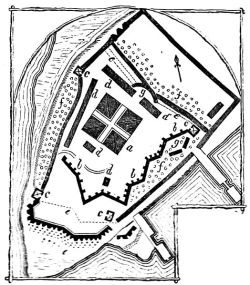
Fort Mifflin, 1777, from Benson John Lossing’s Field Book of the Revolution, 2 volumes (New York: Harper Brothers, 1853), vol. 2, p. 90. Image from Wikimedia Commons
[At Fort Mifflin, in the fall of 1777,] on the frozen, marshy ground within the walls of a stone and wood fort, the American Revolution produced a shining moment. Cold, ill and starving, the young garrison of (now) 400 men at Fort Mifflin refused to give up. The valiant efforts of the men at Fort Mifflin held the mighty British Navy at bay providing Washington and his troops time to arrive safely at Valley Forge where they shaped a strong and confident army. This battle escalated into the greatest bombardment of the American Revolution and one that many say changed the course of American history. . .
English Heritage to Become a Charitable Trust

From English Heritage (26 June 2013) . . .
The Government has announced that it will work with English Heritage to consult on establishing a charity to care for the historic properties in the National Heritage Collection on a self-financing basis, supported by Government investment of £80 million. English Heritage will be awarded this one-off lump sum to invest in the National Heritage Collection of 420 historic sites, monuments and collections in its care. This will support its plan to transfer management of the Collection to a charity, licensed by English Heritage’s governing body, The Commission. This investment in historic properties across the entire country will create jobs and boost local economies.
The National Heritage Collection, which includes Stonehenge, Kenwood, Audley End, Dover Castle and Charles Darwin’s home Down House in Kent, will remain in public ownership. However, the new charity will have more freedom to generate greater commercial and philanthropic income to safeguard and present to the public what is arguably England’s most vulnerable and important collection of cultural treasures.
Under current plans, the new charity will be set up by March 2015. It will retain the name English Heritage and in due course, will be completely self-financing and no longer need tax-payer support. (more…)










2 comments