Ghislain d’Humières to Direct The Speed Art Museum
Press release (25 June 2013) from The Speed Art Museum in Louisville:
 The Board of Trustees of The Speed Art Museum announced today that Ghislain d’Humières has been appointed as the new Director of the Museum. d’Humières, who is currently serving as the Director of the Fred Jones Jr. Museum of Art at the University of Oklahoma, succeeds Charles Venable, who served as Director from 2007 to 2012. d’Humières will assume his role at the Speed on September 3, 2013.
A native of France, Ghislain d’Humieres studied at the Sorbonne in Paris, where he received his DEA in History and License of Art History. He became a specialist in 18th-century furniture for Sotheby’s London, and later transferred to Sotheby’s in New York. To further his education, he studied at the Gemological Institute of America, and became the Director of the jewelry department at Christie’s of Los Angeles, overseeing the West Coast and South America. During his employment, he gained extensive business knowledge, expanded his expertise, and traveled extensively around the World. In 2001, he transferred to Christie’s in Geneva and was in charge of international clients from Europe and South America.
A compassionate leader, d’Humières took an eighteen-month sabbatical in Guatemala, during which time he worked with street children involved in drugs and prostitution. After his sabbatical, he founded the Alix Donation Fund (ADF) for underprivileged children in Guatemala.
Shortly thereafter, he was hired by the Fine Arts Museum of San Francisco as Assistant Director in charge of the opening of the new de Young Museum, located in San Francisco’s Golden Gate Park.
In 2007, Ghislain joined the University of Oklahoma as the Bill and Wylodean Saxon Director of the Fred Jones Jr. Museum of Art. During his six-year tenure at the Fred Jones Jr. Museum of Art, d’Humières has doubled attendance, led a successful $15 million capital campaign, and spearheaded the development and management of the Museum’s new 20,000 square-foot Stuart wing, which doubled the Museum’s exhibition space.
D’Humièresalso created a privately funded program to implement new educational and outreach initiatives which included underprivileged visitors. He supervised more than 40 exhibitions and oversaw the production of numerous exhibition catalogs and museum publications while also expanding the Museum’s educational programs and collaborations with other museums, communities and national and international organizations.
Ian Wardropper Honored as a Chevalier of the Order of Arts and Letters
Press release (11 June 2013) from The Frick Collection:
 On Monday, June 10, Ian Wardropper, Director of The Frick Collection, received the insignia of Chevalier of the Order of Arts and Letters in a private ceremony held during a reception at the museum. Antonin Baudry, Cultural Counselor of the French Embassy, officiated at the ceremony. The Ordre des Arts et des Lettres (Order of Arts and Letters) was created in 1957 to recognize eminent artists and writers, as well as individuals who have contributed significantly to furthering the arts in France and throughout the world. The Order is given out twice annually to only a few hundred people worldwide. Among the Americans who have received this award in the past are Paul Auster, Ornette Coleman, Agnes Gund, Marilyn Horne, Judith Jamison, Jim Jarmusch, Richard Meier, Robert Paxton, Robert Redford, Meryl Streep, and Uma Thurman.
A specialist in European sculpture, decorative arts, and twentieth-century design and decorative arts, Ian Wardropper held key positions first at the Art Institute of Chicago and then at The Metropolitan Museum of Art before being named Director of The Frick Collection in 2011. At The Frick Collection, Wardropper co-curated last year’s Gold, Jasper, and Carnelian: Johann Cristian Neuber at the Saxon Court, the first exhibition on the work of a remarkable eighteenth-century court goldsmith. On view now at the Frick is an exhibition featuring drawing and prints from French masters spanning the entire second half of the nineteenth century: The Impressionist Line from Degas to Toulouse-Lautrec: Drawings and Prints from the Clark. These works represent the diverse interests of Realist, Impressionist, and Post-Impressionist artists in a rapidly changing world. (more…)
Christopher Brown Announces Retirement Plans
Press release (June 2013) from the Ashmolean:
 The Ashmolean has announced that Professor Brown will retire from his post as Director of the Ashmolean on 30 September 2014 after serving in that position for sixteen years. Following a sabbatical year, he will take up a position as a Research Professor in the University for three years until 2018. His work will be on Van Dyck and Rembrandt with the latter to be the focus of an exhibition in the Ashmolean in 2016. He took up the post of Director of the Ashmolean Museum in 1998 and the years of his Directorship have transformed the museum. Visitor figures have risen from 100,000 to over a million during these years. The museum will launch a campaign to create The Professor Christopher Brown Fund which will be used to establish curatorial fellowships at the Ashmolean. The process of finding Professor Brown’s successor will now begin so that his successor will be available to take up the position when he steps down.
Bernard Taylor, Chairman of the Visitors of the Ashmolean has said: “Christopher’s tenure as Director has involved huge positive development for the Ashmolean and he has overseen change on a grand scale with the implementation of architect the late Rick Mather’s wonderful design to transform the museum’s building. Visitor numbers have increased four fold since the opening of the remodelled building, the museum’s scholarly programme has been reemphasised and an ambitious temporary exhibition programme launched. Christopher has been tireless in successfully seeking financial support for the Ashmolean on an international scale. I am delighted that following his retirement, he will remain in Oxford doing his research.” (more…)
New Book | Delftware in the Fitzwilliam Museum
From Philip Wilson’s current catalogue:
Michael Archer, Delftware in the Fitzwilliam Museum (London: Philip Wilson Publishers, 2012), 464 pages, ISBN: 978-1781300022, £55 / $95.
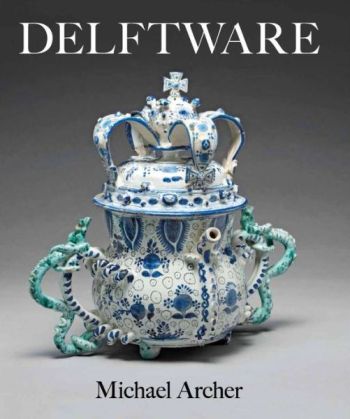 This complete catalogue of the English and Irish delftware in the Fitzwilliam Museum, Cambridge, reveals much that is beautiful and unusual. The greater part of the collection was bequeathed by Dr J.W.L. Glaisher in 1928, and much of it is little known. A detailed publication has long been overdue, and 588 items are illustrated here in colour, many with multiple views. The strength of Dr Glaisher’s collection is the English earthenware of the seventeenth and eighteenth centuries, particularly delftware: no better assemblage has ever been made by a single collector. He amassed objects with great academic rigour over a period of more than thirty years, concentrating particularly on dated pieces while always exercising a discriminating and aesthetical eye. Michael Archer’s catalogue provides details of date and place of manufacture, size, body, glaze, decoration and provenance with a full discussion where appropriate.
Julia Poole has contributed a fascinating chapter with much new material on Dr Glaisher’s life and the extraordinary breadth of his collecting interests. There is also a general introduction to delftware, including a description of the manufacturing process; further sections give indexes and exhaustive information on all the works. This book is an essential addition to the library of all scholars, collectors,auction rooms and dealers in the field and invaluable to those members of the public with an interest in the history of English pottery generally and delftware in particular.
Michael Archer, O.B.E, M.A., F.S.A. is a former Keeper of the Ceramics Department of the Victoria and Albert Museum where he becamethe acknowledged expert on English delftware. He has written numerous articles and books on ceramics, culminating in Delftware: The Tin-Glazed Earthenware of the British Isles, a catalogue of the collections inthe Victoria and Albert Museum, published in 1997.
Colonial Williamsburg and MESDA Form Collaboration
As noted at Art Daily (4 June 2013) . . .
The two leading decorative arts institutions in the South are embarking on a new level of collaboration between their organizations. The Art Museums of Colonial Williamsburg [in Virginia] and the Museum of Early Southern Decorative Arts (MESDA) at Old Salem Museums & Gardens [in North Carolina] have entered a five-year agreement between the museums for reciprocal extended loans. The museums have already collaborated on the recently opened exhibition, Painters and Paintings in the Early American South at the Arts Museums of Colonial Williamsburg. With nine major paintings MESDA is the largest single lender to the exhibition, while select objects from the Art Museums of Colonial Williamsburg are already on display at MESDA.
In total, 40 objects from MESDA are on loan to the Art Museums of Colonial Williamsburg and, conversely, 30 objects from the Art Museums of Colonial Williamsburg to MESDA. These objects range from clocks and high chests to paintings and silver coffee pots. The collaboration is part of a five-year agreement between the museums for reciprocal extended loans. Many of the MESDA objects on loan to Colonial Williamsburg will be featured in a new, long-term exhibition opening at the DeWitt Wallace Decorative Arts Museum, one of the Art Museums of Colonial Williamsburg, in January 2014. A Rich and Varied Culture: The Material World of the Early South will feature furniture, silver, ceramics, textiles and costumes, tools, machines, architectural elements and other materials made in or imported to the South before 1840. (more…)
At Auction | Liberty or Death: Relics from the American Revolution
While I generally refrain from editorializing, it seems to me that there’s something dreadful linguistically and maybe conceptually about the phrase “selling exhibition.” On the other hand, the objects included in the sale and the exhibition look interesting enough, and this is the first I’ve heard of the Museum of the American Revolution (further proof of just how much slips past me!). Robert A. M. Stern’s design plans were unveiled last June, and the museum plans to open in 2016. -CH
◊ ◊ ◊ ◊ ◊
From a Sotheby’s press release (6 June 2013) . . .
Liberty or Death: Relics from the American Revolution
Sotheby’s, New York, 1–28 June 2013

Robert A. M. Stern, Architectural Rendering for the Museum of the American Revolution in Philadelphia
Sotheby’s presents Liberty or Death: Relics from the American Revolution, an exciting cross-platform initiative in collaboration with Philadelphia’s Museum of the American Revolution. The selling exhibition features items for sale by Sotheby’s as well as objects on loan from the museum’s extraordinary collection, creating a fresh, multi-dimensional dialogue on America’s struggle for independence. The exhibition will be open to the public through 28 June 2013.
The Museum of the American Revolution will be a national institution that will chronicle the full sweep of the American Revolution – the deadly struggle between British and American forces as well as the growth of the idea of independence. Located in Philadelphia, Pennsylvania, the museum will be built steps away from where the Declaration of Independence was drafted, debated and adopted. Funds are currently being raised to build the institution. “We are delighted to collaborate with Sotheby’s to display these great treasures from our collection. Through this exhibition, people now have a rare opportunity to view these relics as they await display in the new Museum of the American Revolution,” said Michael C. Quinn, President and CEO of the Museum of the American Revolution.
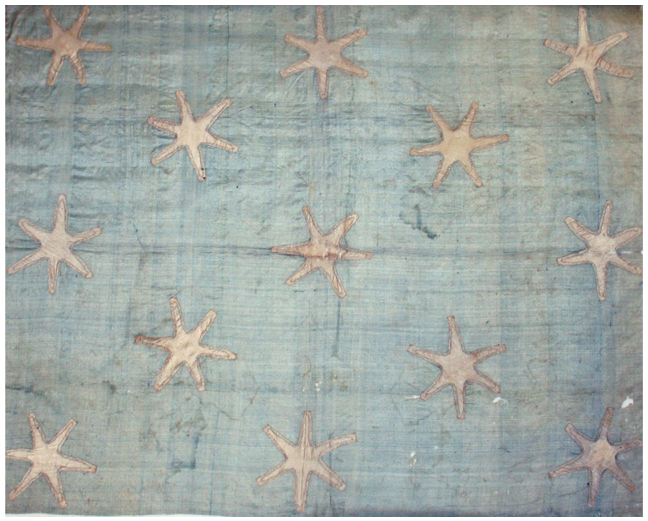
Commander in Chief’s Standard, ca. 1777-83 (Philadelphia: Museum of the American Revolution)
The distinctive thirteen-star blue silk standard circa 1777–83 that marked the presence of the Commander-in-chief on the battlefield and in headquarters is on loan from the museum and currently on view. This rectangular standard has been known for more than a century as George Washington’s Headquarters flag. It descended in the family of Washington’s sister, Betty Washington Lewis, whose son George served as an officer in the Commander-in-Chief’s guard. Also on loan from the museum are ten original silver camp cups from George Washington’s military field equipment with commemorative inscriptions. The original set of twelve cups, used to serve wine to aides and guests at the General’s table, were made in the shop of Philadelphia silversmith Edmund Milne in August 1777.
Sotheby’s selling exhibition will include a rare contemporary printing of the Declaration of Independence, the official printing for Massachusetts Bay, and a fine and rare engraved powder horn from March 22, 1770, owned by Jonathan Leonard Jr. (February 17, 1763 – January 25, 1849), a soldier in the American Revolution. The unique phrase, “Britain to Washington Shall Yield, Freedom Shall Triumph in the Field,” is engraved on the horn, paraphrased from the last verse of the highly popular song of the time, Great News from the Jerseys. Also included in the sale is the William Schuyler American horseman saber with figured maple grip, eagle pommel and original leather scabbard circa 1778–90. Opening hours are Monday – Saturday 10 am – 5pm and Sunday 1 pm – 5pm through 28 June 2013.
The Museum of the American Revolution will tell the complete story of the American Revolution. To be built in historic Philadelphia, just steps from Independence Hall and the Liberty Bell, the museum will feature a distinguished collection of objects, artifacts, artwork, and manuscripts from the period of the American Revolution that will bring to life the original “greatest generation” and engage people in the history and continuing relevance of the American Revolution.
Colonial Williamsburg Collaborates with Benjamin Moore
Up to now, Enfilade has reported on The Met’s relationship with Farrow & Ball and The Cleveland Museum of Art’s relationship with Glidden. The Colonial Williamsburg Foundation has just launched an alliance in the other direction with Benjamin Moore. My hunch is that color consultant Patrick Baty (interviewed for Enfilade in 2011 by Courtney Barnes), will see the range as emphatically leaning toward ‘trend’ rather than ‘tradition’. And yet, there are some lovely drab hues with charming names. -CH
Press release (16 May 2013) from the Colonial Williamsburg Foundation . . .

Benjamin Moore, one of North America’s most respected paint manufacturers and color authorities, has joined with the Colonial Williamsburg Foundation’s Williamsburg brand to launch the Williamsburg® Color Collection by Benjamin Moore – an assortment of paint colors authentically rooted in the history of our nation and its founding. The new, 144-color palette represents a unique intersection of history, science and design that reflects actual colors that existed in the 18th and 19th century, brought to customers through the most advanced paint technology in the industry from Benjamin Moore.
“This work showcases the close collaboration between two firms steeped in a rich heritage, both having passion for bringing history into the home,” said Carl Minchew, Benjamin Moore’s vice president of color innovation and design. “The Williamsburg® Color Collection by Benjamin Moore offers our customers beautiful shades in a palette of amazing, accurate colors that are as stylish today as they were 250 years ago.”
Colonial Williamsburg’s unparalleled research team of historians and conservators examined period documents, paint samples, wallpaper and architectural fragments that led to fresh and unexpected color findings. The Benjamin Moore team then carefully studied pigment compositions in order to precisely match these colors using the latest scientific methods to ensure the highest degree of authenticity to the original hues. As a result, the Williamsburg® Color Collection by Benjamin Moore presents vibrant yet complex shades as they appeared more than 250 years ago that can be effortlessly incorporated into the modern home.
“It has been very exciting to work with Benjamin Moore developing a paint palette based on historic precedent,” said Matthew Webster, director of the Grainger Department of Historic Architectural Resources for the Colonial Williamsburg Foundation. “Together we developed the colors using almost 90 years of paint research and an understanding of historic production methods creating a palette that embodies the Williamsburg ‘trend meets tradition’ theme. It’s personally satisfying to see research become reality with a palette that is consistent with colors that would have been found in the 18th century.”
Meadows Acquires Work Attributed to Juan Alonso Villabrille y Ron
Press release (29 May 2013) from the Meadows Museum in Dallas:
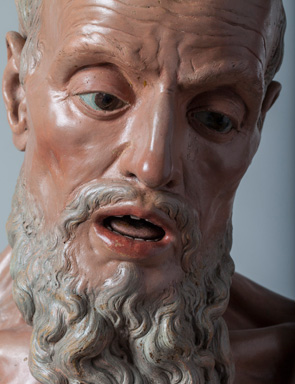
Juan Alonso Villabrille y Ron, St. Paul the Hermit (detail), ca. 1715, terracotta (Dallas: Meadows Museum, SMU)
The Meadows Museum has acquired the first terracotta sculpture attributed to Spanish Baroque master Juan Alonso Villabrille y Ron. In-depth research conducted by museum staff members sheds new light on the identity of the bust-length sculpture’s subject and its historical significance. When the sculpture was initially offered to the Museum it was believed to depict St. Jerome, Doctor of the Church. Meadows curators’ research, however, determined that the subject is in fact St. Paul the Hermit.
Villabrille y Ron is considered one of the most important Spanish sculptors of the Late Baroque period because of his mastery of technique. In addition, he taught another renowned sculptor of the period, Luis Salvador Carmona, and worked for the court in Madrid in the early eighteenth century. The quality of his work was such that he received commissions to create sculptures for some of the most important monuments in the city, such as the Puente de Toledo and the façade of the former Hospicio Provincial (now the Museo Municipal de Madrid). This sculpture is the first terracotta work to be attributed to Villabrille y Ron; not many examples of Spanish terracotta sculptures from the period have survived. Most of the works attributed to Villabrille y Ron are of polychromed wood or stone.
“Villabrille’s sculpture is a work of staggering realism and powerful emotion, and it provides an excellent complement to our already strong collection of works from the Baroque period,” said Mark A. Roglán, director of the Meadows Museum. “The acquisition of this prime example of Late Baroque sculpture will increase our ability to educate our visitors on this rich and versatile era in Spain by using objects that exemplify the style of the period. The students who use our Museum as a learning space and the visitors who come for pleasure will have an enriched experience because of this unique and beautiful example of Spanish sculpture.”
When the sculpture was initially offered to the Museum it was believed to depict St. Jerome, Doctor of the Church, who retired as a hermit to the Syrian Desert for three years’ penance. Meadows’ curators, however, took note of the subject’s prominently positioned woven reed garment, a vestment not present in any of the many other existing depictions of St. Jerome, and concluded the likeness had been misidentified. Their research determined that the subject is in fact St. Paul the Hermit, the first hermit saint of the Christian church, who is always shown as an old man wearing a woven reed garment made of palm leaves sewn together. Various experts in the field of early modern religious iconography, including George Washington University Professor Barbara von Barghahn and Richard P. Townsend, independent art historian, have confirmed the amended identification. (more…)
82nd & Fifth: One work. One curator. Two minutes at a time.
As art historians come around to moving pictures and expanding notions of audience, experiments from the Met (smartly packaged under the label 82nd & Fifth) are particularly interesting. -CH

◊ ◊ ◊ ◊ ◊
As introduced by Thomas Campbell:
[Earlier this year, the Metropolitan Museum of Art] launched 82nd & Fifth, a new Web feature that asks one hundred curators from across the Museum to each talk about a work of art from the Met’s collection that changed the way they see the world. One work. One curator. Two minutes at a time.
82nd & Fifth speaks directly to my interest in linking historical art and culture to a broader conversation. The Met is located at 82nd & Fifth but its relevance is global, allowing people to better understand both themselves and the world around them in the broadest sense.
We live in a sea of constant information, and these two-minute, authoritative commentaries are a welcome way to get powerful and compelling content in quick doses. We hope they will intrigue audiences who love the Met and those who are new to art.
◊ ◊ ◊ ◊ ◊
In “Morning Catch” (episode #38), Jeff Munger addresses a broth bowl from Vincennes, ca. 1740-56.
In “Family” (episode #40), Perrin Stein discusses Jacques-Louis David’s Study for The Lictors Bringing Brutus the Bodies of his Sons, 1787.

New Acquisition | Getty Acquires Runge’s ‘Times of Day’
Press release (23 May 2013) from The Getty:
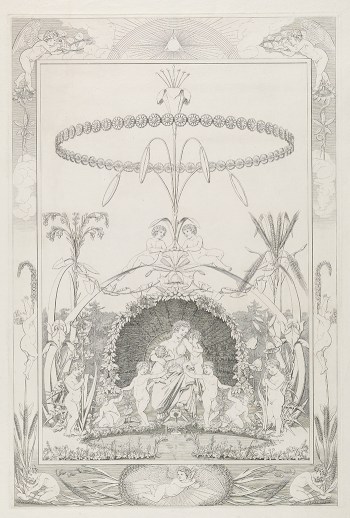
Philipp Otto Runge, Day, from Times of Day, 1805. Printmakers: E.G. Krüger and J. A Darnstedt. Etching and engraving
(Los Angeles: The Getty Research Institute)
The Getty Research Institute (GRI) announced today the acquisition of a rare first edition, Times of Day by Philip Otto Runge (1777–1810). Published in 1805, this suite of four prints representing Morning, Evening, Day, and Night is widely recognized as a monument of German Romantic art.
“This remarkable set of engravings is a radical, personal expression from one of the leaders of the German Romantic movement,” said Thomas W. Gaehtgens, director of the Getty Research Institute. “It is a landmark addition to the Getty Research Institute’s important prints collection.”
Runge, along with Caspar David Friedrich (1774–1840), was one of the leading painters and theorists of the German Romantic movement. He rejected the tradition of academic painting in favor of art that symbolically expressed the essential harmony of nature, humanity, and the divine. The complex iconography of Times of Day, which is very detailed, is meant to express the coming and departing of light—dawn, daytime, dusk, and darkness—and at the same time represents the organic process of conception, growth, decay and death.
“The elegance and purity of these images stands the test of time, expressing universal themes with grace and boldness,” said Louis Marchesano, curator of prints and drawings at the Getty Research Institute. “In his own time, Runge was praised and collected by important cultural figures such as Johann Wolfgang von Goethe.”
From 1802 until his untimely death in 1810 at the age of 33, Runge worked obsessively on these images, carefully articulating every aspect of their compositions and frames. Early in the planning stages, he made four large outline drawings in preparation for the four final images.
This first, small edition of the four engravings, published in 1805, reflects the delicacy of Runge’s carefully constructed preparatory drawings. Although the artist approved the production of a second, significantly larger edition, his original intent was not commercial. Runge shared his first edition with other artists and writers in order to disseminate his new artistic ideas and to announce his plans to create a large painting cycle based upon the designs. Those paintings were never completed; thus the prints are an important record of the artist’s goals.
The prints are now part of the GRI’s Special Collections, which comprise rare and unique collections in art history and visual culture from around the world, including more than 27,000 prints ranging from the Renaissance to the present.










leave a comment