Recreated Ceiling of the Gwoździec Synagogue Unveiled in Warsaw
On Tuesday, 12 March 2013, the Museum of the History of Polish Jews in Warsaw (scheduled to open next year) unveiled the newly completed replica of the ceiling from the Gwoździec Synagogue, which was lost when the building was destroyed during World War II. According to the website of Hands House Studio, the synagogue was largely constructed between 1700 and 1731, with some older portions dating to the seventeenth century. As reported by the Agence France-Presse (AFP):
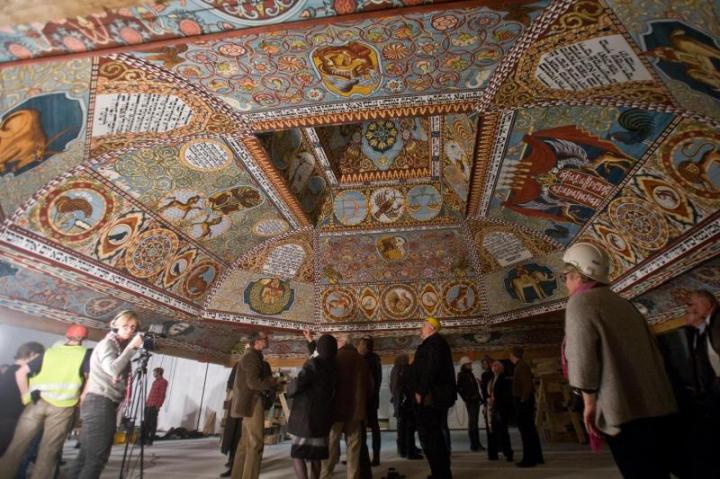
Gwoździec Synagogue Re!construction Project.
Museum of the History of Polish Jews, Warschau
◊ ◊ ◊ ◊ ◊
. . . a life-sized replica of the polychrome ceiling of an 18th-century synagogue inspired awe Tuesday [12 March 2013] as it was unveiled in the Polish capital. Covered in richly coloured Old Testament scenes and lushly stylised floral themes, the original ceiling adorned a wooden synagogue in what was the pre-World War II eastern Polish town of Gwozdziec, near what is now Lviv, western Ukraine. Like thousands of other Jewish religious sites, it was destroyed during the war by Nazi Germany. Its modern replica is the centrepiece of the Polish capital’s new Museum of the History of Polish Jews, due to be formally inaugurated April 19, marking the 70th anniversary of the World War II Warsaw Ghetto Uprising. Its door will open to the public next year. . . .
The replica was handcrafted from wood using traditional tools and techniques and involved nearly 300 craftspeople and artists from around the globe. The new museum is being built in the heart of the Polish capital on the site of the Jewish ghetto that became a symbol of resistance to Nazi Germany’s efforts to eradicate 1,000 years of Jewish presence in Poland. Designed by Finnish architects Rainer Mahlamaeki and Ilmar Lahdelma, the new museum faces the imposing black-stone Warsaw Ghetto Uprising memorial dedicated to those who perished in the doomed 1943 Jewish revolt against the Nazis. . . .
◊ ◊ ◊ ◊ ◊
Note (added 18 January 2023) — More information on the ceiling is available here with Ariel Fein’s essay for SmartHistory (4 April 2022).
Cleveland Museum of Art Acquires Newport Desk and Bookcase
Press release (9 February 2013) from the Cleveland Museum of Art:

Desk and Bookcase, Newport, Rhode Island, ca. 1780-95. Plum pudding mahogany, red cedar, chestnut, white pine and brass; 240 x 108 x 65 cm. (Cleveland Museum of Art)
Donated to the Cleveland Museum of Art by Daniel Harvey Buchanan, a retired Case Western Reserve University professor, in memory of his wife Penelope Draper Buchanan and her mother Dorothy Tuckerman Draper, this desk and bookcase dates from ca. 1780-95, a rich period of cabinetmaking in Newport, Rhode Island, just after the American Revolution. The work is attributed to the master cabinetmaker John Townsend or his brother Thomas Townsend based on stylistic similarities to other known case pieces by this leading cabinetmaking family of Newport. Commissioned by Oliver Wolcott, Sr., a signer of the Declaration of Independence from Connecticut, the desk has an unbroken provenance from its first owner by descent through the Wolcott, Tuckerman, Minturn and Draper families to its final owners, Penelope and Harvey Buchanan.
Dorothy Draper (1889–1969), Penelope Buchanan’s mother, displayed the desk and bookcase in her fashionable New York apartment at the Carlyle Hotel until coming to live in Cleveland in 1965. Dorothy Draper was a world-renowned interior designer and established the first interior design company in the United States in 1923. She had a regular column in Good Housekeeping Magazine and in 2006, Dorothy Draper was honored in a retrospective exhibition of her work by the Museum of the City of New York. According to Stephen Harrison, curator of decorative art and design, “This gift celebrates the extraordinary stewardship of one family in preserving such an important relic of American history from the eighteenth century. Such a gift is transformative in the development of our American collections. We could not have otherwise acquired such a masterpiece in the American furniture market today.” Harrison further stated, “This work will join other colonial-era masterpieces in the museum’s American galleries as a testament to the remarkable craftsmanship of American cabinetmakers in the eighteenth century.”
The quality of the workmanship in this desk and bookcase is superb and displays masterful embellishments known only to the finest Newport case pieces. For example, the use of “plum pudding” mahogany, a type of wood that is extremely rare and named for the blemishes in it that resemble the raisins in a plum pudding along with inset panels with canted corners (a decorative angled corner). Only one other example exhibiting canted corners on the upper panels is known to exist, making this piece extremely rare in the world of Newport furniture. The case also has stop-fluted corner pilasters (columns); carved “cupcake” finials (flattened finial with a corkscrew extending from it); and highly sophisticated drawer details. In addition, it retains its original brass pulls and escutcheons, and there is evidence of original finish inside the desk top. The Oliver Wolcott Desk and Bookcase augments the Cleveland Museum of Art’s small but choice collection of early American furniture and is now on view in the American Colonial Gallery.
Exhibition | Life at the Château de Prangins in the 18th Century
From the museum’s website:
Noblesse Oblige! Life at a Château in the 18th Century
Swiss National Museum, Château de Prangins, beginning 23 March 2013

Château de Prangins, 2005
(Photo from Wikimedia Commons)
◊ ◊ ◊ ◊ ◊
Château de Prangins is bringing its past to life and showcasing its historical heritage. From 23 March 2013 the former reception rooms, comprising the salon, dining rooms and libraries, will be revealed in their original grandeur as the backdrop for the new permanent exhibition. Boiseries in their original colours, textiles with lustrous motifs and false-marble decorations create the perfect surroundings for 600 objects from the era.
 Noblesse Oblige! Life at a Château in the 18th Century is devoted to the everyday life of a noble family in the Vaud region at the end of the 18th century and explores important issues of cultural history. The exhibition offers an insight into the life of a baron and the way in which he manages his estate, his duties and obligations, his family and social life. Each of the nine rooms is devoted to a specific topic that mirrors its original function: hospitality, wealth and lighting in the salon, servants in the butler’s pantry, and the taste for reading in the library.
Two audioguides – one for adults, the other for younger audiences – and specially produced films featuring the voices of the inhabitants allow visitors to immerse themselves in life at a château.
Project manager: Helen Bieri Thomson
The Met and Crystal Bridges to Share Portrait of Alexander Hamilton
Press release (14 March 2013) from Crystal Bridges:

John Trumbull, Portrait of Alexander Hamilton, 1792. Oil on canvas, 86 x 58 inches (219.1 x 146.1 cm)
An iconic full-length portrait by the celebrated Revolutionary-era painter John Trumbull of Alexander Hamilton, then Secretary of the Treasury under President George Washington, will join the permanent collections of both Crystal Bridges Museum of American Art and The Metropolitan Museum of Art, thanks to a gift from the painting’s owner, the global wealth manager and investment bank Credit Suisse.
Each institution will own a half share of Portrait of Alexander Hamilton (1792), which is currently on view at Crystal Bridges and has been on loan from Credit Suisse and on view since the museum opened. The painting will travel to the Metropolitan Museum in summer 2013 and return to Crystal Bridges in 2014. In subsequent years, each museum plans to exhibit the painting for two-year periods, when it will be integrated into the galleries and, on occasion, included in special exhibitions at each museum.
“We are very grateful to Credit Suisse for the generous gift of this distinguished portrait of Alexander Hamilton, whose political and legal acumen put him at the center of the founding of the new American republic, and whose key contributions to business and banking in Federal-era New York City effectively established the financial marketplace in this country,” stated Thomas P. Campbell, Director and CEO of The Metropolitan Museum of Art. “As the greatest known portrait of Hamilton and one of the finest civic portraits from the Federal period, this painting is a splendid addition to our fine collection of portraits of American political leaders. We are pleased and honored to share this remarkable work with Crystal Bridges.” (more…)
The Met Acquires Work by William Theed
As noted at Art Daily (14 March 2013) . . .
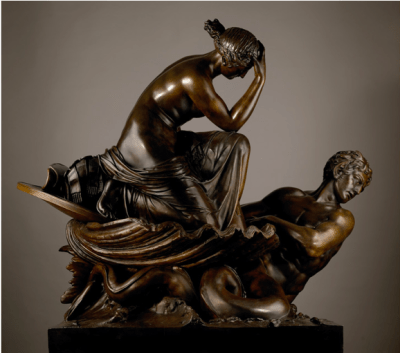
William Theed the Elder (1764-1817), Thetis Returning from Vulcan with the Armour of Achilles. Bronze, cast, chased and patinated, on an integral rectangular plinth. Height: 128 cm; width: 120 cm; length: 143 cm.
For over a year, Tomasso Brothers, the internationally renowned dealers in European sculpture, paintings, furniture and the decorative arts, has been searching for an elegant space in London. Dino and Raffaello are now delighted to announce that from 1 May 2013 they can be found at their new gallery at 12 Duke Street , St James’s. Established in 1993 and based at Bardon Hall, Leeds, Tomasso Brothers is pleased to also have a presence in the heart of London ’s traditional art market where they will showcase exciting pieces from their extensive portfolio.
The two Tomasso brothers are especially renowned for their expertise in European sculpture and boast a number of the world’s greatest museums amongst their clients. Recent sales include a major bronze to the Metropolitan Museum of Art, New York, Thetis Returning from Vulcan with the Armour of Achilles by William Theed the Elder (1764-1817), which was unveiled at the inaugural Frieze Masters in October 2012. This remarkable, almost life-size, bronze depicts the ‘divine Thetis of the silver feet’, most famous of the Nereids in Homer’s Iliad, kneeling by the shield of her son Achilles with the hero’s armour in a giant cockle shell. This spectacular sculpture, described by Sir Timothy Clifford as ‘undoubtedly Theed’s most ambitious work’, was almost certainly originally supplied to the author, philosopher, interior designer and art collector, Thomas Hope (1769-1831) for Duchess Street, London, or his country house Deepdene in Surrey. William Theed was born in London and entered the Royal Academy Schools in 1786. He went to Italy in 1790, returning in 1796. He began his artistic career as a painter but was befriended by the sculptor John Flaxman whilst in Rome and took up sculpture. Flaxman’s designs for Homer’s Iliad clearly made a powerful and lasting impression on the young Theed. Dino Tomasso said: ‘It is hugely gratifying when such a superb sculpture ends up in one of the world’s leading museums’. Dino and Raffaello Tomasso take great pride and pleasure in helping connoisseurs and museums in Europe and America to enhance their collections. In addition the company has promoted and supported through loans and exhibitions major international institutions such as the Fitzwilliam Museum, Cambridge, the Centro Internazionale, Carrara, the National Gallery, Prague, and the Kunsthistorisches Museum, Vienna. Most recently they were one of the sponsors of the landmark show Bronze at the Royal Academy of Arts, London , in 2012.
Tomasso Brothers will be exhibiting at TEFAF, 15 to 24 March 2013, Stand 165, Masterpiece London, 27 June to 3 July 2013, Stand C2, and also joining Master Drawings and Sculpture Week from 28 June to 5 July 2013.
Paper-Cut Project
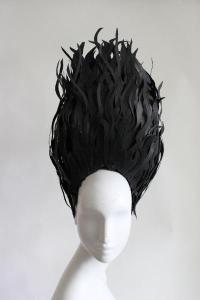
Amy Flurry and Nikki Nye, Marie Antoinette (2006), paper, 2012

Amy Flurry and Nikki Nye, Marie Antoinette (1938), paper, 2012
As profiled by Rinne Allen and Lucy Allen Gillis in the recent issue of Selvedge Magazine 50 (Jan/Feb 2013), Amy Flurry and Nikki Nye, co-founders of the Atlanta-based company Paper-Cut Project, contributed sixteen paper wigs for the V&A’s recent exhibition Hollywood Costume. Given that notice of Isabelle de Borchgrave’s paper dresses exhibited in San Francisco in 2011 remains one of the most popular postings here at Enfilade, I would expect readers to be similarly interested in these paper hair pieces.
–CH
The Nelson-Atkins Names Antonia Boström as Curatorial Director
Press release (27 February 2013) from the museum:
 Following an international search, The Nelson-Atkins Museum of Art in Kansas City today announced the appointment of Antonia Boström as Director of Curatorial Affairs, a position that will lead the Nelson-Atkins’s dynamic curatorial team. Boström brings a wealth of experience from art museums in London and the United States, including her current leadership position at the J. Paul Getty Museum, Los Angeles. She will begin her new post at the Nelson-Atkins in May.
“Dr. Boström’s wealth of experience across continents and in institutions with world-class collections made her unequivocally the ideal candidate for this position,” said Julián Zugazagoitia, Director & CEO of the Nelson-Atkins. “She brings a depth of scholarship and invaluable skills that will advance the curatorial voice of the Nelson-Atkins toward even higher levels of excellence.”
Boström has pursued art throughout her life, and her scholarship and management skills have led her to the Getty Museum, the Detroit Institute of Arts, the Royal Academy of Art, London, and the Victoria and Albert Museum, London, among others. She is excited to come to Kansas City and work with the esteemed collection at the Nelson-Atkins.
“The museum is at a great moment of transition, with the exquisite new Bloch Building, a gem of architecture, and with the leadership of Julián Zugazagoitia,” Boström said. “I am interested in working with a collection that is so renowned, but that perhaps is not widely enough known, and in discovering what the museum means to Kansas City. I look forward to working with a talented group of curators as we strive to reach new audiences.”
Born and raised in London, the daughter of a paintings conservator, she received her B.A. (1979) in the History of Art from the Courtauld Institute of Art, London University, and obtained her PhD in 1996 from the same institution. She worked in London as museum assistant at the National Portrait Gallery (1980), in the National Art Library and as an assistant curator at the Victoria and Albert Museum (1980-1985), as a commissioning editor at the Grove Dictionary of Art for Macmillan Publishers (1985-1988), and as acting curator of the Permanent Collection of Paintings and Sculpture at the Royal Academy of Arts (1995-96).
Boström, fluent in five languages, spent important years at the Detroit Institute of Arts from 1996 to 2004, working with that institution’s rich collection as an assistant, then associate curator in the Department of European Sculpture and Decorative Arts. While there she was co-author of Catalogue of Italian Sculpture in the Detroit Institute of Arts, and she was an adjunct professor at Wayne State University.
Since 2004 she has been the Senior Curator and Department Head, Sculpture and Decorative Arts Department at the J. Paul Getty Museum. Boström led the installation of the Fran and Ray Stark Sculpture Garden and Terrace in collaboration with Richard Meier Architects & Olin Patnership, plus the reinstallation of several Sculpture and Decorative Arts galleries. Among the many she has been involved with are two recent exhibitions at the Getty Museum – Messerschmidt and Modernity and Cast in Bronze: French Sculpture from Renaissance to Revolution. (more…)
Nationalmuseum acquires Miniature Portrait by Adélaïde Labille-Guiard
Press release (February 2013) from the Nationalmuseum in Stockholm:

Adélaïde Labille-Guiard, Madame Lefranc Painting a Portrait of Her Husband Charles Lefranc, watercolour and gouache on ivory, 1779 (Stockholm: Nationalmuseum, NMB 2625) Photo: Bodil Karlsson
The Nationalmuseum has acquired a spectacular miniature by Adélaïde Labille-Guiard. One of the most important women artists in late 18th-century France, she was not previously represented in the museum’s collections. The work is interesting on account of the motif alone, depicting a woman, albeit an amateur, in the role of artist.
Miniature portraits by Adélaïde Labille-Guiard (1749–1803) are extraordinarily rare. Her depiction of Madame Lefranc Painting a Portrait of Her Husband Charles Lefranc was painted five years after she made her debut (1779). Like many other female artists, she realized early on that miniature portraits offered a steady source of income. She was a pupil of the Swiss enamellist François-Élie Vincent, a neighbour of her father’s fashion shop in Paris. Gradually Labille-Guiard also took up working with pastels. She frequently reproduced these works in a smaller format as miniatures. After her election to the French Royal Academy of Art in 1783, she switched over completely to large-scale oil portraits. By then, Labille-Guiard had acquired pupils such as Marie-Gabrielle Capet and Marie-Thérèse de Noireterre. It became their job to translate her portraits into miniature format to satisfy the ever-changing demands of customers.
The acquisition of this spectacular work by Adélaïde Labille-Guiard, made possible by a generous donation from the Hjalmar and Anna Wicander Foundation, has filled a major gap in Nationalmuseum’s world-renowned miniatures collection. Madame Lefranc Painting a Portrait of Her Husband Charles Lefranc also documents a time when women began to emerge as serious artists.
Getty Research Institute Acquires a Rare Set of Chinese Battle Prints
Press release (17 January 2013) from The Getty:

Ping ding Kuoerke zhan tu, or Pictures of the Campaigns against the Gurkhas
(i.e., Nepalese), China, ca. 1793 (LA: The Getty Research Institute)
◊ ◊ ◊ ◊ ◊
The Getty Research Institute (GRI) has acquired an extraordinarily rare suite of battle prints from about 1793 that depict the Chinese Emperor Qianlong’s (reign era, 1736–1795) successful military campaign against invading armies from Nepal. These eight large-format copper engravings represent the complete set of prints commissioned by the Emperor to commemorate his 1792 victory. Printed in China, this set is one of seven so-called ‘Conquest’ suites.
“The rarity of these prints makes them an extraordinary addition to the GRI’s stellar collections depicting ‘China on Paper,’ highlighting cross-cultural relationships between Europeans and Chinese,” said Marcia Reed, Chief Curator at the Getty Research Institute. “Because the GRI holds strong collections of related works, it’s extremely beneficial to bring the collections already in place and these prints together for future research and publication.”
The scenes show dynamic landscapes of undulating mountains which seem to envelope the troops marching and fighting amidst their peaks and valleys. One plate depicts the victorious emperor being carried towards a yurt in front of a grand hall. The defeated soldiers of the enemy are grouped on the left, all on their knees. Each print includes a poem at the top of the engraved print; the poems were based on the Emperor’s own personal commentary on the scenes.
Prints such as these made their way into China from Europe in the 1700s and the emperor would have been given gifts of panoramic battle prints by visiting European dignitaries. In 1765 he ordered drawings to be made from monumental paintings commemorating his recent victories. These drawings, made by Jesuits employed by Qianlong’s court, were sent to Paris for engraving and printing. Created by Europeans for a Chinese audience, the prints were very European in appearance, with Chinese visual tropes incorporated in the drawings. When the prints were received at court, poetry was added to them—a very Chinese touch.
The Pictures of the Campaigns against the Gurkhas break away from this hybrid imagery. Though inspired by a European tradition and using French printing techniques, the drawings are notably Chinese in composition and style.
As part of the GRI’s special collection, these prints will now be available for scholarly research. The GRI’s vaults hold rare and unique collections in art history and visual culture from around the world, including more than 27,000 prints ranging from the Renaissance to the present.
◊ ◊ ◊ ◊ ◊
Additional information and illustrations are available at Amy Hood’s posting on the Getty’s blog, The Iris»
Peabody Essex Museum Appoints Its First Curator of American Art
Press release (6 October 2012) from the Peabody Essex Museum in Salem, MA:
 The Peabody Essex Museum announced the appointment of Austen Barron Bailly as the museum’s first George Putnam Curator of American Art. Bailly joins PEM’s curatorial team following her post as the head of the American Art department at the Los Angeles County Museum of Art (LACMA) and previous positions held at the Metropolitan Museum of Art and Wildenstein & Co., Inc. in New York.
Selected for her interdisciplinary and adventuresome curatorial approach, Bailly joins PEM at the cusp of the museum’s landmark $650 million campaign and expansion project. In her curatorial capacity at PEM, Bailly will lead the development of a multi-faceted American art program focusing on exhibitions, new interpretation in the galleries, and expanding the museum’s collection which currently includes paintings, decorative arts, photographs, folk art, and textiles representing over 300 years of New England and American art and culture.
“Austen brings a fresh and exciting perspective to the field that will greatly accelerate and enhance the museum’s presentation of American Art in the years to come,” said Lynda Roscoe Hartigan, PEM’s James B. and Mary Lou Hawkes Chief Curator.
A native of New Orleans, Bailly earned her PhD in art history from the University of California, Santa Barbara and her MA from Williams College. She will begin her new position as PEM’s George Putnam Curator of American Art in January, 2013. George and Nancy Putnam are long-time PEM Trustees who have made an indelible contribution to the museum’s future with their endowment of Bailly’s position, and that of a future Curator of Fashion and Textiles, for whom a national search is in progress.
PEM announced a comprehensive $650 million Campaign in October 2011, designed to advance the museum’s mission to celebrate outstanding artistic and cultural creativity in ways that transform people’s lives. To date, the museum has received gifts and pledges totaling $570 million. The Campaign includes a $350 million addition to the current $280 million endowment, $200 million for a 175,000-square-foot expansion designed by Rick Mather Architects, and $100 million to support creative new installations of the collection, several infrastructure improvements to existing facilities and other advancement initiatives. The $350 million endowment increase will cover all increased operating and program costs for an expanded facility; support continued development of the museum’s distinctive exhibitions, publications, curatorial and education programs; and enable continuation of a strong financial base. The expansion, set to open in 2017, will add up to 75,000 square feet of new galleries; a new restaurant and roof garden; new public program and education space; and essential improvements to collections storage, exhibition processing and conservation functions.










leave a comment