The UK’s Carriage Foundation

Samuel Butler (designed by William Chambers), Gold State Coach, 1762 (Royal Collection, 5000048). The panels were painted by Giovanni Cipriani. (Photo: Wikimedia Commons, July 2009).
◊ ◊ ◊ ◊ ◊
From Salon: Society of Antiquaries Online Newsletter 352 (2 November 2015) . . .
Julian Munby FSA, Head of Buildings Archaeology at Oxford Archaeology (and, he says, “a Fellow who has written about Queen Elizabeth’s carriages, and studied the English coach in the Kremlin”), writes about a new venture to record historic carriages:
“Historic carriages are a curiously neglected part of our heritage, while they include some of the most superbly designed and decorated examples of furniture on wheels, whether in museums or private collections. The newly launched Carriages of Britain (COB) project aims to create an online database of all historic horse-drawn carriages in collections throughout the UK. On Friday 30 October, in a truly glittering event at the Royal Mews, standing beside the Gold State Coach (1762), Colin Henderson, lately the Queen’s Head Coachman, announced that The Carriage Foundation, founded by enthusiasts for horse-drawn vehicles in 1991, has become a registered charity to promote interest and expertise in carriages through educational resources, publications and study days. In addition to developing historical information through the COB database, the foundation will also explore the foundation of a national carriage museum. Those interested in supporting through membership and donation can contact The Carriage Foundation.”
◊ ◊ ◊ ◊ ◊
From In Harness (August/September 2015), p. 5:
[The Carriage Foundation] now aims to manage, support and seek funding for various carriage related projects. Initially a website will be created which will host the first major project: Carriages of Britain. The project will consist of a searchable and illustrated database of carriages within UK collections, essays, and a photographic archive. Initial work has identified over 1200 carriages in publically accessible collections which will all have an entry on the database. Carriages of Britain will become the first port of call for anyone wishing to research horse drawn vehicles. Further developing our work, The Carriage Foundation are hosting a series of study days through the winter as well as the two established study tours. Long term plans are to explore the possibility of founding a National Carriage Museum.
For more information, contact thecarriagefoundation@yahoo.co.uk.
Online Learning | Sexing the Canvas: Art and Gender

Giovanni Battista Tiepolo, The Banquet of Cleopatra, 1744
(Melbourne: National Gallery of Victoria)
◊ ◊ ◊ ◊ ◊
Now in progress through Coursera (directed by Jeanette Hoorn with familiar faces including Jennifer Milam). . .
Coursera: Sexing the Canvas: Art and Gender
Directed by Jeanette Hoorn, 26 October — 13 December 2015
What do paintings tell us about sex? How is art gendered? Here we get up close to some of the great paintings in the world’s most famous museums, giving you insight into how art speaks to us about sex, sexuality and gender.
This course teaches masterpieces through the lens of sex and gender. We take you to the rich collections of New York’s Museum of Modern Art, Melbourne’s National Gallery of Victoria and California’s Huntington Library giving you access to outstanding works from the western tradition and expert tuition from specialist curators and renowned art historians.
Each unit will examine the circumstances in which paintings are produced and received, and how contemporary spectators and consumers of art view them. Why do works of art made centuries ago continue to speak so profoundly to us today? What do art historians mean when they talk about ‘the gaze’? Are Matisse’s paintings ‘sexy’? What do the nude and the sleeping gypsy signify in Henri Rousseau’s extraordinary pictures? Why do viewers find Frida Kahlo’s small and very personal paintings so powerful? What do Gainsborough’s portraits tell us about masculinity and sensibility in eighteenth century Britain? How is the Australian ‘dreaming’ gendered? These are some of the intriguing questions you will study in Sexing the Canvas: Art and Gender.
Course Syllabus
The course is taught over 7 weeks and is made up of 9 modules:
1 Introduction: Tiepolo’s Cleopatra: Painting, Agency and the Gaze
2 The Culture of Sensibility and the ‘Man of Feeling’: Thomas Gainsborough’s Portrait of the Officer of the Fourth Regiment of Foot
3 Gainsborough at the Huntington: The Role of Music, Costume, Theatre, Charity and Passion in the Gendered Culture of Sensibility
4 Sexual Codes in French Courtly Painting of the Eighteenth Century
5 Orientalism, Gender and Display: Painting in Morocco
6 Henri Rousseau: Challenging the Myth of the Passive Woman
7 Henri Matisse, Paul Cezanne and Max Dupain: Modernism, Gender and the Science of Movement
8 Sexuality and Dissonance: Frida Kahlo and the Struggle to Paint
9 What is Women’s Business?: Australian Indigenous Art and the Dreaming
Recommended Background
No background is required; all are welcome. Visit your local art museum or gallery and look at some paintings.
Suggested Readings
All readings needed to successfully complete the course will be supplied. A rich list of resources will also be supplied within the course to assist you with you study for this subject.
Course Format
The class will consist of lecture videos, which are between 8 and 12 minutes in length. Each unit has key readings, which, with the lectures, provide the content for the short weekly quizzes based on a multiple choice format.
Newly Refurbished Paul Mellon Centre Opens to the Public
From the Paul Mellon Centre (27 October 2015) . . .
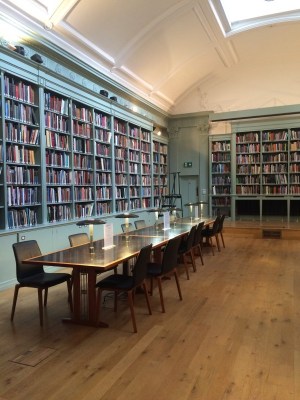 After our ten-month-long refurbishment and expansion project, the Paul Mellon Centre for Studies in British Art has re-opened its doors.
One of the jewels in the Centre’s crown is the Public Study Room (PSR), which, newly decorated, is once again open to readers from 10am to 5pm, Monday to Friday. Users of our PSR will enjoy improved, highly-convenient open-shelf access to the books that provide the mainstay or our rich library collections, and that cover all periods of British art and architecture. However, some of our Research Collection material is not yet installed on the premises; this includes journals, auction catalogues, rare books, and all of our archive and photographic archive collections. We hope that all of this material will be fully integrated into our collections, and available for use by readers, over the next few months. Please call 020 7580 0311 or email collections@paul-mellon-centre.ac.uk for further information.
◊ ◊ ◊ ◊ ◊
In addition to the renewed Public Study Room, the renovation project—completed by Wright and Wright—has doubled the size of the Centre’s listed Grade I premises with the acquisition of the lease of 15 Bedford Square, just next door. Bedford Square (built between 1775 and the 1780s) has been home to the Centre since 1996 (the Centre having previously been based at 20 Bloomsbury Square). The space that now serves as the Study Room had been heavily reworked in the 1920s; and as noted at the Mellon’s Centre’s website, based on “the evidence of the plaster ‘proscenium arch’ at the north end,” it “may well have been designed as a private cinema.” After nearly two decades, the unforgettable green room has been reborn, with this clever video showing the books going back onto the newly painted shelves. I can’t wait until my next visit. –CH
◊ ◊ ◊ ◊ ◊
The Sound of Paris in the Eighteenth Century
◊ ◊ ◊ ◊ ◊
Audio Reconstruction of Eighteenth-Century Paris
A team from Université Lyon-2, led by Mylène Pardoen (Department of Music and Musicology), has reconstructed the soundscape of eighteenth-century Paris.
From Le Journal CNRS (Centre national de la recherche scientifique). . .
La musicologue Mylène Pardoen a reconstitué l’ambiance sonore du quartier du Grand Châtelet à Paris, au XVIIIe siècle. Présenté au salon de la valorisation en sciences humaines et sociales, à la Cité des sciences et de l’industrie, son projet associe historiens et spécialistes de la 3D.
Paris comme vous ne l’avez jamais entendu ! C’est l’expérience que propose la musicologue Mylène Pardoen, du laboratoire Passages XX-XXI, à travers le projet Bretez. Un nom qui n’a pas été choisi par hasard : la première reconstitution historique sonore conçue par ce collectif associant historiens, sociologues et spécialistes de la 3D1, a en effet pour décor le Paris du XVIIIe siècle cartographié par le célèbre plan Turgot-Bretez de 1739 – Turgot, prévost des marchands de Paris, en étant le commanditaire, et Bretez, l’ingénieur chargé du relevé des rues et immeubles de la capitale.
70 tableaux sonores
C’est plus précisément dans le quartier du Grand Châtelet, entre le pont au Change et le pont Notre-Dame, que la vidéo de 8 minutes 30 transporte le visiteur. « J’ai choisi ce quartier car il concentre 80 % des ambiances sonores du Paris de l’époque, raconte Mylène Pardoen. Que ce soit à travers les activités qu’on y trouve – marchands, artisans, bateliers, lavandières des bords de Seine… –, ou par la diversité des acoustiques possibles, comme l’écho qui se fait entendre sous un pont ou un passage couvert… » S’il existe déjà des vidéos sonorisées, c’est la première fois qu’une reconstitution en 3D est bâtie autour de l’ambiance sonore : les hauteurs des bâtiments comme les matériaux dans lesquels ils sont construits, torchis ou pierre, tiennent compte des sons perçus – étouffés, amplifiés… – et inversement. . . .
More information is available here»
Romantic Illustration Network

◊ ◊ ◊ ◊ ◊
From RIN:
The Romantic Illustration Network (RIN) restores to view the importance of book illustration and visual culture in the Romantic period, but also across the eighteenth and nineteenth centuries. RIN brings together scholars working on poetry, prose, the printed book, visual culture, and painting from roughly 1750–1850 to share research and to develop new models for understanding the relationship between word and image in the period, between large and small scale work, and between painting, print and illustration.
We are collaborating with Tate Britain to enhance the Tate’s collection of literary prints and paintings. RIN will foreground artists who have been unduly ignored, and return attention to well-known artists in unfamiliar roles. We aim to recapture lost cultures of looking and of reading, restoring the link between word and image not only in book illustration but in the wider literary and visual culture. Our programme of events will take as starting point in turn the artist, the author, the gallery and the economics of print. We will produce an edited collection of essays and it is hoped that this network will form the basis for a longer research project.
The RIN blog is available here»
Georeferencing the British Library’s Map Collection
◊ ◊ ◊ ◊ ◊
A recent posting at at the British Library’s Maps and Views blog (25 March 2015) describes the latest phase of the project to georeference the BL’s map collection. As a crowdsourcing project, it’s fascinating. And even if you’re not interested in contributing your time, there are lots of resources already available (to search for maps previously georeferenced, use the map portal Old Maps Online, which searches across numerous online map collections, including the British Library). The video below provides an effective introduction to the basic concept of georeferencing. –CH
◊ ◊ ◊ ◊ ◊
From the BL’s Georeference Home:
Help! British Library needs 50,000+ maps georeferenced
 You can join the latest phase of our project, which features over 50,000 more maps from the British Library collections. Help us identify accurate locations for these historic maps! Bear in mind that some places have changed significantly or disappeared completely, creating a puzzle that reveals an exciting contrast.
Your name will be credited, and your efforts will significantly improve public access to these collections. Contributors can see the results of their work, as well as the progress of the pilot and other participants, and the top contributor will be publicly announced.
Newly Formed ANZSECS
Australian and New Zealand Society for Eighteenth-Century Studies

Jean-Baptiste Joseph Pater, The Fair at Bezons, ca. 1733 (New York: Metroplitan Museum of Art)
The newly formed Australian and New Zealand Society for Eighteenth-Century Studies (ANZSECS) exists to promote the study of the culture and history of the long eighteenth century within Australia and New Zealand. The Society encourages research in eighteenth-century studies on a broad interdisciplinary basis—its members work in fields including art history, history, literature, philosophy, bibliography, and the history and philosophy of science. It is an affiliate of ISECS, the International Congress for Eighteenth-Century Studies.
Established in December 2014, the Society draws on a distinguished history of eighteenth-century scholarship in Australia and New Zealand. It advances the exchange of information and ideas among researchers engaged in eighteenth-century studies through various activities and events, including the 3–4 yearly David Nichol Smith Seminar. For more information about the Society, membership, and related events, please visit our website.
Working Group | Home Subjects, ca. 1750–1900

Arthur Devis, The John Bacon Family, 1742–43, 30 x 52 inches (76.2 x 131.1 cm), oil on canvas (New Haven: Yale Center for British Art, Paul Mellon Collection).
◊ ◊ ◊ ◊ ◊
Thanks to Historians of British Art for sponsoring the “Home Subjects” panel at the 2015 meeting of the College Art Association last week in New York. The panel kicked off a series of activities that the organizers of Home Subjects are planning over the course of the next few years in an attempt to bring together scholars interested in the display of art in the the private or domestic interior. Our hope is to make connections across traditional period boundaries in order to encourage and facilitate research and discussion about the role art played in the decoration of the private interior and, in turn, how the display of art in the private interior shaped the direction of contemporary art. Further information about the topics Home Subjects would like to address can be found on our blog. We also encourage anyone interested in participating or sharing ideas to sign up for our email list at homesubjects@gmail.com. Stay tuned for blog posts, calls-for-papers, and more!
Melinda McCurdy, The Huntington Library, Art Collections and Botanical Gardens, San Marino, CA
Morna O’Neill, Wake Forest University, Winston-Salem, NC
Anne Nellis Richter, Independent Scholar and part-time faculty, American University, Washington, DC
Travel Diaries of Crown Prince Friedrich Christian, 1738–40
I imagine many Enfilade readers will be interested to learn of Maureen Cassidy-Geiger’s transcriptions of the unpublished diaries of Crown Prince Friedrich Christian, documenting his travels in Italy from 1738 to 1740. –CH
◊ ◊ ◊ ◊ ◊
From Cassidy-Geiger’s introduction to the project:
Incognito: The ‘Comte du Lusace’ on the Grand Cure in Italy, 1738–40 — The unpublished travel accounts of Crown Prince Friedrich Christian (1722–63) of Saxony/Poland, a disabled tourist traveling in Italy in 1738–40 as ‘Comte de Lusace’, and related documentation and research by Maureen Cassidy-Geiger.
The Prince and I
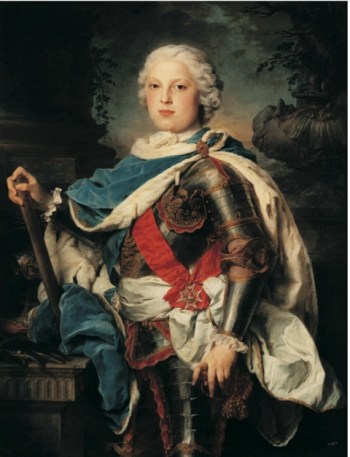
Pierre Subleyras, Portrait of Prince Friedrich Christian of Saxony, 1739 (Dresden, Gemäldegalerie)
I first met Friedrich Christian, Crown Prince of Saxony/Poland, in 2004 in the State Archives in Dresden. I was gathering material for a book and stumbled across the handwritten travel diaries of his Italian odyssey in 1738–40. Sixteen years old and crippled by scoliosis and what was termed “palsy” (probably cerebral palsy), his Grand Tour was less a gap year than an all-out effort to find a cure for his condition in medicine or religion and safeguard the succession. Crowned Elector in 1763, he died prematurely from smallpox, aged 41, after reigning for 74 days. Thus he ended up a footnote in history books instead of a legend. And in 2004, I adopted him as my subject, hero and muse. . . .
The handwritten journals of his two-year odyssey are the guidebooks for this journey of mine, of his. The prince wrote daily, in school-boy French, in the words of a dutiful and obedient child on the uncertain road to manhood. A Catholic crown prince of a Protestant state held tight by the Jesuits and buttressed by the Bohemian mysticism of the court of Vienna, he sat at the center of an able-bodied swirl, incognito as Comte
de Lusace though hardly anonymous. . . .
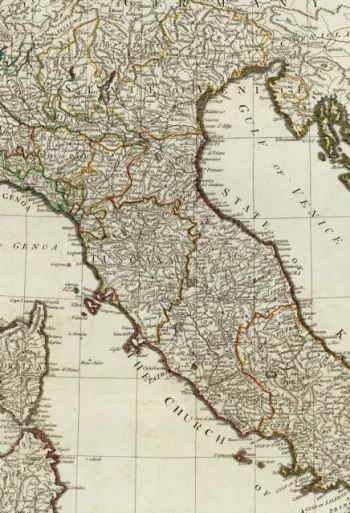
A New Map of Italy . . . from Monsr. D’Anville (London, Robert Sayer, 1790)
To date, I have twice driven the historic itinerary and have conducted research in situ in Dresden, Naples, Rome and Venice, towards an annotated publication. For the moment, however, this WordPress blog is an experimental platform for sharing the contemporary accounts with interested colleagues. The transcriptions retain the inaccuracies, idiosyncrasies and misspellings of the originals and await thorough proofreading and corrections; autocorrect has also introduced inadvertent errors, for which I apologize. . . .
The site is available here»
Research Project | Marrying Cultures: Queens Consort, 1500–1800
This HERA-funded research project on queens consort will be of interest to many readers. Upcoming events are scheduled to take place throughout Europe: Wolfenbüttel, Berlin, Oxford (in conjunction with Kensington Palace), Warsaw, and Stockholm. –CH
Marrying Cultures: Queens Consort and European Identities, 1500–1800
Marrying Cultures is a three-year research project funded by HERA (Humanities in the European Research Area) focusing on the foreign consort as agent of cultural transfer. The case studies to be investigated are the Polish princesses Katarzyna Jagiellonka, Duchess of Finland and Queen of Sweden (1526–83), and Zofia Jagiellonka, Duchess of Braunschweig-Wolfenbüttel (1464–1512); Hedwig Eleonora of Schleswig-Holstein-Gottorp, Queen of Sweden (1636–1715), and Charlotte Amalie of Hessen-Kassel, Queen of Denmark (1650–1714); the Portuguese princess Catarina of Braganza, Queen of Great Britain (1638–1705); Maria Amalia of Saxony, Queen of the Two Sicilies and Queen of Spain (1724–1760); and Luise Ulrike of Prussia, Queen of Sweden (1720–82).
Working with colleagues in historic palaces, museums and libraries (including Kensington Palace, the Victoria and Albert Museum and the National Portrait Gallery, London; the Royal Armoury, Stockholm, and the Duke August Library, Wolfenbüttel), the project members will also consider how it is that certain consorts become embedded in national cultural memory and others do not.
Partners
Historic Royal Palaces (Kensington Palace, London): Dr Joanna Marschner
National Portrait Gallery, London: Dr Catharine Macleod
Victoria and Albert Museum, London: Dr Julius Bryant
Livrustkammaren (The Royal Armoury), Stockholm: Dr Malin Grundberg
The Museum of Polish History, Warsaw: Monika Matwiejczuk
Supportive Institutions
Herzog August Bibliothek, Wolfenbüttel: Professor Hellwig Schmidt-Glintzer
Hochschule für Musik, Theater und Medien, Hannover: Professor Susanne Rode-Breymann
Husgerådskammaren (The Royal Collections), Stockholm: Dr Lars Ljungström
Turku Castle and Historical Museum: Olli Immonen











leave a comment