At Christie’s | Masterpieces from a Rothschild Collection
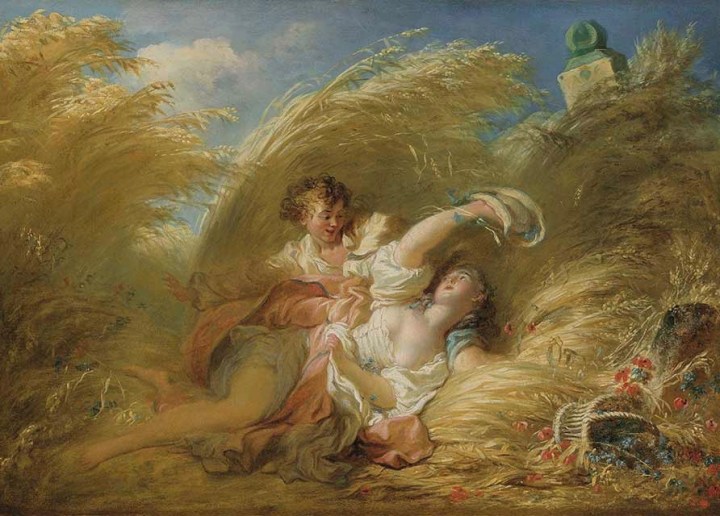
Jean-Honoré Fragonard, Dans les blés
(estimate: £700,000–1 million)
◊ ◊ ◊ ◊ ◊
From the press release (via Art Daily) . . .
Masterpieces from a Rothschild Collection (Sale 17726)
Christie’s, London, 4 July 2019
Telling the remarkable story of objects collected across centuries and treasured for generations, Christie’s will offer a landmark collection sale Masterpieces from a Rothschild Collection in London on 4 of July (Sale 17726). Comprising approximately 57 lots—each with exceptional provenance—this sale includes important European furniture and works of art collected by members of the prominent Rothschild banking family, particularly by Baron Gustave de Rothschild (1829–1911), and housed in some of the family’s magnificent residences.
The sale captures the spirit of le goût Rothschild—the celebrated aesthetic that has influenced many European and American interiors since the 19th century, following the collecting traditions of European royal courts during the Renaissance, Baroque, and Enlightenment periods. With estimates ranging from £10,000 to £2.5 million, select highlights will be on view in New York between 25 and 30 April and in Hong Kong from 24 to 27 May, followed by the London preview which opens to the public on 29 June.
Charles Cator, Deputy Chairman, Christie’s International: “The Rothschild name is synonymous with collecting at the very highest level, with many of the world’s greatest works of art having a Rothschild provenance. Their fabled name is added to the extraordinary roll call of illustrious owners of these masterpieces—many of them royal—from Louis XV and Marie Antoinette to William Beckford and Prince Demidoff. This sale is a celebration of connoisseurship and passionate collecting, and we are very proud to have been entrusted with these masterpieces. With the great resonance of the Rothschild provenance among collectors and institutions this is an unparalleled opportunity, which marks a very special high point in my long career at Christie’s. It is thrilling to have the privilege of handling these supreme works.”
Highlights include
Furniture with Royal Provenance
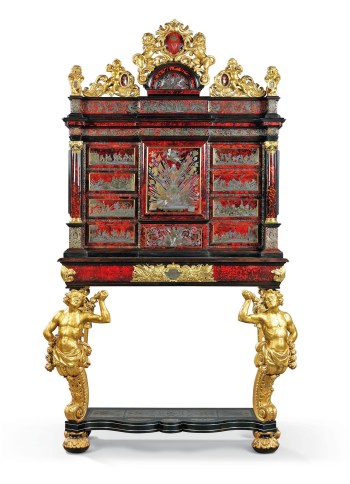
One of a pair of royal Flemish tortoiseshell, brass, pewter, inlaid ‘boulle’ marquetry, and giltwood cabinets attributed to Hendrick van Soest, Antwerp, ca. 1713 (estimate: £1.5–2.5million).
The top lot of the sale, a pair of royal Flemish tortoiseshell, brass, and pewter inlaid marquetry and giltwood cabinets, was commissioned in Antwerp around 1713 for Philip V King of Spain, the second son of the Grand Dauphin and grandson of Louis XIV (estimate: £1.5–2.5 million). This highly important pair of cabinets on stand, inlaid with superb and precious marquetry panels in tortoiseshell and engraved metals, belongs to a group of four cabinets originally commissioned for Philip V King of Spain from the workshop of the celebrated Antwerp furniture-maker and dealer Henrick Van Soest (1659–after 1726), one of the most prestigious cabinetmakers of Flanders who worked in the great tradition of Netherlandish marquetry furniture.
Commissioned by Queen Marie Antoinette of France, almost certainly for her Petit Trianon, a Louis XVI ormolu-mounted mahogany table à écrire, circa 1780, is by Jean-Henri Riesener, the Queen’s favoured cabinetmaker (estimate: £600,000–1,000,000). Notably, the table is marked with Marie Antoinette’s garde-meuble brand, which was applied to her personal furniture after 1784.
Further lots with royal provenance include a sundial by Julien Le Roy (1686–1759), which is thought to have been commissioned by King Louis XV (1710–1774) (estimate: £60,000–80,000).
Traditionally from the Spanish royal family and part of a very small group of luxurious 18th-century furniture incorporating Sèvres porcelain plaques is a Louis XVI ormolu, Sèvres porcelain and marquetry guéridon, circa 1782–83, by one of the most famous ébénistes of the late 18th century, Martin Carlin (estimate: £400,000–600,000). Acquired by Baron Gustave de Rothschild, this lot is closely related to a guéridon in The Frick Collection. Other lots with notable links to leading institutions include a magnificent late Louis XV ormolu-mounted ebony and Japanese lacquer ensemble consisting of two commodes and a pair of encoignures by Bernard III van Risenburgh, son of the celebrated master known as BVRB. Conceived in a bold avant-gardist neo-classical style, the commodes from this group are closely related to the masterpiece by the same ébéniste now at The Metropolitan Museum of Art. The group comprises three lots with a combined estimate of £1,500,000 to £2,500,000.
Kunstkammer Objects
A set of ten parcel-gilt polychrome square enamel plaques by Leonard Limousin, circa 1550, each depicting an apostle in a circular wreath and with an identifying banner, have an estimate of £200,000 to £300,000. Also acquired by Baron Gustave de Rothschild, ‘The Rothschild Apostles’ exemplify Limousin’s finest creations in his clear sense of colour and the lively and original compositions. Two of the plaques, of Saint Andrew and Saint Bartholomew, are signed ‘LL’. These plaques formed part of a larger set of sibyls, prophets, and saints that adorned the antependium of an altar in the now-lost church of Santa Maria della Celestia in Venice. A number of the other plaques from the antependium, and also a liturgical lamp that hung above the altar, remained in the Rothschild family until recently; one is in the Correr Museum in Venice.
An important German silver-gilt double-cup, mark of Hans Beutmuller, Nuremberg, 1594–1602, was in the collections of both Baron Mayer Carl von Rothschild and Baroness James de Rothschild (estimate: £200,000–300,000). It is in the Gothic style revived in Nuremberg by Hans Petzold (1551–1633) at the end of the 16th century. Hans Beutmüller (1588–1622) worked with Petzold and ranked, in his own right, among the most reputable Nuremberg goldsmiths. A Venetian rectangular parcel-gilt, gilt-bronze, and rock crystal casket, circa 1600, belonged to the renowned collector and author William Beckford in the early 19th century (estimate: £100,000–150,000). With the precious use of rock crystal and Islamic-inspired lacquer decoration, it is obvious why it would have appealed to Beckford. When this casket was sold in the celebrated Fonthill Abbey sale of 1823, it was said to have come from the collection of Pope Paul V Borghese, who could have commissioned it himself. The casket was purchased at the Fonthill sale by an agent on behalf of the 2nd Earl Grosvenor.
Old Master Paintings
David Teniers’ lively and brilliantly observed The Ham Dinner was painted in 1648, when the artist was at the height of his powers (estimate: £800,000–1.2 million). Executed on an impressively large copper plate, allowing for a high degree of finish, it is an excellent example of the tavern scene genre that Teniers developed and excelled in. The painting has exceptional provenance, having been in the collection of Charles Ferdinand, Duke of Berry (1778–1820), son of the future King Charles X of France, and later belonging to Count Anatoly Nikolaievich Demidov, 1st Prince of San Donato (1813–1870), a Russian industrialist and one of the most significant collectors of his day. A further highlight is Jean-Honoré Fragonard’s dynamically designed, vibrantly coloured, and masterfully executed Dans les blés (estimate: £700,000–1 million), a masterpiece of the artist’s full maturity and an outstanding example of the artist’s intimate, small-scale ‘boudoir’ pictures, which are recognised as his most original and lasting contribution to the history of art.
Exhibition | Power Couples: The Pendant Format

Barthel Bruyn the Younger, Portrait of a Gentleman and Portrait of a Lady, ca. 1555–65, oil on panel (Salt Lake City: Utah Museum of Fine Arts, University of Utah).
◊ ◊ ◊ ◊ ◊
Opening in July at UMFA:
Power Couples: The Pendant Format in Art
Utah Museum of Fine Arts, University of Utah, Salt Lake City, 11 July — 8 December 2019
Curated by Leslie Anderson
Power Couples: The Pendant Format in Art considers how two interdependent works, called ‘pendants’, convey meaning. The study of this popular format reveals a variety of artistic strategies at play—desires to communicate social hierarchy, gender roles, racial issues, complementary ideas, the passage of time, the continuity of space, and the appearance of truth in art.
Drawn from the UMFA’s rich collection and strengthened with select loans, the expansive exhibition will display works conceived as pairs in European, American, and regional art from the fifteenth century until the present day. Artists on view include Barthel Bruyn the Younger, Dirck Hals, Peeter Neefs the Elder, Gabriel and Augustin de Saint-Aubin, Gilbert Stuart, Edmonia Lewis, Robert Rauschenberg, Lorna Simpson, Nina Katchadourian, Kerry James Marshall, and Roni Horn. Leslie Anderson, curator of European, American, and regional art, organized this exhibition for the UMFA.
Despite its prevalence across time periods and cultures, the pendant, unlike its hinged predecessor the diptych, has never before been the subject of a comprehensive exhibition.
Call for Papers | Power Couples: The Pendant Format
Symposium | Power Couples: The Pendant Format in Art
Utah Museum of Fine Arts, University of Utah, Salt Lake City, 4 October 2019
Organized by Leslie Anderson
Proposals due by 15 June 2019
The Utah Museum of Fine Arts at the University of Utah will host an interdisciplinary symposium to coincide with the upcoming special exhibition Power Couples: The Pendant Format in Art (11 July — 8 December 2019), which will examine ideas imparted by two interdependent works (called pendants) from the fifteenth century until the present day. Papers that consider works conceived as pairs in the visual arts, literature, and music are invited, and new research related to pairs in other disciplines is encouraged. What are the artistic strategies at play in the creation of companion pieces? How do the format and display (or experience) of pendants communicate meaning?
Advanced graduate students, as well as established and emerging scholars, are invited to apply. Please submit an abstract of 250–300 words and a CV to both leslie.anderson@umfa.utah.edu and iris.moulton@umfa.utah.edu by 15 June 2019. Selected participants will be notified on or before 15 July 2019.
This symposium is organized by Leslie Anderson, Curator of European, American, and Regional Art, and Iris Moulton, Coordinator of Campus Engagement, at the Utah Museum of Fine Arts, University of Utah.
Keynote Speaker
Wendy N. E. Ikemoto is Associate Curator of American Art at the New-York Historical Society. She served as organizing curator for Rockwell, Roosevelt & the Four Freedoms (2018), Betye Saar: Keepin’ It Clean (2018–19), Bettina von Zwehl: Meditations in an Emergency (2018–19), and Augusta Savage: Renaissance Woman (2019), and as curator for Panoramic Perspectives (2019–20). She is planning an upcoming exhibition on the American romantic artist John Quidor. Prior to joining the New-York Historical Society, Ikemoto worked in academia at The Courtauld Institute of Art in London and Vassar College in New York and in secondary education at a school for Native Hawaiian students. She holds a BA in Art History from Stanford University and an AM and PhD in the History of Art and Architecture from Harvard University. Her publications include Antebellum American Pendant Paintings: New Ways of Looking (Routledge, 2017) and articles in American Art and The Burlington Magazine.
Conference | The Artistic Taste of Nations, 1550–1815
From the Vrije Universiteit Amsterdam:
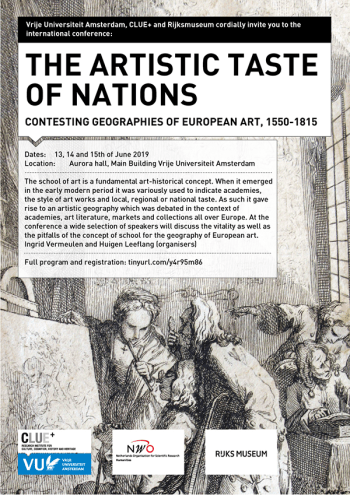
The Artistic Taste of Nations: Contesting Geographies of European Art, 1550–1815
Vrije Universiteit Amsterdam, 13–15 June 2019
Organized by Ingrid Vermeulen and Huigen Leeflang
The school of art is a fundamental art-historical concept. When it emerged in the early modern period, it was variously used to indicate academies, the style of art works and local, regional, or national taste. As such it gave rise to an artistic geography, which was debated in the context of academies, art literature, markets, and collections all over Europe. This conference aims to address the vitality as well as the pitfalls of the concept of school for the geography of European art.
 T H U R S D A Y , 1 3 J U N E 2 0 1 9
12.00 Registration
12.30 Welcome by Gert-Jan Burgers (director research institute CLUE+) and Ingrid Vermeulen (Vrije Universiteit)
13.00 Academies of Art and Artistic Nations
Moderator: Arno Witte (KNIR Rome/ Universiteit van Amsterdam)
• Susanne Kubersky-Piredda (Bibliotheca Hertziana, Max-Planck-Institut für Kunstgeschichte Rome), Notions of Nationhood and Artistic Identity in 17th-Century Rome
• Maria Onori (Sapienza Università di Roma), Spanish Artists and the Academies: Places of Belonging in the Second Half of the 17th Century in Rome
• Ludovica Cappelletti (Politecnico di Milano), Shaping Architecture: The Case of the Regia Accademia di Pittura, Scultura e Architettura in Mantua
14.45 Break
15.15 Drawings, Connoisseurship, and Geography
Moderator: Klazina Botke (Vrije Universiteit)
• Simonetta Prosperi Valenti Rodinò (Università di Roma ‘Tor Vergata’), Father Sebastiano Resta (1635–1714) and the Italian Schools of Design
• Federica Mancini (Musée du Louvre), Connoisseurship beyond Geography: Some Puzzling Drawings from Filippo Baldinucci’s Personal Collection
• Sarah W. Mallory (Harvard University), Arthur Pond’s Prints in Imitations of Drawings: Connoisseurship and the National School in Early 18th-Century Britain
17.00 Drinks reception
F R I D A Y , 1 4 J U N E 2 0 1 9
9.00 Registration
9.30 The Taste and Genius of Nations
Moderator: Marije Osnabrugge (Université de Genève)
• Ingrid Vermeulen (Vrije Universiteit), The ‘Taste of Nations’: Roger de Piles’s Diplomatic Views on European Art
• Pascal Griener (Université de Neuchâtel), How Do Great Geniuses Appear in a Nation? A Historiographical Problem for the Enlightenment Period
10.40 Break
11.10 Print Collecting and School Formation
Moderator: Huigen Leeflang (Rijksmuseum)
• Gaëtane Maës (Université de Lille), Between Theory and Practice: Dezallier d’Argenville’s Idea on Print Collections
• Véronique Meyer (Université de Poitiers), Des Notices générales au Manuel du Curieux: Michael Huber et l’Ecole française de gravure (From Notices Générales to Manuel du Curieux: Michael Huber and the French School of Printmaking)
• Stephan Brakensiek (Universität Trier), Chronology and School: Questioning Two Competing Criteria for the Classification of Graphic Collections around 1800
13.00 Lunch break
14.00 Transnational Identities
Moderator: TBA
• Elisabeth Oy-Marra (Johannes Gutenberg Universität Mainz), Towards the Construction of an Italian School: The Transformative Power of Place in Bellori’s Lives
• Marije Osnabrugge (Université de Genève), Claimed by All or Too Elusive to Include: The Place of Mobile Artists in Artist Biographies and the Local Canon
• Ewa Manikowska (Polish Academy of Sciences Warsaw), The Galeriewerk and the Self-Fashioning of Artists at the Dresden Court
15.45 Break
16.15 Practices of Classification
Moderator: Ingrid Vermeulen (Vrije Universiteit)
• Everhard Korthals Altes (Technische Universiteit Delft), The Dutch and Flemish Schools of Painting in 18th-Century Art Literature, Auction Catalogues, and Collections: Together or Apart?
• Huigen Leeflang (Rijksmuseum), Pieter Cornelis van Leyden’s Collections of Prints and Paintings: Content, Organization, and Schools
• Irina Emelianova (Accademia di Architettura di Mendrisio (Ch), «In the school of the Netherlands I joined two schools, Flemish and Holandaise, I even added some German painters»: The Problem of European Artistic Schools in the Context of the Russian Enlightenment
18.30 Conference dinner for speakers and moderators at the Botanical Gardens, Vrije Universiteit
S A T U R D A Y , 1 5 J U N E 2 0 1 9
9.00 Registration
9.30 Schools Going Public: The Picture Gallery
Moderator: Everhard Korthals Altes (Technische Universiteit Delft)
• Cécilia Hurley (École du Louvre/ Université de Neuchâtel), In Search of a Higher Order: The Organisation of the Munich Hofgartengalerie at the End of the 18th Century
• Christine Godfroy-Gallardo (HICSA Université Paris I – Sorbonne), An Organisation by Schools Considered Too Commercial for the Newly Founded Louvre Museum
• Pier Paolo Racioppi (Fondazione IES Abroad Italy Rome), The ‘Louvre Effect’: The New Arrangement of the Vatican Pinacoteca and Guattani’s Catalogue I più celebri quadri delle diverse scuole italiane (1820)
11.15 Break
11.30 Panel discussion and closing remarks
Call for Papers | Art Academies and Their Networks
 A useful introduction to ACA-RES, including a summary of its wide array of online resources, is available from J18: Émilie Roffidal and Anne Perrin Khelissa, “French Academies in the Age of Enlightenment: An Interdisciplinary Research Network,” Journal18 (February 2019), available here.
From the Call for Papers:
Art Academies and Their Networks in the Age of Enlightenment
Institut national d’histoire de l’art, Paris, 26–28 March 2020
Organized by Anne Perrin Khelissa and Émilie Roffidal, with Markus Castor
Proposals due by 6 September 2019
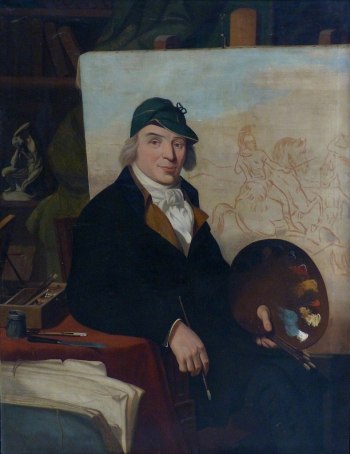
Attributed to Guillaume-Joseph Roques, Portrait of Jacques Gamelin, ca. 1777–85, oil on canvas (Cathédrale Saint-Michel de Carcassonne).
This colloquium is the culmination of three years of research under the aegis of the ACA-RES research programme on art academies and their networks in pre-industrial France (Les académies d’art et leurs réseaux dans la France préindustrielle). It aims to provide new perspectives and build upon this research and collaborative initiatives. Since 2016 the ACA-RES research programme has worked towards shedding further light on art academies and drawing schools in the French provinces between 1740 and the early 19th century. It has built on previous studies by art historians and historians, by focusing on networks and networking across France and beyond. This approach was based on the belief that these fifty or so educational institutions were the expression of a town’s culture as well as a node where men, objects and knowledge functioned on different levels. The objective was to investigate the role of these institutions in Enlightenment society, not only locally, but also within the context of European and international movements.
Three study days, whose proceedings are now on the Hypothèses programme webpage, led to reflections around the following three themes: the human, social and legal circumstances, workings, and establishment of art academies and drawing schools; the importance of movement whether through travel, migration, correspondence, or the circulation of artistic and literary works; and, finally, the often multidisciplinary character of meetings and teaching, which viewed artistic production in the provinces through the lens of utility, fine arts, craft, science, and literature (belles-lettres) being believed to stimulate each other. Collaboration with researchers in Sociology and in Digital Humanities structured and enhanced these reflections. The other issue for the research programme was to challenge the reality of our subject through new ways of doing research. Guided by the philosophy of open access, the purpose of ACA-RES is to offer the academic community all research data and results: digitised archives, digitised library, Zotero bibliography, potted institutional histories, new online articles, relational database, virtual exhibition, etc. All this material is available at the ACA-RES website and can be used by researchers to feed their proposals and future research.
This colloquium invites the rethinking of the role of provincial academies in the administration of the arts in the 18th century and in the formulation of ideas about them. Its ambition is to study this aspect of the history of the French regions in the context of a wider history of France and Europe and to do so by harnessing micro-historical and macro-historical methods. To what extent did artistic careers depend on academies for skills and/or reputation? What did art as an epistemological field gain in practice and thought in these places? What role did these institutions hold outside or in close association with academies in capital cities, given their institutional organisations, forms of sociability, and role as conduits for theoretical and practical knowledge? How did they interact with each other and with other geographical areas and other social circles (literary salons, Freemason gatherings, and agricultural societies)? At heart, the colloquium aims to question whether art academies and drawing schools were sensitive conduits for the diffusion and circulation of artistic and cultural knowledge in Europe, or whether their function was purely honorific. The great academies of Europe’s capitals—a subject for which there is a considerable bibliography—should only be broached in colloquium papers in terms of their relationships with provincial academies.
We welcome proposals for papers exploring the following four themes:
The first theme will focus on approaches that embrace several comparative examples, rather than on a single town, a single school of design or academy, thus permitting reinterpretation of known case studies. Papers might focus, for example, on the teaching of architecture, sculpture, etc., on the link between fine arts, crafts and manufacturing, on the link between art and literature (belles-lettres) or science, on women’s or members’ position in provincial academies, on exchanges between the ‘great’ European academies in capital cities and less important institutions in the provinces, etc., and on the circulation of models and teaching aids between different institutions.
The second theme will consider noteworthy case studies by examining pioneering institutions or personalities that stood out in provincial academies and among their adherents. These actors could comprise an artist who headed an institution, or a member affiliated to several academies, or an amateur whose actions had a significant impact on an academy and its history. The purpose is not simply to trace the biography of an individual but also to capture his or her actions and impact on his/her contemporaries, and to underline his/her links with his/her peers etc.
The third theme will allow for both a detailed and comparative view, highlighting cases and situations which our three-year project has not explored so fully, but which will be developed in our future work. It looks towards international exchanges, in particular with Spain, Portugal, the Italian and German states, transatlantic colonies, etc. Comparisons between the 17th and later centuries will be welcomed, and from the 19th century to the present day.
The fourth focus will be on methodology, in particular new developments in research in art history. The three themes outlined already offer the opportunity to propose a paper on current research tools and methods and on the use of data. We invite research programmes that have worked on the digital publication of primary sources, on building relational databases, on creating virtual exhibitions, or researchers who have a particular resource to highlight among ACA-RES resources (a corpus of texts and pictures, digital archives, etc.) to contribute.
Calendar
Submission of one-page proposal in French or English comprising title, abstract, and biographical note for speaker: 6 September 2019 to programme.acares@gmail.com. Response of the scientific committee: mid-October 2019. Date of the colloquium: 26–28 March 2020 in Paris, INHA.
Publication
The colloquium will be followed by the publication of a collective work, which will subject to scrutiny and selection by the scientific committee. Final submission texts for publication: end of August 2020.
Organising Committee
Anne Perrin Khelissa, Émilie Roffidal, Laboratoire Framespa UMR 5136 CNRS, Université Toulouse-Jean Jaurès, with the collaboration of Markus Castor, Centre allemand d’histoire de l’art, Paris.
Scientific Committee
Nicolas ADELL, maître de conférence en anthropologie, UMR 5193, LISST, UT2J; Sylvain AMIC, conservateur en chef, Musée des beaux-arts de Rouen; Martine AZAM, maître de conférence en sociologie, UMR 5193, LISST, UT2J; Basile BAUDEZ, maître de conférence en histoire de l’art moderne, Princeton University; Pascal BERTRAND, professeur d’histoire de l’art moderne, EA 538, Centre François-Georges Pariset, Bordeaux-Montaigne; Olivier BONFAIT, professeur d’histoire de l’art moderne, UMR 7366, Centre Georges Chevrier, Dijon; Charlotte GUICHARD, chargée de recherche CNRS, ENS; Michel GROSSETTI, directeur de recherche CNRS, UMR 5193, LISST, UT2J; Michèle-Caroline HECK, professeur d’histoire de l’art moderne, EA 4424, CRISES, Montpellier 3; Nathalie HEINICH, directeur de recherche CNRS, UMR 8566, CRAL; Pascal JULIEN, professeur d’histoire de l’art moderne, UMR 5136, FRAMESPA, UT2J; Thomas KIRCHNER, directeur du Centre allemand d’histoire de l’art, Paris; Gaëtane MAËS, maître de conférence HDR en histoire de l’art moderne, UMR 8529, IRHIS, Université de Lille; Véronique MEYER, professeur d’histoire de l’art moderne, Université de Poitiers; Christian MICHEL, professeur d’histoire de l’art moderne, UNIL, Lausanne; Lesley MILLER, Senior Curator of Textiles and Fashion, Victoria & Albert Museum, Professor of Dress and Textile History, University of Glasgow; Olivier RAVEUX, chargé de recherche CNRS, UMR 7303, TELEMME, Aix-Marseille 1; Martine REGOURD, professeur en sciences de l’information et de la communication, EA 785, IDETCOM, UT1 Capitole; Daniel ROCHE, professeur, Collège de France.
Exhibition | Frederick Augustus and Maria Josepha
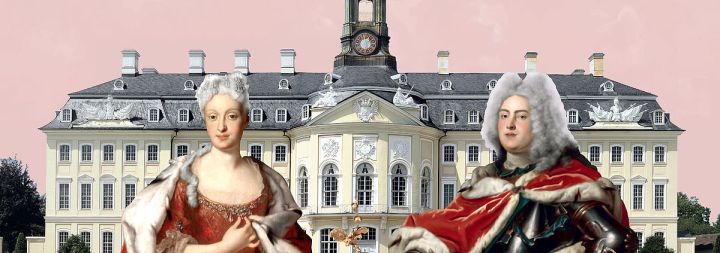
◊ ◊ ◊ ◊ ◊
Begun in 1721, Hubertusburg Palace—named for the patron saint of hunting—was the site of the signing of the 1763 Treaty of Hubertusburg that ended the Seven Years’ War. From the Staatliche Kunstsammlungen Dresden:
Frederick Augustus and Maria Josepha: The Wedding of the Century and Saxony’s Lost Rococo
Es war die Hochzeit des Jahrhunderts – Das verlorene sächsische Rokoko
Schloss Hubertusburg, Wermsdorf, 28 April — 6 October 2019
Outstanding rococo art and a glittering wedding of the century: two special exhibitions at Schloss Hubertusburg, one of Europe’s largest hunting palaces, invite you on a journey through time. When Elector Frederick Augustus (Friedrich August), the son of Augustus the Strong, married the emperor’s daughter Maria Josepha in Dresden in September 1719, the people of Europe were treated to the sight of operas, parades, masquerades, and all the other trappings of a late baroque festival.
In the first part of this exhibition, Staatliche Kunstsammlungen Dresden invite visitors to rediscover the royal couple’s court and Saxony’s Lost Rococo. The exhibition rooms in the palace’s old piano nobile hold over 100 high-profile works of art and precious examples of Saxon rococo that transport visitors back in time to the everyday courtly life of this royal couple who left a deep mark on the style of their times with their passion for music, art, and culture.
In the second part of the exhibition, which addresses the couple’s wedding, Schlösserland Sachsen breathes new life into now unadorned rooms of the palace which have been opened to the public for the first time. Video installations and a rotating 360° video screen return sections of the building to their former glory, allowing visitors to see them as they were once imagined and designed by Maria Josepha and Frederick Augustus II and invites guests to join in the grandiose celebrations at The Wedding of the Century.
A New Royal Couple for Saxony and Poland
The wedding of Frederick Augustus II and Maria Josepha was a one-month spectacle of late baroque festivities. With operas, parades and masquerades, the young royals knew how to put on an impressive show and establish Saxony and Poland’s joint position among the other European powers.

Louis de Silvestre and workshop, Elector Frederick Augustus, ca. 1730 (Rüstkammer/Staatliche Kunstsammlungen Dresden, photo by Elke Estel and Hans Peter Klut).
Courtly Culture and Splendour
The reign of Frederick Augustus and Maria Josepha was marked by their great passion for culture, art and music. Thanks to their patronage and collecting, the Kingdom of Saxony and Poland developed into a thriving cultural landscape.
Operas and Music at the Court
Frederick Augustus and Maria Josepha transformed the Saxon court into a European centre for music, and especially operas. Soon, everyone was talking about the performances at Schloss Hubertusburg, with their high-profile casts and elaborate costumes.
A Passion for Collecting and Hunting
Frederick Augustus and Maria Josepha shared a keen enthusiasm for hunting, a courtly pleasure combining sociable entertainment and princely splendour. The extensive royal collection of hunting weapons—hunting knives, rifles, and pistols—includes some masterpieces of rococo art.
Rococo Palace and Hunting Lodge
Augustus the Strong—Frederick Augustus’s father—commissioned the building of Schloss Hubertusburg for the young royal couple in 1721. The building complex, with its magnificent grounds, is one of the largest hunting palaces in Europe.
Family and Dynasty
Masterpieces of portraiture depict the great family of Frederick Augustus II and Maria Josepha. The princes and princesses established important diplomatic networks by marrying strategically within Europe.
Study Day | Ceramics as Sculpture

Pierre Giovanni Volpato, Personification of the River Nile, ca. 1785–95, hard-paste biscuit porcelain, Giovanni Volpato’s Factory Rome, 30 × 59 × 30 cm (New York: The Metropolitan Museum of Art; Purchase, The Isak and Rose Weinman Foundation Inc. Gift, 2001.456).
◊ ◊ ◊ ◊ ◊
From The French Porcelain Society:
Ceramics as Sculpture, French Porcelain Society Study Day
Masterpiece London, 28 June 2019
The French Porcelain Society is pleased to announce that it will be holding a study day entitled Ceramics as Sculpture, celebrating figurative art, at this year’s Masterpiece London, on Friday, 28 June 2019. The conference aims to open up wider discussion about the contemporary and historical contexts for ceramic sculpture and its place within art history. It also seeks to underline the primacy of sculpture in all the decorative arts, bringing together scholars, curators, artists, and dealers working in the interconnected fields of ceramics and sculpture. Tickets: £45 (includes free entrance to Masterpiece, lectures, tour, tea and coffee, and champagne reception), £20 (student concession). For additional information, please contact Caroline McCaffrey-Howarth, c.mccaffrey-howarth@leeds.ac.uk.
P R O G R A M M E
9.30 Registration
10.00 Welcome by Oliver Fairclough, FSA (Chairman of the French Porcelain Society) and introduction by Caroline McCaffrey-Howarth (V&A/RCA and University of Leeds)
10.10 Session One
• Federica Carta (PhD Candidate, Université de Picardie Jules Verne and at the Università degli Studi di Perugia), Ceramic Sculpture: Ornament and Figuration in the Chapels by Luca Della Robbia at Impruneta
• Antoine D’Albis (Former Chief Scientist at the Manufacture Nationale de Sèvres), La Source ou la Naïade en Porcelaine de Vincennes-Sèvres du Musée du Louvre, New Research
• Elizabeth Saari Browne (PhD Candidate, Massachusetts Institute of Technology), Sculpting le Goût Pittoresque: Clodion’s Bacchic Subjects
• Matthew Martin (Lecturer in Art History and Curatorship, University of Melbourne; Former Curator of International Decorative Arts at the National Gallery of Victoria, 2006–18), Porcelain and Sculptural Aesthetics: Untangling a Troubled Relationship
11.30 Tea and coffee
12.00 Session Two
• Alicia Caticha (PhD Candidate, University of Virginia), Casting Replication: Porcelain and Sculpture Networks in Eighteenth-Century Paris
• Tamara Préaud (Former Archivist of the Manufacture Nationale de Sèvres), Sculpture and Personal Creativity at Sèvres during the Second Empire, 1850–70
• Oliva Rucellai (Former Curator of the Museo Richard-Ginori della Manifattura di Doccia in Sesto Fiorentino, 2002–14), Gio Ponti and Ceramic Sculpture for Richard-Ginori: An Art Director’s Approach
• Martin Chapman (Curator in Charge, European Art, interim; Curator in Charge, European Decorative Arts and Sculpture, The Fine Arts Museum of San Francisco), Accident or Design? Ceramic Sculpture in San Francisco’s Legion of Honor
Thank you by Dame Rosalind Savill, DBE, FBA, FSA (President of the French Porcelain Society, Former Director of the Wallace Collection)
13.30 Lunch break
15.00 Private group tours to ceramics and sculpture stalls at the Masterpiece Fair
17.00 Champagne reception on the terrace
Summer School Program | Three Exhibitions at The Prado
From H-ArtHist:
Escuela de Verano: Tres exposiciones temporales en el Prado, Concepción y organización
Museo Nacional del Prado, Madrid, 8–10 July 2019
Applications due by 24 May 2019
La Escuela de Verano del Museo del Prado es una nueva iniciativa académica de la Escuela del Prado cuyo objetivo principal es abarcar aquellos aspectos de la formación de jóvenes historiadores del arte, futuros conservadores y gestores de museos que las Universidades no pueden cubrir con su programación y que solo se pueden abordar desde una institución como el Prado. Los cursos profundizarán en diversos temas relacionados con el Museo del Prado, sus colecciones, la museografía y la museología, y en distintos aspectos relativos a la gestión de esta gran institución museística, desde la investigación a la exposición de obras de arte o a la conservación de sus colecciones.
Coincidiendo con el Bicentenario del Museo y partiendo de tres de las grandes exposiciones temporales organizadas por el Prado en 2019: Fra Angelico y los inicios del Renacimiento en Florencia; Velázquez, Rembrandt, Vermeer. Miradas afines; y Solo la voluntad me sobra. Dibujos de Goya, el objetivo de esta edición de la Escuela de Verano es acercar a los alumnos al proceso de creación de una exposición desde el momento mismo de su concepción. Esta edición de la Escuela estará dirigida por José Manuel Matilla (Jefe del Área de Dibujos y Estampas del MNP ) y Alejandro Vergara (Jefe del Área de Pintura Flamenca y Escuelas del Norte (hasta 1700) del MNP ). Los alumnos tendrán la oportunidad de recibir la información directamente de los profesionales de distintas disciplinas involucrados en el proceso de una exposición –diseñadores, restauradores, coordinadores de exposición, …- y de poder aprender a través del contacto directo con las obras de arte. El reducido número de alumnos permitirá un contacto directo con el claustro de profesores, y a la vez lograr una participación activa en un ambiente dinámico de recíproca colaboración entre profesores y alumnos.
La Escuela de Verano se desarrollará durante tres días consecutivos, en sesiones que combinarán clases teóricas y clases prácticas que consistirán en visitas a diversos espacios del Museo del Prado como las Salas de Exposiciones Temporales y Permanente, los Talleres de Restauración y los Almacenes de obras de arte, o el Gabinete de Dibujos y Estampas, entre otros.
La Escuela de Verano es una actividad gratuita gracias a la colaboración de la Fundación Banco Sabadell. El plazo de inscripción es de 30 de abril al 24 de mayo de 2019. El número máximo de alumnos admitidos en la Escuela de Verano será de 30 (en dos grupos de 15 participantes por grupo). Los aspirantes no deben superar los 30 años y deben estar en el último año del grado o ser estudiantes de postgrado. No se admitirán candidatos que posean una nota media inferior a notable en el grado. Consultas: escuela.prado@museodelprado.es.
Exhibition | Solo la voluntad me sobra: Drawings by Goya
Opening this fall at The Prado:
Solo la voluntad me sobra: Dibujos de Goya
Museo Nacional del Prado, Madrid, 19 November 2019 — 16 February 2020
Curated by José Manuel Matilla and Manuela Mena
 This exhibition is the result of the research undertaken for the publication of a new catalogue raisonné of Goya’s drawings, as a result of the collaboration agreement signed in 2014 between the Fundación Botín and the Museo del Prado. Since the publication of Gassier’s catalogue in 1973 the number of drawings attributed to Goya has changed, giving rise to the need for a new catalogue raisonné which updates the enormous body of information accumulated over the course of two centuries of literature on this subject.
The exhibition will bring together more than 100 drawings by Goya from the Prado’s own collections and from public and private ones around the world. It will be presented as a chronological survey of his work that includes drawings from throughout his career, ranging from the Italian Sketchbook to the Bordeaux Albums. It will also offer an up-to-date vision of the ideas that recurrently appear in Goya’s work, revealing the ongoing and long-lasting relevance of his thinking. The exhibition is curated by José Manuel Matilla (Museo Nacional del Prado Senior Curator Drawings and Prints) and Manuela Mena (Museo del Prado Senior Curator Eighteenth-Century Painting).
Exhibition | The Master of Paper: Spanish Drawing Books

Opening this fall at The Prado:
The Master of Paper: Spanish Drawing Books of the 17th and 18th Centuries
El maestro de papel: Cartillas españolas para aprender a dibujar de los siglos XVII y XVIII
Museo Nacional del Prado, Madrid, 15 October 2019 — 2 February 2020
Curated by José Manuel Matilla and María Luisa Cuenca
This exhibition will place particular emphasis on Spanish drawing manuals of the 17th and 18th centuries, locating them in their international context. Although few in number they are particularly important, not just because they rapidly reflected this new tradition in art but also because they are notably from the outset for their distinctive Spanish and on occasions innovative character, as well as for the presence of unique elements that denote their national origin. Notable among Spanish artists in this field are Pedro de Villafranca y Malagón and prior to him, José de Ribera. Also notable are the manuals by José García Hidalgo, Friar Matías de Irala and José López Enguídanos.
The exhibition is curated by José Manuel Matilla, Museo Nacional del Prado Senior Curator Drawings and Prints and María Luisa Cuenca, Head of Library, Archive and Documentation Department at Museo Nacional del Prado.










 Enfilade
leave a comment