Call for Papers | Artisans of the Surface in Early Modern Europe
From H-ArtHist:
Artisans of the Surface in Early Modern Europe, 1450–1750
King’s College London, 20–21 September 2018
Proposals due by 8 June 2018
This workshop focuses on the practices of a range of artisans (tailors, barbers, cooks, cheesemakers, gardeners, and agronomists) and their relationships with the fields of meteorology, botany, natural history, medicine, earth sciences, and veterinary medicine. These artisans and their practices shared a set of skills related to the observation and manipulation of human and non-human surfaces. We will explore how, and if, practical knowledge about the surface of things and bodies (and their storage and preservation in relation to specific environmental conditions) led to the concept of nature and matter as composed of layers, and how such a framework contributed to the demise of traditional Galenic and Aristotelian views on nature.
This workshop also aims at getting past the dichotomies between quantitative and qualitative knowledge and between natural philosophy and the arts, and so we intend to broaden the focus to include a set of artisans who have traditionally remained invisible from accounts of this ‘age of the new’. We will explore the many different ways in which ‘modern science’ emerged, the relationships between social and cognitive practices, and the contribution that non-mathematical sciences gave to the mental habits of observing, collecting, experimenting with, and manipulating natural matter.
We welcome proposals, in particular, that address the relationships between gardening, natural history, and medicine; cooking and knowledge; work on animal skin; leatherwork; or veterinary medicine. Proposals (up to 250 words) for 20-minute papers should be sent to Paolo Savoia at renaissanceskin@kcl.ac.uk by 8 June 2018.
New Book | The Queen’s Embroiderer
From Bloomsbury:
Joan DeJean, The Queen’s Embroiderer: A True Story of Paris, Lovers, Swindlers, and the First Stock Market Crisis (London: Bloomsbury, 2018), 400 pages, ISBN: 978-1632864741, £30.
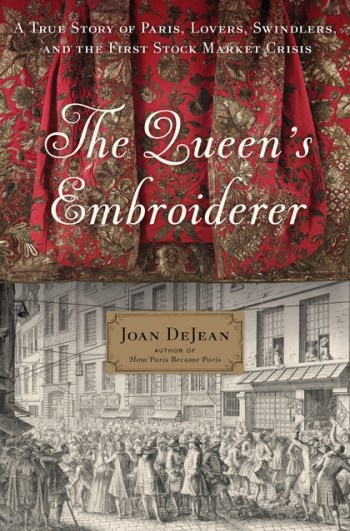 From the author of How Paris Became Paris, a sweeping history of high finance, the origins of high fashion, and a pair of star-crossed lovers in 18th-century France.
Paris, 1719. The stock market is surging and the world’s first millionaires are buying everything in sight. Against this backdrop, two families, the Magoulets and the Chevrots, rose to prominence only to plummet in the first stock market crash. One family built its name on the burgeoning financial industry, the other as master embroiderers for Queen Marie-Thérèse and her husband, King Louis XIV. Both patriarchs were ruthless money-mongers, determined to strike it rich by arranging marriages for their children.
But in a Shakespearean twist, two of their children fell in love. To remain together, Louise Magoulet and Louis Chevrot fought their fathers’ rage and abuse. A real-life heroine, Louise took on Magoulet, Chevrot, the police, an army regiment, and the French Indies Company to stay with the man she loved.
Following these families from 1600 until the Revolution of 1789, Joan DeJean recreates the larger-than-life personalities of Versailles, where displaying wealth was a power game; the sordid cells of the Bastille; the Louisiana territory, where Frenchwomen were forcibly sent to marry colonists; and the legendary ‘Wall Street of Paris’, Rue Quincampoix, a world of high finance uncannily similar to what we know now. The Queen’s Embroiderer is both a story of star-crossed love in the most beautiful city in the world and a cautionary tale of greed and the dangerous lure of windfall profits. And every bit of it is true.
Joan DeJean is Trustee Professor at the University of Pennsylvania. She is the author of ten books on French literature, history, and material culture, including most recently The Age of Comfort: When Paris Discovered Casual and the Modern Home Began and The Essence of Style: How the French Invented High Fashion, Fine Food, Chic Cafés, Style, Sophistication, and Glamour. She lives in Philadelphia and, when in Paris, on the street where the number 4 bus began service on July 5, 1662.
Symposium | Collecting Murillo in Britain and Ireland
From The Wallace Collection:
Collecting Murillo in Britain and Ireland
The Wallace Collection, London, 14 May 2018

Bartolomé Esteban Murillo, The Annunciation, ca.1665–70 (London: The Wallace Collection, P68).
“Oh wonderful Spain. Think of this romantic land covered in Moorish ruins and full of Murillos.” Benjamin Disraeli’s 1830 letter attests to the prominent of Murillo in the minds British travellers and collectors. In celebration of the 400th anniversary of Bartolomé Esteban Murillo’s birth, the Wallace Collection, in collaboration with the Centro de Estudios Europa Hispanica, will be exploring this further by hosting an international one-day symposium on Monday, 14th May 2018 entitled Collecting Murillo in Britain and Ireland. Speakers include Thierry Morel, Veronique Gerard Powell, Xanthe Brooke, Hugh Brigstocke, Isabelle Kent, Xavier Bray, Claudia Hopkins, Thomas Bean, Hilary Macarney and Philip McEvansoneya. The papers delivered will form the basis of a new volume on the subject which will be published by CEEH.
Registration is available here»
P R O G R A M M E
9.30 Registration
9.50 Welcome
10.00 Session 1 | Early Displays of Works by Murillo in Britain
• Thierry Morel (Director and Curator at Large, Hermitage Museum Foundation), Sir Robert Walpole’s Spanish Pictures
• Véronique Gerard Powell (Honorary Senior Lecturer, Sorbonne University), From Lord Godolphin to John Blackwood and Lawrence Dundas: The First British Purchasers of Murillo
11.00 Tea and coffee
11.30 Session 2 | British Collectors in Seville and Madrid
• Xanthe Brooke (Curator of Continental European Art, Walker Art Gallery), Collecting Murillo in Seville: The Case of Julian Benjamin Williams (d.1866) and Frank Hall Standish (1799–1840)
• Hugh Brigstocke (Independent scholar), William Eden: The Discovery of Murillo with his Friends in Spain, Travel and Collecting
• Isabelle Kent (Enriqueta Harris Frankfort Curatorial Assistant, The Wallace Collection), The Curious Case of General Meade (1775–1849): His Collection in Madrid and Its Dissemination
13.00 Break for lunch
14.00 In-Situ Talk in the Great Gallery
• Xavier Bray (Director, The Wallace Collection) and Isabelle Kent, William Buchanan and James Irvine
14.30 Session 3 | Artists and Scholars, Travellers to Spain
• Claudia Hopkins (Lecturer, University of Edinburgh), ‘All Softness’: Murillo through British Artists’ Eyes
• Thomas Bean (Independent scholar), Hand-Book for Travellers in Spain and Richard Ford
• Hilary Macartney (Lecturer, University of Glasgow), Accessing Murillo: Stirling Maxwell’s Contribution to Scholarship, Collecting, and Taste in Britain
16.00 Session 4 | Other Major Collectors
• Philip McEvansoneya (Lecturer, Trinity College Dublin), Collecting and Displaying Murillo in Ireland
Conference | Structuring Fashion: Foundation Garments
From H-ArtHist and the Bavarian National Museum:
Structuring Fashion: Foundation Garments through History
Bayerisches Nationalmuseum, Munich, 13–14 September 2018
Organised by Johannes Pietsch and Jenny Tiramani
Registration due by 30 June 2018
 This conference will focus on undergarments that have shaped fashionable silhouettes. It will cover a broad timespan from the Middle Ages up to the 21st century. Conducted in English, the event will be held in Munich to celebrate a special exhibition and the launch of an exciting new book. The Bayerisches Nationalmuseum preserves the world-famous pair of silk bodies worn by Countess Palatine Dorothea Sabina around 1598. This extremely rare garment will be presented to the public exclusively from September to December 2018, coinciding perfectly with the publication of this pair of bodies in the new volume of the Janet Arnold series Patterns of Fashion 5: The Cut and Construction of Bodies, Stays, Hoops and Rumps, c.1595–1795, presenting over 40 garments in great detail. Internationally renowned experts including Valerie Steele (FIT New York), Alexandra Palmer (ROM Toronto), Peter McNeil (UTS Sydney), Amalia Descalzo (ISEM Madrid), and Denis Bruna (MAD Paris) will be among the speakers of the conference.
Seats are limited to 160 (and only 50 for the excursion), so anyone planning to participate should register soon. Registration ends on 30 June 2018.
T H U R S D A Y , 1 3 S E P T E M B E R 2 0 1 8
9:30 Morning Session
• Jenny Tiramani, Patterns of Fashion and Un-Fashion
• Beatrix Nutz, ‘Petites mameletes, … Dures comme pumete’: Shaping the Medieval Ideal of Beauty
• Amalia Descalzo Lorenzo, Spanish Artificial Undergarments in the Habsburg Period
• Johannes Pietsch, Establishing Identity: Stays and Bodices in Germany, 1600–1800
13.15 Lunch break
14:15 Afternoon Session
• Denis Bruna, Early 18th-Century Panniers in Contemporary Sources
• Sébastien Passot, From Garsault to the Encyclopedia: The Mechanical Construction of Hoops and Stays in 18th-Century French Literature
• Peter McNeil, ‘Conspicuous Waist’: From Macaroni Men to the ‘Despots of Fashion’, 1760–1830
• Thessy Schoenholzer Nichols, Bodice for an Active Life: It Does Not Have to Be ‘Hard to Hold’—Case Histories of Female Upper Dresses, from the Late Middle Ages to the 18th Century, in Italy
17:15 Guided tours
20:00 Evening event
F R I D A Y , 1 4 S E P T E M B E R 2 0 1 8
9:00 Morning Session
• Adelheid Rasche, Crinolonomania and More: Caricatures on Hoop Petticoats
• Pernilla Rasmussen, Robe the Cour at the Swedish Court
• Luca Costigliolo, The Evolution of the Drafting Method of Patterns for Bodies, Stays, and Corsets
11:15 Lunch break and guided tours
15:15 Afternoon Session
• Kerstin Hopfensitz, From Heubach to the World: A Centre of German Corset Production
• Alexandra Palmer, The Origin of the Species: Christian Dior’s New Look Woman
• Valerie Steele, The Corset in Modern Fashion
On Saturday, 15 September, an additional excursion to the Miedermuseum will be offered; this small museum dedicated to corsetry is situated in Heubach, a former centre of the European corset industry.
Nationalmuseum Sweden Acquires Mirror from the 1690s
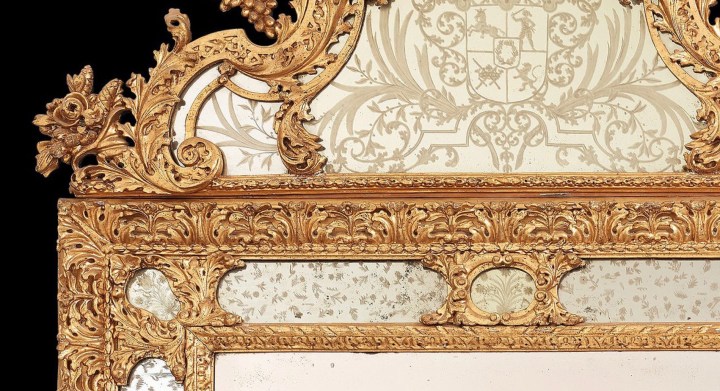
Attributed to Burchard Precht, mirror, 1690s (Stockholm: Nationalmuseum, NMK 114/2017; photo by Bukowskis).
◊ ◊ ◊ ◊ ◊
Press release (17 April 2018) from the Nationalmuseum in Stockholm:
A mirror just acquired by Nationalmuseum is among the most magnificent examples of Swedish Baroque ever produced. The ornately carved and gilded frame contains engraved, inset plate glass. The mirror’s unusually well-documented origins go back to the initial commission.
Count Wrede (1641–1712) was a top official who had earned the unwavering trust of King Karl XI. Following a career as Viborg County Governor, he contributed to preparations for the compulsory restitution of alienated estates in 1680. He was the Lord Marshall for the 1682 session of the Parliament. He subsequently held a number of prominent official positions. Promoting mercantilism in the private sector was among Wrede’s obsessions. It wasn’t long before he was elevated to countship and became one of the wealthiest Swedes alive. His political fortunes declined, however, after he advocated a more defensive military policy than Karl XII was pursuing. In 1711, he was pushed out of nearly all his positions.

Attributed to Burchard Precht, mirror, 1690s (Stockholm: Nationalmuseum, NMK 114/2017; photo by Bukowskis).
The frame of the large, 195-centimetre mirror features a lace border, acanthus, cornucopia, grape clusters and flowers. The inset plate glass is adorned with engraved, scattered flowers. The top of the mirror brandishes a meticulously engraved coat of arms for the Wrede lineage. Though not signed, the mirror is most certainly the handiwork of Burchard Precht (1651–1738). As the leading sculptor of his day, he received many royal and ecclesiastical projects, often in collaboration with court architect Nicodemus Tessin the Younger. Born in Bremen and educated in Hamburg, he emigrated to Stockholm in the 1670s. His workshop produced furniture, frames and crests for the court and nobility. The evidence strongly suggests that he was able to polish and silver glass. No wonder he is regarded as one of the first Swedish mirror craftsmen. The high quality of plate glass is due to the requirement back then that mirrors be imported.
Engraving the glass with an artistic touch was a daunting challenge. The technique had been resurrected in Europe during the early seventeenth century and had become a coveted skill. A handful of engravers passed through Sweden from the 1650s to 1680s. After Kristoffer Elstermann arrived in the 1690s, engraving assumed its rightful place in the Swedish glassmaking tradition. The first time Elstermann shows up in the accounts is 1691, when he received an order from Queen Dowager Hedvig Eleonora for the new royal chapel at the Tre Kronor castle. He had his own workshop and later obtained projects from the Kungsholm Glassworks as well. He was skilful at engraving various motifs that went well with the surface and shape of the particular object. He exerted a major influence on Swedish engraving until his death in 1721. The glassworks have never produced such high-quality engravings as during that period.
The panels in the frame of the Wrede mirror have the same types of scattered flowers as the glasswork used, but their placement is less standardized than later on. The noble coat of arms at the top typifies the dexterity of Elstermann’s works. More than likely, he engraved it himself. Precht’s mirrors also became more streamlined and formulaic as time went on. Cast pewter strips replaced sculptured wood, and the engraved adornment of the frame was painted white. No portents of such austerity are visible in this mirror, which is why it can be dated with so much exactitude to the 1690s.
Wrede’s impact on the appearance of the mirror cannot be overestimated. It’s hard to miss signs of his close association with the court and contemporary vogues, including new ornamentation techniques and Precht’s carved, gilded furniture. He had the financial resources to purchase such an exquisite object, and the cornucopia is a nod to his mercantilist inclinations. The same mindset no doubt convinced him that the mirror should be produced in Sweden to the extent possible.
The records clearly show that his daughter Sophia inherited the mirror when she married Erik Axelsson Sparre in 1707. It has been passed down from generation to generation ever since.
Acquisition of the mirror by Nationalmuseum was made possible by an Axel Hirsch endowment. The museum has no funds with which to purchase handicrafts and works of art but is wholly reliant on donations and private foundations.
Exhibition | The Chocolate Girl by Liotard
On view this fall at the Zwinger in Dresden:
‘The Most Beautiful Pastel Ever Seen’: The Chocolate Girl by Jean-Étienne Liotard
Zwinger, Staatliche Kunstsammlungen Dresden, 28 September 2018 — 6 January 2019

Jean-Étienne Liotard, The Chocolate Girl, ca. 1744–45 (Dresden: SKD, Gemäldegalerie Alte Meister).
The exhibition focuses on one of the most famous works in the collection of the Dresden Gemäldegalerie, The Chocolate Girl by the Swiss artist Jean-Étienne Liotard (1702–1789). Liotard enjoyed enormous success as a pastel painter; even Rosalba Carriera, whose mastery of the medium had helped transform it into a serious and highly-admired art form, declared The Chocolate Girl to be “the most beautiful pastel ever seen.”
It was thanks to the art dealer Count Francesco Algarotti, who purchased the picture in Venice in 1745, buying it directly from the artist for the Dresden collection of Augustus III, that the gallery first began to show works by contemporary artists. The pastel medium suited the Rococo taste for lifelike, brilliant portraits and allowed Liotard to create flawless, porcelain-smooth surfaces. The great popularity of the picture, however, also rests on the fact that it depicts a simple, unidentified housemaid, a hitherto rare motif. The clear-eyed precision of Liotard’s observation anticipated not only the art of the Enlightenment but also nineteenth-century Realism.
Equally worthy of mention are the countless adaptations and appropriations of the motif for other, often trivial purposes. Of no less interest is the eccentric painter himself. A true cosmopolitan, he travelled far and wide, sported a luxuriant beard, exotic clothing and a turban and called himself ‘Le peintre turc’. The exhibition’s epilogue showcases Hann Trier’s take on Liotard’s masterpiece. Painted in 1991, Trier’s three-part sequence La Tasse au chocolat, reinterpreted The Chocolate Girl for the twentieth century.
Stephan Koja and Roland Enke, eds., ‘The Most Beautiful Pastel Ever Seen’: The Chocolate Girl by Jean-Étienne Liotard in the Dresden Gemäldegalerie (Munich: Hirmer Verlag, 2018), 272 pages, ISBN: 978-3777431369, $42.
A full press release is available via Art Daily.
◊ ◊ ◊ ◊ ◊
Note (added 28 September 2018) — The posting was updated to include details of the catalogue and a link to the press release.
Exhibition | The Grand Cure, 1738–1740
From the exhibition flyer:
The Grand Cure, 1738–1740: A Disabled Saxon Prince and His Tour of Italy
Die Grande Kur, 1738–1740: Prinz Friedrich Christian Von Sachsen auf der Suche Nach Heilung und Kultur in Italien
Grünes Gewölbe / Green Vault, Residenzschloss, Staatliche Kunstsammlungen Dresden, 9 May — 19 August 2018
Curated by Maureen Cassidy-Geiger
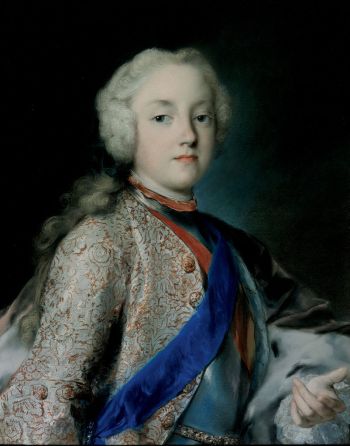
Rosalba Carriera, Crown Prince Friedrich Christian of Saxony, 1740, pastel on paper, 63.5 × 51.5 cm (Dresden, SKD, Gemäldegalerie Alte Meister; photo by Hans Peter Klut/Elke Estel).
This is the first exhibition to be devoted to Elector Friedrich Christian of Saxony (1722—1763), who succeeded King August III in 1763 for just 74 days. Given his brief reign, few are aware of the prince’s profound physical disabilities, akin to cerebral palsy, which prevented him from standing or walking without assistance and made simple tasks like eating and dressing difficult. The marriage of his sister Maria Amalia to the King of Naples in May 1738 inspired their parents to send the fifteen-year-old heir to the throne on an impromptu journey to Italy, for life-saving medical treatments. This exceptional two-year adventure was amply documented, allowing us to precisely reconstruct the prince’s route and daily experiences as he travelled from Dresden to Naples, Rome, Florence, Milan, and Venice. Like the able-bodied Grand Tourists he met along the way, he also travelled incognito with an entourage, enjoyed celebrity status, and collected art, relics, books, and ephemera for shipment home. Some of the Italian gifts and souvenirs have been identified in museums, archives and libraries and are presented in the intimate setting of the Sponselraum.
August the Strong and August III both made Grand Tours as teenagers, with the court of Louis XIV and carnival in Venice as their primary targets. Friedrich Christian, by contrast, went to Italy as a medical tourist. Although he would never be cured, the mineral baths and holistic treatments administered abroad did soothe and strengthen the prince’s atrophied limbs, allowing him to regain the use of his left hand, bear his own bodyweight and walk short distances with two canes. Of necessity, however, he was mostly carried around Italy in a porte-chaise (sedan chair), even ascending the Leaning Tower of Pisa in this manner. Since there was no precedent for portraying a disabled heir to the throne, the Crown Prince was chronicled and painted conventionally, as able-bodied, and even thought of himself as such. A glimpse of his handicap is shown in the view of his arrival at Venice in 1739, but it was not until 1761, while in exile in Munich during the Seven Years’ War, that he was portrayed in a wheelchair. With his premature death from smallpox at the age of 41, however, the Elector’s great promise went unfulfilled.
Maureen Cassidy-Geiger, Die Grande Kur, 1738–1740: Prinz Friedrich Christian Von Sachsen auf der Suche Nach Heilung und Kultur in Italien / The Grand Cure, 1738–1740: A Disabled Saxon Prince and His Tour of Italy (Dresden: Staatliche Kunstsammlungen Dresden, 2018), 52 pages, ISBN: 978-3000596810 (German and English text).
Note (added 26 June 2018) — The posting was updated to include details for the booklet accompanying the exhibition.
Conference | Collage, Montage, Assemblage, 1700–Present
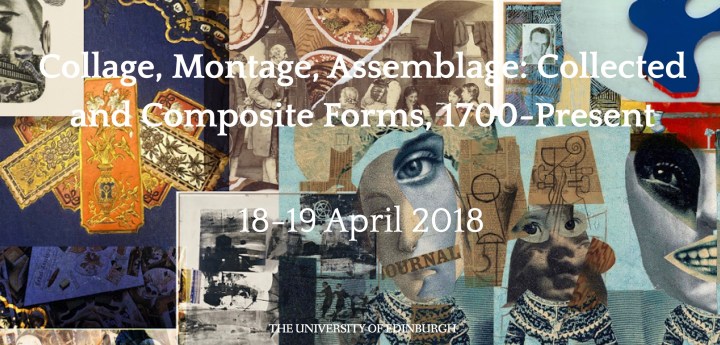
From the conference website:
Collage, Montage, Assemblage: Collected and Composite Forms, 1700–Present
University of Edinburgh, 17–19 April 2018
Organized by Cole Collins and Freya Gowrley
T U E S D A Y , 1 7 A P R I L 2 0 1 8
14.00 Registration and Coffee
14.15 Exhibiting Collage
In Conversation: FREYA GOWRLEY and PATRICK ELLIOT
15.00 Collage in the Museum and Archive
ALLAN MADDEN (The University of Edinburgh), Piecing Together the Narrative: Une semaine de bonté in the library, the archive and the gallery
BRIDGET MOYNIHAN (The University of Edinburgh), Scrappy Contexts: Archival and Digital Interventions on the Edwin Morgan Scrapbooks
15.45 Collage and Subjecthood
TOM DAY (The University of Edinburgh), Jeff Keen, Pop Film Collagist
COLE COLLINS (The University of Edinburgh), Collage as Feminist Strategy and Methodology
17.00 Wine Reception
W E D N E S D A Y , 1 8 A P R I L 2 0 1 8
9.00 Registration and Coffee
9.35 Keynote
LUCY PELTZ (National Portrait Gallery, London), Facing the Text: An Introduction to Extra- Illustration in Britain from the Eighteenth to the Twentieth Century
10.40 Panel 1 | Publications
KAREN DI FRANCO (University of Reading and Tate Britain), The alchemical, the instruction, and the cut up: The performance of collage in the writing of Ithell Colquhoun, Carolee Scheemann, and Kathy Acker
HANNAH VINTER (Kings College London), Historical engagement as textual collage in Ursula Krechel’s Landgericht
ALISON HORGAN (University of Sheffield), ‘Gaudy colours’ and ‘disfigur’d shapes’: The patchwork and Thomas Percy’s Reliques of Ancient English Poetry (1765)
TOBIAS VOGT (Freie Universität, Berlin), Collage avant la lettre: Printed materials in drawings before 1900
10.40 Panel 2 | Bodies
LISA LEE (Emory University), Primal Gestures: Thomas Hirschhorn’s Ur-Collages
GRÁINNE RICE (The University of Edinburgh), ‘I can’t see the joins’: Collage and cut-up bodies in the work of Steven Campbell (1953–2007)
KATHERINE ISELIN (University of Missouri- Columbia), Erotic Aesthetics in Collage Inspired by Giulio Romano’s I Modi
KATIE ANANIA (Harvard University and Hunter College New York), Wheat Paste and Poor Taste: Carolee Schneemann’s Paper Performances, 1966–68
12.25 Lunch
13.25 Panel 3 | Materialities
CATRIONA MACLEOD (University of Pennsylvania), Writing with Scissors: Romantic Collage Poetics
LUCIE WHITMORE (University of Glasgow), Chic rag-and-tatter modes’: Remnant Fashions 1914–18
STEPHANIE KOSCAK (Wake Forest University), A Royal Tête-a-Tête: Decorating (and Decorating with) Engraved Pictures of Kings and Queens in Eighteenth-Century England
EKATERINA KOCHETKOVA (Lomonosov Moscow State University), Assemblage as Method of Garden-Making: The Case of Ian Hamilton Finlay
13.25 Panel 4 | Intimacies, Collaborations, and Emotions
BETHAN BIDE (Middlesex University), Stitching yourself back together: Finding memory, emotion, and creativity in the composite garments made under the ‘Make Do and Mend’ scheme in WW2 Britain
ROGER ROTHMAN (Bucknell University), Topographie Anecdotée du Hasard: A Multi-Authored Literary Collage
MAYA WASSELL SMITH (Cardiff University and National Maritime Museum), Cigarette Cards and the Sentimental: Sailor Collage in the Long Nineteenth Century
MADELEINE PELLING (University of York), ‘Your Affectionate Queen’: Queen Charlotte, Mary Delany, and the Art of Friendship
15.05 Coffee
15.35 Panel 5 | Legacies and Influences
FREYA GOWRLEY (Institute of Advanced Studies, Edinburgh), Reflective and Reflexive Forms: Intimacy and Medium Specificity in British and American Sentimental Albums, 1780–1850
IRENA KOSSOWSKA (Copernicus University in Torun and Polish Academy of Sciences in Warsaw), Modernist Synethesia and a Dialog with the Old Masters: Polish Photo-Collage and Photomontage of the 1930s
TALIA KWARTLER (The Museum of Modern Art, New York), Suzanne Duchamp’s Dada Collages, 1916–21
REBECA ACOSTA (Humboldt Universität, Berlin), ‘Composite Johnson’: Renderings of Samuel Johnson by John Hawkins and Vladimir Nabokov
15.35 Panel 6 | Technologies and Digitality
LUCY WHITEHEAD (Cardiff University), ‘Inlaid’ and ‘Intercalated’: Victorian Biography as Collage Form
BROOKE LEETON (University of Georgia), Meaning and/in Digital Collage
CRAIG BUCKLEY (Yale University), An Architecture of Clippings: Reyner Banham and the Redefinition of Collage
CAITLIN WOOLSEY (Yale University), Imaging Orality in the Sound and Visual Collages of Henri Chopin
17.30 Performance
FLORIAN KAPLICK, Kurt / ANNA \ Paul
A recital collage using texts from Kurt Schwitters and Paul Auster
18.30 Wine Reception
T H U R S D A Y , 1 9 A P R I L 2 0 1 8
9.00 Registration and Coffee
9.15 Panel 7 | Identities
RACHEL MIDDLEMAN (California State University, Chico), Collage as a Feminist Strategy in the Work of Anita Steckel
SUSAN LAXTON (University of California, Riverside), Psicofotógrafa: Grete Stern and the Administration of the Unconscious
KATE SCHNEIDER (University of Cambridge), A Short History of Postwar Reconstruction via Humphrey Jennings’s Swiss Roll Collages
BEATRIZ MANTEIGAS (University of Lisbon), Collage on the Life and Work of R.B. Kitaj
9.15 Panel 8 | Intermedialities
PATRICIA ZAKRESKI (University of Exeter), A Patchwork Novel: Tessellation and Women’s Writing in the 1870s
FLORIAN KAPLICK (Musician and Speech Performance Artist), Composing collages with texts and collaging compositions with music
CHRISTINA MICHELON (University of Minnesota, Twin Cities), Printcraft: Reclaiming and Renaming Early Collage Practices
DAVID NELSON (University of Pennsylvania), City of Paper: The Materiality of Montage in Alfred Döblin’s Berlin Alexanderplatz
10.55 Coffee
11.25 Panel 9 | Ethnographies and Geographies
ORLA FITZPATRICK (National Museum of Ireland), From the medieval to the modern: Decoration, collage, and photography in the album work of Lady Louisa Tenison (1819–1882)
MOLLY DUGGINS (National Art School, Sydney), Crafting the Colonial Environment through Album Assemblage
JOANNA PAWLIK (University of Sussex), Collaging Surrealism in Ted Joans’ The Hipsters (1961)
DEBRA HANSON (Virginia Commonwealth University in Qatar), Interventions: Collage, Black Bodies, and a New History of Modernism
13.10 Lunch
14.15 Panel 10 | Display and Dissemination
COLE COLLINS (The University of Edinburgh), Loss of Texture: Displaying the Collages of Kurt Schwitters
ROCÍO ROBLES TARDÍO (Universidad Complutense de Madrid), Mies van der Rohe: Working with Collage, Thinking about Replicas, 1939–43
KAYLEE ALEXANDER (Duke University), Cut, Copy, Paste: A Truthful Picture of the Paris Catacombs
14.15 Panel 11 | Historiographies
JESSICA BARNESS and STEVEN MCCARTHY (Kent State University and University of Minnesota, Twin Cities), Coding and Decoding: Collage as Communication Design Scholarship
ZOE KINSLEY (Liverpool Hope University), Coherence and Customisation in the Scrapbooks of Dorothy Richardson (1748–1819)
MATTHEW BOWMAN (University of Suffolk), Collage as Model
SAMUEL BIBBY (Art History), ‘How to present your ideas effectively and make them stick’: Historiography as Collage
16.00 Keynote
ADRIAN SUDHALTER (Art Historian and Curator, New York), The Museum of Modern Art’s 1948 Collage Exhibition
17.00 Closing Remarks
Reading and Conference | Walpole’s ‘The Mysterious Mother’
Presented by the Lewis Walpole Library and the YCBA:
Horace Walpole’s The Mysterious Mother: A Staged Reading
Yale Center for British Art, New Haven, 2 May 2018
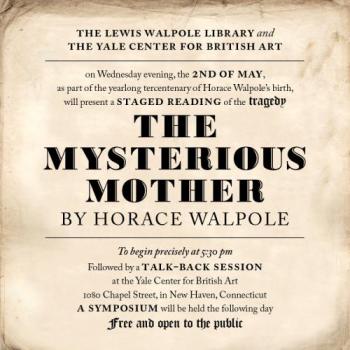 As part of the year-long celebrations of the tercentenary of Horace Walpole’s birth, the Lewis Walpole Library and the Yale Center for British Art are collaborating to present a staged reading of The Mysterious Mother—abridged by David Worrall (Emeritus Professor of English at Nottingham Trent University) and directed by Misty G. Anderson (ReLindsay Young Professor of English, University of Tennessee). Completed just a few years after Walpole’s celebrated gothic novel The Castle of Otranto (1764), this under-appreciated tale of incest and intrigue was initially circulated only among the author’s friends. Walpole never permitted it to be performed during his lifetime except as a private theatrical. Following the reading there will be a talk-back session moderated by Catherine Sheehy (Professor of the Practice of Dramaturgy and Dramatic Criticism, Yale University). This event is free and open to the public. Wednesday, 2 May 2018, 5:30pm, Yale Center for British Art.
◊ ◊ ◊ ◊ ◊
Horace Walpole’s The Mysterious Mother: A Mini-Conference
Yale Center for British Art, New Haven, 3 May 2018
Organized by Jill Campbell and Cynthia Roman

Diana Beauclerk (1724–1808), The Mysterious Mother, Act 3d, Scene 3, 1776 (The Lewis Walpole Library, Yale University).
10:00 Reading The Mysterious Mother
Chair: Jill Campbell, Professor of English, Yale University
• Nicole Garret, Lecturer, Department of English, SUNY Stony Brook
• Cheryl Nixon, Associate Provost, Associate Professor, Department of English, University of Massachusetts, Boston
•Matthew Reeve, Associate Professor Art History, Queen’s University
• Dale Townshend, Professor of Gothic Literature, Manchester Metropolitan University
• Nicole Wright, Assistant Professor, University of Colorado, Boulder
12:00 Lunch
1:15 Breakout session with Cynthia Roman, Curator of Prints, Drawings, and Paintings, The Lewis Walpole Library, to view Diana Beauclerk’s drawings of The Mysterious Mother. Attendance is limited, and advance registration is required.
2:00 Staging The Mysterious Mother
Chair: Misty Anderson, Lindsay Young Professor of English, University of Tennessee
• Al Coppola, Associate Professor of English, John Jay College, CUNY
• Marcie Frank, Professor of English, Concordia University
• Judith Hawley, Professor of English, Royal Holloway, University of London
• Jean Marsden, Professor of English, University of Connecticut
• David Worrall, Professor Emeritus, Nottingham Trent University
New Book | Poetry and the Idea of Progress, 1760–1790
From Anthem Press:
John Regan, Poetry and the Idea of Progress, 1760–1790 (London: Anthem Press, 2018), 222 pages, ISBN 9781783087723, £70 / $115.
 Poetry and the Idea of Progress, 1760–1790 explores under-examined relationships between poetry and historiography in the eighteenth century, deepening our understanding of the relationship between poetry and ideas of progress with sustained attention to aesthetic, historical, antiquarian, and prosodic texts from the period. Its central contention is that the historians and theorists of the time did not merely instrumentalize verse in the construction of narratives of human progress, but that the aesthetics of verse had a kind of agency—it determined the character of—historical knowledge of the period. With numerous examples from poems and writing on poetics, Poetry and the Idea of Progress, 1760–1790 shows how the poetic line became a site at which one could make assertions about human development even as one experienced the expressive effects of metred language.
John Regan is a research fellow in English literature at the University of Cambridge. His research interests centre on the cultural dialogue between poetics and historical writing in the long eighteenth century.
C O N T E N T S
List of Figures
Acknowledgements
Introduction
1 Progress by Prescription
2 Thomas Sheridan and the Divine Harmony of Progress
3 ‘There Is a Natural Propensity in the Human Mind to Apply Number and Measure to Every Thing We Hear’: Monboddo, Steele and Prosody as Rhythm
4 ‘[C]ut into, distorted, twisted’: Thomas Percy, Editing and the Idea of Progress
5 ‘Manners’ and ‘Marked Prosody’: Hugh Blair and Henry Home, Lord Kames
Afterword: Rude Manners, ‘Stately’ Measures: Byron and the Idea of Progress in the New Century
Conclusion
Notes
Bibliography
Index










 Enfilade
leave a comment