Exhibition | Religion in Early America
From the Smithsonian:
Religion in Early America
National Museum of American History, Washington, D.C., 28 June 2017 — 3 June 2018

Thomas Jefferson’s private text, The Life and Morals of Jesus of Nazareth—colloquially known as the Jefferson Bible (Smithsonian’s National Museum of American History; photo by Hugh Talman).
The role of religion in the formation and development of the United States is at the heart of this one-year exhibition that explores the themes of religious diversity, freedom, and growth from the colonial era through the 1840s. National treasures from the Museum’s own collection are on view, such as George Washington’s christening robe from 1732, Thomas Jefferson’s The Life and Morals of Jesus of Nazareth, also known as ‘The Jefferson Bible’, and Wampum beads. Significant objects on loan include Massachusetts Bay Colony-founder John Winthrop’s communion cup, circa 1630; a Torah scroll on loan from New York’s Congregation Shearith Israel, founded in 1654; a chalice used by John Carroll, the first Roman Catholic bishop in the U.S. and founder of Georgetown University; and a first edition of the Book of Mormon. The objects represent the diverse range of Christian, Native American, and African traditions as well as Mormonism, Islam, and Judaism that wove through American life in this era.
◊ ◊ ◊ ◊ ◊
Peter Manseau, Objects of Devotion: Religion in Early America (Washington, D.C.: Smithsonian Books, 2017), 260 pages, ISBN: 978-1588345929, $30.
 Objects of Devotion: Religion in Early America tells the story of religion in the United States through the material culture of diverse spiritual pursuits in the nation’s colonial period and the early republic. The beautiful, full-color companion volume to a Smithsonian National Museum of American History exhibition, the book explores the wide range of religious traditions vying for adherents, acceptance, and a prominent place in the public square from the 1630s to the 1840s. The original thirteen states were home to approximately three thousand churches and more than a dozen Christian denominations, including Anglicans, Baptists, Catholics, Congregationalists, Lutherans, Methodists, Presbyterians, and Quakers. A variety of other faiths also could be found, including Judaism, Islam, traditional African practices, and Native American beliefs. As a result, America became known throughout the world as a place where, in theory, if not always in practice, all are free to believe and worship as they choose. The featured objects include an 1814 Revere and Sons church bell from Salem, the Jefferson Bible, wampum beads, a 1654 Torah scroll brought to the New World, the only known religious text written by an enslaved African Muslim, and other revelatory artifacts. Together these treasures illustrate how religious ideas have shaped the country and how the treatment and practice of religion have changed over time. Objects of Devotion emphasizes how religion can be understood through the objects, both rare and everyday, around which Americans of every generation have organized their communities and built this nation.
Peter Manseau is the Lilly Endowment Curator of American Religious History at the Smithsonian Institution’s National Museum of American History. He holds a doctorate in religion from Georgetown University and writes frequently for publications including The New York Times, The Atlantic, and The Wall Street Journal.
Seminar | Chronicling the Summer Exhibition
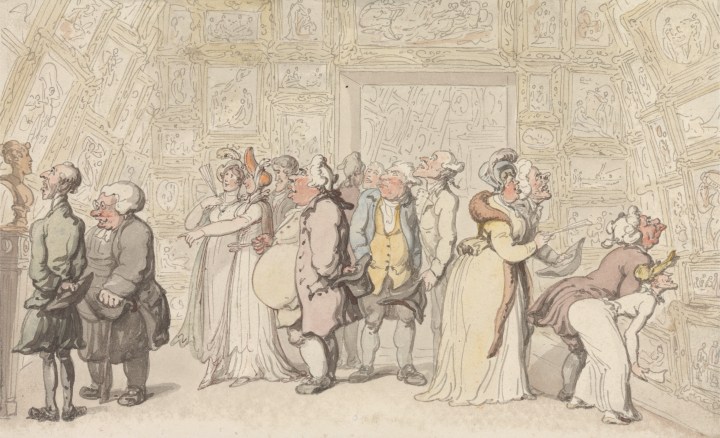
Thomas Rowlandson, Viewing at the Royal Academy, ca. 1815, watercolor with pen and gray and brown ink over graphite on moderately thick, moderately textured, blued white, wove paper, 15 × 24 cm (New Haven: Yale Center for British Art, Paul Mellon Collection, B2001.2.1161).
◊ ◊ ◊ ◊ ◊
From the Mellon Centre:
Chronicling the Summer Exhibition: The Early Years
Paul Mellon Centre for Studies in British Art, London, 2 May 2018
This research seminar will feature Esther Chadwick, Amy Concannon, and Mark Hallett, three of the contributors to the PMC’s major publication project The Royal Academy Summer Exhibition: A Chronicle, 1769–2018. This online publication, which will be launched at the end of May, will feature 250 pieces of writing by leading scholars, critics, artists, and curators about every single RA summer exhibition since 1769. It will also include digitised and fully-searchable versions of every summer exhibition catalogue. In the seminar, the speakers will present some of their own work for the Chronicle, focusing in particular on the exhibitions of the Georgian period, and discuss the challenges and opportunities offered by this new scholarly venture. Wednesday, 2 May, 18.00–20.00; this is a free event, followed by a drinks reception; booking information is available here.
Esther Chadwick has been funded by the Monument Trust to catalogue the Department’s collection of prints kept in roughly 6000 bound volumes, ranging across national schools from the Renaissance to the twentieth century. Esther joined the Department of Prints and Drawings after receiving her PhD in Art History from Yale University in 2016. Her thesis explored connections between eighteenth-century British printmaking and political radicalism. At the Yale Center for British Art she co-curated Figures of Empire: Slavery and Portraiture in Eighteenth-Century Atlantic Britain (2014). She has been a fellow at the Center for Advanced Study in the Visual Arts, Washington, D.C., the Huntington Library, the Lewis Walpole Library, and the Paul Mellon Centre in London.
Amy Concannon is currently in the final year of her AHRC-funded PhD on depictions of the urban landscape in Britain, c.1820–1850; this takes in a wide spectrum of imagery, from topographical prints to academic landscape paintings, and is supervised jointly between the Art History and Geography departments of the University of Nottingham, and Tate. Since 2012 she has worked at Tate Britain as Assistant Curator for British Art, 1790–1850, where she has focused on landscape through a range of projects, from the exhibitions Late Turner: Painting Set Free (2014–15) and Ruin Lust (2014) to the multi-partner tour of Constable’s Salisbury Cathedral from the Meadows. Before Tate, she held roles at Dulwich Picture Gallery and the Wordsworth Trust, Grasmere, Cumbria, where she developed a particular interest in views of the Lake District.
Mark Hallett is the Director of Studies at the Paul Mellon Centre for Studies in British Art and oversees all aspects of the Centre’s activities, ensuring that it supports the most original, rigorous, and stimulating research into the history of British art and architecture, and fosters collaboration with our sister-institution, the Yale Center for British Art.
Exhibition | The Great Spectacle: 250 Years of the Summer Exhibition
From the RA:
The Great Spectacle: 250 Years of the Summer Exhibition
Royal Academy of Arts, London, 12 June — 19 August 2018
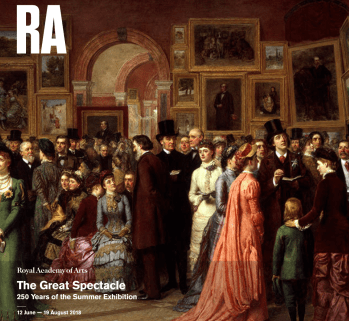 The Great Spectacle tells the story of 250 years of the Summer Exhibition, the world’s longest running annual display of contemporary art. Ever since 1769, and at a succession of locations ranging from Pall Mall to Piccadilly, the Academy’s exhibition rooms have been crowded for some two months each year with hundreds of paintings and sculptures produced by many of Britain’s leading artists.
Over the last two hundred and fifty years, these spectacular displays of art—dominated by what has become a famously crowded and collage-like arrangement of pictures across the Academy’s walls—have provided thousands of artists with a crucial form of competition, inspiration and publicity, and captured the interest of millions of visitors. The Great Spectacle tells the story of these exhibitions and, in doing so, offers an innovative, illuminating and visually stunning celebration of the Academy’s first 250 years and demonstrates the impact of these exhibitions on art in Britain and internationally.
Staged to coincide with the Summer Exhibition of 2018, and taking the form of a sequence of interlinked gallery displays that will recreate a series of important moments in the history of the Academy and its shows, The Great Spectacle will dramatise the excitement, variety and richness of the Summer Exhibition, offering visitors a fascinating, ever-changing journey from Joshua Reynolds to Wolfgang Tillmans.
Mark Hallett and Sarah Victoria Turner, The Great Spectacle 250 Years of the Summer Exhibition (London: ACC Publishing Group, 2018), 224 pages, ISBN: 9781910350706, £25.
Note added (23 August 2018) — Also, see the related online publication: Hallett, Mark, Sarah Victoria Turner, Jessica Feather, Baillie Card, Tom Scutt, and Maisoon Rehani, eds., The Royal Academy Summer Exhibition: A Chronicle, 1769–2018 (London: Paul Mellon Centre for Studies in British Art, 2018).
Newly Redeveloped RA Campus Opens on 19 May 2018
From the press release:
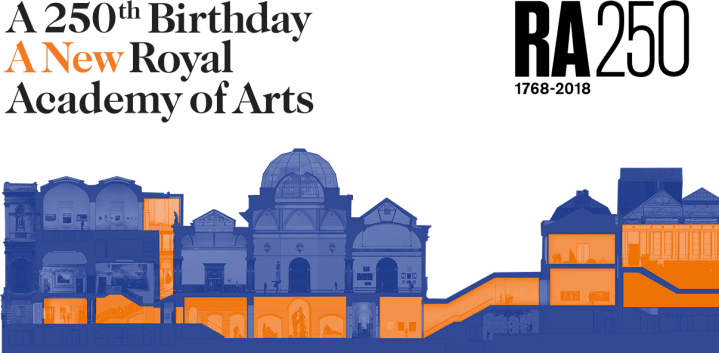
The Royal Academy of Arts, the world’s foremost artist and architect-led institution, will open its new campus to the public on Saturday 19 May 2018 as part of the celebrations of its 250th anniversary year. Following a transformational redevelopment, designed by internationally- acclaimed architect Sir David Chipperfield CBE RA and supported by the National Lottery, the new Royal Academy will open up and reveal more of the elements that make the RA unique—sharing with the public historic treasures from its Collection, the work of its Royal Academicians and the Royal Academy Schools, alongside its world-class exhibitions programme.
One of the most significant outcomes of the redevelopment is the link between Burlington House and Burlington Gardens, uniting the two-acre campus. This will provide 70% more space than the RA’s original Burlington House footprint, enabling the RA to expand its exhibition programme and to create new and free displays of art and architecture across the campus for visitors year-round. From dedicated galleries to surprising interventions, a dynamic series of changing exhibits and installations will present the living heritage of the Royal Academy; exploring its foundation and history in training artists as well as showcasing contemporary works by Royal Academicians and students at the RA Schools. To animate the displays, a new range of free tours, taster talks and object handling stations will be available to visitors.
Tacita Dean: LANDSCAPE (19 May — 12 August 2018) will inaugurate the new Gabrielle Jungels-Winkler Galleries in Burlington Gardens. With Art Fund support, the exhibition is part of an unprecedented collaboration with the National Portrait Gallery and the National Gallery in London. It will showcase the internationally-renowned visual artist and Royal Academician Tacita Dean who will explore the genre of landscape in its broadest sense: intimate collections of natural found objects, a mountainous blackboard drawing and a major new, two screen 35mm film installation, Antigone, that uses multiple exposures to combine places, people and seasons into the single cinematographic frame. Antigone was funded in part through the support of the Laurenz Foundation-Schaulager and its founder Maja Oeri; and VIA Art Fund.
The magnificent new Royal Academy Collection Gallery will present The Making of an Artist: The Great Tradition highlighting works from the RA Collection, including the Taddei Tondo by Michelangelo and the RA’s almost full-size sixteenth-century copy of Leonardo da Vinci’s The Last Supper, along with paintings by Reynolds, Kauffman, Thornhill, Constable, Gainsborough, and Turner. Selected by the President of the Royal Academy, Christopher Le Brun, it will focus on the first sixty years of the RA, juxtaposing masterpieces from the RA’s teaching collection with Diploma Works by past Royal Academicians. The display of the RA Collection has been supported by the Blavatnik Family Foundation.
The Architecture Studio within The Dorfman Senate Rooms will provide a creative space that invites audience engagement with innovative and critical ideas on architecture and its intersection with the arts. It will open with Invisible Landscapes (19 May 2018 — March 2019), explored in three ‘Acts’ of immersive interventions looking at the impact and future of technology in people’s environments. In contrast, recently conserved historical architectural casts on display in The Dorfman Architecture Court will convey the history of teaching architecture: the tradition of learning to draw from casts of buildings.
Located at the entrance to the Weston Bridge, which connects Burlington Gardens into Burlington House, The Ronald and Rita McAulay Gallery will stage site-specific installations by Royal Academicians. The first major work will be Tips for a Good Life by Bob and Roberta Smith RA (September 2018 – September 2019), on the subject of gender in the history of the RA.
Moving through to Burlington House, visitors will arrive at the Weston Studio. Located within the heart of the Royal Academy Schools, the Weston Studio will bring the ethos and thinking of the RA Schools’ postgraduate programme to a changing contemporary series of two displays a year and projects developed by students and graduates. It will open with a group exhibition of works by first year students, revealing their rich use of subjects, approaches, methods, and materials.
Going back in time, The Vaults will exhibit The Making of an Artist: Learning to Draw a formidable selection of plaster casts from the early years of the RA Schools displayed together with works on paper from the RA’s teaching collection, illustrating the RA’s role in the teaching of art since the RA Schools’ foundation in 1769. Works will include anatomical casts and casts of antique sculptures, such as the Venus de Milo and Farnese Hercules, juxtaposed with recent works on related themes by RA Schools graduates. Works on paper include a special display From the Child to the President by John Everett Millais PRA, who aged 11 started in the RA Schools where he was known as ‘The Child’.
Further interventions in Burlington House will include:
• An impressive installation of three dimensional details from buildings designed by current architect Academicians, curated by Spencer de Grey RA, which will be displayed across a three-story vertical wall, an affirmation of British architecture both today and in the future.
• Yinka Shonibare’s Cheeky Little Astronomer, 2013, which will take pride of place in the sculpture niche outside the Grand Café.
• An Allegory of Painting: A Project by Sarah Pickstone, which will feature two new wall and ceiling paintings by Sarah Pickstone (September 2018 – September 2019). A graduate of the RA Schools, she will celebrate the work of Angelica Kauffman RA, one of the two female founding members of the Academy.
• Already open to the public, Richard Deacon RA Selects presents his own selection of sculptures by Royal Academicians from the RA Collection, spanning over 200 years.
Alongside the transformation of the RA’s physical space, the first phase of a new online platform has launched to open up the RA Collection to be more accessible to audiences worldwide. Comprising paintings, sculptures, artists’ letters and books from the RA Collection, over 10,000 items have been newly digitised with the support of the National Lottery. The RA worked with Fabrique, the award-winning designers of the Rijksmuseum’s website.
New Book | The Royal Academy of Arts: History and Collections
From Yale UP:
Robin Simon and MaryAnne Stevens, eds., The Royal Academy of Arts: History and Collections (London: Paul Mellon Centre for Studies in British Art, 2018), 676 pages, ISBN: 9780300232073, $95.
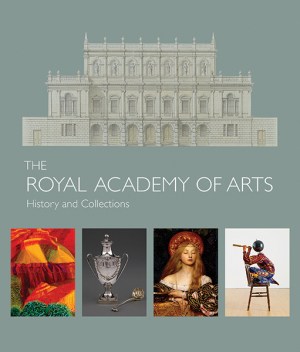 Animated by an unprecedented study of its collections, this book tells the story of the Royal Academy of Arts, London, and illuminates the history of art in Britain over the past two and a half centuries. Thousands of paintings, sculptures, drawings, and engravings, as well as silver, furniture, medals, and historic photographs, make up this monumental collection, featured here in stunning illustrations, and including an array of little-studied works of art and other objects of the highest quality. The works of art complement an archive of 600,000 documents and the first library in Britain dedicated to the fine arts. This fresh history reveals the central role of the Royal Academy in British national life, especially during the 19th century. It also explores periods of turmoil in the 20th century, when the Academy sought either to defy or to come to terms with modernism, challenging linear histories and frequently held notions of progress and innovation.
Robin Simon is editor of the British Art Journal and honorary professor of English at University College London. MaryAnne Stevens is an independent art historian and curator.
Exhibition | Napoleon the Strategist
From the press release for the exhibition:
Napoleon the Strategist / Napoléon stratège
Musée de l’Armée, Paris, 6 April — 22 July 2018
 Following on from the presentation of Napoleon’s political vision with the 2013 exhibition Napoleon and Europe and an exploration in 2016 of his fall and his legend with Napoleon in Saint Helena: His Fight for His Story, in spring 2018 the Musée de l’Armée will tackle another aspect of the history of Napoleon, whose skills as a ‘military genius’ are universally recognised.
Any examination of Napoleon the strategist has to start by defining the notion of strategy and how it evolved. For it was in Napoleon’s time that the notion became inextricably linked to power and the abilities of the person wields it. The word ‘strategy’ emerged in the military world, gradually taking on the meaning and form that are now applied more broadly to politics, the economy, finance, and communications. The idea behind the exhibition is therefore to train the spotlight on strategy, the intangible expression of Napoleonic thinking where the skill lies in mastering a vast range of parameters and their interactions. The exhibition will draw on maps, documents illustrating the master strategist’s deliberations, and objects—vestiges, symbols and representations of historical facts—that embody the tangible reality that strategic thinking seeks to control.
To ensure that the theme is as widely accessible as possible, Napoleon’s role will be illustrated in the context of his era, including a description of his education, abilities, and the means available to him and to his enemies. The exhibition sets out to show the strategist at work, explain the issues at stakes and how campaigns progressed, and get to the heart of the action to analyse his most famous battles, defeats as well as victories.
Although the new event is separate from the permanent collection galleries devoted to the Revolution and the Empire, it contributes to them with a complementary viewpoint. Multimedia tools will offer an immersive experience to help visitors grasp what is an abstract and complex notion. The permanent galleries will feature new digital installations providing a more narrative and explanatory approach to Napoleon’s strategic ideas. Visitors will be able to move freely between these two approaches. The visit continues on the Invalides site with an exploration of the Dome church, home to Napoleon’s tomb.
François Lagrange and Émilie Robbe, eds., Napoléon stratège (Paris: Lienart, 2018), 296 pages, ISBN: 978-2359062328, 29€.
New Book | European Porcelain in the Metropolitan Museum of Art
Distributed by Yale UP:
Jeffrey Munger, with an essay by Elizabeth Sullivan, European Porcelain in the Metropolitan Museum of Art (New York: The Metropolitan Museum of Art, 2018), 288 pages, ISBN: 9781588396433, $65.
 The quest to discover the process of making porcelain was one of the defining aspects of post-Renaissance Europe, and it had significant artistic, technical, and commercial ramifications. This beautifully illustrated book showcases ninety works, spanning the late 16th to the mid-19th century, and reflecting the major currents of European porcelain production. Each work is shown in glorious new photography, accompanied by analysis and interpretation by one of the leading experts in European decorative arts. Featuring blue-and-white wares from Italy, rare examples of German Meissen, French Sèvres, British Chelsea porcelain, and much more, this is a long-overdue survey of the greatest porcelain treasures from The Met’s vast collection.
Jeffrey H. Munger is former curator, and Elizabeth Sullivan is former associate research curator, both in the Department of European Sculpture and Decorative Arts at The Metropolitan Museum of Art.
Exhibition | France Viewed from the Grand Siècle
Now on view at the Louvre:
France Viewed from the Grand Siècle: Drawings by Israël Silvestre (1621–1691)
Musée du Louvre, Paris, 15 March — 25 June 2018
Curated by Bénédicte Gady and Juliette Trey
 While Israël Silvestre’s engravings circulated widely, his drawings remain relatively unknown. The Musée du Louvre is home to a remarkable collection of them, to be shown to the public for the first time.
After training as an engraver under Jacques Callot, Israel Silvestre very quickly turned to the cityscape. Small and picturesque, his early ‘views’ were of his native Nancy and the cities he passed through on the several journeys he made between Paris and Rome. By contrast, his mature works offer broad panoramas of the French capital, with its royal festivities and the changes it was undergoing, and outlines of the cities conquered by Louis XIV in Lorraine and the Ardennes. In addition, his series devoted to the handsome Ile-de-France châteaux—Vaux-le-Vicomte, Meudon, Montmorency, Versailles—brought a fresh eye to architecture and gardens.
The exhibition is organized by Bénédicte Gady and Juliette Trey of the Department of Prints and Drawings, Musée du Louvre.
Benedicte Gady and Juliette Trey, La France vue du Grand Siècle: Dessins d’Israël Silvestre (1621–1691) (Paris: Lienart, 2018), 208 pages, ISBN: 978-2359062311, 29€.
Call for Papers | Excess! at UAAC
Along with the HECAA session at this year’s UAAC Conference, readers may be interested in this panel organized by Ersy Contogouris and Marie-Ève Marchand. Details and a full list of panels (68 in all) are available here»
Excess! | Universities Art Association of Canada
Department of Fine Arts, University of Waterloo, Ontario, 25–27 October 2018
Proposals due by 1 May 2018
 As a transgression of a norm that is culturally contingent, excess has tended to be condemned in the West as a moral failing. Yet, it can also be a strategy for empowerment, agency, and creativity (Skelly, 2017, 2014; Potvin & Myzelev 2009). And though it often manifests itself as overabundance, its counterpart—including vacuum, censorship, or prohibition—can also be a form of excess. This panel seeks to investigate different manifestations of excess in visual art and material culture. At what point does ‘a lot’ becomes ‘too much’? Are there degrees of excess (a moderate vs. an excessive excess)? Who decides? What are the emotional, visual, environmental, conceptual, or other modalities, effects, and responses to excess? What are the gendered, sexualized, racialized, geographical, cultural, class-specific, or other valences of excess? And how can some mediums or materials in themselves be markers of excess? We welcome explorations into these and other displays of excess in art and design from historians, curators, and practitioners. Submissions for presentations in French or English should include an abstract (of up to 300 words) and a short biobibliography (of up to 150 words) and should be sent to Ersy Contogouris (ersy.contogouris@umontreal.ca) and Marie-Ève Marchand (marie- eve.marchan@mail.concordia.ca) using the form available as a PDF file here. For more information, please contact the session organizers.
Exhibition | Slaves of Fashion: New Works by The Singh Twins
Now on view at the Walker Art Gallery:
Slaves of Fashion: New Works by The Singh Twins
Walker Art Gallery, Liverpool, 19 January — 20 May 2018
Wolverhampton Art Gallery, 21 July — 16 September 2018
 Slaves of Fashion: New Works by The Singh Twins explores the history of Indian textiles, Empire, enslavement and luxury consumerism, and the contemporary relevance of these issues in the world today. Focusing on the relationship between Britain and India, hidden details of Europe’s colonial past and its legacies are uncovered, including current debates around ethical trade and responsible consumerism.
The exhibition showcases almost 20 new artworks by the internationally-renowned artists, Amrit and Rabindra Singh. Primarily known for their entirely hand-painted work in the Indian miniature tradition, The Singh Twins’ new work combines traditional hand-painting techniques with digitally created imagery. The series includes 11 digital fabric artworks displayed on lightboxes, with each one highlighting a different theme relating to India’s textile industry. A further nine paper artworks explore the relationship between trade, conflict, and consumerism in an age of Empire and the modern day. Also included in the exhibition are 40 highlights from over 100 objects across National Museums Liverpool’s collection, which have inspired the exhibition.
This exhibition is a collaboration between National Museums Liverpool, The Singh Twins, and Professor Kate Marsh, University of Liverpool. Slaves of Fashion: New works by The Singh Twins has been developed in partnership with Wolverhampton Art Gallery, and the exhibition will tour to Wolverhampton Art Gallery from 21 July to 16 September 2018.
The artworks in this exhibition reflect the artists’ views, not those of the Walker Art Gallery or National Museums Liverpool










 Enfilade
leave a comment